1. Introduction
Some event-related potential (ERP) studies report that the syntax of a second language learned later in life is not processed native-like, while others report that very proficient speakers are indistinguishable from native speakers regarding their language processing signatures (see Kotz, Reference Kotz2009, for a review). Specifically, evidence on non-native syntactic processing is still sparse, and “even so existing data clearly indicate that syntax is a phenomenon that deserves full consideration” (Kotz, Reference Kotz2009, p. 68). Non-native effects in syntactic processing have been reported by Chen et al. (Reference Chen, Shu, Liu, Zhao and Li2007), Hahne (Reference Hahne2001), Hahne and Friederici (Reference Hahne and Friederici2001), Mueller and colleagues (2005, 2007) and Weber-Fox and Neville (Reference Weber-Fox and Neville1996), for instance, all of whom detect different ERP signatures in non-native speakers for certain syntactic tasks. Another group of studies, however, report that very proficient non-native speakers show the same electrophysiological components as native speakers, regardless of the age of exposure to L2 (Kotz, Holcomb & Osterhout, 2008; Rossi et al., Reference Rossi, Gugler, Friederici and Hahne2006). In some instances, studies that focus on the relevance of proficiency for native-like processing in L2 report age effects for specific syntactic tasks; thus, Ojima, Nakata and Kakigi (2005) found that native Japanese speakers with very high proficiency in L2 English show different ERP signatures as compared to native speakers when processing verb agreement violations.
If the studies that have investigated the role of age versus proficiency in language processing are reviewed focusing on the syntactic phenomena they explored, it can be observed that differences in processing attributed to age of acquisition (AoA) tend to be found when the native grammar of the participant diverges significantly regarding the phenomenon tested in the non-native grammar, and high proficiency tends to yield native-like processing when the syntactic phenomenon tested in L2 has an equivalent correlate in the L1 of the participants. Thus, for instance, Hahne (Reference Hahne2001), Hahne and Friederici (Reference Hahne and Friederici2001), Mueller, Hahne, Fujii and Friederici (2005), Kotz et al. (Reference Kotz, Holcomb and Osterhout2008) and Rossi et al. (Reference Rossi, Gugler, Friederici and Hahne2006) tested non-native speakers on syntactic tasks linguistically equivalent to those in their native languages; results showed that as proficiency increased, processing became native-like.Footnote 1
However, if we consider Chen et al. (Reference Chen, Shu, Liu, Zhao and Li2007), Mueller et al. (Reference Mueller, Hahne, Fujii and Friederici2005), Ojima et al. (Reference Ojima, Nakata and Kakigi2005) and Weber-Fox and Neville (Reference Weber-Fox and Neville1996), we observe that age effects obtained whenever very proficient non-native speakers were processing a syntactic phenomenon that had no equivalent correlate in their native language. In the case of Weber-Fox and Neville (Reference Weber-Fox and Neville1996), age effects obtained when testing native Chinese speakers processing subjacency effects in English wh-questions; Chinese lacks overt wh-movement (it is a wh-in-situ grammar), while English is an overt wh-movement language, so that the syntactic phenomenon tested involved a parametric property absent in the native language of the participants (see Cheng, Reference Cheng1997). In Mueller et al. (Reference Mueller, Hahne, Fujii and Friederici2005), the phenomenon tested was classifier morphology, which German lacks completely. In Ojima et al. (Reference Ojima, Nakata and Kakigi2005) and Chen et al. (Reference Chen, Shu, Liu, Zhao and Li2007), the phenomenon tested was verb agreement in native speakers of languages whose grammars lack verb-agreement relations. In a recent study, Gillon Dowens et al. (Reference Gillon, Dowens, Vergara, Barber and Carreiras2010) report both age and proficiency effects on English native speakers’ processing of noun number and gender agreement morphology in Spanish and conclude that “highly proficient learners can show electrophysiological correlates during L2 processing which are qualitatively similar to those of native speakers, but the results also indicate the contribution of factors such as age of acquisition and transfer processes from L1 to L2” (p. 1870).
In this light, the results from ERP studies suggest that it is diverging grammatical phenomena that might be sensitive to age of exposure, rather than superficial morphosyntactic differences. Both age and proficiency have been hypothesized and scrutinized as relevant factors conditioning L2 processing, but perhaps less attention has been paid so far to the issue of what syntactic phenomena are tested, and why. In linguistics, one view of cross-linguistic variation holds that specific grammars result from combinations of a set of linguistic parameters. Thus, syntactic variation would result from differences in the values of this combination of parameters (Chomsky, Reference Chomsky1981; see Baker, Reference Baker2001, Reference Baker2003 for overviews), and the acquisition of syntax would consist in determining the values of these syntactic parameters for the input language.
Here we report the results obtained from a set of experimental studies of syntactic processing in native speakers and highly proficient non-native speakers of Basque whose native language is Spanish. In this study, the syntactic targets that have been selected involve linguistic parameters where Basque and Spanish either converge or diverge. We find differences in native versus non-native performance when syntactic parameters differ in the L1/L2 of the non-native speakers, but only proficiency effects for those syntactic tasks where Basque and Spanish converge, despite superficial morphological differences.
2. The present study
2.1 Preliminaries
We tested Basque native speakers and very highly proficient L2 Basque speakers whose native language is Spanish. Our study involves four conditions: one is a semantic condition, where no native versus non-native differences are expected, given results reported in the literature; the other three involve syntactic parameters: (i) the head parameter, (ii) argument alignment, and (iii) verb agreement.
(i) Spanish and Basque diverge with respect to the value assigned to the head parameter. Whereas Spanish, like English, is head-initial, so that heads of phrases precede their complements, Basque is head-final – heads of phrases follow their complements, as in Turkish or Japanese. The examples in (1) illustrate the order in which verbs, pre-/postpositions and determiners co-occur with their complements in the two languages.
(1)

(ii) These two languages also diverge with respect to argument alignment: Spanish is a nominative–accusative language, like English, while Basque is an ergative–absolutive language, like Dyirbal or Tzeltal (Dixon, Reference Dixon1994). Thus, in Spanish, subjects have the same form and agreement regardless of whether the verb is transitive or intransitive, and objects are different (2a, b). In Basque, intransitive subjects (2c) look like transitive objects (2d) while transitive subjects have a different case-marker and agreement morphology (2d) (de Rijk, Reference de Rijk2008; Hualde & Ortiz de Urbina, Reference Hualde and Ortiz de Urbina2003).:
(2)
In fact, the very characterization of notions like “subject” and “object” is built upon nominative–accusative grammars, as the description of ergativity above in terms of “subject”/“object” makes apparent. There is no morphologically consistent class of “subjects” in ergative languages, at least not one that matches that class in nominative languages.
(iii) The head parameter and the nominative/ergative alignment are two fundamental syntactic parameters where Spanish and Basque diverge. However, Spanish and Basque converge in having verb agreement. Both languages have subject-verb agreement, and Basque also has object-verb agreement, as shown in (2d) above and (3).
(3)
The schematic representation of the parametric setting of Basque and Spanish is presented in the Table 1.
Settings of the syntactic parameters (Basque and Spanish) tested in the present study.

To our knowledge, the impact of argument alignment on L2 processing has not been systematically investigated so far. Previous ERP studies on case morphology, all of them carried out on nominative–accusative languages, showed that case violations elicit a centro-parietal positivity (P600) in 500–800 ms time window, usually preceded either by a Left Anterior Negativity (LAN) (i.e. Coulson, King & Kutas, 1998; Roehm et al., Reference Roehm, Bornkessel, Heider and Schlesewsky2005) or by an N400 component in 300–500 ms time window (i.e. Frisch & Schlesewsky, Reference Frisch and Schlesewsky2001, Reference Frisch and Schlesewsky2005; Mueller et al., Reference Mueller, Hahne, Fujii and Friederici2005; Mueller, Hirotani & Friederici, 2007). Basque provides us with the opportunity to test whether these effects hold also in ergative case systems; some previous results reported by Díaz (Reference Díaz2009) and Díaz et al. (Reference Díaz, Sebastián-Gallés, Erdozia, Mueller and Laka2006) suggest that the electrophysiological signatures elicited by ergative case violations do not differ from those found in nominative languages, eliciting a comparable P600 component. (i.e. Coulson et al., Reference Coulson, King and Kutas1998; Munte et al., Reference Munte, Heinze, Matzke, Wieringa and Johannes1998).
Based on this review of the literature on native and non-native processing, we hypothesize that given high proficiency, native versus non-native differences obtain when a linguistic parameter tested in L2 is absent in L1 (absence of Early Left Anterior Negativity (ELAN), broad distribution/later appearance of LAN/N400, no differences in P600 in comparison to native speakers), while no differences in native/non-native processing obtain when a parametric setting of L2 converges with L1 (comparable early and late ERP components). Besides, no differences in semantic processing are expected between native and early highly proficient non-native speakers (similar N400 component).
2.2 ERP experiment
Participants
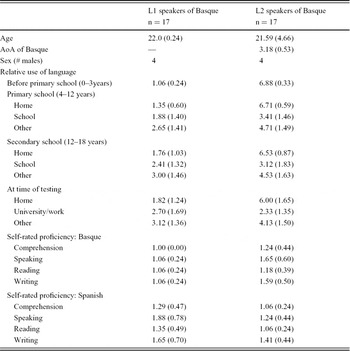
Forty-one neurologically healthy speakers of Basque (undergraduates and graduates at the University of the Basque Country) participated in the experiment: 20 native speakers (six men, mean age 21.5 years, SD = 4.4) and 21 speakers of Basque native speakers of Spanish (six men, mean age 22.2 years, SD = 3.6), who started acquiring Basque as L2 when they were 3 years old (AoA = 3.1 years, SD = 0.53). According to Edinburgh Inventory for Assessment of Handedness (Oldfield, Reference Oldfield1971), they were all right-handed. Data from three native and four non-native participants were excluded from the analysis because of excessive eye movements and other artefacts; consequently the results of 34 speakers were submitted to the statistical analysis. All participants were paid for their participation. According to the language questionnaire (modified from Weber-Fox & Neville, Reference Weber-Fox and Neville1996), all participants reported themselves as very skilled users of Basque (mean value for the native group was 1 and for the non-native group 1.2, applying the following four-point proficiency scale: 1 – native-like proficiency, 2 – full proficiency, 3 – working proficiency, 4 – limited proficiency). The high proficiency of the non-native participants was also confirmed by the fact that most of them had a highest proficiency diploma or were bachelors in Basque Philology when the experiment was carried out. Additionally, they used Basque in their everyday life (at the University or at work) with a frequency similar to native speakers (native speakers: mean value 2.9; non-native speakers: mean value 3.2, applying the following seven-point scale: 1 – I speak only Basque, 2 – I speak mostly Basque, 3 – I speak Basque 75% of the time, 4 – I speak Basque and Spanish with similar frequency, 5 – I speak Spanish 75% of the time, 6 – I speak mostly Spanish, 7 – only Spanish. Their oral fluency in L2 was also corroborated before the experimental session started. The details are presented in the Table 2.
Results of relative use of language and self-proficiency ratings reported by the participants.

The following seven-point scale was applied for measuring the relative use of language: 1 – I speak only Basque, 2 – I speak mostly Basque, 3 – I speak Basque 75% of the time, 4 –I speak Basque and Spanish with similar frequency, 5 – I speak Spanish 75% of the time, 6 – I speak mostly Spanish, 7 – only Spanish.
Proficiency level was determined by using the following four-point scale: 1 – native-like proficiency, 2 – full proficiency, 3 – working proficiency, 4 – limited proficiency. Standard deviations values are in parentheses.
Materials
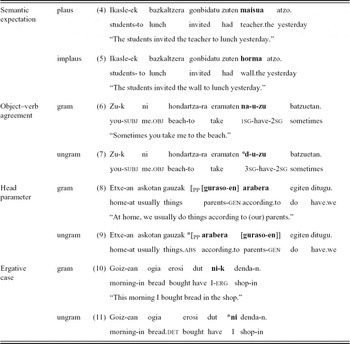
Participants were asked to read 640 sentences distributed in two lists (A and B). Each list contained 320 sentences: 40 for each experimental condition (20 grammatical and 20 ungrammatical) and 160 fillers. Examples of the materials used in the experiment are presented in the Table 3. The critical words in semantic condition (examples (4) and (5) in Table 3) were controlled with respect to length and frequency.
Sample of the materials used in the study (examples (4)–(11)).

plaus = plausible; implaus = implausible; gram = grammatical; ungram = ungrammatical
The implausible (5) violates the semantic expectations for the verb “to invite”, while (4) does not. Sentence (7) is ungrammatical because the auxiliary does not agree with the first person object as it does in (6). In the grammatical (8), gurasoen arabera “according to parents”, the head of the postpositional phrase (arabera) follows the genitive-marked NP complement (gurasoen). In (9) the postposition precedes the complement, yielding ungrammaticality. In (10) and (11), the sentences present an OVS word order, grammatical in Basque, to ensure that both the violation and disambiguation points coincide in the sequence. In (11) the subject ni “I” lacks the ergative/subject marker (-k), rendering the sentence ungrammatical.
Procedure
The whole experiment, including training trial, electrode-cap application and removal lasted about 2 hours 30 minutes. The experiment was carried out in a silent room in ELEBILAB at the Psycholinguistics Laboratory at the University of the Basque Country (UPV/EHU). Participants were seated in a comfortable chair about 0.7 m in front of a 17-inch computer monitor and told how the ERP recording procedures were going to be carried out. All sentences were displayed word by word in the middle of the screen, with appropriate punctuation marks. Each word was presented for 350 ms and the interstimulus interval (ISI) was 235 ms. The EXPE6 program (Pallier, Dupoux & Jeannin, Reference Pallier, Dupoux and Jeannin1997) presented all sentences at random. After each sentence, the Basque words equivalent to English “CORRECT OR INCORRECT” appeared and the participants had to choose by using one of two buttons in order to indicate whether the sentence was grammatical or ungrammatical. The assignment of the buttons “CORRECT” and “INCORRECT”, as well as the order in which the lists were presented was pseudo-randomized, so that one half of the participants used the right hand for the “CORRECT” button and the other half, the left hand. The time the participants used for pressing the button was also designed to allow them to blink. When the participant pressed the button, a fixation point (*) appeared in the middle of the screen indicating that a new sentence was about to be displayed. After the first block was displayed, the participants were given a break and in the meantime, they were asked to complete a language history questionnaire. Next, they read the other list with exactly the same conditions as those mentioned above. After the task finished, the participants were given a short questionnaire about the experiment.
ERP recording
The electroencephalogram (EEG) was recorded from 58 Ag/AgCl electrodes secured in an elastic cap (ElectroCap International, Eaton, USA). Electrodes were placed in the following sites: Fp1/2, Fz, F3A/4A, Fz, F1/2, F3/4, F5/6, F7/8, CZA, C1A/2A, C3A/4A, C5A/6A, Cz, C1/2, C3/4, C5/6, T3/4, PZA, C1P/2P, C3P/4P, TCP1/2, T3L/4L, PZ, P1/2, P3/4, P5/6, T5/6, PZP, P1P/2P, P3P/4P, CB1/2, Oz and O1/2. All recordings were referenced to the right mastoid and rereferenced off-line to the linked mastoids. Vertical eye movements and blinks were monitored by means of an electrode positioned beneath the right eye. Horizontal eye movements were monitored by an electrode positioned to the right of the right eye. Electrode impedance was kept below 5 kohm at all scalp and mastoid sites and below 10 kohm for the eye electrodes. The electrical signals were amplified within a bandpass of 0.001–50 Hz by a BrainVision amplifier system and digitized on-line at a rate of 500 Hz. After the EEG data were recorded, the artefact rejection procedure was applied (off-line) when the amplitude (from bottom to top) of the electrooculogram (EOG) was higher than 50 μV or when the saturation was excessive, as well as when the changes of baseline were bigger than 200 μV/s.
Data analysis
For the data analysis, the critical words of the grammatical sentences ((4) maisua “the teacher”, (6) nauzu “1sg.have.2sg”, (8) arabera “according to” and (10) nik “I”) were compared to their counterparts used in unacceptable sentences ((5) horma “the wall”, (7) duzu “3sg.have.you”, (9) arabera “according to” and (11) ni “I”). As for the ERP measures, segments were constructed from 200 ms before the onset of the critical words in the sentences and included 1000 ms after the critical word onset trigger. The trials associated with each sentence type were averaged for each participant. The EEG 200 ms prior to the onset was also used as a baseline for all sentence type comparisons. Based on the literature and visual inspection of the data, the following temporal windows were considered during statistical analysis: 300–500 ms, 500–600 ms and 600–800 ms for the head-parameter condition, object–verb agreement and ergativity, respectively, and 300–600 ms for semantics. After the stimuli were recorded and averaged, ANOVAs were carried out in nine regions of interest (ROI, henceforth) that were computed out of the 58 electrodes. Each ROI contained five electrodes: left anterior (1) (F3, F5, F7, C3A, C5A), left central (2) (C3, C5, T3, C3P, TCP1), left posterior (3) (P3, P5, T5, P3P, CB1), central anterior (4) (F1, F2, C1A, C2A), central (5) (C1, C2, C1P, C2P, PZA), central posterior (6) (P1, P2, P1P, P2P, PZP), right anterior (7) (F4, F6, F8, C4A, C6A), right central (8) (C4, C6, T4, C4P, TCP2), and right posterior region (9) (P4, P6, T6, P4P, CB2).
An ANOVA was performed for each of the four experimental conditions separately over the between-subjects factor GROUP (native speakers and non-native speakers) and the three within-subjects factors: GRAMMATICALITY (grammatical, ungrammatical), HEMISPHERE (left and right) and ANTERIORITY (anterior, central and posterior). Midline (central anterior, central and central posterior) was analysed independently. Finally, further statistical analyses (MANOVAs) were conducted for each particular region of interest whenever appropriate. Effects for the HEMISPHERE or REGION factors are only reported when they interact with the experimental manipulation.
2.3 Behavioural results
Results showed that the non-native speakers made significantly more errors than the native speakers in the ergative condition (F(1,32) = 11.56; p < .002), whereas both groups behaved similarly in the head parameter, object–verb agreement and semantics conditions (p > .05) (see Figure 1).
Behavioural results of the grammaticality judgment task.
SEM = Semantic expectation; AGR = Object–verb agreement; HEAD = Head parameter; ERG = Ergative case

2.4 ERP results
Semantic expectation
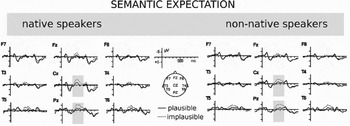
In the 300–600 ms time window (see Figure 2) the GRAMMATICALITY×ANTERIORITY interaction turned out to be statistically significant (F(2,64) = 5.72; p < .05) and the subsequent analyses showed that the negativity elicited by the semantically implausible stimuli was larger over the central (F(1,33) = 77.89; p < .001) and parietal (F(1,33) = 68.93; p < .001) than frontal (F(1,33) = 13.11; p < .01) electrodes. The analysis of the midline electrodes also revealed a significant GRAMMATICALITY×ANTERIORITY interaction (F(2,64) = 5.84; p < .05) and more detailed MANOVA tests confirmed that the amplitude of the negativity was highest over the central (F(1,33) = 64.29; p < .001) and parietal (F(1,33) = 56.09; p < .001) regions of the scalp.
Semantic expectation: ERPs elicited at the critical word position. Dotted lines represent the plausible stimuli and the continued lines represent the implausible stimuli.

Object–verb agreement
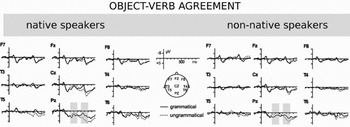
Early components are represented in Figure 3. Analysis of the 300–500 ms time window did not reveal any significant interactions involving both GRAMMATICALITY and GROUP factors. However, GRAMMATICALITY interacted with HEMISPHERE (F(1,32) = 7.72; p < .01) and ANTERIORITY (F(2,64) = 4.49; p < .05), suggesting that the negativity elicited by object–verb agreement violations was not equally distributed over the scalp. Further analyses of the first interaction showed that the negativity was more pronounced over the right (F(1,33) = 27.26; p < .001) than left (F(1,33) = 13.89; p < .002) hemisphere. A detailed examination of the GRAMMATICALITY×ANTERIORITY interaction demonstrated that the negativity was greater over the parietal (F(1,33) = 26.90; p < .001) than fronto-central electrodes. The analysis of the midline electrodes revealed a similar GRAMMATICALITY × ANTERIORITY interaction (F(2,64) = 3.93; p < .05), and further MANOVA tests showed that the negativity was larger over the parietal (F(1,33) = 24.53; p < .001) than frontal and central sites of the scalp.
Object–verb agreement: ERPs elicited at the critical word position. Dotted lines represent the ungrammatical stimuli and the continued lines represent the grammatical stimuli.

Analysis of the late components (represented in Figure 3) revealed no differences between native and non-native speakers in the 600–800 ms time window. The GRAMMATICALITY×ANTERIORITY interaction turned out to be statistically significant (F(2,64) = 48.18; p < .001), indicating that the positivity elicited by the object–verb agreement violations was more pronounced over the parietal (F(1,33) = 59.99; p < .001) than the fronto-central electrodes. The analysis of the midline electrodes led to similar results: a GRAMMATICALITY×ANTERIORITY interaction (F(2,64) = 28.10; p < .001) confirmed that the positivity was more pronounced over the parietal (F(1,33) = 57.57; p < .001) than the frontal or central sites of the scalp.
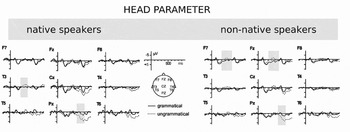
The head parameter
For the electrophysiological data analysis, the potential values elicited when processing the critical words were taken into consideration (see Figure 4). After a detailed inspection of the data, in addition to the classical 300–500 ms, a 500–600 ms time window was also included in the analysis.
Head parameter: ERPs elicited at the critical word position. Dotted lines represent the ungrammatical stimuli and the continued lines represent the grammatical stimuli.

Early components are represented in Figure 4. Analysis of the 300–500 ms time window revealed a marginally significant GRAMMATICALITY×ANTERIORITY×GROUP interaction (F(2,64) = 3.76, p < .06) Further analyses showed that the difference in the amplitude of the negative component between the native and the non-native group was marginally significant only over the frontal region of the scalp (GRAMMATICALITY×GROUP (F(1,32) = 3.57; p < .07), but not in the other electrode sites. Additionally, a GRAMMATICALITY×HEMISPHERE interaction was observed (F(1,32) = 19.96; p < .001). The successive tests confirmed that the negative component was more prominent over the left (F(1,33) = 28.17; p < .001) than right hemisphere (F(1,33) = 9.86; p < .01) in both groups. The analysis of the midline electrodes revealed a GRAMMATICALITY×ANTERIORITY×GROUP interaction (F(2,64) = 3.89; p < .05). More detailed tests revealed that the negativity elicited by the violations was significant the over frontal (F(1,32) = 4.87; p < .05, central (F(1,32) = 6.39; p < .05 and parietal (F(1,32) = 6.09; p < .05) sites in the native group and over the frontal (F(1,32) = 16.85; p < .001) and central (F(1,32) = 9.23; p < .01) sites in the non-native group. The statistical analyses of the 500–600 ms time window revealed a significant GRAMMATICALITY×GROUP interaction (F(1,32) = 4.27; p < .05). Further analyses indicated that the negative component was broadly distributed only in the non-native group (F(1,16) = 4.07; p < .07). No differences between grammatical and ungrammatical stimuli were found in the native group.
The analysis of the late components (600–800 ms time window) revealed a statistically significant GRAMMATICALITY×HEMISPHERE×ANTERIORITY (F(2,64) = 5.31, p < .05) interaction. More detailed analyses showed that the positivity elicited by the violations was distributed similarly among native speakers and non-native speakers, that is, more pronounced over the right parietal (F(1,33) = 83.43; p < .001 than over the other regions of the scalp. The analysis of the midline electrodes also revealed a GRAMMATICALITY×ANTERIORITY interaction (F(2,64) = 39.75; p < .001) indicating that the positivity was larger over the parietal (F(1,33) = 87.58; p < .001) than fronto-central sites of the scalp.
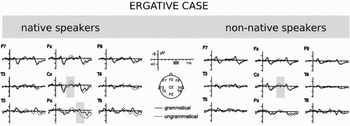
Case marking: Ergativity
Early components are represented in Figure 5. Analysis of the 300–500 ms time window did not reveal either a significant GROUP effect or GRAMMATICALITY× HEMISPHERE interaction, since the negativity was broadly spread over the scalp. However, GRAMMATICALITY (F(1,32) = 18.073; p < .001) main effect was statistically significant. After the analysis of midline electrodes, GRAMMATICALITY (F(1,32) = 16.15; p < .001) effect also turned out to be significant. In addition, the GRAMMATICALITY × ANTERIORITY interaction was marginally significant (F(2,64) = 2.92; p < .09) indicating that the negativity is greater over anterior (F(1,33) = 20.25; p < .001) and central (F(1,33) = 19.69; p < .001) than posterior (F(1,33) = 5.53; p < .05) sites of the scalp.
Ergative case: ERPs elicited at the critical word position. Dotted lines represent the ungrammatical stimuli and the continued lines represent the grammatical stimuli.

The analysis of the late components (600–800 ms time window) showed a significant GRAMMATICALITY × ANTERIORITY × GROUP (F(2,64) = 5.853; p < .05) interaction. Further MANOVA tests confirmed that the effect was significant only in the native group over the central and posterior sites of the scalp (F(1,32) = 8.07; p < .01 and (F(1,32) = 26.40; p < .001 successively). The non-native group showed no significant enhancement of positivity in the 600–800 ms latency window.
Summary of the results
The results from semantically incongruent stimuli generated a classical N400 in all participants. Regarding object–verb agreement processing, all participants showed both an N400 and a P600 effects in the ungrammatical condition. The head-parameter condition showed different ERP responses within the early time window (300–500 ms) in native speakers and non-native speakers: a (left) parietal negativity in native speakers, and a frontally distributed negativity in the non-native speakers. In addition, the latter group showed an enhanced negative deflection broadly distributed over the scalp also within the 500–600 ms time window. As for the late effects (600–800 ms), both groups displayed a similar P600 component with higher amplitude for ungrammatical than grammatical stimuli. Regarding the ergative condition, ungrammaticality lead to a broadly distributed negativity in all participants, but only the native group showed a P600 effect in the late time window.
3. Discussion
These results reveal differences between native and non-native language processing for some specific tasks involving divergent syntactic parameters. According to the predictions, out of the four experimental conditions, only those where Basque and Spanish diverged parametrically revealed a native/non-native contrast: the condition related to the head parameter and the condition related to argument alignment (nominative/ergative). However, the object–verb agreement condition did not reveal any native/non-native effect, and neither did the semantic condition; this latter result was expected because the semantic component has consistently been reported to display native-like processing in highly proficient speakers (i.e. Ojima, 2005; Weber-Fox & Neville, Reference Weber-Fox and Neville1996; etc.). Regarding the lack of differences in native versus non-native processing obtained in the object–verb agreement condition, our results differ from Díaz's (2009), who reported a different P600 distribution for both groups: posterior (classical) for native speakers and frontal for non-native speakers. The differences could be due to the different materials used in both studies: whereas Díaz (Reference Díaz2009) manipulated number agreement, we tested person agreement violations. As for the negative component, a larger amplitude over the posterior than anterior sites of the scalp suggests an N400 rather than a LAN. In Zawiszewski and Friederici (Reference Zawiszewski and Friederici2009), we reported very similar results for native speakers of Basque and we suggested that “when more than one constituent is involved in agreement processes, besides morphosyntactic operations the thematic hierarchy of the arguments (agent–patient) is also taken into account when processing verb agreement structures” (p. 171).
Given that Spanish and Basque converge in having verb agreement, the ERP results reported in our study can be interpreted as showing that equivalent processing mechanisms are employed for the computation of agreement regardless of the input language, regardless of the differences in the morphology, and regardless of the argument the verb agrees with.
As for the parametrically divergent conditions, both revealed differences between native speakers and non-native speakers. In the head-parameter condition, all participants behaved similarly in the grammaticality judgement task, which was to be expected given their high proficiency in the language, but despite the behavioural data, the ungrammatical condition evoked parietal negativity followed by a centro-parietal positivity only in native speakers, whereas non-native speakers showed a fronto-centrally distributed negativity and a P600. In addition, non-native speakers showed a longer and larger negative component towards violations over the frontal sites of the scalp (300–600 ms) than native speakers (300–500 ms). Hence, they seem to engage more resources than native speakers to process the ungrammaticality, a result that is in line with what other studies find, like Weber-Fox and Neville (Reference Weber-Fox and Neville1996), where non-native speakers showed a bilaterally distributed negativity as a response to morphosyntactic violations whereas native speakers displayed left lateral negativity. Wartenburger et al. (Reference Wartenburger, Heekeren, Abutalebi, Cappa and Villringer2003) obtained similar results using fMRI technique: highly proficient late (AoA = 6 years) Italian–German bilinguals showed broader brain activation when judging the grammaticality of the sentences than highly proficient early (AoA = 0) bilinguals. The latency and distribution of the negativity among native speakers suggest an N400 component rather than a LAN; as for non-native speakers, it seems that he same negativity found in native speakers overlapped with and was enhanced by an additional long-lasting (300 ms) frontal activity. This is confirmed by the statistical analyses: both groups differed only with respect to the frontal sites, whereas a similar negative component was elicited by the violations in both groups over central and posterior sites. However, the characteristics of this negativity contrast with previously reported ELAN components, expected for phrase structure violations (see Friederici, Reference Friederici2002; Friederici & Kotz, Reference Friederici and Kotz2003; Hahne and Friederici, Reference Hahne and Friederici2001; etc.). This difference might be accounted for by a different parsing strategy adopted by the participants at this stage of processing: when the ungrammatical postpositional phrase *arabera “according to” was encountered, participants interpreted the preceding noun gauzak “things” as part of a postpositional phrase *gauzak arabera “according to things” and realized that such a phrase is ungrammatical because the noun lacks the genitive inflection required by the postposition. From this perspective, the N400 would be a signature of an ungrammatical case marking (see Frisch & Schlesewsky, Reference Frisch and Schlesewsky2005, for German; Müller et al., 2007, for Japanese; etc.). In the case of non-native speakers, this negativity is broader and more frontally distributed, which could be interpreted as a signature of greater working memory effort. On the other hand, the critical word in the correct head-parameter condition appears at a later sentence position than in the incorrect condition, and consequently, a different baseline has been applied for the data analysis. Thus, it cannot be ruled out that these factors might have influenced the processing strategy and the electrophysiological results to some extent.
With respect to the ergative condition, native speakers and non-native speakers also differed, this time both behaviourally and electrophysiologically. Non-native speakers made more errors than native speakers in this particular condition already during the grammaticality judgement task. They also displayed a different ERP pattern towards ergative case violations. Although the non-native speakers were significantly less accurate than the native speakers in error detection, they responded correctly to 85% of the trials, well above chance. As for the neurophysiological findings, the distribution of the negativity observed between 300 ms and 500 ms in both groups suggests an N400 component. This effect was broadly spread over the scalp and statistically confirmed only by a marginal effect over midline electrodes (negativity more pronounced over anterior and central than posterior sites). We interpret it as an electrophysiological response to the difficulties when attributing a thematic role to the ungrammatically case marked argument (the subject).
These results differ from those found by Díaz (Reference Díaz2009), who reports a comparable P600 component for both groups. Additionally, unlike the native speakers, the non-native speakers displayed a left negativity in the early time window. The differences in the ERP patterns reported in both studies could be attributed to the different materials used in the experiments: Díaz (Reference Díaz2009) used double ergative violations (in which the second ergative could be a subject of an embedded clause) whereas in our study the ungrammaticality was due to the critical word lacking an ergative marker.
As for an N400 as a response to case violations, it is not a novel finding in the ERP literature. Frisch and Schlesewsky (Reference Frisch and Schlesewsky2001) found a similar pattern for accusative case violations in German. They used sentences with animate/animate and animate/inanimate arguments: only when both arguments were animate did the case violation lead to an N400; when the second argument was inanimate no enhanced negativity was found. They interpreted the N400 component as a result of a competition for a thematic interpretation; in our materials, however, only the ungrammatical NP was animate, which makes the thematic competition interpretation less plausible. Mueller and colleagues (2005, 2007) report a fronto-central negativity (labelled as an N400) elicited among native speakers of Japanese by the accusative case violations (double nominatives instead of a nominative–accusative pattern). As they argue, the N400 reflects difficulties of fitting the incorrectly case-marked argument into a thematic context. Given that our materials could be interpreted as containing two absolutive NPs, the result is more likely to be similar to this type of double-case effect. With respect to the late ERP components in the ergative condition, we found a significant P600 effect in the native group, missing among non-native speakers. These findings contrast with those reported in other studies (Hahne, Reference Hahne2001; Hahne and Friederici, Reference Hahne and Friederici2001; Kotz et al., Reference Kotz, Holcomb and Osterhout2008; Mueller et al., Reference Mueller, Hahne, Fujii and Friederici2005, Reference Mueller, Hirotani and Friederici2007; Rossi et al., Reference Rossi, Gugler, Friederici and Hahne2006), in which, depending on their level of proficiency, non-native speakers are particularly sensitive to the early phase of processing but behave similarly to native speakers in a later phase: they do not show the early negativities ((E)LAN/N400), but show a P600 effect.Footnote 2
The lack of the P600 component in the non-native group suggests that either (i) these participants use a processing strategy transferred from L1 (Spanish) and, consequently, do not perceive the sentence as ungrammatical but, rather, interpret the absolutive case as an equivalent of nominative case (no reanalysis/repair, hence no P600), or (ii) they can ignore ergativity and infer subjecthood from other factors, such as animacy. Behavioural data show that although the participants perform at high level in the ergative condition (85%), it is only in this condition that non-native speakers depart from native speakers. This suggests that, for this particular aspect of grammar, and despite participants’ overall proficiency in L2, they do not reach a native-like proficiency level. This decreased proficiency in this very specific domain, we argue, results from the combination of language distance and a delay in AoA. The ERP pattern displayed by the non-native speakers differed from the pattern observed among the native speakers also in another way: in the former group (in the head-parameter condition), the ungrammaticality triggered an additional processing cost (a long-lasting negative component) whereas fewer resources were engaged to process ergative case violations (no P600) in comparison to the native speakers. This could further indicate that in the ergative condition the non-native participants could process the subject ignoring the ergative case violation, and not engaging in a repair process, as the absence of a P600 would indicate, whereas in the head-parameter condition they do detect the violation and engage in repair, as reflected by the P600, and do so by employing more resources, as the additional negativity elicited in this condition indicates.
Language proficiency has also been considered a driving factor influencing peak and extent of activation in brain correlates and in neurophysiological mechanisms (Kotz, Reference Kotz2009). To confirm or rule out this hypothesis, we computed a correlation analysis in which we included participants’ behavioural task values and the amplitude differences corresponding to the late time window. The aim of this analysis was to confirm or rule out the hypothesis that the amplitude of the P600 component is correlated with the behavioural results. The analysis showed no dependency between both factors, that is, the number of errors did not correlate with the changes of the P600 component either in the native (r = −0.59, p = .821) or in the non-native (r = 0.022, p = .932) group. Our results thus suggest that despite their high level of overall proficiency in the language, the non-native speakers process the ergative case alignment of Basque differently from the native speakers, to the point that this difference is detected both at the behavioural and electrophysiological level.
4. Conclusion
In a recent review of ERP studies on L2 processing, Kotz (Reference Kotz2009, p. 73) concludes that “it is necessary to consider and investigate multiple structural subtleties at the linguistic and the neurophysiological level”. Here, we explored native and non-native syntactic processing, paying special attention to the syntactic distance factor. To this end, we compared how native speakers of Basque and highly proficient non-native speakers of Basque who are native speakers of Spanish process certain core aspects of Basque syntax (parameters) that either diverge from or converge with Spanish syntax. Native speakers and non-native speakers behaved alike in those tasks that involved equivalent linguistic phenomena for Basque and Spanish (the verb agreement condition and the semantic condition), but differed in tasks that involved diverging syntactic parameters (the head parameter and argument alignment (nominative/ergative)). The results indicate that, in particular, not all linguistic differences have the same impact in non-native language processing, and they suggest that divergent parameters have a deeper impact in non-native syntactic processing than other seemingly variable but superficially different aspects of language variability.