Introduction
With the global spread of English, research in World Englishes (WE) has burgeoned in the past two decades. Its concepts have been taken up by researchers in Teaching English to Speakers of Other Languages (TESOL) to question ‘native-speakerism’ (Holliday, Reference Holliday2005, Reference Holliday2006) in English instruction. However, the implications of this theoretical discussion have so far yet to be realized in EFL classrooms, where teachers and learners alike still largely submit to native-speaker norms. This study therefore aims to examine how discussions of power, politics, and the spread of Englishes might influence students’ perceptions of English and their experiences of learning and using English. The analysis focuses on papers written by students enrolled in a semester-long WE course, and demonstrates the value of bringing WE into English curriculums to help students become critical learners and confident users of English today.
World Englishes in TESOL
As the world's lingua franca, English is now being used not only by more non-native speakers (NNS) than native speakers (NS), but also more often among NNS than in situations involving any NS (Crystal, Reference Crystal2003; Graddol, Reference Graddol2006). In light of the changing demography of English users, research in WE – a field that studies English and its offspring through a pluricentric approach – provides the conceptual tools for countering the NS-centered view on the spread of English and in legitimizing varieties of English in their own social contexts (Jenkins, Reference Jenkins2006, Reference Jenkins2009; Pakir, Reference Pakir2009; Seidlhofer, Reference Seidlhofer2009).
The introduction of WE-related concepts to TESOL has encouraged critical reflection on current teaching beliefs. For one, attempts have been made to destabilize the NS versus NNS dichotomy. The belief that NS are better teachers, and that their versions of English are more universally intelligible, has been re-examined and challenged by scholars such as Widdowson (Reference Widdowson1994), Norton (Reference Norton1997), Braine (Reference Braine1999), and Jenkins (Reference Jenkins2000, Reference Jenkins2007). Additionally, voices critiquing the colonial self–other narrative embedded in the seemingly neutral label of TESOL have also been raised (see, for example, Pennycook, Reference Pennycook1998; Canagarajah, Reference Canagarajah1999, Reference Canagarajah2002; Kubota, Reference Kubota2001; Lin et al., Reference Lin, W., N. and A. M2002). In the same vein, Lin et al. (2001) propose a paradigm shift from TESOL to TEGCOM (Teaching English for Glocalized Communication) to avoid ‘othering’ (Kubota, Reference Kubota2001) and to acknowledge the shared ownership of English among its global users.
WE theory versus classroom practices
Despite meta-level discussions and critical reflection on the development and teaching of Englishes to date, in real English classrooms, teachers and learners alike still largely submit to NS norms (Seidlhofer, Reference Seidlhofer2005). It is not hard to find English teachers, especially NNS, who still regard British or American English as the most desirable form of international communication (Varghese et al., Reference Varghese, B., B. and K. A2005; Jenkins, Reference Jenkins2007), and ‘many learners of English in Asia themselves subscribe to the idea that native English speakers are necessarily better English teachers than non-native English speakers’ (Lin et al., Reference Lin, W., N. and A. M2002: 311). Lai's (Reference Lai2008) interview with Taiwanese university teachers demonstrates some of the deep-rooted beliefs that practitioners – who are fully aware that English as a lingua franca is shared by all its users rather than monopolized by NS – hold about NS ownership of English and the need to teach NS standards.
Countries located in Kachru's (Reference Kachru, Quirk and Widdowson1985) EFL expanding circle (e.g. Japan, Taiwan, Korea, China) have been reported as having ‘the most extensive spread … in terms of numbers of speakers’ (Jenkins, Reference Jenkins2009: 40), and English is regarded as the key indicator in determining both personal and national global competitiveness (Shih, Reference Shih2004; Lin, Reference Lin2012). English education in these regions, however, is largely equated to the training of four skills (reading, writing, listening, and speaking) and the production of NS-like English users. This situation certainly describes English language education in Taiwan; even at the tertiary level, where English curriculums are less exam-oriented, the variety of courses offered scarcely extends beyond the training of different academic and professional skills (e.g. journalistic English, research writing, business English, translation). Such NS-like, skill-only instruction illustrates a gap between the WE concepts being enthusiastically promoted in theory and their limited reception in reality, especially in regions hosting the largest group of English users and learners in the world.
The project
In a study of Chinese university students’ preferences towards NS/NNS teachers using a WE framework, Jin (Reference Jin2005: 45) argues that ‘Chinese students do not inherently aspire to British and American English, but … the lack of opportunity to access updated information on World Englishes has led to a blind adoration of native-speaker norms.’ In light of the disconnect between meta-level scholarly discussion and grassroots ELT practices in many EFL expanding circle countries, this project aims to bring WE discussions into classrooms to encourage a ‘constant reciprocal relation between theory and practice’ (Pennycook, Reference Pennycook2001: 3). That is, through explicit instruction in WE and its related concepts, the researcher attempts to explore (1) the kinds of WE issues EFL learners find meaningful to them, and (2) whether and how WE instruction can help students reflect critically on their experiences of learning and using English.
The participants in the study were 22 Taiwanese university students enrolled in a WE course taught by the researcher. In Taiwan, English is taught as a compulsory subject from elementary school. These students, aged between 19 and 23, were English majors who had received extensive English instruction for more than 10 years. The semester-long, elective course met once a week for two hours. With the goal of orienting college students to the critical issues surrounding the worldwide spread of English and the development of WE, topics of discussion include the spread of English as the global lingua franca, varieties of English, native and non-native division, the standard ideology, Globish and Esperanto, and language death and preservation. Course activities included lectures, in-class discussions, student presentations, reflection paper writing, and a final exam. Throughout the course, students were encouraged to reflect upon the influence of the global dominance of English on Taiwan's local language policy and practices. The course was conducted in English with occasional switching between Mandarin Chinese and English.
The study reported here is part of a larger research project investigating the influence of WE on Taiwanese students’ language learning. The larger project collected data from written assignments submitted by students throughout the semester and face-to-face interviews with 12 volunteers among the course takers. To shed light on the issues raised in this study, the current analysis focuses on the 22 students’ final reflection papers – in which they were specifically instructed to give a general reflection on what they had learned on the course and their course-taking experience.
Results and discussion
The 22 reflection papers analyzed in this study illustrate a wide range of WE topics that impressed and enlightened the participating students. This section starts with topics the students deemed meaningful, followed by an analysis of how learning about these topics influenced the way the students perceived English and their English learning and using experiences. Excerpts of texts from students’ reflection papers are presented to support the findings. The papers and excerpts are numbered according to their order of appearance.
What is meaningful? WE issues that speak to the students
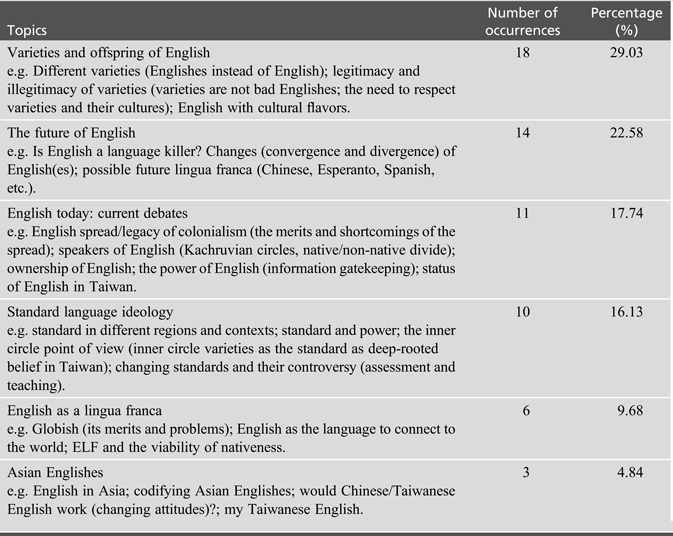
The examination of the WE-related topics mentioned in the students’ final reflection papers yielded data as shown in Table 1. The categorization of the topics is based on the six main themes covered throughout the course (English today, varieties and offspring of English, standard language ideology, the spread of English as an international lingua franca, Asian Englishes, and the future of English). The descriptive statistical data show that among the WE-related topics students wrote about in their reflection of the course, the ones that received the most attention were those related to varieties of English (29.03%), followed by the future of WE (22.58%), English today (17.74%), standard language ideology (16.13%), English as a lingua franca (9.68%) and Asian Englishes (4.84%).
Topics the students chose to reflect on

As can be seen, the existence of multiple Englishes, the legitimacy of these varieties, and their cultural footings (and local flavors) seem to have had the greatest impression on the students. Another topic that spoke to them was the future of English, including issues such as what would happen if English continues to dominate the world while diverging into hundreds of local varieties? Will another language – Chinese, Spanish, or Esperanto, for instance – someday replace English as the international lingua franca? Ranking third are topics related to categorizing English speakers beyond the NS and NNS dichotomy. Having long been labeled as EFL and non-native, the students are intrigued by the ways in which they have been associated with this powerful foreign language that they have been striving to master for more than 10 years. After being introduced to different models of categorization proposed by WE scholars, many try to interpret their identity and resources as English users and propose their own model from the angle of English learners/users in Taiwan. The discussion of the native/non-native dichotomy also helped them understand the power of English and its native speakers in labeling others, and gatekeeping economic, academic, political, and media resources in the world. Related to the deep-rooted ideology of native-speakerism is another theme that appears in several reflection papers: standardization. Should there be one or more standards, and if so, whose? These discussions are often juxtaposed with their English learning experiences and, for some, aspirations to become English teachers. Finally, although there is relatively less discussion on topics related to English as a lingua franca and the features and use of Asian Englishes, students who wrote about these topics touch on issues including the development, functionality, and future outlook of Globish, how English had helped them connect to the world, experiences with Chinglish, and their use of Taiwanese English.
Their reflections show their interest in learning about English in its plural form, uncovering how their lives have been influenced by the hegemony of English languages, analyzing their changing roles in WE, and the possibility of having their native tongue become the next world lingua franca. It is worth noting that not all WE-related issues spoke to their day-to-day experience. For instance, living in a largely monolingual community, topics relating to culturally and physically distant multilingual regions (e.g. the Caribbean, Oceania, Africa) seem rather less intriguing. Also, these students – striving for educational advancement – might need more time to fully embrace the idea that Chinglish, Taiwanese English, or even Hong Kong English are as desirable as the American and British varieties. Nevertheless, the following section draws on the students’ own illustrations of how WE has helped them re-examine their relationship with English.
Through the WE looking glass: noticing power and seeing values
The analysis of the reflection papers shows that the students found many WE ideas introduced in the course enlightening in helping them clear some long-standing doubts and re-examine some of their deep-rooted beliefs about English. Learning about WE helped explain their sense of self-doubt in the presence of native speakers; the reason that American accents were favored over other accents; the choice of second foreign languages being limited to major international languages such as French, German, Spanish, and Japanese; and the categorization of international students into those who need special English requirements (e.g. TOEFL) and those who do not. In fact, their retrospective accounts of the course-taking experience highlight that learning WE made them become more critically aware of English's dominant power as the global language, more open-minded about different varieties of English (including their own), and more interested in seeking ways to counter English hegemony.
Noticing power
One of the most salient themes in students’ writing is the discussion of language and power. Specifically, the analysis of the close – and often reciprocal – relationship between language and its speakers recurs in many course reflections:
Though we are used to think[ing] that we can control languages, we are actually controlled by languages, because they can unite or separate people. [Paper #1, excerpt 1]
The most interesting thing I have learned is that political and economic power [enjoyed by a country] can determine whether [its] language is prestigious or not … When I was a child, I just thought [of] English as a holy language that everyone should learn … Now I know clearly that a country's political power can not only affect its dominant status in the world, but also make their language more prestigious than others. [Paper #2, excerpt 1]
Having realized that the spread of English is not a natural or neutral process, and growing increasingly conscious of the unequal distribution of power among languages, some seem keen to uncover Anglo-centric ideologies that have influenced their thoughts, actions, and learning. As this influence often goes unnoticed by the public, the fact that the course encouraged them to examine how the English language is perceived, taught, and used around them helped them become more aware of the Western views they had unwittingly adopted:
We have long [been] looking at issues of English varieties from the viewpoint of the West, particularly from America and Britain, [but] learning about the world through English or West[ern] values is absolutely not enough.[Paper #3, excerpt 1]
Before taking this course, I always believed that there was only one standard English and one standard accent … I was influenced by the media most, such as western music, Hollywood movie[s], and CNN or BBC news, which I absorbed unconsciously. [Paper #4, excerpt 1]
I didn't realize that English has invaded our lives so much and we have taken it for granted … even now, English still colonizes us. Many people are unaware of the situation and forget their own native culture. Like me, I do not have a clear understanding about Taiwanese culture, but ironically, I know the Western culture better. [Paper #5, excerpt 1]
Nevertheless, the issue of power is not always discussed negatively. Some reflections also point out the dynamic nature of power. That is, as English becomes the international lingua franca, its ownership is shared by both NS and NNS. Using the example of gogi – the name of a dark red berry in Mandarin Chinese – being added to English dictionaries, one student reflects, ‘The example impressed me a lot, [the very fact that] this word is now … in the English dictionary [shows] that people from outer or expanding circles also own English’ [Paper #6, excerpt 1].
Another student discusses the possibility of the power shift from English to Chinese:
The power of the countries which speak English as their native language is the main reason which makes English the international lingua franca… [I] used to think Chinese becoming the next world lingua franca to be highly impossible, but [now I am] reconsidering its possibility after taking the course and understand language and power. [Paper #7, excerpt 1]
Valuing varieties
Seeing power at work in language also led many students to think about the different values attached to language, or specifically English and its varieties, and what counts, and can be counted, as legitimate, standard, or correct:
There should be no discrimination toward languages … the goal of acquiring a new and ‘more prestigious’ language is to enrich one's ability and competitiveness rather than abandoning [one's] own culture and language. [Paper #8, excerpt 1]
Instead of simply showing us what Chinglish is, the course introduced how and why this variety is formed. It makes me [aware of] different Englishes and [I have] become more open-minded to [them]. [Paper #9, excerpt 1]
Many reflect that learning about WE has redefined the purpose of language learning for them and opened their minds to the features found in different Englishes. First, the existence of English in its plural form, for these students, meant a break from the constraints imposed by NS standards. One writes: ‘You do not have to care about the red lines under it when we type the word Englishes on MS word’ [Paper #1, excerpt 2]. After the course, deviation from the so-called American or British standards seems more interesting rather than incorrect, as one student writes: ‘They are not bad Englishes, instead, they have interesting accents, terms, syntactic structure and local flavors’ [Paper #10, excerpt 1]. Understanding that these differences are the evolving artifacts of local cultures, as ‘people tend to change and add something more intimate to strengthen their cultural background’ [Paper #11, excerpt 1], the students seem to have become increasingly aware that ‘each English's existence should be respected’ (Paper #12, excerpt 1]. After all, if each language is a ‘symbol of its [breeding] culture as well as its identity’ [Paper #4, excerpt 2], ‘to acknowledge the varieties means to respect different culture … and respecting others can help us understand each other more’ [Paper #13, excerpt 1].
Learning about the various manifestations of English in the world also helped some re-examine the purpose of their endeavors and question the meaning of being competent in English. As these students tend to be self-conscious about how their non-native accents might prejudice their competence in English, knowing that English can be used and spoken in more ways than one seems to have relieved them of the pursuit of the almost unattainable near-native accent:
It was a big surprise to me that accent is not so vital in judging a person's ability of English. In fact, I have been troubled by my accent and I always envy some friends’ native-speaker-like accents … [After taking this course] I have got more confidence when speaking English. As long as I pronounce words correctly, people will understand me. Whether I have a perfect accent is not that important anymore because I am not a native speaker. I am simply a Taiwanese girl. [Paper #14, excerpt 1]
For many who aspire to become English language teachers after college, the open-mindedness granted by this pluricentric view also seems to have given them new ideas in teaching:
I would like to let students know that the most important thing [about] learning English or other languages is not the accent; the [open-minded] attitudes towards and understanding of cultures should be more important. [Paper #1, excerpt 3]
Countering hegemony
The students’ increased awareness of the power embedded in languages and the value of variety has made many reappraise the way they used to perceive languages. The fervor towards acquiring English no longer seems to be a neutral and natural consequence of one's aspiration for global competition or academic advancement; it is, rather, a dangerous desire that could perpetuate English hegemony and/or deprive other languages’ opportunity to thrive:
English has become a threat because people pay more attention to learning a new powerful language than to have a look on what they already have … the process of learning language risks losing another or more languages. [Paper #3, excerpt 2]
To counter the hegemonic power of NS English, many students chose to advocate a more WE-oriented pedagogy in their reflection papers. For instance, some insist that learners should be made aware of why English is the language that they needed to master. Others, especially those who plan to become English teachers in the future, look for ways to incorporate WE into existing curriculums. For instance, one vows to ‘incorporate the ideas and concepts taught in this course’ [Paper #12, excerpt 2] into their classrooms so that English learners in Taiwan are aware of the diversity and learn to ‘value and protect special distinction[s] of world Englishes’ [Paper #12, excerpt 3]. Others emphasize the need to localize teaching materials in order to make the teaching and learning of English meaningful to students in Taiwan:
It was only fair that we let students know [why] English is the language we have to learn, instead of other language[s] such as Tagalog or Thai … As a learner, you at least have to know why [you] have to learn besides [scoring in] exams. [Paper #1, excerpt 4]
Since most of the teaching materials were published in the U.S. and the U.K. … I would integrate local culture into the class and at the same time explain the difference between the two. Furthermore, I would definitely [reinforce] the concept that all languages are equal. [Paper #8, excerpt 2]
I will teach my students that there are many Englishes in the world, combining Chinese cultures into my lessons to make English more practical, and telling them that … English [is] not just a serious subject … The most important function of English is to communicate, to exchange information with other foreigners. [Paper #4 excerpt 3]
Conclusion and implications
The above analysis of 22 course reflection papers demonstrates the value of incorporating WE into English instruction. For one, students’ reflections suggest that many WE topics – whether tracing the development of English, pinpointing the power underlying the ubiquity of English, learning about the variety and legitimacy of Englishes, or predicting English's future – intrigued them as long-term English learners and users, and helped them acquire a deeper understanding of the language beyond rote learning of American or British standards. Moreover, as the findings illustrate, the opportunity to explore WE and its related topics have helped the participating students become more critical in perceiving, learning, and using English. They have not only become sensitive to the power attached to different languages, but also learned to appreciate the value of different varieties of English. More importantly, the destabilization of many deep-rooted Anglo-American ideologies has liberated them from native standards, helping them to be more open-minded about the legitimacy of Englishes, more confident in using and learning English as non-native speakers, and aware of the need to critique the hegemony of English.
Although the present study only examines data from one Taiwanese university, the findings shed light on the value of bringing WE from scholarly forums to classroom practices, as well as the way English(es) today should be learned by non-native speakers. These findings demonstrate the importance of teaching English beyond practical skills. To help English learners and users in the expanding circle acquire the pluricentric view, critical issues related to the spread, development, and power of Englishes today need to be addressed in English instructions of all levels. For instance, less proficient English learners or those in primary and secondary schools should be explicitly introduced to the features and development of different varieties of English alongside the teaching of practical reading, writing, listening, and speaking skills. More proficient learners, while learning practical skills in academic, scientific, business, or journalistic English, should be exposed to the discussion of language and power, standards, and the relationship between language and identity. As Jenkins (Reference Jenkins2006: 174) argues, this ‘is likely to encourage learners’ confidence in their own English varieties, and in turn reduce the linguistic capital that many learners still believe native-like English to possess’.
More than a decade ago, Kubota (Reference Kubota1998) proposed that EFL curriculums should include, in addition to sharpening practical skills, an introduction to different varieties of English and raising students’ critical consciousness. Years have passed and Kubota's proposal still serves as a timely reminder of what we could and should do as educators in bridging the gap between theory and practice, and in empowering non-native users of English to gain a sense of entitlement in using, learning, and understanding the language they have striven to learn for so long. It is hoped that this paper will encourage more teachers to introduce their students to these powerful and liberating ideas.
YU-JUNG CHANG is an assistant professor in the Department of Foreign Languages and Literature at National Tsing Hua University, Taiwan. Her research interests include applied linguistics, language and identity, and genre theory. She holds a PhD in English from the University of Washington. She is particularly interested in exploring how globalization and world Englishes influence English language users’/learners’ identity. She has published in journals such as Applied Linguistics, Journal of Language, Identity, and Education, and Journal of English for Academic Purposes. Email: yjchang@mx.nthu.edu.tw