Introduction
Ammonia has long been known to attract Diptera (Richardson Reference Richardson1916; McPhail Reference McPhail1939), including members of the family Tephritidae or true fruit flies. Ammonia may be attractive to flies because it indicates a source of protein, needed for reproductive development (e.g., Strangways-Dixon Reference Strangways-Dixon1961; Blay and Yuval Reference Blay and Yuval1997; Jácome et al. Reference Jácome, Aluja and Liedo1999; Wall et al. Reference Wall, Wearmouth and Smith2002). Following the finding that ammonia is attractive to the apple maggot fly, Rhagoletis pomonella (Walsh) (Diptera: Tephritidae) (Hodson Reference Hodson1948), it was found that various compounds emitting ammonia were also attractive to western cherry fruit fly, Rhagoletis indifferens Curran (Frick Reference Frick1952; Frick et al. Reference Frick, Simkover and Telford1954; Banham Reference Banham1973; AliNiazee Reference AliNiazee1978), a major quarantine pest of cherry (Prunus Linnaeus, Rosaceae) in western North America. Ammonia-baited sticky yellow rectangles, which are the most practical and effective traps for R. indifferens (Yee Reference Yee2013), continue to be used to detect emergence of the fly for proper timing of insecticide sprays. These traps can potentially also be used to monitor flies throughout the cherry-growing season to help support or maintain “areas of low pest prevalence” and “pest free production zones” within commercial fruit-growing districts so that requirements for trade with export markets can be minimised. Ammonium carbonate (AC) and ammonium bicarbonate lures can be purchased from pest management supply companies (e.g., Great Lakes IPM, Vestaburg, Michigan, United States of America; Alpha Scents, West Linn, Oregon, United States of America) and are the only effective lures available for monitoring R. indifferens.
One negative effect of using ammonia-based or protein-based attractants for Rhagoletis Loew and other tephritid flies on monitoring is that they also attract non-target flies that can clutter traps (e.g., Howitt and Connor Reference Howitt and Connor1965; Moore Reference Moore1969; Buriff and Davis Reference Buriff and Davis1974; Riedl and Hislop Reference Riedl and Hislop1985; Burditt Reference Burditt1988; Yee et al. Reference Yee, Landolt and Darnell2005; Leblanc et al. Reference Leblanc, Vargas and Rubinoff2010a, Reference Leblanc, Vargas and Rubinoff2010b). In cherry trees, this reduces monitoring efficiency by making it difficult to find R. indifferens on traps (Burditt Reference Burditt1988) and requiring frequent trap replacement. A sticky yellow dome-shaped trap apparently was selective for R. indifferens and caught fewer non-target flies than sticky rectangles (Burditt Reference Burditt1988), but dome traps are cumbersome and have never been used by field workers.
Ammonia release rate affects the attraction of various tephritid flies to traps (Bateman and Morton Reference Bateman and Morton1981; Mazor et al. Reference Mazor, Gothilf and Galun1987, Reference Mazor, Peysakhis and Reuven2002; Yee and Landolt Reference Yee and Landolt2004; Kendra et al. Reference Kendra, Montgomery, Mateo, Puche, Epsky and Heath2005; Thomas et al. Reference Thomas, Epsky, Serra, Hall, Kendra and Heath2008), but its effects on captures of Rhagoletis flies on traps relative to those of non-target flies have never been reported. Differences might be expected for several reasons. Dietary requirements of fly species whose larvae feed on plant or animal tissue may be similar (Hawley et al. Reference Hawley, Simpson and Wilder2016), but the adults may respond to different concentrations of odours from their food or breeding sites; e.g., cherries for R. indifferens (Frick et al. Reference Frick, Simkover and Telford1954) and dung or carrion for filth flies (Greenberg Reference Greenberg1973). Alternatively, differences in captures of R. indifferens and non-target flies on ammonia-baited traps in cherry trees could result from varying proximities of the different flies to lures, which may affect the flies’ ability to detect odours from them.
Here, the hypothesis that AC loss rates from lures differentially affect numbers of R. indifferens and non-target flies caught on sticky yellow rectangles in sweet cherry trees was tested. This was accomplished by deploying lures with different AC loss rates in areas with moderate to high numbers of R. indifferens and non-target flies in Washington State, United States of America. The goal was to identify AC loss rates needed to maintain high R. indifferens captures while reducing non-target fly captures.
Materials and methods
Study sites
Field experiments were conducted in sweet cherry trees (Prunus avium (Linnaeus) Linnaeus) from June to July 2015 at two sites ~100 km apart in central WA. The Moxee site (46°29′24′′N, 120°10′33′′W; 527 m) was the United States Department of Agriculture-Agricultural Research Service experimental cherry orchard near Moxee in Yakima County, Washington, surrounded by sagebrush habitat. Researchers had periodically infested this orchard using R. indifferens that originated from Roslyn (see below) and other Washington sites since 2001. The orchard had 255 sweet cherry trees planted 6.1 m apart within and between rows. Trees were ~3.7 m tall and wide and were managed using conventional orchard practices except that they were not treated with insecticides. The orchard was located 1.2 km north northwest from a dairy facility, which apparently was one source of filth flies in the cherry orchard. The Roslyn site (47°13′11′′N, 120°59′16′′W; 672 m) was located on the edge of the town of Roslyn in Kittitas County, Washington, in ponderosa pine habitat. Flies emerge ~3–4 weeks later there than at Moxee because of the higher elevation. The site had wild seedling trees in groups of contiguous stands; trees ranged from 8 to 11 m in height and width. Mean low and high temperatures during Moxee and Roslyn experiments were obtained from weather stations ~1.6 km from the respective sites.
Experimental lures and experimental design
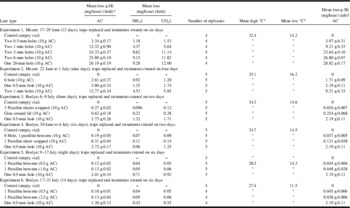
Ammonium carbonate (Keystone Universal Corporation, Melvindale, Michigan, United States of America) in seven-dram (5.5 cm high by 2.5 cm diameter) plastic vials (Thornton Plastics, Salt Lake City, Utah, United States of America) with a white plastic snap-on lid was used as the source of ammonia. All vials were wrapped in grey tape to eliminate any visual cues inside vials. The control was an empty vial. To generate different AC loss rates, Experiments 1 and 2 used vials with 10 g AC and with holes of various diameters. However, it was found that use of 10 g AC and holes could not reduce loss rates to the desired low amounts. Thus in the rest of the experiments, various other methods were included to control loss rates (Table 1). Three 10 cm long×2.5 cm wide parafilm strips (Experiment 3) or 1 strip of the same dimensions (Experiments 4–6) (“M” Laboratory Film; Bemis Flexible Packaging, Neenah, Wisconsin, United States of America) were wrapped around the lid-vial seal for some treatments. Each strip stretched around the lid five times. Other vials had one 5×5-cm sheet of parafilm sandwiched between the lid and vial or had 0.5, 2.5, or 1.0 g AC (Experiments 3–6) or had hot melt glue applied around the lid (Experiment 3). It was thought the dried glue would reduce the AC release rate compared with using parafilm, as molecules may not pass through it as quickly. All lures were hung ~1 cm above a 14×23 cm yellow rectangle trap with sticky pressure sensitive adhesive (Agri-Sense Yellow Sticky Strip; Agri-Sense-BCS, South Wales, United Kingdom) on 588 cm2 of its surface. Lures were weighed before and within three hours of experiments ending to determine mg of AC lost per hour.
Experiments conducted using different ammonium carbonate (AC) loss rates against Rhagoletis indifferens and non-target flies in central Washington State in 2015.

Notes: All lures were seven-dram plastic vials wrapped in grey tape.
* During duration of experiment.
† Over 8.8 days at mean of 22.1 °C, three replicate lures.
‡ Based on molar masses of products of ammonium carbonate (96.09 g/mol) decomposition: 35.45% (34.07 g/mol) is NH3 and 45.8% (44.01 g) is CO2 by molar mass.
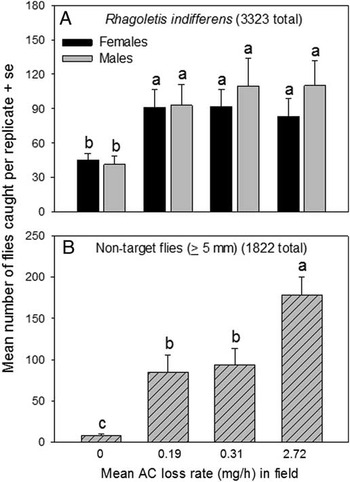
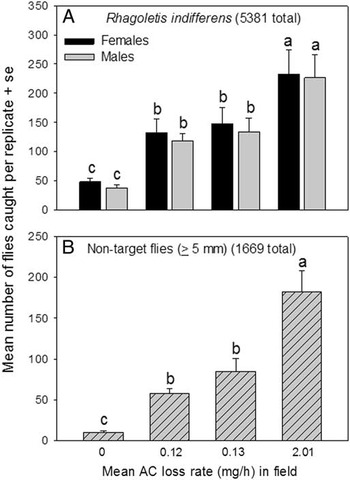
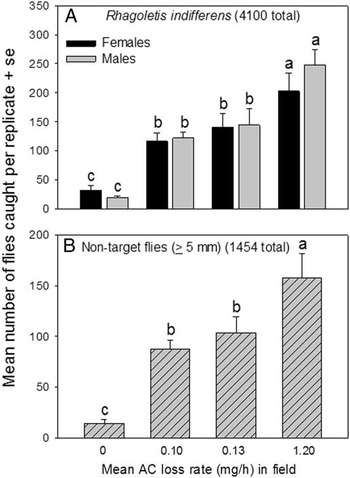
Six similar experiments were conducted using lures that progressively lost less AC. Excluding the control, the ranges in mean AC losses tested in the six respective experiments were (1) 3.34–26.19, (2) 2.61–12.77, (3) 0.27–3.73, (4) 0.19–2.72, (5) 0.12–2.01, and (6) 0.10–1.20 mg/hour (Table 1). Mean AC losses in the field were based on different dates and numbers of exposure days. In addition, AC losses from three of each lure type were determined in the laboratory at 22.1 °C and ~30–40% relative humidity over 8.8 days (Table 1). In all experiments, traps with lures were secured to branches 1.5–2.5 m above ground using three white wire ties per trap on the south sides of trees. Experiments were set up as a complete randomised block design, with blocks being locations. At the Moxee site, a block was a row of four or five trees adjacent to one another, with traps 6.1 m apart. At Roslyn, a block was a group of three to six trees. Traps within each block were 2.1–3.0 m apart. Each experiment lasted 3–14 days (Table 1). Experiment 3 was ended at three days because it was clear that differences in R. indifferens captures among AC treatments were not significant. Traps were replaced every day or every two to four days to minimise non-target fly coverage on trap surfaces. Each time traps were replaced, treatment positions were rotated to reduce location effects. Rhagoletis indifferens were counted and sexed.
Non-target “medium to large” flies, defined as ⩾5 mm in length, were also counted. These flies were grouped for analysis because the main objective was to assess how together they may affect R. indifferens monitoring, rather than to determine the responses of each species. However, it was important to determine which non-target fly families contributed most to problems on traps, so the most abundant flies caught on at least three collection dates in each experiment were identified to family (Johnson and Triplehorn Reference Johnson and Triplehorn2004). Dates were haphazardly chosen and considered representative of all sample days (Experiment 1: 18, 19, 21 June; Experiment 2: 24, 25, 26 June; Experiment 3: 7, 8, 9 July; Experiment 4: 2, 3, 6 July; Experiment 5: 12, 13, 15, 16 July; Experiment 6: 20, 24, 27, 29 July). Minute to small flies (<5 mm long) occurred in low numbers, were rare, covered small trap surface areas, and were not counted. Other Rhagoletis species were caught in low numbers but were not of interest here and also were not counted. Voucher specimens are maintained at the United States Department of Agriculture-Agricultural Research Service Yakima Agricultural Research Laboratory in Wapato, Washington, United States of America.
Losses of ammonia compounds from three commercially available (June 2015) lures were recorded to determine where they fit into the range of AC losses from the experimental lures. These commercial lures were developed for R. pomonella, but also are used for R. indifferens, and were the AgBio lure (27 g ammonium bicarbonate; AgBio Inc., Westminster, Colorado, United States of America), the Alpha Scents lure (7 g AC, RHAPOM; Alpha Scents), and the polycon IPM-3000 lure (13.5 g AC; Great Lakes IPM, Vestaburg, Michigan, United States of America). One lure of each type was hung in each of four or five trees 6.1 m apart at the Moxee orchard in July 2015. Four AgBio lures were hung for 15 days from 1 to 16 July; five Alpha Scents and five IPM-3000 lures were hung for 14 days from 10 to 25 July. Average high and low temperatures during the two periods were 34.1 °C and 17.4 °C and 31.2 °C and 14.3 °C, respectively. No rainfall occurred during these periods. Lures were weighed before and after field exposure to determine compound loss rate.
Statistics
The interest here was not to generate linear relationships between AC loss and fly captures, so lure design type, each corresponding to a particular AC loss rate, was treated as a categorical variable. Before analyses, fly counts from all dates were pooled, square-root transformed, and then tested for normality and equality of variance assumptions using the Shapiro–Wilk and the Brown and Forsythe tests, respectively (SAS Institute 2010). Data in Experiments 1–6 met these assumptions in 12 but not in six cases (case=data set of female or male R. indifferens or non-target flies across all treatments within experiments). When data were normal, a randomised block analysis of variance was conducted, followed by Tukey’s honestly significant difference test. When data were not normal, a Friedman test was performed, followed by a Tukey-type procedure for pairwise comparisons (Zar Reference Zar1999).
Results
For captures of R. indifferens, overall results showed that no AC loss rate comparisons within 0.19–26.19 mg/hour differed, and captures were not reduced until losses were lowered to 0.10–0.13 mg/hour. Thus 0.19 mg AC/hour was the lowest loss rate tested that did not reduce R. indifferens captures compared with the highest rates. In contrast, captures of medium to large (⩾5 mm long) non-target flies were reduced at a rate ~30 times higher, at 3.34 or 3.80 mg AC/hour. Major results from each experiment that led to these conclusions follow.
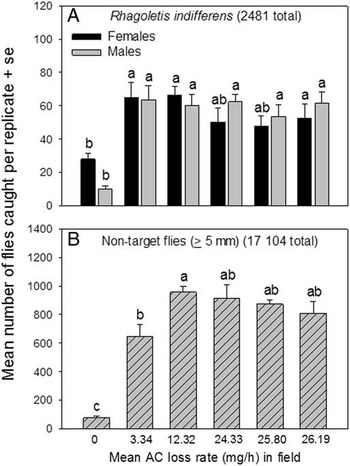
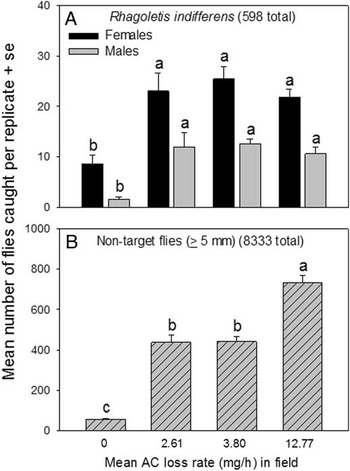
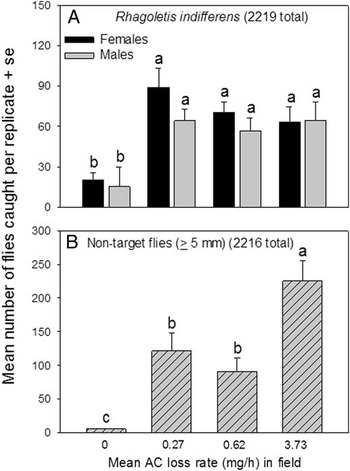
At Moxee in Experiments 1 and 2 (Figs. 1, 2), captures of R. indifferens at 2.61–26.19 mg AC/hour were similarly high, but for non-target flies, they were higher at 12.32–26.19 than 2.61–3.80 mg AC/hour. At Roslyn in Experiments 3 and 4 (Figs. 3, 4), captures of R. indifferens at 0.19–3.73 mg AC/hour were similarly high, but captures of non-target flies at 0.19–0.62 was lower than at 3.73 or 2.72 mg AC/hour. At Roslyn in Experiments 5 and 6 (Figs. 5–6), captures of both R. indifferens and non-target flies were lower at 0.10–0.13 than 2.01 or 1.20 mg AC/hour.
Experiment 1: mean (A) numbers of female and male Rhagoletis indifferens and (B) non-target flies on sticky yellow traps per replicate+standard error with lures having mean ammonium carbonate losses of 0–26.19 mg/hour over 12 days from 17 to 29 June 2015 in sweet cherry trees in an experimental orchard in Moxee, Washington. Non-target flies comprise Sarcophagidae, Tachinidae, and other Diptera ⩾5 mm long. Rhagoletis indifferens: females: F=7.28; df=5, 15; P=0.0012; males: F=56.91; df=5, 15; P<0.0001. Non-target flies: F=55.14; df=5, 15; P<0.0001. Means (within sexes for R. indifferens) with same letters are not significantly different (Tukey’s honestly significant difference test, P>0.05).

Experiment 2: mean (A) numbers of female and male Rhagoletis indifferens and (B) non-target flies caught on sticky yellow traps per replicate+standard error with lures having mean ammonium carbonate losses of 0–12.77 mg/hour over nine days from 22 June to 1 July 2015 in sweet cherry trees in an experimental orchard in Moxee, Washington. Non-target flies comprise Sarcophagidae, Tachinidae, and other Diptera ⩾5 mm long. Rhagoletis indifferens: females: F=12.51; df=3, 12; P=0.0005; males: χ2=9.96; df=3; P=0.0189. Non-target flies: F=242.01; df=3, 12; P<0.0001. Means (within sexes for R. indifferens) with same letters are not significantly different (Tukey’s honestly significant difference test, P>0.05); for male R. indifferens, means shown but ranks analysed.

Experiment 3: mean (A) numbers of female and male Rhagoletis indifferens and (B) non-target flies caught per sticky yellow traps per replicate+standard error with lures having mean ammonium carbonate losses of 0–3.73 mg/hour over three days from 6 to 9 July 2015 in sweet cherry trees in Roslyn, Washington. Non-target flies comprise Sarcophagidae, Tachinidae, and other Diptera ⩾5 mm long. Rhagoletis indifferens: females: F=28.88; df=3, 12; P<0.0001; males: F=19.86; df=3, 12; P<0.0001. Non-target flies: χ2=14.04; df=3; P=0.0025. Means (within sexes for R. indifferens) with same letters are not significantly different (Tukey’s honestly significant difference test, P>0.05); for non-target flies, means shown but ranks analysed.

Experiment 4: mean (A) numbers of female and male Rhagoletis indifferens and (B) non-target flies caught on sticky yellow traps per replicate+standard error with lures having mean ammonium carbonate losses of 0–2.72 mg/hour over six days from 30 June to 6 July 2015 in sweet cherry trees in Roslyn, Washington. Non-target flies comprise Sarcophagidae, Tachinidae, and other Diptera ⩾5 mm long. Rhagoletis indifferens: females: F=9.09; df=3, 12; P=0.0021; males: F=9.99; df=3, 12; P=0.0014. Non-target flies: χ2=13.56; df=3; P=0.0036. Means (within sexes for R. indifferens) with same letters are not significantly different (Tukey’s honestly significant difference test, P>0.05); for non-target flies, means shown but ranks analysed.

Experiment 5: mean (A) numbers of female and male Rhagoletis indifferens and (B) non-target flies caught on sticky yellow traps per replicate+standard error with lures having mean ammonium carbonate losses of 0–2.01 mg/hour over eight days from 9 to 17 July 2015 in sweet cherry trees in Roslyn, Washington. Non-target flies comprise Sarcophagidae, Tachinidae, and other Diptera ⩾5 mm long. Rhagoletis indifferens: females: F=53.92; df=3, 12; P<0.0001; males: χ2=13.56; df=3; P=0.0036. Non-target flies: F=47.22; df=3, 12; P<0.0001. Means (within sexes for R. indifferens) with same letters are not significantly different (Tukey’s honestly significant difference test, P>0.05); for male R. indifferens, means shown but ranks analysed.

Experiment 6: mean (A) numbers of female and male Rhagoletis indifferens and (B) non-target flies caught on sticky yellow traps per replicate+standard error with lures having mean ammonium carbonate losses of 0–1.20 mg/hour over 14 days from 17 to 31 July 2015 in sweet cherry trees in Roslyn, Washington. Non-target flies comprise Sarcophagidae, Tachinidae, and other Diptera ⩾5 mm long. Rhagoletis indifferens: females: F=70.41; df=3, 9; P<0.0001; males: χ2=11.10; df=3; P=0.0112. Non-target flies: χ2=11.10; df=3; P=0.0112. Means (within sexes for R. indifferens) with same letters are not significantly different (Tukey’s honestly significant difference test, P>0.05); for male R. indifferens and for non-target flies, means shown but ranks analysed.

Of the 32 598 medium to large non-target flies counted on traps from Moxee and Roslyn sites, 16 771 were examined for family traits. Combined across all experiments and trap dates, this non-target catch comprised Sarcophagidae (67%), Tachinidae (25%), and other families (8%) (Supplementary Table 1). Because sarcophagids and tachinids were mostly black or grey, these flies could make searching for R. indifferens (mostly black) difficult.
Mean compound loss rates±standard error from the AgBio, Alpha Scents, and IPM-3000 lure in the field were 12.82±0.53, 7.80±0.74, and 20.64±1.23 mg/hour, respectively. Thus, these lures lost ammonia at the higher end of the experimental lures.
Discussion
Ammonium carbonate loss rates differentially affected numbers of R. indifferens and non-target flies caught on sticky yellow rectangles, supporting the hypothesis. Using the trap-lure combination here, results imply that maximum captures of R. indifferens may be obtained at mean AC losses of only 0.19–0.31 mg/hour and that higher AC loss rates are not necessary for monitoring the fly. Ammonium carbonate loss rates greater than the highest rates used here need to be tested to confirm this. However, it is likely that had they been, R. indifferens captures would not have increased, as they plateaued at means of 3.34–26.19 mg AC/hour. Also, very high AC loss rates might reduce captures. In a flight tunnel, Anastrepha suspensa (Loew) (Diptera: Tephritidae) captures declined with increasing ammonia concentration (Kendra et al. Reference Kendra, Montgomery, Mateo, Puche, Epsky and Heath2005). Captures of non-target flies plateaued from 12.3 to 26.19 mg AC/hour, so this range of values may result in maximum non-target fly captures on the traps.
The practical implication of results for seasonal monitoring of R. indifferens is that lures that lose lower than higher amounts of AC may be better to use with sticky yellow rectangles because of the non-target flies. Commercial lures appear to release higher ammonia rates than are needed for monitoring the fly. Results do suggest, however, that AC losses should not be 0.10–0.13 mg/hour or lower, based on tests done in early to late July in Roslyn. Whether this is true for R. indifferens earlier in the season, when more flies are likely to be young, needs study. However, the conclusion that AC loss rates differentially affect trap captures of R. indifferens and non-target flies remains valid regardless.
There is a possibility that differences in R. indifferens and non-target fly captures at the higher AC loss rate treatments were caused by the presence of non-target flies preventing some R. indifferens from landing on traps. However, due to traps being changed frequently, traps were never 100% covered with non-target flies. The non-target flies were at most scattered over ~24% of the sticky surface (the highest non-target fly number on a trap was 488, over three days, so if each fly covered 29 mm2 [6×2.5 mm long and wide+14 mm2 for wings], then the area covered was 142 cm2 over 588 cm2 sticky surface). In addition, at Moxee from 21 to 23 June when only 8.5 and 14.0 non-target flies were caught per trap at lowest and highest AC rates, respectively, numbers of R. indifferens across treatments also did not differ. Unlike here, R. indifferens captures may be affected by non-target flies if traps are replaced infrequently.
One alternative to reducing ammonia release rates to decrease non-target fly catches is to use fruit volatiles specific to R. indifferens, but these have not been identified. In addition, fruit volatiles could attract a different set of non-target flies than ammonia. For example, fruit volatile blends isolated for R. pomonella attract very high numbers of non-target Chloropidae flies (Oscinella Becker) in central Washington (Yee et al. Reference Yee, Landolt and Darnell2005). At some sites there, these flies can quickly cover the entire surface of sticky red spheres, rendering them useless for monitoring R. pomonella (W.L.Y., personal observations). Also, in Washington, AC lures attract more R. pomonella than fruit volatile lures (Yee et al. Reference Yee, Nash, Goughnour, Cha, Linn and Feder2014).
Sarcophagidae flies were the predominant group of medium to large non-target flies caught on traps in most experiments. Thus traps in areas where sarcophagid flies are abundant may need to be replaced more often than in those where they are less abundant. At Moxee, proportions of flies that were tachinids reached nearly 40%, so high tachinid abundance in some areas can also be a problem. In other parts of North America, tachinid flies were the major non-target flies (⩾75%) caught on ammonia-protein baited traps (Moore Reference Moore1969; Buriff and Davis Reference Buriff and Davis1974). Incidentally, using lower AC rates could have the side effect of removing fewer tachinids, which are beneficial parasitic insects (O’Hara Reference O’Hara2008), from the environment.
There are several possible reasons for the differences in capture patterns of R. indifferens and non-target flies across AC loss rate treatments. One is that R. indifferens can detect lower amounts of ammonia than non-target flies; the insects simply could have different optimum odour concentrations they are sensitive to. Results would support this only if both fly groups were the same distances from the traps. This may sometimes happen, as non-target flies (presumably sarcophagids) were seen resting on cherry leaves in trees with no ammonia lures (W.L.Y., personal observations). Another possibility is that most non-target flies rarely reside in cherry trees and thus were farther from lures, so AC losses needed to be high for the flies to detect the ammonia. In contrast, R. indifferens were already in the trees and could detect lower ammonia concentrations because they were closer to the lures.
The range of attraction of R. indifferens to ammonia from lures such as those here is unclear and needs study, but certain observations suggest it may be ⩽1 m. For instance, flies were more “agitated” and “excited” at this distance from AC than farther away (Frick Reference Frick1952). Also, unbaited traps placed 30 cm from ammonia-baited ones catch relatively few R. indifferens (W.L.Y., unpublished data). Ammonia may be detected at relatively short distances by other tephritids: Queensland fruit fly, Bactrocera tryoni (Froggatt), differentially responded to various liquid ammonia traps placed only 50 cm apart in field cages (Bateman and Morton Reference Bateman and Morton1981).
CO2 from AC decomposition might also play some role in repelling or attracting R. indifferens and non-target flies, based on its role in doing so for other tephritids. For B. tryoni, CO2 from liquid in traps may be a mild repellent (Bateman and Morton Reference Bateman and Morton1981), but CO2 from fruit lesions may be a close-range oviposition attractant (Stange Reference Stange1999). For A. suspensa in a flight tunnel, CO2 in combination with ammonia was more attractive than ammonia alone (Kendra et al. Reference Kendra, Montgomery, Mateo, Puche, Epsky and Heath2005). Sarcophagids may be attracted to ammonia and/or CO2, due to their need to larviposit in carrion or excrement (Greenberg Reference Greenberg1973); if CO2 is a strong attractant, then lures releasing only ammonia, e.g., ones with liquid ammonium hydroxide, may reduce captures of these flies. However, liquid lures have never been practical to use for R. indifferens monitoring.
In summary, results suggest that using lures with an AC loss rate of 0.19 mg/hour can maintain high R. indifferens captures while reducing non-target fly captures. This could improve monitoring efficiency, a hypothesis worthy of further study. In addition, results suggest altering release rates of chemical attractants as a method to reduce catches of non-target insects in other trapping systems merits consideration.
Acknowledgements
The author thanks Peter Chapman and Janine Jewett (United States Department of Agriculture-Agricultural Research Service) for laboratory assistance, Grant McQuate (United States Department of Agriculture-Agricultural Research Service, Daniel K. Inouye United States Pacific Basin Agricultural Research Center, Hilo, Hawaii, United States of America) and Dong Cha (Cornell University, Ithaca, New York, United States of America) for reviewing earlier drafts of the manuscript, and two anonymous reviewers for comments on the manuscript.
Supplementary material
To view supplementary material for this article, please visit http://dx.doi.org/10.4039/tce.2016.49