INTRODUCTION
Paramphistomosis is well-known helminth parasites of ruminants, i.e. cattle, buffaloes, goats and sheep, which is caused by digenetic flukes belong to the superfamily of Paramphistomoidea (Gupta et al. Reference Gupta, Singh and Dutt1978). This disease is found in many regions, particularly in Africa, Asia, Australia, eastern Europe and Russia, which results in major economic losses in agriculture (Gupta et al. Reference Gupta, Singh and Dutt1978; Nikitin, Reference Nikitin1979; Hanna et al. Reference Hanna, Williamson, Mattison and Nizami1988; Anuracpreeda et al. Reference Anuracpreeda, Wanichanon and Sobhon2008, Reference Anuracpreeda, Panyarachun, Ngamniyom, Tinikul, Chotwiwatthanakun, Poljaroen and Sobhon2012, Reference Anuracpreeda, Phutong, Ngamniyom, Panyarachun and Sobhon2015). The occurrence of this disease, mainly with Paramphistomum gracile, has also been reported (Chethanon et al. Reference Chethanon, Ausavamatha and Piriyayon1985; Prasitirat et al. Reference Prasitirat, Chompoochan, Nithiuthai, Wongkasemjit, Punmamoamg, Pongrut, Chinone and Itagaki1997; Panyarachun et al. Reference Panyarachun, Ngamniyom, Sobhon and Anuracpreeda2013; Anuracpreeda et al. Reference Anuracpreeda, Anuracpreeda, Watthanadirek, Chawengkirttikul and Sobhon2017). Presently, a transitory diagnosis of paramphistomosis has been performed by conventional method through the detection of the fluke's eggs in the feces of infected animals, in conjunction with the history and clinical signs of the disease. However, this method often results in misdiagnosis and lack sensitivity, particularly in low levels of adult fluke burden or during the prepatent period (Horak, Reference Horak1971; Bida and Schillhorn van Veen, Reference Bida and Schillhorn van Veen1977). As well, the antigen-detection method was found to be more sensitive and specific (Zheng et al. Reference Zheng, Tao Zheng-Hou and Pessens1990; Anuracpreeda et al. Reference Anuracpreeda, Wanichanon, Chawengkirtikul, Chaithirayanon and Sobhon2009a , Reference Anuracpreeda, Wanichanon and Sobhon b ). In the present study, we have developed the monoclonal antibody (MoAb)-based sandwich enzyme-linked immunosorbent assay (sandwich ELISA) for diagnose active P. gracile infection by detecting the 16 kDa antigen in both serum and fecal samples of naturally infected animals. The use of this assay method provides the immunodiagnosis of paramphistomosis by P. gracile in ruminants with high sensitivities, specificities and accuracies.
MATERIALS AND METHODS
Ethics statement
Experiments on animals were approved by the Animal Care and Use Committee (SCMUACUC), Faculty of Science, Mahidol University, Thailand, and were specifically used for this study. Serum and fecal samples from naturally infected cattle were collected from fields in many areas of Thailand with monoinfections of P. gracile, other trematode, cestode and nematode parasites.
Parasite samples and antigen preparations
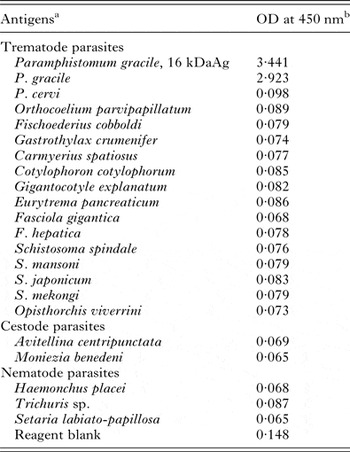
Live P. gracile adult worms were collected from the rumen of naturally infected cattle or water buffaloes killed at the local slaughter houses, Pathum Thani Province, Thailand. Other trematodes, cestodes and nematode parasites were obtained for the cross-reactivity study as shown in Table 1. The whole body (WB) antigen of all parasites and excretory–secretory (ES) antigen of P. gracile were prepared as per the method described by Anuracpreeda et al. (Reference Anuracpreeda, Wanichanon, Chaithirayanon, Preyavichyapugdee and Sobhon2006, Reference Anuracpreeda, Chawengkirtikul, Tinikul, Poljaroen, Chotwiwatthanakun and Sobhon2013a , Reference Anuracpreeda, Poljaroen, Chotwiwatthanakun, Tinikul and Sobhon b , Reference Anuracpreeda, Chawengkirttikul and Sobhon2016b , Reference Anuracpreeda, Chawengkirttikul and Sobhon c , Reference Anuracpreeda, Chawengkirttikul and Sobhon d , Reference Anuracpreeda, Chankaew, Puttarak, Koedrith, Chawengkirttikul, Panyarachun, Ngamniyom, Chanchai and Sobhon e ; Panyarachun et al. Reference Panyarachun, Sobhon, Yotsawan, Chotwiwatthanakun, Anupunpisit and Anuracpreeda2010). The 16 kDa antigen of P. gracile (16 kDaAgPg) was obtained as per the method described earlier by Anuracpreeda et al. (Reference Anuracpreeda, Chawengkirttikul and Sobhon2016a , Reference Anuracpreeda, Anuracpreeda, Watthanadirek, Chawengkirttikul and Sobhon2017). Protein concentrations of antigen preparations were determined by Lowry's method (Lowry et al. Reference Lowry, Rosebrough, Farr and Randal1951).
Cross-reactivity testing of a sandwich ELISA to various crude antigens from trematode, cestode and nematode parasites.

a The protein content of each parasite antigen preparation was adjusted to 20 µg mL−1, and a 50-μL volume was used for analysis.
b Mean OD was determined in triplicates performed on three separate occasions.
Generation and purification of MoAbs and polyclonal antibodies (PoAbs) against 16 kDaAgPg
We previously described the production and characterization of hybridoma clones of MoAbs against 16 kDaAgPg according to the method of Anuracpreeda et al. (Reference Anuracpreeda, Songkoomkrong, Sethadavit, Chotwiwatthanakun, Tinikul and Sobhon2011, Reference Anuracpreeda, Srirakam, Pandonlan, Changklungmoa, Chotwiwatthanakun, Tinikul, Poljaroen, Meemon and Sobhon2014, Reference Anuracpreeda, Anuracpreeda, Watthanadirek, Chawengkirttikul and Sobhon2017). Briefly, the hybridoma clones expressing MoAb against 16 kDaAgPg were produced by fusion of mouse myeloma cells (P3 × 63-Ag8·653) with splenocytes from inbred BALB/c mouse immunized with 16 kDaAgPg, using polyethylene glycol. The immunization of BALB/c mice comprised 3 subcutaneous injections with 25 µg of 16 kDaAgPg. The first immunization was emulsified in complete Freund's adjuvant, and subsequent injections used incomplete Freund's adjuvant. The MoAbs were initially screened for their reactivity by indirect ELISA, and the highly reactive hybridomas were cloned by limiting dilution techniques. Hybridoma clone (1D10) producing a high antibody titre against 16 kDaAgPg was selected and the specific MoAb isotypes were determined by indirect ELISA. In the cross-reactivity study, proteins (10 µg) in WB from P. gracile as well as WB from other trematode, cestode and nematode parasites were separated using 12·5% SDS–PAGE, and transferred onto nitrocellulose (NC) membranes for immunoblotting by the selected MoAb 1D10 according to the method of Anuracpreeda et al. (Reference Anuracpreeda, Chawengkirttikul and Sobhon2016a ). Polyclonal anti-16 kDaAgPg for the detection of antigen captured by the immobilized MoAb was produced by immunizing New Zealand White rabbits with 16 kDa antigen of P. gracile as per the method of Anuracpreeda et al. (Reference Anuracpreeda, Chawengkirttikul and Sobhon2016c ). The IgM fraction of MoAb and IgG fraction of PoAb were purified by affinity chromatography, and the purified IgG of PoAb was subsequently biotinylated as previously described (Anuracpreeda et al. Reference Anuracpreeda, Chawengkirttikul and Sobhon2016c ).
Evaluation of the lower detection limit and the specificity of sandwich ELISA
The method described previously by Anuracpreeda et al. (Reference Anuracpreeda, Chawengkirttikul and Sobhon2016b ) was used to evaluate the lower detection limit of sandwich ELISA. The 16 kDa antigen and WB as well as ES antigens of P. gracile were titrated with a serial dilution method. The endpoint of detection limit was considered to be the lowest amount of parasite antigen still exhibiting the positive optical density (OD) values. To examine cross-reactivity testing, the specificity of ELISA was analysed by using WB antigens from other trematode, cestode and nematode parasites. Each of these antigens was prepared at different concentrations and detected possible presence of 16 kDa antigen.
Detection of circulating 16 kDaAgPg by sandwich ELISA
The sandwich ELISA was performed as per the method described previously by Anuracpreeda et al. (Reference Anuracpreeda, Chawengkirttikul and Sobhon2016b , Reference Anuracpreeda, Chawengkirttikul and Sobhon c ). For each step, 50 µL well−1 was added unless otherwise mentioned. microtitre plate was coated with 10 µg mL−1 rabbit anti-mouse IgG diluted in carbonate buffer. After washing, 10 µg mL−1 purified MoAb 1D10 was added. Then, the plate was blocked with 150 µL well−1 of 5% skimmed milk in phosphate buffered saline (PBS) for 1 h at 37 °C. After washing as described earlier, the reference antigens or samples were added (triplicate wells), and incubated for 3 h at 37 °C. Thereafter, 2 µg mL−1 biotinylated rabbit IgG antibody against 16 kDaAgPg was added, and TMB substrate solution was used as a chromogen to detect streptavidin-conjugated peroxidase reaction. The enzyme reaction was stopped by adding of 1 N HCl, and determined from the OD value measured at 450 nm using an automatic microplate reader.
Evaluation of results and statistics
The cut-off value was calculated according to the method of Anuracpreeda et al. (Reference Anuracpreeda, Chawengkirttikul and Sobhon2016b ), as the mean OD of negative controls plus three times the standard deviations (s.d.). The data were considered no significant if P-value greater than 0·05, and considered to be highly and very highly significant if P-value <0·05 and 0·01, respectively. According to Galen (Reference Galen1980), standard diagnostic indices including sensitivity, specificity, predictive values, false positive and negative rate, and accuracy were calculated.
RESULTS
The specificity of MoAb 1D10 against 16 kDa antigen with other trematode, cestode and nematode’s antigens
In both indirect ELISA and immunoblotting assay, MoAb 1D10 showed strong reaction with the 16 kDa antigen in WB of adult P. gracile at molecular weight 16 kDa, while showing no cross-reaction with WB antigens from other parasites.
The lower detection limit and the specificity of sandwich ELISA
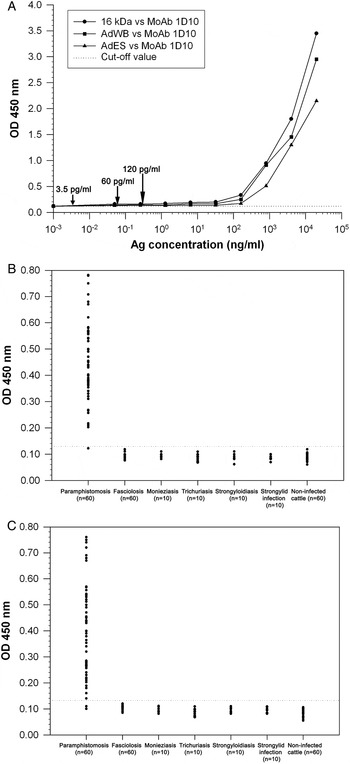
This assay could detect the 16 kDa antigen and native 16 kDa antigen in WB and ES fractions of P. gracile as low as 3·5, 60 and 120 pg mL−1, respectively (Fig. 1A). Moreover, this test was highly specific for the 16 kDa antigen, and the cross-reactions with other parasite antigens were not observed (Table 1).
(A) The sandwich ELISA denotes the analysis of the lowest concentrations of 16 kDa antigen (line with black circle), native 16 kDa antigen in WB (line with black square) and ES (line with black triangle) fractions of adult Paramphistomum gracile. The arrows indicate the lowest concentrations of 16 kDa antigen that could still be detected. (B) Analysis of the relative levels of circulating 16 kDa antigens in the sera from cattle with monoinfections as measured by a reliable MoAb-based sandwich ELISA (OD values at 450 nm). Serum samples obtained from cattle with paramphistomosis, fasciolosis, monieziasis, trichuriasis, strongyloidiasis and strongylid infection were compared with control sera obtained from non-infected cattle. The horizontal dotted line represents the cut-off value for a positive detection. (C) Analysis of the relative levels of circulating 16 kDa antigens in the fecal samples (fecal supernatant) from cattle with monoinfections as measured by a reliable MoAb-based sandwich ELISA (OD values at 450 nm). Fecal samples obtained from cattle with paramphistomosis, fasciolosis, monieziasis, trichuriasis, strongyloidiasis and strongylid infection were compared with control sera obtained from non-infected cattle. The horizontal dotted line represents the cut-off value for a positive detection.

Immunodiagnosis of naturally infected and control serum or fecal samples by sandwich ELISA
Serum or fecal samples from the 220 cattle were collected and examined by sandwich ELISA, including 60 samples from paramphistomosis, 60 from fasciolosis, 10 from monieziasis, 10 from trichuriasis, 10 from strongyloidiasis, 10 from strongylid infections and 60 from non-infected animals. It was evident that 98·33% (59/60) (Fig. 1B) and 96·67% (58/60) (Fig. 1C) of paramphistomosis serum and fecal samples were tested positive, respectively, while all serum or fecal samples from those infected with other infections and non-infected controls were found to be 100% (160/160) negative (Fig. 1B and C). Hence, the diagnostic sensitivity, specificity, positive predictive value, negative predictive value, false positive rate, false negative rate and accuracy were found to be 98·33, 100, 100, 99·38, 0, 1·67 and 99·55% for serum samples, and be 96·67, 100, 100, 98·77, 0, 3·33 and 99·09% for fecal samples. In addition, a positive correlation was found between egg counts in feces of P. gracile-infected animals and the OD values of sandwich ELISA in both serum (r 2 = 0·628, P < 0·01) and fecal samples (r 2 = 0·548, P < 0·01).
DISCUSSION
This study was the first to develop a highly sensitive and specific MoAb-based sandwich ELISA which is utilized for detection of circulating 16 kDa antigen in the serum and fecal samples from cattle naturally infected with P. gracile. The effectiveness of the ELISA implies the presence of 16 kDa antigen in the P. gracile-infected cattle's serum and fecal samples, as has been reported previously (Anuracpreeda et al. Reference Anuracpreeda, Srirakam, Pandonlan, Changklungmoa, Chotwiwatthanakun, Tinikul, Poljaroen, Meemon and Sobhon2014). In our study, this assay could detect 16 kDa antigen and native 16 kDa antigen in WB and ES fractions of adult P. gracile at the concentrations as low as 3·5, 60 and 120 pg mL−1, respectively. The detection limits of our assay are lower than those reported earlier in other closely related trematode parasites. For instance, a capture ELISA was used to detect the ES antigens in the samples of animals infected with Fasciola hepatica at the detection limits at 0·25 (for mice serum), 0·3 (for sheep feces) and 0·6 ng mL−1 (for cattle feces) (Langley and Hillyer, Reference Langley and Hillyer1989; Mezo et al. Reference Mezo, Gonzalez-Warleta and Ubeira2004). In addition, the detection limits of this assay are lower than those of our previous reports when the circulating antigens were detected in the sera of mice and cattle infected with Fasciola gigantica (Anuracpreeda et al. Reference Anuracpreeda, Wanichanon, Chawengkirtikul, Chaithirayanon and Sobhon2009a , Reference Anuracpreeda, Chawengkirtikul, Tinikul, Poljaroen, Chotwiwatthanakun and Sobhon2013a ). Moreover, it was reported that a sandwich ELISA was utilized to detect the ES antigens in both serum and fecal samples of patients infected with F. gigantica at the concentration levels 3 and 15 ng mL−1, respectively (Espino and Finlay, Reference Espino and Finlay1994; Demerdash et al. Reference Demerdash, Diab, Aly, Mohamed, Mahmoud, Zoheiry, Mansour, Attia and El-Bassiouny2011), which were still higher than in this study. Moreover, no cross-reactivity was observed when the ELISA was employed to detect various concentrations of other parasite antigens (Table 1).
It was quite interesting to note that the diagnostic sensitivity, specificity and accuracy of this MoAb-based sandwich ELISA were very high as in naturally infected cattle sera at 98·33, 100 and 99·55%, whereas in fecal samples they were 96·67, 100 and 99·09%, respectively. From our results, it is obvious that this sandwich ELISA would be successfully able to detect the presence of the 16 kDa antigen in both serum and fecal samples of animals infected with F. gigantica. Moreover, a positive correlation was found between egg counts in feces of P. gracile-infected animals and the OD values of sandwich ELISA in both serum and fecal samples. This result was similar to the positive correlation reported by Espino and Finlay (Reference Espino and Finlay1994) and Estuningsih et al. (Reference Estuningsih, Spithill, Raadsma, Law, Adiwinata, Meeusen and Piedrafita2009).
In conclusions, this sandwich ELISA exhibited high efficiencies and precisions, and could be a very useful tool not only for the rapid diagnosis of paramphistomosis in livestock, but also for the seroepidemiological screening and monitoring of chemotherapeutic efficacy of animals from different areas. More importantly, this assay method may be modifiable into a more convenient diagnostic kit, and could be useful in laboratories lacking well-trained microscopists.
ACKNOWLEDGEMENTS
We would like to thank Associate Professor Dr David Piedrafita, Federation University, for providing F. hepatica antigen.
FINANCIAL SUPPORT
This research was financially supported by Research Grants from The Thailand Research Fund and Mahidol University to Panat Anuracpreeda.