


Introduction
Social impact bonds (SIBs) have emerged as a novel, outcome-based approach to financing public services (Galitopoulou & Noya, Reference Galitopoulou and Noya2016), and since their inception, SIBs have gained significant traction and have spread rapidly across various regions. However, research has highlighted that implementing SIBs is far from straightforward. Whereas some regions have noted a growing adoption and utilisation of SIBs (Fry, Reference Fry2019), other regions have encountered notable implementational challenges (Broom, Reference Broom2021; Grimwood et al., Reference Grimwood, Baker, Humpage and Broom2022).
Early studies focused largely on the technical barriers to SIB implementation (Andersen, Reference Andersen2023; Arena et al., Reference Arena, Bengo, Calderini and Chiodo2016), but recent research has increasingly revealed that these technical challenges alone only partially explain the factors shaping SIB development. In contrast, a growing but limited body of research has indicated that a region’s political and historical institutional contexts also influence SIB development (Chiapello & Knoll, Reference Chiapello and Knoll2020; Fraser et al., Reference Fraser, Knoll and Hevenstone2023; Hajer, Reference Hajer2020; Williams, Reference Williams2020). This line of research calls for conceptualising SIBs as a dynamic policy process that requires a deeper exploration of the various factors influencing SIB implementation.
This study sought to add to that strand of SIB research by examining the process of SIB development in a lesser-explored East Asian context, Hong Kong. Guided by the political and historical view (Hajer, Reference Hajer2020; Williams, Reference Williams2020), we applied the Advocacy Coalition Framework (ACF) to analyse the SIB developmental process. Our study revealed that the development of the SIB in Hong Kong was a nonlinear process that, throughout its development, involved tension and contestation between two competing coalitions – one that sought to advance the SIB discourse and one that aimed to limit its growth. Importantly, although coordination of the opposing coalitions was subtle and discreet, their dominance in the sub-system seemed to provide sufficient grounds to influence the process. Hence, apart from other factors that also appeared to affect the local SIB’s development, this power dynamic nonetheless played a part in shaping the SIB’s implementation.
Overall, we contribute to the literature by offering an empirical demonstration of the political aspects of SIB implementation, and we illustrate how different coalitions each frame what SIBs represent according to their own policy beliefs, in order to achieve their own coalition’s goals.
Background
The term SIB broadly denotes a social financing mechanism in which private investors provide upfront capital to service providers to implement social programmes, with the public agency later reimbursing the investors for their initial investment along with an agreed-upon return if the intervention achieves predefined outcomes (Fraser, Tan, Lagarde, & Mays, Reference Fraser, Tan, Lagarde and Mays2018). SIBs represent a variant of outcomes-based contracting and a form of public–private partnership (Edmiston & Nicholls, Reference Edmiston and Nicholls2018). Several authors have posited that the term ‘bond’ in SIBs is misleading because it implies a conventional financial instrument, whereas in practice, SIBs rarely operate as commodities in financial markets (Millner & Meyer, Reference Millner and Meyer2022; Warner, Reference Warner2013).
Apart from describing SIBs as an instrument for financing, researchers have debated their role in public service delivery. With advocates promoting SIBs’ potential to mobilise private capital for the public good and ensure efficiency and accountability in the delivery process (Bugg-Levine & Emerson, Reference Bugg-Levine and Emerson2011), this public sector reform narrative has fostered the conclusion that SIBs are a political means to advance the new public management reform (NPM) agenda (Edmiston & Nicholls, Reference Edmiston and Nicholls2018; Joy & Shields, Reference Joy and Shields2013), although commentators argue that SIBs do not fully function as a market device (Neyland, Reference Neyland2017). Others emphasise that SIBs are a way to catalyse cross-sector collaboration and enable value co-creation, and hence they reflect an approach to achieving the principles of New Public Governance (NPG) (Albertson et al., Reference Albertson, Fox, O’Leary and Painter2020; Carter, Reference Carter2021). Considerable debate has prevailed regarding whether SIBs advance the logic of the NPM or the NPG (Dayson et al., Reference Dayson, Fraser and Lowe2020; Hajer & Chen, Reference Hajer and Chen2024), and SIBs have been characterised as ‘embod[ying] a dualistic conceptual identity’ (French et al., Reference French, Kimmitt, Wilson, Jamieson and Lowe2023, p. 380).
Notably, SIBs are not uncontested, and a cautious narrative has long surrounded their use (Fraser, Tan, Kruithof et al., Reference Fraser, Tan, Kruithof, Sim, Disley, Giacomantonio, Lagarde and Mays2018), as critics challenge that SIBs are a neoliberal instrument that turns social programmes into financial products and creates unchecked influence from the private sector on welfare priorities (Joy & Shields, Reference Joy and Shields2018; Roy & Teasdale, Reference Roy and Teasdale2021). They have also been criticised as being a public effort to marketise welfare and for being part of the trend of financialising social policy (Berndt & Wirth, Reference Berndt and Wirth2018; Dowling, Reference Dowling2017; McHugh et al., Reference McHugh, Sinclair, Roy, Huckfield and Donaldson2013). These characteristics of SIBs, and their description as having a high degree of strategic ambiguity (Tan et al., Reference Tan, Fraser, McHugh and Warner2021), caution that SIBs can be narrated in different ways for different audiences (Smith, Reference Smith2017).
SIB implementation
Precisely because of their strategic ambiguity, SIBs provide policymakers with flexible justifications for experimenting with them as a novel tool in different contexts (Tan et al., Reference Tan, Fraser, McHugh and Warner2021). This feature underpins the phenomenon that SIBs, since the first case of the Peterborough Bond, have gained substantial political traction and have found increased implementation across multiple regions (Arena et al., Reference Arena, Bengo, Calderini and Chiodo2016).
Within the research on SIBs, early studies focused largely on identifying the technical challenges associated with their design and implementation (see reviews by Andersen, Reference Andersen2023; Walker et al., Reference Walker, Goubran, Karami, Dumont-Bergeron, Schwartz and Vico2023). Nevertheless, emerging studies have increasingly raised the concern that such a technical focus risks overlooking the political dynamics that critically influence whether and how SIBs emerge in a given region. For example, Fraser and colleagues (Reference Fraser, Knoll and Hevenstone2023) argued that SIB implementation involves political struggles that actors must navigate and reconcile with the competing logics embedded within local welfare traditions. In the UK, US and Canada, Williams (Reference Williams2020) found that despite relatively sophisticated SIB markets, tensions between actors involved in SIBs – such as mistrust between service providers and financial intermediaries rooted in divergent welfare values – have hindered effective implementation.
In addition, Hajer (Reference Hajer2020) suggested that the emergence of a SIB in a region is conditioned by the region’s welfare governance regime. Using a comparative analysis, Hajer argued that a likely reason the US and UK were the early adopters of SIBs is that the political discourse underlying SIBs is more aligned with those regions’ welfare regimes, which are oriented towards market-centric logic, and this complementarity provided a more fertile ground for the development of SIBs. On the other hand, the limited implementation of SIBs in countries such as Germany and France was due to a lesser alignment of SIBs with their welfare contexts, which are oriented towards conservative/corporatist regimes. Similar arguments exist regarding how welfare logics and historical arrangements affect the implementation of SIBs (Fraser et al., Reference Fraser, Knoll and Hevenstone2023; Hajer & Chen, Reference Hajer and Chen2024; Hajer & Loxley, Reference Hajer and Loxley2021).
Despite these emergent efforts, investigations on SIBs beyond the technical aspect of SIB implementation have been limited. Seeking to add to this line of scant literature, we therefore employed a process view to study the development of SIBs in an East Asian context – Hong Kong. Guided by prior research highlighting that SIB development is a political endeavour, we applied the ACF because it offers a conceptual framework for uncovering how power dynamics between different groups of actors influence policy development (Jenkins-Smith et al., Reference Jenkins-Smith, Nohrstedt, Weible and Ingold2018).
Advocacy coalition framework
The ACF is a widely used framework for explaining policy change (Jenkins-Smith et al., Reference Jenkins-Smith, Nohrstedt, Weible and Ingold2018). Advocacy coalitions are the cornerstone of the ACF, which is defined as being ‘composed of people from various organisations who share a set of normative and causal beliefs and who often act in concert’ (Sabatier, Reference Sabatier1988, p.133). Advocacy coalitions have been described as possessing characteristics of political organisations (Nohrstedt & Heinmiller, Reference Nohrstedt and Heinmiller2024), with features such as seeking to sway policymaking and advance their position towards government.
Scholars of the ACF have posited that actors in the same advocacy coalition not only share beliefs but also coordinate a pursuit of similar policy goals, although the nature of their coordination depends on the context of the policy subsystems (Nohrstedt & Heinmiller, Reference Nohrstedt and Heinmiller2024). In subsystems characterised by high conflict and featuring competing coalitions – adversarial subsystems – actors tend to rely on strong and strategic coordination (Jenkins-Smith & Weible, Reference Jenkins-Smith and Weible2025). In contrast, in unitary subsystems, which feature a dominant advocacy coalition and a weak or absent minority coalition in low to intermediate conflict intensities, coordination among the actors in the dominant coalition can be discreet. This may involve actors behaving in complementary ways without explicit planning – such as monitoring allies’ actions and adjusting strategies accordingly (Weible & Ingold, Reference Weible and Ingold2018). In such contexts, the dominant coalition is the status quo coalition in power (Sabatier, Reference Sabatier1993) – the one with greater coalition resources, such as formal legal authority, financial resources and skilful leadership (Sabatier & Weible, Reference Sabatier and Weible2019), and with a greater likelihood of gaining decision-making power through the access and control of veto players in the policymaking (Heinmiller, Reference Heinmiller2023).
Within the ACF’s conceptual lens, policy change is understood to be a shift in governmental programmes and the overall direction of a policy subsystem (Jenkins-Smith et al., Reference Jenkins-Smith, Nohrstedt, Weible and Ingold2018). A major policy change is a significant alteration in policy core beliefs, whereas a minor change refers to adjustments in secondary aspects (Jenkins-Smith et al., Reference Jenkins-Smith, Nohrstedt, Weible and Ingold2018). Major policy changes typically disrupt coalition stability – such as when the dominant coalition loses power to maintain the policy status quo, or when minority coalitions gain resources or secure control of veto players whose agreement is required for advancing their core beliefs into policy (Heinmiller, Reference Heinmiller2023). The ACF proposes that policy change can emerge from the bottom up. It also explains why policy largely remains stable, stating that the policy core attributes of a governmental programme will not be significantly revised as long as the advocacy coalition that instituted the programme remains in power (Jenkins-Smith et al., Reference Jenkins-Smith, Nohrstedt, Weible and Ingold2018).
Building on the ACF perspective, we conceptualise a region’s SIB development as a process of policy change. Increased implementation of SIBs resembles a process of altering actors’ policy core beliefs and disrupting coalition stability. Given the controversies attached to the ideology of SIBs, a region’s policy subsystem likely includes advocacy coalitions that favour SIBs as well as coalitions that resist the idea. Their differences likely lie in their core beliefs. Conceived as political organisations (Nohrstedt & Heinmiller, Reference Nohrstedt and Heinmiller2024), advocacy coalitions coordinate to gain resources or secure control. This may manifest as tension and contestation, as each side seeks to gain policy dominance.
Methods
To examine this policy process and uncover how coalition dynamics unfolded, this study traces SIB development in Hong Kong through single-case causal process tracing (Blatter & Haverland, Reference Blatter and Haverland2014). For data collection, we relied primarily on three activities, beginning with comprehensive desktop research in which we retrieved all media reports and public records discussing SIBs in the Hong Kong context through a systematic search on the WiserOne news article database and other online search engines, using key phrase searches, including ‘Social Impact Bond’, ‘Pay for Success’, ‘Impact Investing’, and ‘Outcome-based Contracting’. Our search identified sixty-two documents relevant to our research inquiry, dated from 2010 to February 2024. A complete list of these documents is shown in Appendix I. We obtained materials from the Social Innovation and Social Entrepreneurial Development Fund (SIE Fund) of the Hong Kong Special Administrative Region (HKSAR) government related to its activities promoting SIBs. That information will be elaborated upon later in the article, with the SIE Fund being a key actor in promoting SIBs in the local context.
From 2017 onward – when the SIE Fund began promoting the SIB agenda – we prospectively tracked the developmental process, such as by attending events, engaging in discussions and observing critical moments in the policy process. These real-time engagements provided insights into the evolving interactions between coalitions, the contestations of beliefs, and the shifting political dynamics that shaped the Hong Kong SIB trajectory.
To deepen our understanding of actors’ beliefs and their coalition building, we conducted interviews with twenty-one key informants from diverse backgrounds relevant to the Hong Kong SIB’s development. Five were public managers, four were policymakers/advisors, five were social service providers, three were private investors and four were financial intermediaries. Informants were identified through document analysis, referrals from initial contacts, direct invitations at relevant events, and the authors’ professional networks. During the interviews, we explored the actors’ beliefs towards the SIB and their coordinating actions within the process. Their understanding of how other actors coordinated was also sought. Some informants were more directly involved in the SIB’s developmental process (e.g. major advocates, organisers of the SIB campaign), whereas others were less directly involved but had a ‘stake’ in the process (i.e. actors who likely ‘subtly’ influenced the SIB’s implementation and were influenced by it). The backgrounds of the informants and their involvement in the implementation process are provided in Appendix II.
Data analysis involved arranging events chronologically to map the sequences of key developments, decisions and turning points. Each event was assessed for its significance – whether it constituted a necessary condition, a triggering mechanism or a contributing factor. Empirical evidence from documents, interviews and observations was systematically compared against theoretical expectations derived from the ACF. Particular attention was given to how coalitions formed and how coalition interactions produced policy outputs.
Next, we provide a contextual description of Hong Kong’s welfare system, especially regarding the recent debate and political divide on the state’s role in providing social services.
Context
Hong Kong’s modern welfare state took shape in the 1970s, when the colonial government emerged to finance social services delivered largely through non-governmental organisations (NGOs) (Tang, Reference Tang1998; Tsui et al., Reference Tsui, Lee and Chui2013). With this institutional setup, Lee (Reference Lee2005), drawing on Salamon and Anheie’s (Reference Salamon and Anheier1998) social origins approach, characterised the welfare regime in Hong Kong as statist-corporatist: the government kept overall social welfare spending low because of its commitment to financial conservatism (‘statist’), while forming a strong, pragmatic partnership with a selected group of NGOs and heavily subsidising them to deliver social services (‘corporatist’). Since the 1970s, this arrangement has become institutionalised, as the government’s growing and stable subvention enabled those NGOs to expand service delivery in response to citizens’ needs (Chan, Reference Chan and Aspalter2021).
Because of this historical institutionalisation, the social services system in Hong Kong, up to the late 1990s, could be regarded as a unitary policy subsystem with one dominant advocacy coalition. This coalition was largely made up of NGOs that were the government’s established partners in social service delivery. Many actors in this group held the belief that the financial responsibility for social service provision should be borne fully by the government (Leung, Reference Leung2002).
Over time, this group gained substantial political resources because many leaders of these subvented NGOs were direct policy advisers in the government’s social welfare policy development (Wang, Reference Wang2023). These NGOs were dominant not only politically but also in size and financial terms. As early establishers in the sector, many covered a wide range of social services under government subvention. Because of their size, they employed a large proportion of social service workers. With their reputation well established, these large-scale NGOs were also major beneficiaries of local private donations (Lee, Reference Lee2012). Although these actors did not belong to a single formal umbrella organisation, this group is analytically conceived as a coalition because its actors shared broadly aligned policy beliefs. More formal alliances emerged later around specific policy disputes, as discussed below.
Since the late 1990s and 2000s, those entities’ dominance in the subsystem has been challenged (Wang, Reference Wang2023). The key disruption was the government’s introduction of (or imposition of) market logic in social services delivery, as exemplified by considerable cuts in the budgets for publicly subvented social services, a process that ties to the global NPM reform (Lam & Tse, Reference Lam and Tse2013). These historically well-established NGOs, once almost fully subsidised by the government, experienced substantial financial uncertainty and were forced to downsize by cutting staff. That change fractured the previous harmonious relationship between the government and NGOs (Leung, Reference Leung2002). The affected NGOs called the government’s move ‘unjust’ (i.e. an exploitation of service workers). At this point, the coalition-like nature of this group became more visible. In response to the government’s market-oriented reform, many social service actors organised around ‘the Defending Social Welfare Alliance’, which publicly opposed the reform through protest.Footnote 1 The significance of this reform was not confined to the immediate dispute. Its legacy continued to shape the state–NGO relationship, as claims of exploitation rooted in this reform continued to reappear in later public discussion, such as in 2015 and 2018.Footnote 2
This policy shift also gave rise to a group of actors advocating the use of markets for social services delivery, hereafter referred to as the neoliberal market coalition (Au et al., Reference Au, Yuen and Tam2016). Compared with the historically dominant group, the neoliberal market coalition, despite gaining political traction, was arguably still a minority coalition, given that they were the new entrants into the system. Despite the government’s preference for and use of policy tools, such as funding, to support its growth, the market coalition was far smaller in scale than the incumbent group (Chan et al., Reference Chan, Chui and Chandra2022; Lee, Reference Lee2012).
The early development of SIBs
The development of SIBs was underlain by this historical context. We identified that the earliest public discussion on SIBs was in late 2010 (see Figure 1 for a timeline), with advocates proposing the idea of SIBs through local media outlets. The early discourse about SIBs was predominantly from a neoliberal market viewpoint, in which the concept of SIBs was disproportionally framed as an investment opportunity through public service financing. For instance, the earliest local newspaper coverage of SIBs framed them as ‘a first-of-its-kind financial instrument’ and highlighted that they ‘may pay a yield of 7.5 percent to 13 percent’ (see #1 in Appendix I). Multiple media pieces published in the local newspaper outlets in the early 2010s also portrayed SIBs with similar investment-based framing (see #2, #3, #4, #9 and #10 in Appendix I).
Timeline of the process of SIB development in Hong Kong.

There were early signs of governmental interest in SIBs. In 2013, the then Secretary for Home Affairs of the HKSAR Government, Tsang Tak-sing, quoted the UK’s experience with SIBs in a blog post and presented them as a possible alternative for local social service financing, although no concrete follow-through occurred.
Since SIBs have already begun to establish themselves elsewhere … could Hong Kong also develop a broader social investment market? (Translated excerpt from a Chinese-language blog post; see #5 in Appendix I)
A new policy venue for SIB advocacy
So, from the early 2010s, advocacy around SIBs was already present, but it had not yet translated into substantial policy movement. Multiple informants highlighted that the launch of the SIE Fund was a notable juncture that accelerated progress on the SIB agenda. The SIE Fund is a policy programme whose origin traces to the 2012 Chief Executive election, in which one candidate, Leung Chun-ying, advocated social enterprise development as part of his election manifesto. After winning the election, the term ‘social innovation’ was formally introduced in the 2014 Policy Address, leading to the Fund’s establishment with a HK$500 million injection. Its core mission is to drive collaborative, innovative solutions to address social issues, particularly poverty alleviation (HKSAR Government, 2014). Managed by a cross-sector task force of government officials and experts from academia, the private sector and non-profits, the Fund operates as a standalone public administrative agency with its own budget and a decision-making structure. It possesses the institutional flexibility to experiment with new policy tools, such as the SIB.
As such, the Fund became a targeted venue for lobbying. Financial intermediaries made explicit efforts to steer the SIE Fund towards development of the SIB.
We have been advocating impact investing. …. After the SIE Fund was set up, we were the first to contact [a senior official of the Efficiency Office] and ask [the person] to bring the discussion of SIB to the Task Force committees. (Informant 19)
For instance, the Asia Community Ventures published a report directly calling on the SIE Fund to examine SIB applications (see #12 in Appendix I). Think tanks also joined in. The Hong Kong Council of Social Service featured international expertise in its Policy Bulletin and outlined the benefits of SIBs for local welfare management (see #13 in Appendix I). The Our Hong Kong Foundation later also published a report recommending the adoption of SIBs in Hong Kong (see #26 in Appendix I).
Within the Fund’s Task Force (2016–2020), some members were known to think favourably towards the idea of SIBs. Advocates lobbied the Task Force members of the SIE Fund to become ‘insider activists’ for promoting the SIB as a policy priority.
[A Task Force member] is a known proponent of impact investing. We also know few others [largely with a private sector background] who are very likely pro-impact investing. We have reached out to them to ‘convince’ the Fund to explore SIB. (The Informant highlighted the personal connection to these members and then remarked) I know that they made an effort to drive the movement. (Informant 20)
From the data, we argue that the starting point of the introduction of SIBs was a bottom-up advocacy that occurred alongside the top-down neoliberal shift in the subsystem. This can be conceptualised as having an expanding pro-SIB coalition that was primarily nested within the coalition upholding the neoliberal market logic. In broad terms, actors in this pro-SIB coalition mainly constituted financial intermediaries, think tanks favourable to neoliberal reform, and advocates aiming to grow a social impact investing market.
The launch of the Pay-for-Success (PFS) Scheme
Likely because of the growing lobbying, the launching of an SIB scheme had become a key Fund agenda item, and from this point onward, the SIE Fund became a major actor in the pro-SIB coalition. Within the Fund, this agenda led to the establishment of an ‘additional’ internal team tasked with overseeing the development of a local SIB scheme.
Internal to the Fund, we were the team newly assigned to oversee the exploration of the SIB initiative. We also have colleagues who have a specialty in public finance accounting. We figured out the ‘internal hurdle’ related to the setup of such financial arrangement, and we have brought in consultants to explore the project feasibility. (Informant 2)
In 2018, the SIE Fund formalised its commitment to the model by commissioning a comprehensive feasibility study. The primary objectives were to appraise the long-term development of the SIB model in Hong Kong, evaluate the city’s readiness for pilot projects, and co-create possible frameworks for implementation (see Appendix I, #38). The process involved inviting more than fifty organisational stakeholders, including investors, service providers, subject matter experts, academics and government bureaus/departments, to participate in brainstorming and subsequent knowledge-sharing events discussing the SIB model’s viability and policy relevance (for the names of participants, see Appendix I, #38). At this stage, the participation of various actors signalled a marked expansion of the pro-SIB coalition.
These developments culminated in the 2019 launch of the PFS scheme – Hong Kong’s first public procurement initiative based on the SIB model. In 2020, the SIE Fund commissioned the city’s inaugural SIB project, ‘Start from the Beginning – Chinese Supporting Scheme for Non-Chinese Speaking Students in Kindergarten’ acting as the public commissioner. Launched by Oxfam Hong Kong, this project scales up a Chinese-language support programme for non-Chinese-speaking kindergarten students (see #59 and #62 in Appendix I). Notably, the official discourse of the PFS scheme differed from the SIB’s original framing (as financial investment opportunities). The Fund framed the scheme as a pilot to explore capacity-building from cross-sector collaboration, and for learning to catalyse public innovation.
Limited subsequent uptake
For the pro-SIB coalition, the launch of the PFS programme signalled that SIBs had moved from the margins of policy discourse to formal implementation, and that move led to optimism that this success could catalyse further adoption. However, in retrospect, this milestone could be viewed as the peak of SIB implementation. Despite the continued existence of the PFS scheme, no further commissioning followed the initial case.
Evidence indicated that the lack of post-launch PFS scheme adoptions was not because further advocacy was lacking. The Fund’s post-programme appraisal revealed that local agencies might need seed funding to pilot service models aligned with the PFS programme, and the Fund accordingly established a complementary seed grant mechanism. Secretariats of the SIE Fund also reported that they engaged in a range of advocacy work to other public agencies on the PFS programme.
After the successful launch of the first PFS project, we stepped up our promotion efforts. We conducted several roadshows on the scheme and also promoted it to a number of other public administrative units. However, the response was not what we had expected. There were very few inquiries about the PFS scheme. The response to this scheme was quite limited. (Informant 3)
Our engagement with the stakeholders revealed several possible causes that might have contributed to the stagnation of the SIB’s development. First, the technical complexities of SIBs reported in the literature on the implementation of SIBs at the programme level were noted.
The process of lining up intermediaries and private investors, and then coming up with an outcomes measurement plan, was simply too much to handle. (Informant 11)
In addition, because the SIB campaign was overlapped by the outbreak of the coronavirus disease, the shift of immediate policy attention towards the pandemic likely attenuated the policy attention paid to the SIB discussion. Still, despite these contributing factors, our interviews indicated that technical complexity and the pandemic-related shift in policy attention were likely not the full story behind the limited subsequent uptake of the SIB, and a political perspective provides further explanation.
According to financial intermediaries, securing service providers was a considerable challenge in formulating a PFS proposal. The intermediaries highlighted that a large contingent of non-profits showed no interest towards the PFS scheme.
It was difficult to bring service providers on board. From our engagement, many medium- to large-scale NGOs showed little interest in participating. This was quite different from our experience in Singapore, where at least more organisations were willing to discuss the possibilities. (Informant 18)
Our exchanges with this group of social agencies (medium- to large-scale NGOs) also confirmed the observation.
I am aware of the scheme, but we are not considering it at the moment. We would prefer to explore other ways of soliciting financial support than through the PFS channel. (Informant 12)
However, we reasoned that their disinterest towards the PFS scheme likely was a ‘surface’ response. The few that were open to discussing their disinterest revealed that the underlying cause of their disinterest, or more precisely their resistance, lay in what they believed the PFS scheme represented.
Specifically, the informants cast doubt on the rhetoric of the PFS scheme, questioning the framing of this tripartite partnership as a way to bring social innovation and a means to bring additional (private) capital to social service delivery. They regarded this framing as a ‘disguise’ of the true motive. Reiterating the financial investment narrative of how the SIB was originally advocated in the early phase of the local development, the informants highlighted that a widespread perception persisted that SIBs would prioritise benefits for private investors over the social organisations themselves.
I think it was another ‘cheeky’ way for the government to bring in the private sector and reduce its responsibilities. It was presented as collaboration and innovation, but at bottom it was still about budget issues. When the idea was first promoted, it was already surrounded by discussions of budget cuts. (Informant 15)
During the interviews, informants did refer to specific persons and organisations that had resisted the SIB agenda, but also asked that these identities not be disclosed. To protect confidentiality, we therefore do not name these actors directly.
Elaborating on this resistance, some informants, in supplementary conversations, further explained that many of them (primarily from the NGOs, many of which either had been or still were under subvention) did not want to see the idea of SIBs take root in the local context because that could provide an ‘excuse’ for the government to institute another budget cut. Among authors’ interviews and informal exchanges in the fieldwork, the extension connecting SIBs to a neoliberal reform – not just ideologically but with their actual past experiences in the late 1990s and 2000s – was many times ‘unconsciously’ tied together. Among this group of NGOs, the discussion of SIBs seemingly awoke their ‘psychological pain’ from the prior reform.
Of course we will not take part. Why would I help the government [to pilot the scheme]? They may have another excuse to retreat [cut welfare budget]. The agenda to further cut our budget has never gone away. (Informant 14)
Don’t trust the government (referring back to the past publicly driven reform). Last time the government also used a similar strategy (piloting a new scheme) to bait us, and that’s the beginning of the deep trouble (the reform). (Informant 15)
Furthermore, some informants revealed the cognitive process underlying their increased attention (participation) towards the SIB (after the SIE Fund had begun advocating it) and explained that it was a precautionary reaction. Noting that their participation was not driven by a positive perception of a ‘new funding opportunity’, they described that they were instead propelled from a ‘risk/threat’ perspective. That is, if the SIBs were to continuously gain policy traction, they would be better prepared than with the previous one, which had caught them off-guard. Some noted that their participation was intended to keep track of the scheme’s progress and to observe how other actors responded to the PFS initiative.
We were involved in the discussion [about the local implementation of the SIB model]. We even participated in the events about the PFS scheme …[but] I have to admit that we didn’t like the SIB model. The SIB model could bring significant changes to the funding landscape…like the Lump Sum Grant reform, at the time where we were under pressure to adapt to the changes. [Our participation] was more about from learning what’s is going on … you know, to efficiently reposition our organisation in the face of these potential changes. (Informant 13)
Summary of the policy process
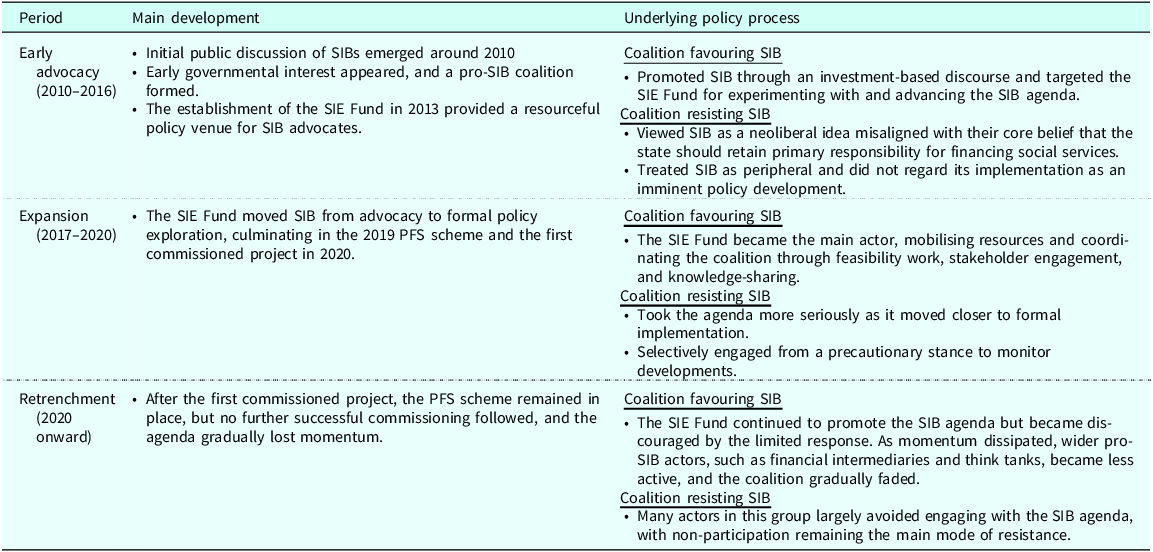
From the accumulated data, we arrived at a representative policy process spanning 2010 to 2024 that can be broadly segmented into three periods – early advocacy, expansion and retrenchment – as summarised in Table 1. In the early advocacy phase (2010–2016), the SIB agenda was advanced mainly by actors in the neoliberal camp, including financial intermediaries and impact-investing advocates, who promoted the idea through an investment-based discourse. Many incumbent social service providers, especially established and publicly subvented NGOs, likely disfavoured the idea because of its neoliberal framing and possible implications for state responsibility in social service financing. Yet their response remained muted, likely because many regarded SIB as a peripheral idea rather than an imminent policy development.
Summary of the policy process of SIB implementation

Table 1. Long description
A table summarizing the policy process of SIB implementation across three periods: early advocacy, expansion, and retrenchment. The table has three columns: Period, Main development, and Underlying policy process. The Period column lists three phases: Early advocacy (2010-2016), Expansion (2017-2020), and Retrenchment (2020 onward). The Main development column describes key events in each phase. The Underlying policy process column details the actions and views of coalitions favoring and resisting SIB during each phase. Row 1: Early advocacy (2010-2016), Initial public discussion of SIBs emerged around 2010, Early governmental interest appeared, and a pro-SIB coalition formed, The establishment of the SIE Fund in 2013 provided a resourceful policy venue for SIB advocates. Row 2: Coalition favouring SIB, Promoted SIB through an investment-based discourse and targeted the SIE Fund for experimenting with and advancing the SIB agenda. Row 3: Coalition resisting SIB, Viewed SIB as a neoliberal idea misaligned with their core belief that the state should retain primary responsibility for financing social services, Treated SIB as peripheral and did not regard its implementation as an imminent policy development. Row 4: Expansion (2017-2020), The SIE Fund moved SIB from advocacy to formal policy exploration, culminating in the 2019 PFS scheme and the first commissioned project in 2020. Row 5: Coalition favouring SIB, The SIE Fund became the main actor, mobilizing resources and coordinating the coalition through feasibility work, stakeholder engagement, and knowledge-sharing. Row 6: Coalition resisting SIB, Took the agenda more seriously as it moved closer to formal implementation, Selectively engaged from a precautionary stance to monitor developments. Row 7: Retrenchment (2020 onward), After the first commissioned project, the PFS scheme remained in place, but no further successful commissioning followed, and the agenda gradually lost momentum. Row 8: Coalition favouring SIB, The SIE Fund continued to promote the SIB agenda but became discouraged by the limited response. As momentum dissipated, wider pro-SIB actors, such as financial intermediaries and think tanks, became less active, and the coalition gradually faded. Row 9: Coalition resisting SIB, Many actors in this group largely avoided engaging with the SIB agenda, with non-participation remaining the main mode of resistance.
The process shifted when the SIE Fund became a key actor in advancing the agenda in the expansion phase (2017–2020), moving SIB from a peripheral idea towards a formal policy initiative. This shift forced some incumbent social service providers to take the idea more seriously and participate more closely. Yet their participation was likely precautionary, driven more by a need to monitor developments and manage perceived risks. Although the SIE Fund framed the agenda in terms of collaboration and public innovation, many social service providers continued to perceive it as a neoliberal initiative.
After the first commissioned case, the SIE Fund and the wider pro-SIB group sought to push the agenda further. However, they achieved little success because many actors disfavouring the idea continued to resist mainly through non-participation. Together with other factors, such as the technical complexity of the PFS model and the pandemic-related shift in policy attention, this weakened the agenda’s momentum and contributed to its gradual retrenchment (2020 onward).
Discussion
Situating SIBs as a contested idea, we used the ACF as a guiding framework for conceptualising Hong Kong’s SIB development. From this analytical perspective, the process can be reconstructed as involving two competing coalitions, with the tension and contestation between them shaping the policy process. As shown above, the coalition favouring SIBs tended to align with market-oriented approaches to social service financing, whereas the coalition resisting SIBs was concerned with preserving the state’s primary responsibility for financing social service delivery. In this way, the paper foregrounds the complex political dynamics of SIB implementation, distinguishing it from much of the SIB literature that has tended to examine implementation primarily through a technocratic lens.
In addition to guiding attention to how actors may behave as political organisations seeking to influence policymaking (Nohrstedt & Heinmiller, Reference Nohrstedt and Heinmiller2024), the ACF also helps explain the observed policy process. For instance, the ACF literature has highlighted how insider activists and access to veto players can shape policy change (Heinmiller, Reference Heinmiller2023). This appears, in part, to account for the early advancement of the SIB agenda in this case, in which financial intermediaries and impact-investing advocates targeted Task Force members of the SIE Fund and helped move SIB towards policy uptake. At the same time, we observed that many incumbent social service providers, although likely resisting the idea of SIB, did not engage in visible collective mobilisation. Rather, they mainly monitored the development of the agenda and withheld participation. Through the ACF lens, we interpret this not simply as disinterest, but as a form of weak coordination that appeared to seek to constrain the advancement of SIB. Drawing on the ACF insight that weak coordination in a unitary subsystem can help the dominant coalition preserve the existing direction of the policy subsystem, we argue that this provides a partial explanation for the limited implementation of SIB in Hong Kong.
This case speaks to the growing SIB literature showing that SIB development is not a linear process (Broom, Reference Broom2021; Grimwood et al., Reference Grimwood, Baker, Humpage and Broom2022). As was the case in New Zealand (Grimwood et al., Reference Grimwood, Baker, Humpage and Broom2022), the growth pattern in Hong Kong was marked by an initial surge of activity that peaked with the institutionalisation of the formal mechanism, the PFS scheme, and was followed by a phase of retrenchment and stagnation. This differs from cases of more gradual integration, such as Norway, where SIBs have been progressively embedded into the welfare system (Kosmynin & Jack, Reference Kosmynin and Jack2022).
This study’s findings provide evidence parallel to the prior literature suggesting that a region’s welfare setting shapes SIB development and negotiations (Fraser et al., Reference Fraser, Knoll and Hevenstone2023; Hajer, Reference Hajer2020; Hajer & Chen, Reference Hajer and Chen2024). Specifically, in Hong Kong’s welfare setting, where provision of social services has traditionally been and remains primarily state-funded, the data indicate that the SIB encountered significant challenges to its legitimacy, particularly among social service actors. Their opposition appears linked to the association of SIBs as a neoliberal market instrument, which contradicts their core belief about the state’s role as the primary welfare provider. The mismatch between the normative welfare arrangement and the ideology underpinning SIBs appeared to play a part in the limited adoption of the SIB in Hong Kong’s context. This case example adds to the growing literature emphasising the political and historical aspects of a region’s SIB development (Loxley & Hajer, Reference Loxley and Hajer2019; Tan et al., Reference Tan, Fraser, McHugh and Warner2021; Williams, Reference Williams2020).
Regarding whether SIBs represent a policy instrument advancing the NPM or the NPG logics, this paper illustrates that such a debate is less obvious at the level of policy process development. From the data, we observed that financial intermediaries and advocates from the private sector repeatedly described SIBs through efficiency discourse (NPM-oriented), and the public authority (SIE Fund) rationalised and promoted the PFS scheme as a core driver for innovation via cross-sector collaborative models (NPG-oriented), whereas the social service providers ‘justified’ their condemnation of the SIB as a counter-measure to constrain the neoliberal movement (e.g. the cautionary narrative; Fraser, Tan, Lagarde, & Mays, Reference Fraser, Tan, Lagarde and Mays2018). Our observation aligns more closely with the emphasis that a SIB is a policy tool with high strategic ambiguity (Tan et al., Reference Tan, Fraser, McHugh and Warner2021). Therefore, depending on which camp the actors occupy, they exploit the fluidity of the concept and advocate what SIBs represent according to their own core beliefs and agendas.
As a whole, this study provides a policy account for outlining the development of SIBs in a lesser-explored East Asian context, with an examination removed from the technical aspects of SIB implementation. The primary reminder of this paper is that the advancement of an SIB in contexts is likely a political process. Especially when SIBs per se pertain to a fluid concept with high malleability in their framing (Tan et al., Reference Tan, Fraser, McHugh and Warner2021), their development in a region likely will involve power struggles among different coalitions in the policy community, each describing SIBs based on their own ideology in an effort to advance their coalition’s agenda. Nonetheless, given the study’s design as an in‑depth case analysis in a regional context, the findings may not be generalisable to other settings. We encourage replication studies to test whether the observed patterns also exist elsewhere. Overall, we advance the emergent viewpoint of SIB development in a political light.
Supplementary material
The supplementary material for this article can be found at https://doi.org/10.1017/S004727942610172X
Acknowledgements
The authors received no financial support for the research, authorship and/or publication of this article.
Competing interests
The authors declare no conflict of interest.



 Open access

