In the past decade, the role of patient values and preferences within health technology assessment (HTA) has received increased attention. HTA has been defined as multidisciplinary policy analysis that investigates the intended and unintended consequences of using a health technology (health intervention) (1). Despite this broad mandate, some observers have suggested that the standard methods of assessing technologies place too great an emphasis on clinical outcomes and societal perspectives, and that patient perspectives are not adequately addressed (1–Reference Krahn and Naglie4). The HTA process has been influenced by evidence-based medicine, in which research that uses cost effectiveness analysis (CEA) and randomized controlled trials (RCTs) are privileged (Reference Facey, Boivin and Gracia1;Reference Bridges and Jones3). Yet, these types of analyses often fail to capture the complexity of patient perspectives (Reference Bridges and Jones3). CEAs often use utility-based measures such as quality-adjusted life-years (QALYs). Utilities are a value-based measure; but, given that these utilities are generally derived from random samples of the general population, one could argue that they are more adept at reflecting social values, rather than patient values. RCTs assess outcomes that are often defined by the scientific and medical community, rather than by patients (Reference Bridges and Jones3;Reference Barham5). The recently created Patient-Centered Outcomes Research Institute (PCORI) in the United States is trying to reverse this trend, by engaging patients in the process of research and funding research which explores outcomes of interest to patients. However, it is still to be determined whether one institute with a limited funding supply can have sustained and widespread impact across a range of clinical research areas.
To address patients’ perspectives within the HTA process, two main processes have been suggested. First, many have suggested the need for greater involvement of patients in the HTA process, such as through participation in HTA groups that help define the research questions, evaluate evidence and communicate findings (Reference Facey, Boivin and Gracia1;Reference Gagnon, Lepage-Savary and Gagnon6). The rationale is that patients have unique knowledge and perspectives that can usefully inform the process, and furthermore, that those who are directly affected by these policies (i.e. patients), should be involved in shaping them (Reference Facey, Boivin and Gracia1). These types of opportunities are increasingly being considered by HTA agencies, although observers note that this process is often neglected (Reference Facey, Boivin and Gracia1;Reference Gagnon, Lepage-Savary and Gagnon6). The second suggestion is to systematically gather and assess scientific evidence on patient perspectives as part of the HTA process (Reference Facey, Boivin and Gracia1). Systematically gathering such research evidence can provide a more representative view of patients’ perspectives than the perhaps unusually vocal patients who choose to be directly involved in the HTA process (Reference Boivin, Green, van der Meulen, Légaré and Nolte2). However, a recent international study found that only 38 percent of full HTA reports included any organizational and/or patient related issue (Reference Lee, Skott and Hansen7). Although in Denmark, the proportion is much higher, as 88 percent of HTA reports include “patient aspects” (Reference Hansen, Lee and van Randwijk8). The international study found that when patient aspects are included in HTA reports, the decision about which of these aspects to explore is often quite arbitrary; methods are often not reported, and the research questions were presented in only a minority of cases (Reference Lee, Skott and Hansen7).
Several authors have suggested that a systematic review of qualitative research can provide important insights into patients’ preferences, perspectives, needs, and experiences and that these should be brought into the HTA process (Reference Hansen, Lee and van Randwijk8;Reference Messina and Grainger9). We agree with this assertion; however, we also believe that there is substantial research on preferences, attitudes and perspectives that use quantitative research methods that can also to be explored.
Many of the terms pertaining to patients’ perspective are inter-related, and are sometimes used interchangeably. Generally, authors have used the terms “patient perspectives” or “patient aspects” as umbrella terms. Thus, “patient perspectives” has been used to refer to patients’ experiences, attitudes, and, beliefs, values and expectations about health, illness, and health technologies (Reference Facey, Boivin and Gracia1). “Patient aspects” has been used to refer to patients’ perspectives, needs, experiences, preferences and acceptance of a technology (Reference Hansen, Lee and van Randwijk8). For this study, we will use the term “patient perspectives” as an umbrella term, to indicate all of the aforementioned categories (patients’ experiences, attitudes, beliefs, values etc.). We will use the word patient “preferences” in a more precise way to denote the patients’ view of the desirability of a health-related outcome, process or treatment choice.
In this study, we chose to explore how quantitative, patient preference data could contribute to the HTA process. The international review of HTA reports identified only one report that used data from preference instruments (Reference Lee, Skott and Hansen7). However, including patient preference data within an HTA report can indicate the general acceptability of a technology to patients, which can be useful for policy makers. Including preference data within an HTA report may also encourage readers to recognize that an optimal decision is not uniform across patients, but is determined by patients’ values concerning treatments or outcomes. Given that many of these concepts are inter-related, we chose to explore all aspects of patients’ perspectives that might have a bearing on the evaluation of a technology, not only patient preferences, but also patients’ attitudes and values. To explore this topic, we chose to work through a case study. At the development stages of this project, the Ontario Health Technology Advisory Committee commissioned a series of systematic reviews on the topic of Chronic Obstructive Pulmonary Disease (COPD) and a series of interventions. In addition, another research group at McMaster University initiated a synthesis of the qualitative research associated with the experience of COPD patients (Reference Giacomini, DeJean, Simeonov and Smith10). This provided us with an ideal opportunity to explore how a systematic review of the quantitative research on preference-related issues of COPD patients could compliment the typical HTA process.
We chose to further restrict the systematic review to an appropriate intervention. Patient preferences are most relevant in several situations, such as when interventions have only marginal benefits, or when interventions involve trade-offs with significant negative and positive consequences (Reference Norris, Nielsen, Engelberg and Curtis11). In these situations, patient choices can vary considerably based on individual patient preferences for outcome or process (Reference Krahn and Naglie4). We selected ventilation treatment for COPD as an appropriate case study, because the survival rates for COPD patients who receive intubation and mechanical ventilation (MV) are fairly poor—approximately 70 percent of patients will come off ventilation and survive to hospital discharge (contrasted to a 95 percent chance of death for those who refuse ventilation) (Reference Wilson, Aaron and Vandemheen12). In addition, the treatment is uncomfortable, as the presence of a ventilation tube impedes the patient from speaking and eating normally. Therefore, the decision to use MV is a preference-sensitive decision; patients will vary in terms of the value they place on prolonging life versus the value of avoiding an unpleasant procedure with only limited, long-term efficacy.
METHODS
General Objective
The general study objective was to explore the feasibility and desirability of conducting systematic reviews on patient perspectives, preferences and values on HTA topics. Specific objectives included: (i) to develop an appropriate search strategy with high sensitivity for finding quantitative research related to patient preferences; (ii) to summarize and synthesize the literature on patient preferences for ventilation among COPD patients; and (iii) to discuss the advantages and disadvantages of including quantitative, patient preference related data within HTAs based on the results of our case study.
Search Strategy
We searched MEDLINE, Cumulative Index to Nursing and Allied Health Literature (CINAHL), Cochrane, American Economic Association's electronic bibliography (EconLit), EMBASE, Health Economic Evaluations (HEED), and PsycINFO databases for relevant studies published in English from 1990 through March 4, 2011. We developed a comprehensive list of terms that relate to patient perspectives, satisfaction, preferences and values (see Supplementary Tables, which can be viewed online at www.journals.cambridge.org/thc2013119, for complete list). Search terms for COPD and for ventilation were developed by referring to systematic reviews of these topics (e.g., Cochrane systematic reviews). Next, we searched abstracts and set aside all relevant quantitative articles. The reference lists for these articles were scrutinized to ensure that we did not omit any relevant literature. This process was repeated until we had developed a search strategy with high sensitivity (see Supplementary Tables for complete list).
Inclusion and Exclusion Criteria
Studies published in English were selected if they met the following criteria: (i) study participants (or a subsample) had COPD; (ii) study interventions included ventilation, MV and/or NIV (noninvasive ventilation) for the treatment of COPD; (iii) patient preferences, perspectives, attitudes, etc., were assessed by means of structured questionnaires or medical records. Our initial search yielded many articles that measured “quality of life” (QoL) indicators. Although quality of life overlaps conceptually with patient preferences, we decided to exclude these studies because of tractability and so that the more neglected topics relevant to preferences, attitudes and values could be emphasized.
Selection of Studies and Data Extraction
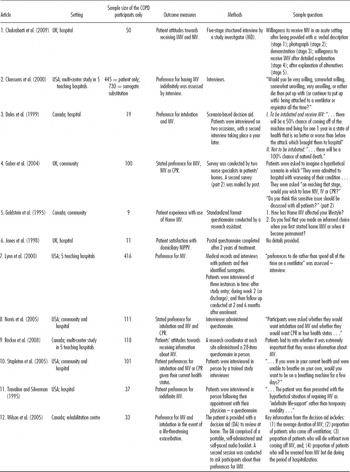
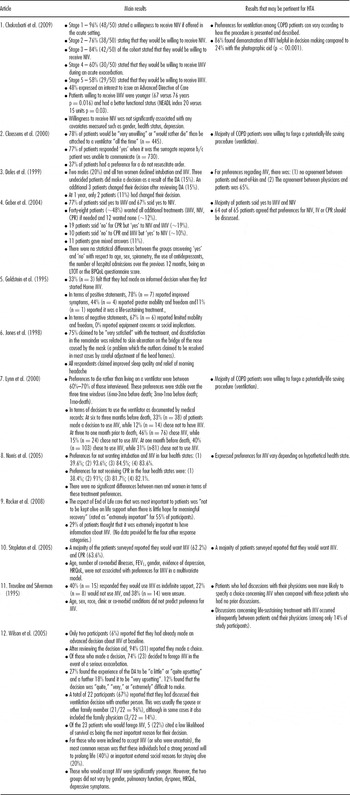
Identified studies were selected based on title and abstract by two authors independently (A.B. and S.C.). Full articles were retrieved if a decision could not be made based on the abstracts. The same authors (A.B. and S.C.) independently extracted data from each study into tables (Tables 1 and 2). Any disagreements were resolved by discussion or consensus with a third party (M.K.).
Summary of Study Methods

Summary of Key Results and Implications for HTA

Analysis
The heterogeneity among studies in terms of instruments and outcomes precluded the possibility of a meta-analytic strategy. Data were analyzed using narrative synthesis, appropriate when the studies are too dissimilar for meta-analysis. A narrative synthesis consists of organizing, describing, exploring, and interpreting study findings and attempting to find explanations for these findings (Reference Mays, Pope and Popay13).
RESULTS
Study Characteristics
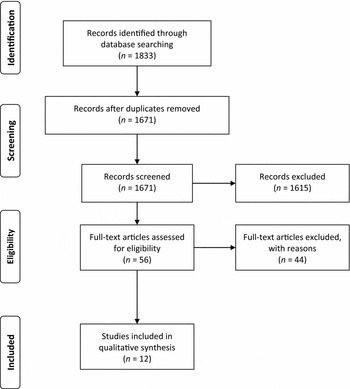
Among 1833 identified citations, twelve studies were eligible for data abstraction (Figure 1). These studies took place in a broad range of settings (Table 1, column 2): community (two studies); hospital (seven studies); community and hospital (two studies); and a rehabilitation center (one study).
PRISMA flow diagram.

The studies that satisfied the inclusion criteria generally focused on COPD patients’ preferences for ventilation (Table 1, column 4). Three studies measured patient attitudes toward either receiving information about MV, or discussing preferences concerning MV/CPR with their health care professional (Reference Chakrabarti, Sulaiman, Davies, Calverley, Warburton and Angus14–Reference Rocker, Dodek and Heyland16). Nine studies assessed patient's stated preferences for the MV intervention (Table 1). One study measured patient decisions regarding MV retrospectively, by means of patient medical record review (Reference Lynn, Ely and Zhong17). In addition, many of these studies provided additional details by exploring whether ventilation decisions vary by patient characteristics or by how the question was addressed to patients. Two studies did not pertain to patient preferences; as they queried patients who had received home ventilation about their views on the intervention (Reference Goldstein, Psek and Gort18;Reference Jones, Packham, Hebden and Smith19).
The questions that were posed to individuals about their preferences varied significantly from one study to another (Table 1, column 6). In some cases, patients were asked about their preferences for indefinite ventilation (“would you be willing, somewhat willing, somewhat unwilling, or rather die than put up with being attached to a ventilator all the time.”) (Reference Claessens, Lynn and Zhong20). In other cases, patients were asked about their preferences for being on a “breathing machine for a few days” (Reference Stapleton, Nielsen, Engelberg, Patrick and Curtis21). These are different hypothetical scenarios, one referring to a temporary use of ventilation, the other scenario suggesting indefinite dependence. One person with stable preferences may respond negatively to the first question, yet respond affirmatively to the second question. There is a further complication, as research has revealed that presenting individuals with exactly the same hypothetical situation, but with altered wording can produce different results (Reference Levin, Schneider and Gaeth22). For these reasons, we developed data extraction tables (Tables 1, and 2) that would be suitable for this type of research. Tables should show the pertinent preference-related questions, so that results can be properly interpreted and understood.
Study Findings
Key study results are summarized in Table 2.
Do COPD Patients Want to Discuss Their Prognosis and Possible Interventions?
Three studies explored whether COPD patients want to discuss preferences for MV, or Advanced Directives of Care (ADC). Rocker et al. (Reference Rocker, Dodek and Heyland16) found that only 29 percent rated it as extremely important to know about mechanical ventilation. Another study found that 48 percent of study participants were interested in issuing an ADC (Reference Chakrabarti, Sulaiman, Davies, Calverley, Warburton and Angus14). In contrast, a UK study found that 98 percent of respondents thought that the sensitive issue of preferences for NIV, IMV (Invasive Mechanical Ventilation), and CPR should be discussed with patients (Reference Gaber, Barnett, McGavin and Planchant15). It is worth noting that only Gaber et al. (Reference Gaber, Barnett, McGavin and Planchant15) had patient preferences elicited by a respiratory nurse who was responsible for coordinating the patients’ care needs; whereas, patients were queried about their preferences by study personnel in the previous two studies (Reference Chakrabarti, Sulaiman, Davies, Calverley, Warburton and Angus14;Reference Rocker, Dodek and Heyland16).
Proportion of COPD Patients Expressing Willingness to Use MV
Several studies elicited COPD patient preferences for MV (Table 2). The proportion of COPD patients who indicated that they would opt for MV varies widely across studies from approximately 22–77 percent (Reference Chakrabarti, Sulaiman, Davies, Calverley, Warburton and Angus14;Reference Gaber, Barnett, McGavin and Planchant15;Reference Lynn, Ely and Zhong17;Reference Claessens, Lynn and Zhong20–Reference Travaline and Silverman23). Note, however, that the respondents were asked very different preference-related questions.
Two studies used a comprehensive decision aid to elicit patient preferences concerning MV and intubation. They found that a majority of respondents were willing to forgo the intervention (60 percent to 74 percent) (Reference Wilson, Aaron and Vandemheen12;Reference Dales, O'Connor, Hebert, Sullivan, McKim and Llewellyn-Thomas24).
Proportion of COPD Patients Expressing Willingness to Use NIV
Only two studies on NIV preferences among COPD patients were identified for this review. A UK study found that approximately 67 percent of their respondents were willing to receive NIV if “admitted to hospital with worsening of their condition” (Reference Gaber, Barnett, McGavin and Planchant15). Another UK study in a hospital setting reported that 76 percent to 96 percent of COPD patients were willing to receive NIV if offered in the acute setting (Reference Chakrabarti, Sulaiman, Davies, Calverley, Warburton and Angus14).
Predicting Preferences for MV and NIV among COPD Patients
Six studies tested associations between patient preferences for ventilation and covariates (Reference Norris, Nielsen, Engelberg and Curtis11;Reference Wilson, Aaron and Vandemheen12;Reference Chakrabarti, Sulaiman, Davies, Calverley, Warburton and Angus14;Reference Gaber, Barnett, McGavin and Planchant15;Reference Stapleton, Nielsen, Engelberg, Patrick and Curtis21;Reference Travaline and Silverman23). None of the variables that were tested showed a consistent association with preferences for MV across all or even most studies. No associations were found between patient preferences for NIV and any measured covariate (Reference Chakrabarti, Sulaiman, Davies, Calverley, Warburton and Angus14;Reference Gaber, Barnett, McGavin and Planchant15) One study, albeit with a small sample size (n = 19) compared patient preferences with the ventilation decisions that would be made by the patient's physician or family member (Reference Dales, O'Connor, Hebert, Sullivan, McKim and Llewellyn-Thomas24). Agreement between patient preferences and physician was low (65 percent) and even lower between patient and next of kin (0 percent).
Patient Preferences Regarding MV for Serious Illness Situations
An American study explored COPD patient preferences for intubation and MV under different hypothetical health states (Reference Norris, Nielsen, Engelberg and Curtis11). Only a minority of COPD patients (31 percent) stated that they would reject intubation and MV in their current health state. However, when asked about intubation and MV in situations of permanent coma, dementia or bed-bound, the percentage of participants rejecting the intervention was: 94 percent, 85 percent, and 84 percent, respectively.
The Issue of “Framing” and Patient Preferences for IMV and NPPV
One study elicited preferences – a multi-stage interview (Reference Chakrabarti, Sulaiman, Davies, Calverley, Warburton and Angus14). They found that following a verbal description, 96 percent of study participants expressed a willingness to receive NIV. However, when shown a photograph, the percentage dropped to 76 percent and after receiving a demonstration, it was 84 percent. In terms of IMV, 60 percent were willing to receive the intervention following a verbal description. This decreased to 58 percent when patients were given an explanation of alternative treatments to IMV.
Decision Aids: Stressful for COPD Patients?
One study provided greater detail about the decision-making process by asking participants whether working through a decision aid was stressful (Reference Wilson, Aaron and Vandemheen12). Although 55 percent of respondents found that “working through the decision aid” was “not at all upsetting,” some patients found it “a little” (Reference Goldstein, Psek and Gort18 percent), “quite” (9 percent) or “very upsetting” (18 percent). In addition, five individuals (15 percent) completed the first interview but declined to take part in the follow-up, and of these, three “specifically indicated that they had been upset by the content of the decision aid”.
COPD Patient Satisfaction with MV, NIPPV in the home
Two studies explored the experiences of COPD patients postventilation (Reference Goldstein, Psek and Gort18;Reference Jones, Packham, Hebden and Smith19). Unfortunately, these two studies have considerable limitations: small sample sizes (n = 9 and n = 11, respectively) and the absence of a comparison group.
Brief Summary and Synthesis
These results indicate that: (i) a substantial proportion of COPD patients are willing to forgo a life-saving procedure (e.g., MV); (ii) expressed preferences among COPD patients for ventilation are not always fixed but can be contingent on the hypothetical situation that is presented to them and on how the intervention is described; (iii) a majority of COPD patients are willing to try NIV; (iv) it is difficult to predict those COPD patients who are willing to receive either IMV or NPPV based on demographic or clinical data, or by speaking to their physician or next of kin; and (v) not all patients want to discuss MV.
Additional insights can be obtained by briefly synthesizing some key themes across studies. Careful scrutiny of the preference-related question indicates that studies that asked patients about MV as “indefinite life-support” (Reference Travaline and Silverman23) or for “all the time” (Reference Lynn, Ely and Zhong17;Reference Claessens, Lynn and Zhong20) had few responding affirmatively (approximately 22–40 percent), whereas studies that asked respondents whether they would be “willing to receive” the intervention (Reference Chakrabarti, Sulaiman, Davies, Calverley, Warburton and Angus14;Reference Gaber, Barnett, McGavin and Planchant15) or willing to be on a machine “for a few days” (Reference Stapleton, Nielsen, Engelberg, Patrick and Curtis21) had approximately 58–77 percent responding affirmatively. Although these comparisons are across studies and with different individuals, this suggests that for many patients this unpleasant procedure may be tolerated for a short period of time but would not be chosen if the procedure is indefinite. The results suggest that health care professionals need to be mindful about how they pose these questions to their patients, because framing these questions in different ways may result in patients offering different responses. Patient preferences may be best elicited through a conversation in which a few different hypothetical situations can be described with patients, and in which possible time frames for the procedure are carefully described.
The results of these studies indicate that some patients do not want to discuss sensitive issues such as preferences for MV or ADCs. Furthermore, for some individuals working through a decision aid was upsetting. However, it is interesting that the one study in which preferences were elicited from a respiratory nurse who was responsible for coordinating the patients’ care needs had 98 percent of respondents who thought that the sensitive issues of preferences for NIV, IMV, and CPR should be discussed. This suggests that preference-related discussions might be best addressed within the context of an established health care relationship.
DISCUSSION
Implications for Preference-Related Data within HTA
We found that it is indeed feasible to conduct a systematic review of quantitative preference-related evidence for an HTA topic and that it yields substantial insights beyond conventional evidence reviews and CEAs. Although effectiveness studies indicate whether an intervention is effective (or contributes favorably to QoL), they do not provide any indication of how many patients will opt for the procedure. By contrast, quantitative preference-related data are particularly useful for understanding the acceptability of an intervention among patients across a range of settings, countries, and based on a range of different questions. There are several other methods that can be used to understand patient preferences, such as patient representation on HTA committees, or qualitative research. However, quantitative research generates data with the most breadth, thus particularly useful for estimating the patient acceptability of an intervention across an entire population.
This evidence could be used to inform purchasing decisions. For instance, if one must decide between two technologies of equivalent effectiveness, then choosing the technology that more patients prefer can optimize patient outcomes.
This type of review has other advantages. It can sensitize readers to the importance of patient preference within the policy domain and at the level of the patient-physician interaction. For physicians who may read such evidence (within an HTA), it can reaffirm the importance of soliciting their patients’ preferences and provide suggestions about how to pose these difficult questions to their patients. For patients, understanding the treatment choices made by others who share their illness, enhances patient knowledge and can thus be empowering.
The process of conducting this preference-related case study also revealed several methodological challenges. We found that the taxonomy was inconsistent across studies. Some researchers used the word “preferences,” while others used terms such as “attitudes toward . . .” when referring to the same construct. Developing appropriate searches is further complicated by the highly varied study designs in this area. For instance, research using discrete choice experiments in which COPD patients are asked about their least and most favorite clinical and social outcomes clearly has implications for their preferences for ventilation, but this research was excluded for this review because it did not satisfy our inclusion criteria as ventilation was not specifically addressed. In addition, although we found many articles associated with patient preferences, our search revealed fewer articles that related to other types of patient perspective research. But “patient perspectives” is an amorphous area with unclear boundaries. Researchers choosing to expand the search on topics related to patient perspective could do so easily; for instance, by including research that investigates the social and psychological consequences of using the intervention.
In addition, we found that the studies in this review used nonstandardized questionnaires and posed different types of preference-related questions. Therefore for this type of evidence, a meta-analytic approach is not ideal. However, a narrative synthesis is appropriate, because in this case, these differences in questions and answers can be analyzed and interpreted, rather than simply ignored and averaged out (as in meta-analysis). Because the primary purpose of this study was to understand how this literature might inform the HTA process, we did not perform an extensive, critical appraisal of the research literature, However, to conduct a critical appraisal of this type of literature, a checklist of items would have to be developed (e.g., response/drop-out rates, validity of measures) and evidence would be judged based on the quality score of each research article. By contrast, systematic reviews of the effectiveness of a technology can typically exclude a large number of studies (e.g., those that are not RCTs). For all of these reasons, a systematic review of the preference literature is messier and likely more time consuming than a traditional, systematic review of effectiveness. Due to these challenges and disadvantages, we do not recommend a systematic review of preference-related data to be appropriate as a routine part of the HTA process. However, we do suggest that it is a promising addition to the HTA process, for preference-sensitive technological decisions and in particular, if some of these methodological challenges are sorted out.
In light of the considerations presented above, we suggest that the area of patient perspectives, preferences, attitudes, and values would benefit from further conceptual and taxonomic work that specifies the conceptual distinctions and commonalities of terms. There is a broad range of terms (preference, quality of life, satisfaction, values, choices, utility), which emanate from different academic disciplines (e.g., economics, psychology, nursing) and/or specific research methods (e.g., qualitative research, conjoint analysis). Identifying all of these terms and understanding the areas of difference and overlap will be a major undertaking, but will be extremely useful when seeking to integrate patients’ perspectives into HTA.
SUPPLEMENTARY MATERIAL
Supplementary Table 1: www.journals.cambridge.org/thc2013119
CONTACT INFORMATION
Ann-Sylvia Brooker, PhD, MSc (as.brooker@utoronto.ca) THETA (Toronto Health Economics and Technology Assessment) collaborative, University of Toronto, Toronto, Ontario, Canada
Steven Carcone, MSc THETA collaborative, University of Toronto, Toronto, Ontario, Canada
William Witteman, BSc., MLIS THETA collaborative, University of Toronto, Toronto, Ontario, Canada
Murray Krahn, MD, MSc, FRCPC Director of THETA collaborative, F. Norman Hughes Chair in Pharmacoeconomics, Social and Administrative Pharmacy Division Head in the Faculty of Pharmacy, Professor at the University of Toronto, Scientist at Toronto General Research Institute; Adjunct Scientist at the Institute for Clinical Evaluative Sciences
CONFLICTS OF INTEREST
All authors report they have no potential conflicts of interest.