Introduction
The shift from egalitarian to so-called complex societies in the ancient Near East has been extensively studied. Many scholars have linked the rise of social and economic elites to changes in food storage and distribution practices—specifically, the control of fertile land and the ability to organise large-scale storage (Childe 1951; Wright Reference Wright1977; Postgate Reference Postgate1992; Rothman Reference Rothman2001; Pfälzner Reference Pfälzner, Al-Gailani Weer, Curtis, Martin, McMahon, Oates and Reade2002). While many published papers address the theoretical aspects of social evolution, archaeological support for claims made is scarce (e.g. Testart Reference Testart1982; Ingold Reference Ingold1983; Hayden Reference Hayden1990; Bartl Reference Bartl2004; Bogaard et al. 2009; Lull et al. Reference Lull, Micó, Rihuente Herrada, Risch, Meller and Bertemes2010).
This lack of archaeological support, especially at the crucial transition from the Late Pottery Neolithic/Early Chalcolithic period to the Late Chalcolithic period (c. 5300–4600 cal BC), can be explained by difficulties in identifying, documenting and analysing the scale and detailed characteristics of storage in the archaeological record. The identification of storage scale is dependent on various lines of evidence. These include specific construction (subterranean or free-standing structures), intra-site spatial association of corresponding artefacts and, most importantly (yet very elusive), the presence of grain or organic residues that may represent accumulated surpluses. Storage installations are well documented in the archaeological record of the ancient Near East. Although arguments have been made for storage bins and other small storage facilities during the Late Epipalaeolithic (e.g. Bar-Yosef Reference Bar-Yosef1998), storage facilities appear more frequently in the Pre-Pottery Neolithic period. There is strong evidence for centralised, probably community-based, storage dating to the Pre-Pottery Neolithic A, and for later storage rooms and installations in some Pre-Pottery Neolithic B sites (e.g. Kuijt Reference Kuijt, Bocquet-Appel and Bar-Yosef2008, Reference Kuijt and Finlayson2009; Kuijt & Finlayson Reference Kuijt and Finlayson2009), reflecting the development of early agricultural communities in this area.
The archaeological record in the Near East has frequently yielded evidence for small-scale Neolithic household-based storage. Direct indications of large-scale, centralised storage are, however, rare, and usually associated with the Early Bronze Age and later periods (e.g. Mazar Reference Mazar and Wolff2001; Milevski et al. Reference Milevski, Braun, Verga, Israel, Bieliński, Gawlikowski, Koliński, Ławecka, Sołtysiak and Wygnańska2014; Golani & Yannai Reference Golani and Yannai2016). Moreover, ethnographic evidence for ritual and symbolic behaviour pertaining to large-scale storage (e.g. Flam Reference Flam1976) was, until recently, barely addressed by scholars working in the southern Levant.
Research on the Tel Tsaf grain silos has already prompted discussion regarding large-scale storage and its significance during the Neolithic–Chalcolithic transition in the Levant (Garfinkel et al. Reference Garfinkel, Ben-Shlomo and Kuperman2009). A new find, discovered during renewed excavations at Tel Tsaf in 2014, adds important evidence to this discussion. The object, a small clay model of a silo found within a structure in which many silos and two associated burials were located (Garfinkel et al. Reference Garfinkel, Ben-Shlomo and Kuperman2009), suggests a possible reconstruction for the enigmatic superstructure of the silos at the site, and offers unprecedented evidence for storage symbolism.
These lines of evidence reflect a vivid image of the mundane and profound attributes of grain storage during the Middle Chalcolithic period, and the link with burials and symbolic behaviour as part of the rituals ensuring the success of crops and the harvest and protecting the stored yields.
Tel Tsaf
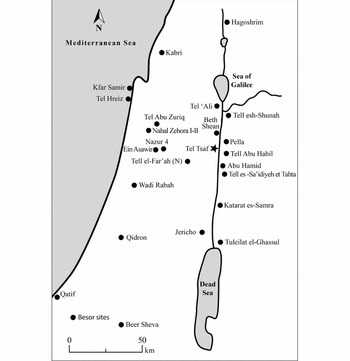
Tel Tsaf, located in the Central Jordan Valley (Figure 1), has been known since the 1940s. It consists of three low hills with a total size of around 5ha (Tzori Reference Tzori1958; Gophna & Sadeh Reference Gophna and Sadeh1988–Reference Gophna and Sadeh1989; Garfinkel et al. Reference Garfinkel, Ben-Shlomo, Freikman and Vered2007, Reference Garfinkel, Ben-Shlomo and Kuperman2009). The chronology of the upper strata of the site covers the period between c. 5200 and c. 4600 cal BC (Rosenberg et al. Reference Rosenberg, Klimscha, Graham, Hill, Weissbrod, Katlav, Love, Pinsky, Hubbard and Boaretto2014; Streit & Garfinkel Reference Streit and Garfinkel2015). This corresponds with the so-called Middle Chalcolithic period, bridging the ‘gap’ between the end of the Late Pottery Neolithic/Early Chalcolithic and the appearance of Late Chalcolithic settlements.
Map showing the location of Tel Tsaf and other Late Neolithic and Chalcolithic sites in the southern Levant.

Four excavation seasons (2004–2007) at Tel Tsaf uncovered approximately 800m2 and two superimposed layers. The total excavated area in both layers reached about 1500m2. Excavations revealed part of a mud-brick architectural complex, including many silos (in which mainly cultivated barley (Hordeum vulgare sp.) and wheat (Triticum sp.) were found—see Graham Reference Graham2014; Rosenberg et al. Reference Rosenberg, Klimscha, Graham, Hill, Weissbrod, Katlav, Love, Pinsky, Hubbard and Boaretto2014). Among numerous associated finds were some that demonstrate far-reaching contact between Tel Tsaf and Syria, Mesopotamia, Anatolia and Iran. These include the earliest metal object (a copper awl) found in the southern Levant, obsidian items, Ubaid-style pottery, sealings and seals (Garfinkel et al. Reference Garfinkel, Ben-Shlomo, Freikman and Vered2007, Reference Garfinkel, Ben-Shlomo and Kuperman2009, Reference Garfinkel, Klimscha, Shalev and Rosenberg2014; Rosenberg et al. Reference Rosenberg, Klimscha, Graham, Hill, Weissbrod, Katlav, Love, Pinsky, Hubbard and Boaretto2014). A single Nilotic shell was also noted.
Four burials were uncovered in the later strata of Tel Tsaf, all directly associated with silos (Garfinkel et al. Reference Garfinkel, Ben-Shlomo and Kuperman2009).
Burial C98 (building CI): an adult individual, aged 20–30 years at death, buried under the floor of a courtyard located adjacent to Silo 74.
Burial C555 (building CI): an adult female, aged approximately 30 years at death, was found in the centre of Silo 339. The grave was dug into the abandoned silo, cutting through the collapsed superstructure and the thick, paved mud-brick floor.
Burial C310 (building CII): a jar burial containing a neonate, found under the floor of a courtyard, located adjunct to Silo 272.
Burial C518 (building CIV): the grave of a two-year-old infant was discovered inside Silo 582. The silo comprised sequential building phases. The interment occurred early in the sequence, with a new silo later constructed above the burial.
The clay silo model
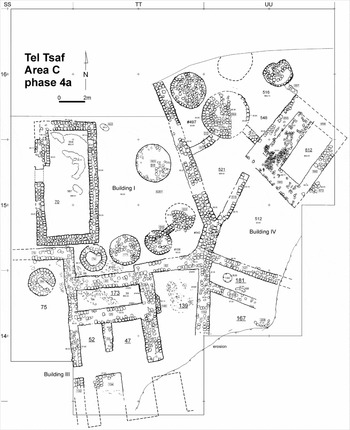
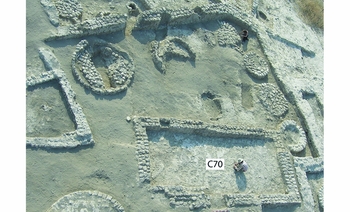
The fragmented clay silo model was found in Room C70, a rectangular structure located in the western part of building CI, in area C (Figure 2). Building CI is a courtyard building (Figure 3), characterised by a large open courtyard that features a series of circular silos and many cooking installations (e.g. hearths, ovens and roasting pits). The abundance of excellently preserved floral and faunal remains recovered from this area attests to the richness of the local diet and economy (Horowitz Reference Horowitz1988–Reference Horowitz1989; Liphschitz Reference Liphschitz1988–Reference Liphschitz1989; Ben-Shlomo et al. Reference Ben-Shlomo, Hill and Garfinkel2009; Hill Reference Hill2011; Garfinkel et al. Reference Garfinkel, Klimscha, Shalev and Rosenberg2014; Graham Reference Graham2014; Rosenberg et al. Reference Rosenberg, Klimscha, Graham, Hill, Weissbrod, Katlav, Love, Pinsky, Hubbard and Boaretto2014).
Area C following the 2007 excavation season.

Building CI and Room C70 following the 2007 excavation season.

Two main stratigraphic phases were identified in this area. In the earlier phase there were four equidistant silos of identical size, between which was a stone courtyard floor comprising medium-sized angular pebbles. This floor was covered by burnt debris containing large patches of charred wood (Garfinkel et al. Reference Garfinkel, Ben-Shlomo and Kuperman2009). Burial C98 was found in the south-western corner of the courtyard, adjacent to Silo 74.
In the later phase, the courtyard contained four silos. These were larger in diameter than their predecessors, probably reflecting increased storage capacities. In the centre of Silo 339, a concentration of eight large stones (one of these found semi-erected) covered the grave of a female (burial C555). This individual had 1668 beads placed on the anterior part of her pelvis, and a copper awl was recovered from the fills above the body (Garfinkel et al. Reference Garfinkel, Ben-Shlomo and Kuperman2009, Reference Garfinkel, Klimscha, Shalev and Rosenberg2014). Two female figurines were found in building CI. These were recovered from debris above the floor, between two nearby silos. The figures were probably placed intentionally near to, or hung on, the silos. When building CI was abandoned, the figures were left inside. Furthermore, concentrations of gazelle horn cores were discovered near the southern wall of building CI (Hill Reference Hill2011: 215).
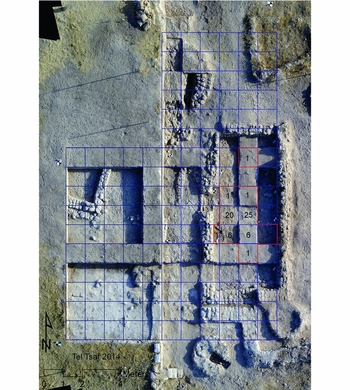
The clay model was found broken into 65 pieces (a few fragments are still missing), scattered over 9.5m2 (Figure 4), and was later restored. It was discovered in the fill accumulated upon what seems to be the earliest floor of Room C70 (locus 865), a context which should probably be associated with the lower phase (C4) noted during Garfinkel's excavations. The majority of fragments were found in front and slightly south-east of the room's entrance. A few fragments and clay balls (see below), however, were found in association with a hearth, north of the room's centre. The only published radiometric date for Room C70 derives from a barley grain retrieved from a surface in the southern part of the room (locus C735). This sample (RTD-7240) was dated to 5211–4987 cal BC (Rosenberg et al. Reference Rosenberg, Klimscha, Graham, Hill, Weissbrod, Katlav, Love, Pinsky, Hubbard and Boaretto2014). The proximity of the clay vessel to the sample, and its stratigraphic position above the lower floor of Room C70, suggest that the vessel and sample are contemporaneous. New unpublished dates from this room mostly fall within this range.
Room C70 and the location of the clay silo model fragments found during the 2014 excavation season (the numbers represent the quantity of clay silo model shards found in each sub-square).

Room C70 yielded many finds. These included a chalk pedestal bowl (in which the bowl was deliberately chipped off, leaving only the base) that was buried upside-down beneath a plaster floor in the doorway; two anthropomorphic miniature clay figurines and another part of a larger figurine; a seal; a quartzite dagger fragment; a small, elongated wooden tool; and many beads and obsidian items. Most of the obsidian items are debitage, but a concentration of eight beads was also recovered in the north-western corner of the room. Flint tools and waste, a few ground stone tools and bone tools were also found. Decorated pottery sherds characteristic of Tel Tsaf (including the ‘Tel Tsaf’-style decoration) were recovered. In the southern area of the room, fragments of large storage jars were found. While faunal remains were not prevalent here (Hill Reference Hill2011), Room C70 yielded a plethora of floral remains, both in terms of quantity and the number of species (e.g. Graham Reference Graham2014; Rosenberg et al. Reference Rosenberg, Klimscha, Graham, Hill, Weissbrod, Katlav, Love, Pinsky, Hubbard and Boaretto2014).
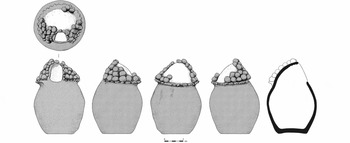
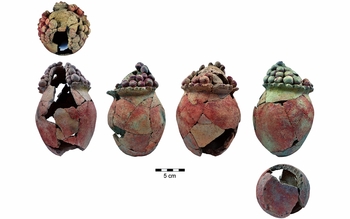
The silo model is a closed vessel (Figures 5 & 6) that resembles an elongated, bag-shaped jar with a dome-shaped top. The fabric is characterised by its light colour and well-levigated paste, characteristics of many of the vessel fragments found at the site. The upper part of the vessel was clearly made by the coil technique, and it is apparent that the model was manufactured in two main parts (upper and lower). The vessel is 200mm tall, with a diameter varying between 70mm at the base to 134mm in the widest part and around 50mm near the top part. The wall thickness ranges from 4–6mm to 101–150mm at the base. The volume is estimated at approximately 1.1–1.4L.
The clay silo model.

Six views of the clay silo model.

The base was slightly pressed, creating a concave exterior and a somewhat bulging interior. The vessel widens from the base to a maximum diameter at around mid-height and narrows again towards its upper part, terminating in a dome-shaped top. Approximately 75mm below the vessel top, a horizontal shelf with a width of 5–15mm was applied to the wall. This encircled the vessel, except at the bottom of the opening. The shelf thickens where it attaches to the vessel wall. The shelf edge is decorated with ‘spikes’ that have a wavy outline. This resembles the ‘thumb-impressed’ handles of the later ‘pie-crust’ rims. These ‘spikes’ protrude approximately 2–4mm from their base.
The dome-like area above the shelf is covered by modelled clay ‘balls’, some of which were placed around the uneven but mostly rounded rim of the rectangular opening (which measures about 54 × 32mm); others formed the first row of balls above the shelf. The remaining balls were positioned in a less organised fashion, filling the rest of the open surface of the dome-shaped upper part. Upon discovery, 40 balls were attached to the vessel. Twenty-two more were found in various locations in Room C70, broadly reflecting the distribution of the vessel fragments. The clay balls are round to oval in shape (some were slightly pressed in order to attach them to the vessel); some resemble the shape of an olive pit. The balls occur in two size ranges: small balls that are mainly placed around the rim, and larger ones that fill the rest of the area (the average length, width and weight are 150mm, 120mm and 2.7g, respectively).
The vessel's outside wall and the majority of the balls were painted red, although the paint is not evenly preserved. The red paint was probably applied to a white cream slip. It was clearly added after the balls were attached, as a white cream surface is visible in places where they are missing. In one location, several vertical cut marks were made before application of the red paint. A small area on the outside wall bears soot marks. No paint was applied to the inner wall.
As no similar vessels have been found in the Levant to date, our interpretation of the vessel as a silo model is based upon other lines of evidence. Most prehistoric building models are rectilinear. At Tel Tsaf, the clay silo model and the silos in building CI (and in the other buildings in area C) are round. The only opening on the model is situated on the upper part of the wall. It faces sideways, rather than up, as is the case in most Levantine clay receptacles. The position of the opening on the upper part of the model further supports our argument. Examples from different countries and time periods show similar silo models with high openings (e.g. Currid Reference Currid1985; Morris & Papadopoulos Reference Morris and Papadopoulos2004), while most house models have openings at the ground level (e.g. Garstang et al. Reference Garstang and Fitzgerald1936; Broman Morales Reference Broman Morales, Braidwood, Braidwood, Howe, Reed and Watson1983, Reference Broman Morales1990; Gallis Reference Gallis1985). The location of the clay silo model in a building that was used for intensive storage (building CI) also presents corroborating evidence. While the round clay balls are a prominent feature of the silo model, interpretation of their symbolic meaning is challenging. Tentatively, they could represent bread loaves, sacks of grain awaiting storage, unidentified foods or objects, or animal dung drying on the silo roof (for examples of dung cakes attached to mud-brick walls in Fayum, Egypt, see Cappers & Neef Reference Cappers and Neef2012: fig. 43).
Discussion
Storage in the context of late hunter-gatherer communities and early farmer settlements of the Near East has been previously discussed (e.g. Kuijt Reference Kuijt, Bocquet-Appel and Bar-Yosef2008, Reference Kuijt2009), as this topic is frequently linked to delayed consumption and risk management. Due to a lack of supporting archaeological evidence, however, few discussions have addressed storage symbolism and its implications for understanding early Near East farming communities. Given the strong evidence for intensive storage in round mud-brick silos at Tel Tsaf, it is unsurprising to find an example of such symbolism at this site.
The Tel Tsaf silos fit well with the universal principles that have guided the construction of these installations worldwide (Currid Reference Currid1985: 104–109; Beedle Reference Beedle2001). These principles can be seen on different scales, from the individual farm storing a few tonnes of grain to large harbour installations that handle millions of tonnes each year:
-
• A cylindrical shape. This better withstands the pressure of the grain by distributing stress evenly onto the sides of the silo, rather than onto the base or corners of a rectilinear shape. A rounded wall requires less building material than rectilinear walls confining an equivalent space.
-
• A number of silos are built in close proximity. It is easier to handle storage in a number of smaller silos than in one large installation, making it possible to store grain from different years, or different crops, separately. In the case of spoilage by fire, humidity, rodents or insects, not all of the stored material will be affected.
-
• Silo organisation in rows, adjacent to each other, optimising their arrangement within a confined space.
-
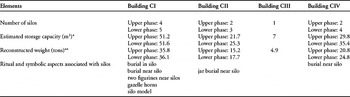
• The extent of grain storage at Tel Tsaf (particularly that of building CI—see Table 1) attests to a function far beyond risk management. Rather, the storage was probably related to the accumulation of wealth by the community, or by specific sections of the community.
Storage in different buildings in area C at Tel Tsaf (based on Garfinkel et al. Reference Garfinkel, Ben-Shlomo and Kuperman2009).

* Height of silo reconstructed as its diameter; **700kg/m3.
The discovery of the clay silo model, with its direct link to storage, allows the symbolism associated with the burials and storage to be considered as a whole. Moreover, the silo model enables a tentative reconstruction of the Tel Tsaf silos’ superstructures (round, upright structures with dome-shaped roofs and a hatch located on the upper part of the wall) and, by deducing the diameter–height proportions, their size. The location of the opening also suggests that the Tel Tsaf silos were probably filled from the top. Thus, the operation of the silos with regard to grain management can also be reconstructed.
Architectural models—objects representing some form of reality, even in an abstract way (Katz 2016: 1)—are a well-known phenomenon in the archaeological record. Clay models are documented from the early Near East and from later periods in south-eastern Europe, Cyprus and the Near East (e.g. Garstang et al. Reference Garstang and Fitzgerald1936; Reisner & Smith Reference Reisner and Smith1955; Smithson Reference Smithson1968, Reference Smithson1969; Gimbutas Reference Gimbutas1982; Broman Morales Reference Broman Morales, Braidwood, Braidwood, Howe, Reed and Watson1983, Reference Broman Morales1990; Gallis Reference Gallis1985; Bolger & Peltenburg Reference Bolger, Peltenburg and Peltenburg1991; Özdoğan et al. Reference Özdoğan, Mikaye and Dede1991; Hansen et al. Reference Hansen, Toderas, Wunderlich, Raeck and Steuernagel2012; Katz 2016). These mostly represent rectangular or square structures, rather than cylindrical, jar-like silos with roof-placed openings (Bretschneider Reference Bretschneider1991; Muller Reference Muller2002).
Clay models of silos are recorded in much later contexts and are depicted, for instance, in later wall paintings from Egypt (e.g. Currid Reference Currid1985: fig. 2; Morris & Papadopoulos Reference Morris and Papadopoulos2004: fig. 11.2). Models of granaries are known from prehistoric sites in Greece and the Balkans; for instance, engraved on a steatite stone from Melos, with a concentration of rounded towers organised around an open courtyard (Marinatos Reference Marinatos1946; Buchholz & Karageorghis Reference Buchholz and Karageorghis1973).
Connections between storage and symbolism have been regularly suggested in archaeological discourse (e.g. Childe Reference Childe1950; Mazar Reference Mazar and Wolff2001; Greenhut Reference Greenhut2011), and are documented ethnographically (e.g. Prussin Reference Prussin1972). Nevertheless, recent archaeological studies have demonstrated a great variability in storage types, and suggest variation in the social and economic relevance of food storage (e.g. Earle & D'Altroy Reference Earle, D'Altroy, Ericson and Earle1982; Pfälzner Reference Pfälzner, Al-Gailani Weer, Curtis, Martin, McMahon, Oates and Reade2002; Bartl Reference Bartl2004; Bogaard et al. Reference Bogaard, Charles, Twiss, Fairbairn, Yalman, Filipović, Demirergi, Füsun, Russell and Henecke2009; Paulette Reference Paulette2015). This socio-economic variation may relate to the complexity of the symbolic apparatus pertaining to storage and related topics, such as crop yields, successful harvests and the preservation of grain from the previous year.
To interpret the Tel Tsaf model silo, it is important to consider its archaeological context. It must be seen as part of the courtyard building where it was found—a large structure dominated by silos and clay sealings that were probably used to seal the silo hatch. Most of the model fragments were found in a small area of Room C70, which was surrounded by silos. Fragment location demonstrates that the model was used, placed and ultimately destroyed in this constrained area of the room. Its use within an area designated as a place for storing surplus or excess production hints at a connection between the vessel and grain storage in the silo. The vessel should, therefore, be understood as forming part of a ritual connected with the yearly harvest and its counting and storage. Consequently, the model should have been laden with symbolic content and used in a related ritual. If this interpretation is correct, then the vertical cutting marks noted above could represent intentional damage and later repair, as the vessel was painted only after it had been damaged.
The Tel Tsaf model prompts a range of questions, and justifies a reconsideration of the significance of southern Levantine storage during this time span. While clearly smaller, the model resembles a unique type of Late Chalcolithic burial jar or ‘urn’ in its morphology and placement of the opening (e.g. Perrot & Ladiray Reference Perrot and Ladiray1980; Goren Reference Goren, Goren and Fabian2002). These ossuary jars are characterised by the location of the opening on the upper side of the vessel (facing sideways), and not at its maximum height, as is usual with pottery vessels (where the opening faces upwards). The tops of ossuary jars were, however, modelled in a rounded, dome-like shape, ending with a mushroom-like crown that is absent from the Tel Tsaf vessel. It has been suggested that these vessels imitate silos (Dunand Reference Dunand1973; see also Katz Reference Katz2006). Silos with dome-like roofs and a mushroom-like crown are known, but only from significantly later contexts, found on cylinder seals from the Uruk culture (Amiet Reference Amiet1972).
The connection between silos and burials in the slightly later Late Chalcolithic period has been further developed by Bar-Yosef and Ayalon (Reference Bar-Yosef and Ayalon2001) in relation to Chalcolithic ossuaries. In the contemporaneous Chalcolithic (Énéolithique Récent) of Byblos, many primary burials were placed inside large silo jars of up to 1–1.5m in length (Dunand Reference Dunand1973). While the connection between the deceased and the storing of grain might be ambiguous in these cases, Tel Tsaf now offers stronger evidence: although no burial was recovered from Room C70 (where the model was found), a direct association between silos and burials is apparent in building CI. Here, two burials were found, one near the silos and another (C555) in a grave dug into a silo base. A copper awl, one of the earliest metal artefacts from the Levant, was found within the sediment covering this individual (Garfinkel et al. Reference Garfinkel, Klimscha, Shalev and Rosenberg2014). When considering the large occupation area uncovered at Tel Tsaf, it is clear that the burials were deliberately associated with the silos (also in Buildings CII and CIV); they were not placed under room floors—a common practice during the Neolithic period—or distributed in the large open courtyard. In two of the four examples, the silos built on courtyard floors were functioning while burials were located nearby. In another case, a grave was intentionally dug into a deserted silo.
The Tel Tsaf silos and the silo-associated burials are both exceptions to the rule within their supra-regional and time-specific contexts. Yet, the correlation of rich burials inside silos, the concentration of silos and sealings and the discovery of a non-functional vessel depicting a silo, all of which clearly reflect a ritual use, imply not only a connection between storage and the wealth of the deceased, but also a ritual accompanying the act of storing (ensuring the success of crops and the harvest, and protecting the stored yields) or the actual extraction of grains from the silos.
Questions concerning who executed that ritual and, therefore, who might have controlled the symbolic aspects and the ideology of grain storage, must remain unanswered for now. An emphasis on grain storage at Tel Tsaf could be understood not only as an early example of control over the means of production and large-scale storage. It may also represent an example of how storage, ritual and related storage symbolism occurred within the same context. This would transform our understanding of rituals entwined with accumulated harvest surpluses. The burials found in or near grain-storage structures could have been associated with myths and beliefs related to death and rebirth (see also Bradley Reference Bradley2003; Nativ Reference Nativ2008).
A similar notion could apply to the imposing display of grain storage in funeral rites of the Late Chalcolithic period. The reflection of new economic strategies in such vessels can now be traced back to the Middle Chalcolithic, and seem to be founded in their essential role in a community's survival and the beginning of the assertion of control over stored goods, agricultural yields and surpluses. This unprecedented evidence from Tel Tsaf in the Jordan Valley reflects an early direct connection between the production of food, its storage, redistribution and consumption, with symbolically charged and probably ritual activities during the later parts of the sixth millennium cal BC.
Acknowledgements
The mini silo was drawn by S. Haad and photographed by E. Gerstein. Graphic design was done by A. Regev. We are grateful to R. Shafir who conducted the restoration. We would like to thank S. Pinsky who supervised the work in Room 70, as well as our students and volunteers for all their help. We also thank R. Chasan for her comments. The renewed Tel Tsaf excavation is conducted under IAA license G-8/2015, and was generously supported by the Irene Levi-Sala CARE Foundation.