





Introduction
Helminth communities in birds are shaped by a complex interplay of host ecology, parasite life cycles and environmental constraints that act across spatial and temporal scales. Birds frequently serve as definitive hosts for trematodes, cestodes and nematodes whose development depends on 1 or more intermediate hosts, often molluscs, arthropods or fish. As a consequence, the realized distribution of avian helminths is determined not only by the presence of suitable definitive hosts but also by the availability of appropriate intermediate hosts and by abiotic conditions permitting completion of the life cycle. This decoupling between host presence and parasite establishment is especially pronounced in migratory birds, which can transport helminths across biogeographic regions without necessarily enabling their local reproduction (Bychovskaya-pavlovskaya, Reference Bychovskaya-Pavlovskaya1962; Bush et al., Reference Bush, Lafferty, Lotz and Shostak1997). Central Europe lies at the intersection of multiple avian migratory flyways and climatic gradients, making it a natural laboratory for studying the balance between locally reproducing helminths and parasites repeatedly introduced by migratory hosts. Reflecting this complexity, the trematodes that infect birds in Central Europe include cosmopolitan species, species that reproduce across Europe, and taxa that are restricted to southern breeding or wintering areas (Bychovskaya-pavlovskaya, Reference Bychovskaya-Pavlovskaya1962; Sitko et al., Reference Sitko, Faltýnková and Scholz2006; Sitko and Heneberg, Reference Sitko and Heneberg2021). However, this categorization is largely qualitative and rarely linked to quantitative population-level patterns within host assemblages.
The age structure of avian hosts provides a powerful but rarely utilized lens through which parasite establishment can be inferred. Young birds often differ from adults in diet, habitat use and migratory behaviour. In many species, pulli consume a broader range of invertebrates than adults do, even in predominantly granivorous taxa, which would predict greater exposure to trophically transmitted helminths early in life (Marchetti and Price, Reference Marchetti and Price1989; Wilson et al., Reference Wilson, Morris, Arroyo, Clark and Bradbury1999). Under a simple exposure-based model, one would therefore expect higher helminth richness or prevalence in first-year (1y) birds than in adults. Deviations from this expectation may signal constraints imposed by parasite longevity, environmental suitability or the absence of intermediate hosts.
The prevalence, abundance and intensity of infection, as defined by Bush et al. (Reference Bush, Lafferty, Lotz and Shostak1997), reflect partially independent biological processes (Rózsa et al., Reference Rózsa, Reiczigel and Majoros2000; Poulin, Reference Poulin2007). Prevalence captures the probability of infection, abundance integrates the probability of infection and parasite burden, and intensity reflects within-host processes occurring after successful establishment. For parasites that do not reproduce locally, these components are expected to show characteristic age- and season-dependent signatures. Short-lived trematodes acquired on wintering grounds or stopover sites may persist for weeks or months after arrival, leading to adult-biased prevalence early in the breeding season and rapid seasonal decline (Galaktionov and Dobrovolskij, Reference Galaktionov and Dobrovolskij2003; Okulewicz, Reference Okulewicz2014; Sitko and Heneberg, Reference Sitko and Heneberg2023). In contrast, long-lived species or taxa that reproduce locally should be detectable in 1y birds and exhibit weaker age effects. Despite these theoretical expectations, studies combining detailed individual-level parasitological data with modern statistical approaches to formally test whether age and seasonality can be used to discriminate between locally reproducing helminths and repeatedly imported taxa are lacking. No study has attempted to validate data-driven classifications against independent expert-based assessments of parasite life cycles and zoogeography.
In the present study, we analysed an extensive dataset of trematode infections in birds from Central Europe. We classified helminths into 3 operational categories based on their occurrence: parasites predominantly found in adults, parasites occurring in both age classes, and parasites showing strong seasonal effects. We then compared this empirical classification with an independent expert-based categorization of trematodes, based on known or inferred developmental stages, availability of intermediate hosts and parasite longevity. We tested the following hypotheses: First, helminths whose life cycles cannot be completed locally are expected to exhibit substantially higher adult-biased prevalence and abundance, reflecting acquisition outside the study area and persistence after migration. Second, helminths with local transmission are expected to occur in 1y birds and exhibit weak or absent age effects. Third, parasites with short-lived adult stages or strong environmental constraints should display pronounced seasonal patterns, independent of host age.
Materials and methods
Study area and study species
All analyses were based on lifelong parasitological examinations of birds collected within the Czech Republic (Central Europe) and conducted by the first author of the present study between 1962 and 2025. Each host bird was treated as a single sampling unit. Age was classified into 2 categories, 1y birds and adults, based on standard ornithological criteria recorded at necropsy. Only individuals with an unambiguous age assignment were included. The examination date was recorded for each individual and converted to a calendar month, serving as a proxy for seasonal environmental conditions.
Analyses and data-driven helminth categorization
Helminth data were analysed at the level of individual host–parasite combinations. For each bird, helminths were identified to the lowest available taxonomic level and counted. Taxonomic labels were standardized before analysis by correcting unambiguous spelling variants and currently recognized synonymous names. Records identified only to genus were retained as genus-level taxa, whereas records assigned only to higher taxonomic ranks were retained at the corresponding rank. When alternative spellings or synonymous labels referred to the same taxon within the same host species, these records were merged before calculation of prevalence, abundance and intensity. When the same taxon occurred more than once within an individual bird, its counts were summed to obtain a single abundance value for that host–taxon combination.
Only birds with an unambiguous assignment to either the 1y or adult age class and with a recorded examination date were retained for inferential analyses. The sampling date was converted to a calendar month. For each helminth taxon, prevalence was defined as the proportion of examined birds infected, abundance as the number of helminths per examined bird, including uninfected individuals, and intensity as the number of helminths per infected bird.
Age-specific prevalence differences were analysed using generalized linear models with a binomial error distribution and a logit link function. Host age class and sampling month were included as predictors, with month treated as a categorical variable. The exponentiated age coefficient was expressed as an odds ratio (OR) comparing adults with 1y birds. Values above 1, therefore, indicate higher odds of infection in adults. For descriptive comparisons of individual taxa and for the pooled life-cycle categories reported in Tables 2–4, 2-sided Fisher’s exact tests were additionally calculated directly from the age-specific infected and uninfected counts.
Helminth abundance was analysed using generalized linear models with a negative binomial error distribution and log link function. The response variable comprised parasite counts for all eligible birds, including zeros. Age class and sampling month, treated as categorical variables, were included as predictors. Exponentiation of the age coefficient yielded a rate ratio (RR) comparing the expected abundance in adults with that in 1y birds.
Infection intensity was analysed separately using negative binomial generalized linear models restricted to infected birds. These models, therefore, estimated age-related differences in parasite burden conditional on infection rather than differences driven by the frequency of uninfected hosts. Age class and categorical sampling month were included as predictors, and the exponentiated age coefficient was expressed as an adult-to-1y RR.
Inferential analyses of prevalence and abundance were restricted to taxa represented by at least 10 infected age-resolved birds with a recorded sampling month. Intensity models were fitted only when at least 15 infected birds were available, and both age classes were represented. These criteria were applied after taxonomic standardization and merging of synonymous or misspelt records.
For each response variable, age-effect P-values were adjusted across eligible helminth taxa using the Benjamini–Hochberg false discovery rate procedure. Month effects were evaluated jointly by comparing the model containing categorical month with the corresponding reduced model without month, and the resulting P-values were likewise adjusted separately for prevalence, abundance and intensity. The Benjamini–Hochberg false discovery rate (FDR)-adjusted q-value ≤0.05 was considered statistically significant.
Helminth taxa were assigned to 3 data-driven analytical categories according to the standardized rules outlined in Supplementary Table S1. Category A comprised taxa showing a statistically significant and pronounced adult-biased age effect, defined as an FDR-adjusted q-value ≤0.05 together with an adult-to-1y OR or RR of at least 3 in at least 1 of the 3 response variables. Category C comprised the remaining taxa showing a significant month effect in at least 1 response variable. Category B comprised taxa that met neither criterion. The classification was therefore based exclusively on the statistical age and seasonal patterns and was independent of the subsequent life-cycle and biogeographic classification.
The correspondence between the independent biological groups and the statistical Categories A–C was summarized using a cross-tabulation. Species-level age effects for the nonlocal biological groups were visualized as ORs with 95% confidence intervals; where a contingency-table cell contained zero, 0.5 was added to all 4 cells to calculate the plotted confidence interval. Monthly age-specific prevalence heatmaps were based on the number of infected/examined individuals within each month and age class.
Classification of trematodes based on the geographic distribution of their intermediate hosts
To interpret trematode occurrence in relation to host migration, we followed the classical ecological-geographic settings proposed by Dogiel (Reference Dogiel1947) and elaborated by Dogiel (Reference Dogiel1962), which groups helminths according to where transmission and development occur relative to the host’s annual cycle. Their approach distinguished: (i) ubiquitous cosmopolitan forms, whose development may proceed both on breeding and wintering grounds; (ii) ‘southern’ forms, acquired on wintering grounds, for which (depending on parasite longevity) individuals may die during migration or mature in the host on breeding grounds, and larger trematodes may persist throughout the breeding season; reinfection on breeding grounds is typically absent because suitable intermediate hosts are lacking or larval development is temperature-limited (e.g. in Postharmostomum gallinum, development may stop when temperatures fall below 20 °C; Groschaft et al., Reference Groschaft, Del Valle and Lorenzo Hernandez1969). Potential molluscan hosts occur locally and could theoretically sustain transmission, but establishment is most likely via introduction by migratory birds or by import of galliform poultry from subtropical regions (reported, for example, from turkeys; J. Sitko, pers. obs.); (iii) ‘northern’ forms, acquired on breeding grounds with transmission peaking in spring and summer and declining toward autumn; the life cycle does not proceed on wintering grounds. Intestinal ‘northern’ trematodes may persist for about 1 month and then gradually disappear after arrival at wintering grounds. In contrast, tissue-dwelling species (e.g. in kidneys, liver, air sacs or subcutis) may survive much longer and can persist until the host returns to breeding areas (e.g. Collyriclum faba detected in great reed warbler after arrival from wintering grounds; J. Sitko, pers. obs.); and (iv) migratory forms, acquired during migration. In inland birds, infection may occur along the sea coast, often with Microphallidae. These migratory forms do not develop on either breeding or wintering grounds, are very rare in the Czech Republic, and may persist only briefly in the definitive host. Our sampling of long-distance migratory waders was limited, and coastal-breeding individuals cannot be reliably distinguished from inland populations.
This scheme was applied in detail to birds by Bychovskaya-Pavlovskaya (Reference Bychovskaya-Pavlovskaya1962), who reviewed the trematodes of birds in the former Soviet Union and assigned them to these groups. Because life cycles were unknown for several rare or sporadically recorded taxa at the time, some placements were necessarily tentative and may be incorrect. We therefore used her synthesis as a starting point, but checked each genus against current information on life-cycle biology and the present-day distribution of intermediate hosts in the Czech Republic; where evidence remained insufficient, assignments were treated as provisional. We therefore categorized trematode species a priori based on their documented life cycles, the geographic distribution of intermediate hosts and known developmental constraints (Bychovskaya-Pavlovskaya, Reference Bychovskaya-Pavlovskaya1962; Galaktionov and Dobrovolskij, Reference Galaktionov and Dobrovolskij2003; Sitko et al., Reference Sitko, Faltýnková and Scholz2006; Sitko and Heneberg, Reference Sitko and Heneberg2021, Reference Sitko and Heneberg2023). Where species-specific information was available, it was also used to refine individual assignments or developmental constraints (e.g. Groschaft et al., Reference Groschaft, Del Valle and Lorenzo Hernandez1969). Genus-level assignments were used where supported by the available biological information. However, species-specific assignments or exceptions were retained where the evidence did not justify applying a single geographic classification to the entire genus.
To provide an independent biological comparison with the data-driven classification, trematodes were categorized a priori based on the geographic distribution of their transmission cycles, the availability of intermediate hosts and known developmental constraints. This classification was based on the ecological-geographic concepts developed by Dogiel (Reference Dogiel1947, Reference Dogiel1962) and Bychovskaya-Pavlovskaya (Reference Bychovskaya-Pavlovskaya1962), supplemented with more recent information on life cycles and the distribution of intermediate hosts in Central Europe. The underlying biological classification was established independently of the statistical age-effect results.
Four principal groups were distinguished (Table 1): (1) cosmopolitan trematodes capable of completing their life cycles across broad geographic regions; (2) taxa developing in marine, coastal or other European habitats but not normally completing their life cycles in the Czech Republic because suitable intermediate hosts or developmental conditions are absent; (3) taxa documented to complete their life cycles in the Czech Republic or the surrounding Central European region; and (4) taxa considered to be acquired primarily on wintering grounds in southern Europe or Africa. The latter classification included both genus-level assignments and species-specific exceptions where the available biological information did not justify assigning an entire genus to a single category.
A priori classification of trematodes according to the geographic distribution of their transmission cycles and intermediate hosts

Table 1 Long description
Columns are Species group, Note, and Examples, listing trematode taxa by where transmission cycles and intermediate hosts occur. Cosmopolitan species are noted as able to complete life cycles across broad regions including Central Europe, with examples including Apatemon gracilis, Diplostomum spathaceum, Echinostoma revolutum, and Prosthogonimus ovatus. European breeding or marine transmission, nonlocal in the Czech Republic, is described as developing at marine, coastal, or neighboring European sites but not normally completing life cycles in the Czech Republic, with marine or northern European genera including Cryptocotyle, Himasthla, Microphallus, Maritrema, Gymnophallus, Renicola, Sphaeridiotrema, Psilotrema, Paramonostomum, Notocotyloides, plus Psilochasmus oxyurus, and nearby freshwater or extraregional taxa including Philophthalmus, Metagonimus, Clinostomum complanatum, and Amblosoma exile. Species completing their life cycles in Central Europe are described as documented from non flying young birds or local intermediate hosts, with examples including Brachylaima, Leucochloridium, Trichobilharzia, Echinochasmus, Plagiorchis, plus Neodiplostomum spathoides, Pulvinifer macrostomus, and Collyriclum faba. Species associated with wintering grounds in southern Europe or Africa are described as acquired primarily on wintering grounds and not normally reproducing in Central Europe, with examples including Postharmostomum, Aporchis, Heterophyes, Ascocotyle, Euclinostomum, Orchipedum, and Echinostoma sudanense, and a note that some Brachylecithum species also belong here.
The classification was established independently of the statistical age and seasonal patterns and distinguishes cosmopolitan taxa, taxa with European or marine transmission not normally completed in the Czech Republic, taxa completing their life cycles in Central Europe and taxa associated primarily with wintering grounds in southern Europe or Africa. Genus-level assignments apply where justified by available biological information; species-specific exceptions were retained where an entire genus could not be assigned consistently to 1 category.
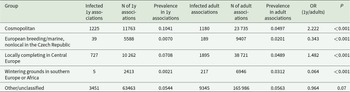
For analyses of age-specific prevalence within these independently defined groups, the standardized host–taxon records from Supplementary Table S2 were aggregated within each biological category. The resulting counts of infected and examined therefore represent summed host–taxon associations rather than unique birds, because an individual bird may contribute observations to multiple trematode taxa. Age-specific prevalence and juvenile-to-adult ORs were calculated from these aggregated counts using 2-sided Fisher’s exact tests (Table 2).
Age-specific prevalence of host–trematode associations grouped according to the a priori biogeographic and life-cycle classification in Table 1

Table 2 Long description
Age specific infection counts and prevalence are listed by Group, with columns for inf_juveniles, N_juveniles, prev_juveniles, inf_adults, N_adults, prev_adults, OR (juv/ad), and p. European breeding or marine, nonlocal in the Czech Republic has inf_juveniles 39 of N_juveniles 5588 with prev_juveniles 0.0070, and inf_adults 189 of N_adults 9407 with prev_adults 0.0201; OR (juv/ad) is 0.343 and p is less than 0.001. Locally completing in Central Europe has inf_juveniles 727 of N_juveniles 10262 with prev_juveniles 0.0708, and inf_adults 1895 of N_adults 38721 with prev_adults 0.0489; OR (juv/ad) is 1.482 and p is less than 0.001. Wintering grounds in southern Europe or Africa has inf_juveniles 5 of N_juveniles 2413 with prev_juveniles 0.0021, and inf_adults 217 of N_adults 6946 with prev_adults 0.0312; OR (juv/ad) is 0.064 and p is less than 0.001. Other or unclassified has inf_juveniles 3451 of N_juveniles 63463 with prev_juveniles 0.0544, and inf_adults 9345 of N_adults 165986 with prev_adults 0.0563; OR (juv/ad) is 0.964 and p is 0.07. P values are shown as less than 0.001 for four groups and 0.07 for Other or unclassified.
Infection counts and denominators were aggregated across host species within each biological group using the standardized analytical dataset. Inf_juveniles and inf_adults denote the summed numbers of infected host–taxon associations in first-year and adult birds, respectively; N_juveniles and N_adults denote the corresponding summed numbers of examined host–taxon associations. Because individual birds may contribute observations for more than 1 trematode taxon, these totals do not reflect the number of unique birds. Prev_juveniles and prev_adults are the corresponding prevalence estimates. OR (juv/ad) is the odds ratio from a 2-sided Fisher’s exact test comparing first-year birds with adults; values below 1 indicate lower prevalence in first-year birds and values above 1 indicate higher prevalence in first-year birds.
Tables 3 and 4 provide species-level analyses of the 2 groups whose life cycles were considered not to be completed locally. Table 3 contains taxa associated primarily with wintering grounds in southern Europe or Africa, whereas Table 4 combines qualifying taxa from marine, northern-European, extraregional European and southern wintering-ground transmission groups. Only species represented by at least 10 infected age-resolved birds in the standardized analytical dataset were included in these species-level tables. Species were selected solely based on the independently established biological classification and the minimum sample-size criterion, not on the observed direction or statistical significance of their age effect.
Age-specific prevalence of trematode species classified a priori as associated primarily with wintering grounds in southern Europe or Africa

Table 3 Long description
Age-specific infection counts and prevalence are listed for first-year birds and adults for six trematode species, along with the odds ratio comparing first-year birds with adults and the Fishers exact p-value. Ascocotyle (Phagicola) longa had inf_juv 1 of N_juv 356 with prev_juv 0.003, and inf_ad 28 of N_ad 800 with prev_ad 0.035; OR (juv/ad) 0.08 and p 0.000. Brachydistomum olssoni had inf_juv 0 of N_juv 80 with prev_juv 0.000, and inf_ad 46 of N_ad 182 with prev_ad 0.253; OR 0.00 and p 0.000. Brachydistomum salebrosum had inf_juv 0 of N_juv 80 with prev_juv 0.000, and inf_ad 11 of N_ad 182 with prev_ad 0.060; OR 0.00 and p 0.021. Brachydistomum ventricosum had inf_juv 0 of N_juv 126 with prev_juv 0.000, and inf_ad 46 of N_ad 2135 with prev_ad 0.022; OR 0.00 and p 0.109. Cercarioides aharonii had inf_juv 0 of N_juv 439 with prev_juv 0.000, and inf_ad 11 of N_ad 817 with prev_ad 0.013; OR 0.00 and p 0.011. Pegosomum asperum had inf_juv 2 of N_juv 18 with prev_juv 0.111, and inf_ad 36 of N_ad 62 with prev_ad 0.581; OR 0.09 and p 0.000.
Only species retained in the standardized analytical dataset and represented by at least 10 infected age-resolved birds were included. Inf_juv and inf_ad denote the numbers of infected first-year and adult birds, respectively, and N_juv and N_ad denote the corresponding numbers examined. Prev_juv and prev_ad are the age-specific prevalence estimates. OR (juv/ad) is the odds ratio from a 2-sided Fisher’s exact test comparing first-year birds with adults; values below 1 indicate lower prevalence in first-year birds and values above 1 indicate higher prevalence in first-year birds. The P column gives the corresponding 2-sided Fisher’s exact P-value. Species were included according to the a priori biological classification and minimum sample-size criterion, not according to the direction or statistical significance of the observed age effect.
Age-specific prevalence patterns of trematode species classified a priori as having nonlocal transmission cycles relative to the Czech Republic

Table 4 Long description
Species rows report infected counts and numbers examined for first year birds and adults, with prevalence for each age group, an odds ratio comparing first year birds to adults, and a Fisher exact p value. Ascocotyle Phagicola longa shows 1 infected of 356 first year birds with prevalence 0.003, and 28 of 800 adults with prevalence 0.035, odds ratio 0.08, p less than 0.001. Brachydistomum olssoni has 0 of 80 first year birds and 46 of 182 adults with prevalence 0.253, odds ratio 0.00, p less than 0.001; Brachydistomum salebrosum has 0 of 80 first year birds and 11 of 182 adults with prevalence 0.060, odds ratio 0.00, p 0.021; Brachydistomum ventricosum has 0 of 126 first year birds and 46 of 2135 adults with prevalence 0.022, odds ratio 0.00, p 0.109. Cercarioides aharonii has 0 of 439 first year birds and 11 of 817 adults with prevalence 0.013, odds ratio 0.00, p 0.011. Cryptocotyle concavum has 3 of 573 first year birds with prevalence 0.005 and 12 of 1117 adults with prevalence 0.011, odds ratio 0.48, p 0.411; Cryptocotyle lingua has 2 of 514 first year birds with prevalence 0.004 and 15 of 719 adults with prevalence 0.021, odds ratio 0.18, p 0.012. Pegosomum asperum has 2 of 18 first year birds with prevalence 0.111 and 36 of 62 adults with prevalence 0.581, odds ratio 0.09, p less than 0.001. Psilotrema oligoon has 9 of 236 first year birds with prevalence 0.038 and 4 of 331 adults with prevalence 0.012, odds ratio 3.24, p 0.049; Psilotrema simillimum has 13 of 746 first year birds with prevalence 0.017 and 3 of 756 adults with prevalence 0.004, odds ratio 4.45, p 0.012. Renicola lari has 1 of 433 first year birds with prevalence 0.002 and 31 of 718 adults with prevalence 0.043, odds ratio 0.05, p 0.000; Renicola paraquinta has 0 of 7 first year birds and 17 of 125 adults with prevalence 0.136, odds ratio 0.00, p 0.594; Renicola pinguis has 0 of 61 first year birds and 63 of 418 adults with prevalence 0.151, odds ratio 0.00, p less than 0.001.
These include taxa associated with marine or northern-European transmission, other extraregional European transmission and wintering grounds in southern Europe or Africa. Only species retained in the standardized analytical dataset and represented by at least 10 infected age-resolved birds were included. Inf_juv and inf_ad denote the numbers of infected first-year and adult birds, respectively, and N_juv and N_ad denote the corresponding numbers examined. Prev_juv and prev_ad are the respective prevalence estimates. OR (juv/ad) is the odds ratio from a 2-sided Fisher’s exact test comparing first-year birds with adults; values below 1 indicate adult-biased prevalence and values above 1 indicate first-year-biased prevalence. The p column gives the corresponding 2-sided Fisher’s exact P-value. Species were selected according to the independently established biological classification and minimum sample-size criterion, rather than the observed direction or statistical significance of their age effect.
Sampling completeness
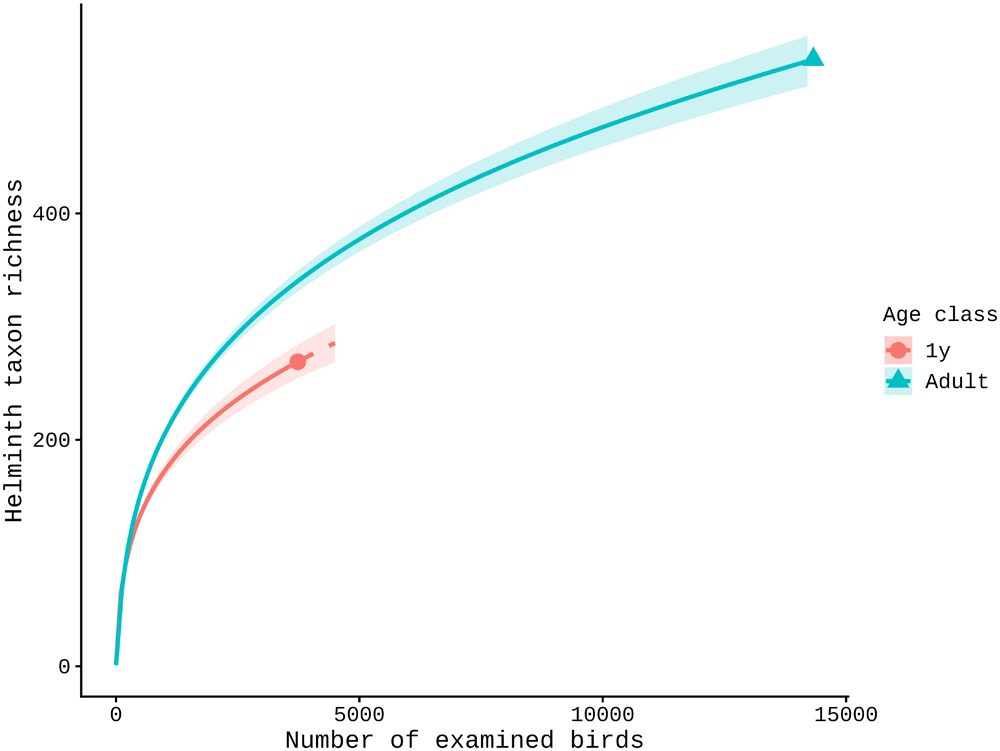
To assess whether the 1y and adult datasets differed substantially in sampling completeness, we constructed sample-size-based rarefaction curves of helminth taxon richness from incidence-frequency data using iNEXT version 3.0.2. Individual birds were treated as sampling units, and taxon occurrence within each bird as incidence data. Hill number q = 0 was used to estimate taxon richness. Confidence intervals were obtained by 200 bootstrap replications at the 95% confidence level. The 1y dataset was extrapolated only briefly beyond the observed sample size (3735–4500 birds), whereas the adult dataset was not extrapolated beyond its observed sample size of 14 328 birds. Sample coverage was estimated independently for each age class.
Statistical software
Primary data processing and inferential analyses were performed in Python 3.13.5. Data handling and numerical operations used Python-based spreadsheet and numerical libraries; statistical analyses used SciPy and statsmodels. Fisher’s exact tests were 2-sided. Statistical significance was evaluated at α = 0.05, with Benjamini–Hochberg correction applied where multiple helminth taxa were tested simultaneously. Rarefaction and sample-coverage analyses were performed in R using iNEXT version 3.0.2.
Results
The age-resolved dataset comprised 18 063 birds, including 3735 1y birds and 14 328 adults. Across these hosts, 583 helminth taxa were recorded after taxonomic standardization, of which 177 met the minimum criteria for the inferential age and seasonal analyses. Observed helminth richness was 269 taxa in 1y birds and 536 taxa in adults. Despite the unequal sample sizes, sampling completeness was very similar in the 2 age classes: iNEXT sample coverage was 98.53% for 1y birds and 98.80% for adults (Figure 1). The most frequently recorded identified taxa included Dilepis undula, Echinostoma revolutum, Porrocaecum ensicaudatum and Plagiorchis laricola. The subsequent analyses, therefore, focus on age and seasonal structure rather than differences in sampling completeness.
Sample-size-based rarefaction of helminth taxon richness in first-year (1y) and adult birds estimated using iNEXT. Solid lines represent rarefaction and shaded areas indicate 95% confidence intervals. The dashed segment represents an extrapolation of the first-year dataset. Symbols indicate observed richness. Sample coverage was 98.53% in first-year birds and 98.80% in adults.

Data-driven age and seasonal classification
After taxonomic standardization and application of the minimum sample size criteria, 177 helminth taxa were retained for data-driven classification (Supplementary Table S1). Thirty-four taxa were assigned to Category A, 9 to Category B and 134 to Category C. Category A comprised taxa with a significant adult-biased age effect after FDR correction and an adult-to-1y effect size of at least 3 in prevalence, abundance or intensity. Category C comprised the remaining taxa with a significant month effect in at least 1 response variable, whereas Category B comprised taxa meeting neither criterion.
Category A included helminths from diverse taxonomic and ecological groups rather than a single transmission type. Examples included Cryptocotyle lingua, Renicola lari, Ascocotyle (Phagicola) longa, Pegosomum asperum, Psilotrema oligoon, Psilotrema simillimum, Lutztrema attenuatum and Urogonimus macrostomus. Thus, Category A represents a statistical pattern of pronounced adult-biased infection after adjustment for sampling month and was not itself used as evidence that a parasite was acquired outside the Czech Republic.
The 9 Category B taxa were Porrocaecum crassum, Cladotaenia circi, Paricterotaenia mariae, Acuaria sp., Brachylaima arcuatus, Cercarioides aharonii, Lyperosomum clathratum, Mediorhynchus sp. and Pterothominx longifila. These taxa showed neither the predefined strong adult-biased effect nor an FDR-significant month effect.
Category C contained 134 taxa and was defined by a significant seasonal effect in the absence of the Category A criterion. It included helminths with aquatic, terrestrial and other transmission pathways. Consequently, Category C should be interpreted as evidence of detectable seasonal structuring rather than as a particular ecological or transmission category.
Age effects across response variables
FDR-significant age effects were detected in 22 taxa for prevalence, 84 taxa for abundance and 15 taxa for infection intensity (Supplementary Table S1). Overall, 85 of the 177 retained taxa showed a significant age effect in at least 1 response variable. Among the 34 Category A taxa, the strong adult-biased criterion was met through abundance in 30 taxa, prevalence in 7 and intensity in 6, with some taxa meeting the criterion for more than 1 response variable. Abundance, therefore, contributed most frequently to Category A assignment.
The 3 response variables did not necessarily yield identical age effects. Prevalence describes the probability of infection, abundance combines infection probability with parasite burden and includes uninfected hosts, and intensity is conditional on infection. Accordingly, a taxon could show a pronounced adult effect in abundance without a corresponding significant prevalence effect, or an intensity difference could occur among infected hosts without a big difference in prevalence. The data-driven classification, therefore, used all 3 response variables rather than requiring their concordance.
Seasonal structuring was widespread. After FDR correction, 167 of the 177 retained taxa showed a significant month effect in at least 1 response variable (Supplementary Table S1). This included 33 of the 34 Category A taxa as well as all 134 Category C taxa. Age and seasonal effects were therefore not mutually exclusive. Category C specifically denotes taxa with significant seasonality that did not meet the stronger adult-biased criterion used to define Category A.
Comparison with the independent life-cycle classification
The independent literature-based classification separated trematodes into cosmopolitan taxa, taxa with European or marine transmission not normally completed in the Czech Republic, taxa capable of completing their life cycles in Central Europe and taxa associated primarily with wintering grounds in southern Europe or Africa (Table 1). This classification was established independently of the statistical age and seasonal patterns.
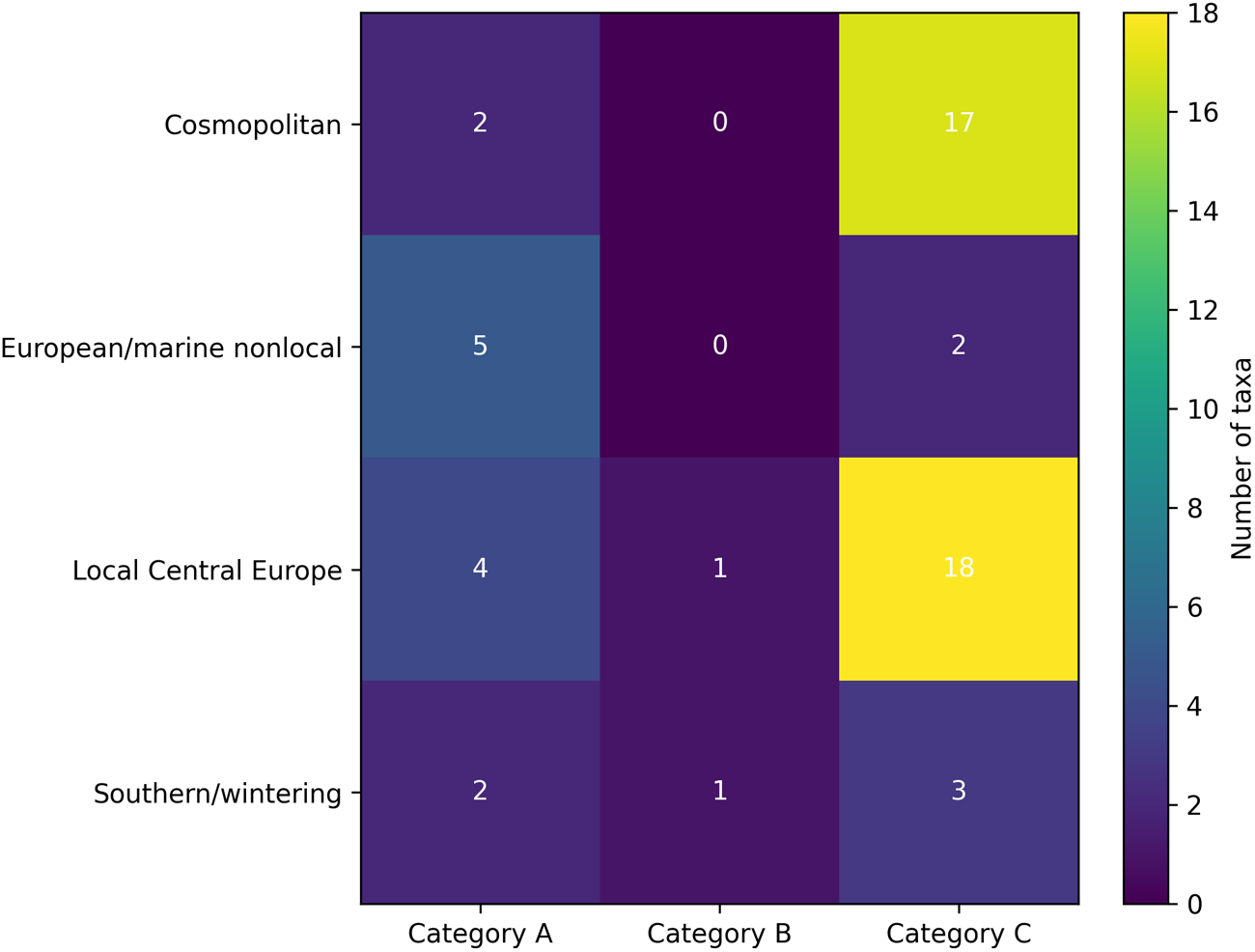
Among the 177 taxa included in the data-driven analysis, 55 could be unambiguously assigned to 1 of these 4 literature-based trematode groups. The statistical categories were not distributed uniformly across the biological groups. Of the 7 taxa assigned to the European or marine nonlocal group, 5 were classified as Category A and 2 as Category C. Among the 6 southern European or African wintering-ground taxa, 2 were Category A, 1 Category B and 3 Category C. The Central European local-cycle group comprised 23 eligible taxa, of which 4 were Category A, 1 Category B and 18 Category C. Among 19 cosmopolitan taxa, 2 were Category A and 17 Category C.
Category A therefore accounted for 5/7 (71.4%) of the European or marine nonlocal taxa, compared with 2/6 (33.3%) of southern wintering-ground taxa, 4/23 (17.4%) of locally completing taxa and 2/19 (10.5%) of cosmopolitan taxa. The correspondence between the statistical and biological classifications was strongest for the European or marine nonlocal group, but the 2 classification systems were not equivalent. The correspondence between the independent biological classification and statistical Categories A–C is visualized in Figure 2.
Relationship between the independent life-cycle classification and the data-driven statistical classification of helminth taxa. Cell values indicate the number of taxa assigned to each combination of biological group and statistical Category A, B or C. The figure illustrates partial rather than complete correspondence between the 2 classification approaches.

Several taxa classified a priori as nonlocal were not assigned to Category A despite a strongly adult-biased raw prevalence. This concerned Renicola pinguis and R. paraquinta in the European or marine nonlocal group, and Brachydistomum olssoni, Brachydistomum salebrosum and Brachydistomum ventricosum in the southern European/African wintering-ground group; Cercarioides aharonii was assigned to Category B. In these taxa, the discrepancy resulted from limitations in the available sampling structure rather than from evidence of local transmission. First-year and adult hosts were unevenly distributed across sampling months, and infections were concentrated in months with predominantly or exclusively adult hosts. Consequently, age class and sampling month were strongly confounded, and the independent age coefficient was poorly estimable after adjustment for month, even when infections occurred exclusively or predominantly in adults.
This sampling limitation was particularly apparent in several species. Renicola pinguis occurred in 0/61 1y and 63/418 adult birds. Brachydistomum olssoni occurred in 0/80 and 46/182; B. salebrosum in 0/80 and 11/182; B. ventricosum in 0/126 and 46/2135; and Cercarioides aharonii in 0/439 and 11/817 1y and adult birds, respectively. Renicola paraquinta was likewise detected only in adults (0/7 1y versus 17/125 adult birds). However, the very small, temporally restricted 1y sample provided insufficient information to reliably separate age from sampling month. Assignment of these taxa to Category B or C should therefore not be interpreted as evidence that their life cycles are completed locally. The underlying month-by-age sampling structure for these biologically nonlocal taxa is illustrated in Figure 3. The literature-based biogeographic classification was retained as an independent biological classification rather than being replaced by the data-driven age and seasonal categories.
Monthly distribution of age-specific prevalence in selected biologically nonlocal trematode taxa assigned to statistical Categories B or C. Cells show the numbers of infected/examined birds within each combination of month and age class, with shading proportional to prevalence. The figure illustrates the uneven temporal representation of first-year and adult hosts and the resulting confounding between age and sampling month in these taxa.

Age-specific prevalence in the literature-based transmission groups
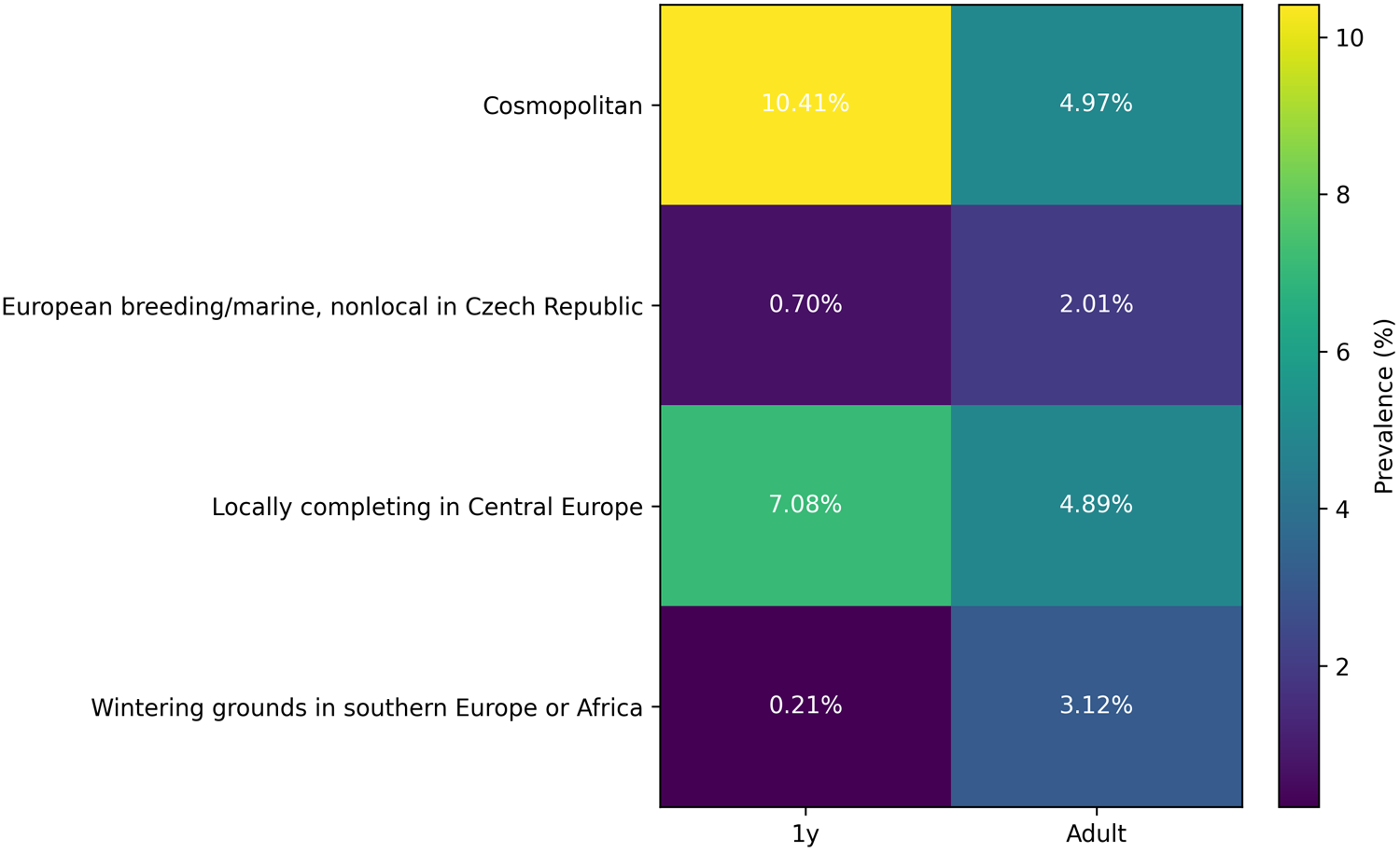
At the host–trematode association level, taxa associated with wintering grounds in southern Europe or Africa showed a pronounced deficit in 1y birds. Prevalence was 0.21% in 1y associations (5/2413) compared with 3.12% in adult associations (217/6946; OR = 0.064, Fisher’s exact P < 0.001) (Table 2). The European or marine nonlocal group showed the same direction of effect, with a prevalence of 0.70% in 1y associations (39/5588) and 2.01% in adult associations (189/9407; OR = 0.343, P < 0.001).
In contrast, the association-level prevalence was higher in 1y birds for the 2 groups whose life cycles were not classified as geographically restricted. Cosmopolitan trematodes occurred in 10.41% of 1y associations (1225/11 763) and 4.97% of adult associations (1180/23 735; OR = 2.22, P < 0.001). Trematodes capable of completing their life cycles in Central Europe occurred in 7.08% of 1y associations (727/10 262) and 4.89% of adult associations (1895/38 721; OR = 1.48, P < 0.001) (Table 2). These pooled comparisons are based on host–trematode associations rather than on unique birds, because an individual host can contribute observations to more than 1 trematode taxon. The contrasting age-specific prevalence patterns among the 4 independently defined biological groups are summarized in Figure 4.
Heatmap of age-specific prevalence across the 4 a priori life-cycle groups. Cell values show the prevalence of host-trematode associations in first-year (1y) and adult birds. The biological grouping was established independently of the statistical age and seasonal classification.

Species-level patterns among trematodes associated with wintering grounds
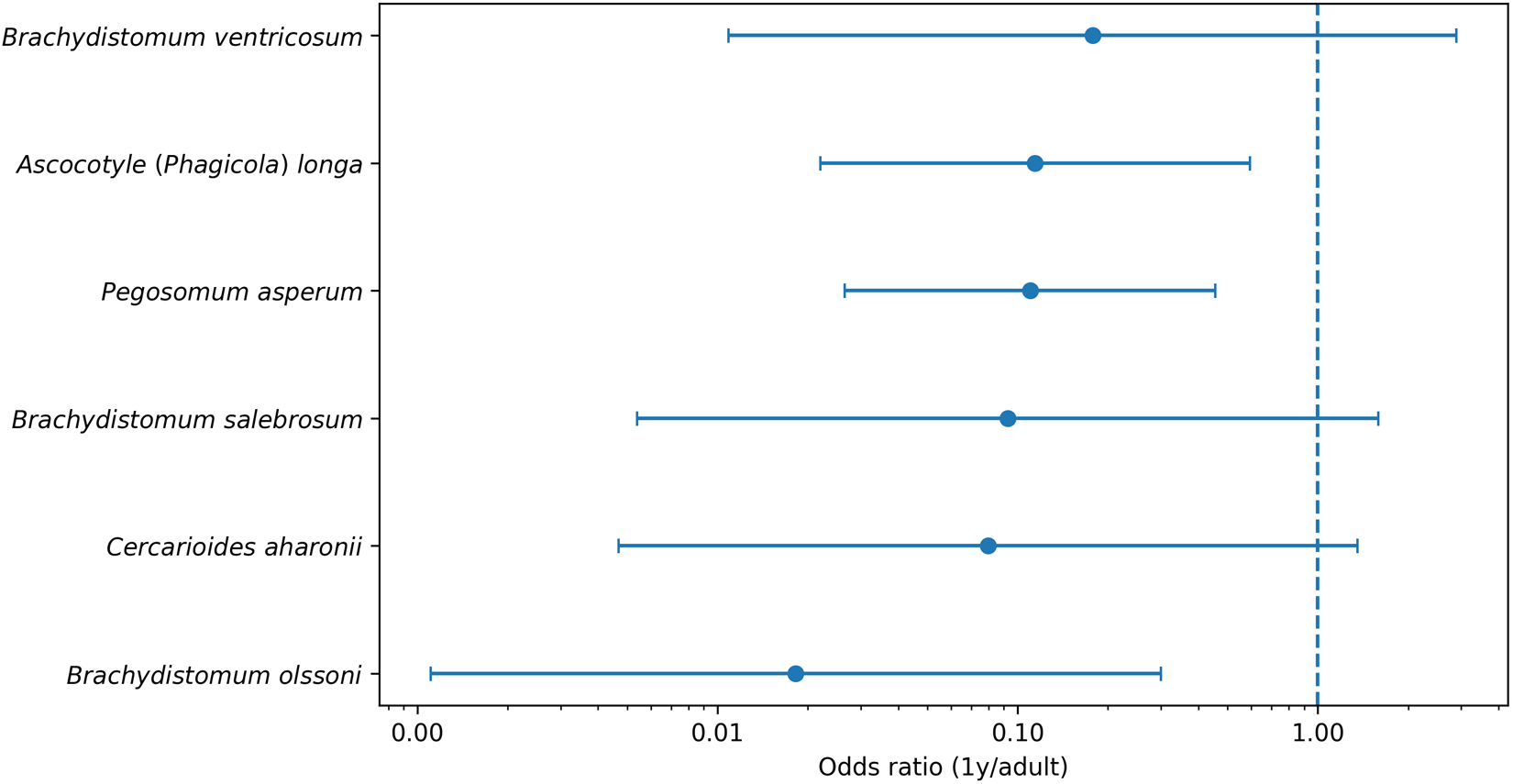
Six species associated primarily with wintering grounds in southern Europe or Africa met the criterion of at least 10 infected age-resolved birds (Table 3). Ascocotyle (Phagicola) longa was recorded in 1/356 1y and 28/800 adult birds (OR = 0.078, P < 0.001). Brachydistomum olssoni occurred in 0/80 1y and 46/182 adult birds (P < 0.001), and B. salebrosum in 0/80 and 11/182, respectively (P = 0.021). Cercarioides aharonii occurred in 0/439 1y and 11/817 adult birds (P= 0.011). Pegosomum asperum was present in 2/18 1y and 36/62 adult birds (OR = 0.090, P < 0.001). Species-level ORs for these wintering-ground trematodes are shown in Figure 5.
Age-specific prevalence effects in trematode species associated primarily with wintering grounds in southern Europe or Africa. Odds ratios compare first-year with adult birds; values below 1 indicate adult-biased prevalence and values above 1 indicate first-year-biased prevalence. Species are ordered according to the magnitude of the age effect. Confidence intervals were calculated after adding 0.5 to all cells where required to accommodate zero counts.

Figure 5 Long description
The horizontal bar chart displays odds ratios for different trematode species comparing first-year to adult birds. The x-axis is labeled ′Odds ratio (1y/adult)′ ranging from 0.0 to 10.0. Each species is listed on the y-axis, including Psilotrema simillimum, Psilotrema oligon, Cryptocotyle concavum, Renicola paraquatra, Cryptocotyle lingua, Brachydistomum ventricosum, Ascocotyle (Phagicola) longa, Pegosomum asperum, Brachydistomum salebrosum, Cercarioides aharonii, Renicola lari, Renicola pinguis and Brachydistomum olssoni. Each species is represented by a point with error bars indicating variability in the odds ratio. A vertical dashed line at 1.0 serves as a reference for equal odds between first-year and adult birds. The odds ratios vary across species, with some having values greater than 1.0, indicating higher odds in first-year birds, while others have values less than 1.0, indicating higher odds in adult birds.
Brachydistomum ventricosum was also detected exclusively in adults, with 0/126 infected 1y birds compared with 46/2135 adults. However, this contrast did not reach statistical significance in the direct Fisher comparison (P = 0.109), reflecting the low overall prevalence and the markedly unequal age-specific sample sizes.
Species-level patterns across all nonlocal transmission groups
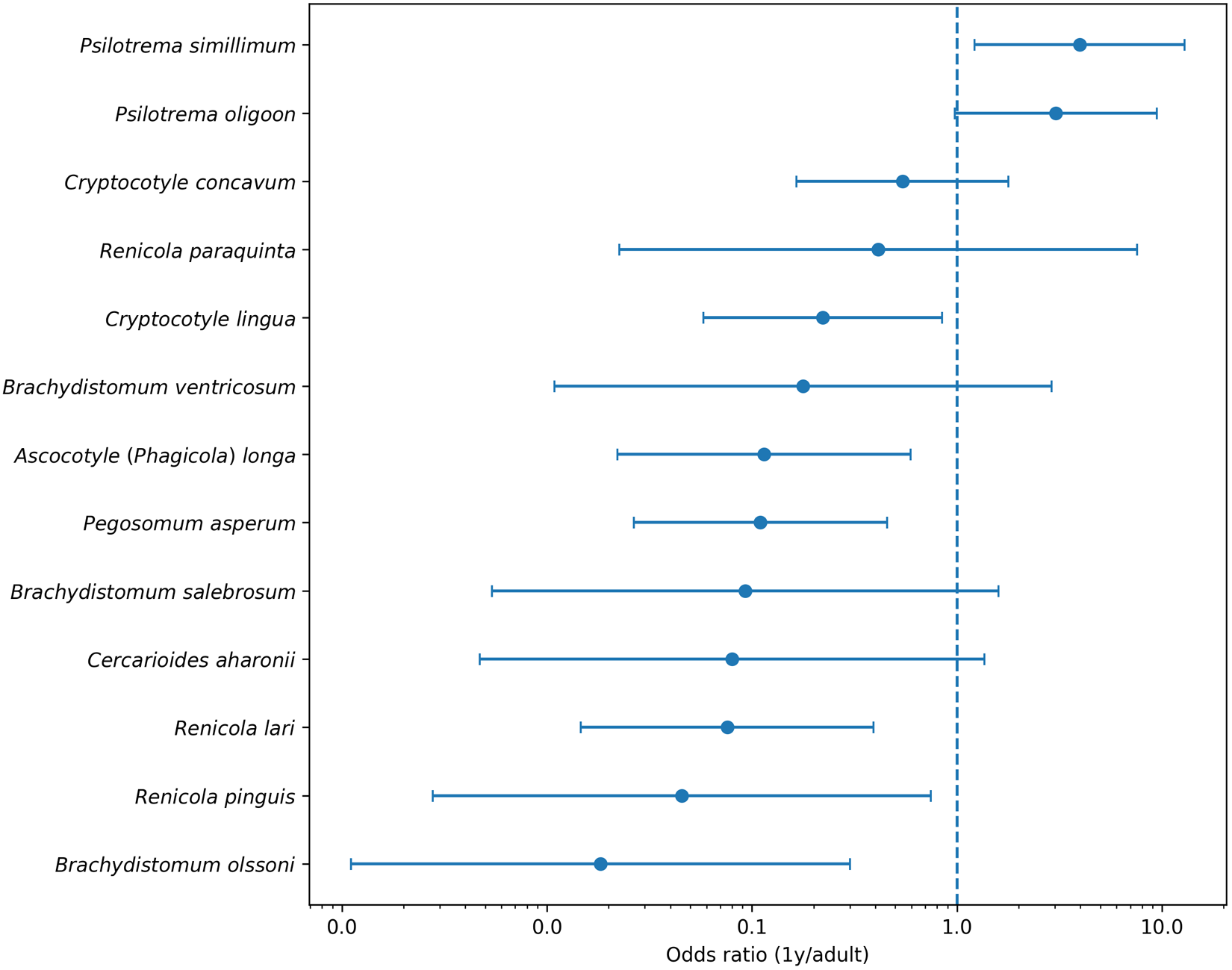
Thirteen species classified a priori as having transmission cycles not normally completed in the Czech Republic met the minimum sample-size criterion for Table 4. Eleven of the 13 showed lower raw prevalence in 1y birds than in adults. Significant adult-biased differences were detected for A. (P.) longa, B. olssoni, B. salebrosum, Cercarioides aharonii, C. lingua, P. asperum, R. lari and R. pinguis.
Cryptocotyle lingua occurred in 2/514 1y and 15/719 adult birds (OR = 0.18, P = 0.012). Renicola lari occurred in 1/433 1y birds, and 31/718 adult birds (OR = 0.051, P < 0.001), and R. pinguis was absent from all 61 1y birds but present in 63/418 adults (P < 0.001). Cryptocotyle concavum showed the same direction of difference, with 3/573 1y and 12/1117 adult birds infected, but the contrast was not significant (OR = 0.48, P = 0.411). Renicola paraquinta was found only in adults, but the 1y sample comprised only 7 birds, and the direct comparison was not significant (0/7 versus 17/125; P = 0.594).
Two species showed the opposite raw prevalence pattern. Psilotrema oligoon occurred in 9/236 1y and 4/331 adult birds (OR = 3.24, P = 0.049), and P. simillimum occurred in 13/746 and 3/756, respectively (OR = 4.45, P = 0.012). Thus, the a priori nonlocal classification was predominantly, though not universally, associated with adult-biased raw prevalence. The occurrence of exceptions also shows that geographic life-cycle classification cannot be inferred from age prevalence alone. The magnitude and direction of the species-level age effects across all qualifying nonlocal trematodes are summarized in Figure 6.
Age-specific prevalence effects in trematode species classified a priori as having nonlocal transmission relative to the Czech Republic. Odds ratios compare first-year with adult birds; values below 1 indicate adult-biased prevalence and values above 1 indicate first-year-biased prevalence. Species are ordered according to the magnitude of the age effect. Confidence intervals were calculated after adding 0.5 to all cells where required to accommodate zero counts.

Figure 6 Long description
The heatmap displays prevalence percentages of different taxa across months from January to December. The vertical axis lists taxa names along with age groups, such as Renicola pinguis for first-year and adult, Renicola paraquatra, Brachydistomum ossican, Brachydistomum salebrosum, Brachydistomum wabvreanum, Brachydistomum venricosum and Cercarioides aharonii. The horizontal axis represents sampling months. Numerical values inside the cells indicate prevalence percentages, ranging from 0 to 50 percent. For example, Renicola pinguis first-year shows values like 0.1 in January and 0.3 in February, while adult shows values like 0.6 in January and 0.9 in February. The color bar on the right side of the heatmap indicates the prevalence percentage scale from 0 to 50 percent.
Seasonal effects
Significant month effects were widespread across the dataset. After FDR correction, 167 of the 177 retained taxa showed a significant month effect in at least 1 of the prevalence, abundance or intensity analyses (Supplementary Table S1). Of these, 134 taxa were assigned to Category C because they showed significant seasonality without meeting the strong adult-biased Category A criterion. Thirty-three Category A taxa also showed a significant month effect, showing that pronounced adult-biased and seasonal patterns frequently co-occurred.
Concordance between statistical and life-cycle classifications
Comparison with the independent life-cycle classification showed that strong adult-biased Category A patterns were most frequent among European or marine nonlocal trematodes (5/7). However, they also occurred among southern wintering-ground (2/6), locally completing (4/23) and cosmopolitan taxa (2/19). Conversely, some biologically nonlocal taxa were assigned to Category B or C because the available age-specific samples did not permit the age effect to be reliably separated from the sampling month.
The imperfect correspondence between the 2 classifications, therefore, partly reflected temporal imbalance in the underlying samples rather than disagreement about the biological origin of the infections. The statistical age and seasonal categories and the literature-based life-cycle categories captured related but non-equivalent aspects of parasite occurrence. In particular, failure to enter Category A should not be interpreted as evidence of local transmission when 1y and adult hosts were sampled at different times during the annual cycle.
Discussion
The present study shows that host age and season contain substantial information about the structure of avian helminth infections. However, these statistical patterns cannot be interpreted as direct proxies for parasite biogeography. The geographic origin of an infection is determined by the parasite’s life cycle, the distribution of its intermediate hosts, the movements of the definitive host and the duration during which the adult parasite remains detectable. These principles have long formed the basis of ecological interpretation of avian helminth distributions (Dogiel, Reference Dogiel1947, Reference Dogiel1962; Bychovskaya-pavlovskaya, Reference Bychovskaya-Pavlovskaya1962) and remain fundamental to modern trematode ecology (Galaktionov and Dobrovolskij, Reference Galaktionov and Dobrovolskij2003). Strong adult-biased effects in our dataset were most frequent among trematodes whose life cycles are not typically completed in the Czech Republic, particularly taxa associated with marine or other extraregional European transmission. Adult-biased patterns also occurred in some locally completing and cosmopolitan taxa, and several biologically nonlocal trematodes failed to enter the strongly adult-biased statistical category because age and sampling month could not be separated reliably in the available material. The age-based analysis, therefore, provides an independent quantitative signal that must be interpreted alongside established information on parasite life cycles and geographic distribution.
The distinction between the data-driven and literature-based classifications is essential. Categories A–C summarize statistical age and seasonal patterns. They do not define where a parasite completes its life cycle. Category A represents a pronounced adult-biased effect in prevalence, abundance or intensity after adjustment for sampling month. Category B comprises taxa that met neither the strong adult-biased criterion nor the criterion for significant seasonality. Category C captures significant seasonal structure among the remaining taxa. In contrast, the biological classification used information on life cycles, geographic occurrence, intermediate hosts and developmental constraints, following the traditional ecological approach of Bychovskaya-pavlovskaya (Reference Bychovskaya-Pavlovskaya1962) and subsequent information for Central European bird helminths (Sitko et al., Reference Sitko, Faltýnková and Scholz2006; Sitko and Heneberg, Reference Sitko and Heneberg2021, Reference Sitko and Heneberg2023).
The comparison between the 2 classifications showed partial but informative correspondence. Category A accounted for 5 of 7 eligible European or marine nonlocal trematodes, compared with 2 of 6 southern wintering-ground taxa, 4 of 23 locally completing taxa and 2 of 19 cosmopolitan taxa. Strong adult-biased patterns were therefore enriched among European or marine nonlocal trematodes, but the correspondence was not one-to-one. This is biologically expected. Parasite assemblages of birds integrate exposure at breeding sites, stopover areas, wintering grounds and other habitats visited during the annual cycle, and the parasites recovered at necropsy may not have been acquired at the site where the host was collected (Bychovskaya-pavlovskaya, Reference Bychovskaya-Pavlovskaya1962; Galaktionov and Dobrovolskij, Reference Galaktionov and Dobrovolskij2003).
Category A should therefore be interpreted as a statistical phenotype of pronounced adult-biased occurrence or burden rather than as an ecological category. In nonlocal trematodes, such a pattern may arise because adults have already visited marine habitats, extraregional breeding sites, stopover areas or southern wintering grounds that 1y birds have not yet reached. In locally completing or cosmopolitan taxa, adult bias may instead reflect cumulative exposure, persistent infections, age-dependent diet, differences in habitat use or repeated consumption of infected intermediate hosts. The importance of trophic ecology and host identity for helminth assemblages has also been shown in earlier analyses of Central European birds, in which host feeding ecology and access to intermediate hosts strongly affected parasite occurrence (Sitko et al., Reference Sitko, Faltýnková and Scholz2006; Sitko and Heneberg, Reference Sitko and Heneberg2021, Reference Sitko and Heneberg2023). A strong adult effect alone, therefore, cannot establish geographic import.
The pooled literature-based comparisons provided the clearest support for migration-mediated acquisition. Trematodes associated with wintering grounds in southern Europe or Africa occurred in 0.21% of 1y host–taxon associations and 3.12% of adult associations. Taxa associated with European or marine transmission, which are not normally completed in the Czech Republic, were 0.70% and 2.01%, respectively. Both groups, therefore, showed substantially lower prevalence in 1y birds. In contrast, cosmopolitan and locally completing trematodes showed higher prevalence at the association level in 1y birds. These opposite directions of age bias across independently defined biological groups are more informative than the statistical A/B/C labels alone because the biological groups were established from life-cycle and distributional information rather than from the observed age effects. This distinction is consistent with the classical view that parasite distributions cannot be interpreted independently of the distributions of their intermediate hosts and the movements of their definitive hosts (Dogiel, Reference Dogiel1947, Reference Dogiel1962; Bychovskaya-pavlovskaya, Reference Bychovskaya-Pavlovskaya1962).
The association-level nature of these pooled comparisons must nevertheless be considered. The denominators in Table 2 represent summed host–trematode observations rather than independent unique birds. A single bird could contribute observations for several trematode taxa, and taxa occurring within the same host population are not equivalent to observations from separate individuals. These values, therefore, describe broad biological patterns rather than estimates from a single individual-level causal model. Their agreement with the predominantly adult-biased species-level patterns in Tables 3 and 4 nevertheless provides independent descriptive support for the same biological interpretation.
Several species provided particularly clear examples. A. longa, B. olssoni, B. salebrosum, Cercarioides aharonii, C. lingua, P. asperum, R. lari and R. pinguis were significantly more prevalent in adults in direct age-specific comparisons. Their known life cycles and geographic distributions make acquisition outside the Czech Republic biologically plausible. Trematode transmission depends on the availability of suitable molluscan or other intermediate hosts and on environmental conditions that permit completion of the larval stages; the absence of these requirements can prevent local completion even when infected definitive hosts regularly enter an area (Bychovskaya-Pavlovskaya, Reference Bychovskaya-Pavlovskaya1962; Galaktionov and Dobrovolskij, Reference Galaktionov and Dobrovolskij2003).
The strength of the age signal differed among species. Some parasites were absent from 1y birds, whereas others occurred at low prevalence in both age classes. Such variation is expected because detection in an adult host depends not only on the place of acquisition but also on parasite longevity, timing of exposure, host migration phenology and the interval between acquisition and examination. Experimental and life-cycle studies have long shown marked interspecific variation in the duration of trematode infections and development within definitive hosts (Groschaft et al., Reference Groschaft, Del Valle and Lorenzo Hernandez1969; Galaktionov and Dobrovolskij, Reference Galaktionov and Dobrovolskij2003). Short-lived intestinal trematodes acquired outside the study region may therefore disappear rapidly after arrival. Tissue-dwelling or longer-lived species may remain detectable throughout a much larger part of the breeding season. The absence of a strong adult effect does not necessarily imply local transmission, and prolonged persistence can amplify an adult-biased signal long after the original exposure event.
This consideration is particularly relevant to Renicola spp., which occupy the renal system rather than the intestinal lumen, and to other trematodes with comparatively persistent adult stages. Earlier parasitological observations indicate that such species can remain detectable for a substantial part of the host’s annual cycle, whereas many small intestinal trematodes have considerably shorter persistence (Bychovskaya-Pavlovskaya, Reference Bychovskaya-Pavlovskaya1962; Galaktionov and Dobrovolskij, Reference Galaktionov and Dobrovolskij2003). The probability of detecting a parasite acquired during migration or wintering is therefore strongly species-dependent.
The assignments of several biologically nonlocal trematodes outside Category A illustrate another limitation. Renicola pinguis and R. paraquinta belonged to the European or marine nonlocal group but were assigned to Category C. Brachydistomum olssoni, B. salebrosum and B. ventricosum belonged to the southern European or African wintering-ground group and were also assigned to Category C. Cercarioides aharonii was assigned to Category B. These assignments do not indicate that the parasites complete their life cycles locally.
The discrepancy arose from the structure of the available samples. First-year and adult hosts were unevenly distributed across the annual cycle, and infections in these species were concentrated in months in which we predominantly or exclusively retrieved adults. Age class and sampling month were therefore strongly confounded. The adjustment for the month reduced the estimability of an independent age coefficient even when all infected birds were adults. This occurred in R. pinguis, recorded in 0/61 1y and 63/418 adult birds; B. olssoni, recorded in 0/80 and 46/182; B. salebrosum, recorded in 0/80 and 11/182; B. ventricosum, recorded in 0/126 and 46/2135; and C. aharonii, recorded in 0/439 and 11/817, respectively. Renicola paraquinta was likewise detected only in adults, but the 1y sample comprised only 7 birds. These examples show why the statistical categories cannot replace independent information on parasite biology.
Failure to enter Category A cannot, consequently, be interpreted as evidence of local transmission. In sparse or temporally imbalanced datasets, adjusting for season may make it difficult to estimate an otherwise conspicuous age difference independently. The literature-based biogeographic classification was therefore retained as a separate biological source of information. This approach is consistent with earlier Central European helminth studies, which have interpreted parasite occurrence through a combination of host ecology, parasite life cycles and intermediate-host availability rather than from prevalence patterns alone (Sitko et al., Reference Sitko, Faltýnková and Scholz2006; Sitko and Heneberg, Reference Sitko and Heneberg2021, Reference Sitko and Heneberg2023).
The occurrence of Category A patterns among locally completing and cosmopolitan taxa provides a cautionary note. Adult-biased infection does not prove geographic import. Adults have had more time to encounter intermediate hosts, may occupy different feeding habitats and may consume different prey than 1y birds. Some helminths can also persist and accumulate after repeated exposure. Such processes have long been recognized as major determinants of parasite burden and aggregation in vertebrate hosts (Bush et al., Reference Bush, Lafferty, Lotz and Shostak1997; Rózsa et al., Reference Rózsa, Reiczigel and Majoros2000; Poulin, Reference Poulin2007). Adult-biased abundance can therefore arise even when the parasite completes its life cycle locally.
Age-related differences in infection may also reflect differences in feeding ecology. This may be particularly relevant in lariform birds, for which earlier work from the study region documented close relationships between host diet and trematode assemblages (Sitko, Reference Sitko1993). Changes in the availability or use of prey serving as intermediate hosts could therefore modify age-specific infection patterns independently of migration. The present data, however, do not allow such long-term dietary or environmental effects to be separated from migration, parasite persistence and other age-related processes.
The 3 response variables captured different components of infection. Prevalence describes the proportion of hosts infected, abundance combines infection probability and parasite burden by including uninfected hosts, and intensity describes parasite burden among infected hosts (Bush et al., Reference Bush, Lafferty, Lotz and Shostak1997). Their ecological meanings are related but not interchangeable (Rózsa et al., Reference Rózsa, Reiczigel and Majoros2000; Poulin, Reference Poulin2007). In our analyses, abundance most frequently produced the strong Category A criterion. This is biologically plausible because host age can influence both the probability of repeated exposure and the number of parasites accumulated following exposure. A taxon can consequently show a pronounced adult increase in abundance without an equally big difference in prevalence.
The predominance of abundance effects also cautions against interpreting all adult-biased results as evidence of imported parasites. Higher abundance in adults can result from repeated exposure, greater consumption of infected intermediate hosts, longer infection duration or differences in host susceptibility. Intensity adds another component because it is conditional on infection and may reflect processes operating after establishment. The simultaneous consideration of prevalence, abundance and intensity therefore provides a more informative description of age structure than any one metric alone, as emphasized in the broader ecological-parasitological literature (Bush et al., Reference Bush, Lafferty, Lotz and Shostak1997; Rózsa et al., Reference Rózsa, Reiczigel and Majoros2000; Poulin, Reference Poulin2007).
Category B was numerically small and ecologically heterogeneous. Its 9 taxa showed neither the predefined strong adult-biased effect nor an FDR-significant month effect. This outcome does not, in itself, imply local transmission or a genuinely age-independent occurrence. A limited sample size, low prevalence, imbalanced age classes and restricted seasonal coverage can all reduce the ability to detect an independent age- or month-level effect. Cercarioides aharonii provides a clear example because it was recovered only from adults but remained in Category B after adjustment for the uneven monthly distribution of samples.
Category C primarily captures detectable seasonal structure. Its ecological heterogeneity is expected because the month can affect parasite occurrence through seasonal availability of intermediate hosts, seasonal changes in host diet, parasite maturation and loss, breeding-related habitat shifts and host movements. Seasonal transmission is especially characteristic of parasites that depend on poikilothermic intermediate hosts, whose activity and parasite development vary strongly over the year (Bychovskaya-Pavlovskaya, Reference Bychovskaya-Pavlovskaya1962; Galaktionov and Dobrovolskij, Reference Galaktionov and Dobrovolskij2003). Category C, therefore, cannot be equated with terrestrial transmission, local life-cycle completion or absence of an age effect.
Seasonal effects were detected in nearly all eligible taxa. Much of this signal is biologically plausible given the pronounced seasonality of temperate helminth transmission and host feeding ecology (Bychovskaya-Pavlovskaya, Reference Bychovskaya-Pavlovskaya1962; Galaktionov and Dobrovolskij, Reference Galaktionov and Dobrovolskij2003). The magnitude of the result must nevertheless also be interpreted in relation to the long-term, non-standardized nature of the material. Birds were not sampled uniformly across months, species, age classes, localities or years. Some host–parasite combinations were represented across much of the annual cycle, whereas others occurred only within restricted seasonal windows. Consequently, a month can capture both biological seasonality and temporal changes in the composition of the sampled host population.
The biological classification itself is not absolute. Knowledge of trematode life cycles and intermediate-host distributions remains incomplete for some species, and geographic distributions can change. The older studies by Bychovskaya-Pavlovskaya (Reference Bychovskaya-Pavlovskaya1962) and the life-cycle framework of Galaktionov and Dobrovolskij (Reference Galaktionov and Dobrovolskij2003) provide essential foundations, but species-specific information is preferable whenever available. Central European faunistic and life-cycle data likewise show that members of the same broad taxonomic group can differ in host use and geographic occurrence (Sitko et al., Reference Sitko, Faltýnková and Scholz2006; Sitko and Heneberg, Reference Sitko and Heneberg2021, Reference Sitko and Heneberg2023). This was the reason for retaining species-specific exceptions rather than applying every geographic assignment indiscriminately to entire genera.
The 2 Psilotrema species illustrate this problem particularly clearly. Psilotrema oligoon and P. simillimum were included in the nonlocal group but were significantly more prevalent in 1y birds than in adults. Their pattern is inconsistent with the simple expectation that acquisition occurs only after the first migration. Several explanations remain possible, including incompletely recognized local or regional transmission, differences in the geographic origin of sampled hosts, variation in parasite persistence or species-specific life cycles not adequately represented by a genus-level classification. These taxa, therefore, identify cases in which intermediate-host distributions and local completion of the life cycle require direct verification rather than inference from the general biogeographic category.
Migration-mediated parasite occurrence also depends on host movement. Birds using different migration routes or wintering areas can encounter different intermediate hosts even within the same nominal host species. Resident and migratory populations may co-occur. Classical avian parasite studies already recognized that the helminth fauna recovered from a bird can contain components acquired in geographically separate parts of its annual range (Bychovskaya-Pavlovskaya, Reference Bychovskaya-Pavlovskaya1962). More recent Central European datasets likewise show strong associations between host ecology and helminth composition (Sitko et al., Reference Sitko, Faltýnková and Scholz2006; Sitko and Heneberg, Reference Sitko and Heneberg2021, Reference Sitko and Heneberg2023). Without individual movement data, an adult infection can therefore be associated with migration only indirectly through the combination of host movements and parasite life-cycle geography.
Parasite persistence further complicates this relationship. A parasite acquired during winter can be detected after arrival only if its adult stage survives sufficiently long. Species with brief adult survival may disappear before spring or summer examination, even when acquisition outside the Czech Republic is frequent. Long-lived parasites may remain detectable for a substantial period, obscuring the exact time of acquisition. The observed age pattern is therefore the combined result of exposure geography, parasite longevity, host movement and sampling date rather than a direct record of the place of infection (Galaktionov and Dobrovolskij, Reference Galaktionov and Dobrovolskij2003).
The long temporal span of the material provides unusually broad coverage of host species and parasite taxa. However, environmental conditions, host populations, migration patterns, land use and intermediate-host communities changed during the sampling period. Long-term Central European helminth datasets have documented substantial temporal variation in parasite assemblages and host–parasite associations (Sitko and Heneberg, Reference Sitko and Heneberg2021, Reference Sitko and Heneberg2023). Such changes may alter opportunities for parasite transmission, but the present analysis was not designed to assign observed temporal variation to particular environmental drivers. Specific causes such as pesticide exposure, habitat modification, climate or changes in host abundance would require dedicated environmental data and separate analyses.
The results also have implications for parasite surveillance and faunistic interpretation. Detection of an adult trematode in a breeding population does not necessarily prove that transmission occurs at the breeding site. This principle follows directly from the complex life cycles of digeneans and their dependence on appropriate intermediate hosts (Bychovskaya-Pavlovskaya, Reference Bychovskaya-Pavlovskaya1962; Galaktionov and Dobrovolskij, Reference Galaktionov and Dobrovolskij2003). Age-specific data can identify records consistent with an imported infection, but direct evidence of local completion requires proof of appropriate developmental stages or of transmission within the region.
The same consideration applies to changes in parasite distributions. Altered climatic or ecological conditions may permit intermediate hosts or parasite developmental stages to occur in regions where transmission was previously absent. A parasite formerly restricted to wintering, coastal or southern environments could consequently establish a local transmission cycle. In such a situation, consistent detection in 1y birds before their first migration would provide particularly informative evidence, although confirmation would still require independent life-cycle data. Repeated age-structured surveillance may therefore complement traditional faunistic and intermediate-host studies.
Limitations
Several limitations affect the interpretation of the present results. Age class and sampling month were unevenly distributed for many host–parasite combinations. This produced temporal confounding and, in some taxa, quasi-complete separation, limiting estimation of an independent age effect after adjustment for month. The birds were not collected according to a balanced prospective sampling design. Sample size, locality, month, year, host species and age structure reflect the availability of carcasses accumulated over a long historical period. The resulting dataset provides broad taxonomic coverage but cannot eliminate all sources of sampling heterogeneity. Categories A–C are statistical summaries of age and seasonal patterns and should not be interpreted directly as categories of imported, local, aquatic or terrestrial transmission. Similar statistical patterns can arise through different biological mechanisms. The literature-based classification also contains uncertainty. Life cycles and intermediate-host distributions remain incompletely known for some taxa, and genus-level assignments may conceal substantial species-specific differences. Geographic transmission categories should therefore be revised when more specific biological or distributional evidence becomes available. The pooled analyses in Table 2 summarize host–taxon associations rather than independent unique birds. Individual birds can contribute observations for several parasite taxa. These pooled comparisons describe broad differences between biological groups but should not be interpreted as independent estimates of individual-level effects. Sparse data remain important despite the minimum infection thresholds. Some taxa had few 1y hosts, few infected individuals or infections restricted to a narrow range of months. Large effect estimates from such taxa can be unstable, particularly when complete or near-complete separation is present. Individual migration histories were unavailable. Acquisition outside the Czech Republic was inferred from parasite life cycles, intermediate-host distributions, known host movements and age-specific occurrence, rather than directly shown for individual birds. Infection intensity may also be influenced by unmeasured variation in host resistance. Hosts experiencing similar exposure can differ in their ability to prevent establishment, eliminate parasites or limit parasite persistence, including through immune-mediated mechanisms. Consequently, higher intensity within a particular age class cannot be uniquely attributed to cumulative or repeated exposure. Because the present dataset contains no immunological measurements, the relative contributions of exposure history and host resistance could not be separated. Changes over the long sampling period may have affected host abundance, migration behaviour, parasite transmission, intermediate host communities and detection probability. The present analyses did not attempt to separate long-term historical trends from age and seasonal effects. Direct confirmation of local life-cycle completion requires targeted intermediate-host surveys, linkage of larval and adult stages, repeated detection in non-migratory or pre-migratory hosts or experimental transmission studies. The present analysis identifies taxa for which such verification would be particularly informative.
Conclusions
Age-structured helminth data provide a useful quantitative signal of parasite transmission geography, but age patterns cannot be interpreted independently of seasonality, parasite persistence, host ecology and sampling structure. Trematodes classified a priori as having nonlocal marine, extraregional European or southern wintering-ground transmission showed substantially stronger adult-biased prevalence than locally completing or cosmopolitan taxa, supporting an important role for migration-mediated acquisition. The correspondence between statistical and biological classifications was incomplete because several nonlocal taxa entered seasonal or otherwise non-Category A statistical groups when age and sampling month were strongly confounded, and some locally completing or cosmopolitan taxa showed strong adult-biased patterns for mechanisms unrelated to geographic import. Category A membership, therefore, does not by itself prove acquisition outside the Czech Republic, and failure to enter Category A does not prove local transmission. Combining age-specific infection data with independent information on parasite life cycles, intermediate hosts, geographic distributions and persistence provides a more robust approach for recognizing likely migration-mediated infections, avoiding erroneous inference of local transmission from adult parasite records and identifying taxa for which local completion of the life cycle requires direct verification.
Supplementary material
The supplementary material for this article can be found at https://doi.org/10.1017/S0031182026102765.
Data availability statement
Representative specimens of the trematodes analysed in this study are available in the collections of the Comenius Museum in Přerov. All data are available in the main text and its supplementary materials. Raw data are provided in Supplementary Table S2.
Acknowledgements
We thank the governmental and local authorities for providing the necessary permissions to conduct this long-term research. We also thank the landlords, fishermen and the staff of local rescue stations for providing us with carcasses of untreatable birds.
Author contributions
J.S. conceived the study and collected the data; P.H. analysed the data and wrote the manuscript; and both authors revised the manuscript and agreed on its final version.
Financial support
The study was supported by the Ministry of Culture of the Czech Republic project DE07P04OMG007.
Competing interests
On behalf of all authors, the corresponding author states that there is no conflict of interest.
Ethical standards
Not applicable. All the host birds were obtained dead and, therefore, no ethics permit was required under Czech law. The research was authorized by the Ministry of the Environment of the Czech Republic; the most recent permit was issued on August 3, 2009, under No. 11171/ENV/09-747/620/09-ZS 25. The collection of birds originating from the Bartošovice Rescue Station was permitted by the Ministry of the Environment of the Czech Republic, permit No. 2020/630/2473, dated October 13, 2020.






 Open access

