Introduction
This survey article discusses the influence and impacts of critical librarianship at University of the Arts London (UAL) libraries; it describes the value that engaging with critical librarianship brings to us as well as some of the ambiguities.
Critical librarianship is not a fixed or simple body of theoretical approaches or practices, and is discussed in more depth elsewhere in this special issue, so this article does not attempt to define it except through the filter of our own experience, but the following is a useful definition:
Critical librarianship seeks to bridge the gap between theory and practice in LIS (Library & Information Studies). It uses a reflexive lens to expose and challenge the ways that libraries and the profession “consciously and unconsciously support systems of oppression”, thereby pursuing a socially just theoretically informed praxis.
Nicholson and Seale, Reference Nicholson and Seale2018:2
It is this reflexive lens that I believe is at the core of our relationship to critical librarianship and has the potential to influence any area of our day to day library practices: from a conversation with a student in the library, to cataloguing a book, to an information literacy workshop, to making research openly available through our scholarly communications activities. It can also be applied to relatively under theorised areas, like systems librarianship, to explore:
…ethical questions around information security, privacy, closed-source technologies and the information commons, and the neoliberal monopolizing of the library systems marketplace
Barron and Preater, in Nicholson and Seale, Reference Barron, Praeter, Nicholson and Seale2018:89
UAL is Europe's largest specialist art and design university comprising Camberwell College of Arts, Central Saint Martins (CSM), Chelsea College of Arts, London College of Communication (LCC), London College of Fashion (LCF) and Wimbledon College of Arts. The university offers a wide range of courses in fine art, design, fashion, media, communication and performing arts at degree preparation, undergraduate and postgraduate level, and is host to Europe's largest research arts and design community.
The university has a diverse student population of c19,000 students. Around a third of our UK students come from Black, Asian or Minority Ethnic backgrounds and our international students come from over 110 countries. This diverse student profile combined with a focus on creative subjects (which draw deeply on the self and entail continual questioning approaches) sets an institutional context we have found both demands and helps engender critical librarianship.
Towards critical librarianship at UAL
Library Services is a university wide department, part of a wider Library and Student Support Services Directorate, and consists of six College libraries, three Learning Zones and the University Archives & Special Collections Centre. In addition to mainstream physical and digital collections reflecting the subjects taught and researched at UAL, the libraries hold many historical and contemporary archives and special collections.
Several factors have combined to drive our developing interest and explorations of critical librarianship across UAL library services, that resulted in a conference Towards a critical (art) librarianship: theories and practices at Chelsea College of Arts in May 2018. Several of the conference presentations are referenced in this article.
One of those factors was an awareness of the growing literature in critical librarianship, particularly Library Juice Press publications including Critical library instruction (Drabinski and others, eds. 2010) and more recently The politics of theory and the practice of critical librarianship (Nicholson and Seale, eds. 2018) which is referred to several times in this article). This literature and discourse is particularly strong in the United States, including the debate following the release of the Association of College and Research Libraries (ACRL) Framework for Information Literacy for Higher Education in 2015. (ACRL, 2015)
The conference explored the ways in which critical librarianship might be specific to the art library; the papers reflected a focus on visual representation, and the particular role that archives and special collections play in the art library and creative education. The visual language of zines, the ‘graphic language of resistance’ (Triggs Reference Triggs2006) was a thread that ran through several presentations.
The ways in which students engage with visual material is also perhaps a characteristic of the art library. May Warren described a series of four collaborative drawing and zine making workshops held in the Library at CSM, led by library staff and established contemporary artists and zine makersFootnote 1, who shared their personal and professional experiences with students. This work can be emotional, because of its relationship with identity, as Warren reflected:
…finding your people is such a fundamental part of being human…We were …able to make the library somewhere where these encounters happen, and also, with the help of the artists, connect this back to learning and information sharing.
May Warren, (email correspondence), 2019
These disciplinary contexts are additional to the more generic problems of representation and bias through language and classification systems.
The interests and initiative of individual staff also drive change. At UAL library staff are encouraged to study the university's PG Cert in Academic Practice which includes an introduction to critical pedagogy, and an elective module on Inclusive Teaching & Learning in Higher Education. Through this many staff are becoming familiar with core texts in critical pedagogy (notably Paulo Friere Pedagogy of the Oppressed and bell hooks Teaching to Transgress), that can also be described as foundational to critical information literacy. Those staff may then bring changed perspectives to inform their library and archival practices.
However, it's important to acknowledge that library staff at UAL have been engaged for many years in various forms of activism and social justice, evidenced for example through proactive collecting practices. The African-Caribbean Asian and African Art in Britain Archive was initiated in the 1980s by Chelsea College of Arts librarian Liz Ward in response to a lack of published material on Black British art.
The virtual non-existence of documentation of contemporary Black British artists and contemporary minority group art, more generally, in the form of books, periodical articles, major exhibition catalogues and videos posed, and continues to pose a great problem to the art librarian seeking to make a relevant collection
Ward, Reference Ward1985: 24
This proactive collecting was clearly based on a deep commitment to inclusivity, the unambiguous position of the library. When asked about the motivation for developing the archive Ward has commented that it was ‘just what art librarians do…’ and intrinsic to the role. (Ward in A Conversation about Recordings, 2018)
Similarly, the LCC Library Zine Collection was established by Leila Kassir in 2009, with specific intentions:
…we felt strongly they [zines] did have a place in our library as they reflect not only a form of printing that, particularly at the time, was not often collected but they also contain histories and opinions that are marginalised from mainstream culture and representation.
Collingwood and Kassir, Reference Collingwood and Kassir2018:82
These are examples of commitment to social justice and on the ground organising and demonstrate the deep roots of the current interest in ‘critical librarianship’.
Participation in a university research initiative, to increase knowledge around issues of diversity inclusion and attainment led to an increased understanding of the ways in which critical theory can help us reflect on our practices. (Crilly, Reference Crilly2017) The research focussed on how we understand diversity in relation to library collections and included interviews with library and archive staff to better understand good practice as well as unintended barriers to the diversification of collections in day to day practices. The research also initiated a conversation with students on the impacts of collections, their expectations and perceptions of gaps, which led to a stronger collaborative relationship with the university's Student Union and support for their Liberate My Curriculum campaign.
Although originally framed within a ‘diversity’ paradigm one of the outcomes of this research was a realisation of the limits of that term (also discussed by Hudson, Reference Hudson2017). This led to a more realistic engagement with positionality, Whiteness, and race, through theoretical approaches including critical race theory and intersectionality. The research project was followed by a series of meetings in the College libraries and archives, to discuss the findings, implications and potential courses of action, indicating that a critically informed approach was supported in the department.
These factors led us to want to explore critical librarianship, to find perspectives that would help to make the familiar strange, connect us to a community of the like-minded and address the sense of a missing dimension, an under-theorisation of our practices in comparison to the emphasis given to the operational. This is a common observation of libraries:
One could go so far as to say that the dominant ideology in librarianship is practicality. David James Hudson argues that in its call to “common sense” logics –“the exaltation of clarity, plain language, the everyday, the utilitarian” - practicality is inextricably entwined with our profession's false claims to neutrality.” The “practicality imperative,” as he refers to it “subtly polices the work we end up supporting and doing and …our sense of what useful and appropriate political interventions look like from the standpoint of the profession.”
Nicholson and Seale, Reference Nicholson and Seale2018:5
The reflexive lens at UAL
Theoretical perspectives are increasingly influencing our practices, particularly in the area of information literacy, and the management and interpretation of collections.
Information literacy
At its core, critical information literacy is an attempt to render visible the complex workings of information so that we may identify and act upon the power structures that shape our lives
Tewell, Reference Tewell2016
Tewell's description characterises our aim to contextualise library resources within a complex and evolving information ecosystem. Importantly the ACRL Framework (ACRL 2015) acknowledges that authority is constructed and contextual, highlights students’ role in creating new knowledge as well as being consumers of knowledge, and emphasises the ethical use of information, data and scholarship.
In the UK, Cilip recently produced a definition of information literacy:
The ability to think critically and make balanced judgements about any information we find and use. It empowers us as citizens to reach and express informed views and to engage fully with society.
Cilip, 2018
This criticality should include an unmasking of knowledge producing systems and structures. It's well documented that classification systems are historically grounded and inevitably reflect hegemonic norms, particularly in relation to gender, sexual identity and ethnicity. (Adler, Reference Adler2017; Berman, Reference Berman1971; Olson, Reference Olson2001)
“Hacking the library” is a workshop with students that analyses or unmasks representations relating to gender and identity in Dewey Decimal Classification, the system in use in UAL libraries. (Eades, 2018) Viv Eades uses the concepts of not naming, positioning /misplacing, misnaming and lumping together, acknowledging arbitrariness and the inadequacy of neutrality as a position. This enables students to appreciate the ways in which knowledge systems are constructed and situated, and their own agency in recognising and unmasking these processes and conceptualising alternatives.
Eades drew on Drabinski's theories of the politics of correction and use of queer theory. (Drabinski, Reference Drabinski2013) Drabinski challenges the idea that classification and subject language can ever be finally corrected, and also argues that incorrect remnants of language serve the purpose of revealing bias, and therefore have a value.
In the library context, queer theories can refocus attention away from the project of producing “correct” knowledge organisation systems, pointing toward a project of dialogical pedagogical interventions that push all users to consider how the organisation of, and access to, knowledge is politically and socially produced.
Drabinski, Reference Drabinski2013, p101
“Hacking the library” can be described as a dialogical pedagogic intervention.
In addition to this philosophical challenge, the mirage of the ‘once and for all fix’, re-classification/labelling work is physically and logistically challenging, especially in our context with varying interpretations of the classification system in use in our six college libraries. However, the habit of fixing things is entrenched, so discussions on what could be achieved continue.
Critical information literacy embraces the complex information eco system that students navigate, including digital information. Cassy Sachar and Alex Duncan describe an Art + Feminism Wikipedia Edit-a-thon, (Duncan and Sachar, Reference Sachar and Duncan2018) that took place in Chelsea College of Arts library in March 2018. The Art + Feminism project is informed by a feminist critique of the lack of information on women artists in Wikipedia, as well as the low number of female contributors.Footnote 2 Edit-a-thons are a way of redressing the tendency for patterns of inequality to be replicated in the digital space.
Collection diversification and decolonisation
Like many institutions in the sector, UAL is working to decolonise the curriculum, and this is an area that is central to the mission of the academic library. Critical librarianship draws on post-colonial and critical race theory amongst other perspectives to examine issues such as Eurocentrism and coloniality in relation to knowledge production and consumption. Recent work in this area of decolonisation in our libraries is perhaps evidence of an increased criticality and sense of agency across the department.
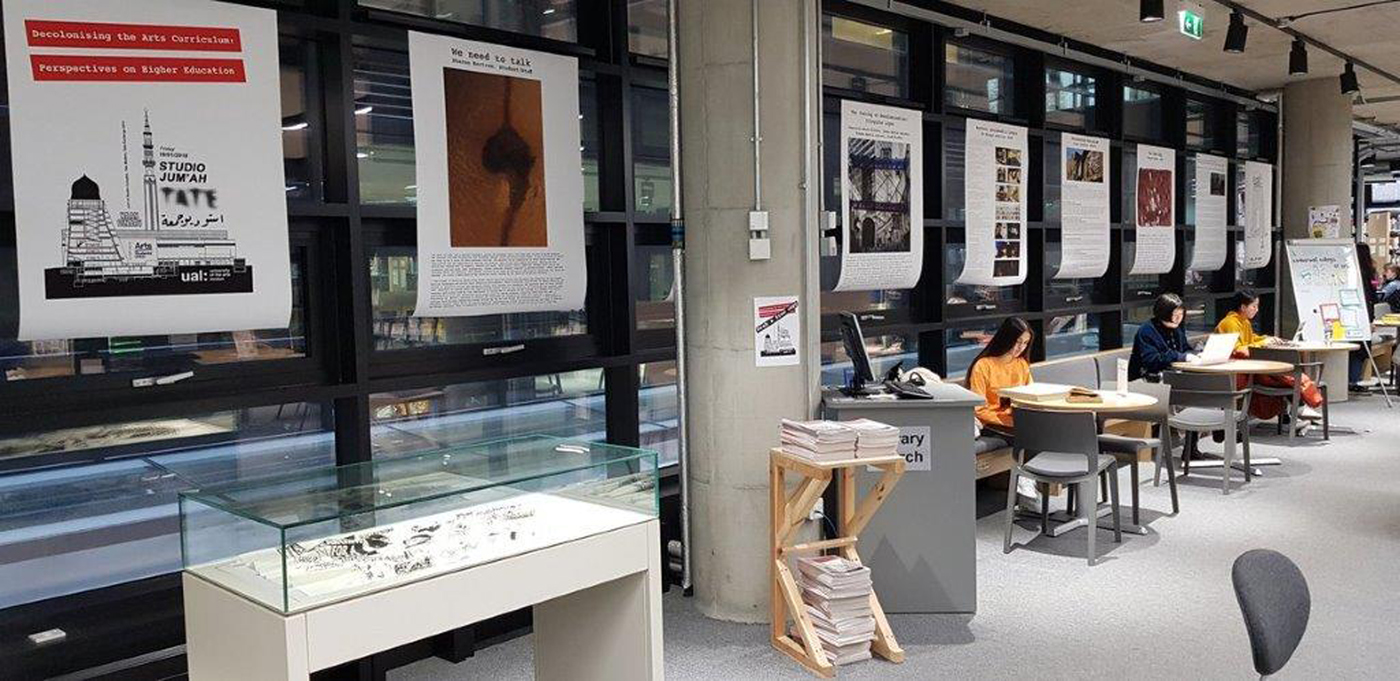
Decolonising the arts curriculum: perspectives on higher education is an initiative led by the Teaching & Learning Exchange at UAL, in collaboration with the Students' Union, launched through the production of a zine (UAL, 2018) in July 2018 that contains contributions from library staff. Library Services is working with The Exchange on a programme of activities that are taking place across the Colleges throughout 2018/19. Library interventions have included exhibitions, both from our own collections and by guest artists and curators, publications, presentations, book readings, film showings, and the production of playlists from Box of Broadcasts and on Spotify.
Decolonising collections is not simply a form of diversification, it includes a critical re-contextualisation of the collections that we hold. For example, at the London College of Communication, library staff re-contextualised items from The Printing Historical Collection, which charts the history and art of the Western book, reflecting its physical, technical and aesthetic development from the 15th to the 21st centuries.
Given the focus of the Printing Historical Collections, these books will primarily have been collected to demonstrate the changing processes of book production, rather than their content. Yet the items shown here reveal something else, our colonial past. Some provide evidence of dissenting voices which were critical of colonialism at the time, but most are the product of and therefore unquestioning of colonialism.
Practice: special collections and decolonisation, 2018
This exhibition offered a series of texts as provocations, to challenge representations of White centring, cultural misappropriation and Eurocentric labelling practices.
Library staff are also engaged in a collaborative project to address the inclusivity of reading lists. This is a collaboration between students on selected courses, librarians who support that course and course leaders, to examine models for auditing reading lists, and collaborate in the production of more inclusive alternatives. This requires some precision on the use of terms such as diversity, inclusivity and decolonisation, and an awareness of their meanings and contexts within the academy, and the institution.
We cannot rely on mainstream publishing sources to diversify our library collections, and zines continue to play an important role in this diversification strategy, with collections across the College libraries
The inclusion of alternative or underground publications ensures voices outside or against the mainstream are represented, allowing LCC's special collections to evolve to incorporate inclusivity and diversity. The zine collection contains zines that are varied in topic: class, sexual identity, gender and body politics, race, ethnicity and faith, mental health, and personal interest. Crucially, these alternative perspectives mean that students see their own voices represented in the collection.
Collingwood and Kassir, Reference Collingwood and Kassir2018:83.
Archives
Archives and special collections are held in the University Archives and Special Collections Centre at London College of Communication, and within the College Libraries. There are well established theoretical perspectives on the role and function of archives and records in relation to social justice, and a recent emphasis on the notion of lost or missing archives, or archival silence (Thomas and others, Reference Thomas2017). This criticality is beginning to inform our practice at UAL. Like many institutions with a similar history, our archives are mainly white, and again, whilst we work to diversify our archives we can also develop new perspectives to recontextualise the collections we hold and use them as a basis for critical analysis and reflection with students through exhibitions and reading groups.
Sticker. Image courtesy of Monica-carmela Sajeva and London College of Communication Library.

A reading group based on African-Caribbean, Asian and African Art in Britain Archive is now in its third year (Grandal Montero, Reference Grandal Montero2018), and a reading group on Feminist Voices in the Archive has recently been established, allowing a theoretical exploration of feminism and intersectionality in the context of archival representation. Reading groups are open to all staff and students, and the texts and discussions provide another way to engage in critical theory.
Archivists Robin Sampson and Hannah Grout brought a critical perspective to their role in constructing the narrative of the university's Institutional Memory, a project that was initiated in 2015. (Reisz, Reference Reisz2018) Recognising that a focus on capturing the experience, through oral history, of key decision makers within the institution ‘the great and good’ risked a lack of diversity they preferred the ‘active documentation’ position of Helen Willa Samuels (Samuels, Reference Samuels1986) actively ensuring that the developing archive is representative of all staff groups, and the diversity of university staff. They use the concepts of absence (gaps in archival holdings) and interpretation (the power of the archivist to curate and present material in certain ways) as a framework for this analysis.
The ultimate goal of the Institutional Memory project, therefore, should perhaps be to ensure that the UAL Archive is a holistic fusion of institutional and community archive, reflecting as Raphael Samuel proclaimed “history from below” as well as history from above. We as archivists may be the “authors” of this collection, but we also have the opportunity to be activists.
Sampson and Grout, Reference Sampson and Grout2018.
Library staff
The academic library is currently a White space. (Brook and others, Reference Brook2015) Ours is a predominately white and middle-class profession; the library workforce overall in the UK is 96.7% white (Sconul Workforce Developments Task & Finish Group). The situation is the same in the archives sector, in 2015 the Archives and Records Association recorded 1% of their members as coming from a BAME background. (ARA, 2015).
There is a lack of diversity in library and archive staff at UAL. Good practice in recruitment supported by staff development are not on their own making a sufficient difference, and it seems clear that there are fundamental and systemic barriers to entry to the library and archive profession and progression within it. These include the financial and educational obligations placed on prospective librarians and archivists and the expectation of often unpaid traineeship and placements, (Wildenhaus, Reference Wildenhaus2018). We need to use our influence in LIS education to change these assumptions of what is required to work in the profession, as well as reconsider our own approaches, if there is to be any credibility to the concept of criticality in our libraries and archives.
There are lessons to be learned from initiatives within UAL such as Teaching Within, initiated by Shades of Noir, a proactive academic progression initiative that responds directly to the under-representation of academics of colour in higher education, as well as sector schemes such as Bridging the Digital Gap, a National Archives scheme for paid technical traineeships in archives, to increase the diversity of entrants into the profession.
Gains and ambiguities
Increasingly we are using critical perspectives to understand historical legacies and taken for granted practices in our libraries and archives, and this has been positive for making sense of experiences, the recognition of practices. Critical librarianship is providing us with a shared vocabulary and theoretical underpinning that supports engagement in the university as we participate in initiatives to understand and address student retention and attainment differentials and work to create a sense of belonging for all our students. This necessitates a critique of the status quo, assumptions and practices, and a deeper reflection on the role of libraries and archives in either reproducing inequalities, or acting as a site of resistance.
As previously mentioned, elements of this are not new, and reflection is not necessarily theory-dependant. Some practices are changing in response to these insights as described in this article, but we face the familiar challenge of turning projects and individual initiatives into embedded practices and an offer to all our students, articulated in policies and frameworks. So far change can be described as organic, rather than systematic, and the question remains, as we gain theoretical insights into the power structures that operate through libraries, what changes will we make, and what risks will we take?
Engaging with critical librarianship introduces all kinds of contradictions and ambiguities; and raises concerns including whether hard pressed librarians are expected to engage with wide ranging and often difficult critical theory, especially as they are not on contracts that include time for research. Staff development opportunities are clearly important, as critical librarianship mainstreams into conferences, and ongoing support of staff doing the PGCert course and, in one case, PhD studies. Theoretical perspectives can be absorbed in many different contexts, including through internal seminars and discussions, and participating in social media (#critlib).
And in this context how much is an interest in critical librarianship a personal pursuit, how much an institutional one? There is an element of personal investment and of risk-taking both in the deliberate pursuit of theory, and challenging practices, and therefore emotional labour needs to be recognised. This is discussed by Tewell (Reference Tewell2016) in his survey of librarians (in the United States) who are working with critical information literacy:
Having the confidence or courage necessary for a critical approach to teaching as well as the support essential to do so was also discussed. This was sometimes scary for one librarian. “When you are committing to a way of teaching that is mostly outside the norm, or outside what you're familiar with, it can feel scary.”
Tewell Reference Tewell2016
Another ambiguity is the gradual mainstreaming and institutionalisation of critical librarianship, and its principles and tenets are in fact aligned with our own institutional and departmental values and objectives.
So critical librarianship is contested in many ways and this is well summarised by Nicholson and Seale, quoting Hudson and Almeida:
In spite of an avowedly active and social justice oriented agenda, critlib…has come under fire from some for being inaccessible, exclusionary, elitist and disconnected from the practice of librarianship, empirical scholarship, and on-the-ground organising for social and economic change. At the same time critical librarianship may be becoming institutionalised, simultaneously legitimating its power to make change and foreclosing on it. As Nora Almeida points out “It is possibly this very tension –between complicity and resistance, between belonging and otherness – that best defines…#critlib.”
Nicholson and Seale, 2017, p2
Donna Lanclos has written about library staff perceptions of their own agency and the power relations that exist within universities - the risk of librarians abiding by an unspoken ‘invitation culture’ of waiting to be asked. To be good allies and collaborators, and play a full role within institutional change, we must not be limited to historic mis/conceptions of scope. Critical perspectives can help us to more fully envisage and articulate the real significance of libraries within the university…
…what is the place of the library? What is the place of library workers? Who tells them that? When is it important to listen? When can you ignore that and make your own place?
Decolonising the Arts Curriculum display at Camberwell College of Arts Library, December 2018. Image courtesy of Gustavo Grandal Montero and Camberwell College of Arts Library.

Donna Lanclos, blog post, Reference Lanclos2018
Thanks and acknowledgments
I would like to thank the library staff whose initiatives and work are described in this review, and all of our staff, in whatever role, for the many ways that they work to make our libraries inclusive.