Introduction
In childhood acute lymphoblastic leukemia (ALL) or lymphoma, cranial radiation therapy (CRT) has been widely used as a prophylactic measure against meningeal relapse. The neurotoxic side-effects of prophylactic CRT became apparent around the 1980s, after which it was mostly abolished and replaced with intensive intrathecal (IT) chemotherapy (Cole & Kamen, Reference Cole and Kamen2006; Pui, Carroll, Meshinchi, & Arceci, Reference Pui, Carroll, Meshinchi and Arceci2011). Over the past decades, survival rates have increased dramatically. Therefore, neurocognitive outcome has gained considerable importance. Most studies regarding neurocognitive late effects have focused on the first 10–15 years after treatment. However, the first cohorts of long-term survivors treated with CRT are now reaching middle adulthood (Armstrong et al., Reference Armstrong, Liu, Yasui, Huang, Ness, Leisenring and Packer2009). Concerns are being raised about the development of neurocognitive deficits in the aging brain (Armstrong, Reference Armstrong2013; Armstrong et al., Reference Armstrong, Reddick, Petersen, Santucci, Zhang, Srivastava and Krull2013). Our previous reports suggested that the irradiated brain ages prematurely. Assessments of white matter integrity and magnetoencephalographic power spectra 25 years after CRT showed neurological similarities with Alzheimer’s disease, a disease associated with older age in the general population (Daams et al., Reference Daams, Schuitema, van Dijk, van Dulmen-den Broeder, Veerman, van den Bos and de Sonneville2012; Schuitema et al., Reference Schuitema, Deprez, Van Hecke, Daams, Uyttebroeck, Sunaert and de Sonneville2013). Additionally, we found that poorer white matter integrity correlated highly with older age of survivors, raising concerns about accelerated aging (Schuitema et al., Reference Schuitema, Deprez, Van Hecke, Daams, Uyttebroeck, Sunaert and de Sonneville2013). This study focuses on the profile of executive dysfunctions on average 25 years after treatment with CRT, and hypothesizes an unfavorable relationship between the severity of these executive dysfunctions and the survivors’ age.
Executive function (EF) has received increasing interest from late effects researchers (Campbell et al., Reference Campbell, Scaduto, Sharp, Dufton, Van Slyke, Whitlock and Compas2007; Krull et al., Reference Krull, Brinkman, Li, Armstrong, Ness, Srivastava and Hudson2013; Spiegler et al., Reference Spiegler, Kennedy, Maze, Greenberg, Weitzman, Hitzler and Nathan2006), but only a few studies have reported on neurocognitive outcome in middle adulthood (Armstrong et al., Reference Armstrong, Reddick, Petersen, Santucci, Zhang, Srivastava and Krull2013; Edelstein et al., Reference Edelstein, D’Agostino, Bernstein, Nathan, Greenberg, Hodgson and Spiegler2011; Harila, Winqvist, Lanning, Bloigu, & Harila-Saari, Reference Harila, Winqvist, Lanning, Bloigu and Harila-Saari2009; Krull et al., Reference Krull, Brinkman, Li, Armstrong, Ness, Srivastava and Hudson2013). Krull et al. reported high incidences of deficiencies in focused and sustained attention, flexibility, fluency, and working memory (Krull et al., Reference Krull, Brinkman, Li, Armstrong, Ness, Srivastava and Hudson2013). These functions were assessed directly, whereas other EF domains such as inhibition, shifting attention, emotional control and self-monitoring were assessed using self-rating questionnaires. Our study complements these results with direct, objective assessment of inhibition, which is a key determinant of behavioral regulation that may have a large impact on daily functioning when compromised, and the assessment of several other components of EF to identify targets of intervention as accurately as possible.
The effects of older age at assessment, younger age at diagnosis, higher doses CRT, and female gender are explored, as these variables are frequently reported risk factors (Armstrong et al., Reference Armstrong, Liu, Yasui, Huang, Ness, Leisenring and Packer2009; Armstrong et al., Reference Armstrong, Reddick, Petersen, Santucci, Zhang, Srivastava and Krull2013; Krull et al., Reference Krull, Brinkman, Li, Armstrong, Ness, Srivastava and Hudson2013). Krull et al. reported that the risk for EF problems increased with time since diagnosis. We argue that the use of time since diagnosis, which is age at assessment minus age at diagnosis, obscures the separate effects of these factors. The impact of treatment changes with age, as does the vulnerability of the developing brain. Survivors treated at age 1 or at age 15, for example, are highly likely to be cognitively affected in different ways, when both assessed 20 years later. Therefore, we decided to use correlations between age at assessment (instead of time since diagnosis) and aspects of EF, controlled for age at diagnosis.
Methods
Participants
We identified 135 survivors of acute lymphoblastic leukemia or lymphoma treated with CRT from patient records of the VU University Medical Center, the Academic Medical Center Amsterdam (The Netherlands), and the University Hospitals Leuven (Belgium). The purpose of the project was to investigate underlying mechanisms of neuropsychological deficiencies in survivors. We, therefore, started by querying the databases for patients treated since 1978 with a time since diagnosis over 18 years, known to be alive. After the first query, indicating 135 eligible survivors, we screened the patient charts for exclusion criteria. It was decided to exclude participants with neurological focal pathology because this type of pathology, even though possibly the result of prior CRT, can have unique cognitive consequences that do not cancel out in groups of this size. Therefore, the sample is only representative for the group of survivors free of neurological diagnoses.
Other exclusion criteria were: use of centrally acting drugs (e.g., antidepressants), genetic conditions known to effect cognition (e.g., Down syndrome), history of head trauma, and pregnancy. The flow diagram in Figure 1 describes how many survivors were excluded in this stage and why.
Flow diagram of survivors.

The remaining survivors (n=107) were sent a letter of invitation. Governmental databases were queried for last known addresses. Nevertheless, we were not able to contact 22% of the addressees, so we cannot account for their medical status or reason for declining. This is quite normal for this type of study, realizing that the patient records were around 25 years old.
Survivors were treated according to Berlin-Frankfurt-Münster (BFM)-based protocols with a duration of approximately 2 years (Riehm et al., Reference Riehm, Gadner, Henze, Kornhuber, Lampert, Niethammer and Schellong1990). Between 1979 and 1983, standard-risk (SR) patients were treated according to Dutch Childhood Leukaemia Study Group (DCLSG) protocol ALL-5 or the Riehm protocol, both characterized by cranial radiotherapy (CRT, 15–25 Gy) and five to seven IT injections of 12 to 12.5 mg of methotrexate (MTX), without the use of leucovorin. The current cohort included 29 survivors treated according to an SR-CRT protocol. We included seven high-risk (HR) patients from this period, treated with additional customized intravenous (IV) high-dose MTX. Administration of MTX IV was always followed by leucovorin (12–15 mg/m2 every 6 hr until serum levels of MTX had dropped below 10–7 mol/L). Fourteen patients were treated for relapse (during childhood) after SR or HR treatment, eight of whom were irradiated only during relapse and six both at initial occurrence and relapse. Group means of cumulative dosages were calculated excluding missing data. Dosages of CRT were available for all patients, but dosages of MTX IV were missing for three survivors.
Clinical features or demographics of the non-participants are unknown. We can only say that they met the inclusion criteria and we know which treatment protocol they received. Participation rates were analyzed per treatment group. The percentage of survivors who declined was highest in the High Risk group (37%). Of the Standard Risk group, 23.7% declined. Of the Relapse group, this was 23.8%. These percentages did not differ significantly from each other (p-values of pairwise comparisons ranged from .20 to .99).
Fifty-three survivors were willing to participate. Neuropsychological performance of survivors (n=50) was compared with performance of healthy controls (n=58) who were recruited by the survivors. The survivors were asked to recruit a sibling, spouse, or friend, reasoning that these people would have the highest chances of having comparable age, socio-economic status, and level of intelligence and education. Furthermore, participation itself was more compelling to survivors when they could do the assessments together with someone close to them. For the controls, the same exclusion criteria were applied. In addition, we asked about complaints regarding attention, memory and/or learning problems, as psychopathology [e.g., attention deficit hyperactivity disorder (ADHD)] was also reason for exclusion.
The ethical principles of the Helsinki Declaration were followed and approval was obtained from the ethical committees of all participating medical centers.
Neuropsychological Assessment
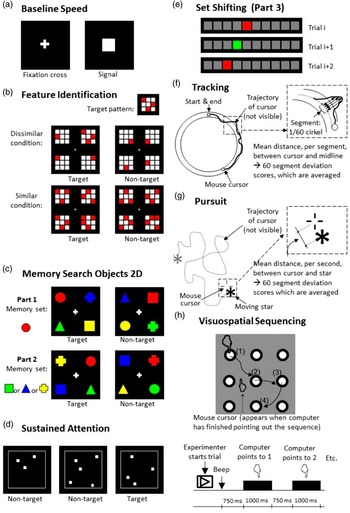
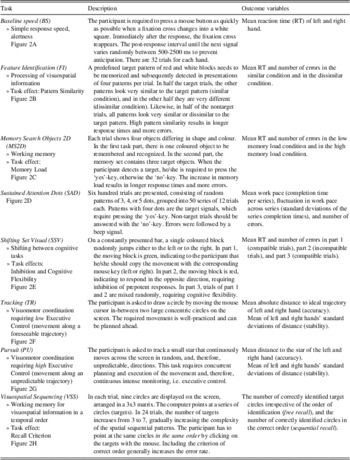
The computerized Amsterdam Neuropsychological Tasks (ANT) program was used, which provides for highly standardized assessments and automated recording of responses (De Sonneville, Reference De Sonneville1999). The program manipulates task load that is associated with specific aspects of information processing and EF, to examine whether increased demands on these functions differentiate survivors from controls. We focused on complexity of information processing, working memory load, executive control of visuomotor performance, inhibition, and cognitive flexibility. A significant Task Manipulation × Group interaction indicates that the effect of the increased demand on a particular cognitive function differs between groups (e.g., an increase in memory load results in a higher increase in number of errors in patients than in controls). The ANT subtasks are described in Table 1 and illustrated in Figure 2.
Illustration of subtasks of the Amsterdam Neuropsychological Tasks.

Description of the tasks of the Amsterdam Neuropsychological Tasks program

The ANT program has proven to be helpful in defining neurocognitive deficit profiles in various clinical domains associated with generally diffuse impact on the brain (Buizer, de Sonneville, van den Heuvel-Eibrink, & Veerman, Reference Buizer, de Sonneville, van den Heuvel-Eibrink and Veerman2005; De Sonneville et al., Reference De Sonneville, Boringa, Reuling, Lazeron, Ader and Polman2002; Huijbregts, Swaab, & de Sonneville, Reference Huijbregts, Swaab and de Sonneville2010; Huijbregts, De Sonneville, Van Spronsen, Licht, & Sergeant, Reference Huijbregts, De Sonneville, Van Spronsen, Licht and Sergeant2002; Mennes et al., Reference Mennes, Stiers, Vandenbussche, Vercruysse, Uyttebroeck, De Meyer and Van Cool2005). The norm data of the ANT show that from the age of 40, increasing age is associated with worse performance on inhibition, cognitive flexibility, executive visuomotor control, and information processing speed (De Sonneville, Reference De Sonneville2014). The reliability and validity of these tasks have extensively been described elsewhere (De Sonneville, Reference De Sonneville2014; Gunther, Herpertz-Dahlmann, & Konrad, Reference Gunther, Herpertz-Dahlmann and Konrad2005). Test stimuli were presented at a desktop computer. The participants used right and left mouse buttons to respond as instructed. Practice runs preceded all test trials. Assessments were conducted by licensed and trained neuropsychologists and scheduled at the participants’ convenience, avoiding interference by fatigue or other distress. Two controls and one survivor did not finish all subtests due to limitations in available time.
Furthermore, all participants were assessed with a short form of the Wechsler Adult Intelligence Scales (WAIS) III (Wechsler, Reference Wechsler1997) consisting of Vocabulary, Similarities, Block Design, and Picture Completion. Based on these four subtests, we estimated the full-scale IQs.
Statistical Analyses
SPSS (version 22; SPSS Inc., Chicago, IL) was used for statistical analyses, comparing survivors and controls. Because of differences in mean age, age at assessment was included as a covariate in all analyses. Group differences were analyzed using (multivariate) analysis of variance [(M)ANOVA] with Group as between-subjects factor and the ANT parameters as dependent variables. For the sustained attention task, response speed, variability of speed, and number of errors were analyzed in a MANOVA. The results of tasks Feature Identification, Memory Search 2D Objects, Set Shifting Visual, and Visuospatial Sequencing were analyzed using separate runs of repeated measures ANOVA, with Group as between-subjects factor and Task Manipulation as within-subjects factor. The within-subjects factors were: Pattern Similarity (FI, similar vs. dissimilar), Memory Load (MS2D, low vs. high), Inhibition [SSV, required (part 2) vs. not required (part 1)], Cognitive Flexibility [SSV, required (part 3, compatible condition) vs. not required (part 1)], and Recall Criterion (VSS, free vs. sequential). The tasks Pursuit and Tracking are regarded as two conditions of visuomotor coordination differing in demand on executive control, which were, therefore, entered as levels of a within-subjects factor (Executive Visuomotor Control).
For each ANOVA, the F-statistic with its degrees of freedom, p-value, and effect size (ηp 2) are reported (weak effect: ηp 2>0.03; moderate: ηp 2>0.06; large: ηp 2≥0.14) (Stevens, Reference Stevens1986). Two-sided p-values <.05 were regarded significant.
Gender differences were analyzed by entering Gender and Group as between-subjects factors, and either an ANT parameter as dependent variable in a univariate ANOVA, or the levels of a task manipulation as a within-subjects factor, and calculating the Gender×Group (×within-subjects factor) interaction.
Age at assessment, age at diagnosis, gender, dose CRT, and dose MTX IT, were entered in linear regression models for each ANT parameter that showed a significant group difference. Interaction terms were considered, but sample size was not sufficient. The significance, R2, and betas are reported of the models containing all predictors. Scatterplots of significant correlations were inspected for spuriousness. Single cases that caused spurious correlations were excluded from that particular analysis. In all analyses involving age at diagnosis, the relapsed patients were excluded due to their double age at diagnosis.
Results
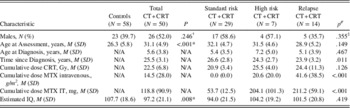
Subject characteristics and dosages of treatment are presented in Table 2. The estimated IQs of the irradiated survivors were on average significantly lower than controls’ (F(1,103)=7.294; p=.008; ηp 2=.067). The mean of the Standard Risk group differs significantly from controls’ (p<.01), but the means of the other two subgroups do not.
Characteristics of the participating groups

N/A=not applicable; CT=chemotherapy; CRT=cranial radiotherapy; MTX=methotrexate.
† P value (two-sided) based on the χ2 test for comparing gender differences between controls and the total survivor group.
‡ P value (two-sided) based on the χ2 test for comparing gender differences between the three survivor subgroups.
* P value (two-sided) based on ANOVA for testing the difference between the means of controls and the survivor group.
# P values (two-sided) based on ANOVAs for testing the differences between the means of the three survivor subgroups on the demographic and treatment characteristics, unless indicated otherwise.
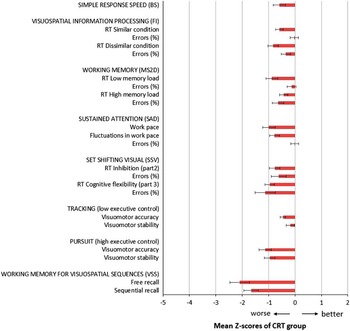
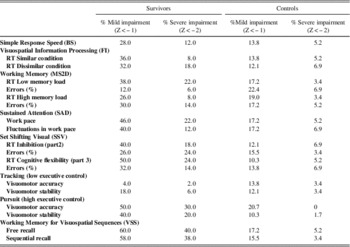
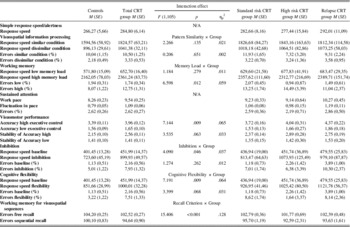
Mean Z-scores of all subtests, based on control group performance, are displayed in Figure 3. Mean Z-scores based on normative data from the ANT program are provided in Online Resource 1. Percentages of survivors and controls performing more than one and two standard deviations worse than average, based on control group performance, are displayed in Table 3. In Online Resource 2, these percentages based on normative data from the ANT program are provided. Statistics of interaction effects, and raw score means are shown in Table 4. In the absence of a (significant) interaction, the main effect of Group is reported in the text.
Mean Z-scores of the irradiated survivors on the tasks of the Amsterdam Neuropsychological Tasks program. Z-scores were computed based on control group performance.

Percentages of survivors and controls with mild (Z < –1) or severe (Z < –2) impairments on each of the subtasks of the Amsterdam Neuropsychological Tasks programFootnote *

* The Z-scores were based on control group performance.
Statistics of the (repeated measures) ANOVAs comparing survivors and controlsFootnote *

* Age at assessment was a covariate appearing in the models, and was evaluated at the value of 28.5064.
Simple Response Time
Irradiated survivors responded significantly slower than controls (F(1,105)=4.514; p=.036; ηp 2=.041). The means of all (sub)groups are displayed in Table 4.
Visuospatial Information Processing
An increased level of complexity of visuospatial information did not differentially affect performance of survivors and controls (see Table 4). Survivors responded generally slower (F(1,105)=8.194; p=.005; ηp 2=.072), but did not make more errors (F(1,105)=0.528; p=.469; ηp 2=.005)
Working Memory
The groups performed similarly when memory load was low, but survivors made more errors than controls when memory load was high (see Table 4). Survivors were significantly slower (F(1,105)=4.506; p=.036; ηp 2=.041), but differences between groups did not increase with memory load (see Table 4).
Sustained Attention
The MANOVA showed that survivors’ sustained attention was overall worse than controls. Survivors’ work pace was significantly lower (F(1,105)=13.388; p<.001; ηp 2=.113), fluctuation in work pace was significantly higher (F(1,105)=12.728; p=.001; ηp 2=.108), but survivors did not make more errors than controls (F(1,105)<0.001; p=.989; ηp 2<.001).
Executive Control of Visuomotor Performance
Visuomotor performance of survivors was less accurate than controls, and differences were larger in the high executive control condition (see Table 4). Visuomotor stability showed a trend for the interaction (see Table 4).
Inhibition
Survivors responded significantly slower than controls, in particular when prepotent responses had to be inhibited (see Table 4). Regarding accuracy, the difference between survivors and controls showed a statistical trend for the main effect (survivors made slightly more errors in both task conditions, [F(1,105)=3.076; p=.082; ηp 2=.028)], but there was no significant interaction effect (see Table 4).
Cognitive Flexibility
Survivors responded slower than controls and differences in speed increased when switching between response sets was required (see Table 4). There was a statistical trend for the interaction, indicating that survivors’ error rate tended to increase more than controls’ when flexibility was required (see Table 4).
Working Memory for Visuospatial Sequences
Free recall of survivors was significantly worse than of controls, and the difference in error rate further increased in the sequential recall condition (see Table 4).
Linear Regression Models of Patient Factors
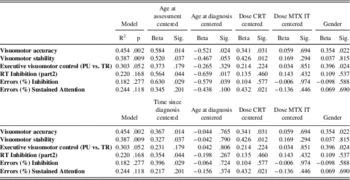
Linear regression models consisting of Age at Assessment, Age at Diagnosis, gender, dose CRT and dose MTX IT predicting neuropsychological performance are reported in Table 5. The significant coefficients for Age at Assessment on visuomotor control and inhibition indicate that older age is associated with poorer performance. Entering Time since Diagnosis into the same models instead of Age at Assessment caused the coefficient of Age at Diagnosis to lose significance, illustrating that using Time since Diagnosis masks the effect of Age at Diagnosis.
Linear regression models of patient factors

Note. PU=Pursuit; TR=Tracking.
Gender Differences
Gender differences were only found for the executive control visuomotor task. Female survivors performed significantly worse than males on visuomotor accuracy [F(1,103)=16.535; p<.001; ηp 2=.138]. To verify whether the vulnerability of women was associated with visuomotor skills or with executive control, the interaction between the within-subjects factor Executive Visuomotor Control, and Gender and Group was investigated. There were significant interaction effects for Executive Visuomotor Control×Gender×Group [F(1,100)=4.186; p=.043; ηp 2=.040], Executive Visuomotor Control×Gender [F(1,100)=16.836; p<.001; ηp 2=.144], and Executive Visuomotor Control×Group [F(1,100)=11.778; p=.001; ηp 2=.105]. These outcomes suggest that poorer performance of the survivor group on the high executive control visuomotor task is largely explained by female vulnerability in the domain of executive control. Of female survivors, 50% performed more than 1,5 SD below average, versus 5.7% of female controls. In men, these percentages were 15.4% of male survivors, versus 4.3% of male controls.
Discussion
Cranially irradiated survivors of pediatric lymphoid malignancies displayed multiple EF deficits. Response speed was significantly decreased, irrespective of the task at hand. Processing of complex visuospatial information was not affected. The survivors made disproportionally more errors in task conditions wherein memory load was increased, reflecting decreased capacity, specifically in visuospatial and sequential working memory. Furthermore, survivors displayed significant deficiencies in inhibition and cognitive flexibility. Visuomotor coordination skills were relatively intact, but performance of female survivors worsened under high levels of executive control, which was not observed in male survivors. Additionally, survivors’ significantly higher fluctuations in work pace during sustained attention reflect attentional fluctuations. Inflexibility, disinhibition, and attentional fluctuations have failing executive control in common.
IQs are known to drop significantly after CRT (e.g., Edelstein et al., Reference Edelstein, D’Agostino, Bernstein, Nathan, Greenberg, Hodgson and Spiegler2011), which was confirmed by our finding that the estimated IQs were significantly lower in our survivor group than in controls. This was clearly reflected in the Standard Risk group, but it was noted that the estimated IQs of the High Risk and Relapse groups were higher than the Standard Risk group, and only the Standard group’s average estimated IQ was significantly lower than controls’. The High Risk group and the Relapse group were quite small, which could suggest issues of representativeness. The High Risk group might have been a coincidental selection of high performing individuals. Furthermore, it should be kept in mind that we based our estimations of the full-scale IQs on Vocabulary, Similarities, Block Design, and Picture Completion, and as such did not include subtests of processing speed and/or working memory. Therefore, all survivors’ estimated IQs might be overestimations of the full-scale IQs.
It is important to realize that survivors with focal neuropathology were excluded from the study. As this type of pathology may likely be attributable to prior CRT, the exclusion has probably resulted in an underestimation of the severity of executive dysfunctions in this patient population.
Younger age at diagnosis and older age at assessment were found to be associated with worse response speed and accuracy of inhibition, and worse executive visuomotor control. Female gender and higher dose CRT were additional risk factors for executive visuomotor control. Furthermore, dose CRT was a risk factor for accuracy on sustained attention. Although the subgroups differed significantly on treatment doses of IT methotrexate, we have found no indications of dose effects of MTX. Presumably, these can be found in survivors treated with chemotherapy only (Buizer et al., Reference Buizer, de Sonneville, van den Heuvel-Eibrink and Veerman2005), but these effects could be nullified by the much larger effects of CRT.
Although our outcomes cannot be directly compared with the studies of Krull (Krull et al., Reference Krull, Brinkman, Li, Armstrong, Ness, Srivastava and Hudson2013), Armstrong (Armstrong et al., Reference Armstrong, Reddick, Petersen, Santucci, Zhang, Srivastava and Krull2013), and Edelstein (Edelstein et al., Reference Edelstein, D’Agostino, Bernstein, Nathan, Greenberg, Hodgson and Spiegler2011) because they used different neuropsychological tests, several outcomes seem to be remarkably different. The other studies described deficits in working memory as mild, whereas the deficiency in visuospatial sequential working memory in our cohort is moderate to severe. Possibly, the visuospatial and sequential elements tap into specific weaknesses within the working memory domain not assessed in the other studies. Also, contrary to Edelstein who found an association between age and accuracy measures but not processing speed, we found this association both with response times and accuracy (of inhibition). Furthermore, our study is the first to measure inhibition objectively (vs. based on self-reports) in this population, and also demonstrates a significant aging effect in this domain. Additionally, our study showed a remarkably high deficiency rate in female survivors regarding executive (visuomotor) control (50%), not observed in other studies.
On executive visuomotor control and inhibition, an aging effect was visible in our survivor group. In other subdomains of EF, such as working memory or flexibility, these effects could not be established in our study, but cannot be ruled out. In any case, the debilitating effect seems largest when aspects of executive control and visuomotor control are combined. This might be important to consider in choosing and evaluating interventions.
Remarkably, visuospatial processing speed was not associated with aging in our survivor group. These findings show parallels with a study where the ANT program demonstrated that visuospatial information processing was relatively less affected in multiple sclerosis patients (De Sonneville et al., Reference De Sonneville, Boringa, Reuling, Lazeron, Ader and Polman2002). MS patients and irradiated survivors have white matter disease in common (Schuitema et al., Reference Schuitema, Deprez, Van Hecke, Daams, Uyttebroeck, Sunaert and de Sonneville2013). The suggested explanation was that this type of task mainly requires automatic (implicit) rather than controlled (explicit) information processing (i.e., requiring less mental effort), and that automatic processing has been demonstrated to be less susceptible to white matter disease (Grafman, Rao, Bernardin, & Leo, Reference Grafman, Rao, Bernardin and Leo1991; Hasher & Sacks, Reference Hasher and Sacks1987; Krupp, Elkin, Strober, Scherl, & Cianciulli, Reference Krupp, Elkin, Strober, Scherl and Cianciulli2001; Mulder, Reference Mulder1986). This again confirms the vulnerability of the executive control domain.
Clinical Implications
If the brain ages prematurely, the general risk of developing dementia will emerge at an earlier age in irradiated survivors, translating into an increased risk of developing early-onset dementia. Therefore, clinicians should be alert to cognitive decline occurring faster than expected and starting at a younger age than expected.
The hypothetical deterioration of executive control may influence many aspects of behavioral and emotional regulation. A lack of inhibition could translate into social behavioral problems, such as doing before thinking. Such problems could have implications for appropriate demeanor at the workplace or in social relationships, as frequently reported by attention deficit hyperactivity disorder (ADHD) patients (Harpin, Reference Harpin2005). As this type of problem is quite invasive, this could hypothetically lead to an increasing demand on (psychological) health care, which should be anticipated. Although, to the best of our knowledge, it has never been studied how declining behavioral regulation combined with deficient visuospatial working memory (the two most salient deficits) would transfer to activities of daily living, these deficits could hypothetically result in difficulty with learning new motor skills at older ages (Anguera, Reference Anguera2008). Therefore, careful monitoring of the development of these functions seems warranted and neuropsychological training should be offered when indicated. However, considering our finding that 50% of female survivors already show a deficit in visuomotor control now, and future decline is likely, prophylactic neuropsychological training for all female survivors might be more efficient.
However, professionals should be aware of the fact that there is an increased, and growing, chance of structural abnormalities in the brain, such as meningiomas or cavernomas, that could be a differential cause of cognitive complaints (Hijiya et al., Reference Hijiya, Hudson, Lensing, Zacher, Onciu, Behm and Pui2007; Jain et al., Reference Jain, Robertson, Gandhi, Gujar, Muraszko and Gebarski2005). Therefore, radiological assessment should be considered before turning to neuropsychological interventions.
In research on traumatic brain injury, several studies reported beneficial effects of interventions on deficits in executive control (Cicerone et al., Reference Cicerone, Langenbahn, Braden, Malec, Kalmar, Fraas and Ashman2011; Kennedy et al., Reference Kennedy, Coelho, Turkstra, Ylvisaker, Moore Sohlberg, Yorkston and Kan2008). Especially multifaceted treatment aimed at, for example, self-monitoring, self-inhibition, and flexibility seem to have beneficial effects on EF in daily life (Spikman, Boelen, Lamberts, Brouwer, & Fasotti, Reference Spikman, Boelen, Lamberts, Brouwer and Fasotti2010; Ylvisaker & Feeney, Reference Ylvisaker and Feeney2009). In research on ADHD, working memory could be improved by training, and effects have been shown to be transferrable to non-trained tasks (Klingberg, Reference Klingberg2010; Klingberg et al., Reference Klingberg, Fernell, Olesen, Johnson, Gustafsson, Dahlstrom and Westerberg2005; Klingberg, Forssberg, & Westerberg, Reference Klingberg, Forssberg and Westerberg2002). It should be noted, however, that these transfer effects were mostly limited to similar tasks, or measured by self-reports or parent behavior ratings (e.g., Klingberg et al., Reference Klingberg, Fernell, Olesen, Johnson, Gustafsson, Dahlstrom and Westerberg2005). The potential effects of such interventions might, however, be amplified by aerobic exercise which is generally believed to support healthy brain aging and attenuate the progression of cognitive decline, notably in executive control (Colcombe et al., Reference Colcombe, Kramer, Erickson, Scalf, McAuley, Cohen and Elavsky2004; Guiney & Machado, Reference Guiney and Machado2013; Hayes, Hayes, Cadden, & Verfaellie, Reference Hayes, Hayes, Cadden and Verfaellie2013; Padilla, Perez, & Andres, Reference Padilla, Perez and Andres2014; Smith et al., Reference Smith, Blumenthal, Hoffman, Cooper, Strauman, Welsh-Bohmer and Sherwood2010). Future research needs to verify whether these interventions can be beneficial for survivors of pediatric lymphoid malignancies. Additionally, brain tumor survivors might benefit from such interventions, as their treatment is still mainly comprised of (even higher doses of) CRT.
Methodological Considerations
Our methodology demonstrated that age at diagnosis and age at assessment have independent effects on cognitive outcome in survivors. By using time since diagnosis in studying the effects of aging, the significances of both the aging-effect and the effect of age at diagnosis are being suppressed. Therefore, the use of age at assessment controlled for age at diagnosis is recommended for studying effects of aging. This is probably a principle applicable to other areas of research too.
A strength is the use of a control group consisting of siblings, partners, and friends, which enabled us to compare raw scores instead of only using normative data. A limitation is that the data are cross-sectional. The progression of cognitive deficits should be studied longitudinally to confirm the notion of premature (accelerated) aging.
Acknowledgments
We thank our consulting statistician, Prof. P.M. Kroonenberg (Leiden University). Funding: This work was supported by a grant to Leo de Sonneville, Anjo Veerman and Cor van den Bos from the Dutch Cancer Society (grant number UL 2006-3630). The funding sources had no role in study design, the collection, analysis, and interpretation of data, the writing of the article, and the decision to submit for publication. Potential conflict of interest: Leo de Sonneville has a consulting role at Friesland Campina, Nutricia Research (Danone). He received honoraria as well as money for travel/ accommodations/ expenses. Leo de Sonneville is director of the company Sonares B.V. This company commercially distributes the ANT program, the neuropsychological test battery used in this study. Cor van den Bos has received research funding from Mediac through his institution. Gertjan Kaspers has consulting roles at Galen Ltd., Boehringen Ingelheim and Celgene. From all three companies he received money for travel/accommodations/expenses. From Galen Ltd., he also received honoraria.
Supplementary Material
To view supplementary material for this article, please visit http://dx.doi.org/10.1017/S1355617715000788