INTRODUCTION
As a participant in the UK Working Party on Pesticide Usage Surveys, the Agri-Food and Biosciences Institute (AFBI), on behalf of the Department of Agriculture and Rural Development for Northern Ireland (DARDNI), conducted a programme of surveys to examine pesticide usage in all sectors of the agricultural and horticultural industry. Principally, the data collected provide information for consideration by the Advisory Committee on Pesticides. In addition, the information may be used by those involved in residue testing, for public information and to evaluate the impact of policy and trends in pesticide usage.
The annual output value of the Northern Ireland sheep industry is approximately £60 million, comprising a population of approximately 2·1 million sheep and 8822 farms (Anon. 2005). Previous surveys of pesticide usage in the Northern Ireland sheep industry have demonstrated that considerable quantities of active ingredients were applied during annual ectoparasite control practices (Jess & Marks Reference Jess and Marks1986; Foy et al. Reference Foy, Clenaghan, Jess, Mitchell, Best and Ruthven1995; Jess et al. Reference Jess, Kidd, McCallion and Matthews2000). Data from the most recent of these surveys are included in the report for comparative purposes.
The revocation of compulsory sheep dipping in 1993 impacted significantly on subsequent ectoparasite control methods and consequent pesticide usage (Jess et al. Reference Jess, Kidd, McCallion and Matthews2000). Since the previous survey in 1997, issues of concern relating to the rural environment, health, safety and animal welfare led the government to introduce a code of practice for both the safe operation of dipping practices and disposal of the spent chemicals (Anon. 2001). In addition, the available number and range of products recommended for the control of ectoparasites have continually decreased. Furthermore, the application methods for these products may also undergo change. Therefore, it is essential that these husbandry practices, which may impact on the local environment, are monitored to facilitate the formulation of policy for ectoparasite control on agricultural livestock.
MATERIALS AND METHODS
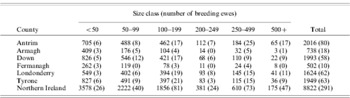
Using the Northern Ireland Agricultural Census, June 2004 (Anon. 2005), a sample of farms to be surveyed was randomly selected from each of the six counties. The sample was further stratified into six size groups based on the number of breeding ewes. Farms selected in the original sample which were unable to provide data were replaced with those from the same county and size group. A total of 291 farms were selected (representing approximately 0·03 of the sheep farm population in Northern Ireland) and visited between November 2005 and February 2006 (Table 1).
Total number of sheep farms in Northern Ireland 2005 surveyed, categorized by flock size class of breeding ewes (number of farms surveyed in parentheses)

The purpose of the survey was explained to selected farmers in preliminary correspondence and data were collected by personal interview. The data collected related to the number of breeding ewes, replacement ewes, rams and lambs produced in 2005. Animal husbandry practices, treatment methods, applicator types, application rates and disposal practices were also recorded. The farmers' perceived reasons for treatment were also included, but may not always seem appropriate. The collected data were analysed using Microsoft Excel and SPSS software.
RESULTS
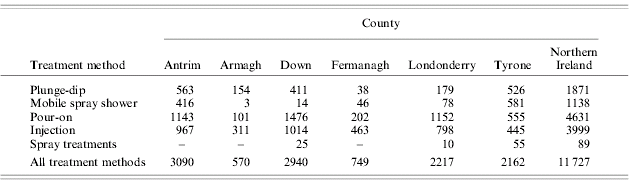
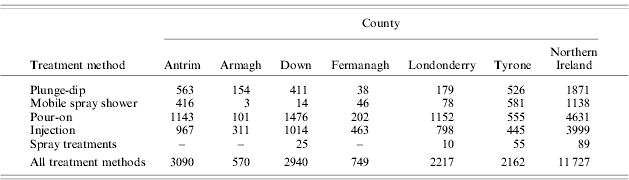
Overall, a majority of sheep farms in the province controlled ectoparasites by applying treatments as pour-on (0·39) or injectable (0·34) formulations (Table 2). Fewer farms employed plunge-dipping (0·16) or communal spraying (0·1) methods for ectoparasite control on sheep. The use of the different control methods was more evenly distributed in County Tyrone, whereas farmers in Counties Down and Londonderry used pour-on treatments most frequently. Farmers in County Armagh preferred injectable treatments but also maintained a relatively high level in the use of plunge-dipping.
Number of farms in county regions employing different treatment methods for the control of ectoparasites on sheep
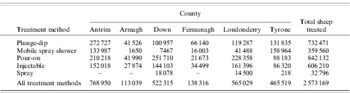
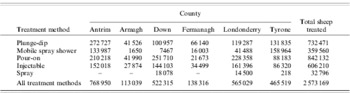
An estimated 0·28 of the sheep population treated for ectoparasites received plunge-dipping while 0·33 and 0·24 received pour-on and injectable treatments, respectively (Table 3). A further 0·14 of sheep treated received spray applications in a mobile spray facility operated by local contractors. A greater proportion of sheep received plunge-dipping treatments in Counties Fermanagh (0·48), Armagh (0·37) and Antrim (0·35). In Counties Down (0·48) and Londonderry (0·40), proportionally more sheep received pour-on treatments and 0·37 of sheep in County Armagh were also treated by this application method. Communal spray treatments were principally applied to sheep in Counties Tyrone and Antrim.
Number of sheep in county regions receiving treatment to control ectoparasites, categorized by treatment method
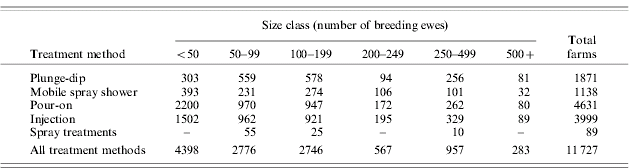
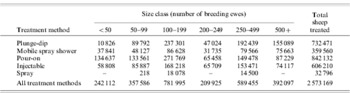
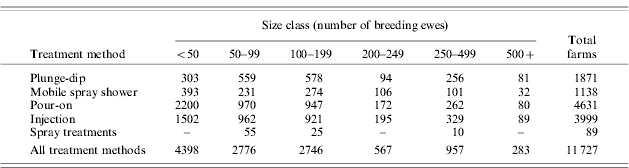
Pour-on treatments were used more frequently on farms with smaller flock sizes of less than 200 sheep and an estimated 0·5 of all applications in flock sizes of less than 50 sheep were pour-on treatments (Tables 4 and 5). Frequencies of injectable and spray shower treatments were more evenly distributed across all flock size categories with a tendency for more spray shower treatments on farms with flock sizes of 200–250 sheep. Plunge-dipping was used most frequently within the larger flock sizes and, in particular, flock sizes exceeding 500 sheep. Nonetheless, more than 0·2 of sheep farms in the 50–100 and 100–200 flock size categories used this application method for sheep treatment.
Effect of flock size on the selection of treatment methods for the control of ectoparasites on sheep, categorized by flock size class of breeding ewes
The total number of sheep in each flock size group receiving treatment for ectoparasites, categorized by treatment method

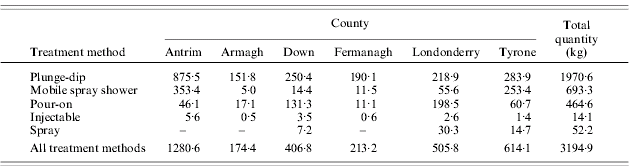
Plunge-dipping accounted for 0·62 of the total quantity of pesticide active ingredient applied to sheep during ectoparasite control treatments. A further 0·22 was applied during communal spray shower and 0·15 applied in pour-on treatments (Table 6). Owing to the relatively low recommended dose rates for injectable formulations, treatments in this category represented only 0·004 of the total pesticide active ingredients.
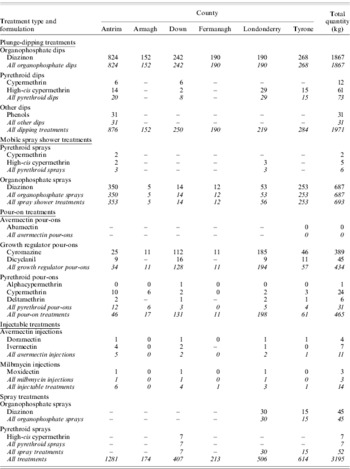
Pesticide usage (kilograms of active ingredients) on sheep farms in different counties categorized by treatment method
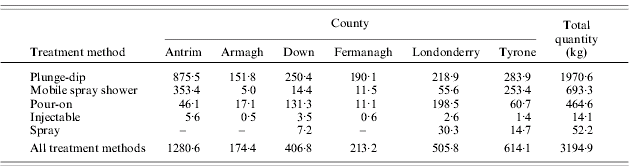
Regionally, County Antrim, which represented 0·28 of the total sheep population, accounted for 0·4 of the total quantity of pesticide active ingredients used, including 0·44 and 0·51 of the quantities of active ingredients used for plunge-dipping and communal spray showers, respectively. County Londonderry, representing 0·16 of the total sheep population accounted for 0·43 of the quantity of active ingredients used for pour-on applications.
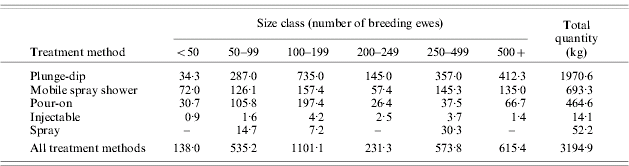
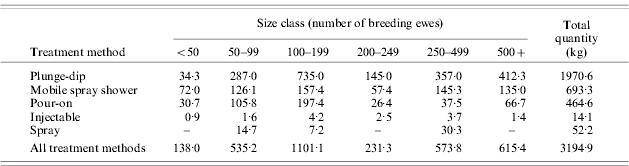
Overall, the quantity of pesticide used for the control of ectoparasites on sheep approximated to flock size (Table 7). However, farms with flock sizes of 100–200 sheep accounted for 0·37 of the quantity of pesticides used in plunge-dipping and 0·42 of that used for pour-on treatments.
The quantity of pesticides (kilograms of active ingredients) used in each flock size class, categorized by treatment method
Treatment types
An estimated 0·28 of all sheep treated in Northern Ireland in 2005 received plunge-dip treatment (Table 8). A further 0·14 received treatments using a spray shower while 0·33 received pour-on treatments and 0·24 received injections to control ectoparasites.
Number of sheep in county regions treated with pesticide formulations, categorized by application method

Of those sheep dipped, 0·84 received treatments containing organophosphate active ingredients while the remaining 0·16 were treated in dips containing pyrethroids. Products containing organophosphate active ingredients were also most commonly used in spray showers accounting for 0·94 of all sheep treated by this method with products containing pyrethroids accounting for the remaining 0·06.
An estimated 0·77 of pour-on formulations applied to sheep contained pyrethroid active ingredients. A further 0·23 received products containing growth regulators and less than 0·01 of sheep were treated with pour-on formulations containing avermectins. For those sheep receiving injections to control ectoparasites, an estimated 0·62 were administered avermectins with the remaining 0·38 receiving milbmycin products.
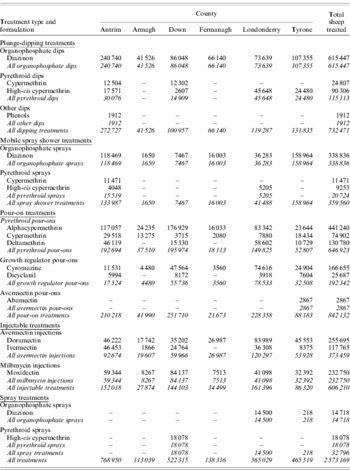
The organophosphate diazinon accounted for an estimated 0·95 of active ingredients used for dipping sheep and 0·99 of those used in spray showers (Table 9). The growth regulator cyromazine represented 0·84 of the quantity of active ingredients applied in pour-on treatments. An estimated 0·23 of sheep treated with pour-on formulations received products containing growth regulators accounting for 0·93 of the pour-on active ingredients applied. Cyromazine (0·9) and dicyclanil were the only two growth regulator active ingredients used by farmers during this period. Conversely, the remaining 0·77 of sheep received pour-on treatments containing pyrethroid formulations, accounting for 0·07 of the quantity of pour-on active ingredients used.
Pesticide usage (kilograms of active ingredients) on sheep farms in different counties, categorized by method of application

Avermectins represented 0·79 of the quantity (0·62 of sheep treated) of active ingredients applied by injection, with ivermectin the most commonly used. The only milbmycin recorded used in this survey was moxidectin.
Overall, when pyrethroids were applied, the active ingredient alphacypermethrin was the most frequently used (0·55 of sheep treated with pyrethroids), accounting for only 0·01 of the quantity of pyrethroid active ingredients used. Conversely, high-cis cypermethrin was used on 0·15 of the sheep treated with pyrethroids and accounted for 0·62 of the quantity of all pyrethroids applied.
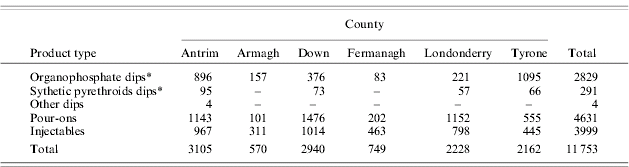
Organophosphorus (OP) active ingredients were most frequently used in plunge-dipping treatments (Table 10). Of the farms that used OP products in plunge-dippers and spray showers, 0·39 were used in County Tyrone and 0·32 in County Antrim. Synthetic pyrethroid products were not used for dipping/showering sheep in all counties. County Antrim accounted for 0·33, County Down for 0·25, County Tyrone for 0·23 and County Londonderry for 0·2 of usage of pyrethroid dipping products used for ectoparasite control.
Number of sheep farms in different counties categorized by product type used for treatment of ectoparasites
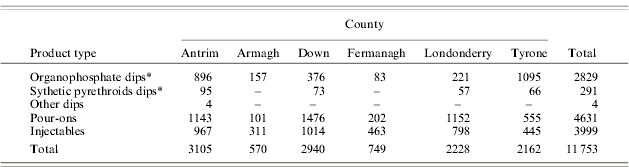
* Includes spray shower products as all products used were plunge-dipping products.
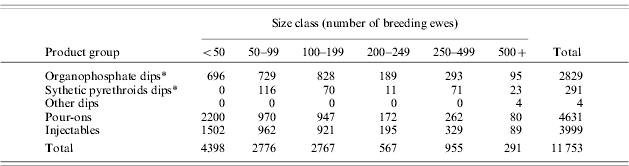
An estimated 0·8 of sheep dipping treatments containing OP dip products were used on farms with flock sizes of less than 200 sheep (Table 11).
Number of sheep farms in different counties categorized by product type used for treatment of ectoparasites
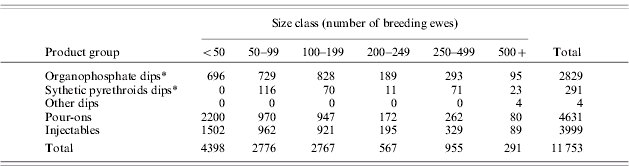
* Includes spray shower products as all products used were plunge-dipping products.
Reasons for use
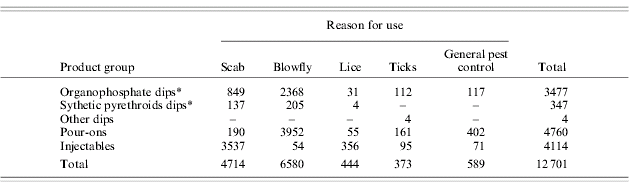
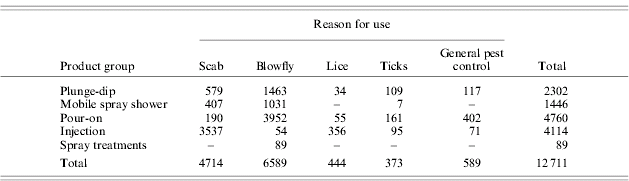
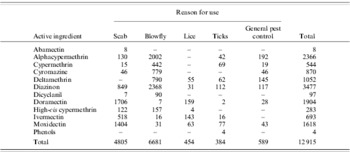
Blowfly maggots (0·52) and scab prevention (0·37) were the main reasons given by farmers for applying treatments to sheep (Tables 12 and 13). Of the farms that used OP dips/showers as a control method for ectoparasites, 0·68 were treating to control blowfly maggots, with 0·24 of farms citing scab prevention as a reason for use of organophosphates. An estimated 0·86 of all injectable treatments were for scab prevention. An estimated 0·83 of all pour-on treatments were applied to control blowfly maggots. Diazinon was the most frequently used active ingredient, principally to control blowfly maggots and was applied to control all ectoparasite types (Table 14). Alphacypermethrin was also frequently used to control blowfly maggots. Doramectin and moxidectin were the main active ingredients given for scab prevention/control.
Reasons for use of treatments for ectoparasites on sheep categorized by product types
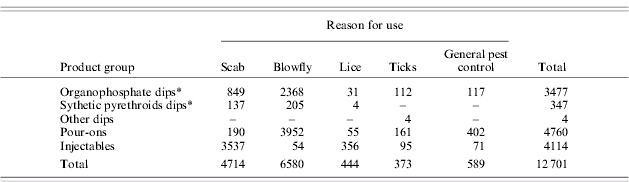
* Includes spray shower products as all products used were plunge-dipping products.
Reasons for use of treatments for ectoparasites on sheep categorized by treatment method
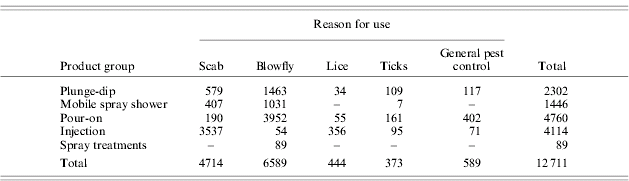
Reasons for use of treatment for ectoparasites categorized by active ingredient applied

Treatments to prevent or control scab were applied in every month of the year with 0·69 of the treatments occurring in the autumn months of September, October and November. An estimated 0·92 of all treatments to control blowfly maggots were applied in the summer months of June, July and August.
Dipping practices
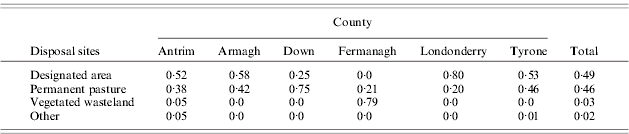
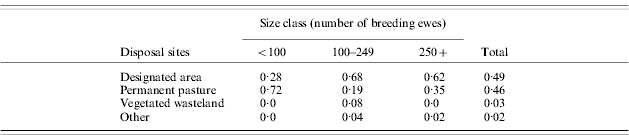
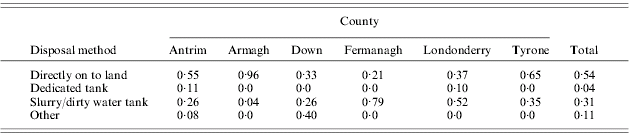
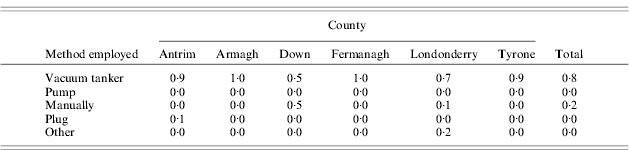
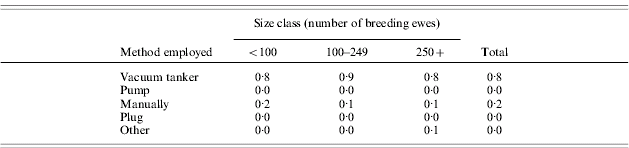
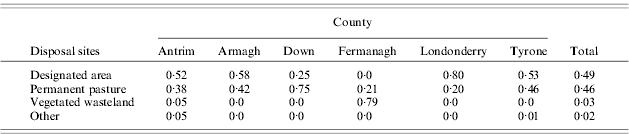
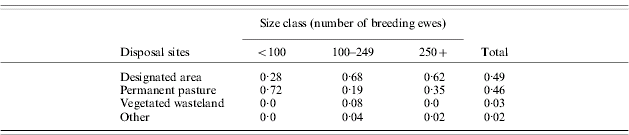
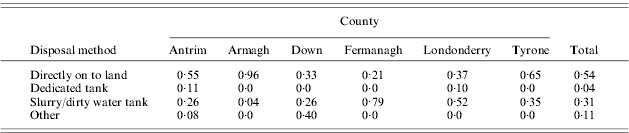
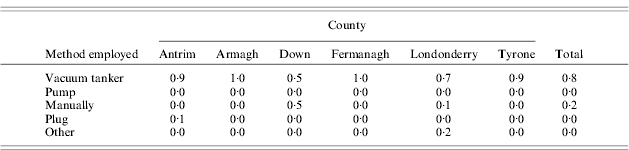
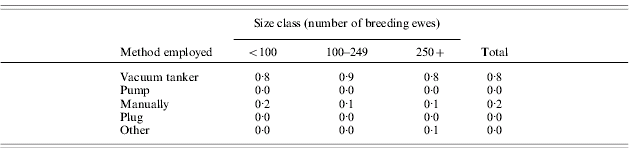
An estimated 0·68 of plunge-dippers were emptied immediately after use (Table 15). Approximately 0·49 of farmers disposed of spent dip on to designated areas, 0·46 on to permanent pasture and 0·03 on to wasteland (Tables 16 and 17). After emptying the dipper, 0·54 of farmers spread the dip wash directly on to land, 0·04 stored it in a dedicated tank to dispose of at a later date, 0·31 disposed of it into a slurry/dirty water tank to be disposed of on to land later and the remaining 0·11 used other methods of disposal (Table 18). An estimated 0·8 of all plunge-dippers were emptied using vacuum tankers, 0·15 were emptied manually, 0·01 using a pump and 0·02 used a plug to empty the dipper (Tables 19 and 20).
Frequency of the timing of dip disposal following sheep dipping in different counties in Northern Ireland 2005

Frequency of use of sites for disposal of spent sheep dips in different counties in Northern Ireland 2005
Frequency distribution of sites used for dip disposal within different flock size groups in Northern Ireland 2005
Spent dip disposal methods in different counties in Northern Ireland 2005
Methods employed to empty sheep dipping tanks in the county regions of Northern Ireland 2005
Methods employed to empty sheep dipping tanks in different flock size groups in Northern Ireland 2005
Approximately 0·73 of farms using plunge-dippers undertook their own disposal, with 0·21 using a contractor and 0·06 allowing a neighbour to dispose of the dip wash. An estimated 0·24 of farmers had been contacted by Department of Environment, Environment Heritage Service officials, 0·64 had not and 0·13 were non-respondents.
Comparison with previous survey in 1997
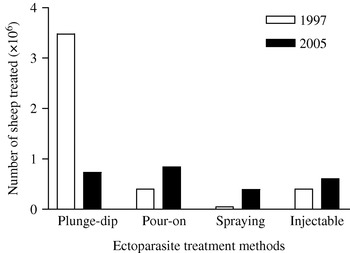
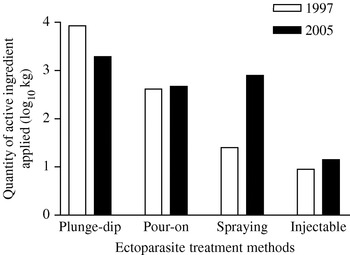
The total number of sheep farms in NI decreased by 25% between 1997 and 2005 with a similar decline in total sheep population. Between the two survey periods, the number of sheep treated with plunge-dips or spray showers decreased by 79% and the quantity of active ingredients used by 77% (Figs 1 and 2). Conversely, the number of sheep treated with pour-on formulations increased by over 100% and the quantity of associated active ingredients increased by 11%. The number of sheep treated by injection and quantity of active ingredients administered by this treatment method increased by 38 and 40% respectively, compared with 1997.
The number of sheep treated for ectoparasites using different control methods in Northern Ireland in 1997 and 2005.

The quantities of active ingredients used for the treatment of ectoparasites on sheep using different ectoparasite control methods in Northern Ireland in 1997 and 2005.

The proportion of sheep dipping or spraying treatments containing organophosphates increased from 0·79 to 0·84 while those containing pyrethroids increased from 0·09 to 0·16 between the two survey periods. An estimated 0·77 of pour-on treatments in 2005 contained pyrethroid active ingredients, compared with 0·25 in 1997. Conversely, 0·23 of pour-on treatments in 2005 contained growth regulators compared with 0·63 in 1997. While fewer sheep were treated with growth regulators in 2005 compared with 1997, the quantity of these active ingredients increased, suggesting either repeat applications or applications at higher rates.
The overall proportion of sheep receiving injections containing milbmycin increased from 0·04 in 1997 to 0·38 in 2005. There was a consequent reduction in sheep numbers treated with avermectins in 2005 compared with 1997.
DISCUSSION
Since the previous survey on sheep treatments in this region was undertaken in 1997 there have been a number of changes in the sheep industry (Jess et al. Reference Jess, Kidd, McCallion and Matthews2000). During the intervening period, the number of sheep farms and the total sheep population have decreased by 25%. In addition, environmental, health and food safety concerns have led to a reduction in chemicals available to control ectoparasites and increased restrictions on methods of disposal of spent chemicals.
The findings of the current paper suggest that sheep farmers in this region are disengaging from the traditional use of plunge-dipping for the control of ectoparasites, particularly in the smaller farm size groups. Initial evidence of this trend was recorded in a previous survey and it was considered that the amendment in 1993 of the Sheep Scab Order (Northern Ireland) 1970 was impacting on ectoparasite control practices (Jess et al. Reference Jess, Kidd, McCallion and Matthews2000). Subsequently, the temporary withdrawal of marketing authorizations for the distribution of sheep dip concentrates containing (OP) compounds in December 1999 and more recently those containing pyrethroid compounds, in February 2006, may also have had an effect. In addition, the introduction of stricter legislation on the disposal of spent sheep dip chemicals, for which farmers are required to have a groundwater authorization from the environment agencies before disposal of spent dip on their land, is another contributory factor (Anon. 2001). This may be particularly problematic for smaller farm sizes where suitable land for disposal is limited.
When compared with results from the previous survey in 1997, the current paper suggests not only a decline in plunge-dipping but also an increase in other methods of applications particularly pour-on treatments. The data indicated that the smaller farm size groups used pour-on formulations as the main application method, possibly due to the ease of application. However, the increase in pesticide usage associated with pour-on treatments may also be due, in part, to repeated applications. The efficacy of pour-on treatments is not well established with farmers, who expressed mixed opinions when discussing adequacy of coverage and persistence. However, contrary to some farmers' beliefs, pour-on treatments are effective against blowfly maggots and 0·6 of all treatments applied for blowfly maggots were pour-on formulations. An estimated 0·23 of the pour-on treatments used were insect growth regulators which have proven efficacy against blowfly maggots giving protection for 10–16 weeks, depending on type (Anon. 2006). Avermectins accounted for <0·01 of pour-on treatments, with the remainder comprising synthetic pyrethroids. Alphacypermethrin, applied as a pour-on formulation, was the active ingredient most frequently used, after diazinon, for blowfly maggot control providing protection for 8–10 weeks (Anon. 2006).
The increased use of communal spray showers is possibly a direct result of the disposal problem associated with spent plunge-dipping chemicals. As the units are mobile, this method is also more convenient for farmers with small flock numbers to use. Communal spray showers are designed to re-cycle excess pesticide throughout the spraying operation. Consequently, less pesticide is used during treatment with a subsequent reduction in the disposal requirements. The chemicals approved for plunge-dipping in the UK were not approved for use in spray shower equipment during the period of this report. The findings of the current paper indicate that the products being used by farmers for this method were products recommended for plunge-dipping only. All spray showering operations recorded in this survey were undertaken by contractors.
The organophosphate diazinon was the most commonly used active ingredient to control ectoparasites on sheep. However, since the previous survey in 1997, the number of farms overall using organophosphates have reduced. Principally, it is those farms with larger flock size groups that continue to use dips containing organophosphates suggesting that this is the most effective control method available to this particular group. This concurs with the findings of a previous study in England and Wales, which concluded that farmers with large flocks are more inclined to use OP dips as they offer the only effective method of controlling scab and have a broad spectrum of activity against other ectoparasites (Bates Reference Bates1993).
The use of injections of macrocyclic lactones with sheep farms in the region has also increased compared with the previous survey in 1997. One possible reason for this is that owing to the anthelminthic activity of macrocyclic lactones it is more cost effective for farmers, particularly those with small flocks, to use a single treatment to control both endo- and ectoparasites in their flocks.
As sheep scab is a notifiable disease in Northern Ireland, farmers were reluctant to acknowledge using treatments to ‘control’ scab and therefore their principal reason for treatment was as a preventative measure. Previously, the principal method for the prevention or control of this disease was to plunge-dip sheep in a solution containing organophosphates. The survey indicates a definite trend away from this practice towards the use of alternative methods including spray showers, pour-on formulations and injectable compounds.
The incidence of sheep scab disease in Northern Ireland flocks is relatively low but has been increasing since 2001. Should this trend continue, it may be necessary to review the effectiveness and sustainability of current control practices for ectoparasites of sheep.
The authors are grateful to the farmers who participated in the survey, without whose cooperation completion of the report would not have been possible. The assistance of Mr Thomas Keatings, Ms Heather Knowles and Ms Trudy-Ann Kelly during data collection and analyses was invaluable.