


1. INTRODUCTION
The nonlinear interaction of short-pulse high-intensity lasers with plasmas has been a subject of experimental and theoretical study due to its relevance to laser driven fusion and laser wakefield accelerators (Esarey et al., Reference Esarey, Sprangle, Krall and Ting1996). There are many different kinds of studies about the use of intense laser pulse or electron beam to excite large amplitude plasma wakes (Matlis et al., Reference Matlis, Reed, Bulanov, Chvykov, Kalintchenko, Matsuoka, Rousseau, Yanovsky, Maksimchuk, Kalmykov, Shvets and Downer2006). Large amplitude waves is a great source of energy in a multi-mode media such as plasma. The energy of these wakes can be used for different purposes as an example of inertial confinement fusion (ICF), particle acceleration or radiation (Sawan et al., Reference Sawan, Ibrahim, Bohm and Wilson2008; Barbiellini et al., Reference Barbiellini, Longo, Gardner and Omodei2008; Dorranian et al., Reference Dorranian, Ghoranneviss, Starodubtsev, Yugami and Nishida2005, Reference Dorranian, Ghoranneviss, Starodubtsev, Ito, Yugami and Nishida2004, Reference Dorranian, Starodubtsev, Kawakami, Ito, Yugami and Nishida2003). An interesting physical phenomena in laser plasma experiments is stimulated Raman scattering (SRS), where the incident laser light resonantly couples with an electron plasma wave, and a scattered light wave (Kline et al., Reference Kline, Montgomery, Rousseaux, Baton, Tassin, Hardin, Flippo, Johnson, Shimada, Yin, Albright, Rose and Amiranoff2009). From one point of view, SRS is a physical process that decreases the efficiency in ICF or particle acceleration experiments. From another point of view, Raman scattering such as harmonic generation or photon acceleration is a kind of coherent radiation mechanism of plasma, which can be used as a diagnostic tool in the laser and plasma interaction experiments (Kim et al., Reference Kim, Lee, Suk and Koa2003; Purohit et al., Reference Purohit, Sharma and Sharma2010). This possibility rise from the multi-mode nature of plasma and shows that plasma is a capable medium for converting the different initial energies into coherent radiation. Traditionally, the first view about the SRS has attracted more attention since in this case SRS can waste a large part of input energy and stop the experiment as an instability.
SRS is usually described as the decay of an incident electromagnetic pump wave into a longitudinal electrostatic plasma wave plus another scattered light wave with a downshifted/upshifted frequency (Stokes/Anti-Stokes). Scattered wave may propagate in the forward direction as same as the pump wave direction or backward direction that is in the opposite direction of propagation of the pump wave, which are known as Raman forward scattering (RFS) and Raman backward scattering (RBS), respectively. The conservation of energy and momentum in this decay is signified by the frequency and wave vector matching conditions ω0 = ω1 ± ωp and k0 = k1 ± kp, in which (ω0, k0), (ω1, k1), and (ωp, kp) describe the frequency and wave vector of pump beam, scattered light wave and plasma electron wave, respectively. Actually, in this mechanism, the pump beam is scattered by the electron-density perturbations of a plasma wave. The longitudinal plasma electron wave propagates in the direction of pump wave with the phase velocity of v p = cωp/2ω0 in which c is the speed of light in vacuum. Since this velocity is much smaller than c, plasma particles may be trapped by this wave and damp it down (Kruer, Reference Kruer1998; Yampolsky & Fisch, Reference Yampolsky and Fisch2009). The transferred energy from the wave to the particles accelerate them up to several MeV. Beating the pump wave and scattered light wave resonantly drives ponderomotive force in plasma, amplifies the plasma density perturbation, and finally will grow up as an instability in a feedback loop. In this process, indeed, the growth rate of RBS instability is greater than that of RFS instability (Barr et al., Reference Barr, Boyd, Gardner and Rankin1984; Kruer, Reference Kruer1998; Drake et al., Reference Drake, Kaw, Lee and Schmit1974).
In the earlier works, non-relativistic effects of RBS are presented for lower order computations or simulations. In most cases, the change in the state of the plasma, associated with the propagation of the laser beam, has been neglected (Winjum et al., Reference Winjum, Fahlen, Tsung and Mori2010; Mendonc et al., Reference Mendonc, Thide and Then2009; Michel et al., Reference Michel, Depierreux, Stenz, Tassin and Labaune2010). However, after employing the laser sources with higher peak power, investigating the instability with the effect of higher orders computation would be required beside the relativistic effects in the laser plasma experiments. Recently, the possibility of accelerating electrons up to GeV level has been investigated by using of a pettawatt laser focused in a uniform plasma in the linear and nonlinear regime. It was shown that the nonlinear effects become significant for higher laser amplitudes (Lifschitz et al., Reference Lifschitz, Faure, Malka and Mora2005). In collisionless plasmas, the nonlinearity arises through the ponderomotive force-induced redistribution of plasma (Sharma et al., Reference Sharma, Monika, Sharma, Chauhan and Ji2010; Mitsuo & Milos, Reference Mitsuo and Milos2010). This nonlinarity is very important in a laser fusion experiment where plasma blocks are generated and accelerated by the nonlinear ponderomotive force, which leads to the heating of the fuel in the fast ignition (Hora, Reference Hora2005, Reference Hora2009; Sadighi-Bonabi et al., Reference Sadighi-Bonami, Hora, Riazi, Yazdani and Sadighi2010). Magnetic fields play an important role in many nonlinear interactions such as excitation of an upper hybrid waves (UHW) for heating the plasma near upper hybrid frequency. When a laser beam propagates through the plasma embedded in a uniform magnetic field, the plasma electron motion will be modified due to the magnetic field, and it will gives rise to change in the dispersion of the laser beam and nonlinear current density, which leads to exciting the natural modes of the plasma (UHW) by a laser. The excited UHW transfers its energy to the plasma particles after Landau damping and leads to enhanced heating of the plasma (Purohit et al., Reference Purohit, Chauhan and Sharma2008, Reference Purohit, Chauhan and Sharma2009). The ultra-intense laser pulses, in excess of 1018 W/cm2, leads to relativistic electron motion in the laser field (Mourou et al., Reference Mourou, Tajima and Bulanov2006). The growth rate of RBS instability in an unmagnetized plasma is linearly calculated as ΓRBS = (k pv os/4)[ωp2/ωek (ω0 − ωek)]1/2, in which ωek = (ωp2 + 3k p2v th2/2)1/2 is the plasma wave frequency, v th is the thermal velocity of plasma electrons, and v os is the oscillation velocity of plasma electrons in the electric field of pump wave. In a cold plasma, this growth rate has the form of ΓBRS = (a 0ωp/4)[ωp/(ω0 − ωp)]1/2, where a 0 is the normalized vector potential. Required condition for this instability is that ω0 ≥ 2ωp i.e., n⪯n cr/4, where n cr is the critical density of plasma (Estabrook & Kruer, Reference Estabrook and Kruer1983; Kruer, Reference Kruer1998).
Guerin et al. (Reference Guerin, Laval, Mora, Adam and Heron1995) have studied Raman instabilities in the relativistic regime. They have derived the dispersion relation in one dimension in a dense plasma and have shown analytically and numerically that a relativistic electromagnetic wave is unstable in plasma.
Since in plasma, the magnetic field plays a crucial role in the dynamics of the laser beam propagation, so it is of a great current interest in laser plasma experiments and inertial confinement fusion. In the past, the effect of external magnetic field on the growth rate of RBS is investigated in several works. Grebogi and Liu (Reference Grebogi and Liu1980), considered propagation of an extraordinary electromagnetic pump wave incident on a magnetized plasma where the static magnetic field was in axial direction. Their results displayed that the RBS growth rate are practically unmodified in compared with the unmagnetized plasma. Salimullah et al. (Reference Salimullah, Liu and Haines1984), made a theoretical investigation about the stimulated Raman and Brillouin backscattering of laser radiation at the upper hybrid frequency in a laser-produced plasma. They ignored relativistic effects and employed a nonlinear Vlasov equation to obtain the growth rate of Raman and Brillouin backscattering in a plasma produced by CO2 and Nd-glass lasers. They found that the growth rate of both scattering processes increase with the self-generated magnetic field (on the order of a few megagauss). Sharma and Dragila (Reference Sharma and Dragila1988) developed Raman forward scattering in the presence of a background static magnetic field in a homogeneous plasma. They demonstrated that when the magnetic field is perpendicular to the direction of propagation of an elliptically polarized extraordinary wave, the growth rate of instability increases. Saini and Gill, (Reference Saini and Gill2004) applied a static magnetic field along the laser propagation direction. In that work, the authors studied the enhanced Raman scattering of a rippled laser beam in a magnetized collisional plasma. They concluded that a low magnetic field suppresses the scattered power, but the scattered power increases in a high magnetic field. A similar approach was taken by Gill and Saini, (Reference Gill and Saini2007). They employed an uniform transverse magnetic field to study the growing interaction of the rippled laser beam with upper hybrid mode leading to enhanced Raman scattering for collisional plasma. They demonstrated that any increasing in the strength of the magnetic field leads to substantial increase in the Raman scattered power. Hassoon et al. (Reference Hassoon, Salih and Tripathi2009) applied an extraordinary laser pulse and studied the effect of a transverse magnetic field on the stimulated Raman forward scattering in a laser produced plasma. They have shown that for an x-mode pump, the RFS is significantly influenced by a transverse magnetic field, so the growth rate increases with the magnetic field and pump amplitude. Chen et al. (Reference Chen, Liu and Li2011) also studied the modulation instability of the intense laser beam in a magnetized plasma. Their analysis showed that the peak growth rate of self-modulation instability is increased due to the magnetization of plasma. In their case, the presence of constant magnetic field tends to increase the combined effect of relativistic and ponderomotive nonlinearities.
Most of the above mentioned work on Raman scattering of the laser beam has not included the relativistic and nonlinear effects simultaneously. In this present theoretical work, the growth rate of RBS instability is calculated in plasma by taking into account the relativistic effects and nonlinearity up to third order. It is assumed that plasma is affected by an external static magnetic field perpendicular to the direction of laser pulse propagation. Also, plasma electrons have a significant mass increase from their relativistic quiver velocity in the pump field. In Section 2, a model is introduced based on the laser plasma interaction. In Section 3, methods and calculations are presented. Section 4 is devoted to results and discussion and finally, conclusion is presented in Section 5.
2. MODEL DESCRIPTION AND BASIC EQUATIONS
In this model, plasma is irradiated by a linearly polarized short laser pulse with an electric field of E0 = exE 0 (z,t)cos(k 0z − ω0t), which propagates in the z direction. We define a short pulse as one whose pulse length is much less than the Rayleigh length. In addition, the applied external magnetic field is in the y direction parallel to the direction of laser pulse magnetic field. Since ω0≫ωp, ions can be supposed as a positive stationary background for electrons. By using of the perturbation theory and considering the relativistic velocity effects, the nonlinear velocity of electrons can be calculated. The equation of motion and the wave equation for plasma electrons are as follow


where, B0 = B 0ey and B = B ey are the magnetic field of laser pulse and external magnetic field, respectively, γ is the relativistic factor of electron motion and J(=− ne v) is the electron current density in the direction of electric field of electromagnetic wave. In this model, the terms due to magnetic fields and convective derivative in Eq. (1a), will be considered in order to calculate the second order nonlinear velocities of electrons. Also the relativistic effects are taken into account to calculate the third order nonlinear electron velocity. From Eq. (1a) the first order equations for velocity along x and z directions are, respectively, given by

and

The linear answers of Eqs. (2a) and (2b) for the plasma electron velocity in the x and z directions are as follow


where a0 (=e E0 /mcω0) is the normalized radiation field amplitude and ωc (=eB/m) is the electron cyclotron frequency.
The presence of magnetic field increases the transverse quiver velocity and also leads to the generation of a longitudinal velocity component. By applying Eqs. (3a) and (3b), in Eqs. (1a) and (1b) and taking into account the terms of magnetic fields and convective derivative for the second order nonlinear velocity of electron motion, we have


The last term in the right-hand side of Eq. (4b) is due to drift velocity of plasma electrons in the electric field of laser pulse. This motion is negligible in comparison with the quiver motion of the electrons and then its effect in the growth rate of Raman scattering isn't so important; However, we take it into account. The solutions of Eq. (4a) and Eq. (4b) are given by


The second order high frequency x-component of velocity is generated due to the uniform magnetic field and the z-component of velocity is generated due to the magnetic vector of the radiation field as well as an external magnetic field. For calculating the third order nonlinear electron motion, the right-hand side of Eq. (1a) can be expanded as follow

The last term in the right-hand side of Eq. (6) is due to weakly relativistic nonlinearity when v 2/c 2≪1. Similarly, by substituting the first and second order nonlinear velocities in Eq. (6), we can find an equation for the third order nonlinear velocity of electrons in plasma as
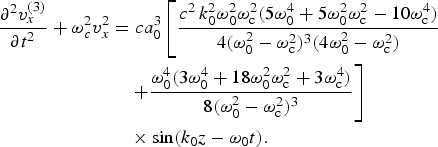
The solution of this equation for the third order electron velocity in the x direction is
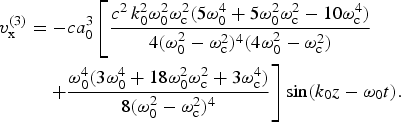
The third-order transverse velocity of electrons has contributions from relativistic effects and perturbations due to the presence of a uniform magnetic field. The first term on the right-hand side of Eq. (8) is due to the Lorentz force of magnetic field, while the second term is the relativistic velocity acquired by plasma electrons under influence of the radiation field in a magnetized plasma. By adding the obtained linear and nonlinear velocities in the x-direction, the total oscillation velocity for electrons would be as follow

where u 0 (ω0) = ω02 /(ω02 − ωc2) − N 0a 02, which N 0 is the term included inside the bracket in Eq. (8). In fact, N 0 is the nonlinear coefficient of the pump wave. Now we can find the nonlinear electron current density in the electric field of electromagnetic wave

Now we can obtain the nonlinear wave equation for the vector potential of the propagated wave by applying Eq. (10) in Eq. (1b) and by using of E0 = −c −1∂ A0 /∂t in which A0 is the vector potential

3. METHODS AND CALCULATIONS
3.1. Perturbational equations
Scattering of electromagnetic pump wave in the interaction of laser pulse with plasma will generate another electromagnetic wave with frequency close to the pump wave frequency plus a plasma wave as perturbations in plasma. Perturbated quantities can be contributed in the form of A = A0 + Ã and n = n 0 + ñ, which leads to the growth of instability in plasma. So, Ã, the amplitude of perturbation, i.e., scattered electromagnetic wave, is another answer of Eq. (11). In this new case, the current density can be written as J~ = −ñe v0⊥ − n 0e v~⊥. Then Eq. (11) can be presented in its new form

where, u(ώ) = ώ2 /(ώ2 − ωc2) − Na 2. Here, N, the nonlinear coefficient of scattered wave, can be obtain by substituting k0 and ω0 with  and ώ in N 0 definition. ώ, and a are the angular frequency, wave vector and normalized vector potential of the scattered wave, respectively. Using the perturbated quantities in the continuity equation and in the equation ofmotion we have

and

In the direction of laser pulse propagation, Eq. (14) becomes

Where, Es is the electric field of plasma fluctuations. The first term in the right-hand side of Eq. (15) arises due to the electrostatic fluctuations of electrons at the upper hybrid frequency, while the second term is due to the ponderomotive force exerted on plasma electrons in the interaction of pump and scattered light wave. Differentiating Eq. (13) and Eq. (15) with respect to time and space respectively and combining them gives a coupled equation of plasma density as a function of time and electrical component of light wave as a function of space

where, ωUH = (ωp2 + ωc2)1/2 is the upper hybrid frequency. Eq. (12) and Eq. (16) are two coupled equations which describe the scattered electric field and plasma density fluctuations in a magnetized plasma. By simultaneous solution of these two nonlinear equations, the different instabilities of plasma can be investigated in laser-plasma interaction.
3.2. Raman Backward Scattering
Raman Scattering process in the transversely magnetized plasma includes the decay of an electromagnetic pump wave into an upper hybrid wave and two scattered Stokes/anti-Stokes sidebands. The laser and the sidebands exert a ponderomotive force on electrons driving the upper hybrid wave. We assume that both scattered light waves (Stokes/anti-Stokes) have linearly polarization as same as the pump wave. So the required quantities including the vector potentials of incident electromagnetic wave and scattered light wave as well as density perturbation that can be assumed as


where, θ0 = k 0z − ω0t, θ± = k ±z − ω±t, and θ = kz − ωt are the phases of electrical pump wave, scattered sidebands (Stokes/anti-Stokes) and perturbation oscillation, respectively. Keeping in mind the fact that in both forward and backward Raman scattering phenomena for right-hand plane wave we have A0.Ã = A 0Ã and using Fourier transformation, we can find equations for the amplitudes Ã(k ±, ω±) by substituting Eqs. (17), (18), and (19) into Eq. (12) looking for e iθ± dependence. So we can deduce the following term

A similar equation for ñ(k,ω) can be derived by seeking e iθ dependence in Eq. (16).

As it can be observed, the first harmonic of the Stokes electromagnetic wave with Ã(k −, ω−) amplitude and anti-Stokes electromagnetic wave with Ã(k +,ω+) amplitude are resulting from the beating of the pump wave and perturbated scattered wave, which are generated in plasma with angular frequency of ώ = ω± = ω0 ± ω and wave vector of  = k ± = k 0 ± k.
By combining Eq. (20) and Eq. (21), the dispersion relation can be found as

To calculate Eq. (22), the effect of second and higher harmonics generation are neglected. In Raman scattering, D(k −, ω−) and D(k +,ω+) are the dispersion coefficients of Stokes and anti-Stokes waves respectively, which can be defined as

The terms related to anti-Stokes dispersion coefficient D(k +,ω+) should be neglected for backward Raman scattering (Kruer, Reference Kruer1998). So the dispersion relation of Stokes wave is

Note that maximum growth rate for RBS instability occurs when both scattered light wave and the upper hybrid wave are resonant (ω = ωUH, D(k −, ω−) = 0) i.e., when

In this case, the matching condition for the frequency of Stokes wave is ω− = ω0 − ωUH and the wave number k is determined by Eq. (25). So we obtain the wave number of upper hybrid wave as

For linear nonmagnetized plasma when the relativistic effects are ignored, the wave number starts from k = 2k 0 for n≪n cr/4 and goes to k = k 0 for n ~ n cr/4. In this case, the RBS instability occurs when ωp/ω0⪯0.5, according to the matching condition (Kruer, Reference Kruer1998). However, required condition for starting RBS in transversally magnetized plasma can be determined by Eq. (26) as

where

Raman instability is associated with the growth of perturbation in plasma. Beating the pump wave and scattered wave will be followed by generation of ponderomotive force that leads to the increasing of the amplitude of the scattered and plasma density oscillation waves. So in RBS, the laser pump wave, scattered Stokes wave and excited plasma wave are contributed in the generation of instability.
In the presence of static transversal magnetic field, we can calculate the growth rate of instability from the real part of Eq. (24) by substituting ω with (ωUH + iΓNRBS) in Eq. (24)

Eq. (29) can be simplified for different plasmas and conditions. In a cold underdense plasma, where v os = cu(ω0)a 0 and (ωp /ω0)2≪1, with assuming ωUH ≅ ck and u(ω−) ≃ u(ω0), the growth rate can be presented as

Where ΓNRBS is the temporal growth rate of nonlinear Raman backward instability in a weakly coupled magnetized plasma where Γ≪ωUH and a 02≪1. By considering the effect of nonlinearity in the absence of external magnetic field, this growth rate reduces to the growth rate of RBS instability in a weakly coupled relativistic plasma as follow

By applying a 0≪1 in Eq. (31) and obtaining Γ as it was presented in the introduction, our model is reduced to linear and unmagnetized regime. So we recover the standard growth rate of RBS instability in a cold underdense and unmagnetized plasma by neglecting the relativistic nonlinearity. Upon this method, the effect of different plasma parameters is investigated in the growth rate of instability.
4. RESULTS AND DISCUSSION
The normalized plasma frequency ωp/ω0 as a function of the normalized wave number of the upper hybrid wave k/k 0 of Eq. (25) is plotted in Fig. 1 for a 0 = 0.2 in a nonlinear magnetized and unmagnetized plasma, when Stokes wave is resonant. As is apparent from the figure, in a nonlinear unmagnetized plasma when the relativistic effects are considered, the required condition is ωp/ω0 ≤ 0.4981. As it is shown, the existence of external magnetic field shifts the matching points to lower values. For instance, for ωc/ω0 = 0.1, RBS instability occurs when ωp/ω0 ≤ 0.4917 and for ωc/ω0 = 0.2, this condition is ωp/ω0 ≤ 0.4723. Although, in a magnetized case e.g., when ωc/ω0 = 0.2, the wave number starts from k = 1.8k 0 and goes to k≈k 0. This effect is due to the external magnetic filed that excites the upper hybrid waves in plasma.
Normalized plasma frequency as a function of the normalized wave number of the upper hybrid wave when a 0 = 0.2.

We can investigate the variations of RBS instability growth rate according to Eq. (30).
Figure 2 displays the growth rate of RBS instability ΓNRBS with respect to the normalized radiation field amplitude a0 in the interaction of high intensity short laser pulse with an underdense magnetized and unmagnetized plasma based on the described model. As a matter of fact, rising the laser pulse intensity enhance the ponderomotive force that leads to an increasing in the amplitude of the plasma density fluctuations, i.e. increase the RBS instability amplitude. For both cases, the growth rate of RBS increases with the intensity of laser pulse. Moreover, the growth rate in the case of magnetized plasma is greater than that of in unmagnetized case. Actually, the presence of magnetic field increases the transverse quiver velocity and also leads to the generation of a longitudinal velocity component. This effect enhance the plasma fluctuations and hence the instability will grows.
Normalized growth rate of nonlinear RBS instability versus normalized vector potential in magnetized and unmagnetized plasma when ωp/ω0 = 0.1.

Figure 3 represents the influence of plasma density in the growth rate of RBS for different laser pulse intensity, when ωc/ω0 = 0.1. Basically by increasing the plasma density, instability grows rapidly for high laser intensities.
Normalized growth rate of nonlinear RBS instability versus normalized plasma angular frequency for different vector potential when ωc/ω0 = 0.1.

Figure 4 illustrates the effect of plasma density and applied external magnetic field in the growth rate of RBS. As it is shown, the growth rate has more enhancement at high amount of external magnetic field with respect to weakly magnetized plasma. Because of the nonlinear nature of magnetic force and relativity, the effect of nonlinearity is much important in the case of magnetized plasma in comparison with unmagnetized plasma. In fact, the effect of increasing magnetic field leads to an additional coupling between the scattered Stokes wave and electrostatic mode of the plasma (UHW). This coupling is so strong that it can increase the plasma density fluctuations and enhance the growth rate of RBS. Thus, RBS instability in magnetized plasma has large values with respect to unmagnetized case.
Normalized growth rate of nonlinear RBS instability versus normalized plasma angular frequency for different electron cyclotron frequency when a0 = 0.2.

Figure 5 depicts the effect of nonlinearity on the growth rate of RBS in magnetized plasma. As it is apparent from this figure, when a0 = 0.3 and ωp/ω0 = 0.2, the nonlinearity properties increase the growth rate up to 10 percent. Therefore, the relativity and ponderomotive force are significant in the nonlinear regime and affect the RBS instability.
Normalized growth rate of nonlinear RBS instability versus normalized electron cyclotron frequency in linear and nonlinear regime when a0 = 0.3 and ωp/ω0 = 0.2.

5. CONCLUSION
In this paper, the nonlinear effects are investigated in the interaction of high power short laser pulse with plasma up to third-order nonlinearity in the presence of external magnetic field B0⊥k. In the previous works in the growth rate of RBS instability, higher orders instability has been neglected. Thus, the present theoretical study reveals that the third-order nonlinearity, which is due to relativistic effects and perturbations due to the presence of a uniform magnetic field, alters the growth rate of RBS instability of a laser beam even for mildly relativistic intensities in the presence of external magnetic field. In this letter, we have considered simultaneously the relativistic and nonlinear effects and also we have investigated analytically the RBS for the first time by using perturbation theory. We have obtained a new relation for the temporal growth rate of RBS instability in a nonlinear magnetized plasma which is reduced to the growth rate in a linear unmagnetized case that was acquired in the past works. Analytical results show an increase in the growth rate of Raman backward instability due to cyclotronic motion of plasma electrons in the external magnetic field as well as nonlinear effects in comparison with the linear or unmagnetized plasma. Increasing the laser intensity also yields an increase in the instability growth rate.
As it was mentioned in the introduction, our theoretical results are entirely coincided with the other previous similar works (Salimullah et al. (Reference Salimullah, Liu and Haines1984), Sharma & Dragila (Reference Sharma and Dragila1988), Gill & Saini (Reference Gill and Saini2007), and Hassoon & Salih (Reference Hassoon, Salih and Tripathi2009)). These results should be of interest in the study of RBS in laboratory experiments and magnetoplasmas. The present treatment ignores the thermal effects. We have also ignored the effect of self-focusing and nonlocal effects as well, hence is valid when the laser spot size is much bigger than c/ωp.



