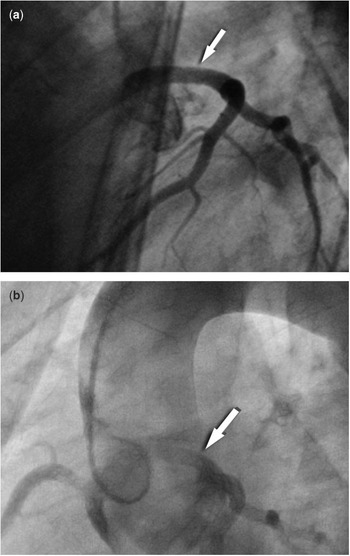
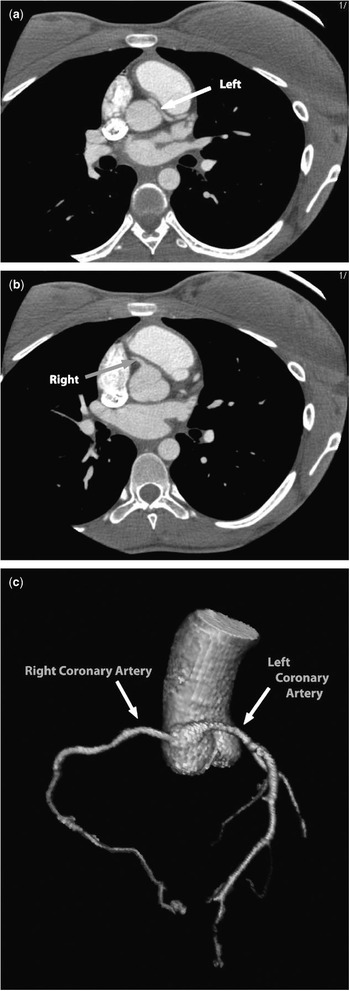
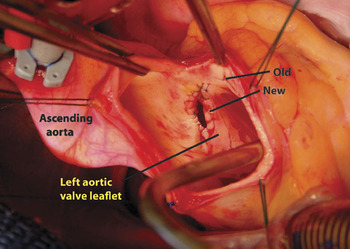
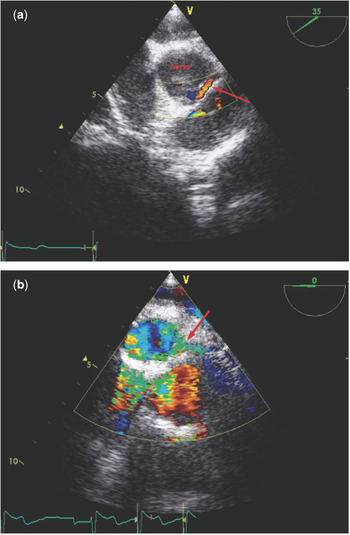
An extremely fit, 15-year old, six-foot-four-inch, female basketball player suffered three episodes of syncope during strenuous competition. On each occasion, 12 lead electrocardiogram and transthoracic echocardiogram in the emergency department were normal, as were subsequent 24-hour Holter monitor and stress test. However, following the third episode, levels of serum troponin were found to be elevated, initially to 0.14 nanograms/milliletre and, after three hours, to 1.29 nanograms/milliletre. This prompted left and right heart catheterization, which revealed normal haemodynamics. Her aortogram and coronary arteries were also thought to be normal. Because of ongoing concerns regarding arrhythmias, the patient underwent electrophysiological studies, during which a very long left coronary artery was engaged in the right aortic sinus (Fig. 1a – arrow). In retrospect, this could be seen also on the aortogram (Fig. 1b – arrow). The diagnosis was confirmed by 64-slice computed tomography with contrast (Fig. 2a and b, slices at levels of coronary origins; c, three-dimensional reconstruction). The patient underwent surgical unroofing of the anomalous left coronary artery into the left sinus of Valsalva (Fig. 3). Prior to the institution of bypass, transoesophageal echocardiography visualized the origin of the anomalous artery and its course through the aortic wall (Fig. 4a – arrow), while post-bypass imaging showed unobstructed flow directly from the left aortic sinus into the left coronary artery (Fig. 4b – arrow). The patient made an uneventful recovery, being discharged from hospital on the fourth postoperative day.
Figure 1

Figure 2

Figure 3

Figure 4

Anomalous aortic origin of either coronary artery is associated with a risk of myocardial ischaemia and sudden death, particularly in young patients. Our patient illustrates the importance of a high index of suspicion and possible imaging modalities to establish the diagnosis and guide surgical repair.Reference Friedman, Fogel and Stephens1
Acknowledgements
We gratefully acknowledge the contributions of Doctors F. Daniel Donovan, Vijaya Joshi, Roxane McKay, B. Rush Waller, III, and Glenn T. Wetzel to the clinical management of this patient.