





1. Introduction
While prior research has demonstrated clear place-linked associations with certain dialectal features (Preston, Reference Preston1989; Carmichael & Reed, Reference Carmichael and Reed2025), some of these associations have a broader reach than others. For example, US listeners from outside of New York City (NYC) and the American South hold strong stereotypes about the accents associated with these locales (Hartley & Preston, Reference Hartley, Preston, Bex and Watts1999). Certain features of these regionalized dialects—e.g. /ai/-monophthongization in the South (Campbell-Kibler, Reference Campbell-Kibler2009; Wade, Reference Wade2022), and non-rhoticity and raised /ɔ/ in NYC (Becker, Reference Becker2009, Reference Becker2014)—have become iconically representative of these dialects. New Orleans English (NOE)—a dialect without strong pan-US awareness—features all three of these variables, plus pre-voiceless raising of /aʊ/ (Carmichael, Reference Carmichael2014), sometimes called Canadian raising, a feature ideologically associated with Canada (Niedzielski, Reference Niedzielski1999). This Northern–Southern combination of features presents a socio-indexical quandary for non-local listeners encountering NOE speakers, with a common outcome of misclassification of New Orleanians as New Yorkers (Carmichael, Reference Carmichael2014; Carmichael & Becker, Reference Carmichael and Becker2018). Exploiting this particularity of NOE, we conducted a matched guise geographic classification experiment to examine how combinations of different features might shift listener perceptions of the speaker’s regional origin.
Two NOE speakers were recorded reading the same sentence frames, one containing only NOE features also indexical of Southern varieties and the other containing only NOE features also indexical of NYC varieties. Variant endings that included NYC features and Canadian raising of /aʊ/ were combined with these frame sentences, to test how listeners responded to potentially conflicting place-linked linguistic features in the same utterance. Participants, all from either the NYC area or the South, heard one variant of each of the two frames from one of the two speakers. Participants then indicated the US region they perceived the speaker to be from. We primarily examined how the variant endings and a participant’s region of origin modulated regional classification of the speaker.
Results illustrated that listeners geographically placed the same speakers differently depending on the features of their NOE dialect showcased in their speech, and participant region of origin influenced dialect classification results. Further, when encountering stimuli containing geographically conflicting cues, listeners appeared to use these combinations in varied and creative ways to socially interpret speakers. Several strategies emerged: some listeners chose geographic classifications that reflected certain place-linked variants simply “winning out” over others, some aimed to reconcile such cues by finding a geographic middle ground between the conflicting locales, and others activated different social personae that helped account for the competing cues. Crucially, these strategies varied systematically across the two speaker voices, suggesting that geographic classification is performed in a socially complex way that considers place-linked linguistic features in richer sociolinguistic context.
2. Literature review
2.1. Dialect classification, enregisterment, and personae
Listeners use social information about speakers’ regional origin in perception, both when categorizing speech sounds (Niedzielski, Reference Niedzielski1999; Hay & Drager, Reference Hay and Drager2010) and when socially evaluating speakers (Campbell-Kibler, Reference Campbell-Kibler2009, Reference Campbell-Kibler2011; Carmichael, Reference Carmichael and Babel2016, Reference Carmichael2018). These processes of classification and evaluation rely on listeners’ sociolinguistic knowledge of these locales, which researchers have argued are established via processes of enregisterment (e.g. Johnstone, Andrus & Danielson, Reference Johnstone, Andrus and Danielson2006; Remlinger, Reference Remlinger, Cornips and de Rooij2018). Agha (Reference Agha2003) defines enregisterment as “processes through which a linguistic repertoire becomes differentiable within a language as a socially recognized register of forms” (231). With respect to regional origin, listeners have been shown to actively make use of this knowledge for both dialect classification and speaker evaluation, among other perceptual processes. US listeners are reasonably accurate at classifying speakers from different regions of the US (Clopper & Pisoni, Reference Clopper and Pisoni2006), performing better with accents that have been shown to be highly enregistered within broader US perceptual dialectology map tasks—those from the South and those from the Northeast around NYC and Boston (Preston, Reference Preston1989, Reference Preston and Schneider1996, Reference Preston, Bernstein, Nunnally and Sabino1997; Hartley & Preston, Reference Hartley, Preston, Bex and Watts1999).
Descriptions of enregisterment processes posit that ways of speaking come to be linked not just with abstract regions or places, but with certain personae, characterological figures, or social “types,” (Coupland, Reference Coupland, Eckert and Rickford2001; Agha, Reference Agha2003; D’Onofrio, Reference D’Onofrio2020), which mediate ideological links between speech styles and locales. Indeed, work in perception has shown that links between personae and linguistic styles can emerge in persona-style matching tasks (MacFarlane & Stuart-Smith, Reference MacFarlane and Stuart-Smith2012; Holliday et al., Reference Holliday, Burdin and Reed2024) and in social evaluation tasks of linguistic variants or styles (Pharao et al., Reference Pharao, Maegaard, Møller and Kristiansen2014; Montgomery & Moore, Reference Montgomery and Moore2018). Expectations related to personae can also influence linguistic behavior, such as phoneme categorization (D’Onofrio, Reference D’Onofrio2018), content recall (D’Onofrio, Reference D’Onofrio2019), and pragmatic reasoning (Beltrama & Schwarz, Reference Beltrama and Schwarz2024). Research has demonstrated that personae are implicated in the construction and circulation of ideologies about regional varieties of English in the US. Performances of characterological figures linked with a given place can be observed in conventionalized scripted phrases (Schilling-Estes, Reference Schilling-Estes2004), joke-telling (Carmichael, Reference Carmichael2013), and parodic performances (Johnstone, Reference Johnstone2011; Pratt & D’Onofrio, Reference Pratt and D’Onofrio2017). Notably, however, the scope of the target audiences varies across such performances. While some performances of place-linked personae become widely recognized, circulating in media that reaches national or even international audiences (e.g. Pratt & D’Onofrio, Reference Pratt and D’Onofrio2017), other such performances occur both by and for local audiences (e.g. Johnstone, Reference Johnstone2011; Carmichael, Reference Carmichael2013), with relatively little uptake from wider communities. For example, Pittsburghese, the linguistic style linked with both Pittsburgh as a locale and with Pittsburgh personae, circulates within the city through commodities (Johnstone, Reference Johnstone2009), local radio performances (Johnstone, Reference Johnstone2011), and meta-linguistic discourse (Johnstone et al., Reference Johnstone, Andrus and Danielson2006). However, Pittsburghese’s recognizability to non-local audiences in the US is limited. Like Pittsburghese, New Orleans English has local cachet and is found performatively represented in comic strips as well as other commodified goods (Carmichael & Dajko, Reference Carmichael and Dajko2016; Carmichael & Reed, Reference Carmichael and Reed2025), though the audience for such performances barely reaches beyond city limits. Indeed, a common complaint within New Orleans is how rarely national media captures the local accent accurately (Walker, Reference Walker2020).
Altogether, previous work illustrates that researchers must consider how local context and the scope of enregisterment might shape the legibility of certain place-linked features or styles for particular groups of listeners. For example, a Pittsburgh listener not only has access to the linguistic features of “Pittsburghese,” but also to the associated social meanings and personae that make these features recognizable as Pittsburgh-linked (Johnstone, Reference Johnstone, Lacoste, Leimgruber and Breyer2013). However, these same features may be difficult to interpret socially by someone from outside the community. In this study, we probe how a locally enregistered dialect—New Orleans English—is perceived geographically by listeners who are from outside the reach of those enregisterment processes. We examine how listeners socially interpret various combinations of features within New Orleans English, some of which overlap with more strongly enregistered regional dialects in the wider US. Highly relevant to this interpretation is how listeners reconcile potentially competing sociolinguistic cues within the same speech stream.
2.2. Sociolinguistic mismatches and feature weighting
Further complicating the process of assigning linguistic styles to places, the same linguistic feature can be a part of multiple linguistic styles and thus linked with a variety of social meanings (Eckert, Reference Eckert2008). A given linguistic feature may index multiple geographic places. For example, non-rhoticity in American English is emblematic of several regional dialects, including those of NYC, Boston, and New Orleans. Which place non-rhoticity indexes in each moment depends on the linguistic and extra-linguistic features with which it co-occurs. It is crucial, then, to understand how combinations of features can work together to index both places and the personae that inhabit them.
A growing body of work has illustrated that individuals indeed package sociolinguistic features together cognitively (e.g. Levon, Reference Levon2007; Campbell-Kibler, Reference Campbell-Kibler2011; Vaughn & Kendall, Reference Vaughn and Kendall2019; Wade Reference Wade2022; Wade, Embick & Tamminga, Reference Wade, Embick and Tamminga2023). For example, Vaughn & Kendall (Reference Vaughn and Kendall2019) found that when prompted to read aloud sentences containing different written variants of ING, speakers modulated additional linguistic variables in ways reflective of the regional and stylistic meanings of the relevant ING variant. Other work has shown that listeners’ own dialect experience shapes how they use combinations of dialect cues to make social inferences. In a production task examining convergence, Wade et al. (Reference Wade, Embick and Tamminga2023) demonstrated that Southerners in the US mapped specific southern dialect features to one another directly, converging to US South-linked styles based on particular acoustic cues they encountered, whereas non-Southerners showed convergence primarily based on top-down labels that activated Southernness socially. This study showed that experience with regional dialects can link multiple cues together cognitively as packages, also illustrating that outsider versus insider experience with regional dialects can differ in which cues are sociolinguistically encoded and linked (see also Sumner & Samuel, Reference Sumner and Samuel2009; Kendall & Fridland, Reference Kendall and Fridland2012; Kayali, Reference Kayali2023).
Given that listeners package together sociolinguistic features in the mind, questions emerge about how listeners handle dialect features that mismatch or go against sociolinguistic expectations. Studies have suggested that encountering linguistic features that are incongruent with social expectations can lead to negative social evaluations (e.g. Gnevsheva, Reference Gnevsheva2018) and even processing slowdowns (e.g. McGowan, Reference McGowan2015). More work is needed to understand the strategies that listeners use to make sense of linguistic features within the same speech stream that seemingly contradict one another in terms of regional associations.
Importantly, prior work has suggested that individual linguistic features of a style can exhibit different amounts of social “weighting” for listeners (e.g. Drager & Kirtley, Reference Drager, Kirtley and Babel2016). Studies have found that regionally linked features about which speakers show metalinguistic awareness operate differently in perception than those that operate “below the level of consciousness” (e.g. Clopper & Dossey, Reference Clopper and Dossey2020; Levon & Fox, Reference Levon and Fox2014; Swan & Babel, Reference Swan and Babel2018). When listeners encounter a speech style that contains a series of conflicting linguistic cues, then, it may be the case that they rely on some cues more heavily than others to determine the speaker’s regional origin. Further, this weighting process may be linked to the strength or consistency of enregisterment processes surrounding features and regions. In this study, we examine how listeners make sense of a regional dialect that contains potentially regionally conflicting linguistic features—New Orleans English—when those listeners are outside of this dialect’s scope of enregisterment.
2.3. New Orleans English
New Orleans is a port city located in the American South along the Gulf of Mexico. While the city has French and Spanish influences resulting from colonial rule in the eighteenth and nineteenth centuries, linguistically these effects are seen mostly in specific lexical items rather than the phonology of local varieties of English. One of New Orleans’ locally enregistered dialects is sometimes called “Yat” based on the playful nickname for its speakers (Carmichael, Reference Carmichael2014). Similar to the “Yinz” dialect in Pittsburgh (cf. Johnstone et al., Reference Johnstone, Andrus and Danielson2006), this specifically white, working-class accent has come to be associated with New Orleanian authenticity and is the subject of much local commentary and commodification in the city (Carmichael & Dajko, Reference Carmichael and Dajko2016; Carmichael & Reed, Reference Carmichael and Reed2025).
Linguists have noted the presence of NYC-affiliated features in New Orleans—such as raised /ɔ/, a split short-a system, and variable non-rhoticity (Labov, Ash & Boberg, Reference Labov, Ash and Boberg2006; Labov Reference Labov2007; Carmichael Reference Carmichael2014, Reference Carmichael2017, Reference Carmichael2020a)—and theorized about their origin, with some proposing that they result from direct contact with NYCE in the past (Labov, Reference Labov2007; Carmichael & Becker, Reference Carmichael and Becker2018; Dinkin & Carmichael, Reference Dinkin and Carmichael2024). Despite key similarities between NYCE and NOE, NOE also features notably Southern features. For example, although speakers do not demonstrate advanced Southern Vowel Shifted features, many New Orleanians do feature /ai/-monophthongization and fronted back vowels /u/ and /oʊ/. Intriguingly, in addition to these notably NYC- and Southern-enregistered dialectal features, a change in progress observable in New Orleans English is pre-voiceless /aʊ/-raising, sometimes called Canadian raising (Carmichael, Reference Carmichael2020b). This feature is also enregistered within North America, often associated with Canada and the Inland North of the US. Thus, some New Orleans English speakers demonstrate an intriguing combination of North–South enregistered features, which presents an indexical quandary for uninitiated listeners. Interestingly, despite these varied linguistic features, New Orleanians commonly note that they are often mistaken for New Yorkers (Carmichael & Becker, Reference Carmichael and Becker2018). New Orleans English’s unique combination of NYC- and South-linked features makes this dialect an ideal site for further examination into how listeners identify and perceive speaker origin in the face of conflicting linguistic evidence.
3. Methods
We conducted a matched guise test using auditory stimuli designed to contain place-linked phonetic features in various combinations, to assess how the presence, absence, and combination of certain NOE features impacted listeners’ regional classification and social evaluations of New Orleanian speakers. We also assessed how listener regional origin influenced these measures, recruiting a balanced sample of participants from the South and the New York area to examine how regional origin influenced and interacted with the linguistic features manipulated in the stimuli.
3.1. Stimuli
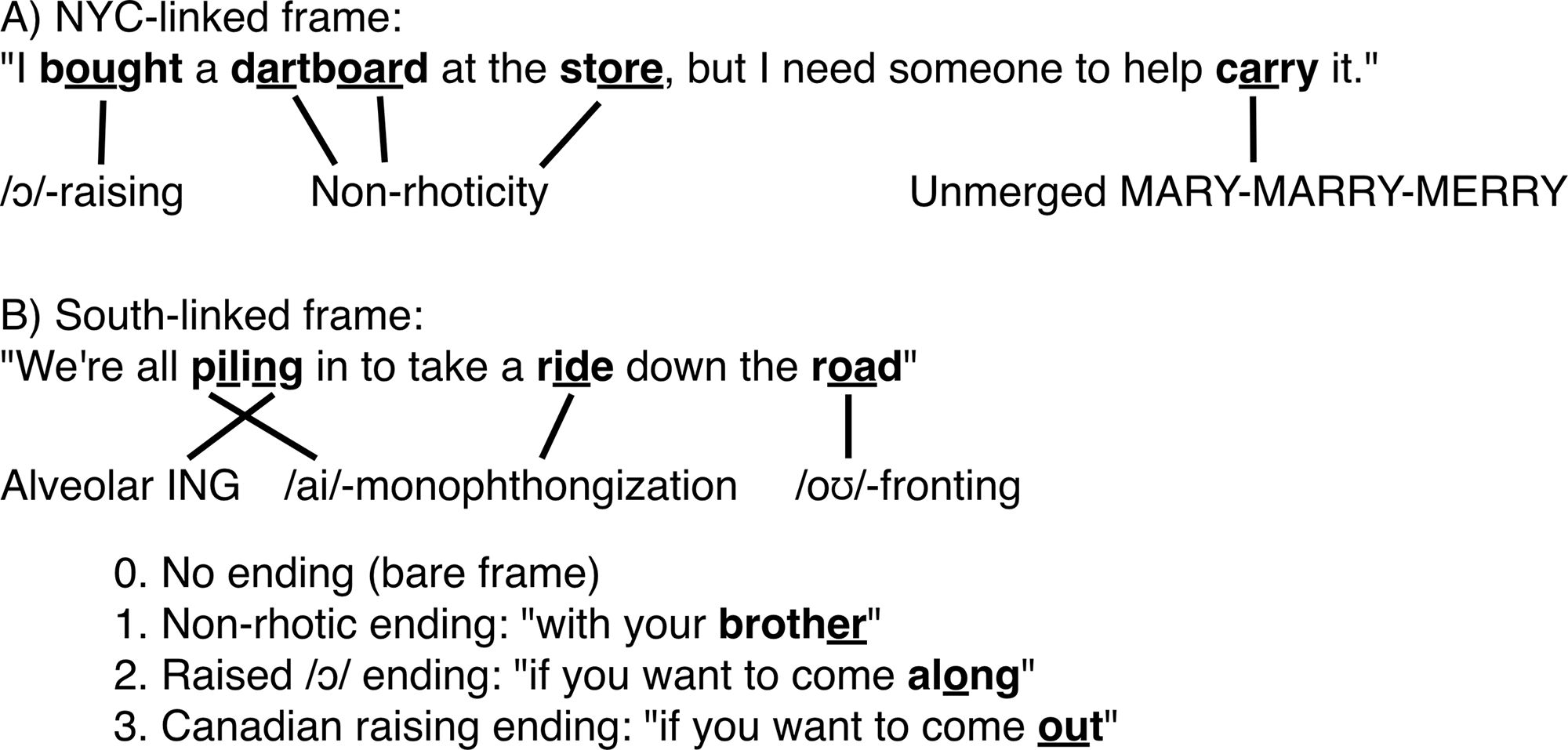
Stimulus sentences were constructed to allow for both the isolation and the combination of features of NOE. We first created two sentence frames that contained multiple NOE features whose regional associations overlapped with A) NYC and B) the South. Each of these frames were able to stand alone as full sentences. We then created sentence “endings,” each of which contained one place-indexical feature. These were designed to be attached to each of the frames without dramatically altering the meaning or tone of the sentence (Figure 1).
Sentence sections used to create stimuli.

Each sentence frame was constructed with the following criteria: (a) contained three distinct features that all indexed either NYC or the South, (b) did not contain any features that indexed the opposing location, (c) could each be combined felicitously with any of the same “endings,” (d) semantically did not reference a particular place, and (e) were similar in length. We required (a–c) and aimed to satisfy criteria (d) and (e) as far as possible.
The endings (Figure 1, 1–3) allowed for one of three “non-South-linked” NOE features to be separately combined with the sentence frames. We chose to isolate non-rhoticity & raised /ɔ/ separately following a prior experiment (Carmichael & D’Onofrio, Reference Carmichael and D’Onofrio2023) using naturally produced sentences that suggested non-rhoticity was more strongly indexical of NYC than raised /ɔ/. In addition, /ɔ/ in New Orleans appears to be less “raised” than in NYC (Carmichael & Becker, Reference Carmichael and Becker2018; Dinkin & Carmichael, Reference Dinkin and Carmichael2024), possibly affecting its indexical salience. Canadian raising was included as an ending in this study since it represents a change-in-progress in NOE without much local awareness or commentary (unlike longstanding NYC-linked features, which are central to local Yat stereotypes). Like the NYCE features in NOE, it is most strongly indexical of another region of North America and represents another opportunity to examine how listeners respond to conflicting linguistic cues.
Auditory stimuli were created by digitally splicing pieces from recorded read speech. Sentences were read by two New Orleans English speakers born and raised in the city who are native users of the Yat accent (Carmichael, Reference Carmichael2014). One of the speakers, Regina,Footnote 1 identified as female and was consistently gendered as a woman in previous pilot data, the other, Damien, identified as male and was consistently gendered as a man in previous pilot data. Regina and Damien were recorded individually, each handed a printed sheet of sentences and asked to read slowly and naturally out loud, pausing between each sentence to avoid list intonation. Once they finished the entire sheet, they were asked to repeat the sentences in the same order. Read sentences were recorded by the first author in 2022 using a Zoom H4 handy recorder and Shure SM10A unidirectional headset microphone to isolate ambient noise, as the recordings were completed “in the field” in public locations chosen by the speakers. The audio was recorded in .wav format at a sampling rate of 44,100 Hz. Both authors confirmed auditorily that the targeted features in question were present within each recording.
Read sentences were digitally manipulated using Praat (Boersma & Weenink, Reference Boersma and Weenink2024). Eight total guises were created by combining each sentence frame (A and B) with each ending (1–3 in Figure 1), in addition to leaving each frame bare (A0 and B0). The full set of these sentences is listed in the Appendix, with labeling reflecting the frame and ending numbering system used in Figure 1. This resulted in sixteen total auditory stimuli items in the experiment: 2 speakers × 2 sentence frames × 4 ending variants.
For each speaker and frame, the same recording of the sentence frame was used for all guises A0–A3 or B0–B3. Similarly, for each speaker and each ending, the same recording of the ending was used for all guises with that ending (A1 & B1, A2 & B2, and A3 & B3). Prior to splicing, each sentence recording was scaled to a mean intensity of 71 dB. All endings were spliced from one of the read sentences at zero crossings, then the same ending was concatenated with each of the two sentence frames for that speaker in Praat.
3.2. Design and procedure
The sixteen stimuli were presented to participants in a between-subjects design. Each participant completed two blocks, one with a stimulus from Regina and the other with a stimulus from Damien. Each block contained either an NYC frame sentence (one of A0–A3) or a Southern frame sentence (one of B0–B3), never with the same ending. In other words, across participants, stimuli were counterbalanced such that each participant heard both speakers, both frames, and two different guise ending variants (that is, no participant was presented with the same frame or same ending more than once across the two speakers). The order of blocks (i.e. which speaker and/or frame was presented first) was randomized across participants.
Participants were recruited and compensated through Prolific, an online crowd-sourcing platform that allows users to complete experimental tasks remotely. Participants were redirected from Prolific to Qualtrics to complete the main task. They were first presented with a consent form, then they completed an audio check.
In each block, listeners were presented with one auditory stimulus accompanied by the following instructions: “We are interested in what impressions you can get about a person just based on their voice. You will hear a person saying the sentence ‘[transcription of stimulus sentence].’ Press the play button to hear the sentence. You can play the clip as many times as you like. Based on what you hear, please make your best guess at the following questions.” The instructions contained the written transcript of the auditory stimulus presented in the block to ensure that participants heard the sentence as intended and thereby interpreted the linguistic variants accurately. Participants were also asked to type the sentence they heard into a text box as an attention check. Trials that did not include an accurate sentence transcription from the participant were removed from analysis.
After listening to the sentence and transcribing it, listeners then responded to a series of questions about each speaker, presented on the same page as the audio clip. The primary question of interest was: “If you had to guess, which region of the US do you think the speaker is from?” The forced choice options (indicated with radio buttons) were: Southern US/Northeastern US/Midwestern US/Southwestern US/Western US. This question was fashioned based on previous pilot work that culled perceived regional information for NOE voices from open responses. The question above served to explicitly define regions of interest within the US that speakers could use for categorization. Additionally, the following questions were provided as open response questions with blank text boxes:
-
• “Do you have a more specific idea of where the speaker might be from?”
-
• “How old do you think the speaker is?”
-
• “What race/ethnicity do you think the speaker is?”
-
• “What gender do you think the speaker is?”
-
• “If you had to guess, what occupation do you think the speaker has?”
-
• “What other impressions do you have of this speaker?”
Participants were required to respond to each question to advance to the next page in the block. The second page in each block contained a naturalness check for the stimulus, with only the following question: “How natural versus computerized/manipulated do you think this audio clip sounded?” The audio clip was presented again, along with a five-point scale from “Naturally produced by a human” to “Robotic/computerized.” Median results for each stimulus were between 1 and 2.5, with no stimulus that sounded particularly robotic or computerized relative to the others. After the two blocks of the main task, participants completed a questionnaire about their own background information, detailed in Section 3.3 below. They were then redirected back to Prolific to receive compensation.
3.3. Participants
160 participants completed the task. Using Prolific’s participant background filters, we recruited based on participants’ self-identified US state of residence and their US state of birth falling into the same of the following two groups: 80 of the participants were from the NY tri-state area, defined as New Jersey, New York, or Connecticut, and 80 were from South, defined using the Atlas of North American English (Labov et al., Reference Labov, Ash and Boberg2006) as Alabama, Arkansas, Georgia, Louisiana, Mississippi, North Carolina, South Carolina, Tennessee, Texas, Virginia, or West Virginia. Participant criteria were also restricted to those who self-designated their first language as English, and who had not completed any previous pilot or norming task in this study. Following the main task, participants completed a demographic survey that included their age, gender, languages spoken, places they had lived, and the ages at which they had lived there. Data from 71 participants from the NYC area (88% of respondents) and 69 participants from the South (86% of respondents) were analyzed after exclusions. Mean ages were 38 years for the NYC area participants and 36 years for the South-based participants.
3.4. Analysis
Our primary quantitative measure of interest was regional categorization of the speaker based on sentence frame (NYC-linked or South-linked), sentence ending (non-rhotic, raised /ɔ/, or Canadian raising of /aʊ/), the participant’s region of origin (NYC area versus South) and the interactions between these factors. We also examined the effect of the speaker (Regina versus Damien). Logistic mixed effects regression models were fitted on the regional categorization responses in R (R Core Team, 2023). First, a model was fitted on all the geographic classification responses, to examine the overall effects of the sentence frame, variant endings, speaker voices, and participant region of origin on classification. In all models, the dependent variable was simplified to a binary variable, testing the likelihood of classification of the region of interest for a given frame. The overall model tested selection of “South” (versus any other region) as its dependent variable. In the overall model, we included “frame” as a contrast-coded main effect, testing whether dialect classification of the same NOE speaker voices differed in the NYC-frame versus the South-linked frame.
Separate logistic regression models were fitted to the relevant regional classification choice for subsets of responses to each sentence frame (NYC-linked and South-linked). For responses to the NYC-linked sentence frame, we fit a model to the dependent variable of “Northeast” speaker classification (versus any other region). For responses to the South-linked sentence frame, we fit a model to the dependent variable of “South” speaker classification (versus any other region). In all three models, our primary predictor of interest was the sentence ending variant (non-rhotic, raised /ɔ/, Canadian raising, or bare sentence frame). The sentence ending variant was treatment-coded with sentence frame as the reference level. In all three regression models, we also included stimulus speaker voice (Regina versus Damien) and participant region of origin (Southern versus Northeastern) as fixed effects; both were contrast-coded. All possible interactions of these three predictors were tested and none improved model fit in any of the three models, so they are not reported in the final model summaries.
As we step through the quantitative results, we also qualitatively assess the open response comments about the speaker’s location of origin, occupation, and general impressions, searching for patterns of responses that reflect differences in how a given combination of features was interpreted by participants.
4. Results
4.1. Overall dialect classification results
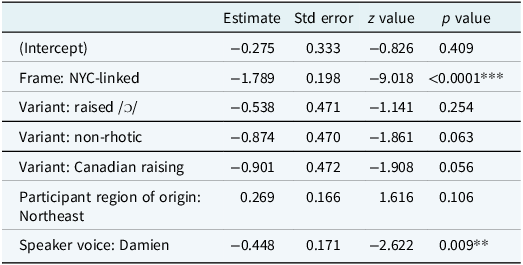
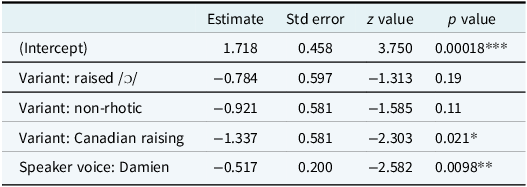
The first logistic regression model was fitted to all the perceived region data, assessing whether participants’ classification of the speakers as Southern (as opposed to one of the four other options: Northeastern, Midwestern, Southwestern, or Western) was modulated by sentence frame, variant ending, participant region of origin, and speaker voice (Table 1).
Summary of logistic regression model predicting “Southern” selections for all sentences. Variant default = bare sentence frame

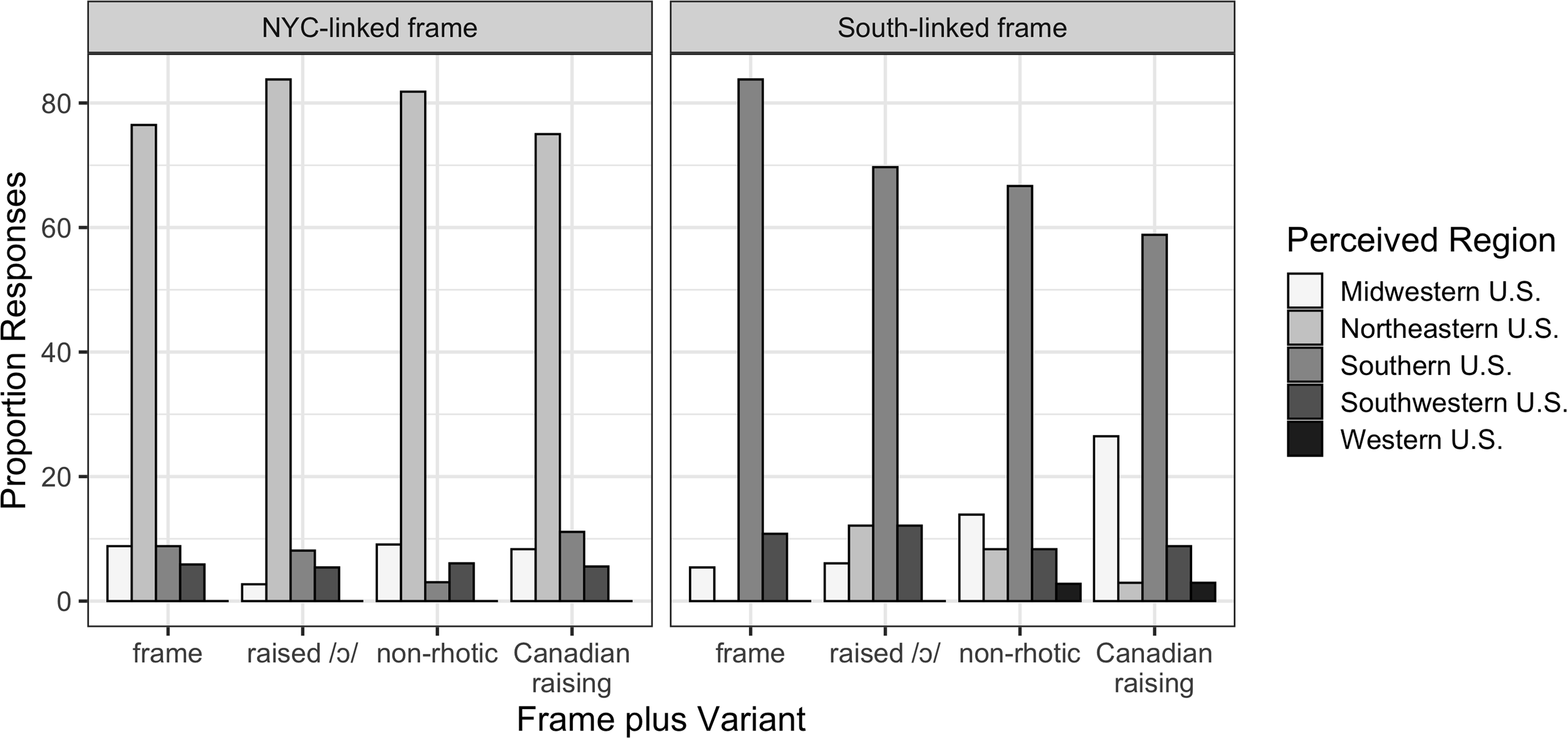
The model presented in Table 1 confirms that the sentence frame that participants heard had a significant effect on classifications of the speaker as from the South, in the expected direction, with South-linked frame responses yielding a significantly greater likelihood of a “Southern” classification than the NYC-linked frame. These results are plotted in Figure 2, which depicts the proportion of classification responses for each of the five possible regions, by variant ending and sentence frame.
Perceived region responses to sentences, by variant ending and frame type.

Figure 2 Long description
Panel A: A bar graph comparing perceived region responses to sentences with NYC-linked frame. The horizontal axis is labeled Frame plus Variant with categories frame, raised /o/, non-rhotic, and Canadian raising. The vertical axis is labeled Proportion Responses. The graph shows vertical bars for each category, with different shades representing different perceived regions: Midwestern U S, Northeastern U S, Southern U S, Southwestern U S, and Western U S. The Midwestern U S region has the highest proportion responses for the frame category, while the Northeastern U S region has the highest proportion responses for the raised /o/ and non-rhotic categories. The Canadian raising category shows varied responses across regions. Panel B: A bar graph comparing perceived region responses to sentences with South-linked frame. The horizontal axis is labeled Frame plus Variant with categories frame, raised /o/, non-rhotic, and Canadian raising. The vertical axis is labeled Proportion Responses. The graph shows vertical bars for each category, with different shades representing different perceived regions: Midwestern U S, Northeastern U S, Southern U S, Southwestern U S, and Western U S. The Southern U S region has the highest proportion responses for the frame and raised /o/ categories, while the Northeastern U S region has the highest proportion responses for the non-rhotic category. The Canadian raising category shows varied responses across regions.
These results illustrate that the intended frame-related manipulation was evident in classification results overall. Although participants always heard the same two New Orleans English speakers, the linguistic features in each frame dramatically shifted the perceived region of the speaker in the expected directions. Regardless of the variant ending attached, when hearing the NYC-linked frame (Figure 2, left), participants were overwhelmingly more likely to respond that the speaker was from the Northeast than any other region. When hearing the South-linked frame (Figure 2, right), participants were most likely to respond that the speaker was from the South. Notably, when exposed to the South-linked bare frame, zero participants responded that the speaker sounded like they were from the Northeast.
The model also illustrated that there was a significant difference in regional classification by speaker voice, such that Damien was less likely to be classified as Southern than Regina, regardless of sentence frame or variant ending (Table 1), a finding we elaborate upon in Sections 4.3.2 and 5. No overall significant effects emerged for variant ending or participant region of origin; we explore these manipulations further in subsets of the data by sentence frame, below.
To contextualize these regional classifications, we examined participants’ open-response comments. In general, regardless of stimulus manipulations, the majority of participants heard the speakers as white, middle-aged, and the speaker’s own gender identity. They varied in their guesses about speaker occupation and specific hometown. 73% of respondents answered an optional open-response question allowing participants to share “any other thoughts” about the speaker. While many of these descriptions centered on social class (“blue-collar”), potential hobbies (“enjoys cooking”), and personality features (“assertive”), others provided surprisingly specific guesses about appearance and temperament (“brunette,” “wearing a plaid jacket,” “would not have patience for these questions”). In examination of broad trends across stimuli containing only Southern cues (consisting of the South-linked bare frame), and the stimuli containing only NYC cues (consisting of the NYC-linked bare frame, the NYC frame plus raised /ɔ/ ending and the NYC frame plus non-rhotic ending), some patterns emerged in open-response comments, shown via word clouds in Figure 3.
Word clouds for only south-linked cues (left) and only NYC-linked cues (right) (generated via https://www.wordclouds.com/).

The most frequent words for the Southern-only stimuli were “farmer,” “South,” and individual states in the Southeast. For NYC-only stimuli, “Boston,” “New York,” and “Northeast” were most frequent, alongside descriptors like “working class,” “bar owner,” and “talks fast.” In other words, when Southern versus Northeastern features were isolated, the region and associated stereotypes were accurately accessed by listeners, and additional place-linked personae (e.g. a Southern farmer or a Northeastern bar owner) were invoked.
4.2. NYC-linked frame results
We next turn to the dialect classification results for the NYC-linked frame, specifically. In this set of stimuli, all features in the base frame were associable with NYC origin, as were the variants that included the raised /ɔ/ (‘along’) and non-rhotic (‘brother’) endings. The only guise with regionally conflicting linguistic cues is that with the Canadian raising (‘out’) ending.
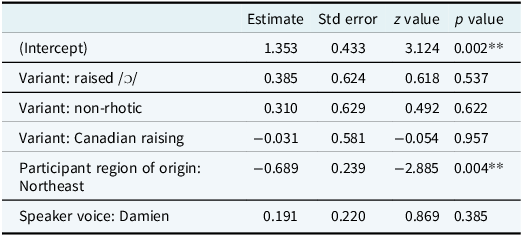
We fitted a logistic regression model on the subset of responses to these NYC-linked sentences to examine whether sentence ending variant, participant region of origin, and speaker voice impacted the likelihood that a participant classified the speaker as from the Northeast (the predicted associated region) or from elsewhere (Table 2).
Summary of logistic regression model predicting “Northeast” selections for NYC-linked sentences. Variant default = bare sentence frame

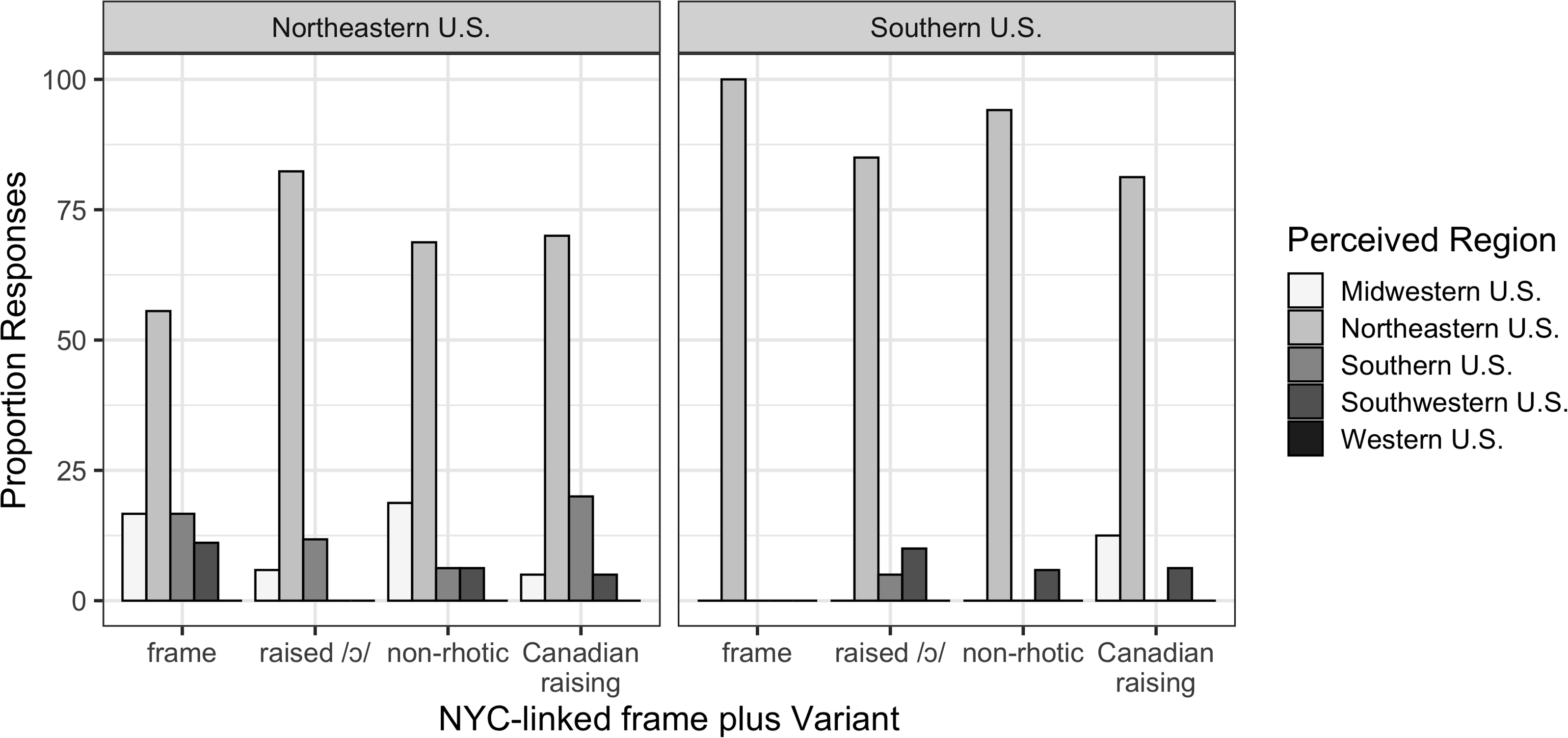
Participant region of origin was the only tested factor that exhibited a significant effect on responses to the NYC-linked frame, such that listeners from the South were significantly more likely to respond that the speaker was from the Northeast than speakers who were themselves from the Northeast (Table 2). None of the three sentence ending variants significantly differed from the base sentence frame in how likely a participant was to respond that the speaker was from the Northeast. Speaker voice also did not show a significant effect, unlike in the overall model. No significant interactions emerged between the three predictors. The results from this subset of the data, divided by the sole significant predictor of participant region of origin, are plotted in Figure 4.
Perceived region responses to NYC-linked frame sentences plus variant endings, by participant region of origin (NYC area, left; South, right).

As found in the overall dataset (Table 1), when participants heard speakers using the NYC-linked sentence frame, they rated the speaker as Northeastern in origin much more frequently than any other region, even when the Canadian raising ending was included. Figure 4 also illustrates that generally, Southern listeners (right) were more likely to classify the speaker as Northeastern than NYC-area listeners were (left). This effect occurred regardless of sentence variant or speaker. That is, while NYC-area listeners were not as overwhelmingly likely as Southern listeners to hear these New Orleans speakers as Northeastern, they still classified them as being Northeastern more frequently than any other region.
Another notable distinction between Southern and NYC-area listeners is that almost no Southern listener heard the NYC-linked guises as Southern (only one of the raised /ɔ/ responses, and zero of the responses for other variants; see Figure 4). Northeastern listeners, however, did occasionally classify the speaker as Southern (between one and four responses for each of the four variants). It is possible that this trend reflects experience, similar to findings from Wade et al. (Reference Wade, Embick and Tamminga2023). Northeastern listeners may have noticed aspects of the speech presented in the stimuli that differed from their first-hand experience living in the Northeast, resulting in non-Northeastern classifications. Southern listeners, potentially relying more strongly on the idea or stereotype of a Northeastern accent, may have been more easily swayed by the identifiably NYC-linked features they encountered in the speech stream.
One notable trend amongst responses to the NYC-linked frame, which contrasted with the South-linked frame results we will present below, was the consistency in descriptors provided for the speakers in the open-ended responses. Most respondents believed that the speakers were blue-collar workers of some kind, repeating common descriptors for New Yorkers such as “gruff,” “tough,” “in a hurry,” “fast talker,” “brash,” “bossy,” “assertive,” “direct,” and “rough around the edges” (cf. Hartley & Preston, Reference Hartley, Preston, Bex and Watts1999:230; Becker, Reference Becker2014:414; Carmichael, Reference Carmichael and Babel2016:163). Multiple participants noted the accent in particular, and explicitly linked it to New York or sometimes Boston, as in the following responses: “Has a heavy accent, so I think this person is from the New York area,” “they sound like they are from the bronx,” “They talk fast like a New Yorker,” and “Either New York or Boston accent for sure.” Very few respondents deviated from this New Yorker persona, even when the NYC-linked frame was presented with a Canadian raising ending. Notably, however, the specific Northeastern locations in the NYC-linked plus Canadian raising guise shifted closer to the Canadian border, with a handful of respondents to this guise suggesting Vermont, New Hampshire, and Maine, whereas the other three guises were nearly unanimously identified as either New York or Boston in the more specific hometown open-ended question.
4.3. South-linked frame results
Our final logistic regression model was fitted on responses to the South-linked frame, testing whether sentence ending variant, participant region of origin, and/or speaker voice predicted responses of “South” for the speaker’s regional classification (Table 3). This set of stimuli presented only Southern features in the bare sentence frame, but it featured two guises in which Southern features were combined with a single NYC feature: non-rhoticity and raised /ɔ/, as well as a guise in which Southern features appeared alongside a token of Canadian raising. The summary of this model is shown in Table 3.
Summary of logistic regression model predicting “South” selections for South-linked sentence. Variant default = bare sentence frame

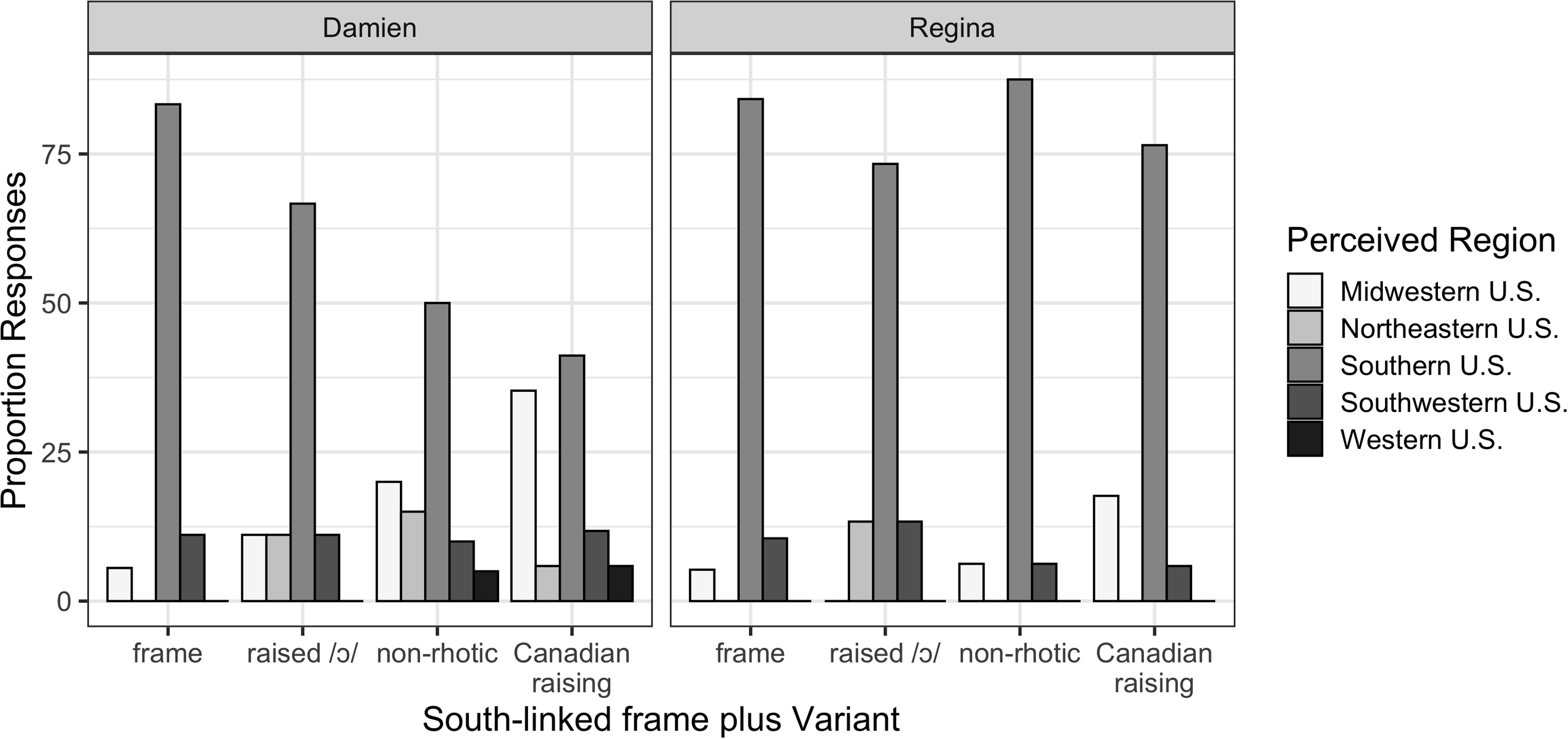
For the South-linked sentence frame, sentence ending variant was a significant predictor, such that the speaker was significantly less likely to be classified as from the South if their sentence ended with Canadian raised ‘out’ as compared to the bare sentence form. The other two variants (non-rhoticity and raised /ɔ/) did not significantly differ from the bare sentence frame in likelihood of Southern classification. The model also found that speaker voice was a significant predictor of “South” speaker classifications, such that Damien was significantly less likely to be classified as Southern than Regina, as previously demonstrated in the overall dataset (Table 1). Finally, unlike in the NYC-linked sentence responses, participant region of origin did not have a significant impact on South classification results and was not included in the best fit model. Given the significant difference of voice, we have plotted the results for the South-linked frame by voice in Figure 5, with responses to Damien’s South-linked sentences on the left and responses to Regina’s South-linked sentences on the right.
Perceived region responses to South-linked frame plus variant endings, by speaker.

As illustrated in the overall dataset, the South-linked frame led participants to classify the speaker as most likely to be from the South (Figure 5), regardless of variant ending. Note that for both voices (left and right in Figure 5), no participants classified the speaker as from the Northeast in the bare sentence frame from either voice, whereas a small proportion of participants chose “Northeast” for raised /ɔ/ (two responses) non-rhotic (three responses), and Canadian raising endings (one response) in Damien’s voice, and for raised /ɔ/ (two responses) in Regina’s voice. For the Canadian raising ending, Southern classifications were significantly lower than the bare sentence frame and appear to have been replaced by Midwestern selections for both speaker voices (Figure 5). This effect was particularly apparent in Damien’s voice (left), where only 41% of responses were “South” and 35% of responses were “Midwest.” As shown in Figure 5, some respondents also heard the speaker who used this variant as Southwestern or Western.
4.3.1. South-linked frame plus Canadian raising ending
We can see some ways that participants attempted to make sense of the combination of the South-linked frame with a Canadian raised ending via their responses to additional questions. Several participants responding to this stimulus classified the speaker as being from a specific Southern state, including Louisiana, with comments straightforwardly reflecting the regional classification of the speaker as Southern (e.g. “they have a thick Southern accent”). Two participants who identified the speaker as being from the South added a caveat in their comments. One participant responding to Damien identified him as being from “Alabama,” but noted that “his accent is weird.” Another explicitly noted the Canadian raised variant ending, classifying Damien as from “Appalachia,” and commenting that, “they sound like a typical middle-aged, white, working-class guy from the more northern parts of the south, except the way they said the word ‘out’, which sounded a bit odd to my ear.”
Another two participants explicitly mentioned Canada, reflecting the strength of the association between pre-voiceless /aʊ/-raising and Canada, even though “Canada” was not one of the five forced-choice geographic classification options. One participant responded that “the person sounds Canadian to me for some reason,” and another classified the speaker as from “one of the midwestern states on the Canadian border.”
As shown in Figure 5, a large portion of participants responded that the speaker using the Canadian raised ending was from the Midwest, with some responding the speaker was from the Southwest or West (more specific non-Southern locales mentioned included Montana, Iowa, Maryland, Colorado, Missouri, Michigan, and “a Western state”).
Notably, regardless of regional classification, many participants ascribed a rural occupation to the speaker, including “farmer,” “rancher,” or in one instance, “rodeo clown.” Furthermore, open response descriptions of the speaker depicted a persona associable with rurality. One participant noted that Damien “just strikes me as a midwestern Rancher. Rough, tough speaking voice but very distinct midwestern accent.” Another described him as “probably from a rural area in the midwest.” Further, the participant who classified the speaker as from “one of the midwestern states on the Canadian border” identified the speaker as a “farmer” who they further described as “friendly, jovial and caring.”
These wide-ranging geographic responses to the South-linked plus Canadian raising guise are reminiscent of ideologies surrounding “country talk,” about which Hall-Lew & Stephens (Reference Hall-Lew and Stephens2011:272) write:
[Participants] are willing to label speech outside of […] the South as country if they have encountered or are aware of communities that have similar cultural characteristics and practices to their own: places that share features of small town, rural life. These associations have become enregistered in large part because of the imagined personae (Eckert, Reference Eckert2008) or characterological representations (Agha, Reference Agha2003) that embody specific social meanings at an ideological level.
That is, key to participants categorizing speakers as “country” is identifying a specific persona linked to qualities often tied to both Southern and generally rural identities. Hall-Lew & Stephens note that while the South broadly was viewed as “country” by participants in their study, the potential for linguistic “country-ness” expanded well into rural, sparsely populated portions of the Midwest (Reference Hall-Lew and Stephens2011).
We suggest that many of our study’s participants, hearing a Southern sentence frame combined with an indexically Upper Midwest/Canadian ending, appeared to reconcile this incongruity by linking the linguistic style with a “country” persona. In some cases, the combination pulled the originally “Southern” geographic assessment Northward, into “country” regions of the West and Midwest, such as Iowa, Montana, and Missouri, invoking rural occupations like “farmer” and “rancher” within regions outside the US South.
4.3.2. South-linked frame plus non-rhoticity and raised /ɔ/ endings
Based on prior results (Carmichael & D’Onofrio, Reference Carmichael and D’Onofrio2023), we expected to see an effect on classification when the South-linked frame co-occurred with non-rhoticity and raised /ɔ/ endings (both NYC-linked) as compared to the Southern bare frame. However, no significant differences emerged between the NYC-linked ending variants and the bare frame guise. There was, however, a significant effect of speaker. Exploring speaker-based differences in responses further, the effect appeared to be motivated by how participants socially interpreted Regina versus Damien when the South-linked frame was combined with the non-rhotic variant ending. Out of 38 participants who heard the South-linked frame plus non-rhotic ending, 10.5% (N = 4) classified the speaker as Northeastern in origin, identifying “Manhattan,” “New England,” “Massachusetts,” and “possibly New York” as the specific geographic location. This indicates that, for some listeners, a single token of non-rhoticity amidst an otherwise South-linked frame was enough to shift the dialect classification to Northeastern. This was not a statistically significant proportion of listeners, but compared to zero Northeastern classifications of the bare South-linked frame, it is worth noting. For all four of these Northeastern classifications, the speaker was Damien. While Regina was frequently classified as Northeastern in the NYC-linked frame guises, she was never heard as Northeastern in any of the South-linked frame guises.
Those who rated Damien’s South-linked plus non-rhotic guise as being from the Northeast also showed some consistency in their identification of speaker race and occupation. All four described Damien’s race as “white,” and the occupations provided were “mechanic,” “construction worker,” “blue collar worker,” and “bank teller.” This suggests that despite the South-linked features in the sentence frame, the presence of the single non-rhotic token led these participants to hear Damien as a white Northeasterner, and in a majority of cases, a person who held a blue-collar occupation. The occupation-based responses are consistent with non-rhoticity’s social class patterning in the Northeast (e.g. Becker, Reference Becker2009; Nagy & Irwin, Reference Nagy and Irwin2010). Although the feature is used by speakers of a variety of racialized and ethnicized groups in New York, Boston, and other Northeastern cities (e.g. Becker, Reference Becker2009, Reference Becker2014; Nagy & Irwin, Reference Nagy and Irwin2010), it is notable that all these participants classified Damien as white. The confluence of social evaluations, along with comments like “[Damien] speaks quickly and runs words together,” echoes responses to the NYC-linked frame, which together are reminiscent of ideologies that link Northeastern non-rhoticity with ideological conceptions of fast-talking, white working-class personae in urban settings (e.g. Preston, Reference Preston1989; Becker, Reference Becker2014; Carmichael, Reference Carmichael and Babel2016).
Notably, the South-linked frame plus non-rhotic ending was unique in its influence on race classifications of the speaker. Of the 38 responses to this guise, 16% (N = 6) described the speaker as Black, and 84% (N = 32) described the speaker as white or Caucasian. Of the six responses that described the speaker as Black, five were responses to Regina’s voice, constituting nearly 30% of the responses to Regina’s South-linked plus non-rhotic guise overall. As a point of comparison, these speakers (both white) were only heard as Black in nine total responses (including the six responses to this guise) across the entire dataset (less than 3% of the time overall, and less than 1% of the time for guises other than South-linked plus non-rhotic).Footnote 2 Damien’s voice in the South-linked plus non-rhotic guise was heard as Black by one respondent, the only time in the entire dataset in which he was not classified as white. In this instance, Damien was categorized as a Black farmer from “the Midwest” who “sounds old.”
Among the responses to the South-linked plus non-rhotic guise where Regina was heard as Black, all five responses classified her as Southern, with listeners proposing origins such as South Carolina, Mississippi, or Georgia. Occupations offered in these five instances included “stay at home mom,” “factory worker,” “something in retail or working with the public,” “hostess,” and “nurse.” In contrast with Damien, Regina was never heard as Northeastern in the South-linked plus non-rhotic guise. Despite the presence of non-rhoticity, Regina was almost exclusively classified as Southern in this guise, at an even higher rate than in the bare South-linked frame. Instead of shifting how listeners placed Regina geographically, as with Damien, the non-rhotic ending seemed to shift how listeners racialized her, instead.
5. Discussion and conclusions
In the matched guise test, we first tested whether listeners changed their geographical classifications of the same speakers based on the dialect features encountered in the speech stream. Crucially, we examined these patterns within a naturally occurring dialect which listeners may indeed encounter in interaction, thereby recreating the common occurrence of non-New Orleanians trying to classify NOE when they first hear it. In the task, the South-linked and NYC-linked bare frames were produced naturally by native speakers of New Orleans English, with careful design to isolate NOE features indexical of the South and NYC. Each frame was classified consistently by listeners as produced by speakers from the targeted locale (the South and the Northeast). Regardless of guise, nobody identified these speakers as New Orleanians. Results thus suggested that perceptually, for these non-New Orleanian listeners, NOE presented sets of linguistic features that were classified as geographically disparate. Overall, these non-New Orleanian listeners were notably unable to access a conceptualization of a New Orleans accent, which although enregistered within the city and its surrounding areas, does not appear to have broader pan-US awareness. This reinforces prior observations that the scope of enregisterment for New Orleans English is highly local (Carmichael, Reference Carmichael2014).
The classification results for the NYC-linked guise, overwhelmingly judged as a Northeastern voice across listener groups, provides some contextualization for why New Orleanians are so frequently heard as New Yorkers (Carmichael & Becker, Reference Carmichael and Becker2018). The NOE features present in the NYC-linked guise did indeed sound overwhelmingly Northeastern, even to most participants from the NYC tri-state area. Yet more subtle differences between NYC and Southern listeners demonstrated that these results are mediated by personal experience, with Southern listeners significantly more likely to identify the NYC frame as Northeasterners, even as both groups had high classification rates for this region. The significant effect of participant region of origin echoes variation in the treatment of place-indexical cues by listeners from different regions in other studies (e.g. Kendall & Fridland, Reference Kendall and Fridland2012; Wade et al., Reference Wade, Embick and Tamminga2023).
Further, we aimed to test how these listeners classify NOE speakers when faced with geographically “mismatched” cues within the same speech stream. For each “mismatched” combination, listeners provided a variety of responses, indicating different strategies for reconciling cues that were perceived as geographically disparate in the bare frames alone. In one strategy, many listeners classified the NYC-linked and South-linked frames as their respective target regions even when they were combined with “non-matched” endings (Canadian raising for both, NYC-linked endings for the Southern frame). In fact, no significant differences emerged between the bare frame sentences and frames plus variant endings except in the case of South-linked frame plus Canadian raising. For many listeners, then, the single conflicting linguistic cue was not indexically weighty enough to shift their geographic classifications of speakers, in contrast with our prior, less controlled study (Carmichael & D’Onofrio, Reference Carmichael and D’Onofrio2023). In a sense, these listeners opted to privilege the features present in the frame—those that appeared earlier and more frequently in the utterance.
However, other listeners deployed strategies that more clearly attempted to integrate the conflicting cues with one another in interpreting the speaker socially. One such strategy was evident in the NYC-linked and South-linked frames when combined with a Canadian raising ending. In both cases, listeners shifted their geographic identification Northward, towards Canada. In the NYC-linked plus Canadian raising guise, that meant continued identification as a Northeasterner, but in the question asking for specific location identification, participants shared places such as Maine and Vermont rather than the NYC and Boston locations dominant in response to NYC-linked guises. Listeners using this strategy appeared to search for a geographic “middle-ground” or “average” between the locales indexed by the conflicting linguistic cues. Similarly, in the South-linked plus Canadian raising guise, listeners were much more likely to identify the speaker as Midwestern than in any other guise, once again pulling the predominantly “Southern” classifications in the bare frame northward toward Canada.
To make sense of the geographically complex linguistic cues they encountered, yet other listeners deployed strategies that drew upon existing ideologies of place-linked personae and stereotypes. This strategy was evident in a variety of ways, and sometimes in combination with geographic “averaging” discussed above. For example, in the case of the South-linked frame when combined with Canadian raising, some listeners who classified the speaker as Midwestern additionally appeared to overlay a rural “country talk” (Hall-Lew & Stephens, Reference Hall-Lew and Stephens2011) frame of interpretation on the speaker, consistently describing them as having a rural occupation such as farmer or rancher, even as they identified the speaker as being from the Midwest more frequently.
A similar triangulation of traits, above and beyond merely shifting the geographic coordinates of the speaker North or South, occurred amongst listeners reconciling the South-linked frame with the non-rhotic ending. While there was no significant shift in classification of either the raised /ɔ/ or the non-rhotic endings when paired with the Southern frame sentence, these conditions did present the highest rates of Northeastern identification within the Southern frame guises. Strikingly, the ways in which listeners resolved indexically competing linguistic cues were, at times, dependent on the speaker they encountered.
In the “mixed” dialect guise of the South-linked frame plus non-rhotic ending, a difference arose in how listeners socially interpreted Damien, on one hand, and Regina, on the other. Similar to what we observed for the South-linked frame plus Canadian raising ending, we suggest that, in working to reconcile conflicting sociolinguistic cues, listeners reached for specific personae that matched the linguistic features they were presented with. However, the personae accessible to accomplish this depended on other aspects of the speakers’ voices. For Damien, it was possible for the non-rhotic variant to index a Northeastern, white, working-class persona for some listeners, dampening social meanings that could have otherwise been linked with South-linked features in the sentence. Notably, however, the same NYC-linked variants that shifted geographical classifications for Damien did not have the same effect in Regina’s voice, as she was overwhelmingly heard as Southern in the South-linked plus non-rhotic guise. It may have been the case that other, more subtle voice cues linked Damien and Regina to different geographical places. However, it is also plausible that the contrast in perceived speaker gender differently licensed the activation of certain place-linked personae when listeners encountered the NYC-linked feature in an otherwise indexically Southern guise.
Stereotypically, the white working-class personae linked with Northeastern urban centers and dialects may be more readily gendered as a man, given both production-based and ideological links between blue-collar occupations, localized “nonstandard” variants like non-rhoticity, and men (Trudgill, Reference Trudgill1972; Eckert & McConnell-Ginet, Reference Eckert and McConnell-Ginet2013). Non-rhoticity may not be as strongly linked with Northeastern personae who are gendered as women. Thus, hearing a single non-rhotic token in an otherwise South-linked frame was not enough to shift the strong perceptions of Regina as Southern. There are several possibilities to explain this trend: one is that non-rhoticity was simply overlooked. Another is that there are Southern personae that are associated with non-rhoticity which are gendered as women—the “Southern Belle” comes to mind, for example. While this is possible, we do not see evidence in the open-response questions of this category being activated for listeners. A third possibility, which we argue was at play for the listeners who racialized Regina as Black, is the activation of a specific Black Southern woman persona. This is consistent with production patterns showing that despite a history of non-rhoticity amongst Southern white and Black speakers alike, white non-rhotic Southerners have become increasingly rare (Feagin, Reference Feagin, Edmondson, Feagin and Muhlhausler1990; Baranowski, Reference Baranowski2007), leading this feature to be a racialized marker in the South linked primarily with Black speakers.
Overall, we found that the majority of listeners in our study tended to deploy one of the following strategies in geographically classifying a speech stream containing indexically conflicting regional dialect features: (1) weighting one or more of the linguistic cues most strongly to settle on geographic identification, dampening incongruent cues, (2) accounting for the multiple indexical locales by shifting geographic classifications to a sociolinguistically felicitous “middle-ground,” and/or (3) drawing upon location-linked personae to make sense of the speaker, using sociolinguistic knowledge of two indexed locations. Crucially, while many listeners appeared to go through some sort of cue weighting or reconciliation process, this was inconsistent across listeners, and it depended variably on the contexts in which these cues were encountered and the geographic experience of the listeners. More broadly, these findings emphasize the significance of considering not just aggregate results designed to represent broad social categories (e.g. home region), but also the role that personae play in mediating listener perception of stimuli (D’Onofrio, Reference D’Onofrio2020).
Acknowledgements
The authors wish to thank Susie Chevalier and Barry Lemoine for providing the stimuli for the listening task. We also thank Northwestern University and the Virginia Tech Speech Lab for providing participant funding. Lastly, we thank audiences at NWAV 50, LAVIS V, and ADS 2024, as well as the two anonymous reviewers and the editorial staff at JLG, for feedback which improved the analyses in this paper. Any remaining mistakes are our own.
Competing interests
The authors declare none.
Appendix Guises
-
A0) “I bought a dart board at the store, but I need someone to help carry it”
-
A1) “I bought a dart board at the store, but I need someone to help carry it with your brother”
-
A2) “I bought a dart board at the store, but I need someone to help carry it if you wanna come along”
-
A3) “I bought a dart board at the store, but I need someone to help carry it if you wanna come out”
-
B0) “We’re all piling in to take a ride up the road”
-
B1) “We’re all piling in to take a ride up the road with your brother”
-
B2) “We’re all piling in to take a ride up the road if you wanna come along”
-
B3) “We’re all piling in to take a ride up the road if you wanna come out”


 Open access

