1. Introduction
Attrition research to date has provided converging evidence indicating that the extent of attrition is largely determined by the age at which the person moves from a first language (L1) to a second language (L2) environment. Studies of case-marking (Yukawa, Reference Yukawa1997), verbal clitics (Montrul, Reference Montrul2004) and voice onset time (Hyltenstam, Bylund, Abrahamsson and Park, Reference Abrahamsson and Hyltenstam2009) have shown that the younger the speaker is at the time of the break with the L1 environment, the more drastic attrition will be.
The locus of attention in research on age effects in L1 attrition has, in other words, typically been the person's language proficiency with linguistic structure. In contrast, very little is known about how age affects the attrition of distinctions that go beyond the formal properties of language. These distinctions, which will be subsumed under the term conceptualization patterns, relate to a given language's preferences for selecting and structuring information about e.g., time, space or motion. Research to date has provided pervasive evidence of how speakers of different languages systematically differ in their conceptualization of time, space and motion (e.g., Berman and Slobin, Reference Berman and Slobin1994; Bloom, Peterson, Nadel and Garrett, Reference Bloom, Peterson, Nadel and Garrett1996; Boroditsky, Reference Boroditsky2001; Strömqvist and Verhoeven, Reference Strömqvist and Verhoeven2004). The majority of these studies presuppose that speakers with different language backgrounds refer to the same events or relationships in conceptually different ways according to the grammaticalization patterns of their language (cf. Jarvis, Reference Jarvis2007). Studies on late bilinguals whose languages differ in certain points of conceptual representation have shown that conceptual knowledge acquired through the L1 may be subject to change under the influence of a L2 (e.g., Pavlenko, Reference Pavlenko2000; Cook, Reference Cook2003). Whether L1 conceptual proficiency is equally affected in early and late bilinguals in situations of reduced L1 exposure nevertheless remains an open question.
The study reported in the present paper is an attempt to supplement the current dearth of attrition studies dealing with age effects on conceptualization patterns. The aim of the study is to explore whether L1 event conceptualization patterns are affected by the age at which the break with the L1-dominant setting took place. The study focuses particularly on the conceptualization of goal-oriented motion events, and examines whether age affects the encoding of endpoints as well as the temporal perspective under which the reaching of the endpoints is construed. The subject group consists of L1 Spanish–L2 Swedish bilinguals who at varying ages experienced a break with the L1 tradition (the age of onset of L2 acquisition will be used as an index of this break).
The outline of the article is as follows: section 2 gives a brief overview of previous findings on age effects in L1 attrition; section 3 delineates the processes of event conceptualization and the conceptualization patterns of goal-oriented events in Spanish and Swedish; section 4 deals with theoretical and methodological aspects of the study of age effects on event conceptualization patterns; in section 5, the specific aims and research design of the study are presented; section 6 presents the findings of the subjects’ conceptualization patterns; and section 7 is dedicated to a discussion of these findings.
2. Age effects in L1 attrition
It is widely recognized that children attrite to both a greater extent and at a faster rate than adult attriters.Footnote 1 Attrition in children may range from structural disintegration as documented in immigrant children (e.g., Seliger, Reference Seliger1991; Turian and Altenberg, Reference Turian and Altenberg1991; Schmitt, Reference Schmitt2000; Montrul, Reference Montrul2002) to apparently complete loss found in international adoptees (e.g., Nicoladis and Grabois, 2000; Ventureyra, Pallier and Yoo, Reference Ventureyra, Pallier and Yoo2004). A healthy adult speaker has never been reported to experience a degree of attrition as dramatic as that found in child attriters (cf. Köpke and Schmid, Reference Köpke, Schmid, Schmid, Köpke, Keijzer and Weilemar2004); instead, adult attrition is primarily manifested in lexical retrieval difficulties (e.g., Olshtain and Barzilay, Reference Olshtain and Barzilay1991). Even though research to date has documented strikingly different proficiency outcomes between early and late attriters, the reliability of this age trend might be compromised by the fact that child and adult attrition have by and large been studied separately, with different test instruments and different linguistic variables. Moreover, the tendency to include either late or early attriters makes specific predictions about age effects difficult: if there are noticeable differences between child and adult attrition, one could expect that there is a point in life at which the susceptibility to attrition alters. Evidence concerning susceptibility alteration, to date, is preliminary and limited to a handful studies in which L1 proficiency in both child and adult attriters has been assessed. Since the present study aims at exploring L1 proficiency in both late and early bilinguals, these studies are of particular interest for hypothesis generation and will be reviewed in the following paragraphs.
Yeni-Komshian, Flege and Liu (Reference Yeni-Komshian, Flege and Liu2000) examined L1 pronunciation proficiency in 240 L1 Korean–L2 English bilinguals. Pronunciation data were elicited through sentence repetition and were then rated by 10 native Korean judges. Results showed that the lower the speaker's age of onset (AO) of L2 acquisition, the lower the score on the L1 pronunciation test. In particular, it was seen that an AO of 12 years was a good benchmark for native pronunciation: almost all subjects with an AO > 12 years received the same score as the Korean monolinguals, whereas the pronunciation in speakers with lower AOs was generally characterized as heavily accented and also more variable than in later AOs. In exploring the factors contributing to this AO pattern, Yeni-Komshian et al. found that amount of L1 contact (as measured with self-report data) had a positive effect on L1 Korean pronunciation. Pronunciation proficiency in the L2, on the other hand, was shown to correlate negatively with L1 pronunciation skills.
Silva-Corvalán (Reference Silva-Corvalán1994) discovered a similar age trend in her study of L1 Spanish maintenance among Mexican immigrants in East Los Angeles. Silva-Corvalán divided her subjects into three groups: Group 1, those who arrived in the US after the age of 11; Group 2, those who arrived before the age of 7 or were born there; and Group 3, those who were born in the US and had at least one parent from group two. Using semi-structured interviews and written tests, proficiency in the Tense-Mood-Aspect (TMA) system and copula verbs were studied across all groups. Results showed that Groups 2 and 3 exhibited simplifications in the TMA system as well as an extended use of the copula estar “to be, to stand”. In Group 1 (with age of arrival > 11), the proficiency in these features turned out to show most conformity with Spanish monolingual norms. Although Silva-Corvalán's work is not concerned with scrutinizing age effects on L1 attrition in particular, it lends support to the idea that a person's L1 proficiency is less subject to change if reduced L1 contact takes place after the age of 11. This finding is, nevertheless, preliminary and could have been further substantiated if the age of arrival of Group 2 had ranged up to 11 years instead of 7.
Hakuta and D'Andrea (Reference Hakuta and D'Andrea1992) examined L1 maintenance in 234 high-school students with Mexican background.Footnote 2 L1 Spanish proficiency was assessed through a grammaticality judgement test, a C-test and a productive vocabulary test. An important finding in the study was that adult language practice in the home was a strong predictor of L1 maintenance: the more frequently Spanish was spoken at home, the higher the scores on the language tests. Hakuta and D'Andrea also found that L1 proficiency correlated positively with AO of L2 English acquisition. There was a linear drop in Spanish proficiency in AOs ranging up to 10 years, after which the function levelled off. In making this observation, Hakuta and D'Andrea mentioned that it was difficult to discern whether the age trend was due to incomplete acquisition or attrition. Another problem with this trend – which is not discussed by the authors – is that the subjects with higher AOs were also the ones who had spent the least time in the L2 setting (all subjects were high-school students). Hence, some of them had possibly not been away from the L1 environment sufficiently long enough for maximum attrition to take place (cf. de Bot and Clyne, Reference de Bot and Clyne1994).
Two other studies that provide data on age effects on attrition are Ammerlaan (Reference Ammerlaan1996) and Pelc (Reference Pelc2001). In contrast to the studies reviewed above, these make only general observations about the relationship between age of reduced L1 contact and attrition outcome and do not provide data about any particular age after which attrition susceptibility alters. Ammerlaan (Reference Ammerlaan1996) examined lexical retrieval processes in Dutch immigrants living in Australia, whose ages of departure from the Netherlands ranged from 6 to 29 years and found that a high age of departure was associated positively with L1 maintenance. Pelc's (Reference Pelc2001) study examined morphosyntactic attrition of L1 Greek in subjects whose ages at the time of arrival in the US ranged from 8 to 32 years. It was found that L1 maintenance correlated positively with age of arrival as well as with years of education in the L1 environment. It may almost certainly be the case that there was collinearity between the variables “age of arrival” and “years of education”, and it would have been desirable to partial out age of arrival to ascertain whether years of education still remained significant.
Despite the different linguistic domains examined as well as some minor methodological uncertainties, the studies reviewed above confirm the outcome differences between child and adult attriters observed in a vast number of studies treating these age groups separately. Secondly and more significantly for hypothesis generation, some of the studies also provide preliminary evidence about a change in the susceptibility to attrition taking place somewhere around age 12.
3. Event conceptualization
3.1 The processes of event conceptualization
The preparation of content for speech implies transforming information units into a format which is expressible in a given language (Carroll, von Stutterheim and Nüse, Reference von Stutterheim and Nüse2003, p. 4). In the present study, the different kinds of processes involved in this transformation will be framed within Levelt's (Reference Levelt1989) model of human language production, as well as the additional work done by Habel and Tappe (Reference Habel, Tappe, Klabunde and von Stutterheim1999) and Christiane von Stutterheim and colleagues. According to Levelt, three levels of representation constitute the language production system: the conceptual level (the conceptualizer), the lemma level (the formulator), and the word level (the articulator). In a communicative situation, the function of the conceptualizer consists of transforming the encyclopaedic knowledge relevant to the communicative intention into a temporary conceptual structure (Carroll and von Stutterheim, Reference Carroll and Stutterheim1993), with which linguistic knowledge can be accessed (i.e. the formulator level). In modelling the conceptualization of events, Habel and Tappe (Reference Habel, Tappe, Klabunde and von Stutterheim1999) suggest four different planning processes: segmentation, selection, structuring and linearization (see also von Stutterheim and Nüse, Reference von Stutterheim and Nüse2003).Footnote 3 The concern of the present study – endpoint encoding and temporal perspectivation – relates to the processes of selection and structuring, respectively.
Segmentation involves the extraction of units from a knowledge base which is not organized hierarchically with respect to a given subject material. This means that complex situations are broken down in accordance with their features of temporal boundedness (cf. Croft, Reference Croft1991): complex static situations are divided into states or property predications whereas complex dynamic situations are broken down into smaller events or processes (von Stutterheim, Reference von Stutterheim, Foster-Cohen and Pekarek Doehler2003, p. 185). Selection entails choosing the units of every individual situation that the speaker wishes to verbalize as well as the components that represent the units. Here, components encompass entities, times, spaces and properties. Consequently, in selecting event components of a goal-oriented motion event, the speaker could mention an endpoint: a man rides to a village. The processes of segmentation and selection relates to what is usually called macroplanning (Levelt, Reference Levelt1989). Structuring entails a perspectivation of the event components according to spatial and temporal reference frames. In establishing the temporal perspective, the speaker has to choose what parts of the situation (i.e. the beginning, course, final, or the situation as a whole) are to be focused upon (von Stutterheim and Nüse, Reference von Stutterheim and Nüse2003, p. 865). The speaker could, for example, focus on the course of a situation by using the progressive form: a man is riding a horse-drawn carriage, or leave the temporal boundaries unspecified: a man rides a horse-drawn carriage. It has been suggested that all the aspects of the structuring process are perspective-driven (von Stutterheim and Klein, Reference von Stutterheim, Klein, Graumann and Kallmeyer2002), these processes will, therefore, be subsumed under the term perspectivation in the present paper. In Linearization, the final step of the planning process, the units selected for verbal representation have to be ordered in order to be transformed into the one-dimensional medium of language (Levelt, Reference Levelt, Peters and Saarinen1982; Carroll et al., Reference Carroll, Stutterheim, Nüse, Habel and Pechmann2003). The linearization process thus involves word ordering. The processes of perspectivation and linearization relates to the stage of microplanning (Levelt, Reference Levelt1989).
3.2 Event conceptualization in Spanish and Swedish
In a baseline study, endpoint encoding of goal-oriented motion events was examined in 15 native speakers of Spanish and 15 native speakers of Swedish (Bylund, Reference Bylund2008). The material used consisted of a set of single-event scenes depicting an object moving along a trajectory. Subjects were asked to describe what was happening in the scenes as soon as they recognized the situation. The quaestio (i.e. the instructional question) posed to the subjects was Vad händer i scenen? “What happens in the scene?” and ¿Qué pasa en la escena? “What happens in the scene?”, respectively.Footnote 4
The underlying assumption of the study was that grammaticalized aspect induces a specific pattern of event conceptualization (e.g., Carroll and von Stutterheim, Reference Carroll, von Stutterheim and Ramat2003). Spanish and Swedish differ when it comes to grammaticalized aspect: Swedish lacks this grammatical category, whereas Spanish conveys aspect through verb stem inflection and verbal periphrasis.Footnote 5 Spanish makes a distinction in present tense between the simple form and the progressive, which is created through estar + present participle “to be/to stand”: Rocinante está trotando “Rocinante is trotting” vs. Rocinante trota “Rocinante trots”. The present participle thus conveys imperfectivity and its basic function is to present the unfolding phase of a situation without attention to its temporal confines (Yllera, Reference Yllera, Bosque and Demonte1999, p. 3392). In Spanish, the distinction between progressive and non-progressive forms is to a certain degree optional (see Havu, Reference Havu1997, for a review), that is to say, the simple present does not necessarily exclude a progressive reading.Footnote 6 Even though the distinction between these two verb forms is sometimes attenuated, it should be noted that the progressive, by virtue of its overt morphological marking, conveys the presence of a feature (i.e. progressiveness) while the unmarked counterpart (i.e. simple present) says nothing about the presence or absence of this feature (cf. Comrie, Reference Comrie1976, pp. 112ff.).
In contrast to speakers of Spanish, Swedish speakers must resort to lexical means to express progressive aspect. This is usually done through the use of serial verbs: by combining the verbs sitta “to sit”, stå “to stand”, ligga “to lie” or hålla på (approx.) “to keep on” with a main verb, ongoingness can be coded. Examples of serial verb combinations are: att sitta och äta “to sit and eat”, att stå och prata “to stand and talk” and att ligga och sova “to lie and sleep”. In Bylund (Reference Bylund2008), it was also noted that some Swedish subjects used the construction ute och + MAIN VERB “out and” in order to convey ongoingness.
Previous studies on the relationship between event conceptualization and grammaticalized aspect have presented evidence of how speakers of aspect languages (e.g., Arabic, English, Russian) tend to exclude endpoints in the selection of eventive components and take an internal temporal perspective on the events, whereas speakers of non-aspect languages such as Norwegian or German display preference toward reference to endpoints for the events and establish event-external perspectives (cf. Carroll et al., Reference Carroll, Stutterheim, Nüse, Habel and Pechmann2003; Schmiedtová, Carroll and von Stutterheim, Reference Schmiedtová, Carroll and von Stutterheim2007). Further evidence of the interconnectedness between grammaticalized aspect and event conceptualization was presented by Bylund and Jarvis (Reference Bylund and Jarvis2007) in a study on L1 endpoint encoding in L1 Spanish–L2 Swedish bilinguals. It showed that the degree of conformity to Spanish monolingual event conceptualization patterns correlated significantly with the subjects’ ability to discriminate aspectual errors in a grammaticality judgement test.
The results presented in Bylund (Reference Bylund2008) conformed with the previous studies by von Stutterheim and colleagues: it was established that speakers of Spanish and speakers of Swedish differed in the degree to which they verbalized endpoints for goal-oriented motion events: two nuns taking a stroll vs. two nuns walking to a monastery. The speakers of Swedish showed a significantly higher frequency of endpoint verbalization than the Spanish speakers. Additional evidence of event segmentation strategies in an online retelling of Modern Times also confirmed this tendency of event closure: in these narratives, Swedish speakers were prone to segment the event flow into bounded macroevents (e.g., “the machine gets a short-circuit”, i.e. the machine short circuits), while the Spanish speakers produced a more fine-grained event resolution, verbalizing smaller unbounded events (e.g., “the machine goes very fast, smoke comes out of it and it gives off sparks”).
Following the contention of von Stutterheim and Nüse (Reference von Stutterheim and Nüse2003), Bylund (Reference Bylund2008) suggested that the speakers of Spanish, due to the grammaticalized aspectual distinctions of their language, are more prone to focus on the progressive phase of an event, thus omitting its possible endpoint, whereas speakers of Swedish, due to the absence of a structure that systematically encodes ongoingness, are oriented towards holistic, event-external perspectives and consequently convey information about the conclusion of the event, i.e. its endpoint.
4. Theoretical-methodological considerations for the study of age effects on event conceptualization
The study of age effects in attrition will inherently have to work with subjects who arrived in the L2 environment at different ages. As a consequence, the subjects’ L1 proficiency prior to the onset of L2 acquisition can be expected to vary as a function of age. This variation has far-reaching consequences for the current study, since possible instances of deviation from the monolingual norm found among the subjects could be a result of either attrition or incomplete acquisition. In research on child attrition, this problem is usually solved by first estimating an age at which the features under examination were (or should have been) acquired and then classifying deviating features as attrition or incomplete acquisition with this age as a point of reference (e.g., Seliger, Reference Seliger1991; Håkansson, Reference Håkansson1995; Montrul, Reference Montrul2002; see also Jaspaert, Kroon and van Hout, Reference Jaspaert, Kroon, van Hout, Weltens, de Bot and van Els1986). In estimating an age that will function as a reference point, researchers generally rely on previous studies on the acquisitional course of the features under examination. In some studies, researchers have access to data on the attriters’ L1 proficiency before the break with the L1 environment and are thus able to determine with greater certainty whether the deviating features are evidence of attrition or incomplete acquisition (e.g., Kaufman and Aronoff, Reference Kaufman and Aronoff1991; Yukawa, Reference Yukawa1997). In the present study, the issue of incomplete acquisition vs. attrition will be approached by drawing on previous findings on the acquisition of the verbal system and narrative structure in Spanish: an estimate will be made, informed by these findings, of the age by which event conceptualization patterns are acquired.
Assuming that the patterns of event conceptualization are rooted in the grammaticalization patterns of the verb system, attention will first be directed to the acquisition course of this system. Studies on the acquisition of Spanish tense and aspect marking (Villamil, 1985, (cited in Salaberry, Reference Salaberry2000, p. 43); Sebastián and Slobin, Reference Sebastián, Slobin, Berman and Slobin1994; Krasinski, Reference Krasinski1995) indicate that by the age of 3, the use of the simple past tenses (preterite and imperfect) is closely connected to the predicate's lexical aspect; i.e. preterite occurs with telic verbs and imperfect is used with stative verbs. The tendency to restrict the use of the tense forms on the basis of the verb's lexical aspect eventually diminishes and at later stages there is no such discrimination. The progressive form is, in contrast to preterite and imperfect, at the same age used with both activity and stative verbs. Data on the acquisition of progressive aspect suggest that up until school age (6 years), this verb form is used to a high degree in scene descriptions as well as for conveying simultaneity and progressiveness. In contrast, nine-year-olds and adults show a refined use of this form, which is essentially limited to denote progressiveness (Sebastián and Slobin, Reference Sebastián, Slobin, Berman and Slobin1994). On the basis of these data, it is usually assumed that at the age of 9, the knowledge of tense and aspect marking is comparable to that of adult speakers (cf. Montrul, Reference Montrul2002).
Important evidence on the acquisition of event component selection in L1 Spanish is presented in the Frog-story-studies by Slobin and Bocaz (Reference Slobin and Bocaz1988) and Sebastián and Slobin (Reference Sebastián, Slobin, Berman and Slobin1994). These investigations have produced a finding that is particularly relevant for the present study: it is shown that after the age of five, Spanish speakers start directing more attention to the source and goal of motion events. In preschoolers, half of the motion descriptions have such specifications, while in the case of nine-year-olds and adults, source and goal is encoded 62% of the time (Sebastián and Slobin, Reference Sebastián, Slobin, Berman and Slobin1994, p. 264).
The studies described above offer important pieces of information about the acquisition of tense/aspect contrasts and event conceptualization patterns. Both the findings on the acquisition of the verbal system and the data on narrative structure indicate that at the age of 9 the command of the verb system and the encoding of goal converge with adult grammars. It should also be noted that although tense/aspect marking in children is not expected to converge fully with that of adults until the age of 9, the Spanish-speaking child early on (age 2) acquires forms that sensitize him/her towards the phasal structure of an event (i.e. beginning, course and final). Recent findings concerning general aspects of the acquisition of tense/aspect marking (Behrens, Reference Behrens2001; Hickermann and Hendriks, Reference Hickmann and Hendriks2006) and spatial categories (Bowerman and Choi, Reference Bowerman and Choi2001), lend support to the idea that children from the start are confronted with and consequently acquire the fundamental distinctions of perspective taking characteristic of their mother tongue early on (i.e. instead of going through a general, language-independent phase followed by a language-specific one, cf. Slobin, Reference Slobin and Slobin1985). Hence, there is reason to believe that the low endpoint encoding before age 9 is also a language-specific stage.
The findings concerning acquisitional stages relative to endpoint patterns and aspectual morphology permit an estimation of an age by which these features are mastered. Even though one should recognize that there might be certain problems involved with establishing a specific age by which a feature has actually been acquired (for a discussion on this matter, see de Bot and Weltens, Reference de Bot and Weltens1991; de Bot, Reference de Bot, Extra and Verhoeven1998), it is believed that the line needs to be drawn somewhere. In the present study, the age by which the child's use of the features under examination converges with that of adult speakers will be interpreted as the age by which native command is reached. Hence, I will tentatively assume that the patterns of endpoint encoding and temporal perspectivation have been acquired by the age of 9.
The decision to accept the age of 9 as a reference point bears important implications for the interpretation of the data presented in the current paper. First, instances of deviation from the monolingual range of event conceptualization behaviour found in subjects with AO < 9 years will be taken as evidence of incomplete acquisition. These subjects most probably experienced a break with the L1 environment before they had attained a proficiency level comparable to that of adult native speakers. Second, deviations from the monolingual behaviour in subjects with AO ≥ 9 years will be interpreted as cases of attrition. In contrast to the subjects with AO < 9 years, this group experienced a break with the L1 setting at a point when they had supposedly already acquired the features examined in the present study.
5. The empirical study
5.1 Aims and hypothesis
The aim of the present study is to explore whether AO of L2 acquisition affects the attainment and retention of L1 conceptualization patterns in L1 Spanish–L2 Swedish bilinguals residing in an L2 context. With the underlying assumption that grammaticalized aspect induces a specific pattern of event conceptualization, the study sets out to investigate how the selection of endpoints in an L1 with grammaticalized aspect (Spanish) that usually excludes endpoints is affected by a consecutively acquired language (Swedish) which lacks this grammatical category and consequently shows a preference for endpoint encoding. The study is also concerned with whether the bilinguals, besides closing the event by means of an endpoint, differ from controls in the temporal perspective taken in the endpoint encodings. In this respect, the study examines whether the subjects show a preference for using the simple present tense or the aspectually marked progressive in describing the reaching of an endpoint.
The scope of the study will thus be circumscribed to the effects that AO of L2 acquisition exerts on L1 event conceptualization. That is to say, the interconnectedness between event conceptualization and linguistic structure as well as related issues such as linguistic relativity and thinking-for-speaking will not be discussed in particular (for an examination of the relationship between grammatical aspect and event conceptualization, see von Stutterheim and Nüse, Reference von Stutterheim and Nüse2003; Bylund, Reference Bylund2008; Bylund and Jarvis, Reference Bylund and Jarvis2007).
The subjects’ varied ages of first exposure to L2 will make it possible to study the relationship between the degree of conformity with L1 monolingual conceptualization patterns (i.e. endpoint encoding and temporal perspectivation) and AO of L2 acquisition. The issue at stake here is how the AO effects are reflected in terms of time course and intensity pattern, i.e., is the conformity to monolingual conceptualization patterns equally affected across the AO range or does the degree of conformity vary as a function of AO?
Thus, the primary research questions addressed in the study are as follows:
1. What are the effects of AO of L2 acquisition on the degree of conformity to L1 monolingual patterns of endpoint encoding?
2. What are the effects of AO of L2 acquisition on the degree of conformity to L1 monolingual patterns of temporal perspectivation in endpoint encodings?
In view of the findings on age effects on L1 maintenance reported in previous attrition studies, the following hypothesis was formulated:
Deviations from L1 monolingual patterns of endpoint encoding and temporal perspectivation will be found primarily among subjects whose AO of L2 acquisition is lower than 12 years.
5.2 Subjects
Thirty-one L1 Spanish–L2 Swedish bilinguals participated in the study. The majority of the subjects (21 out of 31, or 68%) are of Chilean origin whereas the rest were born in Peru (4), Colombia (2), Bolivia (1), Mexico (1), Uruguay (1) and Spain (1). All subjects have completed upper-secondary school and the majority also have academic degrees. AO of L2 acquisition ranges from 1 to 19 years.Footnote 7 In the majority of the cases, AO coincides with the subjects’ relocation to Sweden. Subjects’ length of residence (LoR) in Sweden ranges from 12 to 42 years (mean = 24.8) and their mean chronological age at the time of testing was 32.4 years (range = 20–49). Throughout the AO range there is a fairly even distribution up until the age of 15, after which each AO is represented by a falling number of subjects. This AO distribution, as well as the dispersion of country of origin, is due to the fact that the subjects were originally selected to participate in a project on maturational constraints and L2 ultimate attainment in which the primary criteria for participation were Spanish as a mother tongue (independently of variety) and having passed for a native speaker of Swedish by the majority of a panel of native listener judges (for details, see Abrahamsson and Hyltenstam, 2008). Although the aim was to have three subjects per AO, this turned out to be difficult with increasing AO. Thus, the common denominator of the subjects is that they have reached a proficiency level that allows them to pass for native speakers of Swedish in everyday oral communication.
The control group consisted of 15 adult native speakers of L1 Spanish. These people were either exchange students at Swedish universities or recently-arrived immigrants. In spite of the fact that some – but not all – people in this group did speak English with varying degrees of fluency, I will refer to them as monolingual controls rather than native controls (because they were born and raised in a monolingual Spanish-speaking setting).Footnote 8 The controls were matched with the bilingual speakers with regard to educational level and chronological age. The distribution of the controls’ country of origin is also similar to that of the bilingual subjects: whereas one person was from Spain, approximately 70% of the controls were Chileans and the rest came from other Latin American countries.Footnote 9
The bilinguals are functional in Spanish and use this language on a regular basis. Results from a grammaticality judgement test taken by the bilingual group and the monolingual control group showed that the bilinguals are competent speakers of Spanish. The test concerned verbal and gender agreement and verbal clitic pronouns and the major part of the test sentences were syntactically complex with the intention of putting higher demands on language processing abilities. The maximum score was 80 points. The mean for the monolingual controls was 65.7. (SD 6.25, range 57–76) and for the bilingual group it was 62.9 (SD 9.89, range 41–77). While eight bilingual subjects scored below the range of the controls (AO 3–13), a t-test indicated no significant differences at the group level (t(44) = −.987, p = .33; for a detailed report, see Bylund, Abrahamsson and Hyltenstam, Reference Bylund, Abrahamsson and Hyltenstam2008).
The majority of the subjects also had, in addition to their proficiency in Spanish and Swedish, elementary knowledge of English, French and/or German, which they had acquired in school. None of them had, however, spent any appreciable length of time in a country where such foreign language skills could be practised.
5.3 Procedure and materials
The subjects were administered the tests individually in a sound-treated room by a female native speaker of Chilean Spanish. The test sessions generally lasted 3.5 hours including two 20-minute breaks with sandwiches, fruit and refreshments. The sessions took this amount of time because, apart from the event conceptualization material, the data collection involved different measures on the subjects’ grammatical, lexical and phonological proficiency. The subjects were paid in return for their participation.
The test reported in the present study consisted of a set of video clips projecting goal-oriented motion events. The clips had been compiled by the research team of Mary Carroll and Christiane von Stutterheim, and were the same as those used in the baseline study on the Swedish and Spanish control groups (Bylund, Reference Bylund2008).Footnote 10 The same procedure was used as in the collection of the baseline data: the subjects were shown the clips on a computer monitor and were asked to describe what was happening in each scene (¿Qué pasa en la escena?) as soon as they recognized the type of situation. They were also told to focus on the event and not to describe the scene in terms of e.g., weather conditions.
The video clips depicted an entity (such as a vehicle or a person) moving along a trajectory at the end of which there was a possible endpoint (e.g., a village). The scenes were divided into three main groups that differed with regard to their degree of goal-orientation (Carroll, n.d.). The first group consisted of scenes with a high level of goal-orientation. These scenes showed how the endpoint of the trajectory was reached, e.g., a seagull flying to a perch. Given that the arrivals at the endpoints of these events were overtly shown, speakers of different languages were not expected to differ significantly in the degree to which they mentioned endpoints in these clips. The second category contained scenes representing an intermediate degree of goal-orientation in which there was a visible, possible endpoint for the motion, but the arrival at it was not overtly shown. The subjects’ references to these events did not need to include a mention of the trajectory's goal. An example of this is the situation of the horse carrier: on this item, the subjects could say either a man riding on a horse-drawn carriage or a man riding on a horse-drawn carriage to a village. The third and final category of the video clips consisted of scenes depicting the motion of an entity along a trajectory without a clearly discernable endpoint. An example of this is the clip with scuba-divers at a corral reef: in this scene, there was a colour change to the corral structure which could be interpreted as a cave towards which the divers were swimming. Apart from these motion event categories, the set included two other types of clips: first, there were scenes where the endpoint of the activity was a product, e.g., a man chiselling vs. a man chiselling a sculpture. Given that the focus of the present article is set on motion events, this set of scenes was excluded from analysis. The second category comprised items depicting entities involved in activities without any endpoint orientation whatsoever, such as a sheep grazing in a pasture or a man fly-fishing. These scenes functioned as distracter items and were thus excluded from analysis.
A breakdown of the 41 clips included in the present study is as follows: 7 clips of a high degree of goalorientation, 9 clips of an intermediate degree of goal-orientation, and 11 clips of a low degree of goal-orientation. The distractors and activity-product clips were 10 and 4, respectively. The intermediate and low-degree clips were more numerous due to the fact that (cross-linguistic) differences in endpoint encoding were expected to be most clearly manifested in these categories.
5.4 Method
Each subject's descriptions of the videoclips were audio-recorded and transcribed. The descriptions were then classified according to endpoint encoding and perspectivation. Locative expressions containing the moving entity's arrival at or intention of arriving at a goal were counted as endpoint verbalizations. Examples of such expressions are ir a una parada de autobuses “to go to a bus stop”, caminar hacia un convento “to walk towards a convent”, meterse en un invernadero (approx.) “to enter ø a greenhouse”, aterrizar en un palo “to land on a perch”.
Subjects’ perspectivation in the utterances containing endpoints was analysed through verb form selection (simple present tense or progressive). The percentage of the simple present form used in the utterances containing endpoints was calculated for each subject.Footnote 11 In cases where the scene descriptions contained more than one predicate, e.g., un niño está trepando y salta al colchón “a boy is climbing and jumps onto the mattress”, only the predicate referring to the (intended) arrival at the endpoint was considered for calculation, i.e. in the example above salta but not está trepando would have been counted.
6. Results
The results will be presented in the order of the research questions posed in section 5.1. Firstly, the data on the endpoint encodings of the subjects will be presented. Secondly, the preferred pattern of temporal perspectivation in the scenes containing endpoint verbalization will be examined.
6.1 Endpoint encoding
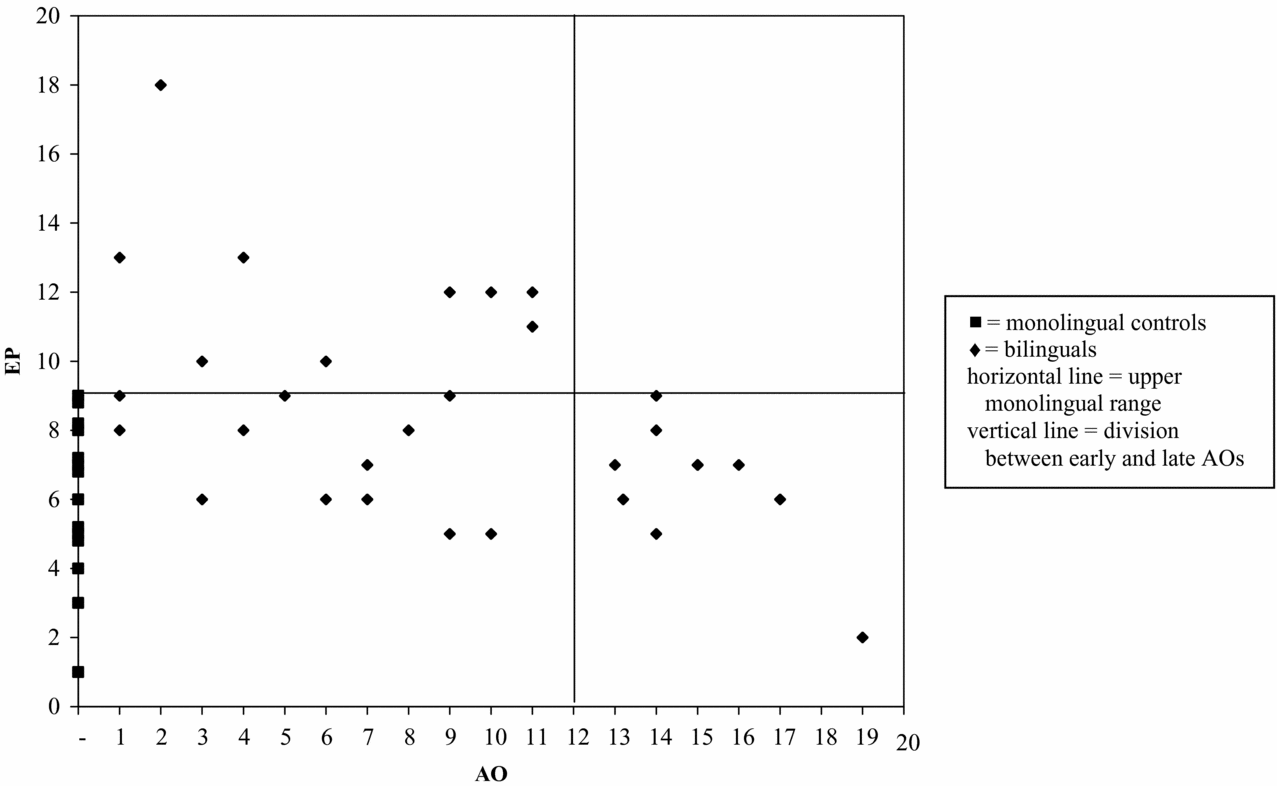
The results related to endpoint (henceforth EP) encoding indicate a clear relationship between AO of L2 acquisition and EP frequency. The overall tendency is that subjects with early AO are more prone to verbalize EP for goal-oriented motion events than subjects with late AO, that is, the earlier the separation from the L1 environment, the more prone the speaker will be to encode dos monjas están caminando hacia un convento “two nuns are walking to a convent”, instead of dos monjas están caminando “two nuns are walking”. The trend observed here indicates that bilingual subjects with lower AO are more likely to exceed the EP frequencies of the Spanish monolingual controls. There was a significant negative correlation between AO and EP frequency, r(29) = −.49, p = .005. The relationship between EP behaviour and AO in the subject group is depicted in Figure 1 together with the EP range of the control group (the upper limit of which is represented by the horizontal line).
Endpoint (EP) encodings and age of onset (AO) of L2 acquisition, r(29) = −.49, p = .005.

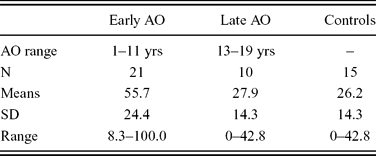
Following the supposition regarding the age of 9 as a reference point (cf. section 3), the results laid out in Figure 1 indicate that only four out of the 17 subjects who allegedly had attained native EP patterns upon arrival in Sweden, show deviating frequencies from the monolingual range. The common denominator for these four subjects is the early AO (9, 10 and 11 years). Actually, in Figure 1 it is seen that EP frequency, although declining with increasing AO, exhibits rather distinct patterns for subjects with AOs before as opposed to after puberty (which is indicated by the vertical line).Footnote 12 The subjects with postpubescent AOs (> 12 years) display an EP frequency which has a relatively low variability (range = 2–9) and, more importantly, falls within the range of the Spanish monolingual controls. The subjects with prepubescent AOs (< 12 years), on the other hand, exhibit an EP frequency with higher variability (range = 5–18) and approximately 43% of these subjects display EP frequencies above the range of the control group. The EP frequencies exceeding those of the control group pertain exclusively to subjects whose AO spans from 1 to 11 years. After AO 11, EP frequencies slope and converge with controls. The hypothesized difference between subjects with AOs < 12 and subjects with AOs > 12 was consequently borne out.
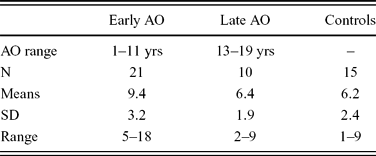
Table 1 presents more detailed information about EP behaviour in these AO categories. A one-way analysis of variance (ANOVA) was conducted to establish whether there were significant differences between the groups’ EP frequencies. Results indicated significant differences among groups, F(2, 43) = 7.395, p = .002. Pairwise post-hoc comparisons using the Tamhane procedure were then performed in order to determine which groups differed significantly.
EP frequencies according to AO group.

The first comparison concerned differences between early and late AOs. Results showed, as expected, that these AO groups differed significantly as regards the number of EP verbalizations (p = .01). The second comparison regarded the differences in EP frequency between the early AOs versus monolingual controls. In this case, results showed that these two AO groups differed significantly in their EP verbalizations (p = .005). The final comparison involved determining whether there was a difference in EP frequencies between the late AO group and the control group. In contrast to the early AOs, results indicated that the late AOs did not differ significantly from the controls’ performance (p = .994).
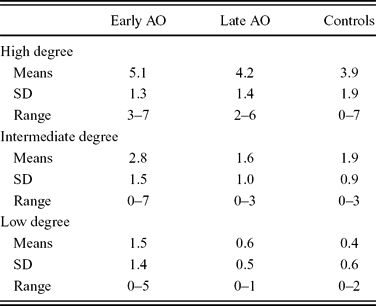
The second step of the analysis involved determining whether the EP encodings were distributed randomly across the scenes or whether they were connected to the degree of goal-orientation (as mentioned in section 5.2, EP encoding is expected to vary as a function of the salience of the goal). The EP distributions were thus counted according to the degree of goal-orientation of the scene to which they referred, i.e. “high degree of goal-orientation”, “intermediate degree of goal-orientation” or “low degree of goal-orientation”. Table 2 presents an overview of the two age groups’ EP behaviour in each of the three scene categories.
EP frequencies according to AO category and degree of goal-orientation.

A 3 (degree of goal-orientation) × 3 (group) mixed ANOVA showed that the main effect of degree of goal-orientation was significant, F(2, 43) = 108.873, p < .000, indicating that EP frequencies are related to degree of goal-orientation. The main effect of group was also significant, F(2, 43) = 7.395, p = .002, implying that the AO groups and the controls generally differed in their EP encoding (as was seen above). The group × degree of goal-orientation interaction was not, however, significant, F(4, 43) = .204, p = .936, which means that the between-group differences are not connected to degree of goal-orientation, nor is the differential behaviour according to degree of goal-orientation related to the differences between groups.
Given the preliminary nature of these findings, I will not delve further into this issue in the present study. Instead, these results will be considered as indicative that the EP frequencies found in the groups are not arbitrarily distributed over the different scene categories, but are to a certain extent related to degree of goal-orientation.
A third step in the analysis consisted of assessing the possibility that the subjects’ LoR (length of residence) in Sweden might have influenced the EP frequencies. Although previous findings tentatively indicate that if LoR exceeds 10 years it may no longer be a factor for L1 maintenance (e.g., Ammerlaan, Reference Ammerlaan1996; de Bot and Clyne, Reference de Bot and Clyne1994; Gürel, Reference Gürel2002), Köpke and Schmid (Reference Köpke, Schmid, Schmid, Köpke, Keijzer and Weilemar2004) maintain that the role of LoR in attrition is still an unsettled issue. In order to address this question, LoR – which among the subjects of the current study was ≥ 12 years – was correlated with the obtained EP values. Results indicated that LoR does not influence EP patterns (r(29) = −.13., p = .46 (n.s.). This finding thus supports the interpretation that the bilingual EP patterns are first and foremost an effect of AO of L2 acquisition. Moreover, the finding is also consistent with previous research showing that a LoR > 10 years has little or no impact on L1 maintenance.
A closer look at the EP encodings reveals that the subjects do not only exceed monolingual EP frequencies: sometimes, the verbalization of an EP entails the path by which the EP is reached, which in turn results in ungrammatical constructions. This is particularly reflected in the subjects’ use of satellite verbs – a construction which normally does not exist in Spanish (see e.g., Talmy, Reference Talmy1991). Among the subjects with early AOs, this innovative construction is triggered by a scene which depicts a boy jumping from a chest of drawers to a mattress lying on the floor. Whereas the controls typically refer to this event using saltando or saltando a una colchoneta “jumping” or “jumping to a mattress”, four of the subjects with early AO verbalize the scene using ??saltando para abajo a una colchoneta “jumping down(wards) onto a mattress”. A similar phenomenon is actually found among the subjects with late AO: although this group do not exhibit deviating EP frequencies, there is a scene showing two ducklings ascending to a nest which two late AOs describe as ??subiendo arriba al nido (approx. “ascending upwards to the nest”). Controls refer to this event with simply subiendo “ascending”. Moreover, in the controls, information about path is usually left to be inferred through descriptions of the setting. This is most clearly manifested in the scene with the boy jumping from a chest down to a mattress: here, controls convey information about the entity's location: un niño encima de una comoda está saltando a una colchoneta (approx. “a boy on the top of a chest is jumping to a mattress”). In this way, details about path – which were expressed through satellite verbs by some of the bilinguals – are conveyed by combining information about static “on the top of” and dynamic “jumping” properties (cf. Sebastián and Slobin, Reference Sebastián, Slobin, Berman and Slobin1994). The deviating satellite constructions found in the bilinguals are analogous to the scene descriptions of the group of L1 Swedish speakers documented in Bylund (Reference Bylund2008): hoppar ner till en madrass “jumps down to a mattress” and går upp/klättrar upp till boet “goes up/climbs up to the nest”. These findings will be further commented upon in section 7.1.
6.2 Temporal perspectivation
The second part of the analysis of the bilinguals’ conceptualization patterns regards the temporal perspective taken in the EP encodings. The significant issue here is whether the subjects, in verbalizing an EP, show any preference for the simple present tense (henceforth SP) or the aspectually marked present participle.
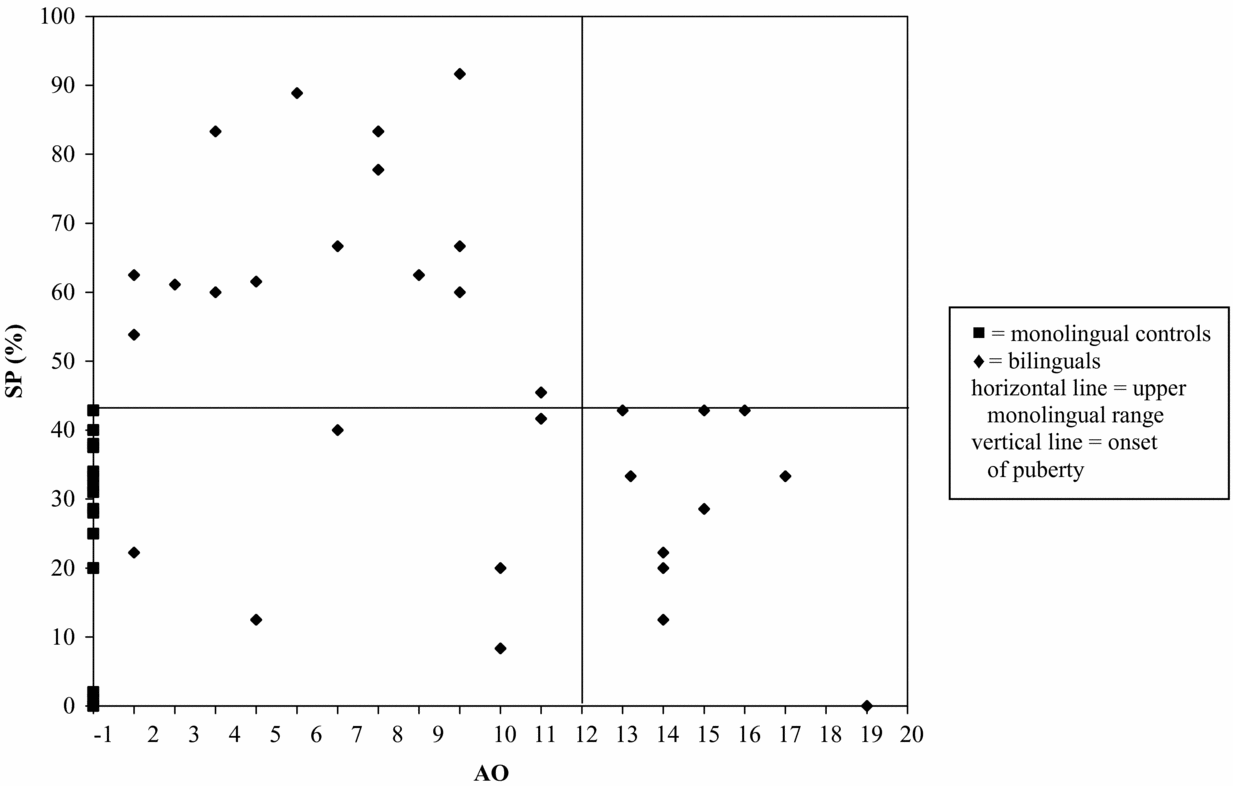
Results show that there is a strong relationship between perspectivation pattern and AO of L2 acquisition. Figure 2 shows the subjects’ SP percentages in accordance with their AO. The use of SP in EP encodings shows a negative correlation with AO which is statistically significant, r(29) = −.50, p = .004.Footnote 13 This means that the lower the AO of the subject, the more likely he/she is to perspectivize the verbalized EP motion by means of the SP, e.g., dos monjas caminan hacia un convento “two nuns walk to a convent” instead of dos monjas están caminando hacia un convento “two nuns are walking to a convent”. The SP values laid out in Table 2 have certain points of similarity with the EP trends shown in Table 1. Firstly, only four out of the 17 subjects that supposedly had attained native-like patterns of temporal perspectivation upon arrival in Sweden deviate from the monolingual range. These four subjects have prepubescent AOs (9 and 11 years). Secondly, puberty (represented by the vertical line) appears to play an important role in establishing temporal eventive perspectives in a native manner: in Figure 2, it is seen that SP percentages among subjects with early AO vary considerably; actually, approximately 71% (or 15 out of 21) of the subjects in this AO category present a use of SP that exceeds the upper limit of the range of monolingual controls (horizontal line). The subjects with late AO, on the other hand, show SP values that, firstly, are less variable, and secondly, fall within the range of the control group. The hypothesis that subjects with AO < 12 would deviate from monolingual patterns was thus corroborated by the results. Table 3 gives more detailed information about the SP behaviour according to AO category.
Simple present tense (SP) and age of onset (AO) of L2 acquisition, r(29) = −.50, p = .004.

SP values according to AO category.

A one-way ANOVA indicated that there was a difference between groups (F(2, 43) = 12.318, p < .000). Post-hoc Tamhane procedures were used in order to establish which groups differed significantly. The first comparison involved determining whether there was a difference in SP values between the group with early AO and the one with late AOs. Results showed, as expected, that these groups differed significantly as regards the use of SP (p = .001). The second comparison consisted in determining differences in SP frequencies between the early AO group and controls. In this case, results showed that these two AO-categories differed significantly (p < .000) in their SP verbalizations. The third and last comparison concerned possible differences in SP values between the late AO group and monolingual controls. In contrast to the subjects with early AOs, results indicated that SP values among late AOs did not differ from those of controls (p = .99); rather, these groups essentially converged on the data displayed in Table 3.
The next step in the SP analysis involved determining whether LoR in Sweden had an effect on the degree of conformity to monolingual Spanish SP patterns (see section 6.1). In order to test this, the subjects’ SP frequencies were correlated with LoR. Results showed virtually no correlation at all between these two measures (r(29) = .02, p = .93). This finding aligns with the finding regarding LoR and EP frequencies reported in the preceding section, and supports the interpretation that AO of L2 acquisition is an important factor in the SP patterns.
Apart from the management of temporal perspectivation as conveyed by the tense form, the subjects’ scene descriptions contain another type of deviating perspectivation worthy of notice. This concerns additional information about the location or corporal position of the entity involved in the event depicted. Two subjects (AO 2 and 3) chose to provide information about the fact that the entities stand up during the event, e.g., un hombre parado va en una carretilla a un pueblo “a standing man rides a carrier to a village”. If we go beyond the utterances containing EPs, this tendency is more clearly manifested: six out of 21 subjects in the early AO group and seven out of 10 late AOs give information about the corporal position (sitting or standing) of the entities. Information about the location of the entities/events is also given by the subjects in e.g., the clip with a boy in a garden throwing a ball towards a slide; this scene is described by two subjects (AO 4 and 6) as un niño juega afuera “a child plays outside”. In total, three out of 21 subjects with early AOs and three out of 10 in the group with late AOs provide information about the location of the entities in their scene descriptions.
Even though the additional information about location and position is framed within grammatically correct constructions – and consequently does not present any structural anomalies – the behaviour of the Spanish monolingual controls indicates that it is not the preferred pattern of conceptualizing the events. Among the controls there is not a single occurrence of such additional information. This type of perspectivation, mediated through the moving entity's location or position, is analogous to Swedish strategies of ongoingness construal.
Summarizing the findings, the analyses of EP encoding and SP use consistently showed that L1 patterns of component selection and temporal perspectivation are closely related to the AO of L2 acquisition. It was seen that divergences from the monolingual patterns of EP encoding and temporal perspectivation were exclusively found in subjects whose AO was below 12 years. About half of the speakers with AOs ranging from 1 to 11 years presented EP and SP frequencies that exceeded the range of monolingual controls. Subjects with AO > 12, on the other hand, were shown to converge with Spanish monolingual performance exhibiting EP and SP frequencies that were practically identical to the controls’.
7. Discussion
In the discussion of the findings, the origin of the deviating event conceptualization patterns will be treated first. Subsequently, the effects of AO of L2 acquisition on L1 event conceptualization patterns are discussed. Because the EP and SP patterns were equally affected by AO, the discussion will not treat these measures separately. In the particular discussion on the effects of age, attention will first be directed to the reliability of the data. This will justify the interpretation that the deviating conceptualization patterns are a function of AO of L2 acquisition. Finally, using the factors of L2 proficiency and L1 contact as a point of departure, an attempt will be made to explain the factors underlying the observed AO effects.
7.1 The origin of the deviations
The deviations found in the subjects’ component selection and temporal perspectivation are, to reiterate, characterized by an overproduction of EP and SP. This pattern resembles the event conceptualization strategies documented in monolingual speakers of Swedish: in Bylund (Reference Bylund2008), it was observed that speakers of Swedish, in describing goal-oriented motion events, encode EP and omit ongoingness structures to a higher degree than monolingual speakers of Spanish. The reason speakers of Swedish prefer bounded perspectives is partly due to the lack of grammaticalized means that express ongoingness on a systematic scale, but perhaps also due to the fact that some of the lexical constructions in Swedish that denote ongoingness are not combinable with EP, cf. ??två nunnor är ute och går till ett kloster “two nuns are out walking to a convent”. In view of the similarities between the deviations attested in the bilinguals and Swedish event conceptualization patterns, as well as the fact that the subjects are near-native speakers of Swedish, it is suggested that the non-native features found in their L1 conceptualization patterns are L2-induced. Further evidence of L2 influence on the subjects’ L1 event conceptualization was also found in the event descriptions containing information about the moving entity's location and position as well as the path by which an endpoint was reached.
Even though it seems quite clear that the deviating conceptualization patterns are L2-induced, I wish to further substantiate this claim by directing attention to the previously commented findings on the acquisitional stages in L1 Spanish (as will be seen in the next section, it is important to understand the roots of the deviations when interpreting the AO effects). According to Sebastián and Slobin's (Reference Sebastián, Slobin, Berman and Slobin1994) study on Spanish speakers, the frequency of EP encodings as well as the use of SP is low among 9-year-olds and adults and even lower among preschoolers. Since many language-specific conceptual distinctions are acquired during the first years of life (spatial distinctions: Bowerman and Choi, Reference Bowerman and Choi2001; aspectual distinctions: Behrens, Reference Behrens2001; Hickmann and Hendriks, Reference Hickmann and Hendriks2006), it was suggested that the low frequency of EP and SP among young speakers of Spanish also reflects a language-specific phase of acquisition, that is, the low occurrence of these features suggests that a Spanish-speaking child sensitized towards features of ongoingness at a young age. The fact that the EP and SP frequencies are low at all stages of L1 Spanish acquisition consequently suggests that the excessive use of these features among the early AOs does not, in contrast to what may be the case of incomplete acquisition and attrition in the realm of tense/aspect contrasts (cf. Montrul, Reference Montrul2002; Polinsky, Reference Polinsky and Browne1997; Silva-Corvalán, Reference Silva-Corvalán1994), reflect a stagnation at or a regression to an earlier acquisitional stage. Rather, the overproduction of EP and SP are evidence of how L1 event conceptualization patterns have been affected by L2.
7.2 AO effects
The primacy of AO
A possible problem concerning the interpretation that AO of L2 acquisition governs the degree of conformity to native Spanish conceptualization patterns relates to the issue of incomplete acquisition (see section 4). Based on findings on the acquisition of tense and aspect marking as well as source and goal encodings in narratives, the assumption was made that the patterns of event component selection and temporal perspectivation converge with adult behaviour by nine years of age. Given the difficulty of establishing an age by which a given feature is mastered, the reliability of the classification of deviations in subjects with AO ≥ 9 could be compromised. That is to say, the differences attested between these subjects and controls might not solely be interpreted in terms of attrition: instead, it could be argued that the differences between early and late AOs are not an effect of the late AOs being less susceptible to attrition but are rather a consequence of the fact that they mastered the features in question by the time of the break with the L1 environment, whereas the early AOs did not. If this were the case, the observed EP and SP trend would not be a function of AO but merely a result of the age of acquisition of these features. There are, however, ground for arguing against such interpretation of the data. The fact that subjects with AOs ≥ 9 present deviations that do not correspond to a stage of acquisition reached prior to the break with the L1 environment (or to any other acquisitional stage), but bear a family resemblance to L2 event conceptualization patterns, should be seen as evidence favouring the classification of these features as instances of L2-induced attrition.
The attrition literature provides further information on the relationship between the age by which a given feature is mastered, the age of onset of attrition, and the outcome of attrition: as previously discussed, findings from Silva-Corvalán (Reference Silva-Corvalán1994) and Yeni-Komshian et al. (Reference Yeni-Komshian, Flege and Liu2000) suggest that the attrition outcome of features that are acquired at different ages (verbal clitics, TMA, copula verbs and pronunciation) is to a great degree dependent on whether attrition sets off before or after puberty. Such findings point in the same direction as the data presented in the study at hand: the retention of a given feature seems to vary more as a function of AO of L2 acquisition than of the age by which the feature was acquired. That is to say, the time during which a given feature has been mastered at native level is of less importance for its retention compared to the age by which attrition sets in (i.e. pre- or post-puberty). It is believed that the quality of the deviations as well as the findings’ congruity with previous research minimize the possibility that the AO pattern found in the present study is merely a function of age of acquisition. Instead, these data suggest that the outcome differences between early and late AOs are due to different degrees of attrition susceptibility.
Another aspect of the data that might trouble the AO interpretation concerns the distribution of AOs: the subject group of the present study comprises 31 individuals, of which 21 have prepubescent AOs and 10 have postpubescent AOs. Although this is a result of the design of the study (see section 4.1), it could be argued that such AO bias weakens the reliability of the trend that non-native EP frequencies and SP values are exclusively found in prepubescent AOs: one cannot exclude the possibility that a greater number of subjects with postpubescent AOs could have increased the EP and SP ranges, and consequently produced deviating values among this AO group.
The finding that puberty plays a crucial role for L1 maintenance is, however, still perfectly in line with previous studies on attrition (cf. Silva-Corvalán, Reference Silva-Corvalán1994; Yeni-Komshian et al., Reference Yeni-Komshian, Flege and Liu2000).Footnote 14 Studies on attriters with adolescent AOs show that the degree of language loss in this group does not vary as a function of AO and is, moreover, usually relatively low (cf. Köpke, Reference Köpke1999; Schmid, Reference Schmid2002; Gürel, Reference Gürel2004). In view of these findings, it could be hypothesized that even though non-native EP and SP frequencies were found in late AOs, such instances of deviation would, firstly, not exceed native ranges substantially, and secondly, be found in a limited number of subjects. Hence, such cases would still not speak against the idea that puberty plays a central role for the maintenance of L1 event conceptualization patterns. Actually, it would not be desirable to interpret these findings as if attrition does not occur among postpubescent AOs, as is sometimes done (e.g., Munnich, Landau and Dosher, Reference Munnich, Landau and Dosher2001). Although the present study did not attest attrition in the EP and SP frequencies of the late AOs, it should be noted that this group did exhibit other types of deviating constructions (i.e. satellite verbs and the use of location or position information in order to convey ongoingness).
Factors underlying the AO effects
The primary function of L2 proficiency in L2-induced attrition is logical: some degree of L2 knowledge is a prerequisite for L2-induced attrition to take place. But to what extent does L2 proficiency govern the attrition outcome? Since the present study deals with L2-induced attrition, one might be prone to overemphasize the role of L2 proficiency when interpreting the puberty-related EP and SP trends: that is to say, one might be prone to interpret these patterns solely as a result of the early AOs having acquired the L2 patterns – and consequently transferred them to L1 – whereas the late AOs have not. There are, however, several reasons for which such reading of the AO trend is problematic. To begin with, claiming that the subjects’ L2 proficiency alone is responsible for the attested deviations would not be adequate, since L2 knowledge per se does not automatically bring about transfer. Actually, cautions should be given when suggesting that a decline in L1 proficiency is simply a consequence of a competing L2. Such claim can be traced back to what has been labelled the Balance Theory of Bilingualism (Cummins, Reference Cummins1981). This theory assumes that “the brain has only a limited capacity and therefore the addition of a second language automatically leads to a decrease of proficiency in the L1” (Hoffmann, Reference Hoffmann1991, p. 129; for a similar discussion, see Flege, Reference Flege and Birdsong1999). The idea that L1 proficiency is inversely related to L2 proficiency is, however, not a given in the field (see Hyltenstam et al., Reference Hyltenstam, Bylund, Abrahamsson and Park2009; Bylund et al., forthcoming) and research on this topic has so far primarily concerned pronunciation proficiency (for an overview, see Flege, Reference Flege and Birdsong1999). Therefore, its applicability to the domain of conceptualization remains unclear.
A second – and more important – reason for not overemphasizing the role of L2 proficiency when interpreting the AO trend is the fact that the subjects of the present study were not randomly invited to participate; instead, they were carefully selected on the basis of their near-native proficiency in Swedish (so-called “non-perceivable non-native” proficiency, see Abrahamsson and Hyltenstam, 2008).Footnote 15 This means that, although there might still be certain variation in the L2 proficiency of the subjects, the variable “L2 proficiency” has been held as high and as constant as possible throughout the AO span. Given this characteristic of the subject group, L2 proficiency alone is unlikely to have produced the varying levels of conformity to monolingual event conceptualization patterns.
For both theoretical and empirical reasons it becomes clear that although L2 proficiency is a necessary ingredient in L2-induced attrition, this factor cannot alone offer an explanation of the AO governed pattern documented in the present study. Instead, in order to arrive at an understanding of the subjects’ behaviour, one needs to integrate a factor that affects early and late AOs differently and still allows for proficiency variability in the first group. I suggest that L1 contact is a factor that meets these criteria.Footnote 16 Research findings to date convincingly show that attriters with early AOs are dependent of L1 contact to a greater extent than late attriters. A comparison of the degrees of attrition between immigrant children and international adoptees shows that when L1 contact is effectively cut off (as in the latter group), L1 may undergo an apparently complete loss (e.g., Pallier et al. Reference Pallier, Dehaene, Poline, LeBihan, Argenti, Dupoux and Mehler2003). No study on attrition in late AOs has found – however little L1 contact the speaker maintains – anything remotely similar to such a drastic picture (Köpke and Schmid, Reference Köpke, Schmid, Schmid, Köpke, Keijzer and Weilemar2004, p. 10). The fact that speakers with early AOs attrite to different extents according to the degree of L1 contact they maintain (as in the case of immigrant and adoptee attriters), suggests that L1 retention in early AOs is by and large dependent on advantageous frequencies of L1 contact. The positive effects of L1 contact on L1 maintenance become obvious not only from comparing the results from different studies on adoptee and immigrant attriters, but they can also be found in one and the same study: as was seen in section 2, the studies on immigrant children by Hakuta and D'Andrea (Reference Hakuta and D'Andrea1992) and Yeni-Komshian et al. (Reference Yeni-Komshian, Flege and Liu2000) corroborate the positive effects that L1 contact exerts on L1 maintenance (see also Sharwood Smith and van Buren, Reference Sharwood Smith and van Buren1991, for a discussion of the role of “evidence” in attrition).
It is thus suggested that L1 contact – probably together with other socio-psychological factors such as motivation for and attitudes towards L1 maintenance – plays an important role in the attrition outcome in subjects with early AO. Given the fact that socio-psychological factors – as opposed to attrition susceptibility – differ in each individual case, such high variability of L1 maintenance is found in the early AO group. The late AOs may well exhibit varying levels of L1 contact but since L1 maintenance in this group is allegedly less dependent on these factors, individual variation should play a minor role for the attrition outcome.
In view of this reasoning, it is suggested that even though an early AO may provide a greater pool of transfer material, circumstances in the linguistic setting exert a major influence on whether these features will be transferred to L1 or not. If a person with early AO is not exposed to a sufficient amount of L1 input or not given sufficient opportunities to make use of his/her L1, this person will be more likely to incorporate L2 features into the L1 repertoire. Thus, the interpretation pursued in the current paper is that it is not the knowledge of L2 conceptualization patterns per se that gives rise to the overproduction of EP and SP; rather, it is this knowledge in combination with the lack of a sufficient amount of L1 contact that produces deviations from the Spanish monolingual behaviour.
For the same reasons, the subjects with late AO are less likely to exhibit deviating conceptualization patterns: due to their allegedly lower attrition susceptibility by the time of the break with the L1 environment, this AO group is not equally dependent on advantageous circumstances of L1 contact and use. In general terms, it can be stated that the L1 proficiency of a speaker having received uninterrupted L1 input up until puberty is less subject to change than the L1 of a speaker who experienced a change in the linguistic setting before the onset of puberty (cf. Bylund, in press, for an in-depth discussion on the critical period hypothesis in an attrition context).
8. Conclusions
This study aimed at exploring the effects of AO of L2 acquisition on L1 event conceptualization patterns. The research questions addressed the role of AO in EP encoding and temporal perspectivation in goal-oriented motion events. In view of previous findings on age effects in attrition, it was hypothesized that deviation from monolingual patterns of conceptualization would be limited basically to subjects with AO < 12 years. The hypothesis was borne out by the results. Although a small number of deviations in features such as satellite constructions were attested among subjects with AO > 12, this group converged with monolingual controls on both EP encoding and temporal perspectivation strategies. Deviations from the controls’ performance on these measures were found exclusively in subjects with AO < 12. These findings consequently suggest that patterns of event conceptualization are affected by AO in the same way as formal language skills. In interpreting the age trend, it was suggested that in situations of reduced L1 contact the early AOs would, as a consequence of their heightened attrition susceptibility, be more prone than late AOs to transfer L2 patterns to L1. Although this interpretation is consistent with critical period theory, it remains tentative due to the lack of firm data on the early AOs’ L1 use during childhood and on the early and late AOs’ specific proficiency with L2 event conceptualization patterns. An important task for future investigations into age-related differences in attrition will accordingly have to be an empirical investigation of both L1 and L2 proficiency and, additionally, collection of data on diachronic and synchronic patterns of language use. Such study design could provide a complete picture of the hypothesized age-related interaction between language contact and language proficiency.
The findings from the present study suggest that research on conceptual proficiency, although yet in its infancy, has the potential to nuance our picture of age effects in the processes and outcomes of attrition. An important issue that merits to be explored by future inquiry is whether age affects different conceptual domains to different extents. Findings from second language research (SLA) on conceptual proficiency clearly show that the effects of a late start of L2 acquisition are selective by nature: whereas classification preferences which mainly rely on sensory experience (concerning e.g., artifact naming) may be attained to a native-like level (e.g., Pavlenko, Reference Pavlenko2007; also Athanasopoulos, Reference Athanasopoulos2006), the acquisition of time and event conceptualization patterns, which are often grammaticalized and present a higher degree of conceptual complexity, seems to be more conditioned by AO of acquisition (Boroditsky, Reference Boroditsky2001; Carroll and von Stutterheim, Reference Carroll, von Stutterheim and Ramat2003; Schmiedtová, in press). Whether age effects are equally selective in attrition, affecting object concepts and grammatical concepts differently, remains an open question. Hence, it is suggested that in order to determine the effects of age on language development, the traditional focus on linguistic structure, which thus far has been the locus of attention in both SLA and attrition research, should be extended to include conceptual proficiency as well.