Implications
This study looks at the potential beneficial effects of providing the milk thistle plant extract (silymarin) to lactating sows. When 1 or 8 g/day of silymarin was fed to sows throughout a 20-day lactation, there were no effects on circulating concentrations of prolactin or urea, oxidative status, sow performance, milk composition or piglet growth. Results corroborate previously published effects of parity on sow performance, whereby multiparous sows had a greater lactation feed intake, and lost less weight and backfat during lactation than primiparous sows. It is apparent that providing up to 8 g/day of the plant extract silymarin to lactating sows is not an effective avenue to increase concentrations of prolactin or improve oxidative status in sows or performances of sows and their litters.
Introduction
The use of plant-derived products to improve performance and health of animals and humans has gained popularity in recent years. Silymarin is a mixture of flavonolignans derived from the plant Silybum marianum (milk thistle) that is known for its hepatoprotective, anti-inflammatory and antioxidant properties (Gupta et al., Reference Gupta, Sing, Bani, Sharma, Malhotra, Gupta, Banerjee and Handa2000; Giese, Reference Giese2001; Wu et al., Reference Wu, Huang and Yen2011). The active component of silymarin is silybin and its concentration can vary greatly between silymarin extracts, thereby potentially affecting its biological effects. Nevertheless, silymarin extracts were reported to increase milk yield in lactating cows (Tedesco et al., Reference Tedesco, Tava, Galletti, Tameni, Varisco, Costa and Steidler2004) and women (Di Pierro et al., Reference Di Pierro, Callegari, Carotenuto and Tapia2008), and to enhance bovine and murine mammary cell proliferation as well as β-casein gene expression (Starvaggi Cucuzza et al., Reference Starvaggi Cucuzza, Motta, Miretti, Macchi, Martignani, Accornero and Baratta2010). Yet, the potential galactogogue effect of silymarin was never studied in swine. The observed beneficial effects of silymarin on lactation performance could be linked to increased prolactin concentrations because silymarin significantly increased prolactin in female rats, and this effect was achieved in part through dopamine receptors (Capasso et al., Reference Capasso, Aviello, Capasso, Savino, Izzo, Lembo and Borrelli2009). Very few studies were carried out with silymarin in swine. Three studies were performed using two different mixtures of silymarin with similar concentrations of silybin (26.7% and 28.7%). It was shown that providing 1, 2 or 4 g/day of silymarin for 8 days to post-weaned cycling sows did not increase prolactin concentrations (Loisel et al., Reference Loisel, Quesnel and Farmer2013), whereas feeding 8 g/day of silymarin from 90 to 110 days of gestation tended to increase prolactin concentrations (Farmer et al., Reference Farmer, Lapointe and Palin2014). On the other hand, supplying 12 g/day during the last 8 days of gestation did not lead to hyperprolactinemia (Loisel et al., Reference Loisel, Farmer, Ramaekers and Quesnel2014). Considering the fact that there is a drastic increase in prolactin concentrations prepartum and that lactating sows seem to have an altered prolactin regulatory system compared with cyclic gilts (Smith and Wagner, Reference Smith and Wagner1985), it would be of interest to determine if silymarin affects prolactin concentrations and piglet growth during lactation in sows. A maximal dose of 8 g/day was selected in the present study because it tended to increase prolactin concentrations in late gestation (Farmer et al., Reference Farmer, Lapointe and Palin2014).
The lactation process is associated with high energetic demands that trigger a great loss of protein, a decrease in sow BW (Hoving et al., Reference Hoving, Soede, Feitsma and Kemp2012), and an increase in systemic oxidative stress (Berchieri-Ronchi et al., Reference Berchieri-Ronchi, Kim, Zhao, Correa, Yeum and Ferreira2011). In all cells, mitochondria are remarkably dynamic organelles that are important for generating energy. Mitochondrial energy metabolism, however, is tightly associated with the production of toxic reactive oxygen species (ROS) that are susceptible to induce oxidative stress conditions in periods of high metabolic activity (Kowaltowski et al., Reference Kowaltowski, de Souza-Pinto, Castilho and Vercesi2009). Furthermore, due to their localization, mitochondrial enzymes are particularly vulnerable to ROS, leading to mitochondrial dysfunction and increases in oxidative pressure during critical reproductive periods in sows (Lapointe, Reference Lapointe, Stepanyan, Bigras and Hekimi2014). There are many possible mechanisms by which silymarin can improve the antioxidant defense mechanisms and oxidative status (Gabrielova et al., Reference Gabrielova, Kren, Jaburek and Modriansky2015; Surai, Reference Surai2015; Feng et al., Reference Farmer, Robert and Rushen2016), and its beneficial effect in protecting against systemic oxidative stress was recently demonstrated in late-pregnant sows (Farmer et al., Reference Farmer, Lapointe and Palin2014). It is likely that the dose of silymarin needed to elicit antioxidant effects is lower than that required to stimulate milk yield. The current study was therefore carried out to determine the impacts of providing either 1 or 8 g/day of silymarin to sows throughout lactation on their circulating prolactin concentrations, oxidative stress, milk composition and litter performance.
Material and methods
Animals and treatments
In all, 99 Yorkshire×Landrace sows (27 first parity, 54 second parity and 18 third parity) from the Cooperative Research Farms (CRF) sow research farm were used for the study. They were housed in individual gestation pens (1.5×2.4 m) and were fed 2.50 kg daily of a standard commercial diet (13.0% CP, 3194 kcal/kg digestible energy, 0.57% lysine) throughout gestation. At the onset of lactation, they were equally distributed to three treatment groups with respect to parity. Sows received no silymarin (controls (CTL), n=33) or received 1 g/day of silymarin (SYL1, n=33) or 8 g/day of silymarin (SYL8, n=33). Silymarin was a standardized milk thistle extract (Monteloeder, Elche, Spain). The extract contained 11.4% and 17.3% of silybin A and B, respectively (relative to the total milk thistle extract). Half the daily dose of silymarin was mixed with 13 g of crushed corn and 12 ml of water and was fed before the two daily meals throughout lactation. Control sows received the corn–water mixture alone. Sows were fed a commercial lactation diet (17.0% CP, 3410 kcal/kg digestible energy, 1.04% lysine) in two equal meals at a rate of 1.81 kg/day on the day of farrowing, 2.72 kg/day on day 1, 4.08 kg/day on day 2, 5.90 kg/day on day 3, 7.71 kg/day on day 4 and then ad libitum for the remainder of lactation. Feed refusals were measured daily to obtain daily feed intakes. Sows were weighed and had their backfat thickness measured ultrasonically at P2 of the last rib (VetkoPlus; Noveko, Lachine, QC, Canada) on the day of farrowing and at weaning (day 20±2 of lactation). Litters were standardized to 13±1 piglets (within treatment group) within 24 h of birth, and piglets were weighed on days 1 (after standardization of litter size), 7, 14 and 18 of lactation as well as on day 66 of age. Piglets had no access to dry feed while suckling so that their weight gain was representative of milk yield. Mortality rate was recorded. Jugular blood samples were obtained from all sows before the morning feeding (between 0730 and 0930 h) of days 7±1 and 18±1 of lactation to measure concentrations of prolactin and urea. The sample from day 18 was also used to determine antioxidant status. Representative milk samples were also obtained from 20 sows per treatment (parities 1 and 2) on day 18 of lactation by collecting milk from three functional glands (anterior, middle and posterior) encompassing both sides of the udder, following an i.v. injection of 1.0 ml of oxytocin (20 IU/ml; P.V.U., Victoriaville, QC, Canada). Piglets were separated from their dam for 45 min before the oxytocin was injected. The post-weaning estrus interval was noted for all sows. Animals were cared according to a recommended code of practice (Agriculture and Agri-Food Canada, 1993), and procedures were approved by the Institutional Animal Care Committee.
Blood handling and assays
Blood samples for measurement of prolactin, urea and antioxidant status were collected in EDTA-tubes (Becton Dickinson and Cie, Rutherford, NJ, USA). They were put on ice and centrifuged within 20 min at 4°C for 12 min at 1800×g, plasma was immediately recovered and frozen at −20°C until assayed. Concentrations of prolactin were determined according to a previously described radioimmunoassay (Robert et al., Reference Robert, de Passillé, St-Pierre, Dubreuil, Pelletier, Petitclerc and Brazeau1989). The radioinert prolactin and the first antibody to prolactin were purchased (A.F. Parlow; US National Hormone and Peptide Program; Harbor-UCLA Medical Centre, Torrance, CA, USA). Validation for a plasma pool from lactating sows was conducted. Parallelism was 98.3% and average mass recovery was 98.3%. Sensitivity of the prolactin assay was 1.5 ng/ml. The intra and interassay CV were 4.09% and 4.84%, respectively. Urea was measured by colorimetric analysis using an auto analyzer (AutoAnalyser 3; Technicon Instruments Inc., Tarrytown, NY, USA) according to the method of Huntington (Reference Huntington1984). Intra and interassay CV were 1.94% and 1.82%, respectively.
Determination of oxidative damage and antioxidant potential
The evaluation of oxidative damage to proteins (protein carbonyl content) in plasma was determined with the OxiSelect™ Protein Carbonyl ELISA Kit (Cell Biolabs Inc., San Diego, CA, USA) according to the manufacturer’s instructions, as described by Neretti et al. (Reference Neretti, Wang, Brodsky, Nyguyen, White, Rogina and Helfand2009). Total superoxide dismutase (SOD) activity was measured in plasma using a commercially available kit (Cayman Chemical, Ann Arbor, MI, USA) according to the provided instructions and as described in Lapointe et al. (Reference Lapointe2009). All activities were normalized to the quantity of proteins used in the assays.
Milk composition
Whole milk was analyzed for dry matter, protein, fat and lactose contents. Dry matter was measured according to a validated method using forced air oven drying (Association Official Analytical Chemistry (AOAC), 2005). Protein content was determined in duplicates with the micro-Kjeldahl method (Kjeltec Auto System; Tecator AB, Hoganas, Sweden), and fat was extracted using an established ether extraction method (AOAC, 2005). Lactose was measured by a colorimetric method using a commercial kit (Megazyme International Ireland Ltd, Bray, Co. Wicklow, Ireland). Intra and interassay CV were 1.14% and 2.62%, respectively.
Statistical analyses
The MIXED procedure of SAS (SAS Institute Inc., Cary, NC, USA) was used for statistical analyses. A randomized block design was used with the sow as the experimental unit. The model for prolactin, urea, oxidative damage to proteins, antioxidant potential and all zootechnical data included the effects of parity and treatment. Repeated measures analyses, with the effect of day and the treatment×day interaction added to the model, were also carried out on the variables prolactin, urea, sow and piglet BWs and sow backfat thickness. Multiple comparisons were used to compare treatments with a Tukey’s adjustment and a specific contrast was used to compare primiparous with multiparous sows. Data in tables and text are presented as least squares means±maximal SEM.
Results
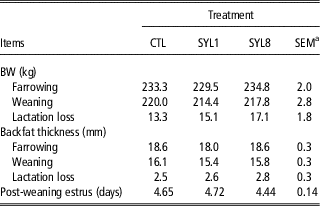
Sow BW, backfat thickness and return to estrus data are shown in Table 1. There was no effect of treatment (P>0.1) on any of these variables as well as on backfat and BW losses during lactation (P>0.1). There was a parity effect on all backfat and BW values (data not shown). Multiparous sows had less backfat (P<0.001) and weighed more (P<0.001) at farrowing and weaning than primiparous sows, and they also lost less backfat (P<0.001) and BW (P<0.01) during lactation. The average sow feed intake over lactation was not affected by treatment (P>0.1) and was 5.61, 5.22 and 5.44±0.18 kg/day for CTL, SYL1 and SYL8 sows, respectively. However, it was affected by parity (P<0.001), with sows from parity 1 eating less (4.22 kg/day) than those from parities 2 (5.76 kg/day) and 3 (6.28 kg/day).
BW, backfat thickness and post-weaning estrus interval for control sows (CTL, n=33) or sows that received 1 g/day (SYL1, n=33) or 8 g/day (SYL8, n=33) of silymarin throughout lactation

a Maximum value of the SEM.
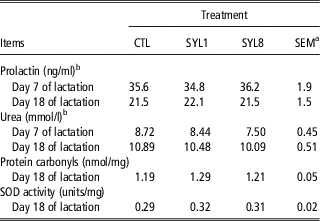
Prolactin and urea concentrations are shown in Table 2. There was no effect (P>0.1) of treatment or parity (data not shown) on prolactin concentrations and values decreased between days 7 and 18 of lactation (P<0.001). Urea was also unaffected by treatment (P>0.1) and concentrations increased with advancing lactation (P<0.001). The repeated-in-time analysis showed an effect of parity (P<0.01), with average values of 8.04, 9.65 and 10.37±0.57 mmol/l for parities 1, 2 and 3, respectively. This parity effect was present on days 7 (P<0.01) and 18 (P<0.05) and, in both instances, was characterized by values being greater in multiparous than primiparous sows (P⩽0.01). Circulating concentrations for the indicators of oxidative status (i.e. protein carbonyls and SOD) on day 18 of lactation were similar for sows of both treatments (Table 2, P>0.1) and of all parities (P>0.1).
Circulating concentrations of prolactin, urea and measures of oxidative status in control sows (CTL, n=33) or sows that received 1 g/day (SYL1, n=33) or 8 g/day (SYL8, n=33) of silymarin throughout lactation

SOD=superoxide dismutase.
a Maximum value of the SEM.
b Day effect (P<0.001).
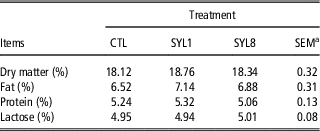
Milk composition (i.e. dry matter, fat, protein and lactose) on day 18 of lactation was not affected by treatment (Table 3, P>0.1), but there was a parity effect (P⩽0.01) on all measured variables. Dry matter (19.02 and 17.79±0.33% for parities 1 and 2, respectively), fat (7.34 and 6.36±0.32% for parities 1 and 2, respectively) and protein (5.43 and 4.99±0.13% for parities 1 and 2, respectively) contents decreased in parity 2 compared with parity 1. On the other hand, lactose content increased from 4.83% to 5.11% (SEM=0.08) between parities 1 and 2.
Milk composition on day 18 of lactation for control sows (CTL, n=33) or sows that received 1 g/day (SYL1, n=33) or 8 g/day (SYL8, n=33) of silymarin throughout lactation

a Maximum value of the SEM.
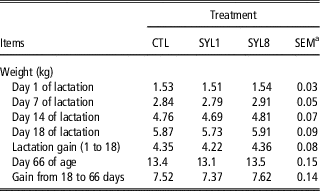
Weights of piglets on any of the days of observation were similar across treatments (Table 4, P>0.1) as were the lactation weight gain and the post-weaning weight gain until 66 days of age (Table 4, P>0.1). There was an effect of parity on all piglet weights (data not shown), with piglets from multiparous sows being heavier than those from primiparous sows on all recording days (P<0.05). The weight gains between days 1 and 18 (4.11 and 4.41±0.06 kg for parities 1 and 2 to 3, respectively), and days 18 to 66 (7.10 and 7.71±0.10 kg for parities 1 and 2 to 3, respectively) were also greater for litters from multiparous than primiparous sows (P<0.01). The percent piglet mortality between uniformization of litters on day 1 and weaning averaged 6.2, 5.9 and 5.6±1.4 for CTL, SIL1 and SIL8 sows, respectively, and was not affected by treatment (P>0.1).
BW of piglets from control sows (CTL, n=33) or sows that received 1 g/day (SYL1, n=33) or 8 g/day (SYL8, n=33) of silymarin throughout lactation

a Maximum value of the SEM.
Discussion
Prolactin holds an essential role in the control of mammary development, lactogenesis and galactopoiesis (see review by Farmer, Reference Farmer2001). In lactating sows, inhibition of prolactin during any week of lactation drastically reduces milk yield, as indicated by a stop in piglet growth (Farmer et al., Reference Feng, Meng, Huang, Shen, Bi and Zhu1998). Taking into account that sows cannot produce enough milk to sustain optimal growth of their piglets (Miller et al., Reference Miller, Collins, Smits, Thompson and Holyoake2012), it is of interest for swine producers to develop new feeding management techniques, such as the use of silymarin, that could increase prolactin release in lactating sows.
It is first important to mention that even though concentrations of the active component of silymarin (silybin) may differ greatly between silymarin extracts, the three studies done in swine used two extracts with similar concentrations of silybin. Concentrations were 26.7% (Loisel et al., Reference Loisel, Quesnel and Farmer2013; Farmer et al., Reference Farmer, Lapointe and Palin2014) and 28.7% (Loisel et al., Reference Loisel, Farmer, Ramaekers and Quesnel2014, current study). In the current study, the absence of effect of silymarin on prolactin concentrations on both days 7 and 18 of lactation corroborates the absence of treatment effect on milk yield, as indicated by the similar growth rate of piglets and sow BW loss during lactation. However, it is in contradiction with results from previous trials in cycling rats (Capasso et al., Reference Capasso, Aviello, Capasso, Savino, Izzo, Lembo and Borrelli2009) and gestating swine (Farmer et al., Reference Farmer, Lapointe and Palin2014). Indeed, Capasso et al. (Reference Capasso, Aviello, Capasso, Savino, Izzo, Lembo and Borrelli2009) reported a significant increase in prolactin concentrations following a 14-day treatment with 50 mg/kg of silymarin and the 8 g/day dose of the current study was equivalent to ~35 mg/kg BW. Yet, it could be that the small difference in dose could account for the absence of effect on prolactin. However, the 8 g/day dose of the current study was similar to that used previously in late gestation (Farmer et al., Reference Farmer, Lapointe and Palin2014) where feeding 4 g of silymarin twice daily from days 90 to 110 of gestation tended to increase prolactin concentrations after 5 days of treatment, but differences were no longer significant after 20 days of treatment. A dose of 4 g/day for a 250 kg sow is also almost equivalent to the 10 g/day given to cows (approximate weight of 600 kg) by Tedesco et al. (Reference Tedesco, Tava, Galletti, Tameni, Varisco, Costa and Steidler2004), where positive effects on milk yield were seen. Nevertheless, it may be that a greater dose could have been beneficial as Capasso et al. (Reference Capasso, Aviello, Capasso, Savino, Izzo, Lembo and Borrelli2009) reported a dose-related response in prolactin concentrations with values doubling when 200 mg/kg of silymarin was provided compared with 25 mg/kg. However, it would be impossible to use such a high dose in swine because the cost would be prohibitive thereby making it unrealistic as a commercial tool.
Duration of treatment with silymarin may also be important for it to have biological effects. Capasso et al. (Reference Capasso, Aviello, Capasso, Savino, Izzo, Lembo and Borrelli2009) reported that prolactin concentrations were still significantly increased after 66 days of cessation of treatment with 200 mg/kg of silymarin. It is not known in the present trial if prolactin concentrations were increased over a very short time period in early lactation because the first blood sample was obtained 7 days after the onset of treatment. In an earlier study where 4 g/day of silymarin was provided to post-weaned multiparous sows, the short-term (up to 9 days after the onset of treatment) prolactin concentrations were not affected (Loisel et al., Reference Loisel, Quesnel and Farmer2013), whereas in another study using 8 g/day of silymarin there was a tendency for prolactin concentrations to be increased after 5 days, but not 20 days, of treatment (Farmer et al., Reference Farmer, Lapointe and Palin2014).
The potential effect of silymarin on various blood biochemical variables was studied in aquaculture. Banaee et al. (Reference Banaee, Sureda, Mirvaghefi and Rafei2011) and Yi et al. (Reference Yi, Gu, Ding, Li, Hou, Wang and Gong2012) observed increased plasma protein concentrations indicative of enhanced hepatic protein synthesis, however, blood urea nitrogen was not altered in the latter study. Protein use is most important in lactating animals as it can limit milk synthesis. In cows, Tedesco et al. (Reference Tedesco, Tava, Galletti, Tameni, Varisco, Costa and Steidler2004) reported that circulating urea concentrations were unaffected by silymarin even though milk yield was increased. Urea is the final metabolite derived from protein and its circulating concentrations were unaffected by silymarin in the present study, thereby suggesting no alteration in protein metabolism. This corroborates the absence of treatment effect on sow feed intake, backfat thickness and piglet growth. There was also no effect of treatment on milk composition of sows on day 18 of lactation, which was to be expected due to the unaltered prolactin concentrations. Tedesco et al. (Reference Tedesco, Tava, Galletti, Tameni, Varisco, Costa and Steidler2004) also reported no effect of silymarin on standard milk composition of cows with increased milk yield due to treatment. On the other hand, in a study done with women, treatment with recombinant human prolactin not only affected milk volume but also its composition (Powe et al., Reference Powe, Puopolo, Newburg, Lönnerdal, Chen, Allen, Merewood, Worden and Welt2011).
Taking into account that increased systemic oxidative stress is observed throughout lactation in sows (Berchieri-Ronchi et al., Reference Berchieri-Ronchi, Kim, Zhao, Correa, Yeum and Ferreira2011), that the lactation process is associated with high energy demands (Hoving et al., Reference Hoving, Soede, Feitsma and Kemp2012), and that mitochondrial ATP production is an essential source of energy (Lapointe, Reference Lapointe, Stepanyan, Bigras and Hekimi2014), it is imperative to avoid mitochondrial oxidative stress during lactation. There are many possible mechanisms by which silymarin can improve the antioxidant defense mechanisms and oxidative status. Recent studies revealed that silymarin can scavenge free radicals in the gut, prevent the formation of free radicals by inhibiting specific ROS-producing enzymes and improve the integrity of electron-transport chain of mitochondria in stress conditions (Gabrielova et al., Reference Gabrielova, Kren, Jaburek and Modriansky2015; Surai, Reference Surai2015; Feng et al., Reference Farmer, Robert and Rushen2016). Silymarin was also shown to maintain an optimal redox balance in cells by activating a range of antioxidant enzymes and non-enzymatic antioxidants via the activation of specific transcription factors (Zhao et al., Reference Zhao, Shi, Li, Li and Zhao2015). Furthermore, it decreases inflammatory responses in the gut and other tissues by inhibiting NF-κB pathways (Gharagozloo et al., Reference Gharagozloo, Velardi, Bruscoli, Agostini, Di Sante, Donato, Amirghofran and Riccardi2010). The study previously carried out with gestating sows showed a beneficial effect of silymarin on oxidative stress conditions. Indeed, silymarin decreased the liver protein carbonyl content, without affecting mitochondrial oxidative status and gene expression of the principal cellular antioxidants, and reduced the accumulation of circulating protein carbonyls. Similar actions of silymarin on protein carbonyls were also observed in rodents (Kiruthiga et al., Reference Kiruthiga, Shafreen, Pandian and Devi2007; Turgut et al., Reference Turgut, Bayrak, Catal, Bayrak, Atmaca, Koc, Akbas, Akcay and Unal2008), and there are indications that a combination of silymarin and lycopene has a protective effect against lipoperoxidation in periparturient cows (Garavaglia et al., Reference Garavaglia, Galletti and Tedesco2015). The potential of silymarin to alleviate systemic oxidative conditions during lactation was never previously investigated in sows. The fact that positive responses were not seen in the current trial using the same dose as the study performed in late gestation (Farmer et al., Reference Farmer, Lapointe and Palin2014) therefore emphasizes the importance of the physiological state of the animal on its response to silymarin. It is also known that silymarin is poorly absorbed, and its low bioavailability therefore necessitates either the use of large doses to achieve therapeutic plasmatic concentrations, or complexation with specific molecules in order to increase its solubility and gastric absorption (Dixit et al., Reference Dixit, Baboota, Kohli, Ahmad and Ali2007; Cao et al., Reference Cao, Fu, Wang, Liu, Deng, Qu, Su, Wei, Xu and Yu2012). It may be that absorption of silymarin is affected by physiological status of sows, and it might also differ between species. Lastly, variations in the content of the bioactive component of silymarin (silybin) in the extracts used must also be taken into account.
Conclusions
The current report is the first demonstration that providing 8 g/day of the plant extract silymarin throughout lactation has no beneficial effect on the circulating prolactin concentrations or on the oxidative status of sows, and also does not improve sow or piglet performances.
Acknowledgements
The authors thank L. Thibault, A. Bernier and C. Roy for their invaluable technical assistance, the staff at the CRF research farm for carrying out the project and S. Méthot for statistical analyses. Sincere thanks are extended to CRF (Richmond, VA, USA), La COOP Fédérée (St-Romuald, QC, Canada) and Swine Innovation Pork for financial support and to Milte Italia S.p.A. (Milan, Italy) for supplying the silymarin.