Introduction
Soil moisture and relative humidity (RH) are two factors that could influence the survival and emergence of tephritid fruit flies and thus help explain fly abundance in different habitats. Within Rhagoletis Loew (Diptera: Tephritidae), a genus found in temperate regions, the effects of soil moisture and/or RH on emergence have been studied only for the walnut husk maggot fly, Rhagoletis suavis (Loew) (Beck Reference Beck1932), the apple maggot fly, Rhagoletis pomonella (Walsh) (Neilson Reference Neilson1964; Trottier and Townshend Reference Trottier and Townshend1979), and the snowberry maggot fly, Rhagoletis zephyria Snow (Tracewski and Brunner Reference Tracewski and Brunner1987). Rhagoletis suavis and R. pomonella evolved in eastern North America (Bush Reference Bush1966) where the climate is relatively moist compared with parts of the northwestern and midwestern United States of America and southern Canada where R. zephyria evolved. For R. suavis, RHs of <40% resulted in <15% emergence, whereas those of 90–100% resulted in 50–60% emergence (Beck Reference Beck1932). For R. pomonella, dry soil prevented emergence (Trottier and Townshend Reference Trottier and Townshend1979), and RHs of 20%, 40%, 60%, 80%, and 100% resulted in 0%, 0%, 4%, 81%, and 70% emergence, respectively (Neilson Reference Neilson1964). Increased rainfall and thus greater soil moisture could be related to higher (Neilson Reference Neilson1964; Rivard Reference Rivard1968) or accelerated emergence of R. pomonella (Smith and Jones Reference Smith and Jones1991). For R. zephyria in Washington State, relative RHs of 14%, 25%, 60%, 85%, and 100% resulted in 0%, 17%, 34%, 54%, and 59% emergence, respectively (Tracewski and Brunner Reference Tracewski and Brunner1987), suggesting this fly is less negatively affected by stressful moisture conditions than R. suavis and R. pomonella. Comparative data for other Rhagoletis species that might link environmental moisture effects on pupae to the fly habitats and distributions are lacking.
Western cherry fruit fly, Rhagoletis indifferens Curran, is a quarantine pest of introduced sweet cherry, Prunus avium (Linnaeus) Linnaeus (Rosaceae), which is abundant in the dry interior valleys of the northwestern United States of America and southwestern Canada. The fly is essentially uni-voltine (the second generation accounts for <1% of the population) and undergoes a near obligatory pupal diapause. In nature, most diapausing pupae in heavy loam soil are found 0–8 cm below the surface (AliNiazee Reference AliNiazee1974). Chilling at 0–4.4 °C for 150 days is required for 80% adult emergence (Frick et al. Reference Frick, Simkover and Telford1954). At 26.7 °C, the first adults emerge at about 23 days after chilling (Brown and AliNiazee Reference Brown and AliNiazee1977). The fly's native host is bitter cherry, Prunus emarginata (Douglas) Eaton (Curran Reference Curran1932), which in Washington State is found in relatively moist and humid coast forests (850 mm annual rainfall) west of the Cascade Mountain range as well as in the drier ponderosa pine forests (250–500 mm annual rainfall) on the eastern slopes of this range (Lyons and Merilees Reference Lyons and Merilees1995). The fly is present wherever bitter cherry is found (Yee and Goughnour Reference Yee and Goughnour2008), suggesting it is tolerant of and has adapted to a wide range of climates in its native habitats.
Sweet cherries were introduced into the northwestern United States of America in the mid 1800s (McClintock Reference McClintock1967) and became hosts for R. indifferens, including in the dry sagebrush–bunchgrass habitat (<250 mm annual rainfall) of the Yakima Valley in central Washington (Eide et al. Reference Eide, Lynd and Telford1949). The fly cannot survive in this habitat without humans providing it cherry trees on irrigated land. Cherry trees can survive in ground where the surface is dry because root systems of cherry trees can reach a depth of ∼3 m (Erlbeck et al. Reference Erlbeck, Haseder and Stinglwagner1998). The presence of flies in such trees that are isolated far from host trees on irrigated land suggests the fly requires little moisture for emergence. Flies also appear to emerge in high numbers from wetter soils in yards that are frequently irrigated (W.L. Yee, personal observations). These observations suggest R. indifferens pupae are tolerant of dry and moist soils in their nonnative habitat. At the same time, high moisture or RH should benefit adult insect emergence (Ashley et al. Reference Ashley, Greany and Chambers1976; Gross Reference Gross1988; Perez-Mendoza and Weaver Reference Perez-Mendoza and Weaver2006), perhaps because it reduces the risk of desiccation of soft-bodied adults.
Two hypotheses were tested in this study: (1) emergence of R. indifferens from dry and moist soil is similar and (2) emergence of R. indifferens is greater and occurs earlier at high than low RH.
Materials and methods
Source of insects and preexperiment conditions
In this study, “pupae” means the puparia + pupae. “Puparia” is the larval skin encasing the pupae. R. indifferens pupae originated as larvae in sweet cherries collected from three trees in July 2011 in Kennewick, Washington, United States of America (46.20°N, 119.16°W, 122 m elevation) and from six trees in August 2011 in Roslyn, Washington, United States of America (47.22°N, 121.00°W, 642 m elevation). Sites were 180 km apart. Kennewick is urbanised and is located in sagebrush–bunchgrass habitat with no native fly hosts but with sweet cherries on irrigated land. Roslyn is rural and is located in a ponderosa pine forest habitat with abundant bitter and sweet cherries on un-irrigated land.
All cherries were placed on hardware cloth suspended in tubs held outdoors in shade for larvae to exit. Pupae were collected from tubs twice a week and maintained at 20–22 °C for seven days in 260 cm3 of soil in a 473-mL clear plastic (polyethylene terephthalate) container (7.5 cm high, 11.5 cm top, and 9.4 cm bottom diameter; Solo Cup Co., Lake Forest, Illinois, United States of America). Soil was an artificial 3:2 volume mix of peat moss:sand. Each container had ∼500 pupae. Pupae were then chilled at 3–4 °C for 150 days in 34% (Kennewick) or 17% moist soil (Roslyn) (g water/g dry soil) (34% resulted in mould growth on the soil surface, so the moisture was lowered).
Effects of soil saturation levels on adult emergence
Test soil was obtained from a sagebrush habitat near Moxee, Washington, United States of America (46.49°N, 120.18°W, 531 m elevation), a region where cherry trees and R. indifferens occur. The soil was a loam consisting of 46% sand, 45% silt, and 9% clay, with 1.5% organic matter (determined by AgVise Laboratories, Northwood, North Dakota, United States of America). The density of the soil when dry was 1.14 g/mL. The maximum water holding capacity of the soil, not compacted, was 41.0% (g water/g dry soil), determined using methods of Naeth et al. (Reference Naeth, Bailey, Chanasyk and Pluth1991); density of 100% saturated soil was 1.76 g/mL.
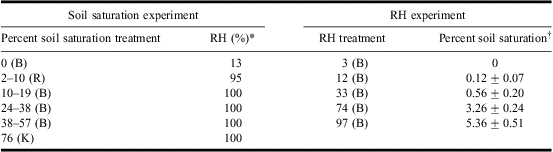
For each replicate for both Kennewick and Roslyn populations, 40 pupae were exposed to soil with the following percent saturation (here, same as relative water contents) right after the 150-day chilling period: (1) 0%, (2) 10–19%, (3) 24–38%, and (4) 38–57%. In addition, for the Kennewick and Roslyn population, 76% (32% water content) and 2–10% (1–4% water content) saturated soils, respectively, were tested. Saturation values are expressed as ranges because they decreased over time due to water condensing on the insides of test containers and by opening of containers to collect flies. Water losses were determined at the end of tests by weighing the top 0.64 cm layer of soil (where pupae were located) and drying it. Three repeated tests, each initiated in a different week, were conducted for both Kennewick and Roslyn populations (only one replicate test of 76% saturated soil for the Kennewick pupae). Each replicate test comprised four containers with the 40 pupae. Relative humidity inside one container of each treatment (Table 1) was measured using a RH logger (Supco SL300TH, Sealed Unit Parts Co., Inc., Allenwood, New Jersey, United States of America).
Mean relative humidity and mean percent soil saturation ± SE in percent soil saturation and in RH experiments, respectively.
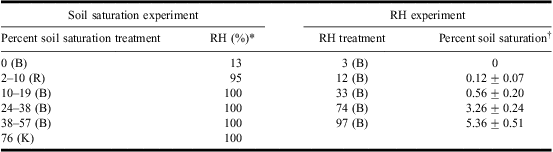
Notes: Letters inside parentheses after treatments indicate fly populations for which the treatment was tested: B, both; R, Roslyn; K, Kennewick.
*One container.
†All three replicates from Roslyn test, determined at end of 60 days.
RH, relative humidity.
Before testing, the soil was sifted through a screen with 1 × 1.75 mm openings to obtain uniform particles, autoclaved at 121 °C for 20 minutes, and then dried at 100 °C for six hours. After 24 hours, water was added to obtain the different saturation levels. A volume of 260 cm3 of each soil treatment was placed in a 473-mL container of the type described above. The soil was not packed. Pupae were spread on the surface, and then covered with a 0.64 cm layer of the same soil treatment. The container was sealed with parafilm (Pechiney Packaging Co., Chicago, Illinois, United States of America) and held at 23–24 °C, ∼22–32% RH, and under 16 hour:8 hour (light:dark). To obtain mean emergence times, fly emergence was checked daily for 40 and 60 days for Kennewick and Roslyn populations, respectively (emergence of Kennewick flies started and ended earlier). Flies emerged over a 10–17 day period, during which they were collected, counted, and sexed daily. Containers were opened quickly to remove flies and then resealed with new parafilm. All puparia and pupae were recovered from the soil within a week of tests ending. Response variables recorded were (1) total fly emergence, (2) first day of emergence, (3) mean day of emergence, (4) % emerged flies that were deformed, (5) % flies partly emerged and dead, (6) % of total pupae that were dead (only head or head + thorax outside the puparia), and (7) % puparia with live pupae. Total fly emergence and other percent variables were calculated based on total pupae minus those parasitised by wasps (resulting in 33–40 pupae). Deformed flies were pale (normal adults are mostly black), had protruded ptilina, wing stubs, were unable to walk normally, and were smaller than normal flies. Each puparium and pupa was dissected under a microscope; live pupae were turgid and yellow; dead pupae were dried or soft and dark brown.
Effects of RH on adult emergence
For Kennewick pupae, mean RHs of (1) 3%, (2) 12%, (3) 33%, (4) 74%, and (5) 97% were tested. The different RH levels were generated using different salts: (1) CaCl2 (anhydrous hygroscopic, Matheson Coleman & Bell, Norwood, Ohio, United States of America), (2) LiCl (Fisher Scientific, Fairlawn, New Jersey, United States of America), (3) MgCl2 (anhydrous hygroscopic, Aldrich Chemicals Co., Inc., Milwaukee, Wisconsin, United States of America), (4) NaCl (Morton International, Inc., Morton Salt, Chicago, Illinois, United States of America), and (5) K2SO4 (certified ACS crystalline, Fisher Scientific, Fair Lawn, New Jersey, United States of America), respectively (Greenspan Reference Greenspan1977; Carotenuto and Dell'Isola Reference Carotenuto and Dell'Isola1996). Each salt was placed in a 30-mL cup (4-cm top diameter, surface ∼12.6 cm2) inside a 473-mL test container (same type as before). Each cup contained 20 g CaCl2 (no water), 5 g LiCl + 2 g deionised (DI) water, 6 g MgCl2 + 2.5 g DI water, 4 g NaCl + 4 g DI water, or 2 g K2SO4 + 3 g DI water. The top of each cup was covered with light nylon tulle cloth (Walmart, Bentonville, Arkansas, United States of America) to prevent flies from drowning. Test containers were sealed with parafilm three days before pupae were introduced for RHs to stabilise. Lids were opened for ∼3 seconds to introduce 40 pupae onto a 3-cm layer (15 g) of dried loam soil in a test container with one of the RH treatments. Lids were then immediately resealed to the test container with parafilm. Soil was not placed over pupae because this might have altered the target RHs, although pupae were slightly embedded in soil. RHs were confirmed using a RH logger (same as above) placed in one test container of each treatment. Salt solutions were replaced once after 10 days because of lowering levels seen in cups.
For Roslyn pupae, the same design was followed, except three times more salt was used so that treatments did not need replacing. Each salt was placed in a 55-mL cup (5.7 cm top diameter; surface ∼25.5 cm2). The RHs of the five treatments were not affected by the increased amounts of salts. At the end of the Roslyn RH tests, soil was weighed and then dried to determine the amount of water absorbed by soil from the air (Table 1). For both Kennewick and Roslyn populations, three replicate tests comprised four containers with 40 pupae.
Data collection for both fly populations was the same. The first adults that emerged inside test containers were recorded. Test containers were sealed throughout to maintain RHs, so flies could not be removed daily. Flies became partially covered with soil after they died, preventing accurate daily counts. However, at the end of 40 or 60 days, all flies were counted and cleaned with 70% ethanol to remove soil (flies were not sexed). Except for mean day of fly emergence, response variables measured were the same as for the soil experiment.
Statistical analysis
Each response variable from Kennewick and Roslyn pupae for both soil saturation and RH experiments was analyzed using randomised block analysis of variance (ANOVA), followed by Fisher's least significant difference test. The Bonferroni correction was not used for multiple comparisons because of reasons summarised by Perneger (Reference Perneger1998). Blocks were the three replicate tests. Percentage data were square-root and arc-sine transformed before analyses. Day data were square-root transformed. The power of the tests (probability of rejecting the null hypothesis when the null hypothesis is false or 1 − probability of a Type II error) at α = 0.05 for effects of treatments on each response variable was calculated retrospectively using the 9.2 version of the Statistical Analysis System (SAS) (SAS Institute Inc. 2008) and are shown in Tables 2–5 under results.
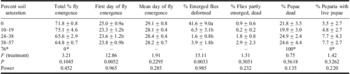
Mean adult emergence and mortality measures of Rhagoletis indifferens ± SE from Kennewick, Washington, United States of America, after 40 days of exposure to loam soil at five saturation levels.

Notes: Means are from three replicate tests, except for the 76% treatment.
*One replicate test, not included in analysis. A replicate test comprised four containers with 37–40 pupae each, excluding pupae parasitised by wasps (determined after tests ended). Means within columns followed by the same or no letter are not significantly different (randomised block ANOVA, Fisher's LSD test, P > 0.05). ANOVA df = 3, 6.
The null hypothesis that the relative frequencies of males and females (sex ratios) were the same for each soil saturation treatment was tested using χ2 contingency tables (Zar Reference Zar1999). No significant differences in frequencies were detected (for Kennewick pupae, a 2 × 4 table: χ2 = 3.4576; df = 3; P = 0.3263; for Roslyn pupae, a 2 × 5 table: χ2 = 8.1436; df = 4; P = 0.0865) (power of Kennewick test, 0.16; Roslyn test, 0.40 [generated from statistics package of Pezzullo Reference Pezzullo(2012)]). Percent emergence data were not separated by sex, as the initial numbers of males and females were unknown because live or dead pupae cannot be sexed. To determine if emergence days of Kennewick and Roslyn flies in the soil saturation experiment differed, a two-way ANOVA was conducted, with populations and soil treatments as the two factors. Analyses were conducted using SAS.
Results
Effects of soil saturation levels on adult emergence
Total emergence of Kennewick flies from dry and moist soils did not differ (Table 2). Pupae in 10–57% saturated soils produced adults ∼2 days earlier than pupae in dry soil but no differences were seen in mean emergence days. More flies in the dry than moist soils were deformed. No differences among treatments in the other three variables were detected (Table 2). All pupae were killed in the one test of 76% saturated soil.
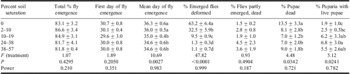
Total and first emergence of Roslyn flies in dry and moist soils also did not differ (Table 3), although mean emergence days in 10–57% saturated soils were earlier than in 0–10% saturated soils. More flies in the dry than moist soils were deformed; fewest deformed were seen in the 24–57% saturated soils. No differences in % flies partly emerged were seen. However, the % pupae dead was higher in dry than moist soils, and % puparia with live pupae was lower in dry than 10–57% saturated soils (Table 3).
Mean adult emergence and mortality measures of Rhagoletis indifferens ± SE from Roslyn, Washington, United States of America, after 60 days of exposure to loam soil at five saturation levels.

Notes: Means are from three replicate tests. A replicate test comprised four containers with 37–40 pupae each, excluding pupae parasitised by wasps (determined after tests ended).
Means within columns followed by the same or no letter are not significantly different (randomised block ANOVA, Fisher's LSD test, P > 0.05). ANOVA df = 4, 8.
Mean emergence time of Kennewick flies was earlier than of Roslyn flies (population: F = 258.10; df = 1, 16; P < 0.0001; soil treatment: F = 1.99; df = 3, 16; P = 0.1554; population × soil treatment: F = 0.25; df = 3, 16; P = 0.8618).
Effects of RH on adult emergence
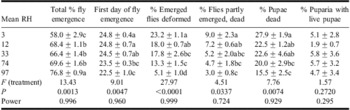
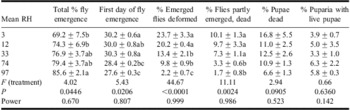
Total emergence of Kennewick flies was highest at 97% RH, intermediate at 12–74% RH, and lowest at 7% RH (Table 4). Flies at 74% and 97% RH emerged ∼2 days earlier than flies at 3% RH. More flies were deformed at 3% and 12% RH than at 74% and 97% RH; fewest at 97% RH. The % flies partly emerged was highest at 3–33% RH and lowest at 97% RH. A similar pattern was seen for % pupae dead. However, % puparia with live pupae did not differ among RH treatments (Table 4).
Mean adult emergence and mortality measures of Rhagoletis indifferens ± SE from Kennewick, Washington, United States of America, after 40 days of exposure to five mean RH treatments.

Notes: Means are from three replicate tests. A replicate test comprised four containers with 36–40 pupae each, excluding pupae parasitised by wasps (determined after tests ended).
Means within columns followed by the same or no letter are not significantly different (randomised block ANOVA, Fisher's LSD test, P > 0.05). ANOVA df = 4, 8.
RH, relative humidity.
Total emergence of Roslyn flies was numerically highest at 97% RH, but it did not differ statistically from that at 33% and 74% RH and emergence at 3–74% also did not differ (Table 5). Flies at 97% RH emerged ∼2.5 days earlier than flies at 3–33% RH. More flies were deformed at 3% and 12% than at 33–97% RH; fewest at 97% RH. The % flies partly emerged was higher at 3–33% than 74% and 97% RH, but the % pupae dead and % puparia with live pupae did not differ among RH treatments (Table 5).
Mean adult emergence and mortality measures of Rhagoletis indifferens ± SE from Roslyn, Washington, United States of America, after 60 days of exposure to five mean RH treatments.

Notes: Means are from three replicate tests. A replicate test comprised four containers with 36–40 pupae each, excluding pupae parasitised by wasps (determined after tests ended).
Means within columns followed by the same or no letter are not significantly different (randomised block ANOVA, Fisher's LSD test, P > 0.05). ANOVA df = 4, 8.
RH, relative humidity.
Discussion
Results support the first hypothesis that emergence of R. indifferens from dry and moist soils is similar, suggesting the fly is tolerant of a wide range of soil moisture conditions when compared with R. pomonella and R. zephyria as reported in the literature. For example, 72% or 83% of R. indifferens emerged from dry soil, whereas 0% of R. pomonella emerged from dry soil consisting of 66% sand, 19% silt, and 15% clay (Trottier and Townshend Reference Trottier and Townshend1979). Even when deformed R. indifferens (see below) are removed from the data, emergence from dry soil was still 30% or 20%. In a study of R. zephyria, only 10% of flies emerged from soil that was wetted once. Even with seven wettings, emergence was only 20.5% (Tracewski and Brunner Reference Tracewski and Brunner1987). Rhagoletis indifferens could be more desiccant resistant than R. pomonella and R. zephyria, a hypothesis that perhaps can be tested using methods to determine water loss and CO2 and H2O release reported for Drosophila melanogaster Meigen (Gibbs et al. Reference Gibbs, Chippindale and Rose1997; Williams et al. Reference Williams, Rose and Bradley1998).
The high levels of deformed R. indifferens from dry soil probably resulted from a combination of the experimental set up and the dry soil impacting the emerging flies. The dry soil drew the RH in the containers down to 13%, similar to the LiCl drawing RH down to 12% (room RH was ∼22–32%). Therefore, the dry loam soil, when shifted to uniform particle sizes and not packed, acted as a desiccant inside the containers, except to the 37% or 58% of flies that developed normally. Water balance and loss related to cuticle permeability (Li et al. Reference Li, Liu, Wang and Li2009) probably contributed to abnormal fly development. The dry soil itself could have had an effect on fly deformities as well. In the Roslyn test, the RH in containers with 2–10% saturated soils was 95%, but the percentages of deformed flies in them were 23–31% higher than in containers with 19–57% saturated soils, which had only a slightly higher RH of 100%. When moisture levels are low, the loam soil could have had an abrasive or suffocating effect on the flies.
If dry soil did have a negative effect on fly development, then 24–38% saturation of loam soil is the lower threshold that maximises the emergence of healthy R. indifferens adults. This intermediate level may be a tradeoff between no water (threat of desiccation) and too much water (lack of sufficient oxygen) in the soil. The 76% saturated soil killed 100% of the pupae, indicating pupae could not respire in soil with too much water. Interestingly, 20.8% of R. pomonella emerged from “saturated” or 40% moist soil (weight/volume) (Trottier and Townshend Reference Trottier and Townshend1979). Possibly, the 66% sand content of this soil (versus the 46% sand in the soil in the present study) allowed pupae to respire; otherwise, R. pomonella could be better adapted than R. indifferens to soils with very high water content.
First or mean emergence time for R. indifferens from wetter soils occurred slightly earlier than from drier soils, suggesting pupae used water as a trigger for exiting the puparia earlier. Perhaps similarly, in R. pomonella, simulated rain reduced the amount of heat units required for first and 50% emergence, compared with when there was no rain (Smith and Jones Reference Smith and Jones1991). Emergence from moist soils may expose teneral flies to higher RHs above ground, reducing the threat of desiccation. The later emergence times of the Roslyn than Kennewick fly populations could reflect rearing or genetic effects but overall soil moisture effects on the two were similar.
The second hypothesis that emergence of R. indifferens is increased by and occurs earlier at higher than lower RHs was supported by results from both Kennewick and Roslyn fly populations, with responses greatest at 97% RH, at least numerically if not always statistically. Results suggest that flies can emerge at high levels when pupae are in relatively dry soil as long as RHs are high. In the soil experiment, emergence from dry soil in containers with just 13% RH was as high as from moist soil in containers with 97–100% RH, which is not consistent with the idea of low RH having a negative effect. Possibly, pupae covered in dry soil are less affected by dry air than pupae not or partially covered, as long as the RH in the air is not below 13%. With respect to earlier emergence at high RHs, high water vapour probably triggered fly exit from the puparia as water did in the soil experiment. Overall data suggest RH rather than soil moisture was a key factor affecting emergence, although to simulate more natural conditions, tests determining the effects of RH on pupae at various depths below the soil surface are needed.
Tolerance of R. indifferens to low and high RHs possibly could help explain the fly's natural distributions. For example, R. indifferens is abundant in backyard cherry trees in Yakima, Washington, United States of America (Yee Reference Yee2008). In Yakima, mean monthly maxima % RHs in the morning from May to July, when R. indifferens emerge, are 69–70%, and in the afternoon are 26–31% (Desert Research Institute 2012). In the Portland area (Oregon, United States of America), the respective figures are 80–84% and 44–52% RHs (Desert Research Institute 2012), but the fly is no more abundant there than in Yakima (Yee and Goughnour Reference Yee and Goughnour2008). This suggests low RH does not limit the fly's distribution. In contrast, R. pomonella (at least from Canada) is less tolerant of low RH and is much less abundant in Yakima than Portland areas (Yee Reference Yee2008; Yee and Goughnour Reference Yee and Goughnour2008).
For subtropical or tropical fruit flies, soils that are too dry or too moist are not conducive to high fly emergence although very high RHs are (Fitt Reference Fitt1981; Bressan-Nascimento Reference Bressan-Nascimento2001; Hulthen and Clarke Reference Hulthen and Clarke2006; Montoya et al. Reference Montoya, Flores and Toledo2008; Li et al. Reference Li, Liu, Wang and Li2009). This seems true to some degree for R. indifferens, so commonalities may exist among diverse tephritid species with regard to moisture needs. For example, for Bactrocera tau (Walker) (Diptera: Tephritidae), soil with relative water contents (relative saturation) of 0%, 20%, 40%, 60%, 80%, and 100% resulted in emergence of 32%, 76%, 84%, 91%, 62%, and 0%, respectively; RHs of 0%, 52%, 76%, and 100% resulted in 3%, 59%, 67%, and 91% emergence, respectively (Li et al. Reference Li, Liu, Wang and Li2009). A difference seems to be that R. indifferens is less tolerant than B. tau of soil with very high water content. However, soil types differ in saturation points and could affect this interpretation (soil type was not described by Li et al. (Reference Li, Liu, Wang and Li2009)).
Compared with pupae of other Rhagoletis species whose responses to soil moisture and RH have been reported in the literature, postdiapausing pupae of R. indifferens appear relatively tolerant of dry and moist environments. This likely contributes to the presence of R. indifferens in a wide range of native and nonnative habitats where chilling requirements are met. Responses of the larval–pupal and diapausing pupal stages to soil and/or air moisture could also contribute to its distributions and are yet to be determined.
Acknowledgements
The author thanks Peter Chapman, Janine Jewett, and Dana Jones (United States Department of Agriculture-Agricultural Research Service) for assistance with experiments and Grant McQuate (United States Department of Agriculture-Agricultural Research Service, Hilo, Hawaii, United States of America) and Joseph Morse (University of California, Riverside, United States of America) for helpful comments on earlier drafts of the manuscript.