

According to the CIRI Human Rights Project (Cingranelli, Richards and Clay Reference Cingranelli, Richards and Clay2014), the vast majority of authoritarian regimes restrict citizens’ right to move abroad. Figure 1 illustrates the prevalence of emigration restrictions worldwide for authoritarian regimes, for the earliest and latest years for which CIRI data are available. While the absolute number of authoritarian regimes declined considerably between 1981 and 2011 (from seventy-seven to twenty-one), the proportion restricting the freedom to move abroad increased (from 78 to 81 per cent).Footnote 1 Authoritarian regimes can restrict the freedom to move abroad in many ways. Burmese citizens, for example, are required to obtain clearance from the Ministry of Finance and Revenue and a departure permit from the Ministry of Immigration and Population. Moreover, Burmese passports are typically valid for no more than three years, and the cost of the accompanying paperwork is roughly equal to a year's salary (Cingranelli, Richards and Clay Reference Cingranelli, Richards and Clay2014). Another example is Eritrea, which has an indefinite military conscription that makes it impossible for young male citizens to leave the country legally (Human Rights Watch 2019). Lastly, North Korea rarely allows its citizens to move or even travel abroad, and imprisonments due to attempted emigration are common. The records of the Database Center for North Korean Human Rights document 5,413 violations of the right to movement and residence. While these violations constitute only 12 per cent of all documented human rights violations, this category is the second-most frequently documented type of violation (after violations of the right to integrity of the person).Footnote 2 Similarly, the Castro regime in Cuba at times used the threat of prison to control emigration flows. Historically, one of the most notorious examples of an authoritarian regime using harsh anti-emigration measures was the German Democratic Republic (GDR or East Germany). Emigration was effectively criminalized, and in 1961 the regime constructed the Berlin Wall to stop emigration altogether.Footnote 3 While the wall slowed down mass emigration considerably, many GDR citizens still tried to leave. While some succeeded, many failed. Our data, described in detail below, show that on average, 1,900 individuals were charged with either an unlawful emigration attempt or support of such an action each year.
Freedom of foreign movement restrictions in authoritarian polities around the world
Note: countries not classified as authoritarian polities (Polity IV score of strictly less than −5) are in light gray.
Source: CIRI project supplemented with information from Hannum (Reference Hannum1987) for the German Democratic Republic and the People's Democratic Republic of Yemen.

In this article, we analyze the conditions under which authoritarian regimes employ harsh anti-emigration measures such as imprisonment, focusing on the role of improvements in economic conditions in other countries. Our theoretical discussion builds on the insight that citizens seek to emigrate in order to improve their economic well-being. When authoritarian rulers perceive emigration as a threat – that is, rulers would be better off if they were to prevent citizens from leaving the country – they have an incentive to employ measures that decrease the likelihood of emigration. We employ a simple theoretical framework to discuss the use of economic reforms, border walls, and more targeted measures such as social programs, passport costs or imprisonment. We theorize about the conditions under which imprisonment will be used, analyzing among other factors the role of budget constraints, the loyalty of security forces and the quality of information at the regime's disposal. We derive two hypotheses: if the regime imprisons people who attempt to emigrate, we expect first that the number of exit prisoners (defined as political prisoners who were arrested for attempting to leave the country) will increase when economic opportunities abroad improve. Secondly, we expect there to be more exit prisoners when citizens are better informed about economic opportunities abroad.
Testing these two hypotheses is challenging for two reasons. First, authoritarian regimes are rarely transparent about what is happening within their borders (Hollyer, Rosendorff and Vreeland Reference Hollyer, Rosendorff and Vreeland2011), and this is especially true of their political prisoners. Data from public sources such as newspaper reports are likely biased by selection effects – more successful attempts to capture political prisoners are less likely to be reported. Secondly, identifying the causal effect of changing economic opportunities abroad on the number of exit prisoners is challenging because of common causes that affect both the economic conditions abroad and the number of restrictions on the freedom to move abroad.
To overcome these empirical challenges, we make use of formerly secret administrative records of the GDR in combination with data on economic growth in the neighboring Federal Republic of Germany (FRG or West Germany) during the same time period. Specifically, we reconstruct the entire database of political and ordinary prisoners in use by the GDR between 1979 and 1988. Since the database, which contains about half a million entries, was designed to manage the prison system in the GDR – and was never intended for release to the public – it contains the universe of exit prisoners in East Germany during this period. Using this database and administrative data on the number of available jobs by occupation group in West Germany, we build a quarterly panel of occupation cohorts. We then use the variance within occupation groups and between quarters to identify and estimate the causal effect of the number of open positions on the number of exit prisoners.
We show that improvements in economic conditions in West Germany increased the number of people arrested for trying to emigrate. Our estimates imply that an increase of about 1,000 open positions in West Germany resulted in one additional exit prisoner in East Germany. We also demonstrate that, consistent with our second hypothesis, counties that had access to West German television (TV), which reported on economic conditions in West Germany, experienced significantly more imprisonments than those without access to West German TV.
While we empirically focus on the case of East and West Germany, our argument is general: economic disparities between countries affect the manner in which many authoritarian regimes restrict emigration. In the last section of this article, we return to the general argument in which restrictions on emigration can be more subtle (high passport costs, costly exit visas and severe taxes on emigration). Using cross-country panel data, we show that emigration restrictions are systematically related to neighboring countries’ economic opportunities. This finding strengthens our confidence in the external validity of our estimates for East Germany.
An extensive literature examines coercive activities by authoritarian regimes, typically using indices of repressive behavior at the country-year level, and domestic political and economic factors as explanatory variables (see for example, Hill and Jones Reference Hill and Jones2014; Svolik Reference Svolik2012). The theoretical link between these variables is usually protest behavior (for example, Shadmehr Reference Shadmehr2014; Siegel Reference Siegel2011; Svolik Reference Svolik2013). For example, a country's high level of inequality may increase citizens’ level of discontent, which in turn motivates the regime to employ repression (Acemoglu and Robinson Reference Acemoglu and Robinson2000). We take a different approach by (1) measuring a specific kind of repression, namely imprisonment at the individual level (similar to Ritter and Conrad Reference Ritter and Conrad2016; Truex Reference Truex2019), (2) using economic conditions abroad as our main explanatory variable and (3) using emigration decisions as a link between economic opportunities abroad and regime behavior (as in the formal literature on exit-voice-loyalty, see, for example, Clark, Golder and Golder Reference Clark, Golder and Golder2017; Gehlbach Reference Gehlbach2006). The most closely related articles are Danneman and Ritter (Reference Danneman and Ritter2014), who analyze how authoritarian repression is affected by civil wars abroad (by contrast, we analyze the effect of economic opportunities abroad on repression), and Miller and Peters (Reference Miller and Peters2020), who study the effect of migration and remittances on a country's regime status (by contrast, we consider migration decisions to be a link between our main independent and dependent variables). Finally, our primary empirical case, East Germany, has been the subject of several studies in political science (Crabtree, Darmofal and Kern Reference Crabtree, Darmofal and Kern2015; Kern and Hainmueller Reference Kern and Hainmueller2009; Lohmann Reference Lohmann1994) as well as in sociology and history (Fulbrook Reference Fulbrook1995; Pfaff Reference Pfaff2006). However, these studies typically focus on the exit and protest decisions that ultimately brought down the GDR in 1989. We are the first to quantitatively examine how the number of exit prisoners changed in the decade before the fall of the regime.
Our results imply that while the recorded number of international migrants is large (244 million in 2015 (UN 2016)), this number is only a lower bound: some would-be emigrants might have ended up in prison instead. Consequently, without restrictions and authoritarian coercion, the number of international migrants would be higher. Conversely, some of the variation in restrictions and repression is due to anticipated cross-national migration, which is an important link that has a profound impact on politics, creating interdependence between countries (Keohane and Nye Reference Keohane and Nye1972). Indirectly, we thus also contribute to the literature on the effect of immigration on political outcomes (Leblang Reference Leblang2010; Salehyan Reference Salehyan2008; Salehyan and Gleditsch Reference Salehyan and Gleditsch2006).
THEORETICAL CONSIDERATIONS
Why Citizens Leave
In any country, but especially in those ruled by an authoritarian regime, at least some proportion of the population is considering emigration. For this group of citizens, various factors determine whether or not they will actually attempt to leave the country. The literature on immigration distinguishes between push factors (domestic variables) and pull factors (international variables) (Lee Reference Lee1966). While it is generally acknowledged that both types of factors influence citizens’ decisions about whether to leave, the importance of economic opportunities abroad as a pull factor has been widely recognized ever since Ravenstein's influential essay on ‘The Laws of Migration’:
Bad or oppressive laws, heavy taxation, an unattractive climate, uncongenial social surroundings, and even compulsion (slave trade, transportation), all have produced and are still producing currents of migration, but none of these currents can compare in volume with that which arises from the desire inherent in most men to ‘better’ themselves in material respects (Ravenstein Reference Ravenstein1889).
Today's micro-economic models of immigration incorporate Ravenstein's insight by modeling the decision to emigrate as a function of wage differentials and (expected) lifetime earnings (Borjas Reference Borjas2014; Harris and Todaro Reference Harris and Todaro1970; Todaro Reference Todaro1969). Formal versions of Hirschman's (Reference Hirschman1970) exit-voice-loyalty framework that typically leave the motives of citizens abstract (Clark, Golder, and Golder Reference Clark, Golder and Golder2017; Gehlbach Reference Gehlbach2006) are consistent with the notion that economic opportunities are an important pull factor.
Of course, citizens do not always have complete information about the economic opportunities in potential destination countries; the exact level of opportunities abroad typically remains unknown. Yet they likely have beliefs about the state of the economy abroad based on a variety of information they receive about other countries’ economies from the media and their social networks. These beliefs are an important determinant in their emigration decisions.
When citizens learn about changes in economic opportunities abroad, the beliefs of some citizens about the attractiveness of other countries change. Whether or not these changes in beliefs affect citizens’ behavior will depend on the relative strength of other push and pull factors, such as the cost of leaving and the extent to which economic interests matter relative to political and social interests. Importantly, it is plausible to assume that citizens are familiar with at least some of the measures taken by the regime to prevent emigration (discussed in detail below). Thus they have to weigh the potential benefits of better economic opportunities abroad against the increased risk of potentially harsher enforcement of anti-emigration measures. If the increase in risk is strong enough, citizens may choose to stay despite an increase in economic opportunities abroad. However, for a citizen previously indifferent about leaving or staying prior to a change in (beliefs about) opportunities, it is sometimes still worth attempting to emigrate despite the chance of being caught.Footnote 4
Emigration – Threat of Opportunity?
For an authoritarian regime, emigration can be a blessing or a curse. On the one hand, emigration can threaten a regime's survival if it causes a labor shortage. For example, according to the ‘brain drain’ hypothesis, countries undergoing mass emigration will face dire economic consequences because fewer and fewer (skilled) workers will produce goods and services (Docquier and Rapoport Reference Docquier and Rapoport2012). Consequently, to the extent that emigration causes a shortage of labor that ultimately hampers economic growth, emigration becomes a threat to an authoritarian leader. More generally, having fewer workers (of any level of skill) reduces the size of the pie available for redistribution or private goods allocation – which can lead to more conflict and rebellion (see Haggard and Kaufman Reference Haggard and Kaufman2018; Smith Reference Smith2008). If emigrants take their savings with them, emigration can also lead to capital flight, which in turn causes further economic problems (see Pepinsky Reference Pepinsky2009). Non-economic considerations may play a role, too. If the political opposition has an easier time organizing itself abroad – for example, because their destination country is a democracy with guaranteed rights of assembly and expression – or if emigrants return and bring democratic norms with them, the likelihood of regime change increases with emigration (see Miller and Peters Reference Miller and Peters2020). Emigrants can also transmit insider knowledge about the regime, such as information about atrocities. For authoritarian leaders, this may pose a security risk as other states might be compelled to impose sanctions on the regime.
On the other hand, emigration may not always be a threat to an authoritarian regime. Remittances by emigrants can stabilize and stimulate the economy, thereby benefiting the regime (Miller and Peters Reference Miller and Peters2020). A regime might also encourage its opponents to emigrate, so these citizens no longer work to overthrow the regime. In this way, emigration provides a safety valve (Hirschman Reference Hirschman1993). Similarly, if it is too costly to repress the opposition physically, forced exile might be optimal from the regime's perspective. For example, Esberg (Reference Esberg2018) presents evidence from Chile under Pinochet that more prominent opposition figures were more likely to experience forced exile rather than the physical repression experienced by less prominent opposition figures. Regimes might also use emigrants as a bargaining chip to destabilize or pressure destination countries (Adelman Reference Adelman1998; Greenhill Reference Greenhill2010; Tsourapas Reference Tsourapas2018; Zolberg, Suhrke and Aguayo Reference Zolberg, Suhrke and Aguayo1989), as in the case of Cuba and the United States, or to extract financial concessions (such as inexpensive loans) from a destination country, as in the case of East and West Germany (Judt Reference Judt2007).
In short, there is a wide variety of reasons why authoritarian regimes may view emigration positively or negatively. In general, the level of emigration, emigrants’ destination preference (specifically, whether the destination country is a democracy), their skills in relation to the needs of the economy, and their political attitudes will determine whether a regime views emigration positively or negatively (see also Miller and Peters Reference Miller and Peters2020). Empirically, it seems that most authoritarian regimes perceive emigration as a threat, as a large majority of regimes do restrict emigration at least to some degree (cf. Cingranelli, Richards and Clay Reference Cingranelli, Richards and Clay2014).
Imprisonment as a Measure Against Emigration
If an authoritarian regime perceives emigration as a threat, how will it react? Why do some authoritarian regimes imprison potential emigrants while others reform the economy or design welfare programs (for example, housing or pension programs) to encourage citizens to stay?
Focusing on anti-emigration measures that can be implemented within a regime's political structure (that is, excluding democratization), existing work on authoritarian politics and emigration suggests a simple framework to unify a diverse set of empirically observable anti-emigration measures. We distinguish authoritarian regimes’ anti-emigration measures along two dimensions. On the one hand, a regime can either increase citizens’ expected utility of staying (reward) or decrease their expected utility in attempting to leave (punish).Footnote 5 On the other hand, a measure can either be more targeted toward citizens who actually consider emigrating, or less targeted, and thus affect all citizens independently of their emigration intentions. Table 1 provides examples of measures that authoritarian regimes use.Footnote 6
Distinguishing authoritarian regimes' anti-emigration measures along two dimensions with empirical examples in the cells

In general, the chosen strategy depends on the measure's effectiveness in preventing emigration and its feasibility. We first discuss when the regime will punish rather than reward before turning to the issue of targeting.
When regimes punish rather than reward
One important factor determining the effectiveness of punishment is the loyalty of the security apparatus. Punishment is a viable strategy to prevent emigration only when the police and army are willing to follow the leadership's orders and coerce citizens who seek to emigrate (see Dragu and Polborn Reference Dragu and Polborn2013; Tyson Reference Tyson2018). By contrast, when the police and army tend to be less loyal, for example because of weak ties to the regime or because they are badly paid (Albrecht and Ohl Reference Albrecht and Ohl2016; Nepstad Reference Nepstad2013), rewarding citizens for staying will be more effective. Of course, providing rewards is feasible only when the regime has sufficient resources. When the regime's pockets are full, for example because of a natural resources boom, it will likely distribute rewards that not only prevent emigration but also garner political goodwill (Wright, Frantz and Geddes Reference Wright, Frantz and Geddes2015). By contrast, tight budgets favor repression because the agents tasked with such coercion are already paid, and so fewer additional resources are needed (for example, Escribà-Folch Reference Escribà-Folch2012). Another important concern is the by-products of the use of a particular measure – particularly the possibility of a backlash. In the context of preventing protests, repressive measures are frequently mentioned as creating a backlash. For example, citizens learn that the regime does not care about their welfare when they observe coercive measures (Bueno de Mesquita and Dickson Reference Bueno de Mesquita and Dickson2007).
But a form of backslash with rewards is also possible. Consider the prospects for an economic reform or a new welfare program that will improve the incomes of groups that are likely to leave, thereby reducing their emigration rates. Four factors may stand in the way of such a reform. First, existing policy choices as well as ideological commitments that are inconsistent with the reform will make its implementation difficult, because citizens might infer that the regime is incompetent or weak, which in turn will endanger its survival (Ginkel and Smith Reference Ginkel and Smith1999; Majumdar and Mukand Reference Majumdar and Mukand2004). Secondly, economic reforms create winners as well as losers (Haggard and Webb Reference Haggard and Webb1993). If the group that would be worse off as a result of the reform is sufficiently important to the regime's survival, the reform is unlikely to pass (see Acemoglu and Robinson Reference Acemoglu and Robinson2006). Thirdly, the international context matters. Some economic reforms might be efficient, but the reaction of allies can damage their prospects, as the reforms in Prague and the subsequent invasion by members of the Warsaw Pact illustrate. Finally, by-products need not be negative. Coercive measures such as passport or visa costs or a long military service prevent emigration and provide an additional benefit to the regime in the form of revenue or military power. For example, in 2012, the Cuban state charged $150 for an exit permit – more than seven times the average monthly salary (Rainsford 2012). Eritrea's indefinite military conscription stops emigration and increases the country's military power, which is important given its rivalry with its larger neighbor, Ethiopia (see Stevis and Parkinson 2016). Finally, the sheer size of the potential emigrant population matters. As more and more citizens choose not to emigrate, measures that reward staying in the polity become increasingly expensive while measures that punish attempts to leave become increasingly cheap. Thus, the likely use of positive or negative measures depends on the prevalence of potential emigrants (Alexander Reference Alexander2017).
Targeted measures to prevent emigration
The most important factor that determines whether targeted measures are feasible to begin with is the amount of information a regime has about its citizens. More targeted measures are likely to be more effective and cheaper, but their implementation requires the regime to have detailed information about which (groups of) citizens are likely to leave (cf. Dimitrov and Sassoon Reference Dimitrov and Sassoon2014). This information is difficult to come by: when the regime punishes attempts to emigrate, citizens have an incentive to engage in preference falsification (Kuran Reference Kuran1997). This suggests that only authoritarian regimes with an extensive and capable surveillance apparatus will be able to use targeted measures. Furthermore, the expected number of potential emigrants (prior to the regime's choice) is an important determinant of the regime's strategy to use more or less targeted measures: the smaller the expected number of citizens attempting to exit, the more likely the regime is to employ targeted measures.
The expected number of potential emigrants, in turn, is affected by at least two factors: (1) existing geographic, cultural or political hurdles to emigration and (2) the skill distribution of the labor force. Concerning the first point, whenever there are severe hurdles to emigration – such as a different language, large geographic obstacles such as rivers or mountains, or political barriers such as border walls – we would anticipate the expected number of emigrants to go down (even if the regime is not actively trying to stop them). As a consequence, targeted measures are sufficient to deal with the remaining set of potential emigrants. By contrast, if they are less severe hurdles, less targeted measures are more likely to be chosen.Footnote 7
Concerning the second point, note that in almost all countries, there are likely to be more low-skilled workers than high-skilled workers. Everything else being equal, we would expect that if low-skilled workers are more likely to leave than high-skilled workers, targeted measures are unlikely to be chosen, precisely because there are so many potential emigrants. By contrast, targeted measures are more likely to be chosen when high-skilled workers are more likely to leave than low-skilled workers. Whether high- or low-skilled workers have greater incentives to leave depends on the structure of the home and destination economies, and specifically on the difference in expected lifetime earnings for both types of workers. We would expect a regime to choose targeted measures to prevent emigration if the difference in expected lifetime earnings is positive only for a small subset of workers; otherwise, we should observe less targeted measures.
Testable Implications
The preceding discussion suggests we should expect imprisonment as a strategy to restrict emigration in authoritarian regimes that (1) are well informed about their citizens’ proclivity to leave, (2) have a loyal security service or military, (3) have longstanding economic policies and corresponding ideological commitments, making economic reforms costly, (4) have to deal with a relatively small set of potential emigrants at this point and (5) are budget constrained.
In these cases, we first expect that as economic opportunities in a destination country improve, the total number of exit prisoners – defined as political prisoners who were arrested for attempting to leave the country – will increase (Hypothesis 1). The reason is that, as more citizens are trying to leave the country, an authoritarian regime making the same effort to enforce its anti-emigration policies arrests more citizens. Moreover, the regime might increase its efforts, in which case even more citizens will be arrested.Footnote 8
Empirical evidence favoring this hypothesis also implicitly provides information regarding the extent to which the regime perceives emigration as a threat. If the regime views emigration positively, we would not expect to find a positive relationship between economic opportunities abroad and the number of exit prisoners.
Secondly, even if economic opportunities remain objectively the same in the destination country, citizens might receive better information about them. This will make them more confident about their expected well-being abroad and will provide a substitute for objectively better economic opportunities. Therefore, we expect that as more information about economic opportunities abroad becomes available, the number of exit prisoners in an authoritarian regime will increase (Hypothesis 2).
EMIGRATION AND EXIT IN EAST GERMANY
One of the most notorious examples of an authoritarian regime using harsh anti-emigration measures was the GDR. Our data from the central prisoner database of the GDR Minister of the Interior suggest that between 1979 and the regime's downfall an average of 1,900 individuals were charged with either an unlawful emigration attempt or support of such an action each year. We use these data to test our previously derived hypotheses. But first we explain why, according to our theory, it is not surprising that the regime in East Germany used imprisonment to stop emigration.
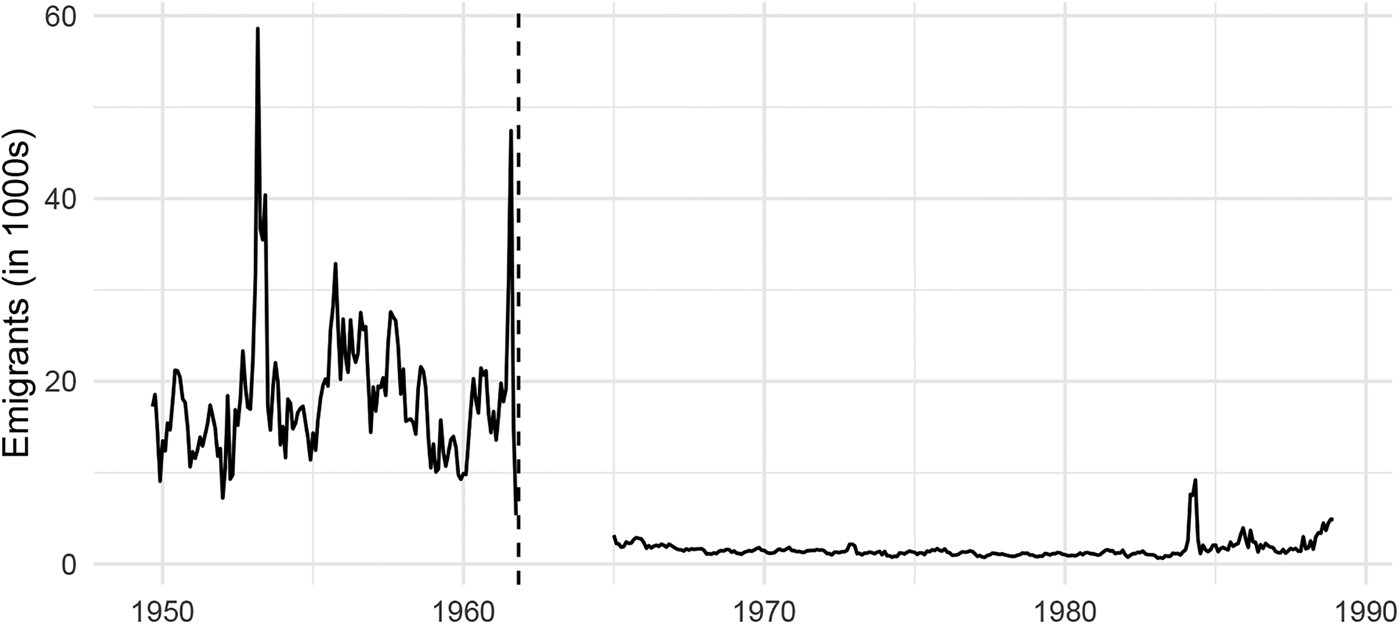
Since its founding in 1949, the GDR struggled with large-scale emigration to West Germany. Figure 2 shows the monthly number of GDR emigrants that were officially processed by the West German authorities. Initially, the East German regime sought to reduce the wave of emigration by increasing the legal barriers.Footnote 9 However, after an average of 18,200 people left the GDR each month in 1961, the authorities began constructing the Berlin Wall, which reduced emigration to less than one-tenth of the average monthly rate before its construction.
Monthly number of emigrants from East to West Germany
Note: the dashed line highlights November 1961 when the construction of the Berlin Wall was completed.
Source: Government of West Germany, collected by the authors (see Appendix for the sources). Data from November 1961 to December 1964 is missing in the archival materials.
The inner German border featured a restricted zone, fences and/or a wall, mines, armed border guards as well as automatic firing systems. In addition to these fortifications, the regime also used a variety of other measures to stop citizens from leaving. One important strategy was propaganda (for an overview, see Gibas Reference Gibas2000). Using biased reporting in newspapers or TV broadcasts (for example, the East German program ‘The Black Channel’ in which selected parts of West German TV were exploited for pro-regime propaganda), the regime attempted to shape citizens’ views about West Germany. Indoctrination was also widespread in the education system, with the ruling party aiming to make each generation less willing to emigrate than the previous one. Another strategy was surveillance. The regime employed a dense network of informants to detect and prevent emigration attempts (see below).
Despite all these efforts, even after the construction of the Berlin Wall and the further fortification of the entire border between East and West Germany, many citizens tried to leave, often using ingenious ideas including building hot-air balloons, digging tunnels and crossing by boat. For example, two citizens armored a firm-owned truck and broke through the border – despite heavy fire by the GDR border guards. Another successful exit attempt involved two citizens who dived into the Elbe River in severe weather conditions that made it impossible for the boats operated by the border guards to patrol. Other successful attempts were less spectacular: some citizens simply did not return after regime-sanctioned travel. And of course, some attempts failed: two citizens spent three years building a hot-air balloon, only to be arrested after an informant alerted the police. Many times, citizens used vehicles to attempt to break through the border, only to be stopped by physical barriers or border guards (all of these examples are from Mayer Reference Mayer2002).
As the regime had a longstanding economic policy, corresponding strict ideological commitments and tight budgets, economic reform or more targeted programs to incentivize citizens to stay were difficult to implement. From a theoretical perspective, we thus expect what has historically happened: the regime expanded its security apparatus to provide information about citizens who were planning to leave the country (Bruce Reference Bruce2010). The staff of the Central Coordination Group (Zentrale Koordinierungsgruppe, ZKG), which was responsible for co-ordinating the efforts of all other departments to prevent citizens from leaving, quadrupled in size during the period 1976–1988, from about 100 staff members to almost 450 (Eisenfeld Reference Eisenfeld1996, 49). Even compared to other East European security agencies, the German security apparatus had both an exceptionally dense informant network and very high numbers of staffers (Thomson Reference Thomson2018).
Every bureaucrat in the security apparatus had to remain dedicated to his or her work to prevent citizens from leaving the GDR. For example, in Order 1/75 from December 1975 Erich Mielke, the head of the Ministry of State Security (Ministerium für Staatssicherheit, MfS), wrote:
The enemy seeks to lure away in particular skilled workers in order to discredit the GDR internationally, to weaken its economy, to obstruct and shatter the socialistic economic integration, to find leverage for additional subversive actions and to simultaneously compensate its own lack in skilled labor in some sectors and with that to strengthen the capitalist economy.Footnote 10
Milke's fear of losing additional workers was not unfounded. Before and after the construction of the Berlin Wall, a typical emigrant was at least partially motivated by economic opportunities abroad:
Although both the East and West German governments tended to present the causes of the mass emigration in political terms – either as a vote for freedom or a betrayal of socialism – material factors were undoubtedly paramount. The West German ‘economic miracle’ of the 1950s exerted a powerful ‘pull’ on many East Germans, especially the young and relatively mobile, and in particular skilled workers, engineers and technicians who were in great demand … At the same time, there was a whole range of economic ‘push’ factors within the GDR, foremost among them the aggravating shortage of consumer goods and housing we have already encountered (Ross Reference Ross2004, 30).
Throughout the lifetime of the GDR, West Germany's economic opportunities continued to be an important motive for leaving the GDR. In a survey of arriving GDR emigrants from 1984, Ronge and Köhler (Reference Ronge and Köhler1984) asked about the main reasons for leaving East Germany. About 46 per cent of the respondents mentioned the limited availability of goods as a motive, 45 per cent an unfavorable future outlook, and about 21 per cent reported unfavorable career opportunities as a motive. In a similar survey conducted a month before the fall of the Berlin Wall, 76 per cent of the respondents said that the low standard of living was a motive for their emigration, and about 54 per cent referenced poor working conditions (Voigt, Belitz-Demiriz and Meck Reference Voigt, Belitz-Demiriz and Meck1990).
Since all Germans were entitled to citizenship in West Germany, citizens of the GDR who reached West Germany could live and work there with minimal hurdles. As West German citizens, GDR emigrants were allowed to work without obtaining a separate work permit first. This also explains why, for example, Schmidt (Reference Schmidt1994) finds that on average, GDR emigrants performed equally well in the West German labor market relative to natives in the mid- and late 1980s (see also Bauer and Zimmermann Reference Bauer and Zimmermann1997; Hofbauer, Billmeier and Warnhagen Reference Hofbauer, Billmeier and Warnhagen1985).
The GDR Prisoner Database
At the end of the 1970s, East Germany embarked on an ambitious project: to create a secret digital database of all of its prisoners. Our archival research suggests that one important function of the database was to identify trends in criminal offenses that the East German government deemed politically relevant. For example, on 13 January 1984, the head of the East German prison regime, Major General Lustik, requested a list of all prisoners charged with illegally attempting to emigrate, broken down by gender, punishment and type of imprisonment.Footnote 11 Since the database was kept secret, and the regime actively used it to identify citizen transgressions, it likely provides accurate data on the number of exit prisoners.
We obtained an anonymized copy of the raw, unmaintained and partially corrupted prisoner database. As we explain in more detail in Appendix B, using a combination of archival research and data forensics, we were able to reconstruct the data for all individuals imprisoned between 1979 and 1982 and from 1984 to 1988. We then filtered the database to include exit prisoners; that is, political prisoners arrested for illegally attempting to cross the border.Footnote 12 Table 2 shows the total number of (newly admitted) prisoners and the total number of (newly admitted) exit prisoners per year.
Total number of prisoners per year and number of exit prisoners charged with either an unlawful emigration attempt or support of such an action
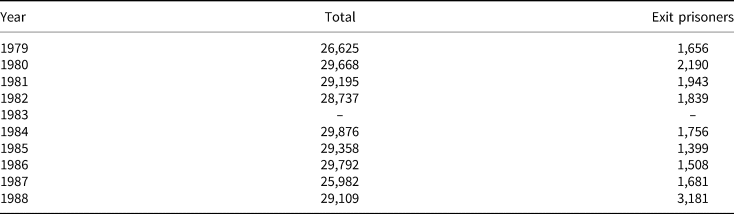
Source: GDR Prisoner Database (1979–1988)
Comparing Cohorts of Exit Prisoners
We used the database to construct a cohort panel in which the number of newly admitted exit prisoners per occupation group and quarter-year is the unit of analysis. The panel consists of thirty-six quarters across thirty-eight occupation groups. Using the information about each prisoner's occupation contained in the dataset and the occupation group classifications constructed by West Germany's Federal Employment Agency,Footnote 13 we classify each prisoner into one of thirty-eight occupation groups. We discuss the details of this coding in Appendix B. To measure economic opportunities for each occupation group, we combine this dataset with detailed quarterly records from the West German Federal Employment Agency about the number of open positions in an occupation group (Bundesanstalt für Arbeit 1989).Footnote 14 In our occupation-quarter panel, the median number of open positions is 2,500 (mean: 4,500) and the standard deviation is about 5,469.
In the Appendix, we show the average number of arrests per occupation group. With an average number of newly admitted exit prisoners of about 80, the occupation category ‘locksmiths, mechanics and related professions’ is the largest, followed by those related to construction work (60) and farming (25). Engineers, chemists, physicists, mathematicians and technicians (10) follow, while housekeeping and authors, interpreters and librarians rank lowest. While this ranking of occupation groups is indicative of the regime's strategy to target certain groups, it is also a function of the prevalence of the occupation groups in the general population.
A bivariate correlation between the number of exit prisoners in the GDR and the number of available jobs in West Germany will typically be confounded. The most likely sources of confounding are general global economic trends that increase the number of available jobs in the FRG and simultaneously (through its effect on the economy in the GDR) the amount of resources the GDR regime has available to prevent citizens from leaving. Our empirical strategy addresses this problem by identifying the effect from the variation within occupation groups and allowing for unobserved common trends such as economic growth. We implement this empirical strategy in our baseline specification, in which we regress the number of exit prisoners on the number of open positions in the FRG using OLS with two-way fixed effects for the units (thirty-eight occupation groups) and time (thirty-six quarters).
However, any correlation might be spurious if there are still differential trends across occupation groups. One conceivable source of such differential trends is the notion that, over time, some occupation groups increase or decrease in size because of the global restructuring of the economy; that is, the number of farmers decreases, but service occupations increase. Such differential trends within occupation groups may generate a spurious correlation between the number of open positions in the FRG and the number of arrests in the GDR. Thus, our preferred specification includes an occupation-specific time trend. Denoting yct as the number of exit prisoners in the cth occupation group in quarter-year t, we use the following specification of the OLS estimator:
 $$y_{ct} = \alpha _0 + \beta {\rm job}{\rm s}_{c( t-1)} + \alpha _t + \alpha _c + \gamma _c{\rm tim}{\rm e}_{c} + \varepsilon _{ct}.$$
The β parameter is of primary interest and measures how 1,000 additional jobs in the previous quarter increase the expected number of newly admitted exit prisoners in the next quarter. The parameters αc and αt denote the unmodeled (fixed) effects for an occupation group c and quarter-year t.
This specification relies on the assumption that a linear time trend can capture any differential trend within occupation groups. To evaluate the plausibility of this assumption, we also estimate a demanding specification that permits occupation-specific effects to vary across years. This allows for a wide range of potential occupation-specific trends and amounts to treating each occupation group in a year as a separate unit identifying the effect of available jobs in the FRG only from the variation within a year.Footnote 15
Before proceeding to the results, we discuss the implications of our identification strategy with respect to our theoretical argument. As discussed, the fixed-effects specification implies that we are using the variation within occupation groups to estimate the effect of economic opportunities abroad on the number of political prisoners. In order for our theoretical argument to be valid, citizens’ beliefs about changes in economic opportunities in West Germany must be positively correlated with actual changes in economic opportunities in West Germany. This prerequisite may seem demanding, but it is likely to be satisfied for the case of the GDR and the FRG as fairly fine-grained information flows between these two countries have been documented. One source of information is West German TV. Even seemingly coarse information from the TV (for example, ‘Economic growth is driven by the manufacturing sector’) provides relevant information for an occupation group (here ‘locksmith’). We return to the role of West German TV below. Another, perhaps more important, source of information is social networks. Letters and phone calls were frequently exchanged between the two German states. In our study period, 62–95 million letters were sent each year in both directions, and in 1987 (the only year for which data are available) 35 million phone calls were made from the West to the East (Plück Reference Plück1995). While the regime's surveillance apparatus kept close tabs on all communication channels, news about economic opportunities was transmitted in a seemingly innocent fashion. For example, a letter from West Germany could include a statement about a relative who got a better job and bought a new car. The receiver of the letter in East Germany can then infer that economic opportunities in West Germany had improved. Moreover, the inference will be strengthened if the relative in West Germany and the receiver of the letter work in a similar occupation.
Economic Opportunities and the Number of Exit Prisoners
The estimates for the fitted bivariate linear regression are shown in the first column of Table 3. The unconditional estimates suggest that an increase of about 1,000 open positions in the FRG is associated with roughly one additional exit prisoner. The table also reports the estimates for our baseline (Column 2), preferred (Column 3) and demanding specifications (Column 4), as described previously.
Estimates of the effect of the number of open positions (per 1,000) in the FRG (jobst -1) on the number of GDR exit prisoners in a quarter-year
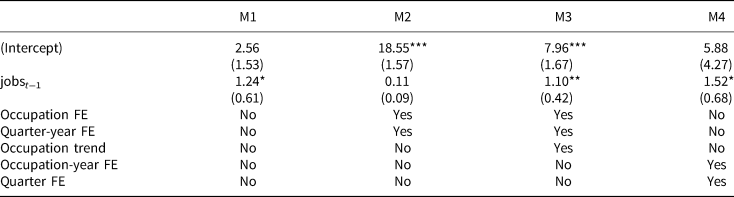
Note: OLS estimates with standard errors clustered by thirty-eight occupations in brackets (n = 1,368). ***p < 0.001, **p < 0.01, *p < 0.05
The baseline specification (Column 2) removes all time-constant confounders and common quarter-year shocks but relies on the assumption that there are no differential trends across occupation groups. Our preferred specification, shown in Column 3, allows for a linear time trend. A comparison of the two columns suggests that our concern with such trends is not unfounded; however, they tend to bias our estimates downward. The estimate from our preferred specification suggests that 1,000 additional jobs in an occupation group led to about one additional prisoner in the same occupation group. An alternative way to understand the substantive effect size is that a one-standard-deviation increase in the number of open positions led to, on average, about 5.7 more arrests. This effect corresponds to an increase of about 1.8 per cent relative to the average of 326 arrests per occupation-quarter in the data.
Column 4 in Table 3 presents the demanding specification, which allows the occupation-specific fixed effects to vary across years. In this specification, we essentially use only the within-year variance for an occupation group to estimate the effect of jobs on the number of exit prisoners. Despite using more local variation, the estimate essentially doubles in magnitude and remains significant with standard errors clustered by occupation group.
In Table 4 we compare the estimates from our preferred specification (M3) to those we obtain using a larger lag of two or three quarter-years (Columns 2 and 3). The estimates for the two- and three-quarter-years’ lag are smaller than the one from the one-quarter lag, suggesting that the citizens and/or the GDR regime promptly reacted to positive economic changes in the FRG.
Estimates of the effect of the number of open positions (per 1,000) in the FRG measured for different quarter-year lags on the number of GDR exit prisoners in a quarter-year
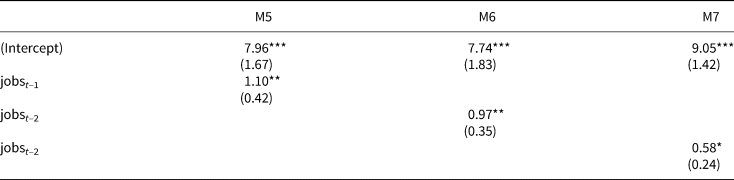
Note: OLS estimates with standard errors clustered by thirty-eight occupations in brackets. All specifications include occupation FE and trend as well as quarter-year FE (n = 1,368). ***p < 0.001, **p < 0.01, *p < 0.05
To examine how sensitive these results are, we conduct a number of robustness checks (reported in Appendix D). First, we show that we obtain similar estimates when using the first-difference or interactive fixed-effect estimator (Bai Reference Bai2009). The latter estimator allows unit and time fixed effects to interact in a structured fashion. The interaction is represented by a low-dimensional factor structure (we use two factors). In our application, this amounts to allowing for some occupation-specific time-varying unobservables, that is, some occupation-specific trends. Secondly, when we estimate the same specifications using a binary version of the jobs variable (defined as more open positions than in 75 per cent of the rest of the sample), we find about five additional arrests in an occupation group after a disproportional increase in available jobs. This result is insensitive to the exact definition of the cut-point. Thirdly, we show that the significant positive effect persists after top-coding values larger than 95 per cent of the rest of the data or estimating a negative binomial regression, suggesting that the positive skew of our variables does not affect our results. In general, the estimates shown in Appendix D generally support our first hypothesis: increasing economic opportunities increases the number of exit prisoners. We estimate that 1,000 additional open positions in the FRG lead to about one additional exit prisoner in the GDR.
We have shown robust evidence that an increase in economic opportunities in West Germany led to a rise in the number of exit prisoners in East Germany. This is in line with our theoretical discussion, in which citizens emigrate in order to enhance their economic prospects but an authoritarian regime uses imprisonment to stop them. It also demonstrates that the East German regime perceived emigration as a threat, as we would otherwise not expect to see a positive relationship between economic opportunities abroad and the number of exit prisoners.
Two mechanisms could explain our main empirical result: (1) for a fixed pool of potential emigrants, there was an increase in the regime's efforts to imprison (enforcement effect) or (2) for a fixed level of imprisonment effort, the pool of citizens who are attempting to leave increased (pool effect).Footnote 16 As we do not have data on the regime's efforts to find potential emigrants, or on citizens’ desire to emigrate, we cannot directly determine the relative importance of these two causal mechanisms. However, two pieces of evidence suggest that the regime increased its enforcement efforts. First, as described in the previous section, qualitative evidence suggests the regime adapted its strategies to current conditions, anticipating that citizens are more likely to emigrate. Secondly, we collected data on successful emigration attempts to calculate the ratio:
 $$\frac{\#\,{\rm exit}\,{\rm prisoners}} {\/ \#\,{\rm exit}\,{\rm prisoners }\!+\!\#\,{\hbox{successful\ emigrants}}}$$
on a quarterly basis and regress our measure of economic opportunities on this ratio. This is a test of the enforcement effect: a positive coefficient on the economic opportunities variable indicates that the regime is exerting more effort on enforcement. This is exactly what we find in our short time series and across different model specifications (for more details, see Appendix D). However, we caution against a causal interpretation of this finding. Future studies should gather data on choices made by both citizens and the regime to provide more conclusive evidence regarding the mechanism.
Information about Economic Opportunities
Our second hypothesis suggests that citizens with access to more information about West Germany should be more likely to be imprisoned. The intuition is that as citizens receive better information about economic opportunities, their confidence in their expected well-being abroad increases, which serves as a substitute for objectively better economic opportunities.
There are two conceivable channels through which East Germans received information about West Germany: their West German relatives and West German TV news. In the main text, we present the results of an analysis in which we estimate whether exit prisoners were living in counties where people could watch West German TV news. In Appendix F we report the results of a second analysis, which shows that exit prisoners were much more likely than ordinary prisoners to have relatives in the FRG. Yet, we are more cautious in interpreting these estimates since they rely on stronger assumptions.
We construct a county-level dataset of exit prisoners for the period 1984–88 based on prisoners’ last place of residence and merge these data with information on the availability of West German TV by Crabtree, Darmofal and Kern (Reference Crabtree, Darmofal and Kern2015).Footnote 17 The empirical strategy for this analysis is based on comparing counties that happened to receive West German TV with those that did not. Excluding the capital district of Berlin, only four districts in East Germany exhibit variation with respect to the availability of West German TV: Neubrandenburg and Rostock in the north and Cottbus and Dresden in the south. Since there is no variation in the availability of West German TV over time, we analyze our data as pooled, repeated cross-sections and condition on a series of observable characteristics of the counties. For more details, see Appendix E.
In Table 5 we present OLS estimates with robust standard errors clustered at the county level. Column 1 presents the estimate for a specification that only includes the TV signal variable as well as a measure of the population size for each year (collected from the Statistical Yearbooks of the GDR), while our baseline (Column 2) and preferred specification (Column 3) include fixed effects for years and districts as well as two time-constant covariates from Crabtree, Darmofal and Kern (Reference Crabtree, Darmofal and Kern2015): the number of cities in a county, the size of the county (in km2), as well as the number of protests during the Uprising of 1953. The fourth specification includes the same covariates, but instead of including them as continuous predictors, we include them in a more flexible manner using a series of dummy variables. We conduct a number of robustness checks that we present in Appendix E.Footnote 18
Estimates of the effect of the availability of West German TV in a county on the number of exit prisoners in a county-year
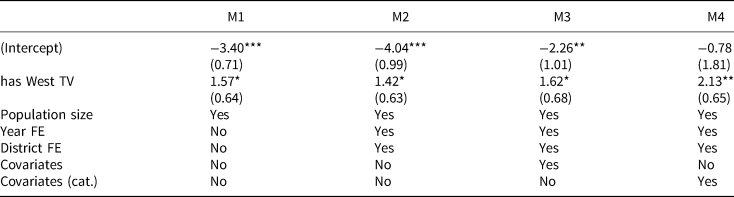
Note: OLS estimates with clustered standard errors at the county level (# of clusters: 61) in brackets. Sample includes four GDR districts: Neubrandenburg, Rostock, Cottbus, and Dresden (n = 305). ***p < 0.001, **p < 0.01, *p < 0.05
Across the four specifications, the effect remains quite stable and increases slightly when we adjust for the covariates in a more flexible matter. The estimates of our preferred specification (Column 3) suggest that the availability of West German TV is associated with at least one additional exit prisoner. These results are consistent with our theoretical expectation: East German citizens with more information about West German economic opportunities were more likely to be arrested. However, since the availability of the TV signal in a particular county in the districts we analyze is a function of geographic characteristics (Kern and Hainmueller Reference Kern and Hainmueller2009), it could be the case that GDR regime opponents were more likely to move to counties with West German TV reception. To the extent that the GDR regime targeted these regime opponents at a higher rate, an increased arrest rate in these counties could be due to regime opponents’ location choice and not their information about economic opportunities in the FRG.
We believe this interpretation is less plausible than the one spelled out in our theoretical discussion for two main reasons. First, while intra-country mobility was very steady starting in 1970 (about 1.3 per cent of the total population migrated across county borders each year), it was about 5 per cent after the June 1953 uprising and steadily declined afterward (Statistisches Bundesamt 1993). Typically, larger cities were the main destinations of internal migration in the GDR (Burkhardt and Burkhardt-Osadnik Reference Burkhardt and Burkhardt-Osadnik1974). In the Appendix we show that, even after excluding all urban counties such as Rostock and Dresden (Stadtkreis), we find a significant effect of West German TV availability. Secondly, previous scholarship has shown that the availability of West German TV is not associated with the 1989 protest activity (Crabtree, Darmofal, and Kern Reference Crabtree, Darmofal and Kern2015); in fact, people living in counties with West German TV were more likely to support the regime in 1988/89 (Kern and Hainmueller Reference Kern and Hainmueller2009). If such sorting of political opponents into these counties happened, one would expect that these counties also had higher protest activity and lower levels of regime support.
EXTERNAL VALIDITY
We conclude with a brief analysis of time-series cross-sectional data that examines the extent to which variation in emigration restrictions is linked to the economic opportunities that citizens of authoritarian countries have in neighboring countries. To that end, we return to the CIRI Human Rights Dataset (Cingranelli, Richards and Clay Reference Cingranelli, Richards and Clay2014), which is one of the most widely used datasets to study repression cross-nationally. This dataset features a categorical variable that measures the degree of restrictions on the right of movement to foreign countries (2 = severely restricted, 1 = somewhat restricted, 0 = unrestricted). We match the CIRI data with information about each country's GDP per capita as well as the GDP per capita of its neighboring countries, focusing on the post-Cold War period. We define two countries as neighboring if they are separated by a land or river border. Our measure of citizens’ economic opportunities abroad is coded 0 if a country systemically exceeds the GDP per capita of all its neighbors (in which case there are no economic opportunities for citizens abroad), and 1 otherwise.
Table 6 shows that economic opportunities abroad are indeed systematically associated with more emigration restrictions even when we include country and year fixed effects. For countries where citizens have better economic opportunities abroad, the 3-point emigration restriction index is 0.72 points higher and the effect is statistically significant (p < 0.05). This effect is robust to including a fixed effect for the neighboring country or controlling for GDP and Polity IV Scores. Even though East Germany is a relative wealthy authoritarian regime (for a comparison with other authoritarian regimes in the 1980s, see Appendix G), these results strengthen our confidence in the external validity of our main findings in the previous sections.
Estimates of economic opportunities abroad on an index of emigration restrictions
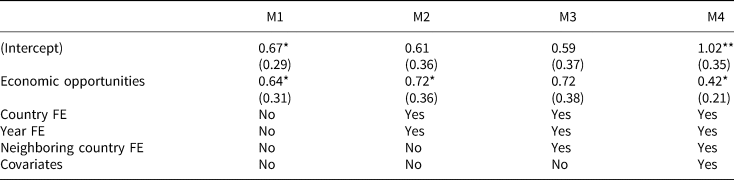
Note: OLS estimates with clustered-robust standard errors by country (# of clusters: 67) in brackets. Sample includes all authoritarian regimes between 1990–2011 (n = 633). Covariates: GDP and Polity IV score for the country and the neighboring country. ***p < 0.001, **p < 0.01, *p < 0.05
DISCUSSION AND CONCLUSION
In this article, we analyze theoretically and empirically how improvements in economic conditions abroad affect the number of citizens arrested for attempting to emigrate. Our theoretical discussion builds on the insight that citizens seek to emigrate in order to improve their economic well-being. When authoritarian rulers perceive emigration as a threat, they impose and enforce limits on the freedom to move abroad. While there are some benefits of emigration to rulers – for instance, opposition supporters may no longer work to overthrow the regime, or the prospect of substantial amounts of remittances – we emphasize the costs: the loss of human capital and the corresponding decrease in economic potential. Authoritarian rulers may use a variety of measures to curb the threat of repression. We distinguish analytically between rewards and punishments as well as between more or less targeted measures. Imprisonment is a targeted punishment that is likely to be used when the regime can count on a loyal security and surveillance apparatus, has longstanding economic policies and ideological commitments, is budget constrained, and faces pressure from a relatively small set of workers who are considering leaving the polity. If the regime imprisons those who try to leave, we expect the number of exit prisoners to increase when economic opportunities abroad improve, and expect there to be more exit prisoners when citizens are better informed about these opportunities.
Our empirical analysis, focused on East Germany, demonstrates that the regime perceived emigration as a threat and that citizens were attracted by economic opportunities in West Germany. We estimate that when the number of open positions in West Germany increased by 1,000, the regime in East Germany arrested one additional individual for attempting to illegally emigrate. We also show that where citizens had better information about economic opportunities in West Germany, more citizens were arrested for illegal emigration attempts. Lastly, we also present evidence that supports the external validity of our analysis using cross-national data from the CIRI Human Rights Dataset. In general, our results point to the importance of global migration flows in analyses of cross-sectional variation in human rights violations. At least some proportion of this variation around the world could be the result of (anticipated) migration flows.
Our results have important policy implications. While many have highlighted the cost of liberal immigration policies for migrant-sending countries in terms of the risk of a ‘brain drain’ (Docquier and Rapoport Reference Docquier and Rapoport2012), we highlight the political consequences: There is a subtle risk that liberal immigration policies will encourage authoritarian leaders to tighten their grip on their citizens. Given the growing economic disparities across the world and an expected increase in international immigration, we expect such considerations to become more and more important in discussions about redesigning immigration policies in Europe and the United States.
Supplementary material
Data replication sets are available in Harvard Dataverse at: https://doi.org/10.7910/DVN/R5YV1L and online appendices at: https://doi.org/10.1017/S0007123420000216.
Acknowledgements
We thank the Bundesarchiv for their valuable support of our archival work and Axel W. Salheiser for sharing his extensive list of occupations in the GDR. We also thank Dominik Hangartner, Holger L. Kern, David D. Laitin, Andrew T. Little, Carl Mueller-Crepon, Alastair Smith, Salif Jaiteh, the seminar participants at New York University, University of Zurich, ETH Zurich, University of Mannheim, Texas A&M University, and the MPSA 2017 panel ‘Repression and other Strategies for Authoritarian Survival,’ the editor René Lindstädt, and three anonymous reviewers for excellent comments. Carlo M. Horz acknowledges funding by the ANR – Labex IAST.



