Introduction
Trypanosoma equiperdum is a protozoan parasite, closely related to the Trypanosoma brucei species, known to cause human and animal African sleeping sickness (Brun et al. Reference Brun, Hecker and Lun1998). Trypanosoma equiperdum is considered the causal agent for a debilitating disease called Dourine, found worldwide affecting only equids. It is the only pathogenic trypanosome species that does not require an invertebrate vector for transmission, thus being passed from animal to animal via coitus (Hoare, Reference Hoare1972). Dourine can present itself as either an acute or chronic disease, often with fatal consequences. Donkeys and mules remain less susceptible to the disease than horses and therefore can act as carriers of the disease, even though no natural reservoir has yet been identified (Claes et al. Reference Claes, Büscher, Touratier and Goddeeris2005). Trypanosoma equiperdum differs from other trypanosomes in that it remains primarily a tissue parasite, often detected in skin biopsies or in the seminal fluid of infected male equids and in the vaginal mucus of infected females. Both are capable of transmitting the disease, where parasites can initially be detected in new infections on the surface of the mucosa before tissue invasion occurs, where the parasite may enter the blood system and then be carried to other areas of the body. Typically, this can cause the appearance of characteristic cutaneous plaques, although the incubation period, severity and duration of the disease can vary immensely. Clinical symptoms are not always seen but can be observed in the form of pyrexia, local oedema of the genitalia and mammary glands, oedematous cutaneous eruptions, knuckling of the joints, incoordination, facial and lip paralysis, anaemia, ocular lesions and severe emaciation. The characteristic cutaneous plaques usually appear above the ribs of the infected animal, are 5–8 cm in diameter and around 1 cm thick. Plaques can occur anywhere on the body, persisting for 3–7 days and are not a constant feature (Clausen et al. Reference Clausen, Chuluun, Sodnomdarjaa, Greiner, Noeckler, Staak, Zessin and Schein2003).
Detection and subsequent isolation of the parasite in the field is extremely difficult, mainly due to the fact that T. equiperdum parasites are only sparsely present in either the blood or even the oedematous areas (of the genitalia) of infected animals. Clinical signs and symptoms are more prominent in developed cases, but recognition in early or latent stages of the disease can be confused with other infections, such as that seen in animals infected with Trypanosoma evansi, the causative agent of the disease, Surra. A definitive diagnosis of dourine is thus hindered by a rare ability for direct parasitological identification or sufficient clinical assessment. Serological techniques, such as the enzyme-linked immunosorbant assay or the complement fixation test often provide false-positive results and do not necessarily demonstrate active or new infections (Hagos et al. Reference Hagos, Degefa, Yacob, Fikru, Alemu, Feseha, Claes and Goddeeris2010a). Recently, DNA-based methods have been explored and even though no specific T. equiperdum polymerase chain reaction (PCR) protocol currently exists, it is possible to differentiate between T. equiperdum and T. evansi, when utilising a Trypanozoon-specific PCR method, based on the resulting band sizes created in test blood samples (Perrone et al. Reference Perrone, Gonzatti, Villamizar, Escalante and Aso2009). A highly sensitive real-time PCR technique is currently being established and can successfully detect low numbers of the parasite when examining tissue and fluid samples from naturally-infected animals (Pascucci et al. Reference Pascucci, Di Provvido, Camma, Di Francesco, Calistri, Tittarelli, Ferri, Scacchia and Caporale2013). There is no currently recognized form of chemotherapeutic treatment as a potential control measure against dourine and therefore all confirmed (and suspected) cases of infected animals must be slaughtered immediately. For many global communities and farming populations, which rely heavily on their animals for their livelihood, such a stringent international regulation can seriously enhance the socio-economic problems attributing to poverty.
Diamidines are dicationic molecules, which bind to the minor groove of DNA at AT-rich sites and can exert their biological activity by primarily binding to DNA and then inhibiting one or more DNA-dependent enzymes or by directly impeding the transcription process. The selective binding of diamidines to kinetoplastic DNA has been suggested to play a vital role in the action of such aromatic molecules against several pathogenic species (Wilson et al. Reference Wilson, Nguyen, Tanious, Mathis, Hall, Stephens and Boykin2005). Diamidines were previously investigated for their curative efficacy against T. evansi, yet it was within that study that several T. equiperdum strains were also primarily investigated, originally performed in order to obtain a panel of reference strains for use in drug screening programmes (Gillingwater et al. Reference Gillingwater, Büscher and Brun2007). Nevertheless, several T. equiperdum strains were found to be highly susceptible to chemotherapeutic treatment in a mouse model of infection. Although the majority of these T. equiperdum strains were later re-identified as mistaken T. evansi strains, 2 ‘true’ T. equiperdum strains remained; the Moroccan BoTat 1·1 and the South African OVI strains, both of which had demonstrated promising results to diamidine activity (Gillingwater, Reference Gillingwater2007). ‘True’ T. equiperdum strains are defined by molecular diagnosis, involving the phylogenetic analyses of 18srRNA and ITS PCR confirmation, which classifies the strain as a member of the Trypanozoon clade, followed by the PCR determination of the maxicircle DNA region to detect NADH-dehydrogenase subunits 4 and 5, not found present in T. evansi strains. In addition, a history of confirmed clinical symptoms should also be prominent. During a recent large-scale epidemiological survey, conducted in Ethiopia on T. equiperdum, the opportunity to isolate a recent ‘true’ T. equiperdum strain presented itself. This T. equiperdum field isolate (Dodola) was further utilized to experimentally infect ‘clean’ horses in Ethiopia, with great success (Hagos et al. Reference Hagos, Degefa, Yacob, Fikru, Alemu, Feseha, Claes and Goddeeris2010a). In addition, the Dodola strain has now been adapted to mice and can be used for extended in vivo mouse model investigations. Although chemotherapy-based experimental studies with available marketed drugs have been conducted using T. equiperdum (Hagos et al. Reference Hagos, Goddeeris, Yilkal, Alemu, Fikru, Yacob, Feseha and Claes2010b), none have yet evaluated the potential for novel candidate compounds as effective chemotherapeutic agents against this parasite. Although there is no official chemotherapeutic treatment currently recognized for T. equiperdum infection, several reference drugs, normally used to combat T. evansi infections, will be utilized to obtain a drug efficacy profile of the current medicines available on the market. These will include diminazene aceturate and quinapyramine sulphate. This drug efficacy profile will also provide a base-line to assess the curative efficacy of diamidines against T. equiperdum. Data from previously investigated studies involving closely related trypanosome species such as T. evansi and Trypanosoma brucei rhodesiense (Gillingwater, Reference Gillingwater2007), will be beneficial in initially selecting the 40 most active compounds from a database of over 2500 analogues of diamidines. All selected diamidine compounds will have previously been investigated for their preliminary acute toxicity in mice, for an accumulated dose of up to 100 mg kg−1 i.p., in order to limit the appearance of side effects. Of these 40 compounds, a further selection of the most active 15 diamidines will then be assessed for their in vivo efficacy, within various (pre-established) mouse models of infection for T. equiperdum.
Materials and methods
Trypanosoma equiperdum strains
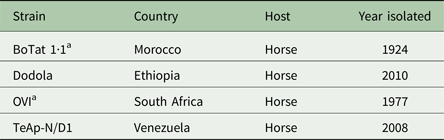
A panel of 4 ‘true’ Trypanosoma equiperdum strains was investigated within this study. The history associated with each of these 4 strains can be found in more detail in Table 1.
Background information for the 4 ‘true’ Trypanosoma equiperdum strains used in this study, detailing their country of origin, host and year of isolation

a Indicates these strains grow in vitro under continuous axenic conditions.
Mice
Female NMRI mice, weighing between 21 and 23 g were utilized in all in vivo experiments. The mice were specific pathogen free (SPF) and were maintained in standard Macrolon type III cages at 22 °C and with a relative humidity of 65%. Mice received pelleted food and water ad libitum. All in vivo experiments involving mice were conducted according to the regulations and guidelines set out by the Swiss Federal Veterinary Office, under license number STP-2813.
Reference drugs and test compounds
Diminazene aceturate (D-7770, Sigma, St Louis MO, USA) and quinapyramine sulphate (Trypacide®, May & Baker, Lagos, Nigeria) were used as the reference trypanocidal drugs in this study. All diamidine compounds tested had previously been synthesized in the laboratories of David Boykin (Georgia State University, Atlanta, USA) or Richard Tidwell (University of North Carolina, Chapel Hill, USA), with emphasis on structural diversity, chemical stability and low cost of goods. Previous knowledge on limited in vivo toxicity and structure–activity relationships were applied, to ensure the most active chemical groups were included.
Culture medium
Bloodstream form trypanosomes of the axenically adapted BoTat 1·1 and OVI T. equiperdum strains, were cultured in Iscove's modified Dulbecco's medium (IMDM; I3390, Sigma, St Louis, MO, USA), supplemented with 3 g L−1 NaHCO3 and 200 mm L-glutamine. The medium was then further supplemented by adding 1% of a 2 mm stock of 2-mercaptoethanol, 1% of a stock containing 5 mm bathocuproindisulfate, 150 mm L-cysteine HCL, 100 mm pyruvate, 50 mm hypoxanthine and 16 mm thymidine, and 15% heat-inactivated horse serum. The complete medium was used in all in vitro drug sensitivity assays.
Stock solutions and dilutions
Stock solutions of 10 mg mL−1 for each compound were prepared, dissolved in 100% dimethyl sulfoxide (DMSO) and stored frozen at −20 °C. From these stock solutions, further compound dilutions were made for use in the in vitro drug sensitivity assays, using culture medium as a solvent. Compound dilutions were prepared fresh on the day of the assay. For the in vivo mouse experiments, a 1·5 mg amount of each compound was weighed out in powder form and dissolved in 15 mL of sterile distilled water to provide a 0·1 mg mL−1 stock solution. From these stock solutions, further compound dilutions were made depending on the dose being tested. All stock solutions and compound dilutions for the in vivo mouse experiments were made fresh on the day of administration and for each experiment.
In vitro drug sensitivity assays
To determine the IC50 values for the selected diamidine compounds, the Alamar Blue assay was used (Räz et al. Reference Räz, Iten, Grether-Bühler, Kaminsky and Brun1997). The trypanosome density was calculated using a cell counter and analyser system (CASY, Schärfe System, Reutlingen, Germany) and the trypanosomes diluted accordingly, to enable a seeding density of 4 × 10⁴ mL−1 in the culture medium. Assay plates were then incubated at 37 °C for 69 h, before being removed from the incubator and adding 10 µL of Resazurin dye (#33934, Aldrich/Fluka, Buchs, Switzerland; 12·5 mg in 100 mL phosphate buffered saline) to each well. The plates were then further incubated for another 3 h under the same conditions. Thereafter, assay plates were read using a fluorescence reader (SpectraMax, Gemini XS, Bucher Biotec, Basel, Switzerland) at excitation and emission wavelengths of 536 and 588 nm, respectively. The data generated were analysed further using SOFTmax Pro software (version 5·2) to determine the inhibitory concentrations. All in vitro experiments were performed in duplicate in 3 separate assays for each compound.
In vivo mouse models of infection
In vivo mouse models of infection were established for each of the 4 ‘true’ T. equiperdum strains. NMRI female mice were independently infected with BoTat 1·1, Dodola, OVI or TeAp-N/D1 at concentrations of 103, 104 or 105 parasites in 0·25 mL of phosphate buffered saline with glucose (ratio 6:4) and the parasitaemia monitored daily, via a tail blood examination technique. Infections for all in vivo mouse models were performed intraperitoneally (i.p.) from stabilated blood, stored frozen in liquid nitrogen. As soon as parasitaemia reached 108 parasites per mL blood, the mice were humanely euthanized, via a CO2 chamber, according to the regulations and guidelines set out by the Swiss Federal Veterinary Office, under license number STP-2813. The number of days (post-infection) required to reach 108 parasites per mL blood were recorded for each respective strain and the optimal starting concentration determined for the in vivo mouse efficacy studies.
In vivo mouse efficacy studies
NMRI female mice were randomly arranged into groups of 4 and independently infected with 104 parasites in 0·25 mL of phosphate buffered saline with glucose (ratio 6:4). Infections for all in vivo mouse efficacy studies were performed intraperitoneally (i.p.) from stabilated blood, stored frozen in liquid nitrogen. A parasitaemia of 105 mL−1 blood was allowed to develop over 48 h, before treatment was administered as a single bolus dose via an i.p. route on day 2, post-infection. Parasitaemia was monitored in the mice twice a week using a tail blood examination technique, until day 60 post-treatment. This 2 month post-treatment follow-up period was carried out to account for any possible relapses during the efficacy studies. After day 60 post-treatment, any surviving aparasitaemic mice were considered cured. Mice were euthanized humanely using a CO2 chamber, according to the regulations and guidelines set out by the Swiss Federal Veterinary Office, under license number STP-2813. Untreated (control) mice survive on average for 5 days post-infection for the BoTat 1·1 and OVI strains, for 4 days post-infection for the Dodola strain and for 3 days post-infection for the TeAp-N/D1 strain.
Results
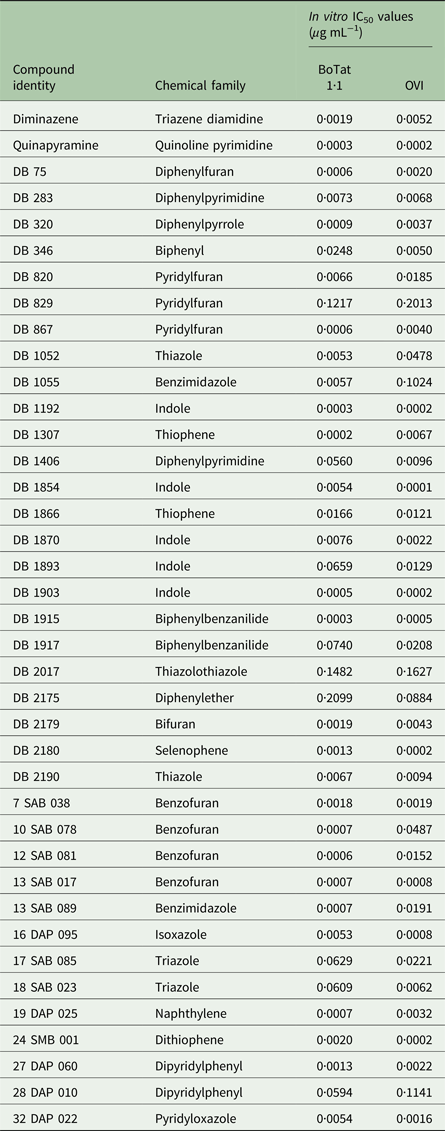
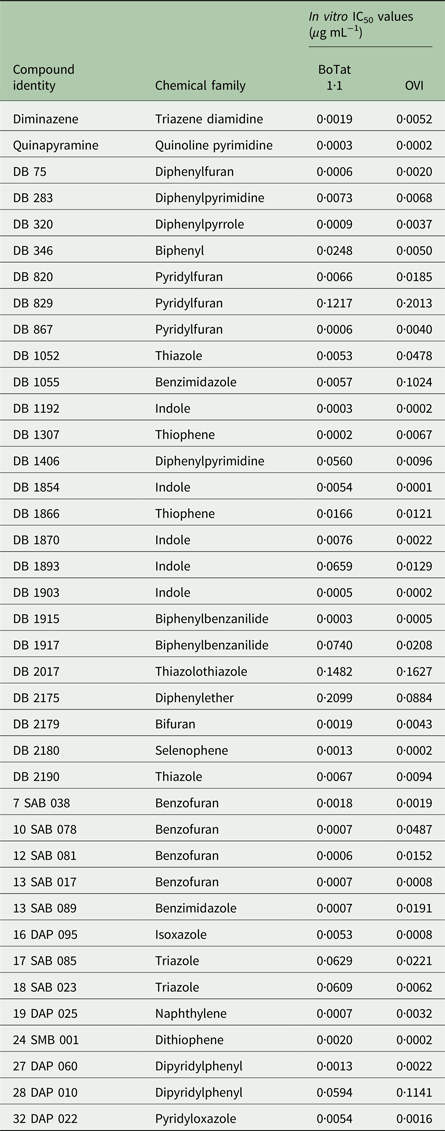
In total, 2 reference drugs (diminazene aceturate and quinapyramine sulphate) together with 37 diamidine compounds, were tested in vitro using a 72 h drug sensitivity assay to determine their efficacy against 2 axenically adapted Trypanosoma equiperdum strains (BoTat 1·1 and OVI). The final inhibitory concentrations (IC50 values in μg mL−1) obtained are shown in Table 2. The IC50 results obtained for the 2 reference drugs against the BoTat 1·1 strain were 0·0019 µg mL−1 for diminazene aceturate and 0·0003 µg mL−1 for quinapyramine sulphate. In comparison, the IC50 results obtained for the 2 reference drugs against the OVI strain were 0·0052 µg mL−1 for diminazene aceturate and 0·0002 µ mL−1 for quinapyramine sulphate. Three of the originally selected 40 novel diamidine compounds were no longer available for synthesis and were hence removed from the study. The IC50 values obtained for the remaining 37 novel diamidine compounds tested, ranged from 0·0002 to 0·210 µg mL−1 for the BoTat 1·1 strain and from 0·0001 to 0·201 µg mL−1 for the OVI strain. In summary, 26 of the 37 diamidine compounds (70%) demonstrated IC50 values below 0·1 µg mL−1 against the BoTat 1·1 strain and 23 of the 37 diamidine compounds (62%) demonstrated IC50 values below 0·1 µg mL−1 against the OVI strain. Furthermore, 12 of the 26 compounds (46%) provided IC50 values below 0·001 µg mL−1 against the BoTat 1·1 strain and 8 of the 23 compounds (34·8%) provided IC50 values below 0·001 µg mL−1 against the OVI strain, respectively.
In vitro drug sensitivity values (given as IC50 in μg mL−1) for 2 reference drugs and 37 novel diamidine compounds against the axenically adapted BoTat 1·1 and OVI Trypanosoma equiperdum strains
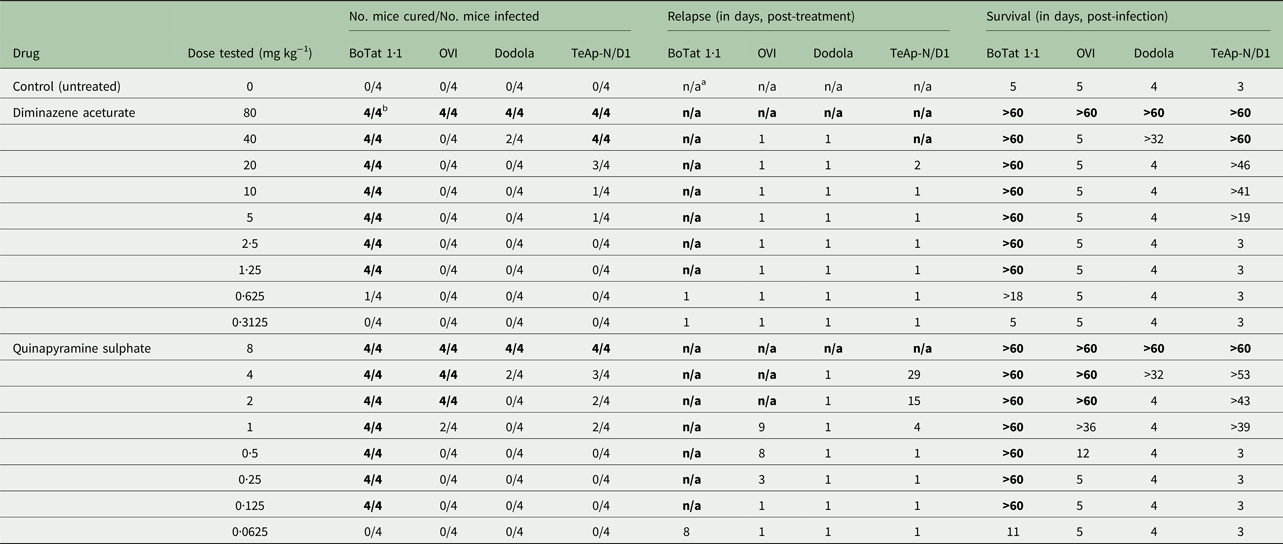
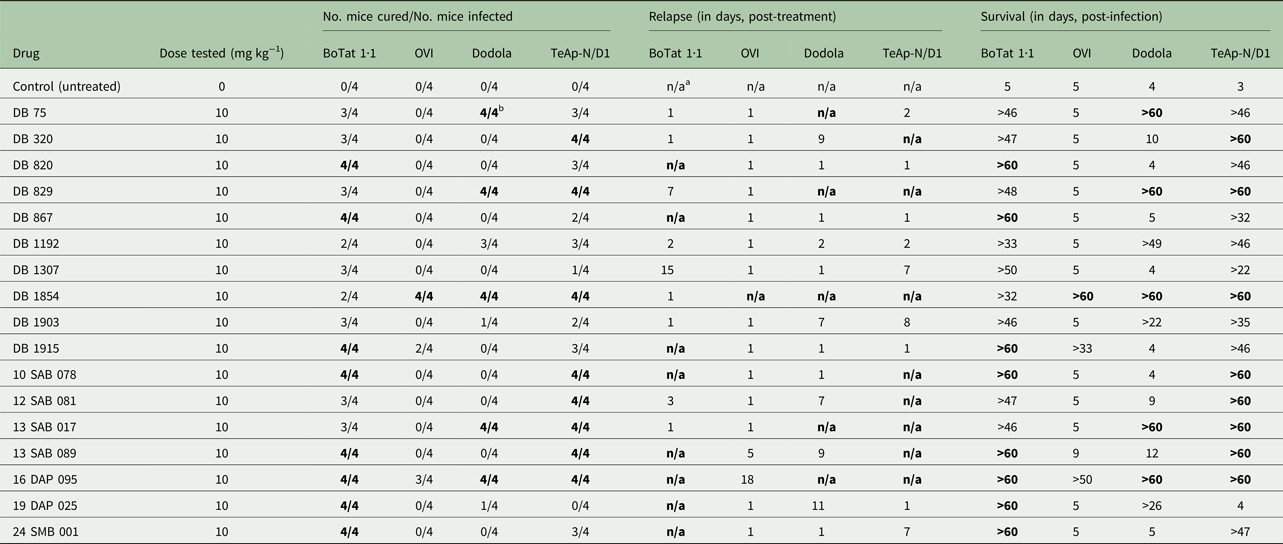
In vivo (mouse) drug profiles were established for 2 reference drugs, diminazene aceturate and quinapyramine sulphate, against 4 ‘true’ T. equiperdum strains in female NMRI mice. The in vivo efficacy and dose-response results obtained for these 2 reference drugs, against these 4 ‘true’ T. equiperdum strains, are depicted in Table 3. The minimal curative (single) doses obtained for diminazene aceturate against these 4 strains were 1·25 mg kg−1 for BoTat 1·1, 80 mg kg−1 for OVI and Dodola and 40 mg kg−1 for TeAp-N/D1. The minimal curative (single) doses obtained for quinapyramine sulphate against these 4 strains were 0·125 mg kg−1 for BoTat 1·1, 2 mg kg−1 for OVI and 8 mg kg−1 for Dodola and TeAp-N/D1. Relapses in the mice were recorded as days post-treatment, whilst survival of the mice was recorded as days post-infection. Control mice, receiving no drug treatment whatsoever, survived on average for 5 days post-infection for the BoTat 1·1 and OVI strains, for 4 days post-infection for the Dodola strain and for 3 days post-infection for the TeAp-N/D1 strain. Subsequently, 17 of the most active diamidine compounds were further investigated in pre-established mouse models of infection, against the 4 ‘true’ T. equiperdum strains, at a single bolus dose of 10 mg kg−1, given i.p. The in vivo efficacy results obtained for these 17 selected diamidines can be seen in Table 4. A total of 15 out of the 17 compounds tested (88%) demonstrated 75% curative efficacy or above, in mice infected with the BoTat 1·1 strain, of which 8 of these 15 compounds (53%) demonstrated 100% curative efficacy. Only 2 out of the 17 compounds tested (12%) demonstrated 75% curative efficacy or above, in mice infected with the OVI strain, of which only 1 of these 2 compounds (50%) demonstrated 100% curative efficacy (DB 1854). A total of 6 out of the 17 compounds tested (35%) demonstrated 75% curative efficacy or above, in mice infected with the Dodola strain, of which 5 of these 6 compounds (83%) demonstrated 100% curative efficacy. A total of 13 out of the 17 compounds tested (76%) demonstrated 75% curative efficacy or above, in mice infected with the TeAp-N/D1 strain, of which 8 of these 13 compounds (62%) demonstrated 100% curative efficacy. In summary, 8 of the 17 compounds tested (47%) were capable of providing at least 75% curative efficacy or above, against 2 strains, whilst 4 of the 17 compounds tested (24%) were capable of providing at least 75% curative efficacy or above, against 3 strains. Only 1 diamidine (16 DAP 095) of the 17 compounds tested (6%) was capable of providing at least 75% curative efficacy or above, at a single bolus dose of 10 mg kg−1 i.p., against all 4 ‘true’ T. equiperdum strains.
In vivo efficacy and dose-response for 2 reference drugs, given as single bolus doses (i.p.) to NMRI mice, infected separately with 4 different Trypanosoma equiperdum strains
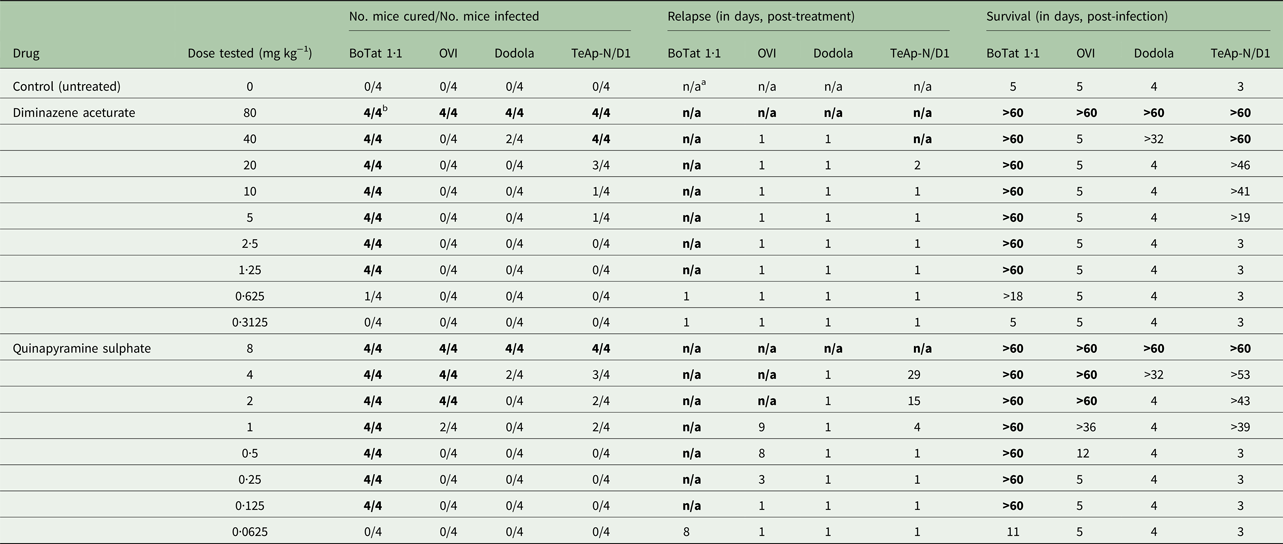
a n/a denotes not applicable, as no relapse was seen during the complete 60-day monitoring phase.
b Numbers in boldface indicate that all mice were cured (100% efficacy) at that respective dose.
In vivo efficacy of 17 novel diamidine compounds, given as a single bolus dose of 10 mg kg−1 (i.p.) to NMRI mice, infected separately with 4 different Trypanosoma equiperdum strains
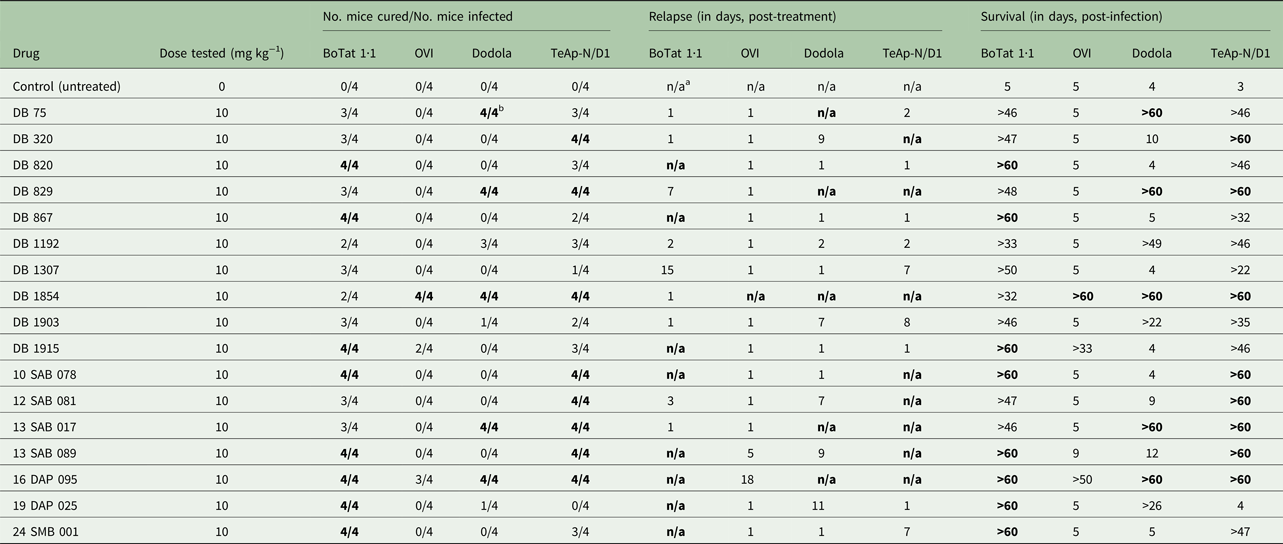
a n/a denotes not applicable, as no relapse was seen during the complete 60-day monitoring phase.
b Numbers in boldface indicate that all mice were cured (100% efficacy) at that respective dose.
To determine whether any of the selected diamidine compounds could provide complete in vivo cure (100% efficacy) across all 4 ‘true’ T. equiperdum strains, 3 novel diamidines were chosen and tested at a single bolus dose of 20 mg kg−1 i.p. The in vivo efficacy of these 3 diamidine compounds (DB 1854, DB 1915 and 16 DAP 095), against all 4 T. equiperdum strains, is shown in Table 5. Both DB 1854 and 16 DAP 095 were capable of curing all infected mice at 20 mg kg−1 i.p. when infected with any of the 4 strains. Unfortunately, DB 1915 was only capable of full efficacious cure in 3 out of the 4 strains. None of the mice (0/4) infected with the Dodola strain could be cured with DB 1915 at a single bolus dose of 20 mg kg−1 i.p.
In vivo efficacy of 3 novel diamidine compounds, given as a single bolus dose of 20 mg kg−1 (i.p.) to NMRI mice, infected separately with 4 different Trypanosoma equiperdum strains

a n/a denotes not applicable, as no relapse was seen during the complete 60-day monitoring phase.
b Numbers in boldface indicate that all mice were cured (100% efficacy) at that respective dose.
Discussion
Dourine affects many global communities and farming populations worldwide, which rely solely on their animals for independence, sustainability and an overall livelihood. Trypanosoma equiperdum contributes to the socio-economic burdens of many poverty-induced countries and remains one of the most prominent and debilitating neglected veterinary diseases currently found circulating today. With the serious lack of efficient diagnostic tools and numerous difficulties surrounding actual parasitological and clinical evaluation of infected animals, current control measures are limited to strict guidelines set out by the World Animal Health Organisation (OIE), in an attempt to prevent the transportation of ‘potentially-infected’ horses and the subsequent threat and introduction of the parasite to presently Dourine-free regions. This study shows that experimentally T. equiperdum can indeed be effectively treated with chemotherapy and that by producing sound scientific evidence, the opportunity to translate such knowledge to confirmed cases of infection, could initiate a much needed revision of the current control measures associated with dourine on a global scale.
The limitations involved in strain isolation have made scientific advancement in T. equiperdum research extremely challenging. Although this study utilized the only 4 ‘true’ T. equiperdum strains currently available worldwide, more recently isolated strains are urgently required, in order to solidify such promising efficacy results. A T. equiperdum strain from Mongolia has recently been successfully isolated from naturally infected horses and adapted for use in in vitro culture (Suganuma et al. Reference Suganuma, Narantsatsral, Battur, Yamasaki, Otgonsuren, Musinguzi, Davaasuren, Battsetseg and Inoue2016), which could provide an additional aid in the screening of new drugs against T. equiperdum. The in vivo standard drug profiles in mice against all 4 T. equiperdum strains demonstrated the range of potential efficacy of diminazene aceturate and quinapyramine sulphate. Compared with the recommended effective doses prescribed by these market drugs of 3·5–7 mg kg−1 and 0·5–1 mg kg−1, respectively, 3 out of the 4 T. equiperdum strains tested reached acute toxicity levels, in order to achieve full cure in the mice, implying an 11- to 23-fold increase in the recommended dose was required for diminazene aceturate and an 8- to 16-fold increase in the recommended dose was required for quinapyramine sulphate. Complete curative efficacy in infected mice treated with novel diamidine compounds, however, was observed in several T. equiperdum strains at single bolus doses of 10 mg kg−1 and at just 20 mg kg−1 against all 4 strains. These results reveal the competency of treating T. equiperdum-infected mice with selected diamidines, whilst still remaining within the therapeutic window and avoiding adverse reactions related to acute toxicity.
Since the active diamidines were investigated for in vivo efficacy against all 4 T. equiperdum strains, the resulting data enables the evaluation of the curative efficacy of diamidines against geographically diverse strains. This, in turn, has identified whether T. equiperdum strains from different countries (or continents even) can universally be treated with diamidines or whether some strains may have been previously exposed to current veterinary drugs and hence demonstrates a form of chemotherapeutic cross-resistance. Even though no official drug resistance for these 4 T. equiperdum strains between the reference drugs was expected, this situation cannot be entirely ruled out, since many of the regions where T. equiperdum infections occur, often overlap with regions endemic for Trypanosoma evansi and/or Trypanosoma vivax infections. In Morocco (the origin of the BoTat 1·1 strain), camels infected with T. evansi are treated using quinapyramine sulphate, whereas throughout the African continent, diminazene aceturate remains the most widely used veterinary drug, combating infections in livestock caused by Trypanosoma brucei brucei, Trypanosoma congolense, T. vivax and T. evansi. In Latin America (the origin of the TeAp-N/D1 strain), quinapyramine sulphate is similarly given for T. evansi treatment in infected horses, whilst diminazene aceturate is utilized for T. vivax infections in cattle. It is therefore not completely clear whether the in vivo drug profiles of these 4 T. equiperdum strains in mice have resulted from previous exposure to current veterinary drugs used under field conditions or whether they involve cross-resistance between one another. It is widely believed that quinapyramine resistance confers additional cross-resistance to the other veterinary products presently available. By extending this study to include a broader range of reference drugs (such as suramin, melarsomine dihydrochloride and isometamidum chloride), it may be possible to determine whether the in vivo drug profiles currently established are just a result of cross-resistance between closely related molecules or indeed official drug resistance. It recently emerged that T. equiperdum actually originated from East African Trypanosoma brucei and that 3 of the 4 ‘true’ T. equiperdum strains investigated in this study, actually form a close monophyletic cluster based on genomic SNP analysis (Cuypers et al. Reference Cuypers, Van den Broeck, Van Reet, Meehan, Cauchard, Wilkes, Claes, Goddeeris, Birhanu, Dujardin, Laukens, Büscher and Deborggraeve2017). This implies that very little variation occurs between the South African (OVI), the Ethiopian (Dodola) and the Venezuelan (TeAp-N/D1) strains. In contrast, the Moroccan (BoTat 1·1) strain is completely distinct from this cluster and could be an attribution as to why this strain appeared to be more susceptible to the reference drugs and the diamidines, when examined for their in vivo efficacy in infected mice.
Although this study is the first to demonstrate the curative efficacy of novel compounds against T. equiperdum strains, the data produced, both in vitro and in vivo using the mouse models of infection, needs to be directly translated to the target animal (i.e. equids) found naturally affected. The low single bolus doses effective in the T. equiperdum-infected mouse models for several diamidines ensure a wider selectivity index range when being administered to larger animals, such as horses. The relative curative efficacious dosage thus required in a larger animal (i.e. horses), compared with that required to demonstrate 100% curative efficacy in a mouse, is on average at least 10-fold lower. This has major implications not only in terms of a significant reduction in the economic cost, hence the realistic possibility of producing an affordable market drug, but also in terms of adverse side effects or toxicity observed in animals, such as horses, highly sensitive to chemotherapeutic agents. By using lower doses of an efficacious compound sufficient to effectively treat T. equiperdum-infected horses, adverse side effects and issues surrounding toxicity can be diminished. Diamidines are well known for their pharmacokinetic features, especially their tissue-absorbing nature and long half-lives, implying that chronic T. equiperdum infections normally found in horses could be effectively treated at even lower doses than those tested in the acute mouse models. The presence of high drug concentrations within the blood and tissues of an infected animal would ensure that parasites could, therefore, be eliminated over a longer time period, than that seen within the 60-day mouse model protocol. The disease progression of this tissue parasite in horses is a complex process, that is not fully understood yet and therefore, the next immediate step would be to determine the curative efficacy of novel compounds (such as the diamidines) within an experimental in vivo horse model of infection. By investigating the parasitological, molecular and pharmacological progression in the target animal in this way, data could be obtained providing a more accurate conclusion on the possibility of using chemotherapy to control dourine.
Acknowledgements
The author wishes to express sincere gratitude to Dr Ashenafi Hagos from the Addis Ababa University in Ethiopia for the kind donation of the Dodola Trypanosoma equiperdum strain and to Professor Marissa Gonzatti from the Simon Bolivar University in Venezuela for the kind donation of the TeAp-N/D1 Trypanosoma equiperdum strain, both used in this study. Additional thanks and appreciation are extended to Michael Marzolla and Pascale Steiger for their expert care and assistance with animal maintenance.
Financial support
This work was supported by a personal scholarship grant awarded to the author by the University of Basel Research Foundation, under grant number DZX 2122.