


1. INTRODUCTIONFootnote *
Set within the generative framework of the Minimalist Program (MP) (Chomsky, Reference Chomsky1995, Reference Chomsky, Martin, Michaels and Uriagereka2000, Reference Chomsky and Kenstowicz2001; Pesetsky & Torrego, Reference Pesetsky, Torrego and Kenstowicz2001, Reference Pesetsky, Torrego, Karimi, Samiian and Wilkins2007), the present article analyses the syntax of imperative sentences in Modern Standard French and across vernacular varieties of French in Europe and Canada. This sentence type offers a rich testing ground for hypotheses on the properties of both the negative particle ne and on pronominal argument clitics as these linguistic items interact in interesting and distinct ways across closely related language varieties: we see enclitics used for pronominal arguments in positive imperatives (prends-les ‘take them’), but in negative imperatives, Modern Standard French procliticises pronominal arguments (ne les prends pas ‘don't take them’), while they remain enclitics in Quebec French (prends-les pas ‘don't take them’). Essentially, this article argues that there is compelling evidence that French ne, even in dialects that still have this particle, is no longer negative, and therefore cannot be analysed as the head of NEGP. Rather, ne should be considered an affix merged to the Tense projection (TNSP) endowed with uninterpretable features of polarity. This proposal provides a unified solution for the distributional properties of ne in finite and non-finite contexts alike as compared to the distribution of clitics. It especially provides an explanation of the structure of French imperatives crucially linked to the properties of the functional category TNS in distinct varieties of European and Canadian French, and extends this approach to account for restrictions on passive imperatives, and infinitival root sentence with injunctive meaning.
The article is organised as follows: section 2 briefly introduces the syntactic framework of the MP and distinguishes between feature interpretability and feature valuation. Section 3 presents the view of sentential negation in French argued for in Péters (Reference Péters1999) in which ne is a Tense affix constituting the realisation of a sub-label of the Tense (TNS) functional category and pas (‘not’) is an inherently negative adverb merged in the specifier of the highest vP to express sentential negation. Section 4 introduces assumptions on the imperative sentence type, assuming overt verb movement to the COMP functional category and the presence of a defective Tense category. Section 5 develops a syntactic approach to the distribution and co-occurrence of pronominal argument clitics in French based on Laenzlinger (Reference Laenzlinger1993, Reference Laenzlinger1994), Cardinaletti and Starke (Reference Cardinaletti, Starke and van Riemsdijk1999), Roberts (Reference Roberts2010) and others, assuming that clitics are deficient pronouns with respect to Case and prosody, required to lean on a verbal host at Spell Out. Section 6 synthesises the previous theories to provide an account of the syntax of imperatives across varieties of French with respect to the pre and post-verbal position of clitics in interaction with sentential negation in this sentence type. Section 7 extends the account to passive imperatives in different varieties as well as to infinitival directives in Standard French. Finally, section 8 draws some conclusions and suggests avenues of future investigation.
2. SYNTACTIC FRAMEWORK
Within the generative framework and the MP (Chomsky, Reference Chomsky1995, Reference Chomsky, Martin, Michaels and Uriagereka2000, Reference Chomsky and Kenstowicz2001), a sentence is constructed by the operation ‘Merge’ applying to lexical items selected from an initial array of lexical items (a numeration). This approach is derivational in the sense that there are no independent levels of syntactic representation, such as ‘Deep’ or ‘Surface’ structure, instead the lexical and functional items manipulated by the computational system of the faculty of language (in a narrow sense, FLN) are entirely constituted of syntactic and semantic features that must be interpreted at the interfaces of Logical Form (LF) and Phonetic Form (PF) interacting respectively with the Conceptual-intentional and Articulatory-perceptual systems of the faculty of language (in a broad sense, FLB) (Hauser, Chomsky & Fitch, Reference Hauser, Chomsky and Fitch2002). At various points in the derivation (known as ‘phases’), the derivation splits thanks to the operation ‘Spell Out’ such that one branch is sent towards PF for phonetic ‘interpretation’, while the other branch continues the derivation towards LF. In the spirit of Distributed Morphology (Halle & Marantz, Reference Halle, Marantz, Hale and Keyser1993), phonetic features are introduced post-syntactically.Footnote 1
In order to account for movement and agreement properties of human languages in a unified manner, Chomsky (Reference Chomsky1995, Reference Chomsky, Martin, Michaels and Uriagereka2000, Reference Chomsky and Kenstowicz2001) establishes a distinction between interpretable morpho-syntactic features (iF) and uninterpretable (uF) ones. The latter must be deleted by the operation ‘Agree’ before the derivation reaches the interface level of LF. Agreement occurs between a ‘Probe’ feature and one or several ‘Goals’ that contain matching features. An unvalued feature F (a probe) on a head H scans its c-command domain for another instance of F (a goal) with which to agree. If the goal has a value, its value is assigned as the value of the probe. Movement is but a special case of feature agreement when the probe has so-called EPP properties that trigger the immediate attraction and re-merging of the goal (and its containing category), to the head (or to a projection of the head) containing the probe. The consequence of this conception of ‘Move’ as a special case of ‘Agree’ is that movement is always triggered, and never optional. According to Chomsky, features unvalued at the interface are delinquent and, in order for a derivation to converge, must be eliminated through valuation in the most economical way.
Pesetsky and Torrego (Reference Pesetsky, Torrego, Karimi, Samiian and Wilkins2007) propose to distinguish interpretability from valuation and reinterpret the Agree relation as feature valuation. This modification provides for a wider range of agreement relationship as both uninterpretable and interpretable features can be valued or unvalued. Only unvalued features, whether interpretable or not, can serve as probe. For instance, as they argue, the category Tense has an interpretable and unvalued [iT_] feature whose value is normally established by the form of the verb, the verb containing a valued (for instance, + past) but uninterpretable sub-label [uT: +past] feature.
3. SENTENTIAL NEGATION IN FRENCH
The most influential proposal concerning the syntax of sentential negation within the generative framework has been the NEGP hypothesis presented in Pollock (Reference Pollock1989), with ne as head of the negative projection containing pas in its specifier, and developed in Belletti (Reference Belletti1990), Zanuttini (Reference Zanuttini1991, Reference Zanuttini1997), Haegeman (Reference Haegeman1995), Rowlett (Reference Rowlett1998), among others:
1. [TNSP TNS [NEGPpas [NEGne] [AGRP AGR [VP V]]]
This proposal is integrated in the more general split-IP hypothesis that has allowed researchers to better understand the clause structure of sentences across languages and it formalises the link that exists between the bipartite negation ne and pas (‘not’) in French, by generating them together in a single projection. There are however well known difficulties with the NEGP proposal as applied to French (Péters, Reference Péters1999).
First, the expected order ‘pas + ne’ is never grammatical even in non-finite tenses:
2.


Pollock (Reference Pollock1989) and Belletti (Reference Belletti1990) propose to treat ne as a clitic raising to Tense, but while the negative particle indeed patterns with argument clitics in finite clauses (ne me les), it doesn't in infinitive clauses:
3.
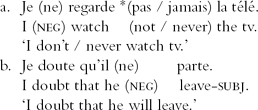
A more serious difficulty is that the supposed head of negation is in fact redundant, optional and sometimes expletive (Péters, Reference Péters1999: 110–12). This is a puzzling observation for an element supposed to be the centre of sentential negation. It is redundant as it is not allowed without a negative ‘auxiliary’, such as pas.Footnote 2 It is generally omitted in spoken French as shown in numerous sociological surveys on the topic (Coveney, Reference Coveney1996, and others). Finally, it is expletive in chosen contexts in formal registers (see example 4.b):Footnote 3
4.
Even more importantly, ne makes no contribution to the interpretation of negation as its satellite pas entirely determines the scope of negation and its grammaticality with respect to other adverbials (Péters, Reference Péters1999: 112):
5. Paul (souvent/probablement) n'a (souvent/probablement) pas (souvent/ *probablement) compris.
Paul (often/probably) neg has (often/probably) not (often/probably) understood.
‘Paul (often/probably) hasn't (often) understood.’
For example in (5), the acceptability of the epistemic adverb probablement and the interpretation of the frequentative souvent depend on their respective position to the left or the right of pas, and not on their position with respect to ne.
Yet, the negative particle ne closely patterns with Tense (see Zanuttini, Reference Zanuttini, Belletti and Rizzi1996) as can be seen in TNS-to-COMP movement leading to a subject-verb inversion configuration:
6. N'est-il pas parti?
neg is he not gone
‘Didn't he leave?’
To account for these properties, Péters (Reference Péters1999) proposes that the negative particle ne is directly inserted on the Tense functional category in cases of sentential negation. This hypothesis directly accounts for the position of ne within finite and non-finite sentences, and for the essentially pre-verbal nature of ne (Zanuttini, Reference Zanuttini1991, Reference Zanuttini, Belletti and Rizzi1996, Reference Zanuttini1997).
Within the current framework, this idea is formalised by proposing that Tense has an uninterpretable and unvalued sub-label negative feature [uNeg_]. Valuation and checking via agreement with a matching feature from the checking domain is therefore required for the derivation to converge. The current proposal considers ne as the affixal instantiation of this unvalued polarity feature, sub-label of TNS. It is merged to the left of TNS, and attaches to any lexical material to its right.Footnote 4 This proposal allows us to centre negation on the truly negative marker pas (or possibly its empty variant when negation is expressed with n-words, as in Rowlett, Reference Rowlett1998).
In contrast to ne, pas (‘not’) is an inherently negative adverb. I therefore assume that it is endowed with an interpretable and valuated [+negative] feature: [iNeg:+negative]. However, it cannot be considered the head of NEGP as there is ample evidence that pas has properties of XP phrases, most notably in instances of constituent negation, when merged in the specifier of other categories: for example, a Prepositional or a Verbal Phrase:
7.
The ability of pas to express sentential negation depends on the timing of its merging within the derivation. Assuming that the position of the floating quantifier tous (‘all’) is akin to an overt trace of subject movement within the VP-internal Subject Hypothesis (Sportiche, Reference Sportiche1988), (8.a) shows that pas must be merged to the left of the VP-internal insertion point of the subject.Footnote 5
8.
Furthermore, (8.b) compared to (7.b) shows that, in order to be sentential, that is, to have sentential scope over the subject and the predicate (with its internal arguments), pas must be associated with the highest verb endowed with Tense features, in this case, the auxiliary verb avoir (‘have’) in the complex VP structure.
There are two options to account for these facts: either one merges pas in the Spec. of a separate NEGP with an empty head, or assumes that pas is merged in the specifier of the highest verbal projection, that is, the vP projection in a verbal complex:
9.
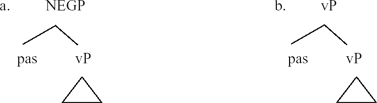
In a framework that allows for the merging of multiple specifiers at no extra cost for the computational system, the second solution seems more appealing. This solution also allows us to avoid an unmotivated lexical ambiguity between an XP constituent pas and an X sentential pas.Footnote 6
For the representation of the verbal predicate, I assume a complex shell structure headed by a light verb v (Chomsky, Reference Chomsky1995). The light verb has agentive properties and hosts the VP-internal subject of transitive and unergative verbs in its specifier. More generally, within Distributed Morphology, each syntactic structure should contain a morpho-syntactic head that turns a category-neutral root selected from the numeration into a lexical category (Halle & Marantz, Reference Halle, Marantz, Hale and Keyser1993): v turns a root into a verb that immediately adjoins to the light verb.
10.

In brief, the negative adverb pas is inherently endowed with an interpretable [+negative] formal feature and it can merge as a modifier in the specifier of XP categories. It can therefore merge freely to the vP as well. As seen before, in order to have sentential scope over the subject, the predicate and its internal arguments, pas must merge in the outer specifier of the highest vP (that is, above the subject). I now propose that the light verb can be endowed with a [uNeg _] feature.Footnote 7 This feature is valued in situ in the most economical way by the merging of the inherently negative marker pas in its specifier directly from the numeration. The verbal complex becomes ‘alive’ as a suitable goal for agreement with the negative probe of Tense.
11.
Besides the uninterpretable and unvalued polarity feature (not associated with an EPP property), the Tense functional category also contains several v- and n-related features associated with strong EPP features that overtly attract the highest tensed verb ([dort-v]) as well as the lexical subject (Paul) in their checking domain. Therefore, the Agree relation resulting in the agreement and mutual elimination of the delinquent negative features of Tense and the light verb, can be done while piggy-backing on the movement of the verb to Tense. There is an economy condition here where the movement of one element able to check two delinquent features is more economical that two separate agreement relations. The negative feature of Tense is then optionally realised as ne at the stage of vocabulary insertion.
The previous example has shown how the derivation can converge with an interpretation of sentential negation when pas is generated in the specifier of the highest vP in the verbal complex. However, we must still exclude the possibility for a constituent (or term) negation generated in a lower vP projection to license a sentential negation. In other words, how can we prevent *Jean n'a été [vPpas tué] (‘John has been not killed’) to express sentential negation equivalent to Jean n'a pas été tué (‘John hasn't been killed’)?Footnote 8
Crucially, vPs are assumed to constitute phases (Chomsky, Reference Chomsky and Kenstowicz2001), that is, points in the derivation at which the operation ‘Spell Out’ applies such that any constituent inside the domain of a phase is unable to participate in any further computation. The only way for a constituent to escape a phase is to have moved first to the left edge of the phase: that is, to a specifier of vP or to a position left-adjoined to the v head. Remembering that vPs are phases, a possible answer comes forward: the pas in a lower vP will be unable to value the delinquent negative feature of Tense because it is no longer visible to the computational system (by the Phase Impenetrability Condition) once the domain of the phase has been sent to PF and LF for interpretation.Footnote 9
4. THE SYNTAX OF IMPERATIVE SENTENCES IN FRENCH
Imperative sentences are characterised by the defective morphology of their main verb using only default indicative and person suffixes. In French, imperative verbs are only found in 2nd person singular and plural, and 1st person plural. For most verbs, the default person suffix is attached to an indicative stem, but for some irregular verbs, it is attached to a subjunctive stem: savoir (to know), avoir (to have): être (to be), vouloir (to want), etc., notably without the Tense morphology:Footnote 10
12.
13.

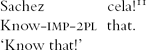
In French, the subject of the imperative verb is never expressed overtly. Two entities must be carefully distinguished though (Jensen, Reference Jensen2003): on the one hand, the ‘addressee’ of the utterance will always be a second person by definition, representing a salient group of people, and on the other hand, the external argument of the imperative verb, the agent performing the action, will be the ultimate target of the illocutionary force.Footnote 12 The former is sometimes expressed with the help of a vocative term of address (Danon-Boileau, Morel & Perrin, Reference Danon-Boileau, Morel and Perrin1992) that I assume base-generated in a topicalised position:
14. Paul / vous / quelqu'un, venez m'aider, s'il vous plait.
Paul / you / someone, come-imp-2pl me-acc help, please.
‘Paul / you / someone, come and help me, please.’
The latter is assumed by Han (Reference Han1998, Reference Han2001) to be a PRO controlled by an implicit addressee argument contributed by the meaning of a [directive] feature in COMP (Han, Reference Han1998: 136).Footnote 13 Following Potsdam (Reference Potsdam and van der Wurff2007), who analyses the position of overt subject in English imperatives, the PRO subject can be considered to move to the specifier of Tense to value an uninterpretable [uT_] feature.Footnote 14 Inversely, Tense possesses n-related features (for instance, an uninterpretable and unvalued D-feature with a strong EPP property, [uD_]EPP), triggering the immediate attraction of the PRO subject in its specifier.Footnote 15
To account for the idiosyncratic properties of the imperative across languages, it is usually assumed that the illocutionary force of the sentence is represented by syntactic features located in the matrix COMP. For Han (Reference Han1998), there is an imperative operator sub-label of COMP constituted by a bundle of [directive] features (encoding the illocutionary force of request/suggestion), and [irrealis] features (encoding the meaning that the situation or action denoted has not happened yet). Since the illocutionary force is linked with the ‘here and now’ of the speech time, it entails that the situation or action must be in the future. I propose the formal ‘directive’ feature of the operator to be an interpretable and unvalued Modality feature associated with an EPP property ([iModdir_]EPP). The verb with uninterpretable imperative morphology is immediately attracted into COMP to value this feature and receive its illocutionary force in the process. As far as the associated unrealised interpretation is concerned, it is presupposed by the illocutionary force of request/suggestion. I assume the so-called ‘irrealis’ feature sub-label of COMP to be an unvalued and uninterpretable temporal feature devoid of EPP property ([uTirr_]), that selects and enters into an Agree relation with the interpretable Tense valued as [possible future] (Stowell, Reference Stowell1982: 562).Footnote 16
15.
Additionally, following Zanuttini (Reference Zanuttini1991) and Laenzlinger (Reference Laenzlinger1994), I assume that the Tense functional category is deficient, but nevertheless projected (Jensen, Reference Jensen2003): lacking v-related features, it cannot agree with the imperative verb. Inversely, the imperative verb lacks T-related features. Therefore, as both Tense and the imperative verb have no feature in common, the former does not interfere with the triggered movement of the latter to COMP in order to receive its illocutionary force, and the imperative verb can safely skip the inert Tense functional category without violating the Head Movement Constraint.Footnote 17
In relation to negation, there are two noticeable properties of imperatives. First, French employs true negative imperatives contrary to the many Romance languages, such as Spanish or Italian, that make use of a surrogate form of the subjunctive or the infinitive in negative imperative sentences.
16.
17.


The examples in (17.b) show that, to express a prohibition in Spanish, the subjunctive or the infinitive moods must be used instead of the true imperative morphology found in positive imperatives as in (17.a).Footnote 18
For Zanuttini (Reference Zanuttini, Belletti and Rizzi1996: 187–9), the use of a surrogate subjunctive or infinitive morphology is required by the assumption that Negation in Spanish or Italian (as opposed to Modern Standard French) obligatorily selects the Tense category and therefore that a verbal form marked for Tense (such as the subjunctive or the infinitive) must be used instead of the Temporally defective imperative form. For Han (Reference Han2001), however, the use of imperative morphology in French is rather accounted for by the maximal projection status of the interpretable marker of sentential negation pas: XP negations do not interfere with the movement of the verb to COMP while in the many Romance languages that have a preverbal negative marker of category X0 (Zanuttini, Reference Zanuttini1991), the negation does interfere with the assignment of Directive illocutionary force to the verb.Footnote 19
The second property linked to negation is that pronominal arguments are procliticised to the verb in negative imperatives in Modern Standard French as in (18.a), as opposed to their enclitic position in positive imperatives and in all types of imperatives in vernacular varieties spoken in Canada (and elsewhere) as in (18.b).Footnote 20
18.
5. THE SYNTAX OF CLITICS IN FRENCH
Argument clitics are phonologically deficient pronominal elements that must attach to a verbal host at PF (see Cardinaletti & Starke, Reference Cardinaletti, Starke and van Riemsdijk1999).Footnote 21 They are ‘special clitics’ in the sense described by Zwicky (Reference Zwicky1977) in that they are obligatorily displaced from the position in which a corresponding full DP or a strong pronoun would be inserted in the syntactic derivation.Footnote 22
19.
20.


The clitic pronoun leur is obligatorily displaced to the left of the verb from the position in which (à) ton professeur or a strong pronoun (à) eux licensed by the modifying adverb are generated.
In Modern Standard French, pronominal clitics are preverbal in all verb tenses and moods, with the exception of positive imperative sentences. Positive imperatives (as opposed to negative ones) take non-nominative enclitic argument pronouns rather than proclitic ones.
21.

Interestingly, many other Romance languages such as Italian or Spanish have a wider range of enclisis contexts including untensed infinitival and gerund verbs, as shown in (23.a-d):
22.
23.
Following the seminal work by Kayne (Reference Kayne1975, Reference Kayne1991), and subsequent work by Laenzlinger (Reference Laenzlinger1993, Reference Laenzlinger1994), and Rizzi (Reference Rizzi2000), this article argues that the difference between enclisis and proclisis, and the relative position of argument clitics with respect to each other, can be treated within narrow syntax. First, following Laenzlinger (Reference Laenzlinger1993, Reference Laenzlinger1994), Uriagereka (Reference Uriagereka1995), Belletti (Reference Belletti and van Riemsdijk1999), Rizzi (Reference Rizzi2000), Nevins (Reference Nevins2011) and others, let us assume that clitics are of category D (or maybe more accurately ‘Person’ as in Roberts, Reference Roberts2010: 56, or IP (encoding all phi-features) as in Cardinaletti and Starke, Reference Cardinaletti, Starke and van Riemsdijk1999: 214) and that they are part of a big-DP structure, with the DP lexically realized in cases of clitic doubling. Following Roberts (Reference Roberts2010: 54), clitics can be considered at the same time maximal and minimal projections, a property allowed within a bare phrase structure theory (Chomsky, Reference Chomsky1995). Furthermore, following Cardinaletti and Starke (Reference Cardinaletti, Starke and van Riemsdijk1999) and Roberts (Reference Roberts2010), clitics lack Case of their own (contra Laenzlinger, Reference Laenzlinger1993, Reference Laenzlinger1994), and therefore can escape the Case-marked DP structure of which they are part. In this article, I adopt the proposal made by Nevins (Reference Nevins2011: 953) to generate the clitic in the specifier of an argumental KP (K for Case) merged to the full DP:Footnote 23
24.

Furthermore, let us assume that clitics occupy an identical position in proclisis and enclisis, and therefore that the difference in positioning with respect to the verb essentially depends on the properties of the verb itself with regard to the functional projections it agrees with. In a normal proclisis situation with a tensed verb selecting one direct object argument clitic, the case-marked KP/DP initially moves to the checking domain of vP for Case-related checking purposes.Footnote 24 Once the Case of the big-DP is valuated in the specifier of vP, the DP is frozen in place, but the clitic escapes its KP/DP when attracted to the Tense functional projection in order to check the phi-features (person, number, gender, that I assume to be uninterpretable, unvalued and associated with a strong EPP feature) sub-labels of Tense.
25.
The tensed verb, independently attracted by the v-related sub-label features of Tense, tucks in to the Tense functional projection.Footnote 25 The clitic can remedy its prosodic deficiency and satisfy the requirement of attachment to a verbal host at PF.
Remembering that in a positive imperative sentence, the Tense functional category is entirely devoid of v-related features capable of agreeing with the imperative verb, but endowed with n-related features allowing it to attract PRO, I now propose that the same phi-features of defective Tense attract the argument clitics in essentially a similar manner to proclisis.Footnote 26, Footnote 27 For example, in the course of the derivation, the clitic le is overtly attracted to the deficient Tense category while the verbal complex raises to COMP skipping Tense. The distribution of clitic pronouns in positive imperatives therefore follows.Footnote 28
26.
The clitic (in TNS) subsequently merges to its verbal host (in COMP) to satisfy its prosodic requirement at PF.Footnote 29
Another crucial factor identified by Laenzlinger (Reference Laenzlinger1994) is constituted by the particular prosodic properties of French (as opposed to other Romance languages) in which phrases are stressed on the last syllable. The consequence is that, in positive imperatives, with the exception of the clitics le, la, les, word final clitics are substituted by their corresponding weak pronoun in order to bear stress: me, te are replaced by moi, toi. Laenzlinger assumes that the pronominal clitics and weak pronouns lui, nous, vous, leur are indistinguishable in form. Weak pronouns are not part of a big-DP structure: they are transitive Ds in which the NP complement is realised as pro (Laenzlinger, Reference Laenzlinger1994: 87) and they do not cliticise to Tense, but remain in the specifier of vP in narrow syntax (AgrOP for Laenzlinger, Reference Laenzlinger1994):
27.
In order to ensure that PF incorporation of the pronoun to a verbal host takes place, no phonetically overt material that would prevent the weak pronoun from finding its verbal host can therefore intervene between the pronoun and the verb in the linear sequence.Footnote 30
Third, when two internal argument clitics are used simultaneously, the order across Romance languages for first/second person oblique object and third person direct object is normally ‘dative + accusative’ in enclisis and in proclisis alike, as shown in the following Spanish examples:Footnote 31
- 28.
a. Me lo dio. (ME > LO in proclisis (Spanish))
Me-dat it-acc give-past-3sg.
‘He gave it to me.’
b. Dá-me-lo. (ME > LO in enclisis (Spanish))
Give-imp-2sg me-dat it-acc,
‘Give it to me.’
This is also the order observed for proclisis in all varieties of French (me le) in (29.a) and for enclisis in European and Canadian vernacular varieties of French (moi/me-le) in (29.b), but in Modern Standard French, the mirror order ‘accusative + dative’ is observed in positive imperatives, as in (29.c), and it is in fact the only order prescribed in written French for this sentence type:
- 29.
a. Paul me le donnera. (ME > LE in proclisis (French))
Paul me-dat it/him-acc give-fut-3sg.
‘Paul will give it to me.’
b. Donne-moi-le.Footnote 32 (MOI > LE, enclisis in Vernacular French)
Give-imp-2sg me-dat it-acc.
‘Give it to me.’
c. Donne-le-moi. (LE > MOI, enclisis in Modern Standard French)
Give-imp-2sg it-acc me-dat.
‘Give it to me.’
Following Laenzlinger (Reference Laenzlinger1994), when the order in enclisis is identical to the order in proclisis, as in the varieties of vernacular French (29.a-b) or as in Spanish (28.a-b) above, it means that both pronouns are clitics, and are attracted to Tense in the expected order ‘dative + accusative’ (with moi in these cases reinterpreted as a clitic by the computational system).Footnote 33 However, when the order is reversed, as in Modern Standard French, it means that only the pronoun closest to the verb (le) is actually a clitic while the one further away (moi) is a stress-bearing weak pronoun stranded in its Case checking position.
The co-occurrence of argument clitics clusters is however characterised by stringent restrictions such as the ‘Person Case Constraint’ (PCC) (Bonet, Reference Bonet1994), that is, a first or second person ‘accusative’ clitic cannot co-occur with a ‘dative’ clitic, as in (30.a).Footnote 34
30.
In French, a felicitous repair strategy to circumvent the PCC using syntactic means consists of using a periphrastic construction with a strong pronoun (or lexical DP) in place of the indirect object clitic, as in (30.b). As pointed out by a reviewer, another frequently used repair strategy involves the ellipsis of the indirect object pronoun. This alternate repair strategy is of a morphological type (as opposed to the syntactic/periphrastic one): it allows the speaker to realise the underlying indirect object third person clitic with a phonetically null variant, a pro, as in (30.c). This empty clitic no longer creates a PCC violation because it is presumably underspecified for person features.Footnote 35, Footnote 36
6. FRENCH NEGATIVE IMPERATIVES
We are now in a position to account for the interaction of negation and clitics in imperatives in both Standard and separate vernacular varieties of French.
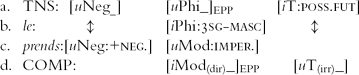
In negative imperative sentences, reinterpreting Laenzlinger (Reference Laenzlinger1994) and Zanuttini (Reference Zanuttini1991), the Tense functional projection is activated by the presence of a v-related uninterpretable and unvalued sub-label Polarity feature ([uNeg_]). For its part, the verbal complex is, as proposed in section 3, endowed with an uninterpretable negative feature [uNeg:+Negative] valuated in situ. Because it is valuated, this uninterpretable feature has the ability to transfer its value via agreement with the corresponding negative sub-label of Tense (a probe in search of a value). Furthermore, being uninterpretable, this verbal negative feature also has to be eliminated by agreement with the relevant polarity sub-label of Tense before it reaches LF. The verbal complex is therefore required to pass through Tense on its way to COMP (in accordance with the Head Movement Constraint). Because of a ban on excorporation (Baker, Reference Baker1988: 73; Laenzlinger, Reference Laenzlinger1994: 77), the verb picks up the clitics previously adjoined to Tense. Finally, ne is inserted to the left of Tense in the usual manner. So, the derivation of negative imperatives can be represented as follows:
31.
To summarise, the derivation can converge because all uninterpretable sub-label formal features are eliminated before LF and all unvalued features receive a value via four separate Agree relations between corresponding probes and goals:
32.
With respect to negative imperative sentences, Hirschbühler (Reference Hirschbühler2001) establishes a distinction between European and Canadian vernacular varieties. First, in European varieties, ne is optional and the clitic precedes the verb. They however identify some restrictions on the optionality of ne in this variety of French: when the Genitive or Locative pronouns en and y are used, either the negative particle ne is retained, or the pronoun is exceptionally encliticised:
33.
Within the current framework, this pattern is interpreted as meaning that, in European varieties, both the verb and Tense are endowed with negative features of polarity even in cases when ne is not phonetically realised,Footnote 37 thereby demonstrating that the verb passes through Tense and picks up the clitics on its way to COMP. I assume that obligatory ne-retention (in 33.b) could be influenced by different phonetic/lexical factors, such as the fact that the clitics en and y are vocalic, as suggested by a reviewer.Footnote 38 The other structure consisting of realising the genitive pronoun post-verbally as in (33.c) could then be analysed as an alternative PF repair strategy allowing for the spelling out of a lower copy of a clitic when the realisation of the highest copy leads to a PF violation. In fact, Hirschbühler (Reference Hirschbühler2001) analyses this data by considering that, in imperatives, certain clitics are subject to a residual constraint retained from Old French which specifies that they cannot appear in an initial position (the so-called Tobler-Mussafia effect).Footnote 39
Second, in Canadian varieties of vernacular French (as well as in various dialects from the Atlantic coast in France according to Hirschbühler, Reference Hirschbühler2001), there is no difference between positive and negative imperatives: the ne is never realised in imperatives and enclisis is systematic in all cases, as attested by examples in (34.a-b) taken from the ‘Corpus de français parlé au Québec’ (CFPQ):Footnote 40
34.

The generalised enclisis phenomenon observed in Quebec French with imperatives can be accounted for by assuming that, in this variety, there is no negative sub-label on Tense. The Tense functional projection remains inactive and incapable of attracting the imperative verb raising to COMP. In such a variety, as suggested in Laenzlinger (Reference Laenzlinger1994: 84–5) and Rowlett (Reference Rowlett2007: 127), sentential negation is expressed solely by means of a negative quantifier pas that I still assume merged in the specifier of vP.Footnote 42
In order to account for the word order in vernacular varieties of French, it is useful to follow Zribi-Hertz (Reference Zribi-Hertz, Cinque, Koster, Pollock, Rizzi and Zanuttini1994) in distinguishing ‘Modern Standard French’ which she defines as ‘productive formal style, rid of various archaisms’ (Reference Zribi-Hertz, Cinque, Koster, Pollock, Rizzi and Zanuttini1994: 460) (or ‘Late Classical French’ in Massot, Reference Massot2010) from ‘Advanced French’ (or ‘Spoken French’ in Barro-Jover (Reference Barra-Jover2004), ‘Demotic French’ in Massot (Reference Massot2010)), which has two strata: ‘Colloquial French’ (CF): ‘the unmarked informal style used by those speakers who also master Modern Standard French’ and ‘Very Advanced French’ (VAF), a variety ‘including all forms regarded as substandard or dialectically marked by Modern Standard French and Colloquial French speakers’.Footnote 43
I tentatively suggest that this tripartition can help us to clarify the data on imperatives which we have examined: the Modern Standard French variety would have enclisis in imperatives and proclisis in negative imperatives with ne-retention: donne-le-moi / ne me le donne pas (‘give it to me’ / ‘don't give it to me’), the CF variety would then be characterised by the usual omission of ne (retained in certain phonological or lexical contexts): donne-le-moi / me le donne pas (‘give it to me’ / ‘don't give it to me’) and by the alternative orderings of pronouns in enclisis: donne-moi/me-le (‘give it to me’) in which the ‘weak’ personal pronoun moi is reinterpreted as a clitic by the computational system, while the VAF variety (typical of Vernacular Canadian French, and of some varieties of European French) would be characterised by the systematic omission of ne (in all contexts) and by generalised enclisis and reordering of enclitic pronouns with the imperative sentence type: donne-moi-le / donne-moi-le pas (‘give it to me’ / ‘don't give it to me’). This tripartition could be interpreted as the realisation in synchrony of the diglossic system proposed in Massot (Reference Massot2010) with ‘educated’ speakers navigating between the first two varieties and ‘non-educated’ speakers the last two (CF being a variety in common). The data is also compatible with the diachronic processes of the Jespersen's cycle (Reference Jespersen1917) on the evolution of negation, characterised by the progressive appropriation of the expression of sentential negation by a negative auxiliary (in this case the quantifier pas) accompanying the weakening of the original marker of negation (in this case, the evolution of ne from being the head of sentential negation with clitic properties to becoming an optionally realised Tense affix) to its complete elimination. According to my proposal, this process is well under way since the pre-verbal negative marker has already been overtaken by the pas as the centre of sentential negation in the eyes of the computational system.
7. EXTENSION: PASSIVE IMPERATIVES AND INFINITIVAL DIRECTIVES
Interestingly, the previous account can be extended to two related constructions: passive imperatives and infinitival directives.
7.1 Passive Imperatives
In French, passive constructions are not allowed with positive imperatives, but are allowed with negative imperatives (Danon-Boileau, Morel & Perrin, Reference Danon-Boileau, Morel and Perrin1992).
35.
Assuming, as in Baker (Reference Baker1988), that passive morphology is encliticised on the inflectional category, the structure will not be licensed in positive imperatives, because the defective Tense does not provide a site for the generation of passive auxiliary support. In negative imperatives, however, Tense, being endowed with a v-related feature of polarity, does provide a merging point for the passive auxiliary.
A prediction of this account should be that, since there is no difference in the featural constitution of Tense in positive and negative imperatives in Quebec French vernacular varieties, passive imperatives should be as ungrammatical in negative imperatives as they are in positive imperatives. According to one informant I consulted, this is indeed the case, as both sentences are equally bad, and must be replaced by an alternative causative construction:
36.
The specifications of Tense and the assumption that ne is simply the phonetic realisation of a negative sub-label of Tense can therefore naturally be extended to account for the behaviour of these imperatives in distinct varieties of French.
7.2 Infinitival Imperatives
In French, matrix infinitives, either positive or negative, with pragmatically induced injunctive meaning are attested in various contexts listed in Sandfeld (Reference Sandfeld1978: 209): exclamation, detail of a plan or a recipe, etc. According to Han (Reference Han2001), the COMP in infinitival directive structures is endowed with an [irrealis] feature, but lacks a [directive] one. The directive force of the infinitive in a matrix clause is generated via pragmatic inference since the directive force is compatible with the unrealised modality associated with the infinitive mood, but non-directive interpretations are also available given the right pragmatic context and are the only ones available in embedded clauses.Footnote 44
However, in parallel structures with other modes of injunctions requiring a directive interpretation, only the negative infinitive is grammatical to express a prohibition (Pollock, Reference Pollock1989: 402; Sandfeld, Reference Sandfeld1978: 211 for more examples).
37.

This infinitive with injunctive force is often considered somewhat archaic. According to Grevisse (Reference Grevisse1969: 690), the infinitive preceded by the negation could be used in Old French to express prohibition, albeit an abrupt one. But it is still part of the speakers’ competence nowadays as attested by examples found on the Internet:
38.
The directive infinitive only seems to be felicitous when its use represents a voice of authority or expertise to express a warning that a certain action would have dire consequences.Footnote 45 Inversely, even though the actual addressee of the utterance may be identified in context, for instance with the help of a vocative term of address, the target of the illocutionary force of such an infinitive imperative may always be the generic set of potential individuals concerned. This is why the imperative negative is found in notices addressed to the general public under the auspices of an administrative authority: Attention! Ne pas fumer! (‘Smoking not allowed’).
Following Kayne (Reference Kayne, Tasmowsky and Zribi-Hertz1992), Zanuttini (Reference Zanuttini1997), Han (Reference Han1998), Péters (Reference Péters1999), Rooryck and Postma (Reference Rooryck, Postma and van der Wurff2007), I hypothesise an empty modal verb μ with a wide scope deontic interpretation (equivalent to English ‘must’) at the source of the prohibition (μ > NEG). Kayne (Reference Kayne, Tasmowsky and Zribi-Hertz1992) posits such a modal-like phonetically empty element in Italian in order to account for an unexpected proclisis in injunctive infinitives, as in (39.c), even though proclisis is normally ungrammatical with infinitives, as in (39.b):
39.
The irregularity disappears as soon as the apparently proclitic pronoun is analysed as an instance of clitic climbing to an empty modal.Footnote 46
In French, besides the stringent pragmatic conditions on the use of the imperative infinitive, the interaction between negation and infinitival morphology appears to be crucial for the directive force to emerge. As argued in Péters (Reference Péters1999), the phonetically empty modal is primarily generated to serve as a placeholder for the negative marker pas merged in its specifier. The empty modal inherits the negative features of the negative marker (in the usual way) and checks the Polarity features sub-label of TNS (ne phonetically realised on TNS in the usual way). The light modal verb is required to raise overtly to the Tense functional projection in order to have an impact on interpretation at LF. The raising of the modal verb with deontic interpretation above the negative is also necessary for the former to have scope over the latter in order to express a prohibition: MUST > NOT (Rooryck & Postma, Reference Rooryck, Postma and van der Wurff2007), or FALLOIR (‘to-be-necessary’) > NOT in French.
40.

In Péters (Reference Péters1999), the presence of the light verb is in fact generalised to all negative infinitives. The directive interpretation is however not pragmatically licensed in embedded contexts. This hypothesis of a bi-clausal structure with an empty modal in infinitival clauses crucially provides an explanation for the stacking of negations analysed by Hirschbühler and Labelle (Reference Hirschbühler and Labelle1993):
41.

This construction cannot simply constitute an instance of NEGP recursion in a mono-clausal structure. The presence of several T-related negative affixes (ne) suggests to us a multi-clausal structure. This impression is confirmed by the impossibility for the auxiliary verb avoir (‘to have’) to climb higher than the first adverbial negation. Indeed, the infinitival auxiliary verb, usually able to raise in a limited way to the inflectional level (Pollock, Reference Pollock1989), is clause bounded:
42.
This structure with a light modal verb is analogous to –and interacts with – overt modals: devoir (‘must, need’), pouvoir (‘can’) or savoir (‘to know how’):
43.
Crucially, this light modal μ depends on the presence of a negative pas (or an empty Negative Operator in the case of other n-markers) to which it offers a merging site. It cannot be generated in a positive infinitive for reasons of economy of structure: the mono-clausal structure is preferred to the bi-clausal one if the bigger structure has no identifiable effect on interpretation at PF or LF:
44.

The same economy constraint on the empty modal identified in the apparent stacking of negations applies to infinitives with directive force: only negative infinitives can be associated with a light modal verb with deontic interpretation.Footnote 47 Interestingly, Pollock (Reference Pollock1989) identifies another restriction on the use of such infinitives with directive meaning: the auxiliaries such as avoir (‘have’) or être (‘be’) which are marginally permitted to raise over the negation in infinitives cannot do so in infinitive imperatives:
45. *Allons, n'avoir pas peur, s'il vous plait! (Pollock, Reference Pollock1989: 402, example 90.b)
Go-imp-1pl, ne have-inf not fear, please.
‘Come on! Don't be afraid, please!’
This ungrammaticality indirectly supports the hypothesis of the necessary presence of a light deontic modal verb in order to obtain an imperative interpretation. In this example, the directive interpretation is not available because the modal cannot be generated since the negative marker is clearly merged in the specifier of the auxiliary verb.Footnote 48
8. CONCLUSION
The study of negative imperatives in French is a challenging topic because, through a theoretical lens, it lies at the intersection of syntactic theories on the imperative mood, argument clitics and sentential negation. Simultaneously, when viewed through an empirical lens, there exist observable differences in the syntax of this structure across varieties. These varieties which seem to coexist in a diglossic relation (Massot, Reference Massot2010) represent a system in transition which may allow us to peek into the diachronic processes at play within the Jespersen's cycle.
Within the generative approach of the Minimalist Program, and the particular interpretation of ‘Agree’ as feature valuation (Pesetsky & Torrego, Reference Pesetsky, Torrego, Karimi, Samiian and Wilkins2007), this article demonstrates how what is essentially an adverbial modifier/quantifier pas with constituent scope over the XP category it modifies (un garcon pas sympa ‘a not friendly boy’) can turn out to be the centre of sentential negation (je parle pas ‘I don't speak’). By merging in the outer specifier of the highest vP category, pas acquires scope over the predicate and its arguments.
Argumental clitics are prosodically deficient pronouns in need of a verbal host (Laenzlinger, Reference Laenzlinger1993; Cardinaletti & Starke, Reference Cardinaletti, Starke and van Riemsdijk1999). I have proposed that they are attracted to the functional domain of the clause (Tense endowed with phi-features in search of valuation), and that pro- or enclitizisation of the clitics to a verbal host depends mainly on the position of the verb in interaction with functional categories. For instance, when the verb is independently attracted to Tense, the clitics incorporate to the left of the verb, that is, in proclisis (Paul me le donne ‘Paul gives it to me’).
The assumption that ne is the instantiation of a polarity feature of Tense has allowed us to deduce the proclisis of argument pronouns in negative imperatives in Modern Standard French (ne me le donne pas ‘don't give it to me’) and most European vernacular varieties (me le donne pas) as opposed to their enclisis in positive imperatives across all varieties (donne-le-moi / donne-moi-le ‘give it to me’) (Hirschbühler, Reference Hirschbühler2001). Assuming the Tense projection in positive imperatives to lack v-related features, Tense does not constitute a potential landing site for the imperative verb on its way to the left periphery in order to receive its illocutionary force of request/suggestion. The enclitic order of argumental pronouns, still independently adjoined to Tense in the usual way, follows. Additionally, following Laenzlinger (Reference Laenzlinger1994), in imperatives, the prosodic properties of the French language require some final position enclitics to be substituted by weak pronouns (*donne-le-me > donne-le-moi ‘Give it to me’) which sometimes happen to be indistinguishable from the corresponding clitic (lui = lui). These weak pronouns, because of their structural make up, are assumed to remain in their Case checking position, while clitics adjoin to Tense in the usual way.
The hypothesis that the negative sub-label of Tense is a v-related feature can explain why in negative imperatives, the imperative verb cannot skip the Tense projection on its ways to COMP. Because of a ban on excorporation, the verb must pick up the clitics adjoined to Tense and these end up procliticised to their host. The fact, that in more ‘advanced’ varieties of the language (such as in vernacular Quebec French), the complete elimination of ne correlates with a generalised enclisis of pronominal arguments for positive and negative imperatives alike (donne-moi-le / donne-moi-le pas ‘give it to me / don't give it to me’) suggests complete similarity in the featural constitution of the Tense category across polarities. Therefore, the enclitic order reveals the absence of negative features on Tense in these varieties. More research is needed on the order of enclitics and on the properties of pas (sentential or constituent negation) as well as on its interaction with other negative words.
The properties of clitics and the properties of Tense were correlated with the varying availability of passive imperatives in European and Canadian varieties of the language: allowed with negative imperatives in the former, and completely disallowed in the latter. Finally, the additional assumption of a light deontic modal verb, serving as a placeholder for the marker of sentential negation in root negative infinitives, allowed us to deduce the use of negative imperative infinitives as well as the structure of stacking of negations.
Stringent pragmatic constraints restricting the use of infinitival imperatives in French have been identified, pending a proper structural treatment. Most notably, an imperative infinitive seems to be felicitous only as a warning given by a voice of authority (ne pas fumer ‘smoking forbidden’). The distinction between an addressee (sometimes identified by a vocative term) and the external argument of the verbal predicate (referring to the generic set of all concerned individuals), which I assume to be the real target of the illocutionary force, seems particularly relevant. The study of negative imperative infinitives in interaction with clitics might provide a way to analyse further the interface between syntax and pragmatics.


