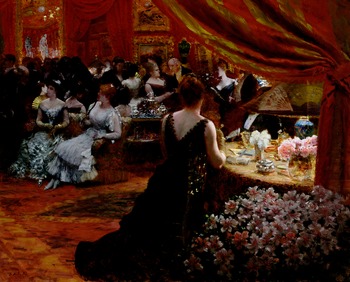
An 1883 painting by Giuseppe de Nittis depicts a salon at the Parisian hôtel particulier, or urban mansion, of Princess Mathilde Bonaparte, cousin to Napoleon III (see Figure 1). Hosting a large-scale music salon every Sunday during the December to April social season, Princess Mathilde was among those who set the standard for receptions during the Second Empire.Footnote 1 Her soirées were representative of aristocratic salons, court-like gatherings that brought together politicians, ambassadors, writers, artists and other dignitaries. In many ways, Nittis’s rendering reinforces established historical thought on the Parisian salon, presenting a dense scene of attenders circulating in an ample residential space.
Giuseppe de Nittis, Salon of Princess Mathilde (1883), oil on canvas. Pinacoteca Giuseppe de Nittis, Barletta, Italy/Bridgeman Images.

Nittis’s painting also exposes a factor that has been largely taken for granted in musical scholarship, namely the architectural complexity of the Parisian salon. Historians have traditionally viewed music salons as concert-like environments where performers and audience were gathered in a designated music room.Footnote 2 However, Nittis’s representation indicates the use of at least three reception rooms at Princess Mathilde’s event: first, the grand salon, the focal point of the painting, which is filled with a throng of guests; second, the adjoining room visible in the left corner; and finally, the implied third reception room from which the viewer observes the scene, its boundary delineated by the draped curtain. Although no musicians are pictured, the attentive postures of the two seated women could suggest that they are observing a performance off the canvas. Nittis’s painting underscores the fact that attenders would typically disperse across multiple rooms, a factor that complicates the spatial logistics of the salon.
The multidimensional attributes of Princess Mathilde’s rue de Berry salon were not exceptional for aristocratic salons, and not even for smaller-scale bourgeois salons. Examination of the design history of Parisian hôtels particuliers and appartements built in the eighteenth and nineteenth centuries shows that architects commonly situated the salon beside other reception spaces, promoting the circulation of guests through multiple rooms at social gatherings. Written accounts in newspapers, journals, personal memoirs and literature articulate ways in which the room distribution had a bearing on the activity of guests at residential events. While this may seem to be an innocuous factor, it has the potential to contribute new perspectives on a variety of long-standing enquiries surrounding the salon, such as audience listening habits and the aesthetic characteristics of salon repertory.
Space has been a central topic in salon studies; however, the emphasis has always slanted towards analysing conceptual space rather than material space. Applying Jürgen Habermas’s theorization of the public sphere, Dena Goodman’s work has shown that the type of social discourse fostered by the eighteenth-century Parisian salon opened a conceptual public space within private residences.Footnote 3 Taking a slightly different approach and interpreting the salon through the lens of Friedrich Schleiermacher’s ‘third space’ (neither public nor private), Jennifer Ronyak has suggested that the Stägemann salon in nineteenth-century Berlin was a flexible arena where social parameters of gender could be challenged through musico-literary improvisation.Footnote 4 Both Goodman’s and Ronyak’s approaches underscore the idea that the salon arena facilitated activities and behaviours that subverted the norm. Such analysis is valuable in understanding the social currency of the salon, particularly reinforcing the idea that salons in European cities functioned as a laboratory for new ideas about music, politics, aesthetics and gender roles. However, the conceptual approach to salon space has eclipsed other spatial approaches, such as those that consider its materiality, interior decoration and architecture.
The fact that material approaches are scarce is not surprising, because it is difficult to pinpoint a static model of the salon for analysis. Unlike concert halls or opera theatres, singular venues that remained a relatively fixed space for a vast number of performances, the circuit of salon venues was constantly in flux, evolving as hosts experienced changes in social standing, and shifting with the different political regimes. Further compounding the variability in salon spaces, each household had its own site-specific conditions, a factor that may have discouraged scholarly generalization about the salon’s material characteristics.
Setting these challenges aside for the time being, however, it is evident that musical studies have comprehensively shown that material environments have been influential factors that have shaped audience behaviour, repertory and music reception. Considering audience behaviour, James Johnson’s architectural analysis of Parisian opera houses indicates that seating arrangements affected listening habits, with factors such as line of sight, lighting and enclosed boxes directing audience attention towards or away from the stage.Footnote 5 As to spaces shaping musical repertory and generic evolution, Anselm Gerhard has argued that rapid urban growth in Paris presented a new ‘space of experience’ that led to the development of grand opera, a genre that corresponded to the sprawling scale of the modern metropolis.Footnote 6 Even musical reception, as Adam Krims has shown, can be affected by geography and interior design as musical objects or performances are interpreted in relation to their surroundings.Footnote 7 How then, might these modes of analysis be applied to the salon? For instance, it logically follows that the structural designs of the salon would have affected the organization of audiences and therefore have influenced listening habits. In addition, the salon’s ‘space of experience’ might be considered a factor that inspired generic or compositional development. Following this line of enquiry, one is tasked with determining which spatial characteristics might be interpreted as constant factors across a seemingly variegated domestic terrain.
Some scholarship has taken strides towards addressing the materiality of salon space. Salon scholars, such as David Tunley and Myriam Chimènes, present detailed descriptions of salon rooms in their monographs that chronicle nineteenth-century Parisian salon life.Footnote 8 Information about salons’ decoration and furnishings has been well documented in the visual arts as well as in guests’ diaries, particularly by social aspirants who were impressed by the material displays of wealth and accomplishment.Footnote 9 This visual aspect of the salon has drawn attention from guests and modern historians alike; however, few have speculated as to how those features might have affected music-making. One exception is the work of Deborah Howard and Laura Moretti, who have shown that the acoustic profile of music rooms in early modern European residences determined the types of household instruments that were viable in the space.Footnote 10 This research is useful in helping historians characterize salon repertories, building an understanding of musical functionality in domestic space; the study does, however, analyse the activity as it is bound by a single music room.
This article draws from architectural perspectives on the salon but looks beyond the single-room model. I propose that the multiroom organization of the salon is central to understanding its musical activity. A survey of the design history of Parisian hôtels particuliers and appartements built in the eighteenth and nineteenth centuries shows that there were long-standing features of domestic architecture that structured reception activity. Drawing from written accounts in newspapers, journals and other writings that articulate salon experiences, I identify the ways in which room distribution bore upon guest circulation and modes of listening. Finally, I consider how composers adapted music to the salon’s multidimensional features, considering improvisatory genres such as the fantasy and potpourri, as well as the genre of opéra de salon that flourished from the 1850s into the 1870s. Composers and librettists of salon opera went so far as to incorporate residential architecture into staging instructions in order to create an interdimensional theatrical experience, a feature epitomized in Gustave Nadaud’s successful work Le docteur Vieuxtemps (1854).
Structuring receptions in the Parisian hôtel and appartement
The aristocratic salons hosted at hôtels particuliers have historically been distinguished from the bourgeois-style salons held at modest appartements as scholars have agreed that these stratified groups had distinctly different tastes and behaviours.Footnote 11 Viewing these salons through an architectural lens, however, one finds unexpected commonalities, since architects had standardized the spatial composition of reception spaces during the eighteenth century. This evidence introduces considerations about how salon circles were navigating similar environments, even if those groups formed different habits in response to multiroom receptions.
Most upper-class and aristocratic music salons were hosted in hôtels particuliers or hôtels privées, multilevel residences featuring front courtyards and rear gardens. When aristocrats mobilized around court life in Paris in the eighteenth century, they increased the demand for hôtels. During this period, construction proliferated and architects optimized the hôtel floor plan to facilitate large social receptions.Footnote 12 The resulting generation of luxury residences eventually housed some of the most prominent music salons of the nineteenth century. For instance, Émile and Delphine Girardin lived in Hôtel Marbeuf, which underwent extensive interior remodelling by Jacques-Guillaume Legrand and Jacques Molinos in 1789–90.Footnote 13 Princess Belgiojoso, famed for hosting the Liszt–Thalberg piano duel at her salon, lived from 1831 to 1848 in an hôtel on rue d’Anjou built for Madame de Malesherbes in the eighteenth century.Footnote 14 In addition, from 1826 until 1838, the arts patron and ambassador Antoine Apponyi regularly hosted musical events at his residence, the Austrian embassy at the Hôtel de Monaco in rue Dominique, built in 1784 by the architect Brongniart.Footnote 15
Although each hôtel would have a different structural footprint, its interior layout would have adhered to the design principles standardized in the eighteenth century.Footnote 16 One of the most important tenets was functional distribution, or the spatial arrangement of rooms, a topic that was addressed at length in Jean Courtonne’s 1725 architectural treatise.Footnote 17 Designers not only were particular about the general location of rooms, but also reflected upon which rooms should adjoin and, moreover, how the placement of doors could steer inhabitants or guests through the house. The architect Nicolas Le Camus de Mézières proposed that the residential floor plan should progressively direct traffic through public reception rooms, such as the antechamber and salon, before progressing to the more intimate spaces, such as the bedroom and study.Footnote 18 Another priority in residential design was to promote circulation at social gatherings. Eighteenth-century architects accomplished this by clustering groups of reception rooms in what was called a massée arrangement, a feature that became standardized in hôtels and a distribution that was captured in Nittis’s painting discussed earlier.Footnote 19
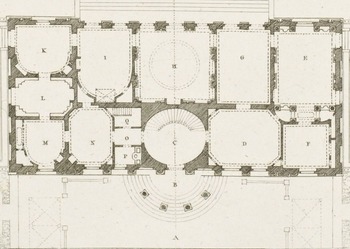
The floor plan for Count Apponyi’s residence at the Hôtel de Monaco is a case in point (see Figure 2). Leaving their horses and carriage in the courtyard, guests would enter through the vestibule (C) and would move counter-clockwise to the antechamber (D), a waiting-room space where visitors were received. From there, guests would be ushered into the music room (G), where large open doorways welcomed visitors to circulate to the dining area (E) on the right or the grand salon (H) on the left. This sequence of interconnected, massée reception rooms reflects the design intent to circulate guests across several rooms. In accordance with eighteenth-century design standards, the more private areas, such as the bedroom, dressing room and washroom, are located on the opposite side of the residence with a small passage (O) discouraging general circulation through these areas.Footnote 20
Hôtel de Monaco floor plan (detail), residence of the Austrian ambassador Antoine Apponyi from 1826 to 1838. BnF.

Accounts of musical receptions at the Hôtel de Monaco documented by the embassy attaché Rodolphe Apponyi affirm how the massée reception rooms structured the event and, most significantly, divided the crowd during the musical performance. Describing a typical soirée, Apponyi indicated that the buffet salon would be set with food while another adjoining room would have game tables, set with the intent of dispersing the crowd (‘partager la foule’).Footnote 21 When the group assembled for the music programme, Apponyi indicated that the volume of guests would not fit in a single room. At an 1832 new year’s event featuring Chopin, Kalkbrenner, Liszt and Rossini, Apponyi reported that two large rooms were filled, necessitating listening from adjacent spaces.Footnote 22 Some hôtel doorways could measure up to ten feet high and five feet wide, facilitating sonic and some visual communication between rooms. However, many were narrower and would have obstructed the view of peripheral listeners.Footnote 23
While hôtels had ample capacity for salon guests, even modest-sized events at appartements or maison particuliers, smaller single-floor residences, promoted similar patterns of circulation.Footnote 24 Modelling the appartement design after the hôtel, city developers built a larger number of these smaller accommodations in the first half of the nineteenth century. These structures were designed for the expanding middle class, who emulated the leisurely pursuits of the urban elite by hosting salons and other household soirées. The reception rooms of the appartement functioned much like those of the hôtel but were simply reduced in proportion.Footnote 25
The journalist Henri Blanchard, who traversed dozens of salon receptions varying in size, prestige and location, reported on such events in his Revue et gazette musicale column ‘Auditions musicales’ between 1849 and 1858. Reflecting on the parameters for a successful event, Blanchard claimed in 1852 that a flourishing salon needed not only to feature a talented roster of musicians but also to meet some architectural preconditions. He wrote:
Every aristocratic or bourgeois salon that can contain a hundred people by adding the dining room, the bedroom, and the cleared-out study has its own composer of the future, its own distinguished pianist, its Pleyel or its Thalberg, its Vieuxtemps or its Servais, its Dorus, its Leroy, its Jancourt, its Garimond, its singers of romances and chansonettes rivalling Mmes Sabatier and Ponchard or Levassor.Footnote 26
Blanchard indicates that a music salon would comprise at least four adjoining reception spaces. In appartements, even the bedroom (chambre à coucher) may have been among the receiving rooms.Footnote 27 Because of the smaller scale, architects did not have the flexibility to separate the intimate spaces (bedroom, study) from the social areas of the residence (salons, dining areas). As a result, the appartement bedroom would often be linked to the primary reception spaces, and in some cases guests would even need to walk through the bedroom to reach the main salon, a feature that probably aggravated bourgeois anxieties about breaches in domestic privacy.Footnote 28
Because the proportions of the appartement were more compressed, the hosts of bourgeois salons were more likely to regulate the circulation of guests at a musical event. In some instances, hosts provided seating arrangements that limited movement. The playwright and painter Virginie Ancelot described the resulting gridlock in the performance room, also verifying the fact that guests listened from adjoining rooms in an appartement. She wrote:
The seats placed in the main salon where drama and music are played are amassed in rows that cover the room entirely, without any free space to circulate […] From a distance, we see the women we know, gentlemen friends at the doorways, since men are relegated to the rooms that surround the great salon, because we have arranged to have a few more guests than the appartement can contain; it is an absolute necessity that some guests cannot enter; this makes the evening quite memorable.Footnote 29
Ancelot’s account underscores the fact that the guests’ overflow was not due to the miscalculation of the host but rather a customary feature of the salon. Sources corroborate this detail, showing that bourgeois hosts went so far as to employ staff to direct the flow of guests. The Italian composer and pianist Giuseppe Curci stationed guards at the doors of his Parisian salon to coordinate arrivals and departures. When his salon reached capacity, guests were compelled to wait outside until others exited. Apparently, even the reviewer Blanchard was once left to wait in the cold.Footnote 30 Measures such as fixed seating and stationed guards indicate that bourgeois hosts anticipated and supervised the interspatial dynamics of the salon. The nature of these measures also illustrates how the massée reception rooms which promoted circulation were fundamentally at odds with the emerging nineteenth-century preference for silent audiences. It is, therefore, not surprising that movement was strictly regulated in the aforementioned salons, since the middle-class audiences were known to be stringent proponents of this trend, an ethic exaggerated in the behaviour of the fictional character Madame Verdurin in Proust’s À la recherche du temps perdu, who was intolerant of those who talked over or disturbed musical performances.Footnote 31
One of the by-products of the spatial divisions in salon space was that the architectural borders of a room often differentiated between conversations and activities. It resulted in groupings of guests that stratified the social experiences, often by gender. For instance, accounts suggest that the smoking and billiard rooms were typically populated by men, while the women congregated in the music room. The previous quotation from Ancelot substantiates this idea, as she claimed that she was typically seated amid an audience of women in the music room while men were relegated to peripheral rooms.Footnote 32 Princess Caroline Murat also described such divisions in Princess Mathilde’s salon and wrote: ‘While [Princess Mathilde’s] men guests were mostly to be sought in the groups of talkers, the women overflowed the music-rooms.’Footnote 33 In another instance, a journalist reported on an 1868 salon hosted by Archbishop Georges Darboy at the Hôtel du Châtelet and observed differences in the ways that men and women circulated between three reception rooms, noting that a group of young men congregated in the billiard room.
A double door, wide open in front of the fireplace, reveals a young priest and a second lieutenant playing billiards [… Women] come and go as they please. The young women are innocently drawn near the billiard door […] As the gallery door is opened, excellent chamber music can be heard. An usher distributes the programme of works selected by the archbishop. We listen religiously at first, then conversations resume with the discreet chatter produced by a large meeting of well-behaved people. The young men have abandoned billiards to come and listen to the music.Footnote 34
These spatial distinctions reflect the gender stereotypes surrounding the salon, given the fact that the music salon and its repertory have been historically feminized.Footnote 35 However, the notion of gender division in the salon warrants cautious treatment because it distracts from the fact that guest groupings were ultimately flexible. After all, the report on Archbishop Darboy’s salon eventually pointed out that the groups of men and women rejoined each other to hear the music performance. Furthermore, the notion that the music room in a salon was, in some cases, largely populated by women could lead to the more traditional thinking that the salon audience encompassed only the people in the concert room.
To this point, I have worked towards establishing the fact that salons hosted in urban appartements and hôtels systematically utilized multiroom reception spaces, often organized in massée formation, and that this architecture was a consideration in event planning. Such standardized conditions offer further opportunity to examine the ways in which the space structured modes of listening as well as aesthetic choices in music composition.
Considering peripheral listening in the multiroom salon
Historians agree that it is difficult to generalize about the behaviours of nineteenth-century audiences, conceding that even in single-room spaces, such as concert halls and opera houses, audiences had highly variegated experiences. The emerging ethic of attentive, immersive listening in the nineteenth century often clashed with logistical matters of the theatre, such as audience members arriving late, departing early or becoming distracted with side conversations.Footnote 36 In this respect, music salon guests and concertgoers faced similar disruptions. However, one anomaly – the routine convention of listening from adjacent rooms – was truly unique to the salon. Studying this audience group, therefore, brings a new set of considerations into focus.
Did (for instance) some peripheral listeners regard salon music-making to be ambient sound? Did the indirect transmission of music to adjacent spaces cultivate more passive listening habits? In this view, salon architecture might have delineated boundaries between potentially active listeners in the music room and passive listeners in the surrounding spaces. One might presume that the latter group would not exert the necessary degree of attentiveness to track elements of musical structure and meaning.Footnote 37 Such a premiss would validate the success of potpourri-style works and fantasies in the salon, since such genres do not oblige listeners to trace thematic linkage between sections. Along those lines, improvisatory-style genres also forgive lapses in attention, providing natural gathering points where a guest might re-engage as a listener when attracted by a familiar theme. An unusual arrangement by the cellist and composer Auguste Franchomme, a regular performer in the salon of Princess Mathilde, invites this analytical perspective. In his setting of Chopin’s Nocturne in F major, op. 15 no. 1, Franchomme adapted it into a quasi-potpourri for cello and piano, a curious choice since the original work might have been considered a quintessential example of Parisian salon music (see Example 1).Footnote 38
Frédéric Chopin, Nocturne op. 15 no. 1, arranged by Auguste Franchomme for cello and piano, bars 1–8 and 25–32.

Transposing the initial theme of the nocturne to G major, Franchomme’s arrangement retains the ternary form but omits the étude-like middle section of Chopin’s piece, replacing it with the primary theme of Chopin’s Nocturne in G minor, op. 37 no. 1. Perhaps Franchomme replaced the middle section of op. 15 no. 1 because the original pianistic idioms were ill-suited for a string instrument and he recognized that a lyrical, singing melody would better display the cello. Alternatively, his revision might have been a compositional exercise designed to display how the two nocturne themes correspond as melodic and modal inversions – each begins on D4, the major-key theme rising a major sixth to B4 in the first phrase, whereas the parallel minor-key theme descends a minor sixth to F#3 (compare bars 1–4 with bars 25–6). Viewed through the lens of the multiroom salon, the potpourri-style format may have accommodated the mercurial attention of guests. The middle section offers listeners a point of re-engagement with the introduction of a second ‘primary’ theme.
While some adjacent guests may have viewed the concert as background, it is also worthwhile to consider how peripheral listeners might have been more active participants in the salon audience. Nineteenth-century accounts corroborate this interpretation, indicating that spatially detached guests were not excluded from the performance, but that they simply comprised another audience layer. The violinist Eugène Sauzay wrote of Princess Mathilde’s salon at 20 rue de Courcelles, where she lived from 1857 until 1870:Footnote 39
Four salons communicate through a large greenhouse. In the salon in the middle [stood] the piano around which the singers grouped, with the instrumental quartet on the left and, on the right, a piano-organ on which Saint-Saëns or Cohen improvised. At the first chord, each of the listeners had chosen their place, the more musical near the piano exchanging compliments with the performers, the others dispersed either in the greenhouse, or in the adjoining rooms, where the poetry of the flowers and their perfume mingled with the charm of the music.Footnote 40
Sauzay’s word choice is apt when he notes that the four salons ‘communicate’, implying that a current of interaction was promoted by the massée spaces. He observed that sound and scent bent around architectural perimeters, highlighting the flexible boundaries of the space.
Peripheral guests were also shown to be engaged members of the audience in James Tissot’s 1875 painting Hush (see Figure 3). The scene depicts a residential concert in London where Parisian-style society salons proliferated.Footnote 41 Tissot acknowledges the parallelism between the London and Parisian salon scenes by picturing Giuseppe de Nittis in the doorway, in a nod to his colleague who later painted Parisian social events such as the interdimensional scene at Princess Mathilde’s residence (see again Figure 1).Footnote 42 Tissot’s painting shows a violin-and-piano duo poised to perform: the violinist awaits her cue, her bow resting at her side, while the pianist examines the pages of his score. Most notably, a large number of guests are pictured outside the music room – the crowd extends into the atrium and up a winding flight of stairs, substantiating the notion that peripheral audiences could be sizeable. Furthermore, their seating on the stairs suggests decisive positioning – the guests situated themselves with the intent to listen, even though they lacked a clear line of sight.
James Tissot, Hush (1875), oil on canvas. © Manchester Art Gallery/Bridgeman Images.

These adjacent guests ultimately subvert the traditional understanding of architectural partitions. Walls and doors are conventionally understood to be situational boundaries that divide activities and conversations, even if they do not block the acoustic seepage. Listening across those boundaries, therefore, destabilizes those situational divisions.Footnote 43 When it is done secretively, as in eavesdropping, such listening is considered a breach of social etiquette. In the salon, however, overhearing or listening through a wall was a collectively sanctioned form of listening and was not viewed as improper. This paradigm shift is significant because it illustrates how the salon event temporarily suspended the rules of privacy delineated by residential architecture, supporting the idea that the massée rooms were viewed as a cohesive unit.
Even so, adjacent audiences would have missed details of the performance. Studying eavesdropping in the writing of Proust and others, Ann Elizabeth Gaylin theorizes that outside listeners must exert greater hermeneutical effort in their analysis of events because they glean an incomplete set of data, lacking a degree of context or meaning.Footnote 44 Gaylin argues that the outside listener seeks to complete the narrative by retelling or re-examining the information in order to arrive at a more coherent yet highly subjective interpretation. This line of analysis maps well onto adjacent listening in the salon. Missing elements such as gestural cues and other performance expressions visible to the immediate audience, the detached listeners would be compelled to compare their experiences with other guests. Thus, discussion about the music functioned not only as intellectual exchange, but also as information gathering to help guests construct a more complete narrative of the concert. In this respect, peripheral listeners might have performed a central function in salon culture by catalysing discourse. This idea aligns with the salon’s reputation as a dynamic place where musical works were discussed and evaluated, a dialogue that may have been fuelled in part by the guests’ urge to compare their experiences in order to arrive at a more cohesive narrative.
Salon performances may have also worked towards engaging the imagination of adjacent listeners. For instance, aural gestures such as ornamentation or brilliant passages may have compensated for the visual impediments of the salon. Nineteenth-century audiences were particularly attentive to the gestures of performers, reading expressive content into the embodied flourishes and facial rhetoric of performance.Footnote 45 Since architectural partitions obstructed this visual element, it follows that salon performers may have incorporated sonic gestures to conjure the visuality of their performance. Virtuosic elements found in salon-style compositions were critiqued in their own time because they seemed excessive and superfluous.Footnote 46 Viewed through the lens of the multiroom salon, however, seemingly overindulgent passages can be read as aural annotations that translated the visual component that peripheral audiences lacked.
Admittedly, one could hear fantasies and elements of bravura in concert halls – certainly these genres and gestures were not designed for residential stage alone, even if the salon did cultivate them. In this regard, the direct relationship between compositions and the architecture of the salon is difficult to trace. One genre, however, emerges as an exception, constituting a decisive response to the spatial idiosyncrasies of residential receptions. Proliferating in Paris between the 1850s and 1870s, salon operas, or opéras de salon, were written expressly for residential performance. Propelled by the interest and support of prominent patrons such as Rossini, Madame Gaveaux-Sabatier and Princess Mathilde, these one-act musical comedies were fundamentally connected to residential architecture since they routinely incorporated the salon’s massée reception spaces into the staging and plot.
It is important to note that salon opera is an area that has received negligible attention in musical studies and warrants more detailed investigation (see Appendix for a selective list of works consulted for this study).Footnote 47 Further work is needed to show how the genre fits into the aesthetics and ecosystems of nineteenth-century opera, particularly considering its close relation to the subgenres of opérette, opéra-bouffe and vaudeville. While it is beyond the scope of this present study to offer a comprehensive treatment, the following discussion offers inaugural thoughts, particularly considering how salon opera emerged as a product of its environment.
Staging interdimensional music
As one critic observed in 1854, Nadaud’s salon opera Le docteur Vieuxtemps was not only à la mode, but was being performed ‘just about everywhere’ on the Parisian residential circuit.Footnote 48 A prolific chansonnier who wrote more than 300 art songs during his career, Nadaud was familiar with the formulas for musical success in the salon arena.Footnote 49 Probably his opera circulated widely not only because it was clever and appealing, but also because he was shrewd enough to design a portable production. To be successfully restaged in different residential spaces, Nadaud’s opera and others like it required only modest resources.Footnote 50 Most salon operas involved only a small cast of two to five singers (accompanied by the piano) who alternated spoken dialogue, airs and ensemble pieces.Footnote 51 The scenery and set were similarly minimalistic. In fact, librettists strategically set the action of many salon operas in private, urban homes.Footnote 52 Thus, the salon rooms became the scenery and the material decorations of the hosting residence – from the piano to the tables and chairs – were repurposed as the props.Footnote 53
By incorporating the material features of the residence into the dramatic action, salon operas ultimately blurred the boundaries between staged space and reception space. In many cases, salon operas further destabilized this conceptual barrier by incorporating metatheatrical elements and parody. In L’accord parfait (1863) by the composer Paul Bernard and the librettist Galoppe d’Onquaire, for instance, one of the main characters is a viscount who composes salon operas. The viscount sings a song about staging his opera for an audience of 300. The song constitutes a comical metanarrative as the character describes the very scene that surrounds him, explaining that the guests first squeeze into the limited seating and later participate in animated debates to critique the operatic plot and music. D’Onquaire’s libretto to L’accord parfait also experiments with the structure of the salon audience by integrating adjacent listening into the scene. The opera opens with a prolonged interdimensional dialogue in which the viscount and his neighbour, the marchioness, greet each other and perform a duet while occupying two different reception rooms.Footnote 54 While one of the rooms is treated as the main stage and the other as offstage, presumably guests seated outside the main performance area would have had a view of the offstage activity, presenting a flipped perspective of the performance. The scene is inventive because it ensures that each audience member would see only a portion of it. Therefore, irrespective of seating, each guest would need to overhear part of the performance, engaging modes of listening that had become common practice for adjacent listening in the salon.
Salon opera librettos show that some creators integrated the massée reception rooms into the staging directions. Several called for characters to sing from adjacent rooms, to speak from behind closed doors and even to communicate through open windows. By surrounding the audience with the action, opera would probably have been experienced by guests in an especially immersive format. Beyond this, composers and librettists also used interspatial dialogues as a dramatic device that provided the circumstances for misunderstanding and the opportunity for unseen trickery. Nadaud’s Le docteur Vieuxtemps is a case in point.
In a plot that parodies Rossini’s Il barbiere di Siviglia, Le docteur Vieuxtemps presents the tale of two young sisters, Rosine and Isabelle, who live in Florence with their 60-year-old uncle Géronte. The audience is led to believe that Géronte is in love with his wards and wishes to marry whichever would have him. Géronte keeps Rosine and Isabelle locked in the household, hiring two valets, Scapin and Crespin, for domestic service. Pretending to be old and ugly, the new servants are in fact young wealthy gentlemen in disguise who pledge their love to Rosine and Isabelle. When the sisters both turn down Géronte’s proposal of marriage, the uncle seeks vengeance by vowing to marry them to the seemingly undesirable valets. The sisters willingly sign the marriage contracts and the disguised suitors reveal their true identities, Dorante and Valère. In the end, the plot departs from the Rossinian standard when Géronte announces that he orchestrated the whole scheme. Knowing that the girls were penniless and therefore not easily matched in marriage, he locked the girls in the house as a pretence in order to propel the curiosity of the townspeople, thus inspiring sympathetic young men to come to their rescue.
From the outset, Nadaud’s opera eschews traditional notions of staging. First, the libretto instructs that the set should be empty during the first scene, with the two main characters hidden behind closed doors. Nadaud’s libretto describes the scene:
A salon. Door at the back. Doors on the right and left. Three chairs and two small tables loaded with upholstery cloth. On the small table on the left, ink and a feather pen. The scene is empty. Rosine and Isabelle are locked in their rooms on the right and on the left. Footnote 55
In a staging of Le docteur Vieuxtemps at Princess Mathilde’s residence at 20 rue de Courcelles in 1854 that was billed as the hundredth performance, the greenhouse salon was treated as the ‘main stage’.Footnote 56 Presumably her guests of honour, such as Emperor Napoleon III and Empress Eugénie, would have been seated in this greenhouse, although it is safe to assume that other guests spilled into the surrounding rooms. Those situated in the greenhouse would have heard but not seen the sisters exchange morning greetings in the opening duet, ‘Bonjour, ma sœur’ (see Example 2). In his musical setting, Nadaud’s topical cues compensate for visual impediments, sonically depicting the hidden characters with formulaic musical gestures. For instance, the treble range and delicate texture of the broken chords in E major foreshadow the gender and age of the singers (bars 1–4), and the shift to a sicilienne in the parallel minor (bar 6) signals a lament. Some of Nadaud’s musical hints, however, rest below the surface textures. For instance, after Rosine sings her first stanza, Nadaud modulates to C major/minor as Isabelle sings her parallel verse a third lower. On the one hand, this transposition is practical, distinguishing between mezzo and soprano vocal ranges. On the other hand, Nadaud complicates a seemingly straightforward strophic duet by ending in a different key, a manoeuvre that foreshadows the sisters’ ability to evade containment, harmonically and figuratively:
Gustave Nadaud, Le docteur Vieuxtemps (1854), scene i, no. 1, bars 1–20.

| Rosine (de sa chambre à droite): | Rosine (from the right bedroom): |
|---|---|
| Bonjour, bonjour, ma sœur; | Hello, hello, my sister; |
| Le soleil dore ma fenêtre; | The sun gilds my window; |
| Il semble que tout va renaître | It seems that all will be reborn |
| A sa bienfaisante chaleur. | In its beneficent warmth. |
| Et, seule en ma triste demeure, | And, alone in my sad abode, |
| Je le vois briller et je pleure! | I look at it shine, and I cry! |
| Bonjour, bonjour, ma sœur. | Hello, hello, my sister. |
| Isabelle (de sa chambre à gauche): | Isabelle (from the left bedroom): |
| Bonjour, bonjour, ma sœur, | Hello, hello, my sister, |
| Je vois voltiger l’hirondelle; | I see the swallow flutter; |
| Il me semble qu’il m’appelle | It seems to me that he calls me |
| Avec un cri plain de douceur … | With a cry of sweetness … |
| Et, seule en ma triste demeure, | And, alone in my sad abode, |
| Je la vois voler et je pleure! | I look at it fly, and I cry! |
| Bonjour, bonjour, ma sœur. | Hello, hello, my sister. |
As Nadaud’s opera proceeds, wall partitions continue to be used as a narrative device. A wall conceals Rosine and Isabelle as they plot to overturn the balance of power from the confinement of their rooms. This reaches a climax in scene xvi, when Géronte announces his plan to marry the sisters to Scapin and Crespin. From the main stage area, Géronte sings to Rosine and Isabelle, who respond behind the locked doors of their adjoining bedrooms (see Example 3):
Gustave Nadaud, Le docteur Vieuxtemps (1854), scene xvi, no. 7, bars 1–55.

| Géronte (allant vers la porte à droite): | Géronte (going to the door on the right): |
| Ah! mademoiselle Rosine, | Ah! Miss Rosine, |
| De résister vous faites mine! | You pretend to resist! |
| Vous préférez les jeunes gens | You prefer young men |
| Aux beaux hommes de soixante ans. | To handsome men of sixty. |
| Vous épouserez Scapin! | You will marry Scapin! |
| Rosine (de sa chambre) | Rosine (from her room) |
| Tant mieux! | Fine! |
| Géronte | Géronte |
| Hein! | Huh! |
| Qu’est-ce à dire? | What should I say? |
| Un coucou niche par ici. | A cuckoo nests here. |
| Est-ce de moi que l’on veut rire? | Is it laughing at me? |
| Vous épouserez Scapin! | You will be married to Scapin! |
| Je l’ordonne ainsi! | I order it so! |
| Rosine | Rosine |
| Tant mieux! | Fine! |
| [Géronte] se dirige vers la chambre d’Isabelle à gauche | [Géronte] goes to Isabelle’s room on the left |
| Ah! ma tendre nièce Isabelle … [etc.] | Ah! my dear niece Isabelle … [etc.] |
Responding to Géronte’s threats, the sisters chirp the concise response, ‘Tant mieux!’, a descending major third that imitates the call of a cuckoo (Rosine in bars 32–4 and 47–51; Isabelle in bars 87–9 and 102–6).Footnote 58 The sisters’ interjections present a double entendre: they pose as caged birds, seemingly submissive to Géronte’s orders; at the same time, the cuckoo call signifies their underlying deception as they guard their knowledge of Scapin’s and Crespin’s true identities.Footnote 59 The audience is led to believe that Géronte is hoodwinked when he asks, ‘A cuckoo nests here. Is it laughing at me?’ These expectations are overturned, of course, when it is revealed that Géronte orchestrated a broader heist in plain sight. The tapestry of misdirection in Le docteur Vieuxtemps works towards illustrating the complexity of salon interactions as participants interpret cues both hidden and visible.
As Le docteur Vieuxtemps demonstrates, creators of salon opera purposefully incorporated the idiosyncrasies of salon space on many levels. Salon guests were exposed to different sections of a partitioned scene, resulting in the fragmentation of audiences’ perspectives. Opera characters used walls and closed doors to conceal their schemes, thus transforming architecture into symbolic dramatic tools. Guests were sonically and visually surrounded by the immersive action, and therefore compelled to participate in a multimodal, sensory experience. Combining these elements with a degree of irony and metacommentary, creators of salon operas tested the traditional boundaries between audience and stage, and they challenged guests to reflect upon the artistic production of the salon with self-consciousness.Footnote 60
These facets of salon opera would have been novel for Parisian audiences. Moreover, the interdimensional effects they witnessed were quite different from those experienced at opera houses. At the Paris Opéra, offstage elements were typically used to distance the audience from uncanny, mystical or supernatural characters. For instance, a distant celestial voice promises God’s forgiveness in Act 3 of Verdi’s Don Carlo (premièred at the Paris Opéra in 1867). In the same vein, a choir of angels affirms the salvation of Marguerite in Act 5 of Gounod’s Faust (1859).Footnote 61 In salon operas, however, offstage singing was never used for grandiose effect, since the urban-centred plots revolved around amusing tropes of miscommunication, more akin to the plots found in Italian opera buffa and some opéra-comique. In these last two genres, however, offstage happenings were neither prolonged nor routinely used since the limited wing space at smaller theatres like the Opéra Comique was prohibitive.Footnote 62
One consideration that invites speculation, however, is how salon opera may have influenced the Théâtre des Bouffes Parisiens. Opening in 1855, when salon opera was just reaching its stride in the residential circuit, some Bouffes Parisiens productions seem to have taken a cue from salon opera by featuring extended offstage elements. Jacques Offenbach’s Un mari à la porte (1859, libretto by Alfred Delacour and Léon Morand), for example, dramatizes (as the title suggests) interdimensional activity inside and outside the house.Footnote 63 The correspondence is suggestive of the ways in which salon opera spurred others to explore deconstructive approaches to musical comedy.
At the performance of Le docteur Vieuxtemps at Princess Mathilde’s residence, members of the audience acknowledged Nadaud’s novel approach to staging salon space. Reviewing Le docteur Vieuxtemps for the front pages of Le nouvelliste and Le constitutionnel, Count Henri de Viel Castel praised Isabelle and Rosine’s opening duet, the interdimensional scene previously discussed, declaring that it was one of the most successful numbers and won the audience’s immediate approval.Footnote 64 Viel Castel went on to argue that salon programming should not merely replicate the musical material presented at mainstream venues, but that it should maximize the potential of the salon through tailored productions. He wrote,
At the receptions of high society, four or five first-rate talents or prodigies protected by public favour repeat a hundred times in a winter the pieces of music and the songs they perform or sing better at the Conservatoire, at the Grand Opéra or at the Italian Opera. Why not let them rest next winter? Why not look for new entertainment for our salons, composed for our salons? Why not allow a phalanx of writers and artists to be reformed, raised and matured in the greenhouses of the world to work for [salon patrons]? Footnote 65
Referring to the ‘greenhouse’ in which Nadaud’s opera was premièred, Viel Castel aptly uses metaphors of cultivation to argue that the sprouting genre held promise. Stirred by the performance of Le docteur Vieuxtemps, Viel Castel critiqued the standard musical fare of the salon, questioning the suitability of conservatoire-style programmes and excerpted opera arias in residential contexts. Contemplating the possibilities for customized salon repertory, Viel Castel confronted the ways in which the salon affected the structure of musical performances.
Conclusion
My objective in this study was to invite new consideration of the salon, viewed through a spatial lens. The multiroom aspect of the residential receptions complicates the ways in which we might assess the repertory and activity of the salon. Applying an environmental mode of analysis to the salon sheds light on performative elements, inviting enquiries about musical embodiment and gesture in compositions. It also raises questions about the development of nonlinear modes of listening – for instance, might Erik Satie’s experiments with ambient listening in his musique d’ameublement (furniture music) have been inspired in part by the prismatic listening habits developed in the salon much earlier in the century? As composers of salon opera experimented with staging in residential theatres, they may have ultimately paved the way for more deconstructive and multimodal approaches to musical drama.
Returning to Nittis’s painting after considering the intricacies of salon architecture, one might interpret new layers of detail. The draped curtains in the foreground frame the reception rooms as a multifaceted stage. Though the musical performers are seemingly absent from the scene, we might surmise that they are simply obstructed from view, as was so often the case. Nittis displays the members of the audience as if they were the performers, heightening the salon’s ambiguous differentiation between staged and unstaged space. The painting also presents a limited view of the event, encapsulating the ways in which the audience would see and hear only a fraction of the activity, lacking the more holistic viewpoint that a concert hall could offer. The seemingly innocuous architectural distribution of massée rooms for residential receptions ultimately presents a complex space of experience that moulded the fundamental structures of the artistic activity it sustained.
APPENDIX
SELECTED OPÉRAS DE SALON CONSULTED FOR THIS STUDY
Note: The librettos and scores are all available at the Bibliothèque Nationale de France, Paris.
| Composer | Librettist | Opera | Year |
|---|---|---|---|
| Nadaud, Gustave | Nadaud, Gustave | Le docteur Vieuxtemps | 1854 |
| Nadaud, Gustave | Nadaud, Gustave | La volière | 1855 |
| Jonas, Émile | Mestépès, Eugène | Le duel de Benjamin | 1855 |
| Weckerlin, Jean-Baptiste | Malherbe, Jules | Tout est bien qui finit bien | 1855 |
| Manry, Charles | Onquaire, Galoppe d’ | La bourse ou la vie | 1856 |
| Nadaud, Gustave | Nadaud, Gustave | Porte et fenêtre | 1857 |
| Weckerlin, Jean-Baptiste | Onquaire, Galoppe d’ | Le mariage en poste | 1857 |
| Weckerlin, Jean-Baptiste | Onquaire, Galoppe d’ | L’amour à l’épée | 1858 |
| Bernard, Paul | Onquaire, Galoppe d’ | Bredouille | 1858 |
| Weckerlin, Jean-Baptiste | Onquaire, Galoppe d’ | La laitière de Trianon | 1858 |
| Weckerlin, Jean-Baptiste | Onquaire, Galoppe d’ | Manche à manche | 1858 |
| Bernard, Paul | Onquaire, Galoppe d’ | Loin du bruit | 1860 |
| Aulagnier, Antonin | Constantin, Marc | La dot de Rose | 1860 |
| Mahoudeau, F. | Mahoudeau, F. | Un billet de logement | 1861 |
| Bordès, Luigi | Saint-Germain, Jules Tardieu de | Le miracle des roses | 1862 |
| Pfeiffer, Georges | Onquaire, Galoppe d’ | Le capitaine Roch | 1862 |
| Duprato, Jules M. | Bogaerts, P. | Marie Stuart au château de Lochleven | 1863 |
| Duprato, Jules M. | Bogaerts, P. | Une promenade de Marie-Thérèse | 1863 |
| Bernard, Paul | Onquaire, Galoppe d’ | L’accord parfait | 1863 |
| Hocmelle, Pierre-Edmond | Onquaire, Galoppe d’ | La mort de Socrate | c.1863 |
| Lecocq, Charles | Guette, Jules de la | Le baiser à la porte | 1864 |
| Lecocq, Charles | Guette, Jules de la | Liline et Valentin | 1864 |
| Nadaud, Gustave | Nadaud, Gustave | Le roseau chantant | 1864 |
| Mahoudeau, F. | Mahoudeau, F. | Souvenirs d’enfance | 1875 |
| Douay, Georges | Tourte, Francis | Un mariage d’autrefois | 1875 |