The rise of Atlantic history since the 1980s, and the more recent global turn, have encouraged a reconfiguration of the borders within early modern historiography. The mercantilist framework inherited from the nineteenth century with its focus on individual nation-states, and self-contained imperial systems, has given way to a new emphasis on co-operation and complementarity across dividing lines.Footnote 1 A high proportion of this activity was illegal, and cannot be measured in any systematic way but, nonetheless, it is clear that large volumes of people and goods moved between empires. In the case of Jamaica, a smugglers’ emporium, estimates suggest that, in the late seventeenth century, the island's contraband commerce out-valued trade in its own commodities.Footnote 2 Smuggling was more than a marginal activity, and according to Bernard Bailyn, illegal flows were integral to the working of the Atlantic system.Footnote 3
Despite heightened awareness of the porousness of national boundaries, there has been relatively little analysis of how economic co-operation functioned in illicit trade but it is clear that its importance complicates narratives of ‘modernization’ which find favour with many economists. According to Douglas North and his followers, the development of long-distance commerce required an institutional evolution in which traditional, communitarian, and supposedly inefficient, private-order institutions, gave way to modern, individualistic, and efficient markets characterized by impersonal corporations and state-backed contracts.Footnote 4 Illicit trade does not fit the story. Of necessity, smugglers eschewed formal contracts and were reliant on private order institutions for enforcement which created new opportunities for traditional forms of business organization, such as the merchant diaspora, to adapt, survive, and flourish.
An examination of Jamaica's contraband commerce highlights the costs and risks attached to the defiance of mercantilism and the difficulty of securing trust across imperial boundaries. As English merchants struggled to make a profit, the king and others were persuaded by the economic arguments for opening island doors to members of the strategically networked Jewish diaspora, and a small group of Sephardic merchants, with valuable social capital, played a prominent role in establishing Jamaica's illicit trade.Footnote 5 Yet, as Francesca Trivellato has forcefully demonstrated, the diaspora did not conform to common stereotypes and was not an ‘idyllic consortia of cooperative kith and kin’ any more than it was an ‘inefficient relic of a pre-modern world’. Any assessment of the reasons for the Sephardim's success should avoid totalizing explanations which conceive of trustworthiness as an inate attribute of kinship, ethnicity, or religion.Footnote 6 Family, countrymen, and co-religionists can often disappoint each other and any ‘ethnically homogeneous middleman group’ needs to develop a strategy which is appropriate to its context.Footnote 7 In the case of the Jamaican Sephardim, they built on a favourable geographical and historical legacy and used restrictions on entry, high mobility, good information, and credible punishment power to develop an intense ‘diasporic sociability’ which gave them important competitive advantages in a high-risk business environment.Footnote 8
I
In 1655, Cromwellian forces launched an ambitious attack on Spanish America. After a humiliating defeat at Hispaniola, the English troops seized the smaller and poorer island of Jamaica as a consolation prize. Initial disappointment soon gave way to a realization that the island would prove a valuable asset as it was situated ‘within [the Spaniards’] bowels’, straddling the richest trade routes, and within easy sailing distance of their major ports.Footnote 9 Jamaica would provide an ideal base for a trade which would allow the English to profit from Spanish America's wealth without the labour and expense of working the mines.Footnote 10
From the first Discoveries, the Spanish empire was seen as a source of almost limitless riches. The fabled wealth of the Peruvian and Mexican silver mines was seen to falter in the early seventeenth century, but it recovered and, between 1660 and 1700, annual average output of Spanish American silver has been valued at £2·5 million and far exceeded that of any other New World commodity including sugar.Footnote 11 A population of six to eight million (compared with around 400,000 in British America), strong regional economies, and large towns created a buoyant market for enslaved labour, provisions, and manufactured goods which were exchanged for bullion, cochineal, cocoa, dyewoods, indigo, precious stones, and other valuable commodities.Footnote 12
The Spanish crown took measures to limit access to its American markets and maximize rents. Colonial commerce was strictly regulated by the Casa de Contratación in Seville and most commodity trade was confined to two supposedly annual fleets from Cadiz.Footnote 13 Although the law excluded foreigners, they had little difficulty in penetrating the system and, by 1600, they dominated the trade. However, in the seventeenth century, profits were squeezed as competition intensified; taxes, fees, bribes, and other rents rose; and the fleets became increasingly irregular so that capital invested in Cadiz was tied up for years and Spanish America was starved of supplies.Footnote 14
Mounting difficulties in trading with the monopoly fleets encouraged foreigners to attempt to expand the rather opportunistic direct smuggling trade from permanent bases in the Caribbean which could maintain regular commerce with the Spanish colonies. The Dutch provided a model for development at Curacao, a small island off the coast of Venezuala, where they settled in 1634 and from which the West India Company used the slave trade to open Spanish ports.Footnote 15 The human traffic was the one commerce which was not controlled by the Casa and was in the hands of independent crown licensees.Footnote 16 Not only did Spanish colonists pay high prices for enslaved workers but the trade provided cover for contraband commerce and the perceived value of this chink in the Spanish imperial wall does much to explain the very high esteem in which the slave asiento was held. Before the capture of Jamaica, the English were ill-placed to compete with the Dutch as the wind system meant that their early settlements on the eastern periphery of the Caribbean had poor access to Spanish markets. However, Jamaica was admirably well suited to serve as an emporium for Spanish American trade.
The English did not expect the Spaniards to open their doors to free trade without pressure. After all, the English built their own mercantilist walls around their much smaller empire with the Navigation Acts introduced in 1651 and refined after the Restoration: all trade with the colonies was to be carried in English or colonial ships and valuable (enumerated) commodities were to be exported only to English or colonial ports.Footnote 17 Even after 1670, when the treaty of Madrid proclaimed peace between Spain and England in the Indies, and implicitly accepted English ownership of Jamaica, Spain maintained strict prohibitions on commercial exchange or English settlement within its imperial territories.Footnote 18 However, the treaty did expand opportunities for covert trade through permission for ships of either nation to enter the other's harbours with messages from the governors, or to ‘wood and water’ when in distress. Furthermore, in 1662, England's newly formed African Company obtained a contract to supply the asientistas with 2,400 enslaved Africans a year from bases in the Caribbean and opened Spanish ports to English ships involved in this business.Footnote 19 The first contract came to little as English slaving was disrupted by the Second Dutch War, but the business gained strength after the treaty of Madrid and, in 1677, the asientistas settled an agent in Jamaica.Footnote 20 The island maintained a strong role in the Spanish slave trade, with its attached smuggling possibilities, down to abolition in 1807 although there were repeated changes in organization most noticeably after the British crown was awarded the asiento in 1713.Footnote 21 The monopoly contract was bestowed on the South Sea Company which used Jamaica as its main base and, with the advantage of factories in Spanish America, expanded access to imperial ports.Footnote 22
Smugglers who could not colour contraband with any legal business which gave access to Spanish American ports resorted to the many bays, creeks, and islands lying outside the official gaze. This ‘coast trade’, as it was known, became concentrated at fixed points including Monkeys Key in the Samballoes, a few miles outside Portobello, the Brew which served Cartagena, and the South Keys of Cuba.Footnote 23 With a variety of illicit routes into Spanish markets, the English maintained high expectations that, although Spain was unlikely to give them formal access, Jamaica would be able to develop a mutually profitable collusive trade for, as Carlisle argued, ‘a little connivance in this matter to ingratiate the people one to another cannot I think amount to any hurt or damage to either crown’.Footnote 24
II
Despite the high hopes of easy profits, the direct contraband trade proved tricky: transactions costs were high and profit margins slim.Footnote 25 Smugglers were, of course, subject to all the perils of legal commerce. It was difficult to match supply and demand, as fashion was fickle, and consumer tastes changed. Competition was intense with the Dutch, French, and other nations vying with the English for a share of the trade. Markets were often over-stocked so that goods had to be unloaded at a loss or returned unsold.Footnote 26 In addition to these usual commercial risks, smugglers had to make bargains without the benefit of resident agents or written documentation. Care was taken to avoid incriminating paper trails at every stage of the trade. Supercargoes might carry letters for Spanish merchants but they did not carry invoices or bills of lading in either direction and little was copied into the letter-books which were usually produced as evidence in court cases. Transactions on the coast rested on verbal agreements and, on return home, the supercargoes did not provide written accounts.Footnote 27 Smugglers had limited recourse to formal contract enforcement if they were cheated by traders on either side of the border. Furthermore, if they were betrayed and information was passed to an official, goods were liable to confiscation, and although the trader might obtain restitution, they would be made to ‘to pay through the nose for it’.Footnote 28 Inside information and influence were prime assets.
Risks were especially high at sea. As foreign interlopers expanded trade in the late seventeenth century, the Spanish colonial authorities were authorized to take retaliatory action against ‘the pirates’ and commission coast-guards who seized any vessel carrying so-called ‘Spanish’ commodities.Footnote 29 Smugglers not only lost their ship and goods but also their liberty. In 1681, the Jamaican governor reported that twelve island vessels had been taken in the previous nine months and that between 300 and 400 Englishmen were being held ‘as slaves’ in the Spanish Indies.Footnote 30 Anecdotal evidence suggests that the mutual hostilities increased in the eighteenth century and, in 1718, Governor Lawes complained that ‘pyrates have lately taken up of thirty sail of ships and vessels trading to and from this island’.Footnote 31
Smugglers attempted to improve risk management and reduce transactions costs at every stage of the trade. They sought current information about consumer preferences and market conditions.Footnote 32 They employed reputable captains and supercargoes to accompany the goods and devised profit-sharing arrangements to reduce opportunism and encourage good performance: it was usual to fix the price of goods in advance and, if they were sold, the sloop and supercargo retained half the profit but, if the goods were unsold, the owner paid no freight or charges.Footnote 33 Vessels were well-armed and heavily manned (at double wages).Footnote 34 Many sailed in fleets of four or five and some secured naval convoy although they paid a hefty fee for protection (in 1718, naval captains charged 12·5 per cent for protection and 5 per cent on sales as commission).Footnote 35
On the coast, everything was done to promote ‘uneasy trust’.Footnote 36 Although English merchants could not settle permanent agents, they made efforts to establish regular trading partnerships, monitor reputations, and forge reliable links with office-holders in the colonial administration.Footnote 37 Nathaniel Uring, a merchant who traded on the coast at the end of the War of Succession, described how all negotiations were conducted in Spanish, performed face-to-face, and followed well-established routines and rituals: commodities were subjected to full and open inspection before witnesses, payment was taken on delivery, and credit was not given.Footnote 38 However, none of these measures could fully compensate for the difficulties of establishing trust across a linguistic, religious, and cultural divide. There was huge temptation to betray so-called friends at every link in the long chain of transactions especially in conditions of long-standing mutual suspicion and hostility.
Disappointment and failure were commonplace. In 1672, Thomas Lynch, who, as governor of the island, did all he could to promote a little ‘underhand’ trade with the Spaniards, complained that they were the ‘most ungrateful, senseless people in the world’ after the seizure and destruction of his own cargo in Cartagena.Footnote 39 The Hall brothers who moved to Jamaica in the 1680s, with high hopes of undercutting the Cadiz trade, reported a series of disappointing ventures with low prices, unsold goods, and losses to guarda-costas.Footnote 40 They largely withdrew from trade ‘on the coast’ and instead sold their linens to Jewish merchants who took the risk of the re-export trade.Footnote 41 In 1700, Governor Beeston complained that ‘our trade with the Spaniard is much abated by their dishonest and unjust dealing’ and, in the 1720s, James Houston, a Scottish merchant who spent many years in the Indies, complained loudly about the costs and uncertainties of ‘private trade’.Footnote 42
Given the difficulties of trading across linguistic and cultural borders without formal mechanisms for contract enforcement, it is surprising that Jamaica's collusive commerce did reach sizeable proportions. Although he did not record trade with Spanish America, the naval officer reported that, in 1679, forty of the eighty-nine ships entering Port Royal from North America or England went on to trade with the Spaniards. The continued disparity between entries and clearances in the 1680s suggests that this ratio was maintained and the largest ships from Europe, such as the Blue Dove, carried cargoes valued at above £6,000. In addition, the island's own sloops had ‘little designs with the Spaniards’ which, in 1679, were valued at around £20,000 a year.Footnote 43 Evidence from the Royal African Company's records shows that over a third of the Africans delivered to the island in the 1680s were resold to Spanish buyers and this trade provided cover for further trade in dry goods and provisions.Footnote 44 A government report claimed that, in 1706, Jamaica exported English goods and slaves to the value of £275,000 to Spanish America.Footnote 45 In 1690, Jamaica's bullion exports to England, earned largely in illicit trade, were reputed to be worth above £100,000, and rose to £150,000 a year in 1700, and £250,000 in 1706–7, alongside large quantities of Spanish cocoa, indigo, hides, and cochineal.Footnote 46 Although contemporaries claimed that the island's trade suffered from the South Sea Company's monopoly, it is clear that contraband commerce continued at high levels although much went through different channels. It was with some justice that Jamaica was commonly portrayed as England's ‘silver mine’.Footnote 47
III
Contemporary commentators, such as Governor Lynch, attributed much of Jamaica's hard-earned success in the difficult contraband trades to the activities of a small group of Jews who began to move to the island with ‘good stocks and correspondents’ soon after first settlement.Footnote 48 These migrants were drawn from a highly mobile Sephardic population descended from Iberian Jews who had been forcibly converted in the late fifteenth century, and had sustained further outflows from the peninsula either to escape religious persecution, or in search of economic betterment, or a combination of both.Footnote 49 They developed a compact, decentralized, but well-connected commercial network with populations concentrated at points of strategic significance in Iberian American trade and a ‘mother community’ in Amsterdam where Jews were made relatively welcome and where, from the early seventeenth century, they were allowed to practise their religion in the open.Footnote 50 After more than a century of making their faith invisible in the peninsula, many chose to recover ancient practices and rebuild a public Judaism with customs and rituals which promoted community cohesion but set them firmly apart from the majority population. As Daviken Studnicki-Gizbert has skilfully shown, this self-styled ‘nation’ combined commercial dynamism and a composite religious culture born of ‘conversion, exile, survival, and recovery’ which, in many cases, supported fluid identities across territorial boundaries.Footnote 51
The Sephardim played a major role in developing contraband trade in Dutch Brazil and Curacao and, after their eviction from Recife, and their readmission to England in 1656, the Jews were quick to take advantage of parallel opportunities in the English Atlantic world.Footnote 52 The Navigation Acts aimed to exclude foreigners from England's plantation commerce but, as seen in Menasseh Ben Israel's petition to Cromwell in 1655, soon after the capture of Jamaica, the Jews and their supporters could argue that they possessed valuable financial and social capital which had contributed to Dutch commercial prosperity and would have equal benefits for the English.Footnote 53 Both Cromwell and the Restoration government were persuaded, and after 1662, Jews with patronage at court and the means to pay fees were able to obtain patents of endenization which gave them rights to trade on the same terms as Englishmen.Footnote 54 By 1700, there were between 2,000 and 3,000 Jews scattered around the empire including about 900 in London.Footnote 55
In 1661, a ‘French’ Jew, Jacob Joshua Bueno Henriques, who had spent two years in Jamaica after its capture by the English, promoted his case for endenization with a well-tried strategy: a claim to knowledge of mineral deposits in the island.Footnote 56 Nothing seems to have come of this scheme but, in the following year, a similar ploy was used by two Amsterdam Jews with the backing of Sir William Davidson, the king's envoy in the Low Countries who had an interest in promoting the Spanish slave trade.Footnote 57 The bait worked. Prospecting rights were granted with patents of endenization and, in 1663, six Jews embarked for Jamaica with a ‘rich cargo’ and a clear indication that they intended to trade in Spanish markets. The promised gold was not found and two of the Jews soon departed but others set up shop in Port Royal, including Moses Jesuran Cardosa, who remained in the island until his death, and played a leading role in establishing a permanent Jewish presence in the island.Footnote 58
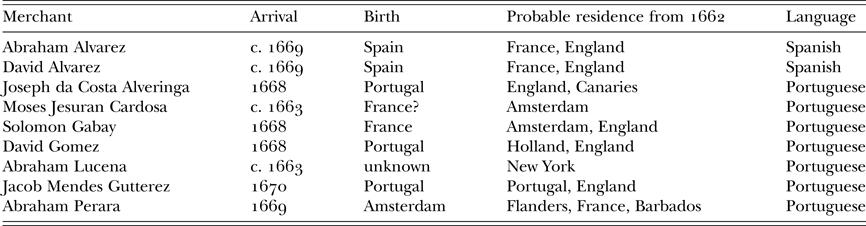
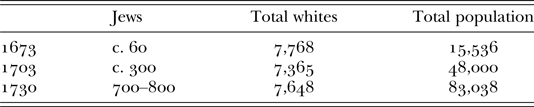
In 1672, a group of Jamaican merchants complained about the ‘prejudices and inconveniences’ being caused by the ‘infinite number of Jews who daily resort to the island’ and brought unwanted competition.Footnote 59 They overstated their case, but the governor did confirm that the island had attracted a settled community of thirteen ‘free’ Jews, of whom nine can be identified from court cases (Table 1). Combined with the sixteen Jews ‘which act under them’, women, and children, there was a total population of around sixty.Footnote 60 These early arrivals did not come as a group but were drawn from dispersed ports scattered around the Sephardic network. Nonetheless, they quickly constructed a community which provided a stable base for further Sephardic migration to the island including a small number from Surinam after it was handed to the Dutch.Footnote 61 In 1680, the census of Port Royal, where the Sephardim were based, listed twenty-one probable Jewish households (holding seventy-seven whites and fifty blacks) among the total of 507.Footnote 62 It also listed twenty-two Jewish names among the 1,101 militia men belonging to the town.Footnote 63 Further recruits arrived in the 1680s, including Diego Gonzalez, who left a collection of letters and business documents arising from a court case, and Aaron Lamego who, in 1685, was expelled, along with other Jews, from French territory. Although Jamaica's overall white population fell back in the 1690s, the Sephardim seem to have more than maintained their numbers (Table 2). After Port Royal suffered massive destruction in an earthquake in 1692, the Jews established new congregations in Spanish Town and Kingston. A document of 1703 claimed that there were eighty Jewish households which suggests a total population of around 300, making it the largest in British America, and the second largest in the entire Caribbean (after Dutch Curacao with around 600).Footnote 64 In the eighteenth century, Jewish names became increasingly frequent among surviving probate inventories (Table 3) and according to Benjamin Bravo, a resident in the 1720s, the population numbered 700–800 by 1730.Footnote 65
Jewish settlers with patents of endenization in Jamaica in 1672

Sources: TNA HCA 13/77; Jacob A. P. H. Andrade, A record of the Jews in Jamaica from the English conquest to the present times (Kingston, Jamaica, 1941).
White population of Jamaica

Sources: Journals of the Assembly of Jamaica (Kingston, Jamaica, 1811), i, pp. 20, 28; TNA CO 138/10, fo. 82; TNA CO 137/19/2, fo. 3; TNA CO 137/22, fo. 34.
Jewish decedents in Jamaican probate inventories, 1686–1721

Source: Inventories, National Archives of Jamaica, Spanish Town, Inv. 1B/ii/3, vols. 3, 5, 9, 11.
Despite their extravagant claims in the 1660s, the Jews showed little interest in planting or mining ‘for their design was only to insinuate themselves into the country for the sake of trade’.Footnote 66 This was choice and not necessity. The Jews had full property rights and it was usual for them to patent land especially in the early years when prices were low.Footnote 67 All nine of the ‘free’ Jewish settlers who could be identified in 1672 patented, at least, 300 acres, and most developed plantations, but agriculture remained secondary to their commercial activities. For example, at his death in 1693, Abraham Alvarez owned an indigo plantation in Vere with ‘seventy-six working negroes and ten pickaninnies’. Nonetheless, he lived in Port Royal and was described as a merchant on his tombstone.Footnote 68 The Jews plainly calculated that they had an advantage in trade, and perhaps because of their precarious past, a preference for high liquidity. Analysis of 1,180 probate inventories surviving from between 1685 and 1721 confirms contemporary assertions that the Jews were overwhelmingly urban and commercial.Footnote 69 At least twenty-four of the thirty-two probable Jews lived in towns (Port Royal, Kingston, or Spanish Town) and twenty-three of the twenty-eight with an occupational descriptor were merchants, alongside four planters and one widow.Footnote 70
The merchant inventories show that over half the Jewish merchants were interested in illicit Spanish commerce and that they drew heavily on diasporic connections at every stage of the trade.Footnote 71 A court case of 1666 showed how they used their European networks to secure direct supplies of continental commodities for sale in Spanish markets.Footnote 72 By making minimum adherence to the Navigation Acts, by simply calling at a south coast port, they kept costs down and could offer advantageous terms.Footnote 73 At other times, they landed goods from Dutch or French ships in bays and creeks outside Port Royal in a well-organized smuggling business.Footnote 74 The Jews were also active in developing the provision trade with North America from where their co-religionists delivered flour, beef, kosher beef, and even pork for Spanish markets.Footnote 75
The Jamaican Jews seem to have played little direct role in the risky transatlantic leg of the African slave trade but they obtained human cargoes at the Royal African Company's sales. Moses Jesuran Cardosa, an active contraband trader, was the largest single purchaser at the Company's sales in the 1670s and 1680s. He bought 582 Africans at forty-three sales between 1674 and 1686 and paid less than half the average price of £21 which suggests that he was concentrating purchases on children and what were described as ‘refuse slaves’ (the sick and old) who found ready sales on the poorer parts of the Spanish coast.Footnote 76 The Jews played an important role in settling the asiento agents in Port Royal in the 1690s and they remained prominent in the smuggling trade conducted by South Sea Company employees after 1713.Footnote 77
After assembling the goods and persons for sale, the Jews played an active role in taking them to market. By 1679, the island had a fleet of around eighty small, stoutly built sloops of which, at any time, around twenty might be engaged in ‘little designs with the Spaniards’.Footnote 78 Some Jews such as Jacob Lopez Torres, listed as a mariner in the 1680 census, and an overseer of the Port Royal synagogue, owned a number of vessels but others hired shipping and Christian mariners.Footnote 79 On the other hand, the Jews played a prominent role as supercargoes to ensure close personal oversight of their own, and their community's, transactions as well as taking on business for Christians.Footnote 80 According to Houston, three Jews dominated the English coast trade in the 1720s – Aaron Diaz Fernandez, Daniel Mendes de Costa, and Moses Mendes – and they maintained a sort of floating warehouse on the coast which others used to make up stocks for sale.Footnote 81 As noted above, the English were formally excluded from settling in Spanish territories before 1713, and found it intensely difficult to forge reliable business relationships across the religious and linguistic divide, whereas the Jews had complete fluency in Iberian languages, and an appearance which allowed them to pass unnoticed in Spanish territory. Although Jewish merchants did not name their ‘friends’ in Spanish territories, it is clear from their regular exports of kosher beef that they had firm links to co-religionists. Despite prohibitions, and the Inquisition, the Jews had communities in all the major towns and had forged a web of clandestine activity with well-established distribution channels and long experience with dealing with, and even serving, the regulatory regime.Footnote 82 They knew who to trust, who to bribe, and how to turn the system to their advantage.
Finally, the importance of the Jews in Jamaica's contraband trade was reflected in their role in the export of Spanish goods, above all bullion.Footnote 83 Over half the Jewish inventories surviving from the period between 1685 and 1721 contained large quantities of bullion with 56 per cent listing above £500 in cash and some owning much larger sums such as Jacob Baruch Alvarez, who died in 1724 with around £3,000 worth of silver and gold.Footnote 84 The lists of debts in the inventories, including bonds and mortgages, show that the Jews played a banking function in the island and during the war of the 1690s, Mennaseh and Benjamin Peraira had a contract to furnish the island's governor with an annual supply of bullion valued at £5,800.Footnote 85 In 1688, a ship's captain listed ninety bullion consignments for London of which fifteen were consigned to eight Jews. Not all were valued, but they included fifteen barrels of silver worth almost £3,000 for Abraham de Paiva who was a leading player in London's bullion market.Footnote 86 Another prominent Jew, Jacob Mears, who settled in Jamaica in 1692, was involved with Dummer in the packet boat service used to transport large quantities of Spanish silver to England in the War of the Spanish Succession.Footnote 87
Jews were also conspicuous in the dye-stuffs trade. They provided capital to expand logwood cutting and to finance export of the product.Footnote 88 Island records suggest that, in the early 1670s, Jamaica exported around 900 tons of Spanish logwood a year but only a small proportion was retained in England. In 1671, London imported around 100 tons with 95 per cent assigned to one Jewish merchant, Antony Gomezsera (for whom Cardosa was factor).Footnote 89 Much of the remainder was shipped to Europe, with minimal adherence to the Navigation Acts. In 1672, the Providence was seized at Cowes with a cargo of 60 tons of logwood intended for sale in Amsterdam on account of eight Jamaican Jews.Footnote 90 The Jews played a similar role in the indigo trade: in 1717, six Jews accounted for over half of London's indigo imports from Jamaica and, in the 1720s, drawback on duties on re-exported indigo at Port Royal shows that six Jews accounted for over a third of the trade.Footnote 91
Just as it is impossible to estimate the value of Jamaica's illegal trade with Spanish America, it is even more difficult to assess the proportion in the hands of Jewish merchants, although contemporary commentators had no doubt that they used their diasporic connections to secure a disproportionate share and it was often claimed that they dominated the trade.Footnote 92
Despite their heavy focus on the riskiest trading sector, the Jews prospered. Probate evidence shows that Jews accounted for almost 20 per cent of estates valued at above £2,000 in the period 1686–92 and the mean value of the Jewish estates identified for the period 1686–1721 was £1,930. In a separate survey, Meyers compared the wealth of thirty-two Jewish merchants he identified from the period 1685–1716 with that of eighty-nine non-Jewish merchants and found that the former were significantly richer. The median wealth of the Jewish estates was £1,509 and 56 per cent were valued above £1,000, while the median wealth of the non-Jewish estates was £406 and 28 per cent were valued above £1,000. Jewish merchants possessed about three times as much wealth as the Anglo merchants, and their wealth was more evenly distributed. Meyers noted that ‘Anglo anxieties about the collective wealth of the Sephardim, while probably exaggerated, would appear to be substantiated.’Footnote 93
IV
The commercial success of the Jews in Jamaica, above all in high-risk contraband trade, had multiple causes and requires careful explanation. Although envious rivals denounced the Jews for operating as ‘a kind of joint stock company’ and trading as a ‘perfect monopoly’, the Sephardim, in fact, eschewed company organization.Footnote 94 Like the private traders whose locally informed initiatives are seen to have driven East India Company expansion after 1660, the Jews maintained high levels of individual autonomy and flexible, fluid organization within a decentralized network with thick horizontal links.Footnote 95 Within the diaspora, they drew on strong social capital, which had been accumulated over generations of dispersal, to create local cohesion and high levels of co-operation and collaboration with other groups over a wide geographic area.
The broad geographic reach and decentralized structure of the Sephardic diaspora is seen in the backgrounds of the group of ‘free’ Jews who settled in Jamaica by 1672. Nine of the thirteen can be identified from court cases and other sources (Table 1) and although all but the Spanish Alvarez family (father and son) identified themselves as ‘of Portuguese extraction’, their birth-places were dispersed: three were born in Portugal, three in France, two in Spain, and one in Amsterdam. All had led peripatetic lives.Footnote 96 Most had moved between, at least, three countries (including Jamaica) in the previous ten years. Between them, they had gained first-hand experience of, at least, eleven countries including Barbados, Brazil, the Canaries, the Dutch Republic, France, Italy, New York, Portugal, and Spain. At least two-thirds of them had lived for some time in the Iberian peninsula where they would have had to assume a Christian identity. All had passed through London, though often for a very short time, and obtained patents of endenization with a clause which allowed them to trade on the same foot as Englishmen. All had agents in both London and in Amsterdam (where at least four had close kin).
While benefiting from broad networks, Jamaica's early Jewish settlers required skill to mould a group of relative strangers into a cohesive community. Only four of the nine had a close kin connection: Abraham and David Alvarez were father and son; the partners Solomon Gabay and David Gomez married two Perara sisters and were brothers-in-law. Although all had friends in common, none had first-hand acquaintance with every other member of the group before migration to Jamaica. However, in adjusting to a new environment they clung together, and as Studnicki-Gizbert has argued, they were able to draw on collective memory of dispersion and well-established strategies for strengthening ties between members of mobile communities.Footnote 97 Until the earthquake of 1692, almost all Jamaica's Jews settled in Port Royal. The twenty or so families lived, worked, and socialized in close proximity, and according to testimony provided by a young merchant, Abraham Perara Delgado, the Jews met ‘in company’ on a daily basis.Footnote 98 In 1677, the leaders, including Moses Cardosa, purchased a plot in the middle of Port Royal on which they built a synagogue.Footnote 99 The building provided a symbol of collective affiliation, and difference, a public declaration of permanence, and an important social centre for the community, used for daily assembly and information exchange, as well as worship.Footnote 100 Two new congregations were formed in Spanish Town and Kingston after the earthquake, but all three were in a radius of twenty miles, and were in close communication sustained by overlapping membership and common interests, reinforced by a policy of strict endogamy which not only restricted access to the group but also necessitated high levels of intermarriage and the formation of dense kin networks. The thick web of personal relationships ensured rapid diffusion of information about personal and business affairs which facilitated oversight and enforcement of norms.Footnote 101
In forging solidarity and social discipline, the Sephardim deployed strategies common to the associational culture which flourished throughout early modern Europe as the growing bourgeoisie struggled to adjust to rapid economic and social change.Footnote 102 Although Port Royal was notorious for its riotous and unruly lifestyle; the factionalism of economic, social, and political life; and low levels of business probity, the Sephardim stood apart. The Jews successfully promoted the type of conduct which is commonly associated with the Protestant work ethic: abstemiousness; thrift; and self-restraint.Footnote 103 However, the Sephardim reinforced their common-place sociability with rigorous adherence to a range of customs and rituals which had survived and been adapted from before the forced conversions and which set them apart. As seen in tombstone inscriptions, they maintained their Iberian languages among themselves until the late eighteenth century.Footnote 104 They buried their dead in a well-maintained separate cemetery from the 1660s and worshipped in a public synagogue from 1677.Footnote 105 They observed their own calendar with its Saturday Sabbath and religious holidays on which they refused to take part in militia training.Footnote 106 They followed a kosher diet.Footnote 107 Their young people attended the Yeshibah (a school for religious instruction) which inculcated a strong awareness of their Jewish heritage, and their ‘difference’, and encouraged members to behave for the benefit of the community.Footnote 108 At the level of the individual, such practices were costly. They required time and self-discipline and made it difficult to socialize with Christians but, on the other hand, the signalling traits not only strengthened group cohesiveness but also lowered the costs of identifying insiders.Footnote 109
In common with other purposeful associations, and friendly societies, of the late seventeenth century, the Sephardim cemented group commitment with mutuality.Footnote 110 Membership of the small, tight-knit Jamaican Jewish community delivered a range of economic and social benefits which offered household security over the life-cycle. Schooling and business training were provided within the community. A good marriage brought a handsome dowry. Interest-free loans were available and were especially helpful for those early in their careers. The articles of agreement made between David Lopez Narbona and Solomon Gabay in 1674 show that the former obtained start-up funding on easy terms as well as assistance with his family's transport costs and initial subsistence.Footnote 111 Although merchants maintained high levels of personal mobility, and flexibility, by avoiding large, long-standing partnerships, they came together as ‘a sort of company’ when there were clear benefits in collaboration as when eight Jews freighted the Providence for a voyage to Amsterdam in 1672.Footnote 112 There was well-organized relief for those who fell on hard times, and in old age, with a compulsory contribution to the ‘poor fund’ levied on all trade transactions. Wills show that it was usual to make bequests to community institutions and the ‘poor of the Nation’ and there was generous alms-giving at funerals.
The tools of sociability and mutuality which bound the Jamaican Sephardim were also used to create and maintain ties and promote information exchange with communities overseas. Families had a tendency to divide, disperse, and come back together as business opportunities opened and closed. For example, Abraham de Lucena moved to Jamaica from New York in the 1660s but, a generation later, his son returned to New York to take part in the growing provisions trade with the Caribbean.Footnote 113 Joseph da Costa Alvaringa's son moved to London in the 1690s where he was involved with the asiento trade via Jamaica and was joined by his mother after his father's death.Footnote 114 Dispersal was reinforced by endogamy which often necessitated a move overseas to find a suitable partner. Esther Marques, daughter of a prominent Jamaican family, married Luis Gomez, a large-scale provision merchant trading from New York to the Caribbean, and two of her sons also married Jamaican Jews who they met in the course of working as supercargoes in the family firm.Footnote 115 The strong family connections between Jamaica and New York Jews are highlighted in New York testaments surviving from the periods between 1700 and 1750. A third of the wills indicate a close family link with Jamaica.Footnote 116 Connections could be cultivated and maintained through conversations in written correspondence, as emphasized in David Hancock's work on the Madeira wine business, but the Jews reinforced these ties through frequent face-to-face contact.Footnote 117 It was common for Jewish merchants to travel with their goods and they benefited from direct contact with customers.Footnote 118 Shared religion took these mobile merchants into the Sephardim's tightly confined social spaces wherever they were, and ensured rapid transmission of personal and business information which, at times, also extended to Ashkenazi Jews, who began to arrive in the Atlantic in small numbers and attended the Sephardic synagogues.Footnote 119
As with Amsterdam's ‘global’ Jews examined by Jessica Roitman, Jamaica's Sephardim did business with those outside their own community.Footnote 120 They bought and sold goods to Christians; they undertook commission business for Christians; and they hired Christian mariners. They also undertook business in partnership with well-placed individuals who could offer political capital. However, where trust was most needed, they relied on insiders as in using Jewish supercargoes on the Spanish American coast. Good information about the moral and business conduct of members of their own small, close-knit island congregation, combined with knowledge of those overseas, to allow early detection of bad behaviour and group discipline was enhanced by the supervisory role accorded to Jewish leaders. Although early congregation records have not survived, it is clear that, like other Sephardic communities, the Jamaican Jews elected a governing board (Mahamad) which administered the community's affairs, appointed Rabbis, supervised religious and moral order, dealt with internal disputes, and represented community interests to the government. The leaders also oversaw the rating, assessing, and collection of the extraordinary taxes imposed at various times ‘in the lump’ from the 1690s: a role which provided them with detailed financial information about their co-religionists.Footnote 121
Early English Jamaica was notorious for low levels of business morality.Footnote 122 In a published memoir, Houston left a colourful picture of the ‘burlesque’ of Jamaica's early eighteenth-century business world and claimed that the islanders ‘reckoned no disgrace, or loss of credit, to fail in, or fall from your word, bill or bond’.Footnote 123 He was scathing about the corruption of the island's legal system and the difficulties of getting redress for bad behaviour through the courts, and his sentiments were echoed by the Jewish merchant Diego Gonzalez, who complained that ‘it doe signifie nothing to go to law, for after you get judgement and your money goes in the Provost Marshall's hands you are as bad as before’.Footnote 124 However, although the Jews did make use of formal contracts within the community, as seen in the Articles of Association between Gabay and Narbona, and did also, on occasion, use the courts to sue for debts, they were generally able to avoid formal institutions and turn to internal mechanisms for settling disputes within their community.Footnote 125
Wills and deeds reveal that, at best, a damaged reputation reduced access to group benefits such as apprenticeship, a good marriage, business collaborations, inheritance, and social welfare.Footnote 126 At worst, disgrace threatened partial, or absolute, exclusion from the group, which was akin to economic and social death.Footnote 127 While the forging of a closed and separate community, with distinct social practices, increased trust among insiders, it also defined the Jews as a nation apart. Between 1687 and 1690, the Christian Hall brothers had transactions with seven Jews, of whom four (including Moses Jesuran Cardosa) were large repeat customers but, although they made thirty-three references to ‘a Jew’ in their forty-seven letters, they never once identified these individuals, even repeat customers, by name – names here have been extracted from invoices and lists of debts.Footnote 128 The Jews were seen ‘in the lump’ and, at best, they were viewed with suspicion and, at worst, with envy and venom. According to Houston, they were ‘the worst set of rogues that ever I knew…a set of meer low-level thieves’.Footnote 129 It was difficult for an expelled Jew to form a new network or join the majority population.Footnote 130 Outsider status not only promoted community cohesion among the Jews but also gave the Jewish elders a powerful disciplinary tool and, although the early congregation records have not survived, there is evidence that excommunication was a credible threat within the Sephardic diaspora.Footnote 131 The strong capacity to detect and punish opportunistic behaviour among their brethren gave the Jews a significant competitive advantage where legal enforcement was weak, or entirely absent, as in contraband trade. It has been argued that these economic advantages help explain why a stigmatized group persisted in maintaining its separate identity. If distinctiveness had had costs alone, and no benefits, it would be expected that the signalling traits would have died out through a Darwinian mechanism.
The economic value of high-quality information networks and the capacity to curb opportunism cannot be computed with precision. Nonetheless, business records do demonstrate that these community assets allowed the Jews to reduce risk and transactions costs in illicit trade and undercut their Christian rivals. In the 1680s, Francis Hall complained that the Jews supplied French silks and stuffs at 20 per cent below the usual market price and he repeatedly urged his correspondents to withdraw from these trades as they could not compete.Footnote 132 The Jews also charged lower commission rates: a sample of 143 invoices from the period 1681 to 1725 shows that English merchants charged, at least, 10 per cent commission, and their Jewish rivals undercut them by 5 per cent.Footnote 133 This competitive edge allowed the Jews to gain Christian customers which provoked the charge that the Jews did ‘eat us and our children out of all our trade’ and raised the threat of retaliatory action.Footnote 134
Although the Jews had full property rights, they were excluded from voting in Assembly elections, or holding office above constable, and so lacked a voice in island government.Footnote 135 Thus, the Jews were exposed to discriminatory measures such as the imposition of a tax on the community ‘in the lump’ at regular intervals from the 1690s.Footnote 136 Nonetheless, leading Jewish merchants were able to limit the damage through a series of bargains with the political elites. They combined with governors, African Company agents, naval captains, and South Sea Company agents, in various ‘exclusive’ trading arrangements. In these, the Christians gained the benefits of the Sephardim's social capital, and the Jews gained both the opportunity to limit competition though manipulating the regulatory regime to their advantage, and also improved security.Footnote 137 By giving the Christian elite a stake in their business, the Sephardim raised the cost of the type of retaliatory action which had so often destabilized Jewish life in the past and gained political protection as seen in William Wood's energetic defence of their rights in the 1730s.Footnote 138
V
In the last two decades, historians have highlighted the importance of the web of illicit commercial transactions which connected competing national networks to create an integrated Atlantic economy but have paid little attention to how co-operation worked across borders. Of necessity, smugglers acted without the legal protections and state-backed enforcing institutions which are often afforded a central role in narratives of modernization. In the case of Jamaica, a hub of illicit trade, most merchants found it difficult to survive in this high-risk environment but members of the Sephardic diaspora, a traditional, communitarian group, with strong private-order institutions, had competitive advantages which they exploited with vigour. Equipped with appropriate language skills, and long-standing links to the Iberian empires, the Sephardim did not scatter at random but rather chose to settle communities at Jamaica and other strategic points in the web of illicit commerce which distributed Spanish American riches around the Atlantic and beyond. In Jamaica, they did not rely on innate attributes of kinship, ethnicity, or religion. Rather, they pursued strategies which restricted entry and also cultivated attributes which ensured that group behaviour could be carefully monitored, and high levels of social discipline maintained, with credible rewards and punishments which were reinforced by their outsider status.
High levels of trustworthiness within the Jewish community provided a competitive advantage which stimulated envy and retaliation but also allowed the Sephardim to combine with the Christian elite to capture rent-seeking opportunities and obtain political protections. Far from falling away, and becoming irrelevant, as modernization gained pace, the Sephardic diaspora survived and flourished because it built on its historical and geographical legacy to construct strong private-order institutions which continued to be necessary in large swathes of the economy where neither impersonal corporations nor state-enforcement mechanisms were able to manage risk. Furthermore, merchant diasporas continue to play a key role in high-risk environments and remain important in understanding the processes of globalization today.