Introduction
Otosclerosis is a primary cause of progressive conductive hearing loss in adults, characterised by abnormal bone remodelling and fixation of the stapes footplate.Reference Cureoglu, Schachern, Ferlito, Rinaldo, Tsuprun and Paparella1 Surgical intervention, particularly stapedectomy or stapedotomy, remains the gold standard for otosclerosis treatment and has been shown to provide long-term improvement in hearing outcomes in most patients.Reference Vincent, Sperling, Oates and Jindal2 Despite such efficacy, post-operative complications continue to be a clinical concern, with taste disturbances among the most frequently reported.Reference Patil, Rajguru, Raghavan, Singh and Naga3
Taste sensation is mediated by receptors in the tongue and oral cavity and transmitted to the brain via the chorda tympani nerve (CTN), a branch of the facial nerve.Reference Doty4 This nerve traverses the middle ear between the malleus and incus, making it highly susceptible to injury during middle ear surgeryReference Blijleven, Wegner, Stokroos and Thomeer5. The prevalence of post-operative taste disorders has been reported to vary between 15 per cent and 80 per cent.Reference Berling Holm, Knutsson, Strömbäck, Danckwardt Lillieström, Papatziamos and Rosenblad6–Reference Pellegrino and Hummel8 This variation could be because of the differences in the surgical technique and instrumentation, use of microscope versus endoscope, intra-operative handling of the CTNReference Takihata, Kurioka, Mizutari and Shiotani9 and patient-related factors such as reporting accuracy and symptom perception.Reference Katsura, Kaneshiro, Hiraumi, Obara, Tamura and Shiga10 More often, the patients do not relate the disturbance in taste with ear surgery or under-report the symptom, thereby causing an underestimation of the true incidence.Reference Božanić Urbančič, Vozel, Steiner, Hribar, Fošnarič and Šifrer11
The management of the CTN during surgery remains controversial. Some authors argue that preservation, even with stretching, may result in worse outcomes than transection, while others suggest that nerve sacrifice leads to more persistent dysfunction.Reference Katsura, Kaneshiro, Hiraumi, Obara, Tamura and Shiga10 Recent anatomical and endoscopic studies have highlighted the variability of CTN pathways, further complicating intra-operative decision making.Reference Huang, Xu, Lyu, Wang, Fu and Ma12–Reference Belsare, Dehadaray and Chauhan14 Moreover, factors like prosthesis diameter, surgical instrumentation and surgeon experience may influence the risk of CTN injury and subsequent taste disturbance.
Taste dysfunction can significantly affect patients’ quality of life, mood and dietary habits. Reduced enjoyment of food, altered appetite and disturbances in salivary secretion are among the consequences of CTN injury.Reference Cureoglu, Schachern, Ferlito, Rinaldo, Tsuprun and Paparella1, Reference Doty4 Berling Holm et al. reported that over 60 per cent of patients experienced taste disturbance after stapes surgery, though most recovered within 1 year.Reference Berling Holm, Knutsson, Strömbäck, Danckwardt Lillieström, Papatziamos and Rosenblad6 More recent studies have emphasised the importance of assessing taste function systematically, as under-reporting remains common. Age has also been identified as a modifying factor, with older patients demonstrating slower recovery and greater impact on quality of life.Reference Doty4, Reference Božanić Urbančič, Vozel, Steiner, Hribar, Fošnarič and Šifrer11
Despite the clinical importance of this complication, comprehensive national data on taste disturbance following stapedectomy are lacking in Iran. The present study was therefore designed to investigate the prevalence of taste dysfunction after stapedectomy in patients with otosclerosis, to analyse demographic and surgical predictors, and to evaluate recovery patterns over time.
Materials and methods
This prospective study was conducted in our otolaryngology department at University Hospital. We have included patients (age range: 20–70 years) who underwent otosclerosis surgery between October 2016 and May 2024 and reported absence of taste disorders prior to ear surgery. All patients underwent ear, nose, and throat (ENT) examination, nasal endoscopy, otomicroscopy, anterior rhinomanometry and taste testing. Exclusion criteria included a history of middle ear surgery, the presence of taste disturbances before otosclerosis surgery and patients lost to follow‐up. The follow‐up period was up to one year after surgery.
Surgical procedure
All surgeries were performed by a single surgical team using an operating microscope, via the ear canal, with elevation of a tympanomeatal flap. In each case, the intra-operative status of the CNT was assessed and classified into one of three categories: intact (unaffected), stretched (abnormally tense) and transected (severed).
Data collection
Demographic information, pre- and post-operative audiogram results, and taste function status were extracted from clinical records and structured questionnaires. Taste disturbances were assessed at four time points: pre-operatively, 7 days, six weeks and one year post-operatively. The questionnaire included items on the presence and type of taste changes (e.g. reduced taste sensation, tongue numbness, impaired perception of sweet, salty, bitter or sour flavours).
In order to evaluate the impact of symptoms on quality of life, daily discomfort due to taste disturbance was measured using a 0–10-point visual analogue scale (VAS), with 0 expressing no discomfort and 10 expressing severe discomfort, at different times of examination. Dietary changes were assessed using a 5-point Likert scale (from ‘not at all’ to ‘very much’).
Statistical analysis
Data were analysed using SPSS (version 26, IBM, Armonk, New York, USA). Descriptive analysis was conducted by mean and standard deviation (SD) for quantitative variables, frequency and percentage for categorical variables. Associations between qualitative variables were examined using the chi-square test. Multivariate logistic regression analysis was employed to identify predictors of taste disturbance. All p-values were two‐sided, with statistical significance evaluated at the 0.05 level.
Results
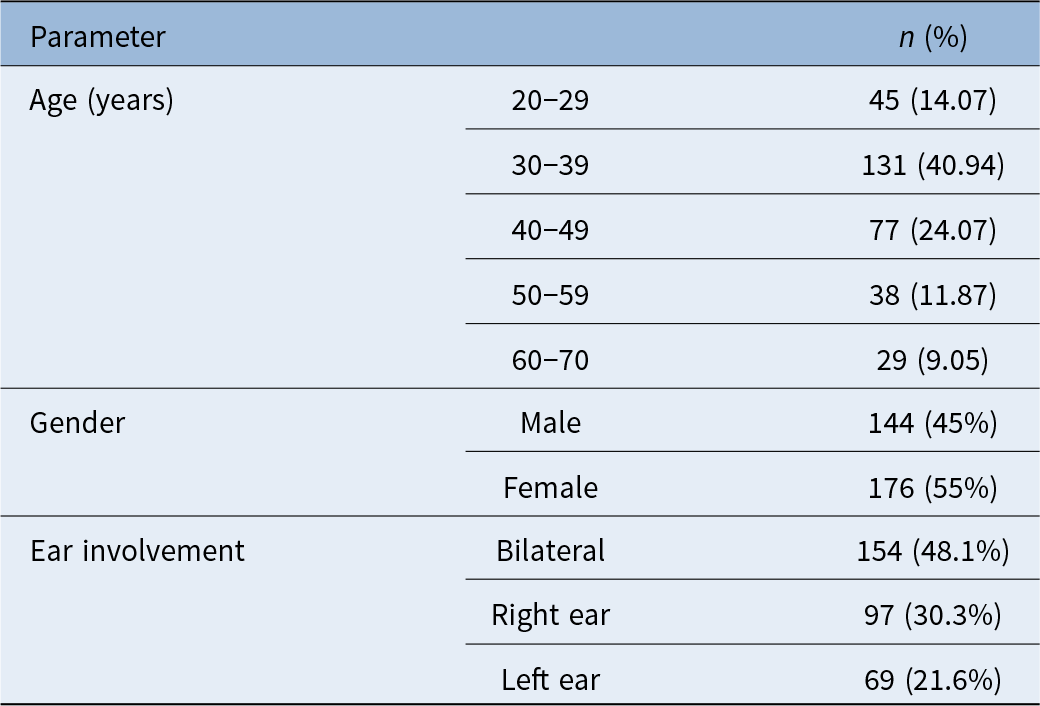
Of 346 eligible patients, 26 were excluded due to lack of post-operative follow-up. Then, 320 patients entered the study. The age of participants ranged from 20 to 70 years, with a mean of 40.61 ± 11.03 years. Also, 176 patients (55 per cent) were female, and the remaining (45 per cent) were male (Table 1).
Demographic characteristics of study population

Table 1 Long description
Parameters listed are age in years, gender, and ear involvement, with counts and percentages in the column labeled, n percent. Age groups are 20 to 29 years, 45 and 14.07 percent; 30 to 39, 131 and 40.94 percent; 40 to 49, 77 and 24.07 percent; 50 to 59, 38 and 11.87 percent; and 60 to 70, 29 and 9.05 percent. Gender counts are male, 144 and 45 percent, and female, 176 and 55 percent. Ear involvement is bilateral, 154 and 48.1 percent; right ear, 97 and 30.3 percent; and left ear, 69 and 21.6 percent.
In 217 (67.81 per cent) patients, the CTN was not visible initially; it became apparent after removal of the posterior canal wall bone. Our findings indicated that the CTN was intact in 257 patients (80.31 per cent). The CTN was also stretched and transected in 54 patients (16.88 per cent) and 9 patients (2.81 per cent), respectively.
Taste disturbance was present in 114 out of 320 patients (35.6 per cent) 1 week post-operatively. We also found post-operative taste disturbance in 25 patients (7.8 per cent) and 3 patients (0.9 per cent) at 6 weeks and 1 year after otosclerosis surgery, respectively. There was a significant reduction in taste disturbance prevalence over time (chi-square test, p < 0.001).
Among 114 patients with taste disturbance, 76 cases (66.6 per cent) reported reduced taste sensation and 69 patients (60.5 per cent) reported metallic taste.
Altered perception of flavours was manifested as salty 61 (53.5 per cent), sweet 47 (41.2 per cent), bitter 34 (29.8 per cent) or sour 31 (27.3 per cent). Tongue numbness was also reported in 12 patients (10.5 per cent) within 6 weeks, and in 2 patients (0.6 per cent) at 1 year post-operatively.
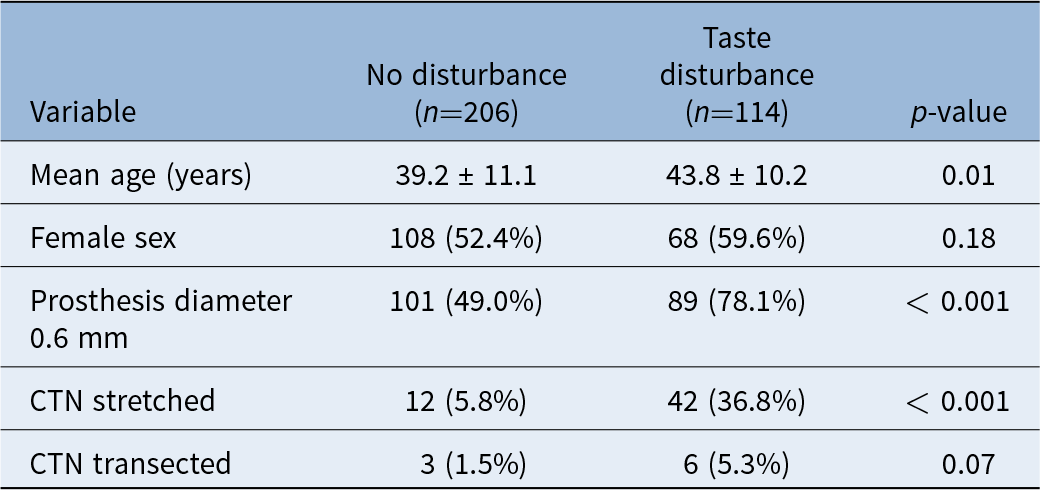
During this study, the relationship between demographic/surgical variables and the presence of taste disturbance was examined (Table 2). Our results indicated that older age, larger prosthesis diameter and CTN stretching were significantly associated with an increased risk of taste disturbance.
Associations between demographic/surgical variables and taste disturbance at week 1

Table 2 Long description
Demographic and surgical variables are compared between patients with no disturbance, n 206, and taste disturbance, n 114, with a p value for each row. Mean age was 39.2 plus or minus 11.1 years with no disturbance and 43.8 plus or minus 10.2 years with taste disturbance, p value 0.01. Female sex was 108 patients, 52.4%, with no disturbance and 68 patients, 59.6%, with taste disturbance, p value 0.18. Prosthesis diameter 0.6 mm was 101 patients, 49.0%, with no disturbance and 89 patients, 78.1%, with taste disturbance, p value less than 0.001. CTN stretched was 12 patients, 5.8%, with no disturbance and 42 patients, 36.8%, with taste disturbance, p value less than 0.001. CTN transected was 3 patients, 1.5%, with no disturbance and 6 patients, 5.3%, with taste disturbance, p value 0.07.
CTN: Chorda tympani nerve
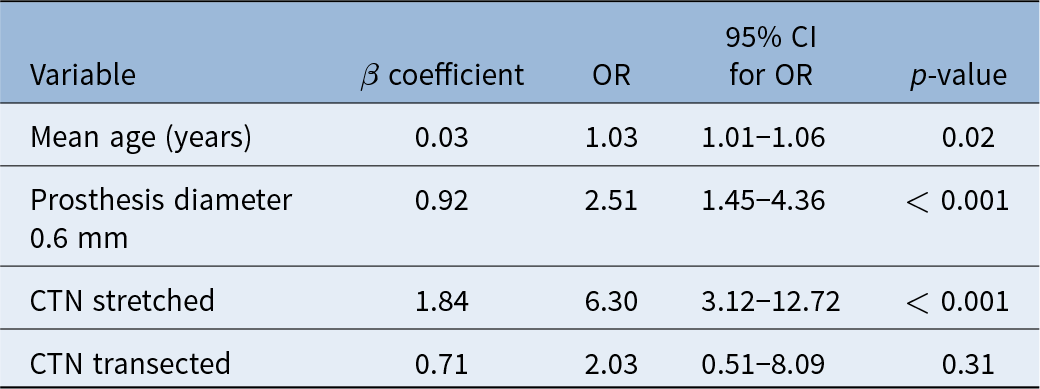
To identify independent predictors of taste disturbance, a multivariate logistic regression model was applied. According to our data, CTN stretching and prosthesis diameter of 0.6 mm were identified as the strongest independent predictors of post-operative taste disturbance (Table 3).
A multivariate logistic regression model for prediction of taste disturbance

Table 3 Long description
Multivariate logistic regression results are listed with columns for beta coefficient, odds ratio, 95% confidence interval for the odds ratio, and p-value. Mean age in years has beta coefficient 0.03, odds ratio 1.03, 95% confidence interval 1.01 to 1.06, and p-value 0.02. Prosthesis diameter 0.6 mm has beta coefficient 0.92, odds ratio 2.51, 95% confidence interval 1.45 to 4.36, and p-value less than 0.001. Chorda tympani nerve stretched has beta coefficient 1.84, odds ratio 6.30, 95% confidence interval 3.12 to 12.72, and p-value less than 0.001. Chorda tympani nerve transected has beta coefficient 0.71, odds ratio 2.03, 95% confidence interval 0.51 to 8.09, and p-value 0.31.
CTN: Chorda tympani nerve; CI: Confidence interval; OR: Odds ratio
The mean daily discomfort at 7 days, six weeks and one year post-operatively was calculated as 6.6, 3.7 and 1.7, respectively.
The number of patients who reported dietary changes at 7 days, 6 weeks and 1 year post-operatively was 45.61 per cent (45/114), 25.43 per cent (29/114) and 13.15 per cent (15/114), respectively.
Discussion
This study examined the prevalence and predictors of taste disturbances following stapedectomy in patients with otosclerosis. Post-operative taste dysfunction was observed in 35.6 per cent of patients at 1 week, declining to 7.8 per cent at 6 weeks and 0.9 per cent at 1 year. These findings highlight the transient nature of most taste disturbances after stapedectomy, with only a small proportion of patients experiencing persistent symptoms.
The observed prevalence is consistent with earlier reports. Just et al. demonstrated that manipulation of the CTN during middle ear surgery is strongly associated with taste dysfunction, though recovery is common within months.Reference Berling Holm, Knutsson, Strömbäck, Danckwardt Lillieström, Papatziamos and Rosenblad6 Berling Holm et al. reported a higher prevalence of 61.9 per cent after stapes surgery, but more than 94 per cent of patients recovered within 1 year, underscoring the self-limiting nature of most cases.Reference Berling Holm, Knutsson, Strömbäck, Danckwardt Lillieström, Papatziamos and Rosenblad6, Reference Takihata, Kurioka, Mizutari and Shiotani9 Pellegrino and Hummel also confirmed that chemical and electrical taste responses decline after middle ear surgery, though partial recovery occurs over time.Reference Pellegrino and Hummel8
Our findings identified CTN stretching as the strongest independent predictor of taste disturbance (odds ratio = 6.30). This finding aligns with the systematic review summarised by Blijleven et al., which suggested that stretching the CTN may cause more severe dysfunction than transection.Reference Blijleven, Wegner, Stokroos and Thomeer5 Takihata et al. further emphasised that anatomical variability influences the risk of CTN transection, highlighting the importance of careful intra-operative nerve management.Reference Takihata, Kurioka, Mizutari and Shiotani9
Prosthesis diameter was another significant factor, with patients receiving a 0.6 mm prosthesis at higher risk of taste disturbance. Although few studies have directly examined prosthesis size, Berling Holm et al. noted that more severe surgical trauma to the CTN correlated with greater disturbance, supporting the idea that technical details of surgery influence outcomes.Reference Berling Holm, Knutsson, Strömbäck, Danckwardt Lillieström, Papatziamos and Rosenblad6
Age also emerged as a predictor, with older patients more susceptible to taste dysfunction.Reference Božanić Urbančič, Vozel, Steiner, Hribar, Fošnarič and Šifrer11 Age-related deficits in taste and smell confirm that older individuals experience slower recovery and greater impact on quality of life.Reference Doty4 Blijleven et al. also highlighted age as a modifying factor in CTN injury outcomes and recovery.Reference Blijleven, Wegner, Stokroos and Thomeer5
The qualitative features of taste disturbance in our cohort reduced taste sensation, metallic taste, and altered perception of sweet, salty, bitter, and sour flavours mirror those described by Berling Holm et al.Reference Berling Holm, Knutsson, Strömbäck, Danckwardt Lillieström, Papatziamos and Rosenblad6 and Just et al.Reference Patil, Rajguru, Raghavan, Singh and Naga3 Although these symptoms were distressing initially, their impact on quality of life diminished substantially over time, consistent with previous findings.
Other complications observed in this study, including transient vertigo, tinnitus, tympanic membrane perforation and facial nerve palsy, occurred at rates comparable to those reported in the literature. Uranaka et al. highlighted the variability of CTN anatomy, which may explain differences in complication rates across studies.Reference Uranaka, Matsumoto, Hoshi, Iwasaki, Kakigi and Yamasoba7
One limitation of this study is that all procedures were performed using an operating microscope. Endoscopic ear surgery may provide improved visualisation of the CNT and could potentially influence the incidence of post-operative taste disturbance. Future comparative studies between microscopic and endoscopic techniques are suggested.
Conclusion
Taste disturbance is a relatively common but largely transient complication of stapedectomy. Chorda tympani nerve stretching and prosthesis diameter were identified as the strongest predictors, while older age also increased risk. Most patients recovered within one year, with minimal long-term impact on quality of life. These findings, supported by earlier and recent evidence, emphasise the importance of meticulous surgical technique and nerve preservation strategies to minimise morbidity while maintaining the high efficacy of stapedectomy.
Funding statement
This research received no specific grant from any funding agency, commercial or not-for-profit sectors.
Competing interests
The authors declare none.
Ethical standards
This study was conducted in accordance with the Declaration of Helsinki and Institutional Review Board approval was obtained from the local Ethics Committee (registration number: IR.AJUMS.REC.1399.134). Written informed consent forms were signed by all the participants.
Author contributions
SN: Study design, data collection, manuscript drafting. AB: Project conception, data collection, data analysis, manuscript preparation, manuscript editing. NS: Critical review of manuscript draft, project supervision. SMH: Data acquisition, interpretation, manuscript drafting. MK: Critical review of manuscript draft, project supervision, project conception.