Excessive movement, difficulty controlling impulses and/or a persistent pattern of inattention are seen as the three main symptoms of the Attention Deficit Hyperactivity Disorder (ADHD). The presence of all or some of these symptoms and the intensity with which they appear tends to be variable; hence the DSM-IV-TR (APA, 2000) proposes three kinds of ADHD: A predominantly inattentive type, a predominantly hyperactive/impulsive type and a combined type. Patients with ADHD constitute a very heterogeneous group and both the number of symptoms and their development differ. This in turn can be a source of confusion in people who are unfamiliar with the disorder.
The prevalence of ADHD in the pediatric population is within in the 3 – 5% range (APA, 2000). At the school level, this means that approximately 1 in 25 pupils has ADHD. However, despite the high number of children with ADHD, there are studies which show a large percentage of teachers claiming they have never come across pupils with ADHD. In recent studies by Soroa, Balluerka, and Gorostiaga (Reference Soroa, Balluerka, Gorostiaga and Norvilitis2012) and Soroa, Gorostiaga, and Balluerka (Reference Soroa, Gorostiaga, Balluerka and Banerjee2013), for instance, 42.25% of 1444 infant and primary education teachers with a mean of 16.75 years of professional experience said that they had never had a pupil diagnosed with ADHD in their classrooms. The remaining 57.75%, who had dealt with ADHD diagnosed children, stated that they met approximately two students throughout their careers. This data is in line with that obtained by authors such as Jarque, Tárraga, and Miranda (Reference Jarque, Tárraga and Miranda2007), Jones and Chronis-Tuscano (Reference Jones and Chronis-Tuscano2008) and Sciutto, Terjesen, and Bender (Reference Sciutto, Terjesen and Bender2000).
The data presented shows that there often is a mismatch between the actual percentage of children with ADHD and the identified percentage. Given the negative consequences ADHD might have for sufferers from it, it would be advisable to correct this mismatch. Though ADHD detection in children can occur in different environments (family, healthcare system, etc.) schools offer a good opportunity for early detection. Teachers have the chance to observe children grouped according to their age, which allows them to differentiate normal from abnormal development. We therefore believe it is important that teachers be familiar with this disorder.
Data from different studies show that teachers generally have an average knowledge of ADHD (Ghanizadeh, Bahredar, & Moeini, Reference Ghanizadeh, Bahredar and Moeini2006; Jarque et al., Reference Jarque, Tárraga and Miranda2007; Kos, Richdale, & Jackson, Reference Kos, Richdale and Jackson2004; Sciutto et al., Reference Sciutto, Terjesen and Bender2000; West, Taylor, Houghton, & Hudyma, Reference West, Taylor, Houghton and Hudyma2005; White et al., Reference White, Sukhodolsky, Rains, Foster, McGuire and Scahill2011) and that it would be advisable for them to improve this knowledge given that they are unfamiliar with and/or have wrong beliefs in terms of aspects such as the nature, causes, course, consequences and treatment of ADHD (Pfiffner, Reference Pfiffner and Barkley2002). Furthermore, improving ADHD knowledge on the part of teachers would not only favor early detection in children but would also promote cooperation between the different agents working with those children. It would greatly help the diagnosis process and the treatment and it would improve teachers’ attitudes towards children with ADHD (Soroa et al., Reference Soroa, Balluerka, Gorostiaga and Norvilitis2012).
Unfortunately, many of the instruments which have been used to measure teachers’ knowledge of ADHD lack methodological rigor (Soroa et al., Reference Soroa, Gorostiaga, Balluerka and Banerjee2013). The bulk of them fail to provide evidence of their validity and reliability. Moreover, most of them have been applied to small samples, which limit their usefulness in the educational context.
The most widely used instruments to measure teachers’ knowledge of ADHD in the scientific literature have been the ADHD Knowledge Scale by Jerome, Gordon, and Hustler (Reference Jerome, Gordon and Hustler1994) and The Knowledge of Attention Deficit Disorders Scale (KADDS) by Sciutto et al. (Reference Sciutto, Terjesen and Bender2000). The former was groundbreaking and has been the starting point for multiple studies in the field. However, its psychometric properties have not been published and it has a dichotomous answer format (True/False) which, in the case of doubt, promotes guessing and increases the percentage of false matches (Jarque et al., Reference Jarque, Tárraga and Miranda2007; Sciutto et al., Reference Sciutto, Terjesen and Bender2000). The second questionnaire, whose authors were the first to publish data about its psychometric properties, has aspects that could be improved (a factor analysis, for instance, should have been carried out to justify the dimensions proposed). However, it features strengths such as the three-option answer format (True/False/Don’t know), which means its results are more accurate than those derived from previous instruments in terms of teachers’ knowledge of ADHD. This format allows for discerning right answers, false beliefs and gaps in teachers’ knowledge (Jarque et al., Reference Jarque, Tárraga and Miranda2007; Kos, Richdale, & Hay, Reference Kos, Richdale and Hay2006; Sciutto et al., Reference Sciutto, Terjesen and Bender2000).
In brief, given the large percentage of children with ADHD and the benefit pupils and their families get from teachers with advanced knowledge of this disorder, we believe it is necessary to create instruments which can reliably measure teachers’ knowledge of ADHD. These instruments would result in the acquisition of reliable and valid data on teachers’ level of knowledge of ADHD and, if necessary, training programs aiming at increasing this knowledge could then be designed.
Based on this need, this study aimed at creating an instrument to measure the knowledge infant and primary teachers have of ADHD in a valid and reliable fashion. The process of elaboration and validation of this measure, namely the MAE-TDAH, is detailed throughout this paper.
Method
Participants
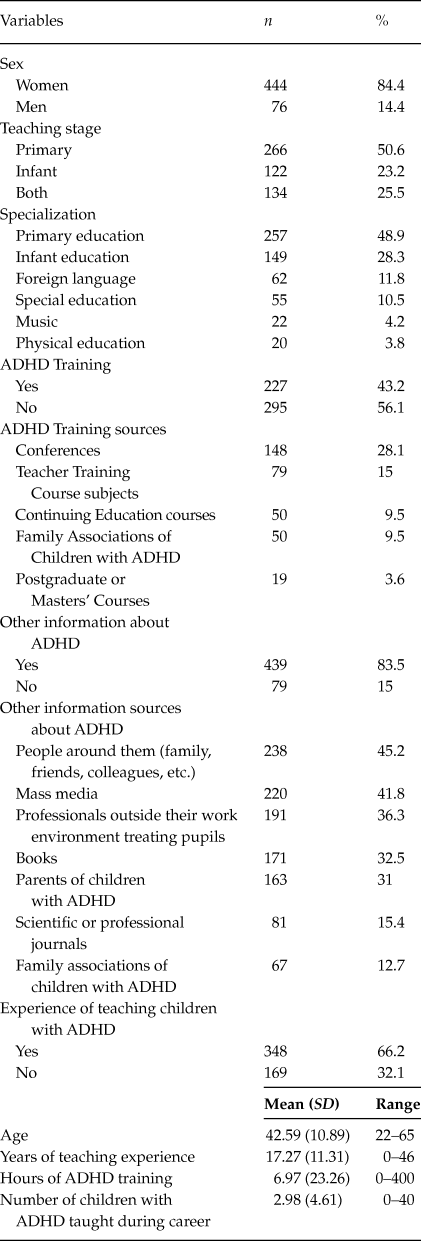
In this research 526 teachers took part. Participants worked in 57 state or state-subsidized schools in the Autonomous Community of the Basque Country (55.5%) and Navarre (44.5%). The socio-demographic characteristics of participants are shown in Table 1. The schools were selected randomly from data bases submitted by the Departments of Education of the corresponding Autonomous Communities. All participants gave their informed consent. The study received official approval by the Ethics Committee for Human Research at the Universidad del País Vasco.
Participants’ socio-demographic information

On a ten points scale, teachers indicated their perceived knowledge of ADHD as well as their perceived capacity to effectively teach children with ADHD, and they obtain a mean of 4.32 and 4.5 points, respectively (SD = 1.8 and SD = 1.98).
Instruments
Sociodemographic variables questionnaire
This questionnaire was created ad hoc for this research. It includes 13 questions with answers in different formats divided in 6 sections. It collects information on age, gender, teaching stages and specialties, teaching experience, number of children in their classrooms, ADHD specific training, length of this training, information they have received on this disorder and the means through which they have been informed about it, the number of children diagnosed with ADHD they have had in their classrooms, whether or not they know any person with ADHD outside their work environment, perception of ADHD self-knowledge and perceived capacity to effectively teach children with ADHD. Appendix 1 includes the socio-demographic variables questionnaire.
Questionnaire for the evaluation of teachers’ knowledge of ADHD [Cuestionario para evaluar el conocimiento de los maestros acerca del TDAH, MAE-TDAH]
This questionnaire measures infant and primary teachers’ knowledge of ADHD. It features 26 items written in Spanish, 21 of them true and 5 false, which measure four areas of knowledge: 1) General information about ADHD (for instance, «Young people with ADHD drop out of school more frequently than others»; true item); 2) Symptoms/Diagnosis of ADHD (for instance, «Children with ADHD have trouble completing the tasks they have started»; true item); 3) Etiology of ADHD (for instance, «Stressful events such as divorce of parents or the birth of a new brother or sister may be the cause of ADHD»; false item); and 4) Treatment of ADHD (for instance, «The collaboration of the teacher with the treatment being received by the child with ADHD has an influence on the result of that treatment»; true item). The questionnaire features three-option answers (True, False, Don’t know). Each correct answer scores 1 point and incorrect answers and knowledge gaps score 0.
Spanish version of “The Knowledge of Attention Deficit Hyperactivity Disorder” (KADDS) (Jarque et al., Reference Jarque, Tárraga and Miranda2007)
This questionnaire measures teachers’ knowledge of ADHD. It features 36 items, 18 of them true and 18 false, which measure three areas of knowledge: a) Symptoms/Diagnosis of ADHD (for instance, «In order to be diagnosed as ADHD, a child must exhibit relevant symptoms in two or more settings (e.g., home and school)»; true item); b) General information on the nature, causes and implications of ADHD (for instance, «ADHD children generally experience more problems in novel situations than in familiar situations»; false item); and c) Treatment of ADHD (for instance, «Stimulant drugs are the most common type of drug used to treat children with ADHD»; true item). It features three-option answers (True, False, Don’t know). Each correct answer scores 1 point and incorrect answers and knowledge gaps score 0. The Spanish version of KADDS has shown adequate internal consistency and some proofs of external validity (Jarque et al., Reference Jarque, Tárraga and Miranda2007).
Procedure
At the first stage in the study 105 preliminary statements were proposed for the MAE-TDAH. This statements were proposed bearing in mind the guidelines in Barbero (Reference Barbero, Barbero, Vila and Suárez2003), Hernández, Fernández-Collado, and Baptista (Reference Hernández, Fernández-Collado and Baptista2006) and Moreno, Martínez, and Muñiz (Reference Moreno, Martínez and Muñiz2004, Reference Moreno, Martínez and Muñiz2006) for the construction of items and were based on the scientific literature on ADHD. Once the items were formulated and in the pursuit of obtaining evidence of content validity, we carried out a consultative process which involved the participation of eight experts in ADHD (university professionals, pediatricians and psychiatrists). As a result of this consultation the initial questionnaire was reduced to 76 items and the three-option answer format was adopted (True, False, Don’t Know).
A pilot study in a sample of similar characteristics to the target population of the questionnaire was carried out at the second stage of the study. Sixty-eight infant and primary teachers working at 14 schools in the Autonomous Community of the Basque Country and Navarre participated in the study. Seventy-eight percent were female teachers and 22% were male, the mean age being 43 years (SD = 10.87) and the teaching experience mean being 18 years (SD = 11.67). Based on a series of quantitative analyses carried out during the pilot study the items with the highest discrimination level were selected. Furthermore, those items which proved to be difficult to understand were revised and rewritten. We thus arrived at a 51-item questionnaire (see Soroa et al., Reference Soroa, Balluerka, Gorostiaga and Norvilitis2012 for more exhaustive information on the content validity of MAE-TDAH).
At the third and last stage the instrument derived from the pilot study was applied to the sample of 526 teachers described in Participants section of this article. To that aim, the director of each of the randomly selected schools was contacted and general information about the project was provided. A total of 57 schools decided to take part in the study. The research team visited all the schools and explained to directors the questionnaires application procedure. In addition to that, a dossier with all the project documentation, the administration protocol for the questionnaires, an informative letter with the informed consent sheet attached and the questionnaires for every teacher were submitted to the schools’ administrations. Teachers were briefed regarding the voluntary and confidential nature of the study.
Data analysis
A factor analysis with oblique rotation was carried out on all 51 items in order to select the definitive ones. Those items with a factor loading equal or superior to .35 and which adequately represented the underlying construct were selected. Starting from the 26 items selected, the dimensionality of the instrument was examined by means of an exploratory factor analysis based on polychoric correlations using the Unweighted Least Squares (ULS) method. The number of dimensions was decided by means of the Kaiser procedure, and the Direct Oblimin rotation method was chosen to simplify the factor structure.
Regarding the reliability analysis, we first estimated the internal consistency of each of the MAE-TDAH dimensions by means of the Omega coefficient. Next the temporal stability of the instrument was calculated with Spearman’s Rho correlation coefficient. It is worth noting that temporal stability was examined with a sub-sample of 112 teachers and with a time interval of four weeks between the first and second application of the instrument.
In order to obtain evidence of convergent validity we examined the relationships between the scores obtained in the different dimensions of the MAE-TDAH and the scores in equivalent dimensions of the Spanish version of the KADDS (Jarque et al., Reference Jarque, Tárraga and Miranda2007). Given that the assumption of normality was not met, we used Spearman’s Rho correlation coefficient.
Finally, the correlations between participants’ scores in the different dimensions of the MAE-TDAH and a series of variables related to the construct the questionnaire intended to measure were analyzed. These correlations were examined using Spearman’s Rho correlation coefficient.
Results
Dimensionality of the questionnaire
Prior to the factor analysis with the 26 selected items, the Kaiser-Meyer-Olkin (KMO) measure of sampling adequacy and Bartlett's test of sphericity were carried out. The KMO index showed a value of .82 and Bartlett's test was statistically significant, χ 2 (325) = 8390; p = .00001, which led us to conclude that the factor analysis was pertinent. This analysis showed a four factor structure which accounted for 60.73% of the total variance. Table 2 shows the factor loading of each item, the percentage of explained variance for each factor and the components’ eigenvalues.
Factor loadings for Exploratory Factor Analysis with Direct Oblimin rotation of MAE-TDAH (original items in Spanish, with their English translation. The questionnaire is currently being adapted into English language and culture)

The first factor, «Etiology of ADHD» accounts for 34.04% of the variance and includes 4 items. This dimension refers to the possible causes which provoke or influence the onset of ADHD.
The second factor, «General information about ADHD», accounts for 12.14% of the variance and is composed of 4 items which refer to general information on the nature, prevalence, evolution and problems associated to ADHD.
The third factor, «Treatment of ADHD», accounts for 8.92% of the variance and includes 7 items. This dimension covers information on the different kinds of interventions carried out on children with ADHD.
The fourth and last factor, «Symptoms/Diagnosis of ADHD», accounts for 5.6% of the variance and is composed of 11 items. This dimension includes information regarding the different symptoms which might appear in children with ADHD. It also contains information regarding the process of diagnosis of this disorder.
Reliability
Omega values ranged between .83 and .91 for the four dimensions of the MAE-TDAH, which indicates adequate internal consistency. Furthermore, test-retest correlations were also good, their values ranging between r = .62 and r = .79 (p < .01) for all four dimensions. Table 3 shows the internal consistency and temporal stability indices for the four dimensions.
Internal consistency and temporal stability indices of the MAE-TDAH

Relationship between MAE-TDAH dimensions and those in the Spanish adaptation of the KADDS (Jarque et al., Reference Jarque, Tárraga and Miranda2007)
The correlations between the scores obtained on the three comparable MAE-TDAH and Spanish adaptation of the KADDS (Jarque et al., Reference Jarque, Tárraga and Miranda2007) dimensions ranged between r = .39 and r = .58 (p < .01 in all cases). More detailed information is shown on Table 4.
Correlations between the scores obtained by participants on the three comparable MAE-TDAH dimensions and those in the Spanish adaptation of the KADDS

* p < .01
Relationship between MAE-TDAH and other variables
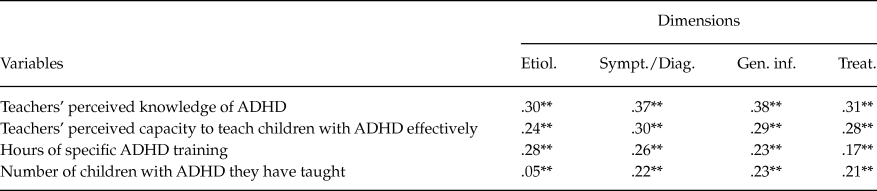
The correlations between the scores obtained by teachers in the different dimensions of the instrument and a series of variables related to the construct intended to be measured were analyzed with the aim of obtaining external validity evidence. As Table 5 shows, the data revealed statistically significant correlations between teachers’ perceived knowledge of ADHD and the scores obtained by teachers in all four dimensions of the questionnaire (ranged between r = .30 and r = .38, p = .001 in all cases). Moreover, statistically significant correlations were also observed between the teachers’ perceived capacity to effectively teach children with ADHD and the scores obtained by educators in the dimensions «General information about ADHD» and «Symptoms/Diagnosis of ADHD» (r = .29, p = .001 and r = .30, p = .001, respectively). However, variables such as having taken specific ADHD training and the duration of it, having children with ADHD in classrooms through teaching career or the number of children with ADHD they have taught did not show the expected relationships.
Correlations between participants’ scores on the MAE-TDAH dimensions and other variables

** p < .001
Discussion
The purpose of this study was the elaboration of a valid and reliable instrument to measure infant and primary teachers’ knowledge of ADHD. Both qualitative and quantitative methods were used to that aim. We thus started with a consultation with experts so as to guarantee content validity in the setting up of the questionnaire. Then, various quantitative analyses were carried out in order to examine the instrument’s dimensionality, internal consistency and temporal stability and to obtain evidence of both its convergent and external validity.
Following an exhaustive review of the literature on the existing instruments used to measure teachers’ knowledge of ADHD, it is worth noting that the MAE-TDAH is one of few instruments which has undergone a rigorous process to guarantee its content validity. Also noteworthy is the fact that there is no other instrument with a similar aim in the scientific literature which has published evidence of its factor structure. In this study the dimensionality analysis allows for the proposal of a 4 factor internal structure: a) Etiology of ADHD; b) General information about ADHD; c) Treatment of ADHD; and d) Symptoms/Diagnosis of ADHD. In addition to that, reliability analyses have shown that all four factors show good indices of internal consistency and temporal stability. Moreover, convergent validity was examined by calculating the existing correlations between the comparable dimensions of the MAE-TDAH and the Spanish adaptation of the KADDS (Jarque et al., Reference Jarque, Tárraga and Miranda2007). These analyses gave proof of convergent validity.
In terms of external validity, it should be noted that the knowledge infant and primary teachers have on different aspects of ADHD correlates with variables such as teachers’ perceived knowledge of ADHD and perceived capacity to effectively teach children with ADHD. Part of these results are in line with those obtained by Jarque et al. (Reference Jarque, Tárraga and Miranda2007), who note that the scores obtained by teachers in the different sub-scales of the Spanish version of the KADDS correlate with their perceived capacity to effectively teach children with ADHD variable, among others. It should also be noted that the highest correlations between the different dimensions of the MAE-TDAH and the sociodemographic variables analyzed are observed in the Symptoms/Diagnosis and General information dimensions, results that concur with the existing literature on the subject (e.g. Sciutto et al., Reference Sciutto, Terjesen and Bender2000). This is probably due to the fact that, as Anderson, Watt, Noble, and Shanley (Reference Anderson, Watt, Noble and Shanley2012) point out, the contents covered by the Symptoms/Diagnosis and General information dimensions stand out more in the classroom than the rest of the aspects of ADHD.
On the other hand, variables that in several studies have shown relationships with the teachers' knowledge on ADHD, that is, variables such as previous training in ADHD (Jerome et al., Reference Jerome, Gordon and Hustler1994; Perold, Louw, & Kleynhans, Reference Perold, Louw and Kleymhans2010; Vereb & DiPerna, Reference Vereb and DiPerna2004; West et al., Reference West, Taylor, Houghton and Hudyma2005) or previous contact with children with ADHD (Jarque et al., Reference Jarque, Tárraga and Miranda2007; Kos et al., Reference Kos, Richdale and Jackson2004; Perold et al., Reference Perold, Louw and Kleymhans2010; Sciutto et al., Reference Sciutto, Terjesen and Bender2000), have not shown the expected relationships. The fact that a high percentage of the teachers who took part in this research declared that they had received little training in ADHD and had had little contact with the children with ADHD has probably influenced these results.
Another significant finding is that the main sources of information on ADHD for teachers are people from their environment and the media, data that Ghanizadeh et al. (Reference Ghanizadeh, Bahredar and Moeini2006) already pointed out in a previous study. In this respect, it should be noted that in order to obtain reliable information on ADHD, it would be preferable for the teachers to seek this information in books, scientific and professional journals, at courses or conferences given by experts in ADHD, or from professionals external to their workplace who deal with their pupils and who are specialized in the subject.
It should be pointed out that the sample used for the validation of the MAE-TDAH was very broad and it was randomly selected. Few instruments in this area meet either one or both of these conditions. Added to that, we opted for a three-option format answer (True, False, Don’t know), which lowers false positives and allows for the differentiation of right answers, false beliefs and knowledge gaps (Jarque et al., Reference Jarque, Tárraga and Miranda2007; Kos et al., Reference Kos, Richdale and Hay2006; Sciutto et al., Reference Sciutto, Terjesen and Bender2000).
Even though we worked with a random sample, we cannot overlook the fact that it is fairly homogeneous in terms of geography (two Autonomous Communities in the north of Spain). Therefore, it would be interesting to extend the study to participants from other Autonomous Communities of the state. It should also be noted that the evidence obtained regarding the external validity of the measure was modest.
These limitations notwithstanding, based on the data obtained in the process of validating the MAE-TDAH, it can be stated that this questionnaire offers sufficient guarantees to measure teachers’ knowledge of ADHD adequately. As mentioned in the introduction, many of the instruments used for similar purposes show methodological deficiencies (Soroa et al., Reference Soroa, Balluerka, Gorostiaga and Norvilitis2012; Soroa et al., Reference Soroa, Gorostiaga, Balluerka and Banerjee2013), while the MAE-TDAH has adequate psychometric properties. This feature makes it possible to assess teachers’ knowledge of ADHD in a reliable and valid fashion and, if necessary, to design and implement training programs tailored according to the needs of users.
Socio-demographic variables questionnaire
Please answer the questions in this section by filling in the blanks or with an “X” in the correct place. Read all the questions and make sure you do not skip any.
-
1. PERSONAL INFORMATION
-
1.1. Age: ______
-
1.2. Sex: □ Male □ Female
-
-
2.. TEACHING EXPERIENCE
-
2.1. Which stage(s) do you teach?
-
□ Infant education only
-
□ Primary education only
-
□ Both
-
-
2.2. What is your specialization?
-
□ Infant education
-
□ Primary education
-
□ Special education
-
□ Foreign language
-
□ Music
-
□ Physical education
-
-
2.3. How many children are you teaching this year? __________
-
2.4. How long have you been working as a teacher? _________
-
-
3. TRAINING
-
3.1. Have you ever received specific ADHD training? □ Yes. □ No. If your answer is Yes, please indicate where:
-
□ Teacher Training Course subjects
-
□ Postgraduate or Master’s studies
-
□ Continuing education courses
-
□ Talks or conferences
-
□ Family associations of children with ADHD
-
□ Others (specify): ________________________________
-
-
3.2. State the approximate number of hours of ADHD training you have received: ____________
-
3.3. Have you received any other information about ADHD? □ Yes. □ No. If your answer is Yes, state how you have been informed:
-
□ People around you: family, friends, colleagues, etc.
-
□ Parents of children with ADHD
-
□ Professionals outside your work environment treating your pupils: psychiatrists, clinical or educational psychologists, pediatricians, neurologists, etc.
-
□ Family associations of children with ADHD
-
□ Books
-
□ Scientific or professional journals
-
□ Mass media: T.V., internet, radio, newspapers, informative magazines, etc.
-
□ Others (specify): ________________________________
-
-
If you had to choose one of the above, which would you say most frequently provided you with information about ADHD? ________________________________________________________________
-
-
4. EXPERIENCE OF PEOPLE WITH ADHD
-
4.1. Have you ever taught a child diagnosed with ADHD? □Yes □ No.
-
If your answer is Yes, how many children diagnosed with ADHD have you taught during your career? ___________
-
4.2. Do you know anybody with ADHD (child or adult) outside your work environment? □ Yes □ No
-
-
5. PERCEIVED KNOWLEDGE
-
5.1. How would you describe your level of knowledge about ADHD? (put an “X” where appropriate):
-

-
6. PERCEIVED TEACHING CAPACITY
-
6.1. How would you describe your capacity to teach children with ADHD? (put an “X” where appropriate):
-