Self-silencing is a tendency to suppress the expression of thoughts and opinions within a romantic relationship, and it affects the way people perceive and interpret their relationships and their actions (Jack & Dill, Reference Jack and Dill1992). Withholding self-expression has been associated with difficulties in handling romantic relationships in adolescence and emerging adulthood (Harper, Dickson, & Welsh, Reference Harper, Dickson and Welsh2006; Harper & Welsh, Reference Harper and Welsh2007). However, there is comparatively little research on the longitudinal associations between self-silencing in adolescence and handling romantic relationships in emerging adulthood. In addition, previous research has not examined possible changes in self-silencing over time and the extent that such changes might be associated with future outcomes. The present study examines the longitudinal associations between self-silencing measured at age 16 and changes in self-silencing from ages 16 to 23. Additionally, this study examines the quality of future romantic relationships and capacity to cope with romantic stress at age 23.
Self-Silencing and Romantic Experiences
Self-silencing theory (Jack, Reference Jack1991) posits that individuals who initiate and maintain romantic relationships in self-suppressing ways are more likely to experience difficulties in their romantic relationships. Self-silencing individuals suppress their personal voice and opinions due to the fear that self-expression would lead to dissolution of the relationship and a loss of the romantic partner (Jack, Reference Jack1991). This inhibition of self-expression inevitably leads to the individual's ‘loss of self’ within the relationship. The individual is then forced to present a contrived self in order to increase intimacy, which subsequently interferes with the possibility to manage relationships competently and develop a mature and intimate relationship (Jack & Dill, Reference Jack and Dill1992).
Although self-silencing behaviour has been described as specific to romantic relationships, elaborating on Jack's (Reference Jack1991) conceptualisation, Smith, Welsh, and Fite (Reference Smith, Welsh and Fite2010) discuss self-silencing as part of one's ‘relational schema’ or ‘lens’ through which relationships are viewed. Although not exactly a personality trait, self-silencing is a lens through which relationships are viewed, and it affects how people perceive and interpret their relationships and the actions and intentions of their romantic partners.
Relational schemas are activated during interactions between romantic partners and, in particular, among adolescents (Smith et al., Reference Smith, Welsh and Fite2010). Romantic involvement is a new experience for adolescents, and it can be a source of excitement and stress that is associated with enhancing or decreasing one's self-esteem (Seiffge-Krenke, Overbeek, & Vermulst, Reference Seiffge-Krenke, Overbeek and Vermulst2010). It is thus not surprising that during encounters with romantic partners, adolescents are more likely to exhibit less authentic behaviours (Neff & Harter, Reference Neff and Harter2002). It was suggested that the process of self-silencing begins in adolescence (Shouse & Nilsson, Reference Shouse and Nilsson2011; Spinazzola, Wilson, & Stocking, Reference Spinazzola, Wilson, Stocking, Collins, Dunlap and Chrisler2002) when social pressures become prevalent. Consequently, individuals tend to suppress the expression of their genuine thoughts and opinions in order to form and maintain their romantic relationships (Jack, Reference Jack1991).
Individuals who silence themselves approach relationships with behaviours such as compliance or avoidance of raising sensitive issues with their partners. Although raising disagreements or conflict might seem detrimental to a relationship, it is through discussion of disagreements that partners learn to recognise one's own and others’ needs, and how to balance closeness and independence. This, in turn, might facilitate conflict resolution and satisfaction, as well as greater competence in handling a relationship (Tuval-Mashiach & Shulman, Reference Tuval-Mashiach and Shulman2006). In contrast, withholding feelings is likely to undermine effective handling of conflicts and result in increasing dissatisfaction among partners (Galliher & Bentley, Reference Galliher and Bentley2010).
Competent discussion and handling of conflict can also enhance the capacity to flexibly experience and express a range of emotions that romantic partners have to cope with in their interactions (Shulman, Davila, & Shachar-Shapira, Reference Shulman, Davila and Shachar-Shapira2011). This capacity is important for learning to cope constructively with stressors and for inhibiting inappropriate responses (Fabes, Hanish, Martin, & Eisenberg, Reference Fabes, Hanish, Martin and Eisenberg2002). For example, suppression of emotion may prevent coping with a breakup that is then likely to remain incomplete or be prolonged, and might lead to increasing feelings of distress. In contrast, expression of emotions and their adaptive regulation can ease stress and facilitate recovery. Furthermore, adaptive coping with emotions may facilitate ‘positive psychological change’ as a result of having the capacity to perceive a stressful event in a comprehensive manner and draw a lesson for future challenges (Tedeschi & Calhoun, 2004).
Research indicates that adolescents who silence themselves experience lower relationship satisfaction, probably stemming from their tendencies to avoid conflict (Remen, Chambless, & Rodebaugh, Reference Remen, Chambless and Rodebaugh2002), approach conversations with their romantic partners passively (Witte & Sherman, Reference Witte and Sherman2002), and are more likely to perceive negative outcomes in their interactions (Smith et al., Reference Smith, Welsh and Fite2010).
The tendency to self-silence can become a stable pattern and evolve into a negative relationship schema, which could explain its persistence over time and its impact on future relationships (Hankin et al., Reference Hankin, Oppenheimer, Jenness, Barrocas, Shapero and Goldband2009). Relatedly, both theory and empirical research have suggested that experiences in romantic relationships during adolescence serve as a model for future relationships (Furman & Collibee, Reference Furman and Collibee2014; Williams & Russell, Reference Williams and Russell2013). Within their romantic experiences, adolescents are expected to learn how to interact with romantic partners, experience emotional and sexual intimacy, and above all, navigate a range of emotionally charged interactions. In a similar manner, an adolescent might develop a pattern of self-silencing.
Past research has examined only the short-term correlates of self-silencing among adolescents (e.g., see Smith et al., Reference Smith, Welsh and Fite2010). Extending past research, the current study examines the detrimental effects of self-silencing during adolescence on the quality of a future relationship. The longitudinal effects of self-silencing can be expected to be expressed both in the quality of a future relationship and in the competence to cope with inevitable relationship stressors. Earlier tendencies to silence oneself are thus likely to be associated with future low confidence in the relationship and to continue silencing oneself. It is also reasonable to assume that such relationships will be less supportive. Considering the detrimental effects of self-silencing on the capacity to regulate emotions (Fabes et al., Reference Fabes, Hanish, Martin and Eisenberg2002: Shulman et al., Reference Shulman, Davila and Shachar-Shapira2011), the current study also examines the long-term effects of self-silencing on coping with relationship stressors such as breakup and the capacity to recover from a breakup.
Changes in Self-Silencing
Relationship schema have been described as rigid cognitive structures that filter social and affective information about events, and are associated with the responses individuals employ (Hankin et al., Reference Hankin, Oppenheimer, Jenness, Barrocas, Shapero and Goldband2009). However, there is also evidence that changes over time can occur together with stability (Hankin, Reference Hankin2008). Relational experiences might lead to the exacerbation or decrease of relational vulnerabilities over time; for example, peer victimisation was found to lead to the exacerbation of relational vulnerabilities (Haines, Metalsky, Cardamone, & Joiner, Reference Haines, Metalsky, Cardamone, Joiner, Joiner and Coyne1999) and greater difficulties attending to and coping with the maintenance of relationships. In contrast, positive experiences with a partner might lead to greater confidence to handle a relationship.
In the last two decades, longitudinal research in personality development shows that young people typically progress in positive directions while making the transition to adulthood (Roberts & Davis, Reference Roberts and Davis2016; Specht, Egloff, & Schmukle, Reference Specht, Egloff and Schmukle2011). Over time, most people become more agreeable, conscientious, and emotionally stable in young adulthood (Roberts & Davis, Reference Roberts and Davis2016). Additionally, increases in measures of constraint have also been observed during this transitional period of life (Donnellan, Conger, & Burzette, Reference Donnellan, Conger and Burzette2007). While these changes could be attributed to maturational processes, Roberts and Davies (Reference Roberts and Davis2016) argue that they result from an increase in social interactions and social investment, as well as the assumption of an adult role.
The majority of the studies on personality change assessed changes in the Big Five measures. Recently, Hafen, Spilker, Chango, Marston, and Allen (Reference Hafen, Spilker, Chango, Marston and Allen2014) documented a decrease in rejection sensitivity between adolescence and emerging adulthood. Both rejection sensitivity and self-silencing are not personality traits; instead, they are relational schemas that have much in common. For example, Smith and colleagues (2010) found a significant correlation between the two constructs. Conceptually, both self-silencing and rejection sensitivity are driven by individuals’ concerns regarding rejection. Individuals high on rejection-sensitivity may try to prevent rejection by silencing aspects of the self and inhibiting behaviours that might jeopardise the acceptance of others whose acceptance and support is both valued and doubted (London, Downey, Romero-Canyas, Rattan, & Tyson, Reference London, Downey, Romero-Canyas, Rattan and Tyson2012). Rejection-sensitive individuals are also likely to display compliant behaviours, such as suppressing a differing opinion, in an attempt to prevent the perceived anticipated rejection (Harper et al., Reference Harper, Dickson and Welsh2006; Thomas & Bowker, Reference Thomas and Bowker2015). Indeed, in following their adolescent participants for a period of 4 years, Hafen and colleagues documented a significant decrease in the level of rejection sensitivity over time. Moreover, the decrease in rejection sensitivity predicted the quality of romantic relationships of young adult partners above and beyond the contribution of the initial level of rejection sensitivity (Hafen et al., Reference Hafen, Spilker, Chango, Marston and Allen2014). Considered together, we may assume that similar changes in self-silencing across time can also be expected.
Considering the conceptual similarity between self-silencing and rejection sensitivity, it is reasonable to assume that during the transition to adulthood, a decrease in self-silencing can also be expected (Hafen et al., Reference Hafen, Spilker, Chango, Marston and Allen2014). During the transition to adulthood, individuals become involved in new and different romantic encounters that have the potential for changes and even decreases in the magnitude of self-silencing in emerging adulthood (Robert & Davies, Reference Roberts and Davis2016). In turn, decreases in self-silencing are likely to be associated with higher quality of romantic relationships and greater capacity to cope with, and overcome, relational stressors.
The following hypotheses were formulated:
1. We expect to find a decrease in the level of self-silencing between age 16 and age of 23.
2. Self-silencing at age 16 will be associated lower quality of future romantic relationships (greater concealment from one's partner, less certainty in one's relationships, and less partner support) and a lower ability to cope with romantic stressors (greater breakup distress and a decreased posttraumatic growth) at age 23.
3. Decreases in the level of self-silencing between the age of 16 and the age of 23 will be associated with a higher quality of future romantic relationships (less concealment from partner, greater certainty in one's relationships, and higher partner support) and a higher ability to cope with romantic stressors (lower breakup distress and greater post distress growth) above and beyond the contribution of the initial level of self-silencing measured at age 16.
Method
Participants and Procedure
Eleventh- and 12th-graders who were recruited from three schools in the centre and the north of Israel were included in the study. Participants were included in the study after parental consent was given. The response rate after receiving parental consent was 60%. The current sample of the age 16 assessment consisted of 144 adolescents (86 females, 58 males; mean age = 16.57 years, SD = .71, range = 16–18 years). All of the participants were from schools representing mainly middle-class families. Mean years of schooling for fathers and mothers were 15.37 years (SD = 2.59) and 15.58 years (SD = 3.40) respectively. Twenty-one adolescents (14.58%) belonged to divorced families.
Seven years later, for the age 23 assessment, 110 participants were recruited (76.4%; 68 females, 42 males; mean age = 22.79 years, SD = .86, range = 21–25 years). In order to assess relationship quality, participants were asked to report on the quality of a current relationship in which they were involved at the time of the study, or on a recent relationship in which they were involved. There were no differences between those who participated in the first assessment and those who dropped out on any of the demographic variables or on self-silencing. Participants were compensated at each assessment with a sum of 100 NIS (about USD25.00). All procedures were approved by the university's Institutional Review Board. The questionnaires were administered in Hebrew using Brislin's procedure for translation.
Measures
Age 16 assessment (Time 1). Self-silencing
The Self-Silencing Questionnaire (Jack, Reference Jack1991) was used to assess self-silencing. This is a nine-item scale assessing the extent to which adolescents inhibit self-expression in order to avoid conflict or possible dissolution of an intimate relationship (e.g., ‘I don't speak my feelings in an intimate relationship when I know they will cause disagreement’). Items are rated on a scale from 5 (strongly agree) to 1 (strongly disagree). In the current study, Cronbach's alpha at the age 16 assessment was .88.
Age 23 assessment (Time 2)
First, participants were asked to indicate whether they are currently involved in a romantic relationship and the length of this relationship. Subsequently, the following questionnaires were completed.
Self-silencing
The Self-Silencing Questionnaire was administered again. The Cronbach's alpha for the age 23 assessment was .83.
Relationship quality. Concealment
This scale consists of five items assessing self-concealment from one's partner (Larson & Chastain, Reference Larson and Chastain1990). Participants rated items such as ‘There are lots of things about me that I keep from my romantic partner’ on a 1 (strongly disagree) to 5 (strongly agree) scale. Cronbach's alpha was .91.
Relationship certainty
Relationship certainty was adapted from Kellermann and Reynolds (Reference Kellermann and Reynolds1990). This scale consists of nine items that measure a couple member's general confidence in predicting his or her partner's current interest in, and future visions for, the relationship (e.g., ‘How confident are you of your partner's interest in this relationship?’). Items were rated on a scale from 1 (not confident) to 5 (highly confident). Cronbach's alpha for the scale was .91.
Perceived romantic partner support
A shortened version of the Network of Relationship Inventory (NRI; Furman & Buhrmester, Reference Furman and Buhrmester1985) assessed perceived romantic partner support. Participants rated (from 1 = low to 5 = high) the quality of support across eight items (i.e., ‘I can rely on …’). Cronbach's alpha for the current sample was .87.
Responses to relationship stress. Breakup distress
The Breakup Distress Scale (BDS; Field, Diego, Pelaez, Deeds, & Delgado, Reference Field, Diego, Pelaez, Deeds and Delgado2010) is a 16-item inventory that assesses the intensity of distress and preoccupation with an ex-partner following a romantic breakup (i.e., ‘I feel I cannot accept the breakup I've experienced’). Responses ranged from 1 (not at all) to 4 (very much so) and Cronbach's alpha in the current study was .94. Participants were asked to report a recent breakup or any other breakup they had experienced in the past.
Posttraumatic growth
This scale was patterned according to Tedeschi and Calhoun's (Reference Tedeschi and Calhoun1996) Posttraumatic Growth Inventory and assessed the capacity to overcome distress following difficult events. Participants were asked to assess the extent of change they had made and their feelings following stressful events in their romantic relationships such as breakups or an intense conflict. It consisted of two subscales: Changes concerning oneself (i.e., intrapersonal growth; e.g., ‘I have learned that I have the capabilities to cope with difficulties’), and Changes with regard to relationships (i.e., interpersonal growth; e.g., ‘I feel greater closeness with others’). The first subscale consisted of seven items and its internal consistency was .83. The second subscale consisted of three items and its internal consistency was .79.
Analytic Plan
A series of regression analyses were conducted to assess predictors of perceived relationship involvement, quality, and coping with romantic stressors at the age of 23. Gender was entered at the first step to control possible effect of gender. Level of self-silencing at age 16 was entered at the second step. At the third step, romantic status (1 = not in a relationship, 2 = currently in a relationship), along with the length of a current romantic relationship, were entered to control the possible effect of a current romantic involvement on the outcome measures. Finally, the change in self-silencing between the first assessment at age 16 and the second assessment at age 23 (the residual) was entered at the fourth step (both times were self-evaluated). For this purpose, the residual of the change in the level of self-silencing between the two assessments was computed. A residual greater than predicted level of self-silencing at Time 2 indicates increases in self-silencing over time.
Results
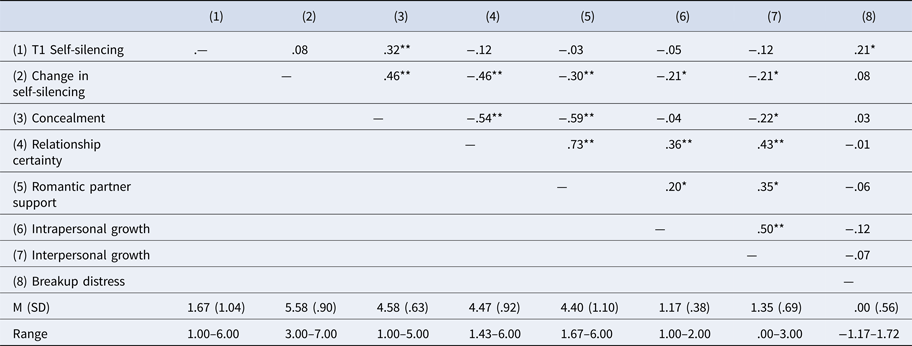
Correlations among variables are presented in Table 1. Prior to the analysis of the study questions, we compared levels of self-silencing at age 16 and at age 23. In line with the first hypothesis, the difference between self-silencing during adolescence and during emerging adulthood was significant, M = 1.35 (SD = .69) versus M = 1.08 (SD = .59); t = 18.69, p < .0001. Thus, self-silencing decreased with age.
Correlations Among All Variables

Note: *p ≤ .05, **p ≤ .01.
Relationship Quality
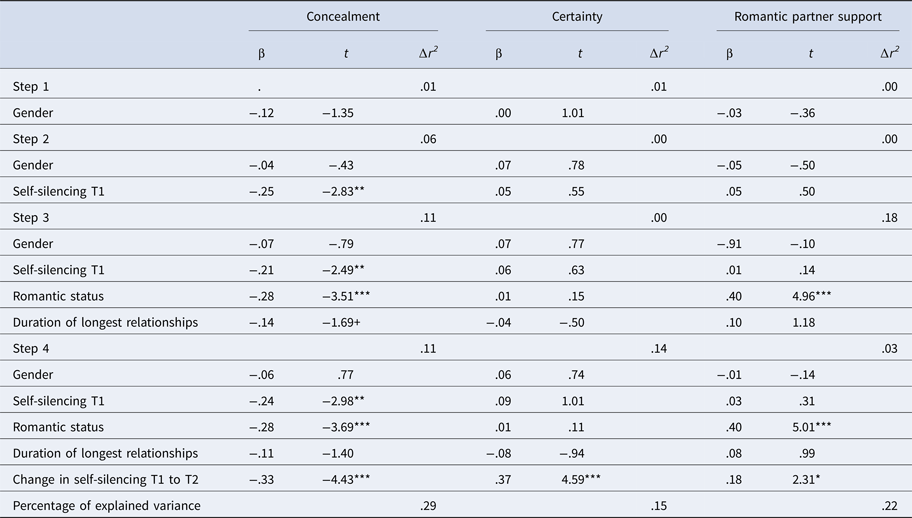
Regression analyses were conducted separately, with the initial level of self-silencing at age 16 and changes in self-silencing from Time 1 and Time 2 as the predictors of relationship quality: (a) relationship certainty, (b) concealment, and (c) perceived romantic partner support, each as the outcome variables. These results are presented in Table 2. Results showed that initial level of self-silencing measured at age 16 significantly predicted greater concealment at age 23. In addition, romantic status at age 23 (entered as control variables) were associated with lower level of concealment and higher level of romantic support. Finally, a decrease in self-silencing significantly and positively predicted higher partner support and relational certainty and less concealment above and beyond the prediction of the initial level of self-silencing at age 16, controlling for the romantic status at age 23 and the length of the current relationship.
Prediction of Relationships’ Qualities

Stress and Posttraumatic Growth
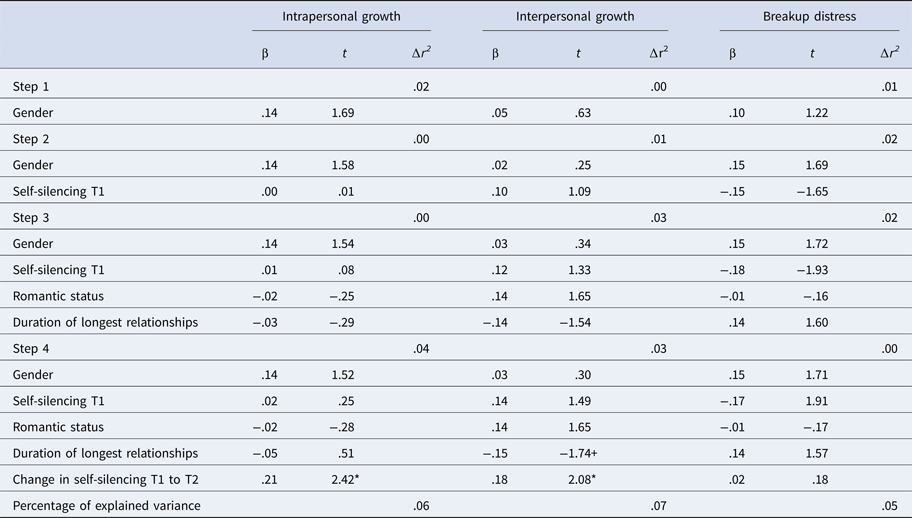
Regression bootstrapping analyses were conducted separately, with the initial level of self-silencing at age 16 and changes in self-silencing from Time 1 and Time 2 as the predictor variables and (a) breakup distress, (b) intrapersonal growth following a relationship stressor, and (c) interpersonal growth following a relationship stressor each as the outcome variables. These results are presented in Table 3. Results showed that decreases in self-silencing were associated with increased intrapersonal growth and interpersonal growth following conditions of romantic stress. Finally, changes in self-silencing did not explain intensity of breakup distress at age 23.
Prediction of Relationships’ Qualities

Note: +p < .10, *p ≤ .05, **p ≤ .01, ***p ≤ .001.
Taken together, in line with our hypotheses, both self-silencing at Time 1 and the decrease in self-silencing from Time 1 and Time 2 explained the quality of romantic involvement at age 23. Comparing the contribution of the two indices of self-silencing showed two important distinctions (see Table 3). Compared to the long-term impact of self-silencing, the influence of a decrease in the level of self-silencing was found across more aspects of relationship quality and was the only predictor of posttraumatic growth. The decrease in the level of self-silencing explained between about 8% to 26% of the variance of the different features of relationship quality.
Discussion
Our findings showed that self-silencing at age 16 and, in particular, a decrease in self-silencing between the age of 16 and the age of 23 predicted relationship quality by age 23. The price paid for silencing one's voice was also evident in the greater difficulty of coping with and recovering from stressful events within a relationship during emerging adulthood. The impact of self-silencing on the quality of a future relationship is understood because it interferes with the capacity to handle a relationship competently. The current findings complement previous research in two ways. Previous research has demonstrated that difficulties in romantic interactions during adolescence can contribute to maladaptive relational behaviours during adulthood (Donnellan, Larsen-Rife, & Conger, Reference Donnellan, Larsen-Rife and Conger2005). This study is the first to show the longitudinal effects of self-silencing — a relational pattern expressed in the context of romantic relationships in adolescence — and its effect on future relationships. The additional novel and important contribution of the current findings is that the earlier patterns of self-silencing also change across time, and these changes in self-silencing have an additional significant impact on future outcomes.
Our findings demonstrate the longitudinal effects of relational vulnerabilities on the quality of future relationships and can be embedded within the clinical psychology framework. Importantly, our findings are more complex. The clinical literature discusses the extent to which the initial level of a negative cognitive style, such as negative attitudes, affect future depressive symptoms (Hankin et al., Reference Hankin, Oppenheimer, Jenness, Barrocas, Shapero and Goldband2009). The longitudinal effects of self-silencing measured 7 years earlier were, however, quite modest and associated only with higher future concealment in relationships. In contrast, it was the decrease in self-silencing over time that was associated with a few future outcomes in the quality of romantic relationships and the ability to cope with and recover from relational stressors. Notwithstanding the continuation of earlier patterns of behaviour learned during adolescence (Furman & Collibee, Reference Furman and Collibee2014), it is also important to note that ‘relational schema’ might change during the transition to adulthood, decreasing the intensity of a relational vulnerability, which in turn will affect the quality of a future romantic relationship (Hafen et al., Reference Hafen, Spilker, Chango, Marston and Allen2014). Conceptually, the decrease in the intensity of a relational vulnerability can be attributed to the changes taking place during the transition to adulthood.
During emerging adulthood, young people are theorised to explore, expand their identities, and experiment with a variety of different behaviours (Arnett, Reference Arnett2015). Relationships with parents undergo significant changes during emerging adulthood with regard to housing, closeness, support, and intimacy (Lowe & Dotterer, 2017). In addition, the world of attending high school and living with one's parents, for example, is quite different from attending college or joining the workforce, where individuals interact with people from a diversity of backgrounds and young people are exposed to new experiences (Bryant, Reference Bryant2003). Focusing on parent-child relationships, Lowe and Dotterer (2017) argued that these changes in parent-child relationships increase the awareness of family members to one another's separate needs and priorities, while maintaining their relationship. The increasing awareness of one another results in greater synchronisation between parents and children, and relationships are more beneficial. In his description and theory of emerging adulthood, Arnett (2004) suggested in addition to the changes in parent-child relationships, changes at work or in college can also lead to a broader understanding of the relationships one has with family, friends, and romantic partners. This increased awareness of self and others can explain the change in self-silencing found in the current study. Relatedly, emerging adulthood has been described as the time during which personality characteristics change significantly, and young people tend to become more emotionally stable and conscientious, and less negative (Roberts & Davis, Reference Roberts and Davis2016). In their theory of personality change, Roberts and Davis (Reference Roberts and Davis2016) similarly attributed the changes in personality to increases in ‘social investment’. The greater involvement with others at work or in a romantic relationship, as well as assumption of an adult role, can facilitate achieving a more comprehensive understanding of self and others. It can additionally enable the individual to give meaning to people's behaviours and to understand others’ thoughts and feelings (Fonagy, Gergely, Jurist, & Target, Reference Fonagy, Gergely, Jurist and Target2002), as well as explain personality changes such as lower neuroticism. Though self-silencing like rejection sensitivity is not a personality trait (Jack, Reference Jack1991; Smith et al., Reference Smith, Welsh and Fite2010) it seems that increasing different experiences with parents, friends, and romantic partners facilitate developing a more mature and competent attitude toward relationships, which in turn leads to decrease in self-silencing.
Limitations and Future Directions
This study included several limitations. Our study was limited by its focus on one romantic partner's perspective. Including dyadic data and/or observational data would provide a more nuanced understanding of the ways self-silencing affects romantic partners both individually and relationally. While our findings described changes in self-silencing and their impact on future relationships, our data is short of informing us as to the factors that can explain a decrease or increase in self-silencing over time. Participants who were not romantically involved at the time of the second assessment at age 23 reported on the quality of a previous relationship. Additionally, retrospective reports on a relationship that had dissolved could be coloured by biases against a former partner.
This sample included Israeli youth. Israel is a Western culture, and when making the transition to adulthood, young Israelis face dilemmas and uncertainties similar to those of their counterparts in other Western countries (Mayseless & Scharf, Reference Mayseless and Scharf2003). However, young Israelis are subjected to a military service of two or three years. During military service, young people might develop close friendships and these may contribute to their future confidence to establish close relationships. Future studies could indicate whether the pattern of our findings would be replicated in a different culture.
Implications
Our findings have several implications when considering the romantic lives of young people. It is important to consider the relationship vulnerabilities of adolescents for whom behavioural patterns or schema such as self-silencing might be carried forward into encounters and affect future romantic interactions. Self-silencing may easily be overlooked given its subtle, hidden nature. Indeed, choosing to suppress an opinion on occasion might not be inherently detrimental, but individuals who self-silence on a regular basis and those partners who respond poorly to their partner's seeming lack of awareness or self-expression might be hiding larger relationship issues (Harper & Welsh, Reference Harper and Welsh2007). Thus, educators and clinicians who work with adolescents and emerging adults might benefit from assessing and challenging this schema, to help young people build and foster alternative romantic frameworks. Given the general malleability of self-silencing, relationship and therapeutic interventions can serve to bolster adaptive qualities in romantic relationships. It would be beneficial to include discussions about how characteristics such as self-silencing can affect romantic interactions following mate selection.
In sum, the present study demonstrated the longitudinal effects of self-silencing and decreases in self-silencing over a 7-year period on the quality of future romantic relationships, and the capacity to cope with and recover from relationship stressful events. Previous research has demonstrated the longitudinal effects of earlier romantic experiences (Furman & Collibee, Reference Furman and Collibee2014) as well as relational vulnerabilities (Hafen et al., Reference Hafen, Spilker, Chango, Marston and Allen2014) on future romantic outcomes. Our findings point to the importance of examining possible changes in the relational pattern or schema of self-silencing during adolescence, as self-silencing might change during the transition to adulthood and decrease the impact of the earlier relational vulnerability.
Acknowledgments
This study was supported by the Israeli Ministry of Health — Grant # 6412/12 and the Ben Dov Chair in Youth Psychology given to Shmuel Shulman.