Introduction
What causes imperialism? The earliest theories came from Spencer (Reference Spencer1902: 180–200) and Hobson (Reference Hobson1965 [1902]) who sought to explain Britain's territorial assaults on Asia and Africa in the late nineteenth century (Semmel Reference Semmel1993: 103–30). Spencer emphasized the culture of militant nationalism. In Spencer's view, British society was undergoing a “re-barbarisation” partly manifest in a jingoist press and parliament. Imperialism was the direct result (Spencer Reference Spencer1902: 180–200). Alternatively, Hobson (Reference Hobson1965 [1902]) argued that British imperialism resulted from a build-up of excess capital. Facing underconsumption in England, financiers transferred their capital abroad. They then pressured the state to annex new territories in order to protect their investments (Hobson Reference Hobson1965 [1902]: 80). These theories in turn inspired Schumpeter's thesis of “social imperialism” (Reference Schumpeter1951) and later Marxist theories of imperialism (Arrighi Reference Arrighi1978; Harvey Reference Harvey2003; Hilferding Reference Hilferding1981; Lenin Reference Lenin1939; see Baumgart Reference Baumgart1982: 109–11; Brewer Reference Brewer1990; Mommsen Reference Mommsen1982; Semmel Reference Semmel1993: 163 for a review).
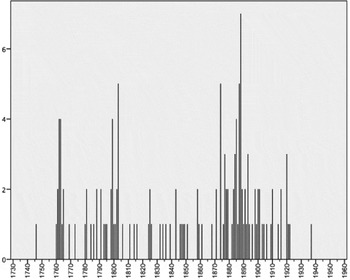
Considering that the British empire was one of the largest and most influential empires in the modern world, it is fitting that British imperialism has been the site of initial theorization. Yet three limitations impede a richer understanding. First, the Spencer-Hobson tradition overlooks the role of the imperial state. By definition, imperialism involves state action: the sort of imperialism theorized by Hobson and Spencer, that is, formal (or territorial) imperialism, means that the state declares sovereignty over foreign territory to make it a colonial dependency.Footnote 1 Yet classic theories of imperialism treat the state as little else than a siphon through which other forces flow, as if the state has no interests of its own. Second, classic theories illuminate the domestic (or “metropolitan”) factors propelling imperial expansion. We get little sense that the imperial state operates in a wider global system. Finally, classic theories and subsequent research has been silent on broader historical patterns. The original theories of Spencer and Hobson focused upon British imperialism in the late nineteenth century—the so-called new imperialism. Similarly, other studies examine particular cases of colonial acquisition or specific historical moments but not broader temporal or spatial regularities (e.g., Baumgart Reference Baumgart1982). Time-series data on the number of colonies acquired by Britain shows that British imperialism has had a longer career than existing theory and research implies (figure 1).
British colonies acquired, 1730–1960.

So what drove these imperial dynamics over the long durée? In addressing this question, the present essay develops an explanation that goes beyond the limitations of the Spencer-Hobson tradition. It shows that British imperialism was not produced by the ebbs and flows of militant nationalism, nor was it driven by internal economic requirements or the needs of financiers. It was rather produced by structural competition. Imperialism was a strategy for meeting the state's imperatives of geopolitical security (containment) and economic growth (capital) in the face of external threats. Such threats were most likely to be perceived when the global system was at its most economically competitive.
Theorizing Imperialism
The structural-competition explanation induced from the present analysis builds in part upon various works on imperialism that have already transcended the analytic confines of the Spencer-Hobson lineage. While both Spencer and Hobson emphasized domestic causes and overlooked state interests, these other studies suggest alternative approaches that highlight global factors or state imperatives. The first is a “trade regimes” approach from world-systems research. This approach has been developed to explain colonization in the entire world system rather than by an individual state (Bergesen and Schoenberg Reference Bergesen, Schoenberg and Bergesen1980; Boswell Reference Boswell1989; Chase-Dunn and Rubinstein Reference Chase-Dunn and Rubinson1979; Pollins and Murran Reference Pollins and Murran1999), but it can be adapted to also theorize British imperialism. This approach suggests that global trade patterns oscillate historically between phases of free trade and periods of mercantilism (marked by high tariffs and constricted international flows).Footnote 2 Free trade periods mean less colonization because states prefer open markets. But when free trade declines, states respond with colonization in an effort to obtain and maintain privileged access to materials and markets (Boswell Reference Boswell1989: 185). Imperialism is a functional alternative to open trading systems (Bergesen and Schoenberg Reference Bergesen, Schoenberg and Bergesen1980: 242).
Other approaches include “Realist” approaches such as Realist International Relations theory and variants (including historians’ research). These explanations bring in global factors while emphasizing state interests. In classic realism, imperialism is the result of the states’ rational pursuit of interests. All states seek to maximize power, new territory adds to states’ power, and so states naturally seek new territories. What determines whether or when states will pursue territory is their capability. States will expand when they can; that is, when they are militarily stronger than other states (Morgenthau Reference Morgenthau1978). Variants of this approach include “state-centered realism,” which emphasizes internal capabilities rather than military power. States will expand when they have the organizational capacity to do so (Zakaria Reference Zakaria1998). Alternatively, “defensive realism” asserts that states expand when they must (rather than when they can); that is, when their security is threatened (Snyder Reference Snyder1991). This latter approach surfaces in other work too. For instance, some historians suggest that Britain's new imperialism was a response to rival's colonizing activities (Baumgart Reference Baumgart1982: 39–42; Fieldhouse Reference Fieldhouse1973; Robinson and Gallagher Reference Robinson and Gallagher1961). Likewise, Abernathy (Reference Abernathy2000: 209) characterizes European expansion as “defensive aggression”: European states felt threatened when other states took territory and so responded in equal measure.
The evidence in the following text yields a different explanation: structural competition. British imperialism was not the product of finance capitalism or jingoism but was rather a state strategy to contain threats—geopolitical and economic—that arose when the global structure was at its most economically competitive. This structural-competition approach thus partly builds upon the “defensive realism” thesis and Abernathy's related theory of “defensive aggression.” But it expands them. Like these approaches, a structural-competition approach posits imperialism as a response to external threats. But unlike standard defensive realism, the structural-competition approach specifies the structural conditions under which such external threats are most likely to be felt. Abernathy (Reference Abernathy2000: 9) suggests that European states lived “in a pervasive sense of insecurity” and seized territory in direct response to other states’ “territorial advances” (209; emphasis added). Similarly, classic International Relations (IR) theory suggests that threats emerge when rival states take new territory; France takes Algeria, so England takes West Africa. Baumgart (Reference Baumgart1982: 40) suggests that the threats can be “real” or “imagined,” which leaves open the question as to when states are more likely to perceive such threats. In contrast, a structural-competition approach suggests that perceptions of threat are most likely to proliferate during specific historical phases: that is, multicentric phases defined by an economically competitive global structure.
To clarify, the idea of multicentricity draws from world-systems theory that proposes that the global economic system oscillates between two different phases (Boswell Reference Boswell1995; Wallerstein Reference Wallerstein1980, Reference Wallerstein1989). One phase is the unicentric or hegemonic phase. This is when the world system has a hegemon: one state enjoys a “preponderance over the world economy” (Boswell Reference Boswell2004: 4). During this phase, there is an unequal distribution of global economic power (with one state—the hegemon—dominating the scene). By definition, the system is not competitive. The other phase is multicentricity: there is more of an economic balance across the field (and hence the former hegemons’ economic power declines relative to other states). This means that the system is at its most competitive: unlike unicentric phases, there is no single economic “winner.” Ultimately this multicentric phase can give way to a new unicentric phase as one of the contenders becomes hegemonic (Wallerstein Reference Wallerstein and Lenski1984, Reference Wallerstein, O’Brien and Cleese2002).
How does this matter for imperialism? Multicentric phases—that is, when the system was its most economically competitive—induce the most threats (economic as well as geopolitical). Imperialism results as a state strategy to manage those threats. The threats can be either real or imagined. They might take the direct form of rival powers taking territory, but they need not take such a form. States do not respond to rival powers’ territorial advances in a one-to-one fashion. Instead, multicentricity entails a pervasive sense of insecurity: a climate of threat attendant with economically competitive environments. Imperialism is the result.
But exactly why and how? Multicentric structures cause imperialism for two reasons. First, in multicentric periods, state rulers face enhanced pressure for expansion from capitalists. By definition, during multicentric periods, capitalists operating in or who have an interest in overseas environments face consistent economic challenges from competitors. Rival firms are poised to undercut capitalists’ market share or areas of investment. Even domestic capitalists face these threats if the growing power of rivals threatens to invade domestic markets. Therefore, in this situation, capitalists are more likely to prefer direct colonial control by their home state because such control might (a) offer security for their own operations overseas in a competitive environment and (b) prevent rival firms from taking those territories to expand their power. Accordingly, during multicentric phases, capitalists will most likely pressure the state to seize colonies for economic security and defense.
Second, the state feels more threatened during multicentric phases. Even if capitalists do try to secure their economic interests through imperialism, it cannot be assumed that the state will respond affirmatively. So why might the state be interested in annexing territory? The answer is capital and containment. The first refers to revenue: states need resources to function. This means the state has an interest in imperialism that coincidentally converges with the interests of capital: states take new territory because it helps increase trade, which might help capitalists, but the new trade is taxable or might spur economic growth that in turn provides more taxable revenue (see also Abernathy Reference Abernathy2000: 206–13; Boswell Reference Boswell1989). In benefiting capitalists through imperialism, state rulers can benefit themselves. The second interest, containment, refers to security. States might expand in order to protect the integrity of their own borders (including the borders of preexisting colonial territory) against threats from other states. Colonies can help protect state borders and serve as nodal points in a military defense network. Annexing territory can also help prevent the growth or threat of rival states, keeping military opponents at bay. This interest in containment even merges with the states’ interest in capital: additional colonies might help protect existing overseas trade networks and production facilities or even promote them.
The state's interests in imperialism are heightened during multicentric phases: that is, periods of global economic competition. As increased interfirm international competition during multicentric periods threatens capitalists’ trade, so too does it threaten state revenue. More competition means more threats to taxable trade and economic growth. The state will thus seize new colonies to meet its own revenue imperatives while also meeting the interests of capitalist allies. Furthermore, multicentric periods enhance not just economic threats but also perceived geopolitical threats. As some states rise in economic strength, other states (including the rising or falling hegemon) will fear that the new upstarts will convert their economic strength to geopolitical and military strength. Annexation for geopolitical security becomes more likely in this situation. In short, during multicentric periods, not only do capitalists pressure the state to colonize, but also the state is most likely to succumb to those pressures out of its own interests.
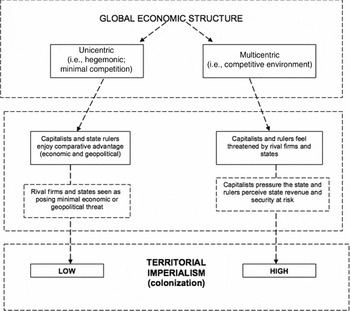
All of this, however, refers to multicentric phases of the world system. What about unicentric (or hegemonic) phases? If multicentric periods increase threats to the imperatives of capital and containment and thereby lead to heightened imperialism, unicentric/hegemonic periods lessen them, and hence reduce imperialism. First, when the hegemonic state enjoys a relative preponderance over the world economy, interfirm competition is limited and so firms enjoy a comparative advantage. Therefore, capitalists will be less likely to pressure the state to seize more territories. Because they already enjoy relative economic success, they prefer free markets. Second, even if some capitalists do pressure the state to take colonies for mercantilist privileges, the state is less likely to respond affirmatively. Because the state faces minimal competition, threats to the states’ revenue sources are likewise minimized. And because other states are economically much weaker, they pose less military threats. In short, unicentric periods render the hegemonic state more secure than otherwise. This is not to say that peace prevails or that threats do not exist. But relative to other historical periods, the threats are less: in perception if not in reality. And while these threats might be met with direct military action, they are not as serious as to demand costly military intervention and costly annexation. In short, as hegemonic capitalists enjoy an economic advantage during unicentric periods, the state enjoys a comparative geopolitical advantage during unicentric periods too. Therefore, both capitalists and state managers are more likely to pursue their interests through diplomacy or treaties rather than through the coercive and costly hand of colonialism. Hegemons, exactly because they are hegemonic, prefer the status quo—nothing broken, nothing to fix (see figure 2).
A structural-competition model.

Estimating British Imperialism
The relative explanatory power of the structural-competition approach can be assessed using time-series data. As noted, existing studies have not adjudicated the different explanations for British imperialism; they tend to focus upon short time periods or single cases of colonial annexation. Time-series data on acts of British colonialism over centuries can help here (e.g., Boswell Reference Boswell1989; Ostrom Reference Ostrom1990; Pollins and Murran Reference Pollins and Murran1999).
Dependent Variable
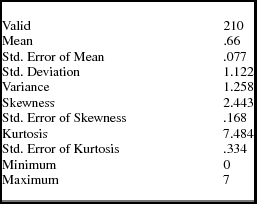
The dependent variable is an event count: the number of territories (or “colonies”) annexed by the British state per year. This comes from Stewart's encyclopedia (Reference Stewart1996) of British colonies, which offers more robust data than might be typically used, such as Henige's list (Reference Henige1970). Henige lists colonial governors appointed by all states. Scholars have used Henige's data as a rough measure of the year when a new colony was annexed, corresponding with the year when the first colonial governor was appointed. But this data does not differentiate between territories that are newly acquired and territories that are renamed or reorganized. Stewart's list, which provides a brief historical overview regarding each annexation, enables one to ascertain the year when Britain first annexed a territory and treat it as a single event. Table 1 gives descriptive statistics of the dependent variable. Figure 1 plots the variable over time.
Descriptive statistics for dependent variable: Number of colonies annexed by Britain, 1730–1939

The question is: What explains these dynamics? Existing theories have different answers that can be tested through the following independent variables.
Hobson-Lenin Thesis
According to the Hobson-Lenin thesis, British imperialism was driven by financiers seeking new outlets for investment. To capture this I enter the amount of British capital exported abroad: the net outflow of British savings into foreign assets. Economic historians offer good information for this variable in the form of the overall balance on the current account. This represents annual net foreign investment from Britain minus annual additions to bullion reserves. Economic historians typically use it to measure British overseas investment (Tiberi Reference Tiberi2005). Using this measure, the hypothesis is that the greater the amount of foreign investment, the more colonies Britain subsequently took to protect those investments. Alternatively one might argue the reverse: the state takes colonies first, investment follows. But this is not the Hobson-Lenin thesis. In their theory, financial investment comes first and annexation follows. Both Hobson and Lenin suggest the new imperialism was driven by financiers who had already invested abroad and then pressured the state to colonize afterward (Brewer Reference Brewer1990: 73; Eckstein Reference Eckstein1991: 303–5; Hobson Reference Hobson1902: 63). In any case, the tests correct for this also, as discussed in the following text.
Militant Nationalism
I test the Spencer-Schumpeter alternative thesis that militant nationalism drove imperialism by using two measures. The first is the proportion of the population in the armed forces. This is a useful measure of Spencer and Schumpeter's concept of a warlike culture or “re-barbarization.” According to Spencer and Schumpeter, one key element of re-barbarization is the spread of militaristic attitudes and practices throughout the nation. The proportion of the population in the armed forces is a good measure of this, for Spencer referred to the growth of the military as an indicator of the growth of military culture throughout British society (Reference Spencer1902: 113). While the proportion of the population in the entire armed forces (both the army and navy) would be the ideal measure, especially considering the prominence of the British Navy, that data is only available from 1815 onward. The proportion of the population in the army is used instead because data is available for much further back in time. This should not be problematic; the available data show that army and navy membership is significantly correlated (Pearson r = .471 sig. at .001).
The other aspect of the Spencer-Schumpeter thesis is nationalism; or more precisely, “jingoism” in the popular press. To capture this, the number of articles in The London Times with the phrase “our empire” is used. The Times was the main periodical for the social groups that are identified by Spencer as the leading jingoists: educated upper classes, journalists, and statesmen. It is probably the only quantifiable source capturing the discursive consciousness of those groups. The phrase “our empire” is selected because scholars agree that the term empire during the late eighteenth and nineteenth centuries was a mark of pride and distinction. It was not primarily used to refer to Britain's overseas colonies but to Britain's strength and power (Koebner and Schmidt Reference Koebner and Dan Schmidt1964: 33–46; Portner Reference Porter2004). It is reasonable to suggest that the more the phrase “our empire” was uttered among the leading classes, the more jingoist they were. The hypothesis: the greater the proportion of articles using “our empire” and/or the higher the proportion of the population in the armed forces, the more colonies were taken.
Realist Theory
Classic realism posits that the greater the states’ capabilities relative to other states, the more expansionist it will be. One common measure is Modelski and Thompson's “world leadership” measure. Showing that state relative capabilities correlate with relative naval power, Modelski and Thompson construct an index of relative sea power for each state in the system from the sixteenth century onward to capture the relative distribution of state capabilities across the system at any given time (Modelski and Thompson Reference Modelski and Thompson1988, Reference Modelski and Thompson1996).Footnote 3 Classic realism predicts a positive relationship between this variable and colonization. The other variant of realism (state-centered realism) proposes that states will expand when they have the administrative capabilities to do so. A standard measure is tax revenue per capita (Organski Reference Organski1984). Another measure is the states’ internal military capacity measured by the proportion of state spending devoted to military spending. One or both of these variables should be positively associated with annexation if state-centered realism is correct.
The other relevant realist theory is “defensive realism.” This theory suggests that states respond to threats with imperialism and define threats as the territorial advances of other states. It can be operationalized by measuring the number of colonies per year taken by other states. The hypothesis: the more other states took colonies, the more Britain seized other territory for itself in response.
World Systems Trade Regime Theory
As noted, a “trade regime” variant of world-systems research theory proposes that imperialism is a functional alternative to free markets/open trade. For this I use the actual amount of cross-national trade in the system, that is, trade globalization. Chase-Dunn et al. (Reference Chase-Dunn, Kawano and Brewer2000) have developed this measure to capture the amount of trade between states in the system. According to the theory, the amount of interstate trade in the system should be negatively related to colonization.
Structural Competition
According to the structural-competition theory, the state will expand during multicentric phases (i.e., competitive phases) and will be less interested during unicentric periods. Note that this is different from cycles of “hegemony” or “world leadership” by some scholars (e.g., Modelski and Thompson Reference Chase-Dunn, Kawano and Brewer1996, Reference Modelski and Thompson1988) who define historical phases in terms of military capabilities and technological capabilities. The phases for structural-competition theory refer to the relative distribution of economic power in the world system. Accordingly, the perfect measure would be share of world gross domestic product. Estimates for this come from Chase-Dunn et al. (Reference Chase-Dunn, Kawano and Brewer2000) but unfortunately the data does not cover an extended time frame. A commonly used alternative is a dummy variable. For this, scholars identify two phases of multicentricity from the eighteenth century onward: (1) 1730–1815, the end of Dutch hegemony to the end of the Napoleonic Wars, and (2) 1873–1939, the turn of the twentieth century to World War II. In between (from 1816 to 1872) was a period of unicentricity or British “hegemony” (again in terms of economic preponderance). This periodization follows Hopkins and Wallerstein's (Reference Hopkins and Wallerstein1979) classic periodization of hegemonic cycles, which has also been used to construct dummy variables of hegemonic phases in time-series analyses of world-system dynamics (Boswell Reference Boswell1989; Pollins and Murran Reference Pollins and Murran1999). Years are coded as either part of the period of competition/multicentrism (coded “1”) or unicentrism/hegemony (“0”).Footnote 4
Political Party
A dummy for political party in power is used as a control variable. In England, despite the multiparty system, only two parties have traditionally dominated: the Tory (or Conservative) and the Liberal (or Labor or Whig) parties.
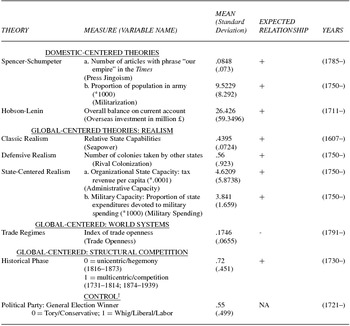
All of the independent variables and associated theories are given in Table 2. Most of the variable years begin in the early or mid-eighteenth century. This does not cover the entirety of British imperialism. Britain had already established colonies in previous years. Still, this data extends further back than most existing studies, which tend to look only at the late nineteenth century.Footnote 5 The data is also robust because it covers two distinct periods of multicentricity and one period of British unicentricity. The analysis ends in 1939 when the age of modern territorial imperialism ended: after World War II, territorial imperialism was no longer part of global culture. Most of the world had been carved up into colonial domains and anticolonial nationalism made direct colonial rule less legitimate (Wimmer and Feinstein Reference Wimmer and Feinstein2010). Accordingly, no states in the world system colonized after this period (Bergesen and Schoenberg Reference Bergesen, Schoenberg and Bergesen1980). Restricting the analysis to the period before World War II allows me to control for the confounding effects of developments in global culture.
Variables

†Other controls: Baseline Time Trend (first year = 1, second = 2, etc.) and Lagged Dependent Variable
Method
The number of colonies acquired by the British state per year is estimated using negative binomial regression. A common method for count data, negative binomial is a generalization of Poisson-based regression, with the same mean structure. But it is often preferred to Poisson because it corrects for overdispersion by introducing a stochastic component to the model (Beck and Tolnay Reference Beck and Tolnay1995; Cameron and Trivedi Reference Cameron and Trivedi1998; Hilbe Reference Hilbe2011). It can be represented as follows:
 \begin{equation*}
\ln \lambda _{\rm i} = \alpha + {\rm X}_{\rm i} \beta + \varepsilon ,
\end{equation*}
where lnλ i is the natural logarithm of counts of British colonization, α is the constant term, Χi is the covariate matrix, β is the regression coefficient, and ε is the error term. The exponentiated values of the coefficients refer to the effect of a unit change in the independent variable on the occurrence of the dependent variable. In the analysis, robust standard errors are calculated. To address endogeneity, the independent variables are lagged by one year. A baseline time trend and a lagged dependent variable to correct for autocorrelation are included, as is common in time-series regressions (Cameron and Trivedi Reference Cameron and Trivedi1998) (though some autocorrelation could be expected by the structural-competition theory).Footnote 6
Results and Discussion
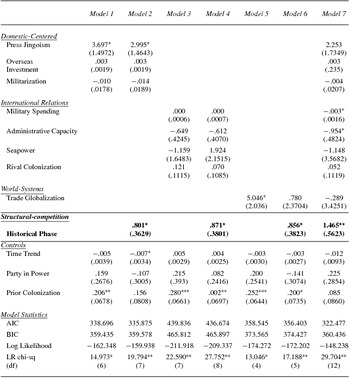
Separate models are run first, each covering the different theoretical approaches. The first model (table 3, model 1) tests the classic domestic-centered theories. While the press jingoism variable and the lagged dependent are positive and significant, the introduction of the structural-competition variable (model 2) makes the lagged dependent variable lose its significance and the press jingoism variable decrease in explanatory value. Simply put: domestic variables do not predict British imperialism as well as structural competition.
Negative Binomial Regression Coefficients

Standard errors in parentheses
*sig. at <.05; **sig. at <.01; ***sig. at <.001 (two-tailed)
Model 3 tests realist theory. Only the lagged dependent variable is positive and significant but when the structural-competition variable is introduced the latter becomes a more important predictor (model 4). Model 5 tests the world-systems trade regime theory. Trade globalization is significant and positive but when the structural-competition variable is introduced (model 6) its explanatory value decreases and becomes insignificant. The structural-competition variable again is positive and significant.
Model 7 tests all of the variables. It is the best fitting model of all. Furthermore, the structural-competition variable, as in the other models, has a high and significant coefficient (1.465). The only surprises are the significant coefficients for two variables derived from realist theory: military spending (as a proportion of total expenditures) and state revenue per capita. Both are meant to capture realist state-centered theory that argues that the greater the administrative and/or military capacity, the more there is imperialism. But their values are negative, which is the opposite of what realist theory would predict. This could be interpreted as supplementary to structural-competition theory, which theorizes that one of the factors driving imperialism is the state's coffers: imperialism is a means by which to protect or enhance state revenue. Likewise, the negative values of the administrative capacity variable suggest that the British state used imperialism when its revenues were threatened. Less revenue led the state to be more imperialistic.
One potential problem in the regressions in the preceding text is that two of the variables (press jingoism and trade globalization) only reach back to the late eighteenth century. This is still further back than existing studies and covers a sufficient time frame to capture the different historical phases covered by the structural-competition variable, but it potentially limits our conclusions. Therefore, a model was run to reach further back in time (to 1750) by removing the two variables from the full model (neither of which had proved consistently significant anyways). The results (model 8) show that global competition retains its explanatory power relative to the other variables. Furthermore, to more properly assess world-systems trade regime theory, a new variable was also introduced. In these tests, the variable for trade globalization, which only reached back to 1791, is replaced with a dummy variable capturing trade policy. The dummy variable reaches back to 1730. Economic historians agree that three eras mark British trade policy: (a) mercantilism (from 1730 to 1846), (b) free trade following subsequent laws repealing the Corn Act (1846–70), and (c) neo-mercantilism (after 1870) (O’Brien and Pigman Reference O’Brien and Pigman1992). The introduction of this variable to the models, however, does not alter the main findings. Finally, to explore the Hobson-Lenin thesis other models were run. It could be argued that colonization was first and then financial investment followed. To test this I made colonization the predictor of financial investment and lagged the financial data by one year and then two. These models did not alter the findings.
Comparing Multicentricity and Unicentricity
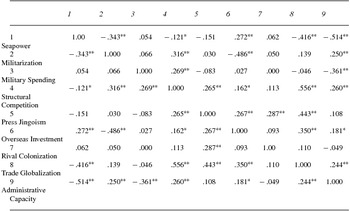
The quantitative examination shows that phases of global competition increase imperialism but does not illuminate causal mechanisms or processes. Cross-correlations between some of the variables suggest the need for further analysis (see table 4). This section employs comparative-historical qualitative data to deepen the quantitative examination. Comparative-historical data is useful because it is especially suited to tracing causal processes, thereby digging beneath the surface-level regressions to show underlying mechanisms (Mahoney Reference Mahoney, Mahoney and Rueschemeyer2003: 363). In particular, the qualitative analysis in the following text enlists the method of “individualizing comparisons” across different time periods to locate the causal processes leading to imperialism during multicentric periods and reduced imperialism during unicentric periods (Haydu Reference Haydu1998).
Pearson correlation coefficients

*<.05. **<.01 (2-tailed).
So what would we expect to find? According to the structural-competition theory, historical phases matter because they differentially impact the perception of threats. Therefore, we would expect that, during multicentric periods, the sense of threat (economic and geopolitical) among capitalists and state elites was heightened and that this fear caused them to push for imperial expansion. Alternatively, we would expect that in the unicentric phase the perceived threats were weaker. State elites preferred the status quo and therefore imperialism decreased. We can see if this is the case for British imperialism by using a qualitative comparison across time periods with secondary and primary archival materials.Footnote 7
Multicentricism/Competition I: 1730–1815
The period from the 1730s to 1815 was a multicentric system of “five great powers” marked by intense economic competition (Kennedy Reference Kennedy1987: 73–74; Wallerstein Reference Wallerstein1989: 70). Britain was only one of these powers. In 1750, Britain's industrialization level was roughly the same as France and Belgium and took up less percentage share of world manufacturing than France, Russia, and Austria-Hungary (Bairoch Reference Bairoch1982: 280–96). Even in the 1760s, after Britain had emerged victorious from the Seven Years’ War, it was unclear that Britain would overtake France economically (Wallerstein Reference Wallerstein1989: 70). This economic competition also played out overseas. While Britain had already established a string of satellite colonies along the North American coast and in parts of the Caribbean that were becoming vital to England's growing economy (Cain and Hopkins Reference Cain and Hopkins1993: 85; Price Reference Price and Marshall1998: 89), Spain and France were also positioned there. The French especially were already dominant in the slave trade, sugar sector, and entrepôt trade in Caribbean produce and were poised to take over Britain's activities in other realms (Harris Reference Harris1996: 135).
In this competitive environment, British capitalists consistently fretted. They were especially concerned about France: Anglo-French competition was so strong in some sectors that British capitalists perceived competition in other sectors where competition was in fact minimal (such as fishing) (Black Reference Black1986: 135). British merchants also feared competition from France in the Ottoman Empire, the Mediterranean and India (Price Reference Price and Marshall1998: 87, 101). Throughout the mid- to late eighteenth century, mercantile lobbies repeatedly fretted about France's economic growth and its rising overseas trade; it was “an important undercurrent in public discussion” (Harris Reference Harris1996: 135). These fears and worries led British capitalists to exert pressure on the government for some kind of remedy. While they did not always agree on specifics, they shared the assumption that the government should take an active role in creating a “stable and hospitable environment for conducting business” and opening up “access to inexpensive raw materials” and “colonial markets” (Koehn Reference Koehn1994: 18–19). Many were worried that rival governments were doing more to protect and promote capitalists’ interests than the English government and so lobbied the Privy Council and Parliament to act (Olson Reference Olson1992). One widely read commercial expert complained in 1757 that the French government was providing “unspeakable Advantages” to French business and therefore urged the British Crown to help expand British trade similarly. The government should seek “every measure that [would] . . . enable us to stem the Torrent of their [France’s] commercial rivalship” (Postlethwayt Reference Postlethwayt1757: 247, 261).
It is exactly for such reasons that British manufacturers, merchants, and planters ardently supported the Navigation Acts and other measures that discriminated against rivals (O’Brien Reference O’Brien and Marshall1998: 71). This is also why they called for territorial expansion. Expansion would make the new measures even more potent by helping to expand British trade while thwarting rivals’ trade (Koehn Reference Koehn1994: 18–19; Wilson Reference Wilson1995: 187–94). For example, merchants in the 1790s insisted on taking colonies from France because this would reduce France's capacity to “recruit her exhausted commerce, or to repair her shattered marine, which were both in a most flourishing fate before . . .” (Bowles Reference Bowles1797: 19). Traders even called upon the British government to take territory in Africa. One wrote that colonies were necessary not only for the many “advantages” that would accrue to the “mother country” but also because “it is our interest to restrain the trade of France, our natural enemy, as much as we possibility can” (Demarin Reference Demarin1772: 4).
The multicentric structure of the global field generated the business sector's interest in imperialism but it also shaped the state's interest. British officials worried that that rivals’ economic strength would translate into security threats. They especially felt threatened by France, not least because France was the main economic rival (Black Reference Black1986). “France,” explained the Times, “is the only power whose maritime force has hitherto been a balance to that of Great Britain and whose commerce has rivaled ours in the two worlds” (Times, February 8, 1793). Officials wrote that the “great object of the French Ministry is to ruin us in the East-Indies” (World, January 1, 1791). Envoys overseas in the 1770s worried that the French would use their economic power to expand its military power and “threaten us, with a powerful fleet” (Public Records Office, Kew, United Kingdom [hereafter PRO] 78/291 f.96–9). Westminster was also worried about French expansion in the Americas. “[The] French” were seeking to “master the whole [North American] continent” (Little Reference Little1748: 28). French colonial holdings were also a threat: they contributed to France's economic growth (particularly in the sugar trade) while also serving as springboards for invading Britain's wealthy settlements or blockading vital trade routes during wartime (Duffy Reference Duffy1987: 19).
Exacerbating such fears was the fact that Britain's security depended upon its economic health, yet its economic health was not secure given the multicentric structure of the global system. The English state in the mid- to late eighteenth century was a “fiscal-military state” that demanded that large portions of public funds go to the military. Public funds depended upon healthy foreign trade: taxes from customs revenues and harbor and shipping dues sometimes constituted close to two-thirds of government revenue, providing the economic basis for British military power (Brewer Reference Brewer1989: 202–4; Koehn Reference Koehn1994: 20; O’Gorman Reference O’Gorman1997: 177). Maintaining security and a healthy overseas trade were intertwined. “A Nation cannot be safe without Power,” went the common view in the 1760s, “Power cannot be obtained without Riches; nor Riches without Trade” (Mildmay Reference Mildmay1765: 3). Rival economic powers posed a threat to England's healthy trade, and this economic threat put England's security at risk—abroad as well as at home. If the French continued to be “active” and “vigorous” and expand in the Americas, wrote Mculloh in 1755, Britain would be “utterly unable to repair the Loss of our Trade and Settlements, which in the End may prove destructive to us, by cutting off all the Channels of our Supply, and consequently render us unable to support the Weight of heavy Taxes, or to make any considerable struggle against the ambitious views of France in making herself Umpire of Europe” (129).
Imperialism followed from this climate of fear. Converging with the interests of capitalists, British officials used territorial expansion as a strategy for meeting the economic and strategic threat posed by economic, hence geopolitical, rivals. Taking colonies would provide added security to British interests by providing territorial bulwarks against other states. In the 1760s, newspapers urged the conquest of territory in the Americas in order to put existing English colonies “beyond the reach of rival states in future times to endanger” (Chronicle, January 7, 1762: 26). Earlier, Westminster worried that the French “have done much more to promote their colonies than we have ever done for ours” and expressed deep fear that France was “artfully working for universal Empire in America.” The only solution was to take Martinique and “all other islands protected by the French” as well as taking any remaining Spanish territories (Westminster Journal, April 30, 1748). When the British later took territories after the Seven Years’ War, Lord Shelburne explained that it not only helped protect the existing English colonies there from “the molestation of enemies” but it likewise contributed to the larger goal: “to remove France from our neighborhood in America.”
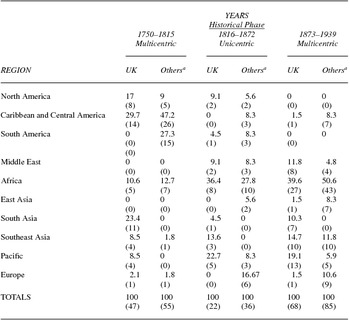
Taking new territory was also a strategy for undercutting rivals’ trade and economic power, thereby removing the economic and security threat at once. In the 1740s William Pitt had already laid out the essence of this idea, asserting that taking territory in North America “puts it in our power absolutely to ruin the great trade carried on by the French” (British Library, London, United Kingdom [hereafter BL] Stowe 354, f.248). Shelburne pointed out that new territories not only provide a buffer against rivals but also “open a new field of commerce,” thereby furnishing “great additional resources for the increase of our naval power” (Hansard Reference Hansard1815: 1272). Other officials added that the advantages of taking territories in Canada included “the State of Security . . . by the Removal of the French; The extensive Trade with the Indians [and] the Increase of the Fishery . . .” (W. Shirley to T. Robinson, August 15, 1755, Colonial Office [PRO] [hereafter CO]). Later, the Secretary of State in 1793 argued that taking complete control of the West Indies, which accounted for two-fifths of France's total foreign trade, would be beneficial “both in the view of humbling the power of France, and with the view of enlarging our wealth and security” (BL, Bathhurst 57/107). Similarly, proponents of expansion in London lobbied ministers in the 1790s insisting: “France is the only power whose maritime force has hitherto been a balance to that of Great Britain and whose commerce has rivaled ours in the two worlds. . . . Could England succeed in destroying the naval strength of her rival; could she turn the tide of that rich commerce, which has so often excited her jealousy, in favor of her own country . . . the degree of commercial prosperity . . . would exceed all calculation” (Times, February 8, 1793). Tobago, St. Lucia, Dominica, Grenada, and Trinidad were thus taken as colonies not only because of their potential economic value but also to round out Britain's naval network by which Britain could maintain defense and undercut rivals’ trade (Fieldhouse Reference Fieldhouse1982: 76). Fittingly, the vast majority of British acquisitions in this period occurred in the Americas and the Caribbean: that is, exactly where rival France and Spain also operated and where Britain's key growing economic interests lay (table 5). The Americas and the Caribbean was where structural competition was most palpable. Accordingly, it is there where much of British imperial action took place.
Colonial annexations by global structural phase and region, 1730–1939: England and other states (percent and number)

Sources: Henige (Reference Henige1970); Stewart (Reference Stewart1996).
aFrance, United States, Germany, Italy, Belgium, Russia, Spain.
Hegemony/Unicentrism, 1815–1873
The period from 1815 to 1873 was different. Britain emerged from the Napoleonic wars as Europe's leading economic power. For the next sixty years or so, Britain dominated the globe economically (Platt Reference Platt1968: 362), which translated also into military dominance (Kennedy Reference Kennedy1987: 155). Realist International Relations theory would predict that this global climate increased Britain's capacities and therefore propelled further imperialism. But as the quantitative analysis and Table 5 show, Britain seized far less territories in this period than it did before (and less than it would later). This was despite many opportunities. For example, British forces occupied parts of China, Latin America, and western Africa but then cut and ran without annexation. And London refused to annex new territories even when local elites in them requested it. This happened in Cuba, the Dominican Republic, Fiji, Sarawak, and Uruguay (Doyle Reference Doyle1986: 254; Winn Reference Winn1976: 107). Why?
It is true, as trade regime theory would suggest, that Britain initiated free trade treaties in this period. Rather than colonize China or Latin America, for instance, Britain initiated new trade treaties with them. But the very reason why Britain preferred trade was because of its economic dominance. Economic dominance was important because it meant that, unlike in the previous multicentric period, British capitalists benefited from the existing state of affairs rather than feeling threatened. Most of their trade and economic activity occurred outside its colonies. Britain's trade with independent countries was greater in quantity and more than double in value than trade with its own colonies (Tomlinson Reference Tomlinson and Porter1999). Therefore, because British capitalists enjoyed a comparative advantage, they did not pressure the state for new colonies as much as they did during other periods. Instead, as Platt (Reference Platt1968: 356) has shown, they pushed for trade treaties with independent nations.
Even in the rarer cases when capitalists did push for colonization, the British state was less interested than it had been during the multicentric phase. Here is the second reason why unicentricity mattered: because Britain was hegemonic in wealth and power, the British state had a geopolitical comparative advantage just as British capitalists had an economic comparative advantage. In other words, the sense of threat during this period was much less palpable than in others. This is especially evident in regard to Britain's relations with France. During the previous multicentric period, British officials consistently worried about French power, but note what happened when France made advances on Algeria in the mid-nineteenth century. According to the “defensive annexation” thesis, Britain should have responded by acquiring its own new colonies to ward off the threat. But, in fact, British officials were hardly bothered. “France's possession of Algeria,” declared a British member of Parliament (MP) in 1860, “is not disadvantageous to Britain. It is a constant drain on the military and financial resources of France.” Even if there was war between France and England, this MP declared, French Algeria would not be a problem. Because England dominated the seas, Algeria would just as easily “fall into British hands” (Lewis to Palmerston, November 23, 1860, University of Southampton Special Collections [hereafter USCC]).Footnote 8 In short, given the lack of global economic competition, rival's territorial advances were not seen as significant threats; therefore, territorial expansion was not needed. As Kennedy (Reference Kennedy1987: 155) suggests, Britain enjoyed a “relative lack of external pressure” in the mid-nineteenth century, such that many policy makers argued that “colonial acquisitions were unnecessary.”
The discourse of policy makers when Britain turned down opportunities to colonize further reveals how the relative sense of security dissuaded the British state from resorting to imperialism. For example, the British state repeatedly declined opportunities to take Sarawak in the 1850s and 1860s. Vanguard British entrepreneurs had already made inroads into the territory and acted as “white rajahs.” But these were rogue agents (as the British home office lamented) who wanted Westminster to officially take the territory as a colony, thereby providing them with proper protection and regalia. But officials in Westminster refused on the grounds that there was not significant threat that warranted annexation. While British entrepreneurs argued that annexation was necessary to fend off the nearby Dutch, for instance, Lord Carnavaron explained that this was not sufficient to warrant colonization because “our freer system of trade might give us some advantages over the Dutch” (January 25, 1859, Foreign Office [PRO] [hereafter FO] 12/35). The Foreign Office added that acquisition was not necessary because “the Dutch are and must remain too weak to cause us any alarm” (August 18, 1860, FO 12/28).
Other examples include the Niger Delta. Trade between England and the delta increasingly grew in importance through the 1840s to the 1860s, but, despite this, London appointed a consul to the region rather than colonize it. The stated reason was that British trade flourished and there were no serious European rivals to threaten it (Chamberlain Reference Chamberlain1988: 125). Similarly, when the Colonial Office in London was offered by Fijian chiefs to annex Fiji, it turned the offer down, despite warnings that the French might take it instead. The reason was that the French were not a threat. “England,” the report rejecting annexation explained, “completely commands the Western portion of the Pacific.” British trade was already so strong in the region that even if France took Fiji, she would be forced to import from British sources. “Should she [France] seize the Islands, England would have little cause of inquietude; as in forming her Establishments France would import largely from the English colonies” (Smyth, May 1, 1861, CO 83/1).
England's economic dominance meant that all that was needed was to maintain trade, not annexation. Palmerston took this a rule for his foreign policy, such that he turned down many opportunities to colonize. When British forces went to Abyssinia to successfully rescue a British agent captured by a local warlord, they could have remained and seized it as a colony. But Palmerston refused: “I do not see any advantage in our getting land in these quarters. All we want is trade and land is not necessary for trade; we can carry on commerce on ground belong to other people” (Hyam Reference Hyam2002: 107). If anything, colonial expansion would upset the status quo from which Britain so benefited. When British merchants and some officials suggested that England had rights over the Falklands, the prime minister rejected annexation: “We have possession of nearly every valuable port and colony in the world, and I confess that I am anxious to avoid exciting the attention and jealousy of other powers by extending our possessions, and setting the example of gratification of a desire to seize more territories” (Wellesley to Murray, July 25, 1829 USSC). In 1857, Lord Palmerston spoke similarly against annexing Egypt: “Let us try to improve all those countries by the general influence of our commerce, but let us abstain from a crusade of conquest which would call down upon us the condemnation of all other civilized nations” (Cromer Reference Cromer1908: 92). Rather than upset the global system from which they and capitalists benefited, state managers preferred to keep things intact. This made imperialism less likely than in other periods (table 5).
Multicentrism/Competition II: 1873–1939
Everything changed around 1868–73. There was an economic depression that lasted only five years but portended new economic troubles after decades of prosperity. This is when Britain began its decline and the global configuration entered a multicentric phase: Germany, the United States, France, and Russia increased their productive capacities and market shares (Tomlinson Reference Tomlinson and Porter1999: 69). The structure of the global economic system was similar to that of the previous multicentric phase that had lasted until 1815. The only difference is that Britain was in decline rather than in ascent. Nonetheless, in this multicentric phase, as with the earlier one, a climate of worry and fear replaced the relative complacency of previous decades. Writers opined that England's dominance had become “a dream of the past” because “[o]ther nations have entered the race, and although we are still the great traders of the world, the singularity of our position has gone” (Grant Reference Grant1870: 184). Capitalists and merchants also began to feel more insecure, fearing rightly “that Britain's commercial supremacy was no longer something they could take for granted” (Hynes Reference Hynes1976: 972). They were particularly concerned about rivals’ tariff systems, which appeared to be intensifying at the future expense of British trade (O’Brien and Pigman Reference O’Brien and Pigman1992: 104). Accordingly, as their predecessors had done in the earlier multicentric phase, capitalists, producers, and merchants urged London to take new territories to fend off the threats. For instance, though they had been content to promote trade in West Africa rather than colonial control, capitalists became nervous about the growing activity of other European firms. As Hynes (Reference Hynes1976: 973) shows, they subsequently pressured officials in London to take action, emphasizing “the vast importance of the development of additional markets” while complaining that rival powers had begun to take new areas and set up tariff blocs. They also pressured the state to take colonies elsewhere for the same reasons (Fieldhouse Reference Fieldhouse1973: 383).
State officials were open to these demands because multicentrism threatened the states’ interests too. The discourse of politicians and writers is filled with worry that the economic power of rivals would be converted into security threats. “Great Britain,” asserted the widely read pamphlet by Lloyd and Tebbitt, “must be prepared for hostile combinations in the future, far exceeding in potency those whose fate our history recounts” (Reference Chase-Dunn, Kawano and Brewer1880: 58). The rise of rivals like the United States meant that “we are in danger of being devoured by our own offspring, of sinking into the position of a minor state” (Reference Lloyd and Tebbittibid., 15). Prime Minister Disraeli's response in 1871 to the Franco-Prussian war fretted about “new and unknown . . . dangers with which to cope. . . . The balance of power has been entirely destroyed” (Buckle Reference Buckle1920: 133–34). While Britain was still the most powerful military force in the world (based upon its naval power), officials feared that rivals were using their economic growth to build their naval capacities. As one Royal Commission report declared in 1883, Britain will soon be “blotted out from the list of great countries” (Semmel Reference Semmel1986: 91). The 1879 Royal Commission investigation on the “defence of British possessions and commerce abroad” argued that if Britain no longer dominated the seas—or if its bases and security nodal points were vulnerable to attack—both its commerce and its security would be seriously threatened (Burroughs Reference Burroughs and Porter1999: 334). The imperatives of capital and containment were thus intertwined.
Britain's “new imperialism” followed, leading to more than three times as many annexations in this multicentric phase than during the unicentric phase. Notably much of it took place in Africa, Asia, and the Pacific where rivals’ economic activity and naval activity were growing: the region of threat had shifted (table 5).
To see more precisely how multicentricity led to these annexations, consider cases that the British state declined to take as territories during the unicentric phase but now, during the multicentric phase, finally decided to annex. What changed that led to annexation? Fiji is one such case. Before annexation, rumors circulated in London that Germany and the United States were interested in expanding into the Pacific region (McIntyre Reference McIntyre1960: 372). During the previous years, in the unicentric phase, London had heard similar rumors but, as seen previously, because Britain had been hegemonic at the time, the rumors did not cause worry. This time, though, the multicentric context gave the rumors a different accent. As officials discussed whether to annex Fiji, worries and concerns about rivals like Germany and the United States dominated discussions (Knatchbull, June 25, 1872 CO 309–107). The Colonial Office especially worried about America's interests in nearby Samoa and Borneo: “. . . they hope to be master of the Pacific presently” (Herbert, October 29, 1872 CO 309–05). The threat of the United States or others using Pacific outposts to expand their economic and geopolitical standing therefore compelled Prime Minister Disraeli to opt for annexation (Times, August 6, 1874; McIntyre Reference McIntyre1960: 372). The Colonial Office later explained that taking Fiji would help England in its goal of “quietly acquiring paramount influence” in the Pacific against the movements of Germany, the United States, and France (Herbert, May 5, 1875 PRO 30/6/47).
The occupation of Egypt in 1882 is another example. As seen, England had opportunities to take Egypt during mid-century but refused. It was only during this later period of multicentricism that the British state finally intervened. So what had changed? The Hobson-Lenin thesis emphasizes the influence of finance capital. While it is true that England had financial interests in Egypt, those had been longstanding and bondholders had previously asked London to intervene to no avail (Platt Reference Platt1968: 160). The real concern was rivalry brought on by the new multicentric environment. Officials worried that Russia, given its economic growth, would advance into the eastern Mediterranean and Turkey. British occupation would halt that (Porter Reference Porter1999: 12). They also feared Egyptian bankruptcy, which would have made Egypt susceptible to rival occupation. During the era of British hegemony, Palmerston and other officials did not worry about this. But in the new competitive environment, the scenario was frightening. Prime Minister Gladstone reiterated that Egypt's Suez Canal was necessary to hold because “for England, the Suez Canal is . . . invaluable for the center of its commerce” and “for India, the Suez Canal is the connecting link between herself and the centre of power” (Hansard's Parliamentary Debates [BL] 282: 808). British occupation was necessary to maintain British trade in the face of rivals’ advances.
Burma and East Africa are also exemplary. Britain had previously annexed parts of Burma but had turned down opportunities to seize even more land, opting to initiate trade with local rulers. Things changed in the 1880s. French competitors compelled British capitalists operating in the region to pressure officials in London. This time, unlike before, London responded positively. Why? Because officials in London learned that the French were seeking special trading privileges with local rulers. This was not merely about preserving British economic interests. London took the French efforts to obtain trading privileges as a signal of their rising influence in the region—which extended to India—and they were determined to stop it (Webster Reference Webster2000: 1013–14). The threat of rivals also drove London to take Uganda in East Africa, even though previously London had not been interested. The coast along East Africa from the Cape had been pinpointed as a possible alternative route to India for rivals to take and the Nile Valley was seen as essential for British trade and security. But rival powers like France, Italy, and Leopold II appeared to make inroads in the area. Taking Uganda was thus an anticipatory defensive move to ward off rivals from accruing further power (Fieldhouse Reference Fieldhouse1973: 380–81). And this mattered most in the context of British decline—that is, of multicentricity. As multicentricity increased the sense of threat, so did the British state heighten its imperial activity.
Discussion and Conclusion
The quantitative and qualitative evidence adduced here shows that British imperialism was a strategy to meet the imperatives of capital and containment in competitive environments. When the global structure was most competitive (i.e., during multicentric phases), perceived threats to the imperatives of capital and containment were exacerbated. Imperialism followed. Conversely, when the British state was hegemonic, imperialism lessened because the relative lack of structural competition (i.e., unicentricity) reduced the sense of threat. This structural-competition approach draws from the “defensive realism” approach but also advances it. Defensive realism proposes that the colonization of rivals sparks imperialism in response. But, as seen, the defensive realism variable did not prove significant in the statistical analysis. And the British state did not colonize territories during its unicentric phase in response to other states’ imperialism in one-to-one fashion. It was not the objective fact of rival powers’ territorial advancement that mattered but whether those advancements and other events took place in a globally competitive economic environment. When they did, they were classified as more threatening than otherwise. Consequently the British state was more likely to colonize foreign territory. The analysis here thus contributes to defensive realism by specifying the conditions under which the threats compelling imperialism are most likely to be perceived.
The analysis here in turn suggests that domestic factors specified by classic theories are less important than global factors. But does this completely rule them out? Despite the findings here, it may still be that the causal factors posited by such theories work in conjunction with multicentricity, however for certain cases or limited time periods such as the late nineteenth century. For example, in Spencer's theory and the related social imperialism thesis, part of what was driving nationalist jingoism was the desire of politicians to distract the masses from social problems and garner electoral support. But before the late nineteenth century, imperialist expansion did not require mass support because the electorate was limited: the suffrage was only extended to the urban and agricultural workers much later (1867 and 1884). Arguably this is why the variables for Spencer's theory did not appear significant in the regression analysis, because they might have only been operative in the late nineteenth century when the electorate was expanded. This suggests that the classic theories of Spencer and others are historically specific theories with delimited temporal scope.
The present analysis is restricted to British imperialism but it has broader implications. First, the structural-competition approach offers a sequential model of hegemonic states and their imperialist activity. Hegemons undergo phases: ascent (multicentrism), hegemony (unicentrism), and decline (a return to multicentrism). The analysis here illuminates imperial correlates. Hegemons on the rise engage in imperialism to undercut or ward off rivals; when they become fully hegemonic, they engage in less imperialism; but as they decline they reassert themselves as a last ditch effort to maintain power in the face of rising rivals. Using British imperialism as a model, we might compare this with other states—like the United States or perhaps China (e.g., Go Reference Go2011). Second, while the analysis is restricted to hegemonic states, it might also be relevant for other states. It is possible that, during multicentric periods, all states become imperialistic because structural competition implies threats for all of them. Within competitive environments, all states sought to ward off threats and perhaps gain advantage through imperial expansion. Alternatively, during unicentric periods, even though not all states are hegemonic, they might still lessen their imperialism as the hegemon does. Exactly because there is a hegemon that monopolizes power, other states might fear retribution if they expand. A look at rates of colonization in the entire world system lends preliminary support to this notion: states besides Britain were more likely to colonize during multicentric periods than during the unicentric period (table 5; also Bergesen and Schoenberg Reference Bergesen, Schoenberg and Bergesen1980). This is hardly conclusive. But it warrants further exploration.