Introduction
With the pesticide resistance of pests being widely demonstrated in these decades, biological control is an important and alternative strategy to fight against pests. In the context of pest management, the control efficiency is of great interest. The immune responses of pests against biological agents in the field were always ignored. Recent investigations revealed that the control efficacy of using entomopathogenic fungi against Rhynchophorus ferrugineus (Olivier) (Coleoptera: Curculionidae) was around 85% under laboratory and semifield conditions (El-Sufty et al., Reference El-Sufty, Al-Awash, Al-Bgham, Shahdad and Al-Bathra2009; Dembilio et al., Reference Dembilio, Quesada-Moraga, Santago-Ālvarez and Jacas2010). Nevertheless, it has also been revealed that some insects had the ability to recover from infection (Parmakelis et al., Reference Parmakelis, Slotman, Marshall, Awono-Ambene, Nkondjio, Simard, Caccone and Powell2008). To our knowledge, increased immune protection following early exposure to bacteria, often being defined as immune priming, has been shown in several species of invertebrates (Kurtz & Franz, Reference Kurtz and Franz2003; Little & Kraaijeveld, Reference Little and Kraaijeveld2004; Sadd & Schmid-Hempel, Reference Sadd and Schmid-Hempel2006; Roth et al., Reference Roth, Sadd, Schmid-Hempel and Kurtz2009; Yue et al., Reference Yue, Zhou, Wang, Ma, Wang, Wang, Zhang and Song2013). Therefore, a new problem, if the control efficiency of a biological agent on its target pest will decrease because some infected individuals survived and recovered after being attacked, might present before us.
Growing evidence indicate that insects rely solely on a suite of innate immune responses, which can be classified into two main types, to combat infection by a wide array of pathogens (Cherry & Silverman, Reference Cherry and Silverman2006). Constitutive defenses that rely on the response of hemocytes and several rapidly activated enzyme cascades such as penoloxidase and lysozyme are always present and ready to act (Siva-Jothy et al., Reference Siva-Jothy, Moret, Rolff and Simpson2005; Cerenius et al., Reference Cerenius, Lee and Söderhäll2008). Coupled with this line of defense is mediated by humoral factors, especially antimicrobial peptides, which are rapidly produced in the fat body after infection to kill a wide array of microbes (Cherry & Silverman, Reference Cherry and Silverman2006). It is generally recognized that innate immunity depends on the recognition of broadly conserved molecular moieties and exhibits only weak specificity, such as the ability to distinguish between different structural classes of peptidoglycan (Kaneko et al., Reference Kaneko, Yano, Aggarwal, Lim, Ueda, Oshima, Peach, Erturk-Hasdemir, Goldman, Oh, Kurata and Silverman2006).
Because insects lack the molecular machinery as the vertebrate adaptive immune system employ, it is thought that they lack the ability to produce lasting and specific immunity. However, in recent years, numerous lines of evidence show that the experience of a microbial infection or parasitic attack can improve the immune response of insects to a subsequent exposure to pathogens or parasitoids (Moret & Schmid-Hempel, Reference Moret and Schmid-Hempel2001; Schmid-Hempel, Reference Schmid-Hempel2005; Roth et al., Reference Roth, Joop, Eggert, Hilbert, Daniel, Schmid-Hempel and Kurtz2010; Zanchi et al., Reference Zanchi, Troussard, Martinaud, Moreau and Moret2011). For instance, immune priming has been demonstrated over an adult's lifetime in bumble-bee Bombus terrestris exposed to bacterial pathogens (Sadd & Schmid-Hempel, Reference Sadd and Schmid-Hempel2006). Similar results also have been found in flour beetles such as Tribolium castaneum (Roth et al., Reference Roth, Sadd, Schmid-Hempel and Kurtz2009) and in Drosophila melanogaster (Pham et al., Reference Pham, Dionne, Shirasu-Hiza and Schneider2007). Obviously, these reports are mainly from social insects and some model systems. Despite these studies have advanced our understanding of the abilities of insect immune systems, because of high diversification of insect species and their life history, it is still unclear how general immune priming is and whether immune priming generally occurs in the invertebrates including the destructive invasive pests and in response to different pathogens.
R. ferrugineus is an invasive and extremely devastating pest for many palm species in China and European countries and this makes it advisable to control it as a quarantine pest (Ju et al., Reference Ju, Li, Du, Chi, Yan and Xu2006; EPPO, 2008; Llácer et al., Reference Llácer, Negre and Jacas2012a ). Since R. ferrugineus often hides inside palm trunks except for mating and oviposition, it is usually difficult to find adults and larvae, let alone trying to kill them with chemical insecticides. At present, it is a priority to develop integrated pest management based on pheromone traps and biological control (El-Sufty et al., Reference El-Sufty, Al-Awash, Al Amiri, Shahdad, Al Bathra and Musa2007; Poorjavad et al., Reference Poorjavad, Goldansaz and Avand-Faghig2009). However, the success of two above strategies is still insufficient. In this regard, R. ferrugineus is considered as one pest that is very difficult to be controlled, and rare data are still available about the immunity of R. ferrugineus against its pathogens. Thus, investigations on the immune defenses of this pest against its pathogens are promising because they could provide some novel suggestions to improve and even develop new control strategies. The purpose of this study is to determine whether previous nonlethal infection of R. ferrugineus could affect its immune response when they were under the secondary attack by bacteria pathogen. As a holometamorphosis insect, the larvae, pupae and adult of R. ferrugineus may be attacked by different pathogens and have various infection risk. Consequently, if so, is this influence pathogen species-specific and could the parent's infection experience protect their offspring when they were also attacked by the same pathogen as their parents?
Materials and methods
Insect rearing
A laboratory population of red palm weevil was established by the larvae which were collected from the naturally infested Washingtonia filifera trees on October, 2009 in Fuqing City (25.73°N, 119.39°E), Fujian Province of China. In the laboratory, the larvae were reared on sugarcane stem in the climatic chamber at 27±1 °C, 75% relative humidity and a photoperiod of 24 h night. The development of the different larval instars was observed by detecting the molted head capsules. After the adults emerged, they were individually transferred into 100 ml plastic bottles with perforated lids and also fed with sugarcane stem under the same conditions as for the larvae except for a photoperiod of 12: 12 h (L:D).
Immune challenge for the larvae, adults and their offspring
As few good bacteria pathogen are isolated and identified from R. ferrugineus (Manachini et al., Reference Manachini, Arizza, Parrinello and Parrinello2011), Gram-negative bacteria Escherichia coli DH5α was used as the pathogen to challenge the individuals in this study. This bacteria species was cultured at 30 °C overnight with OD600=1 in Luria-Bertani's (LB) medium (1000 ml distilled water, 10 g tryptone, 5 g yeast extract, 10 g NaCl and pH 7.2). Approximately 1 ml of the cultured bacteria solution was centrifuged with the velocity of 12,000 g under room temperature and discarded the supernatant and then washed the cell pellet using sterilized phosphate buffer saline (being abbreviated as PBS thereafter, distilled water 500 ml, NaCl 4 g, KCl 100 mg, Na2HPO4 720 mg, K2HPO4 720 mg, pH 7.2) for three times. Finally, the cell pellet was resuspended with 1 ml sterilized PBS and stored at 4 °C for late use.
To test whether the previous infection influenced the immune responses of R. ferrugineus when they encountered the same pathogen, the fifth instar larvae were firstly injected with 1 μl E. coli solution or PBS. After 24 h, these larvae were infected by E. coli again. All the injections in this study were completed with 10 μl Hamilton syringe (Reno, Nevada, USA). Twenty-four hours after the second challenge, the hemolymph of each individual was collected to be assayed in the following experiments. PBS injection and no challenge groups served as controls. Ten individuals were treated as one replication and four replications were completed in each treatment.
To detect whether trans-generational immune priming (TGIP) occurs in R. ferrugineus, male and female adults 15 days after emergence experienced the following immune challenge treatments: injection of E. coli (E), PBS (P) or no challenge (naïve, N). Twenty-four hours after being challenged, the following breeding pairs were established (15 pairs per treatment, total n=90 pairs): (1) male Ec (E), female naïve (N); (2) male PBS (P), female naïve (N); (3) male naïve (N), female Ec (E); (4) male naïve, female PBS; (5) male Ec (E), female Ec (E); and (6) male naïve (N), female naïve (N). Each pair was fed alone in a single plastic container. The breeding pairs were allowed to oviposit for 21 days (the oviposition peak) and the eggs of each pairs were transferred into the Petri dish (9 cm in diameter) with a humid cotton layer every 3 days. After eggs hatched and developed into fifth instar larvae, they were randomly designated into the three following treatments: (1) Ec injection, (2) sterilized PBS and (3) naïve. Ten individuals were treated as one replication and each treatment contained four replications. After 24 h, the hemolymph of each larva was collected individually to be assayed in the following experiments.
Hemolymph collection
Before collection, the individuals were immobilized on ice for not over 10 min and then their body surface was sterilized with 75% alcohol. Subsequently, the first back segment was pricked with a sterilized insect needle (1#) and then lightly squeezed the larva body to push the hemolymph out. The hemolymph bubble was immediately transferred by 2.5 μl pipette (Eppendorf North America, Hauppauge, NY, USA) into 94 μl cold PBS for phenoloxidase (PO) activity assay and 2 μl PBS supplemented with Phenylthiourea to inhibit melanization) for antibacterial activity assay, respectively. All the collected hemolymph samples were saved under −80 °C condition for late assays.
PO activity assay
PO activity was measured using a spectrophotometric assay (Shi & Sun, Reference Shi and Sun2010). After being taken out from the −80 °C refrigerator, the hemolymph samples were placed into the ice bath box to dissolve. After centrifugation (4 °C, 10,000 rpm, Sigma 5084R Centrifuge), 20 μl of the supernatant were mixed with 140 μl ultrapure water, plus 20 μl cold PBS and 20 μl L-Dopa (Acros Organic, 4 mg ml−1 ultrapure water) as a substrate. The reaction was allowed to proceed at 30 °C in a microplate reader (SpectraMax, Molecular Devices Corp., USA) for 30 min. Readings were taken every 30 s at 490 nm. For each sample, two independent assays were performed and an average V max (the slope value of the reaction curve) was determined from the two reactions to measure the enzyme activity.
Antibacterial activity assay
Both E. coli and Staphyloccocus aureas were grown under the above conditions in LB medium. The hemolymph samples were taken out from the −80 °C refrigerator, dissolved as above and then diluted into the volume of 220 μl with cold PBS. Our preliminary assays found that it was optimal to the antibacterial assays of hemolymph samples after the culture was serially diluted by 500 times with fresh LB medium. Antibacterial activity assays were performed in sterile 96-well plates with a final volume of 140 μl. An aliquot of 100 μl of diluted culture, or sterilized PBS or tetracycline solution (1 mg ml−1) was added to 40 μl of hemolymph samples. The latter treatments served as the negative and positive controls, respectively. Subsequently, plates were incubated at 30 °C for 12 h. Growth of bacteria was measured as the cell concentration which was determined by the absorbance value at 600 nm using a SpectraMax reader (Molecular Devices Corp., USA).
Statistical analysis
A general linear model was used to determine the effect of immune challenge on the immune response of R. ferrugineus larvae. Least-significant difference or Tamhane's T2, determined by the results of the test of homogeneity of variances, was used as the multiple comparison procedure to determine cohort group differences. A confidence level of 95% (P<0.05) was maintained for all tests. All statistical analyses were performed with SPSS 12.0 for Windows (SPSS Inc.: Chicago, IL, USA, 2003).
Results
Immune protection from nonlethal early infection in the larvae of R. ferrugineus
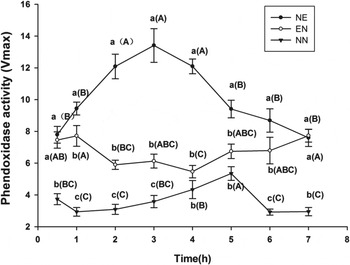
Statistical analysis revealed that there were no significant differences in the antibacterial activity between sterilized PBS-injected groups and blank groups (antibacterial activity: P>0.05), which suggested that the injection treatment itself could not induce the antibacterial activity of R. ferrugineus. However, this is not the case for PO activity of R. ferrugineus. The PO activity of individuals injected by sterilized PBS was markedly stronger than that of the naïve ones (P<0.001), which indicated that injection itself could up-regulate the insect's PO activity. Compared with the sterilized PBS-injected individuals, both the PO activity and the antibacterial ability of E. coli solution-injected ones were dramatically enhanced (P<0.001). Therefore, the injection of E. coli solution could mount the immune system of R. ferrugineus. As shown in fig. 1, 24 h later after being injected, the PO activity of R. ferrugineus larvae was relatively stable and maintained at markedly lower level. Thus, the second injection was completed 24 h after the first immune challenge.
Dynamic changes in the PO activity of R. ferrugineus larvae after being injected at different time points

The PO activity of E. coli-injected larvae was dramatically higher than that of those PBS-injected ones and the larvae without injection (ANOVA: F 3,156=61.355, P<0.001). Time-course analysis revealed that the PO cascade was activated within 0.5 h after being infected, and 1 h later, the PO activity of larvae with previous infection by E. coli was always markedly higher than that of PBS-injected ones and blank treatments. Especially, the PO activity at 1 h was two times higher than that of larvae previously injected with PBS (table 1). These data revealed that the previous exposure to E. coli could enhance the PO activity of larvae dramatically when they were infected by this species of bacteria again.
Dynamic analysis on the PO activity (V max) of R. ferrugineus larva after being treated in different patterns on multiple time points.

Notes: EE-two injections of Ec solution, PE-successive injections of PBS and Ec solution, PP-two injections of PBS, NN-larvae without being challenged. The different lowercase and capital letters indicated the statistical significance was determined in the columns or rows by post hoc test, respectively.
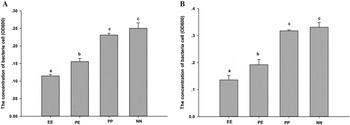
The infection by injecting E. coli into the hemocoel of R. ferrugineus dramatically induced the antibacterial ability of their hemolymph (ANOVA: F 3,156=61.355, P<0.001). As shown in fig. 2, the concentration of E. coli cells after being incubated with the hemolymph of the larvae immune priming with E. coli was obviously lower than other treatments. These data suggested that the antibacterial activity of the larvae immune priming with E. coli was significantly stronger than that of immune priming with PBS (fig. 2a). Interestingly, the hemolymph of larvae immune priming with E. coli could also inhibit the propagation of Gram-positive bacteria S. aureas (fig. 2b). After being uniformized with the negative control in the antibacterial activity assays, the ratio of inhibiting E. coli (0.47) was lower than that of inhibiting S. aureas (0.51). It indicated that the hemolymph of Ec-infected individuals presented higher inhibition ability on the growth of E. coli than that of S. aureas and this priming performed with low species-specific level.
The antibacterial activity of R. ferrugineus larvae against E. coli (a) and Staphyloccocus aureus (b) in the secondary infection Statistical significance was given by the different lowercase letters above the histograms (P<0.05).

Mother-derived trans-generational immune protection in R. ferrugineus
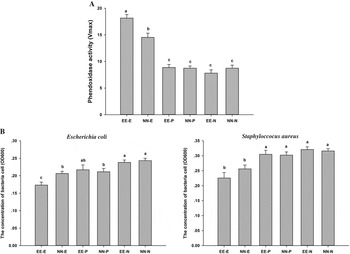
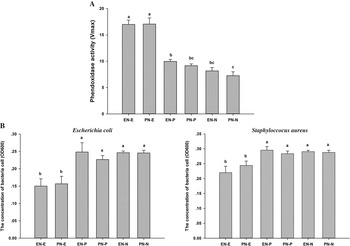
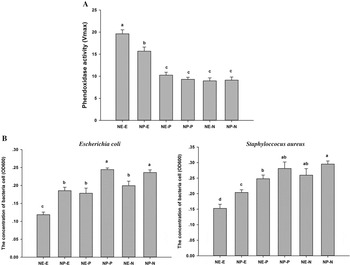
Our data demonstrated that the PO activity of offspring was different across treatments (ANOVA: F 5,439=43.825, P<0.001) and parental immune priming caused up-regulated PO activity in the hemolymph of their offspring under the secondary exposure of E. coli, but no significant differences were detected in these larvae when they were not challenged (fig. 3a). However, no significant difference was detected by post hoc test between the offspring from Ec-challenged and PBS-challenged fathers (P=0.781), which showed that paternal immune priming with E. coli and PBS had no main effect on levels of the PO activity of their offspring (fig 4a). Only maternal priming produced the significant influence on the activation of PO cascade in their offspring. When their offspring were under the secondary exposure, the PO activity of their hemolymph was dramatically higher than that in other treatments (fig 5a).
The influences of parental immune challenge on the PO activity (a) and antibacterial activity (b) of their Ec-challenged offspring. Statistical significance was given by the different lowercase letters above the histograms (P<0.05).

Effects of paternal infection experience on the PO activity (a) and antibacterial activity (b) of their Ec-challenged offspring. Statistical significance was given by the different lowercase letters above the histograms (P<0.05).

Effects of maternal infection experience on the PO activity (a) and antibacterial activity (b) of their Ec-challenged offspring. Statistical significance was given by the different lowercase letters above the histograms (P<0.05).

Antibacterial activity of larvae varied across our six designated treatments (ANOVA: F 5,239=7.711, P<0.001). Under no challenge conditions, no significant differences were found in the antibacterial activity between the offspring from parents priming with E. coli and PBS, respectively. However, after being infected with E. coli, the antibacterial activity in the offspring of E. coli-challenged parents was stronger than that from parents without infection experience (fig. 3b). It showed that previous infection experience of parents could alter the magnitude of immune defense of their offspring when they were attacked. No statistic difference was detected in the antibacterial activity of larvae between the groups with only fathers being infected and controls (fig. 4b). As shown in fig. 5b, the concentration of bacteria which was incubated with the hemolymph of larvae from only mother being primed was statistically lower than that of larvae from control groups. Furthermore, the hemolymph of their offspring did not only inhibit the growth of E. coli that attacked their parents but also retarded the propagation of S. aureas (figs 3b, 4b and 5b). These data suggested when parents were challenged with bacteria, only mothers transferred immune protection to their offspring. In other word, paternal priming produced no main effects on their offspring's immune response when the offspring were under infection situation.
Discussion
In the present work, we provide the evidence that priming with E. coli could enhance the magnitude of the immune response of R. ferrugineus larvae against subsequent bacterial infections. The induced changes cover two aspects of the immune response containing PO activity and the antibacterial activity. This study gives further support to the existence of immune priming in the innate immune defense of invertebrates (Kurtz & Franz, Reference Kurtz and Franz2003; Little et al., Reference Little, O'Connor, Colegrave, Watt and Read2003; Sadd & Schmid-Hempel, Reference Sadd and Schmid-Hempel2006). R. ferrugineus is considered as an invasive and destructive pest for palm trees in China now. This species is a concealed tissue borer that lives inside the palm and the larvae is the main lethal factor for the palm trees because the larvae often destroy the trunk of palm to cause its death. In the context of pest management, the larvae stage is the main target to be controlled. The mortalities of R. ferrugineus larvae caused by bacterial pathogens, including Pseudomonas aeruginosa (Bunerjee & Dangar, Reference Bunerjee and Dangar1995) and three species of Bacillus (Salama et al., Reference Salama, Foda, El-Bendary and Abdel-Razek2004) ranged between 40 and 60%. That is also the case for Beauveria bassiana against this pest (Llácer et al., Reference Llácer, Santiago-Álvarez and Jacas2012b ). Here, our data suggested that the previous infection experience of R. ferrugineus larvae elevated its immune defense magnitude when they were under secondary exposure and this immune priming was not species-specific to bacteria species. According to this result, if only one biological agent was often employed to fight against R. ferrugineus, the control efficiency might be decreased because of the existence of immune priming in this pest. Thus it is possible to sustainably control this pest by the combination of different control agents and strategies.
On the other hand, we also demonstrated that after parental exposure to E. coli infection, the immunocompetence of their offspring was statistically higher than that of offspring from the control treatment on the second contact with E. coli. These data suggested that the infection experience of parents altered the immune response of offspring in R. ferrugineus upon secondary attack. To discriminate whether the immune protection is from father or mother or both, we have designed six kinds of breeding pairs and checked up the immune response of their offspring under the secondary exposure. Interestingly, all the offspring produced by primed mothers had elevated immune defense upon secondary exposure to E. coli, but no primed immune was detected in the offspring from challenged fathers. This result indicates that only mothers can transfer biochemical information that primes the immune system of the offspring to target the pathogens already experience by the mother's immune system. Our results contrast to those of Roth et al. (Reference Roth, Joop, Eggert, Hilbert, Daniel, Schmid-Hempel and Kurtz2010) and Zanchi et al. (Reference Zanchi, Troussard, Martinaud, Moreau and Moret2011) who showed that TGIP occurred through fathers as well as mothers in red flour beetle T. castaneum and yellow mealworm beetle Tenebrio molitor, respectively. We think that the above difference in the pattern of TGIP might be partly explained by the following reasons. Firstly, two beetle species are both stock pests characterized by overlapping generations and relatively low dispersal which should favor persistence of infection across generations while this is not the case for R. ferrugineus with high dispersal ability. Secondly, previous work suggests that TGIP is likely to be cost the parents and costs for father-derived TGIP could be larger than the costs for mother-derived TGIP (Zanchi et al., Reference Zanchi, Troussard, Martinaud, Moreau and Moret2011). Taken together, no father-derived immune protection was detected in R. ferrugineus because of high dispersal of this pest and larger potential cost. It also supports the opinion that males are the ideal candidate to be used as vector to disperse B. bassiana (Llácer et al., Reference Llácer, Santiago-Álvarez and Jacas2012b ). Our finding of mother-derived immune priming in R. ferrugineus has important evolutionary and ecological consequences such as affecting life-history trait evolution and protecting offspring against pathogens and disease. From this perspective, immune priming in this invasive pest may be beneficial to fight against pathogens to facilitate its successful dispersal in new regions.
A striking result of our study is that the magnitude of immune response upon the exposure to S. aureas in the offspring from Ec-challenged parents is significantly greater than that of the offspring from PBS-challenged and control parents. However, species-specific and strain-specific immune priming have been documented in D. melanogaster (Pham et al., Reference Pham, Dionne, Shirasu-Hiza and Schneider2007) and T. castaneum (Roth et al., Reference Roth, Sadd, Schmid-Hempel and Kurtz2009), respectively. As suggested by Roth et al. (Reference Roth, Sadd, Schmid-Hempel and Kurtz2009), the phenomenon of specific priming depends on the type of pathogen involved. So the nonspecific immune priming documented in R. ferrugineus might be caused by E. coli, an opportunist-generalist pathogen that we used in the present study. As far as is known, insects lack somatic rearrangement of immune receptors as found in vertebrates. Although recent advances have shown that immunological priming was detected in over ten species of insect, including Galleria mellonella, T. castaneum, T. molitor, Aedes aegypti, Periplaneta americana and B. terrestris (Kurtz, Reference Kurtz2005), little is still known about the mechanism underlying the immune priming of insect now. Recent evidence showed that phagocytosis (Pham et al., Reference Pham, Dionne, Shirasu-Hiza and Schneider2007; Roth & Kurtz, Reference Roth and Kurtz2009), hemocyte differentiation (Rodrigues et al., Reference Rodrigues, Brayner, Alves, Dixit and Barilla-Mury2010) and maternal transfer of bacteria to the developing eggs (Freitak et al., Reference Freitak, Schmidtberg, Dickel, Lochnit, Vogel and Vilcinskas2014) mediated the primed immune response in D. melanogaster, Anopheles gambiae mosquitoes and G. mellonella, respectively. Other interesting alternative mechanisms, such as genomic imprinting (Moore & Haig, Reference Moore and Haig1991) and microRNAs that copy the transcriptomic and epistatic information are delivered to the offspring (Krawetz, Reference Krawetz2005), might mediate TGIP as well. However, the evidence to support the above views is still scarce. Therefore, the mechanistic background underlying the immune priming of insect remains to be further investigated.
In summary, our study demonstrated that priming R. ferrugineus larvae with E. coli could protect them against the secondary challenge of E. coli and S. aureas by induced an increased activity of PO cascade and antibacterial ability. Furthermore, we also revealed that only challenged mothers delivered the immune protection to the offspring in the second contact with pathogen, which suggests that different strategies might be employed by females and males to the immune protection of offspring in the aspect of TGIP. Our study comes in support of previous work on the existence of immune priming and maternally derived immune priming for offspring in insects (Roth et al., Reference Roth, Joop, Eggert, Hilbert, Daniel, Schmid-Hempel and Kurtz2010; Zanchi et al., Reference Zanchi, Troussard, Martinaud, Moreau and Moret2011; Trauer & Hilker, Reference Trauer and Hilker2013). More importantly, we provide the evidence that more types of biological agents might be used alternatively or in combination to fight against this destructive pest because of the existence of immune priming.
Acknowledgement
We are very grateful to the grant from the National Basic Research Program of China (973 Program 2009CB119204).