




No CrossRef data available.
Article contents
Semantic interference deficits and the detection of mild Alzheimer's disease and mild cognitive impairment without dementia
Published online by Cambridge University Press: 06 February 2004
Abstract
Impairment in delayed recall has traditionally been considered a hallmark feature of Alzheimer's disease (AD). However, vulnerability to semantic interference may reflect early manifestations of the disorder. In this study, 26 mildly demented AD patients (mild AD), 53 patients with mild cognitive impairment without dementia (MCI), and 53 normal community-dwelling elders were first presented 10 common objects that were recalled over 3 learning trials. Subjects were then presented 10 new semantically related objects followed by recall for the original targets. After controlling for the degree of overall memory impairment, mild AD patients demonstrated greater proactive but equivalent retroactive interference relative to MCI patients. Normal elderly subjects exhibited the least amount of proactive and retroactive interference effects. Recall for targets susceptible to proactive interference correctly classified 81.3% of MCI patients and 81.3% of normal elderly subjects, outperforming measures of delayed recall and rate of forgetting. Adding recognition memory scores to the model enhanced both sensitivity (84.6%) and specificity (88.5%). A combination of proactive and retroactive interference measures yielded sensitivity of 84.6% and specificity of 96.2% in differentiating mild AD patients from normal older adults. Susceptibility to proactive semantic interference may be an early cognitive feature of MCI and AD patients presenting for clinical evaluation. (JINS, 2004, 10, 91–100.)
Information
- Type
- Research Article
- Information
- Journal of the International Neuropsychological Society , Volume 10 , Issue 1 , January 2004 , pp. 91 - 100
- Copyright
- © 2004 The International Neuropsychological Society
INTRODUCTION
Memory complaints are increasingly prevalent with advancing age and present a challenge for clinicians who must distinguish a benign condition from the early manifestations of a potentially serious and progressive illness (Celsis, 2000; Sherwin, 2000). The term mild cognitive impairment (MCI), an intermediate cognitive state between normal aging and dementia, was operationalized by Petersen and co-workers (1997, 1999) and denotes memory performance typically falling 1.5 standard deviations or more below the mean as compared to age- and education-related normative data. According to these criteria, the diagnosis of MCI can only be given when the individual does not have general intellectual decline or meets criteria for a dementia syndrome as evidenced by the preservation of all functional abilities required for independent living. In clinically diagnosed patients, the rate of conversion from MCI to dementia over a three-year period has ranged from 20% to 53% (Black, 1999; McKelvey et al., 1999; Wolf et al., 1998). Morris et al. (2001) recently reported that 60.5% of 277 patients with MCI converted to Alzheimer's disease (AD) within 5 years and that 100% of these individuals had converted over a 9.5-year follow-up period, leading to the conclusion that MCI represents the pre-clinical stage of AD in clinic samples. Growing recognition of the importance of MCI as a diagnostic entity requires instruments that are increasingly sensitive and specific in the detection of this mild level of memory impairment. Further, these measures should have utility in monitoring progression of disease and response to newly developed pharmacological interventions (Ritchie & Touchon, 2000).
Early memory dysfunction, particularly rapid rate of forgetting and impaired delayed recall have traditionally been considered to be among the most sensitive indicators of mild AD (Ashford et al., 1989; Locasio et al., 1995; Tröster et al., 1993; Welsh et al., 1991) and to be predictive of dementia in otherwise cognitively normal community dwelling elders (Masur et al., 1994). Other investigations, however, have not found accelerated rates of forgetting in AD patients (Christensen et al., 1998; Money et al., 1992).
It has also been postulated that the primary deficits in AD might reflect impairments in the structure of semantic memory (Beatty et al., 1997; Salmon et al., 1999). Alternatively, it has been suggested that the structure of semantic memory is largely intact and that deficits in AD indicate difficulties in lexical access and information processing (Bell et al., 2000; Shenaut & Ober, 1996).
Difficulty with delayed recall among AD patients may be related to deficient storage and consolidation of to-be-remembered material. Such impairment may also reflect increased susceptibility to interference from competing information during the intervening time from exposure of information to recall (i.e., retroactive interference). Proactive interference (PI), where new learning is inhibited by the effects of old learning, has been observed in amnestic syndromes and animal models where the hippocampal structures have been damaged (Hasslemo & Wyble, 1997; Peinado-Manzano, 1994). It has also been described following impairment of the cholinergic basal forebrain (De Rosa et al., 2001) and frontal lobe dysfunction (McDonald et al., 2001; Smith et al., 1995).
Proactive interference in AD patients has been investigated using paradigms in which subjects learn a series of targets over several learning trials and then examining the extent to which this prior learning interferes with subsequent recall of newly presented targets. In these studies, AD patients have demonstrated less proactive interference effects relative to individuals with other disorders such as Parkinson's disease presumably because of the poor initial encoding of the to-be-remembered targets (Helkela et al., 1989; Rouleau et al., 2001). Paradigms that have identified the release from proactive interference in AD require subjects to learn different lists of targets that are similar on some dimension (e.g., semantic or acoustic), which should theoretically result in larger decrements in performance due to the build-up of proactive interference. The subsequent presentation of a dissimilar list should theoretically result in a recovery of performance (i.e., release from proactive interference). However, studies on build-up and release from proactive interference with AD patients have been mixed (Bellenville et al., 1992; Binnetti et al., 1995; Cushman et al., 1988). A potential limitation of these paradigms in AD is that deficits in initial encoding and recall for items presented for only one trial may result in floor effects, making it difficult to evaluate decrements in recall when other semantically related targets are presented. This also hinders efforts to investigate any release from proactive interference when a dissimilar list is finally presented.
An alternative approach in investigating the role of semantic interference in AD emanated from our work with the Fuld Object Memory Evaluation (OME; Fuld, 1981), a selective reminding task that intersperses recall trials for common objects with brief verbal fluency distractor trials that interfere with initial storage and consolidation of the to-be-remembered targets. Loewenstein et al. (1989, 1991) demonstrated that mildly impaired AD patients are specifically prone to semantic intrusions that suggest incomplete processing of the target. These intrusions include substituting the target item for a semantically similar exemplar (e.g., “lighter” for “matches”) or for the superordinate semantic category to which the target belonged (e.g., “jewelry” for “ring”). The susceptibility of AD patients to semantic errors raised the possibility that these intrusions reflected an underlying deficit in inhibiting the activation of competing semantic exemplars within a general semantic category. Therefore, the use of an interference paradigm in which semantically similar objects compete for expression in memory might further highlight the specific information processing deficits associated with AD and help to identify those in the early stages of the disorder (i.e., MCI). This hypothesis provided the foundation for the recent development and validation of the Semantic Interference Test (SIT; Loewenstein et al., 2003). In the present study, we evaluated the utility of the SIT in differentiating mildly demented AD patients and non-demented MCI patients from normal elderly subjects.
METHODS
Research Participants
Mildly impaired Alzheimer's disease group (mild AD)
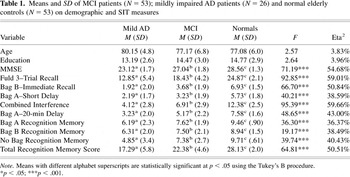
Twenty-six English-speaking patients (11 males and 15 females) were diagnosed with probable AD, using NINCDS-ADRDA (McKhann et al., 1984) criteria based upon (1) a neurological evaluation by the study neurologist (RD), including a detailed history from an informant, a brief neurocognitive battery that evaluated memory, language, calculations, praxis, visuospatial and visuoconstructive skills, and higher order executive functions, and the Clinical Dementia Rating Scale (CDR; Morris, 1993); (2) blood tests; (3) brain magnetic resonance imaging. All of these individuals obtained a global CDR score of 1.0, suggestive of mild dementia, and evidenced impairment in social and occupational functioning, a required criterion for the diagnosis of dementia according to DSM–IV (American Psychiatric Association, 1994). As shown in Table 1, these individuals had a mean age of 80.15 (SD = 4.8) years, mean educational attainment of 13.19 (SD = 2.6) years, and mean scores on the Mini-Mental State Evaluation (MMSE; Folstein et al., 1975) of 23.12 (SD = 1.7).
Means and SD of MCI patients (N = 53); mildly impaired AD patients (N = 26) and normal elderly controls (N = 53) on demographic and SIT measures

Mild cognitive impairment without dementia (MCI)
Fifty-three English-speaking patients (28 males and 25 females), who were evaluated as described above, were diagnosed with MCI. Patients in this group had a global CDR score of 0.5 (questionable dementia), met criteria for amnestic MCI as described by the criteria of Peterson's et al. (2001), and fulfilled NINCDS–ADRDA criteria for possible AD except that there was no dementia or functional impairment according to DSM–IV criteria. In the few cases where the patient presented alone, there was an attempt to contact an informant by telephone to obtain collateral information. The assessment of memory was largely based upon a four-trial delayed recall of the three words of the MMSE utilized in the neurocognitive battery that have been previously shown to have good sensitivity and specificity in discriminating MCI patients versus normal community-dwelling elderly controls (Loewenstein et al., 2000). As indicated in Table 1, the mean age of the MCI group was 77.17 (SD = 6.8) years, the mean level of educational attainment was 14.47 (SD = 3.0) years, and the mean MMSE score was 27.04 (SD = 1.8).
Normal community-dwelling elderly
Ninety-eight English-speaking cognitively normal adults were recruited via a community memory screening program as described below. These community-dwelling normal elderly had scores that did not deviate more than 1 standard deviation below the mean compared to age- and education-adjusted normative data on a neuropsychological battery. The latter included measures that assessed memory (i.e., Modified 3-Trial OME; Loewenstein et al., 2001), language (Boston Naming Test, Goodglass & Kaplan, 1983), praxis (Block Design–WAIS–III, Wechsler, 1997), attention (Digit Span, WAIS–III, Wechsler, 1997) and executive function (FAS Letter Fluency, Benton & Hamsher, 1977; Trails B; Reitan, 1958). Since these cognitively normal elders tended to be younger than patients in our mild AD and MCI groups, 53 of these individuals (21 males and 32 females) were age-matched to the 53 subjects in the MCI group As indicated in Table 1, the mean age for these 53 subjects group was equivalent to scores obtained by the other two study groups. There were no significant differences between the mild AD, MCI and normal elderly groups with regards to the proportion of males versus female subjects (χ2(2) = 2.49, p = .29).
Administration of the Semantic Interference Test
All subjects were first administered the modified three-trial version of the OME (Fuld, 1981; Loewenstein et al., 2001) followed by the SIT as the first task in the neuropsychological battery. Subjects were required to identify, by touch, 10 common household objects in Bag A (button, scissors, ball, ring, matches, cup, playing card, nail, key, and bottle). After identifying the objects by touch, subjects were allowed to view the objects. If the subject failed to name the object by touch or vision, the examiner then provided the name of the object. Subjects were then engaged in a 60-s verbal fluency distractor task (i.e., people's names) and then asked to recall the 10 objects. Selective reminders of the unrecalled objects were provided. The testing then alternated between recall trials with selective reminders and 30-s verbal fluency tasks (i.e., foods, vegetables) for two additional trials. The semantic interference paradigm required the subject to identify, by touch, 10 new common household items (belt, knife, whistle, bracelet, lighter, bowl, domino, screwdriver, lock, and can). After identifying Bag B objects by touch, the objects were visually presented to the subject. If the object could not be identified by touch or vision, the examiner provided the name of the object. The subject was then presented with a 60-s verbal fluency distractor task (i.e., fruits) and was then required to recall Bag B objects during a 60-s period (Bag B–Immediate Recall). The subject was then asked to recall the Bag A objects (Short-Delay Recall). The Combined Interference Score was calculated, consisting of Bag B Immediate Recall score and Bag A Short-Delay Recall score. After a 20-min delay, during which non-memory tests were administered, subjects were asked to recall Bag A items (Long-Delay Recall). A recognition memory task followed where the examiner read a list of items to the subject. The list consisted of the 10 Bag A targets, the ten Bag B targets and ten additional targets which were not in Bag A or Bag B. The patient was required to indicate whether each item was presented in Bag A, Bag B or in neither bag. The total number of the items correctly classified constituted the Recognition Memory Score.
As described in Loewenstein et al. (2003), Bag B objects belonged to the same semantic categories as those in Bag A and were carefully selected by a committee of four experienced neuropsychologists on the basis of a prior study that had examined the type of intrusive errors made by several hundred AD patients compared to normal elderly controls (Schram et al., 1995). For example, among AD patients, the most frequently occurring intrusion for the ring was a bracelet or other type of jewelry. Therefore, a bracelet, an exemplar of the category jewelry was selected as one of the items in Bag B. Similarly, a knife, which was also included in Bag B, is a common intrusion for scissors, presumably because both targets belong to the category of instruments that are used to cut material or objects. It should be noted that after Bag B items were presented, no selective reminders were provided to maintain consistency with frequently used list learning tasks that assess retroactive interference by having the subject recall an original set of targets immediately after a recall trial of the most recently presented targets.
Evaluating proactive and retroactive interference effects after controlling for memory performance
Comparative semantic interference effects were examined between groups by adjusting for overall memory impairment. A proactive interference ratio (PIR) was calculated by dividing Bag B recall by the average recall score of the initial three trials of the Fuld OME. The first OME trial was not utilized in isolation for this index since it is the only SIT measure which involves incidental memory and, as a single estimate, it is not as stable index of overall memory function as is the average three trial recall score (Loewenstein et al., 2001). A retroactive interference ratio (RIR) was also calculated by dividing Bag A-Short Delay Recall from the last recall trial of Bag A, before the introduction of Bag B to determine any decrements in performance associated with the semantically related set of Bag B objects. Lower PIR scores and RIR scores would indicate greater proactive and retroactive interference, respectively. The total interference ratio (TIR) score was computed by summing the PIR and RIR ratios. Finally, the rate of forgetting index (RFI) was calculated by dividing the 20-min delay recall for Bag A from the last recall trial of Bag A, before the introduction of Bag B.
Intrusions
Intrusions were defined as retrieval of any item other than the to-be-remembered targets. Intrusive errors are commonly recorded in paradigms investigating proactive interference and were of particular interest in the present study given the semantic similarity of the two arrays of to-be-remembered targets. The number of intrusions was recorded during all recall trials (i.e., three acquisition trials of Bag A, Bag B Immediate Recall, Bag A Short-Delay Recall and Bag A Long-Delayed recall). An intrusion that was mentioned across two or more learning trials was only counted once, on the first trial where it was produced.
RESULTS
All results were analyzed utilizing one-way analyses of variance (ANOVA). Kruskal-Wallis nonparametric tests of ranks were conducted in cases where there were unequal numbers of subjects per group and significant heterogeneity of variance. Since these analyses produced results that were equivalent to those using parametric procedures, only the results of standard ANOVAs are presented.
As indicated in Table 1, all indices of the SIT were effective in distinguishing mild AD patients, MCI patients and normal elderly controls. To examine which SIT index was most effective in distinguishing between groups, the sum of squares explained by the group effect was divided by the total sum of squares in ANOVA models yielding eta-squared, the proportion of explained variance for each measure accounted for by the group effect. Eta-squared is a measure of effect size and it is equivalent to the R2 obtained in regression models. The Combined Interference Score (Bag B Immediate Recall and Bag A Short-Delay Recall) was the index that explained the most between group variability (59.7%). The Bag B Immediate Recall score alone explained more between group variability (50.8%) than the Bag A 20-min delayed recall score (43.0%).
Evaluating Proactive and Retroactive Interference After Adjusting for Overall Memory Impairment
Bag B Immediate Recall and Bag A Short-Delay Recall likely reflect the effects of proactive and retroactive interference, respectively, but may also be related to general memory function. As shown previously, the best and most stable estimate of general memory and learning ability in the SIT is the total three-trial recall score for the original targets in Bag A (Loewenstein et al., 2001). To control for overall memory function, a series of analyses of covariance (ANCOVA) were employed in which the initial three-trial recall for the original targets was entered into the model as a covariate. After adjusting for the covariate effect, the Bag B Immediate Recall [F(2,128) = 8.20, p < .001] and Bag A Short-Delay Recall score [F(2,127) = 4.18, p < .02] both remained statistically significant, indicating that group differences on these measures were not merely a reflection of differences in overall memory function.
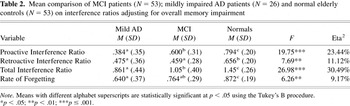
As described in the Methods section, another approach to evaluating the effects of semantic interference for each group was to calculate the PIR and RIR. Depicted in Table 2, there was a statistically significant group effect for PIR [F(2,135) = 19.75, p < .001]. Tukey's B post-hoc tests revealed that mild AD patients had the most proactive interference followed by the MCI patients, with the lowest level of proactive interference exhibited by normal elderly participants. There were also statistically significant differences between groups on the RIR [F(2,129) = 7.69, p < .01] and TIR [F(2,129) = 26.98, p < .001]. On the RIR, mild AD and MCI groups differ from the cognitively normal group but not from each other. The TIR findings indicate that the mild AD group evidenced the greatest degree of total interference. Normal elderly individuals exhibited less total semantic interference than the MCI group. Finally, there were significant group differences in their rate of forgetting [F(2,129) = 6.26, p < .004], with the mild AD group having significantly lower RFI than normal elderly subjects, but not differing from the MCI group.
Mean comparison of MCI patients (N = 53); mildly impaired AD patients (N = 26) and normal elderly controls (N = 53) on interference ratios adjusting for overall memory impairment

Accuracy of Subject Classification
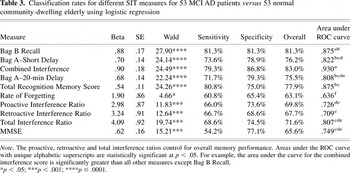
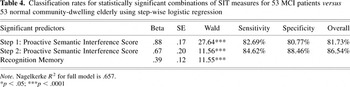
Classification rates for all SIT measures were calculated using logistic regression. The only SIT measure not employed in logistic regression analyses was the total score of the three initial Bag A recall trials. While performance on the first three learning trials of the OME was not used to classify any of the AD patients, normal scores on this measure were required as part of the neuropsychological inclusion criteria for normal elderly controls making it inappropriate to employ this measure in classification analyses. As indicated in Table 3, the overall highest classification rate by logistic regression for MCI patients versus normal elderly subjects was the Combined Interference Score, which yielded a sensitivity of 79.3% and a specificity of 86.8%. The area under the ROC curve for this index was .930 and was statistically greater than that obtained for any other index except for Bag B recall. Recall for Bag B targets yielded a sensitivity of 81.3% and a specificity of 81.3%. The area under the ROC curve for this measure was .875, which was significantly greater than rate of forgetting, MMSE, TIR, PIR, and RIR. A stepwise logistic regression analysis was subsequently conducted to investigate the combination of indices that provided the best classification rates. As depicted in Table 4, when stepwise multiple regression analyses were conducted, the Total Recognition Memory Score and the Bag B Proactive Interference Score entered into the model and yielded a sensitivity of 84.6% and specificity of 88.5% for MCI patients versus normal elderly subjects. An identical level of classification was obtained when the Combined Bag B and Bag A Short Delay Interference score was entered into the model with Recognition Memory instead of the Bag B score alone.
Classification rates for different SIT measures for 53 MCI AD patients versus 53 normal community-dwelling elderly using logistic regression

Classification rates for statistically significant combinations of SIT measures for 53 MCI patients versus 53 normal community-dwelling elderly using step-wise logistic regression

As indicated in Table 5, the highest classification rate by logistic regression for Mild-D patients versus normal elderly subjects was again for the Combined Interference Score, yielding a sensitivity of 84.6% and a specificity of 96.2% although the area under the ROC curve was similar to that of other measures. No other variables in the step-wise logistic regression model enhanced classification for mild AD patients and normal elderly controls beyond the Combined Interference Score.
Classification rates for different SIT measures for 26 mildly impaired AD patients versus 56 normal community-dwelling elderly using logistic regression

Intrusion Errors
The results of chi-square analyses indicated that there were significant group differences in the proportion of individuals within the three groups that made one or more intrusion errors across the three initial learning trials of Bag A (χ2(2) = 8.055, p = .018) and during recall of Bag B items (χ2(2) = 12.85, p = .002). There were no significant group differences in the number of intrusions produced during the short-delay recall of Bag A (χ2(2) = 8.89, p = .064) or the proportion of intrusions exhibited upon a 20-min delayed recall for Bag A (χ2(2) = 3.30, p = .192). Only 9.4% of normal elderly subjects made one or more intrusion errors across the initial three Bag A recall trials compared to 26.4% and 34.6% of MCI and mild AD groups, respectively. Similarly, only 12.2% of normal elderly subjects made intrusions during Bag B recall compared to 44.0% and 39.1% of MCI and mild AD groups, respectively. For all mild AD patients, the intrusion errors made when trying to recall Bag B items consisted of Bag A items, while only 61.9% of MCI patients made this type of intrusion error. An additional 19.5% of MCI patients incorrectly recalled an item belonging to the same semantic categories but did not represent either specific Bag A or Bag B targets. Thus, 100% of mild AD patients and 81.4% of MCI patients made intrusions that reflected actual Bag A objects or incorrect semantic representations of the to-be-remembered targets. Of the limited number of intrusions committed by normal elderly subjects, there appeared to be a relatively equal distribution between the number of intrusions involving incorrect recollections of Bag A targets, semantic intrusions that were not Bag targets and intrusions semantically unrelated to either Bag A or Bag B items.
DISCUSSION
To our knowledge, this study represented the first attempt to determine the extent to which recall of common objects was susceptible to proactive and retroactive semantic interference and, further, if such interference could differentiate non-demented MCI patients and mildly demented AD patients from normal community-dwelling elderly subjects. The current results indicate that even after accounting for differences in overall memory function, mild AD patients evidenced, on average, the largest proactive interference effects followed by the MCI group. Normal community-dwelling elderly participants demonstrated the smallest average proactive interference effects. In contrast, after controlling for overall memory impairment, retroactive interference effects was not different between MCI and AD patients but was lower for normal elderly participants, suggesting that average proactive but not retroactive interference effects might be more pronounced with greater disease severity. A combination of recall of targets susceptible to proactive semantic interference and the recognition memory scores provided optimal classification of MCI patients versus normal elderly subjects. The Bag B proactive interference score alone demonstrated both greater sensitivity and specificity than the delayed recall score, the MMSE or the recall of targets susceptible to retroactive interference. Recall of targets susceptible to proactive interference also had a statistically greater area under the ROC curve than the rate of forgetting index or the MMSE.
Taken together, the finding that susceptibility to proactive interference is present in both MCI and early AD is consistent with research that demonstrates that proactive interference is related to damage to the entorhinal cortex and hippocampus (Hasslemo & Wyble, 1997; Peinado-Manzano, 1994) and impaired integrity of the cholinergic basal forebrain (De Rosa et al., 2001) and the frontal lobes (McDonald et al., 2001; Smith et al., 1995), structures which have been implicated in the pathology of early AD. In addition, information processing deficits have been associated with the disruption of various neurotransmitter systems, loss of synapses and decrements in neuroplasticity within these and other areas of the brain (Adams, 1991; Mesulam, 2000) and may account for susceptibility to semantic interference as well as the ability to filter and inhibit irrelevant stimuli (Delis et al., 1991; Helkela et al., 1989; Loewenstein et al., 2003; Simone & Baylis, 1997; Spieler et al., 1996).
A primary deficit in mild AD is the difficulty in encoding new information and the inability to profit from semantic elaboration (Buschke et al., 1997). The present results suggest that vulnerability to proactive semantic interference may also hinder the encoding and subsequent recall of to-be-remembered information. Further, the finding that recognition memory for the source of the targets (Bag A, Bag B or No Bag) enhanced the classification of MCI versus normal elderly participants supports the notion that deficits in source memory for specific targets may have also contributed to impairments in encoding and retrieval. Recent studies suggest that deficits in source memory are associated with prefrontal impairment (Dalla Barba et al., 1999; Multhap & Balota, 1997). Recent functional MRI imaging studies have also indicated that the right hippocampus and the left prefrontal cortex are involved in the encoding and retrieval of episodic information related to source judgments (Casino et al., 2002).
Mild AD and MCI patients could be differentiated from normal elderly individuals on their performance on the delayed recall task, which is consistent with previous findings that delayed recall or rate of forgetting is a hallmark feature of amnestic syndromes such as AD (Locasio et al., 1995; Masur et al., 1994; Tröster et al., 1993). Although the average rate of forgetting was higher for mild AD patients than for elderly subjects, mild AD and MCI patients did not differ on this measure. In contrast, recall of targets susceptible to proactive interference demonstrated both greater sensitivity and specificity in logistic regression than the measures of delayed recall and rate of forgetting.
The greatest area under the ROC curve in distinguishing MCI patients from normal elderly controls was the Combined Interference score. This measure was also effective in distinguishing mild AD patients from normal elderly participants. The Combined Interference score was influenced by both proactive and retroactive interference as well as the brief delay between recall trials. It is likely that the greater range of scores on the Combined Interference measure reflected the most stable estimate of these specific impairments in MCI and mild AD patients. An alternative explanation was that there was a potential trade-off between proactive and retroactive interference effects. It is possible that those patients who most strongly encoded the initial targets over three learning trials may have been especially prone to proactive semantic interference effects for newly presented semantically similar Bag B targets and thus, exhibited better performance on the Short-Delay recall of the original Bag A items (which is most susceptible to the effects of retroactive interference). Post-hoc analyses of the data however, failed to reveal an inverse relationship or any correlation between these measures.
Less than 10% of normal controls made intrusion errors across the three learning trials of Bag A, as compared to about 25% and 33% of the MCI and mild AD groups, respectively. This extends the findings by Loewenstein et al. (1989, 1991) that mildly impaired AD patients are more prone to intrusion errors on the OME than normal elderly controls. In these previous studies, however, mean MMSE scores were considerably lower than for the MCI patients in the current investigation and five recall trials were used on the OME, rather than the three trials used in the present investigation. Approximately 40% of MCI patients and mild AD patients made intrusion errors on the recall trial for Bag B relative to 12.2% of the normal elderly group. For mild AD patients, all the intrusion errors were from Bag A targets while for MCI patients, 80.4% of intrusion errors consisted of Bag A targets or items belonging to the same semantic categories but did not represent either Bag A or Bag B targets. This further supports the notion that interference from items on the previous list affected recall performance during the Bag B trial for AD patients and likely contributed to decrements in performance on this measure.
A particular strength of the current study was that semantic interference scores were not used for diagnostic classification, thus avoiding the circularity of using measures that have been used for diagnostic purposes as primary outcome variables (Tuokko & Frerichs, 2000). In addition, performance on measures susceptible to proactive and retroactive interference was examined independently and after controlling for effects of overall memory impairment. Another advantage of this paradigm is that it was derived from an established object memory paradigm, previously shown to be less prone to confounds related to limited educational attainment and cultural bias (Loewenstein et al.,1991, 1994, 2001). Finally, the multimodal presentation of the targets and the use of multiple initial learning trials for common household objects, presumably facilitated a sufficient build-up of proactive interference that has been difficult to achieve in other studies.
Several potential limitations of the current investigation should be addressed. Although strict diagnostic criteria were employed, there is a possibility that some very mildly impaired individuals, particularly in the MCI group, may have been incorrectly diagnosed as having preclinical AD without functional impairment. Although the literature has indicated that by the end of 4 to 5 years the vast majority of amnestic MCI cases presenting to a memory disorders clinic will eventually be diagnosed with AD (Morris et al., 2001; Peterson et al., 2001), some patients might have the early manifestations of other degenerative disorders. It should be noted however, that this limitation is associated with all MCI studies because the preclinical stage of other possible etiological conditions is yet to be delineated. Future studies should address the extent to which these findings apply to other neurological or neuropsychiatric groups.
It is also possible that the observed interference effects in AD patients may not have been limited to semantically related material and may have also been observed with target objects that were similar on some other dimension (e.g., size or shape). This is unlikely however, since intrusions that were not semantic in nature tended to be unrelated to either Bag A or Bag B targets (e.g., comb) and did not appear to reflect physical properties of the objects. It might also be argued that the observed proactive interference differences between groups were due to Bag B targets being more difficult to recall than Bag A targets. This is unlikely for several reasons. First, pilot studies in our laboratories have suggested that recall of Bag A and Bag B items is of relatively equivalent difficulty. Moreover, the proactive interference ratio was calculated in an equivalent manner for all groups and was relatively modest for the normal elderly controls, suggesting that Bag B items were not appreciably more difficult to recall than Bag A items. Post-hoc analyses reveal that the initial inability to identify the item by touch or vision did not appear to be related to whether or not the item in Bag A or Bag B was recalled on subsequent recall trials.
Finally, it might be argued that the 20-min interval for assessing delayed recall may not have been of sufficient duration to assess delayed recall. However, a range of 20 to 30 min delay interval is commonly employed in the vast majority of commonly utilized neuropsychological measures (Delis et al., 1987; Taylor, 1959; Wechsler, 1997).
This investigation expands our understanding of the increased vulnerability of MCI and mildly demented AD patients to the potential effects of semantic interference. As pointed out by Celsis (2000), it is essential to develop measures that are sensitive to MCI before the onset of a dementia syndrome, when pharmacological agents that may improve memory are more likely to be effective. Since mild AD patients demonstrated a greater vulnerability to proactive interference than MCI patients even after adjusting for overall memory impairment, the SIT may also be useful in staging the progression of specific information processing deficits associated with the disorder. Although preliminary, the present results support the notion that the SIT may be useful in identifying MCI and early deficits associated with AD and is worthy of further research.
ACKNOWLEDGMENTS
This study was supported by NIA Grant 1 R01 AG02094-01A1 to Dr. Loewenstein, Principal Investigator.
References
REFERENCES
Adams, I.M.
(1991).
Structural plasticity of synapses in Alzheimer's disease.
Molecular Neurobiology,
5,
411–419.Google Scholar
American Psychiatric Association.
(1994).
Diagnostic and statistical manual of mental disorders
(4th ed.).
Washington, DC:
Author.
Ashford, J.W.,
Kolm, P.,
Colliver, J., &
Bekian, C.
(1989).
Alzheimer patient evaluation in the mini-mental state: Item
characteristic curve analysis.
Journals of Gerontology,
44,
P139–P146.Google Scholar
Bell, E.E.,
Chenery, H.J., &
Ingram, J.
(2000).
Strategy-based semantic priming in Alzheimer's dementia.
Aphasiology,
14,
949–965.Google Scholar
Bellenville, S.,
Peretz, I.,
Arguin, M.,
Fontaine, F.,
Lussier, I.,
Goulet, P., &
Joanette, Y.
(1992).
Assessment of semantic processing in patients with Alzheimer type
dementia. The release-of-proactive-interference paradigm.
Neuropsychology,
6,
29–41.Google Scholar
Beatty, W.W.,
Testa, J.A.,
English, S., &
Winn, P.
(1997).
Influences of clustering and switching on the verbal fluency
performance of patients with Alzheimer's disease.
Aging, Neuropsychology and Cognition,
4,
273–279.Google Scholar
Benton, A.L. &
Hamsher, K.
(1977).
Multilingual aphasia examination.
Iowa City:
University of Iowa.
Binnetti, G.,
Magni, E.,
Padovani, A., &
Cappa S.F.
(1995).
Release from proactive interference in early Alzheimer's
disease.
Neuropsychologia,
33,
379–384.Google Scholar
Black, S.E.
(1999).
Can SPECT predict the future for mild cognitive impairment?
Canadian Journal of Neurological Sciences,
26,
4–6.Google Scholar
Buschke, H.,
Sliwinski, M.J.,
Kuslanski, G., &
Lipton, R.B.
(1997).
Diagnosis of early dementia by the Double Memory Test: Encoding
specificity improves diagnostic sensitivity and specificity.
Neurology,
48,
989–997.Google Scholar
Casino, S.,
Maquet, P.,
Doland, R.J., &
Rugg, M.D.
(2002).
Brain activity underlying encoding and retrieval of source memory.
Cerebral Cortex,
12,
1048–1056.Google Scholar
Celsis, P.
(2000).
Age-related cognitive decline, mild cognitive impairment or
preclinical Alzheimer's disease?
Annals of Medicine,
32,
6–14.Google Scholar
Christensen, H.,
Kopelman, M.D.,
Stanhope, N.,
Lorentz, L., &
Owen, P.
(1998).
Rates of forgetting in Alzheimer dementia.
Neuropsychologia,
36,
547–557.Google Scholar
Cushman, L.A.,
Como, P.G.,
Booth, H., &
Caine, E.D.
(1988).
Cued recall and release from proactive interference in
Alzheimer's disease.
Journal of Clinical and Experimental Neuropsychology,
10,
685–692.Google Scholar
Dalla Barba, G.,
Nedjam, Z., &
Dubois, B.
(1999).
Confabualtion, executive functions and source memory in
Alzheimer's disease.
Cognitive Neuropsychology,
16,
385–398.Google Scholar
Delis, D.C.,
Kramer, J.H.,
Kaplan, E., &
Ober, B.A.
(1987).
California Verbal Learning Test: Adult Version.
San Antonio, TX:
The Psychological Corporation.
Delis, D.C.,
Massman, P.J.,
Butters, N.,
Salmon, D.P.,
Cermak, L.S., &
Kramer, J.H.
(1991).
Profiles of demented and amnesic patients on the California Verbal
Learning Test: Implications for the assessment of memory disorders.
Psychological Assessment,
3,
19–26.Google Scholar
De Rosa, E.,
Hasslemo, M.E., &
Baxter, M.G.
(2001).
Contribution of the basal cholinergic forebrain to proactive
interference from stored order memories following associate learning in
rats.
Behavioural Neuroscience,
115,
314–327.Google Scholar
Folstein, M.,
Folstein, S., &
McHugh, P.
(1975).
Mini-mental state. A practical method for grading the cognitive
state of patients for the physician.
Journal of Psychiatric Research,
12,
189–198.Google Scholar
Fuld, P.A.
(1981).
Fuld Object-Memory Evaluation.
Woodale, IL:
Stoelting Company.
Goodglass, H. &
Kaplan, E.
(1983).
The assessment of aphasia and related disorders
(2nd ed.).
Philadelphia:
Lea and Febiger.
Hasslemo, M.E. &
Wyble, B.P.
(1997).
Free recall and recognition in a network model of the hippocampus.
Behavioral Brain Research,
89,
1–34.Google Scholar
Helkela, E.L.,
Laulumaa, V.,
Soininen, H., &
Reikkinen, P.J.
(1989).
Different pattern of episodic and semantic memory in
Alzheimer's disease and Parkinson's disease with
dementia.
Neuropsychologia,
27,
1241–1248Google Scholar
Locasio, J.J.,
Growdon, J.H., &
Corkin, S.
(1995).
Cognitive test performance in detecting, staging, and tracking
Alzheimer's disease.
Archives of Neurology,
52,
1087–1099.Google Scholar
Loewenstein, D.A.,
Acevedo, A.,
Schram, L.,
Ownby, R.,
White, G.,
Mogosky, B.,
Barker, W.W., &
Duara, R.
(2003).
Semantic interference in mild Alzheimer's disease: Preliminary
findings.
American Journal of Geriatric Psychiatry,
11,
252–255.Google Scholar
Loewenstein, D.A.,
Argüelles, T.,
Argüelles, S., &
Linn-Fuentes, P.
(1994).
Potential cultural bias in the neuropsychological assessment of the
older adult.
Journal of Clinical and Experimental Neuropsychology,
16,
623–629.Google Scholar
Loewenstein, D.A.,
Argüelles, T.,
Barker, W.W.,
Schram, L.,
Ownby, R.,
Acevedo, A.,
Mogosky, B.,
White, G., &
Duara, R.
(2001).
The utility of a modified object memory test in distinguishing
between three different age groups of Alzheimer's disease patients
and normal controls.
Journal of Mental Health and Aging,
7,
317–324.Google Scholar
Loewenstein, D.A.,
Barker, W.W.,
Harwood, D.G.,
Luis, C.,
Acevedo, A.,
Rodriguez, F., &
Duara, R.
(2000).
Utility of a modified Mini-Mental State Examination with extended
delayed recall in screening for mild impairment ending committed
dwelling.
International Journal of Geriatric Psychiatry,
15,
434–440.Google Scholar
Loewenstein, D.A.,
D'Lia, L.,
Guterman, A.,
Eisdorfer, C.,
Wilkie, F.,
LaRue, A.,
Mintzer, J., &
Duara, R.
(1991).
The occurrence of different intrusive errors in patients with
Alzheimer's disease, multiple cerebral infarctions and major
depression.
Brain and Cognition,
16,
104–117.Google Scholar
Loewenstein, D.A.,
Wilkie, F.,
Eisdorfer, C.,
Berkowitz, B., &
Duara, R.
(1989).
An analysis of intrusive error types in Alzheimer's disease
and related disorders.
Developmental Neuropsychology,
5,
115–126.Google Scholar
Masur, D.M.,
Sliwinski, M.,
Lipton, R.B.,
Blau, A.D., &
Crystal, H.A.
(1994).
Neuropsychological prediction of dementia and the absence of
dementia in healthy elderly persons.
Neurology,
44,
1427–1432.Google Scholar
McKelvey, R.,
Bergman, H.,
Stern, J.,
Rush, C.,
Zehirney, G., &
Chertkow, H.
(1999).
Lack of prognostic significance of SPECT abnormalities in
non-demented elderly subjects with memory loss.
Canadian Journal of Neurological Sciences,
26,
23–28.Google Scholar
McDonald, C.R.,
Bauer, R.,
Russell, M.,
Grande, L.,
Gilmore, R., &
Roper, S.
(2001).
The role of the frontal lobes in memory.
Archives of Clinical Neuropsychology,
16,
571–585.Google Scholar
McKhann, G.,
Drachman, D.,
Folstein, M.,
Katzman, R.,
Price, D., &
Stadlan, E.M.
(1984).
Clinical diagnosis of Alzheimer's disease: Report of the
NINCDS-ADRDA work group under the auspices of Department of Health and
Human Services task force on Alzheimer's disease.
Neurology,
34,
939–944.Google Scholar
Mesulam, M.
(2000).
A plasticity-based theory of the pathogenesis of Alzheimer's
disease.
Annals of the New York Academy of Sciences,
924,
42–52.Google Scholar
Money, E.A.,
Kirk., R.C., &
McNaughton, N.
(1992).
Alzheimer's dementia produces a loss of discrimination but no
increase in rate of memory decay in delayed matching to sample.
Neuropsychologia,
30,
133–143.Google Scholar
Morris, J.C.
(1993).
The Clinical Dementia Rating (CDR): Current versions and scoring
rules.
Neurology,
43,
2412–2414.Google Scholar
Morris, J.C.,
Storandt, M.,
Miller, J.P.,
McKeel, D.W.,
Price, D.L.,
Rubin, E.H., &
Berg, L.
(2001).
Mild cognitive impairment represents early stage Alzheimer's
disease.
Archives of Neurology,
58,
397–405.Google Scholar
Multhap, K. &
Balota, D.A.
(1997).
Generation effects and source memory in healthy older adults and in
adults with dementia of the Alzheimer type.
Neuropsychology,
11,
382–391.Google Scholar
Peinado-Manzano, M.A.
(1994).
Amygdala, hippocampus and associative memory in rats.
Behavioural Brain Research,
61,
175–190.Google Scholar
Petersen, R.,
Doody, R.,
Kurz, A.,
Mohs, R.C.,
Morris, J.C.,
Rabins, P.V.,
Richie, K.,
Rosser, M.,
Thal, L., &
Winblad, B.
(2001).
Current concepts in mild cognitive impairment.
Archives of Neurology,
58,
1985–1992.Google Scholar
Petersen, R.C.,
Smith, G.E.,
Waring, S.C.,
Ivnik, R.J.,
Kokmen, E., &
Tangalos, E.G.
(1997).
Aging, memory, and mild cognitive impairment.
International Psychogeriatrics,
9,
65–69.Google Scholar
Petersen, R.C.,
Smith, G.E.,
Waring, S.C.,
Ivnik, R.J.,
Tangalos, E.G., &
Kokmen, E.
(1999).
Mild cognitive impairment: Clinical characterization and outcome.
Archives of Neurology,
56,
303–308.CrossRefGoogle Scholar
Reitan, R.M.
(1958).
Validity of the Trail Making Test as an indicator of brain damage.
Perceptual and Motor Skills,
19,
199–206.Google Scholar
Ritchie, K. &
Touchon, R.M.
(2000).
Mild cognitive impairment in conceptual basis and current
nosological status.
Lancet,
355,
225–228.Google Scholar
Rouleau, I.,
Imbault, H.,
Lamframboise, M., &
Bédard, M.A.
(2001).
Pattern of intrusions in verbal recall: Comparison of
Alzheimer's disease, Parkinson's disease and frontal lobe
dementia.
Brain and Cognition,
46,
244–249.Google Scholar
Salmon, D.P.,
Heindel, W.C., &
Lange, K.
(1999).
Differential decline in word generation from phonemic and semantic
categories during the course of Alzheimer's disease: Implications
for the integrity of semantic memory.
Journal of the International Neuropsychological Society,
5,
692–703.Google Scholar
Schram, L.,
Rubert, M., &
Loewenstein, D.A.
(1995).
A qualitative analysis of intrusive errors in Alzheimer's
disease.
Archives of Clinical Neuropsychology,
10,
256–263.Google Scholar
Shenaut, G.K. &
Ober, B.A.
(1996).
Methodological control of semantic priming in Alzheimer's
disease.
Psychology and Aging,
11,
443–448.Google Scholar
Sherwin, B.B.
(2000).
Mild cognitive impairment: Potential pharmacological treatment
options.
Journal of American Geriatrics Society,
48,
431–441.Google Scholar
Simone, P.M. &
Baylis, G.C.
(1997).
Selective attention in a reaching task: Effects of normal aging and
Alzheimer's disease.
Journal of Experimental Psychology: Human Perception and
Performance,
23,
595–608.Google Scholar
Smith, M.L.,
Leonard, G.,
Crane, J., &
Milner, B.
(1995).
The effect of frontal-lobe or temporal-lobe lesions to
susceptibility to interference in spatial memory.
Neuropsychologia,
33,
275–285.Google Scholar
Spieler, D.H.,
Balota, D.A., &
Faust, M.A.
(1996).
Stroop performance in healthy younger and older adults and in
individuals with dementia of the Alzheimer's type.
Journal of Experimental Psychology: Human Perception and
Performance,
22,
461–479.Google Scholar
Taylor, E.M.
(1959).
Psychological appraisal of children with cerebral deficits.
Cambridge, MA:
Harvard University Press.
Tröster, A.I.,
Butters, N.,
Salmon, D.,
Cullum, C.M.,
Jacobs, D.,
Brandt, J., &
White, R.F.
(1993).
The diagnostic utility of savings scores: Differentiating
Alzheimer's and Huntington's disease with the logical memory
and visual reproduction tests.
Journal of Clinical and Experimental Neuropsychology,
5,
773–788.Google Scholar
Tuokko, H. &
Frerichs, R.J.
(2000).
Cognitive impairment with no dementia (CIND): Longitudinal studies,
the findings, and the issues.
Clinical Neuropsychologist,
4,
504–525.Google Scholar
Wechsler, D.
(1997).
Wechsler Adult Memory Scale Scale–3rd Edition.
San Antonio, TX:
The Psychological Corporation.
Welsh, K.,
Butters, N.,
Hughes, J.,
Mohs, R., &
Heyman, A.
(1991).
Detection of abnormal memory decline in cases of Alzheimer's
disease using CERAD neurological measures.
Archives of Neurology,
48,
278–281.Google Scholar
Wolf, H.,
Grunwald, M.,
Ecke, G.M.,
Zedlick, D.,
Bettin, S.,
Dannenberg, C.,
Dietrich, J.,
Eschrich, K.,
Arendt, T., &
Gertz, H.J.
(1998).
The prognosis of mild cognitive impairment in the elderly.
Journal of Neural Transmission,
54
(Suppl.),
31–50.Google Scholar
Means and SD of MCI patients (N = 53); mildly impaired AD patients (N = 26) and normal elderly controls (N = 53) on demographic and SIT measures
Mean comparison of MCI patients (N = 53); mildly impaired AD patients (N = 26) and normal elderly controls (N = 53) on interference ratios adjusting for overall memory impairment
Classification rates for different SIT measures for 53 MCI AD patients versus 53 normal community-dwelling elderly using logistic regression
Classification rates for statistically significant combinations of SIT measures for 53 MCI patients versus 53 normal community-dwelling elderly using step-wise logistic regression
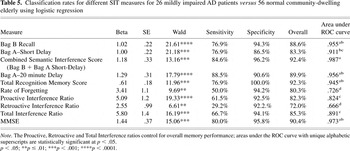
Classification rates for different SIT measures for 26 mildly impaired AD patients versus 56 normal community-dwelling elderly using logistic regression
 You have
Access
- 82
- Cited by