I. INTRODUCTION
Recent work on thermoelectric (TE) materials has demonstrated that nanosized dispersions in a matrix could introduce novel effects, such as thermopower (or Seebeck coefficient) enhancement or lattice thermal conductivity (κL) reduction, and improve TE figure of merit (ZT) as proven in Bi2Te3-basedReference Beyer, Nurnus, Böttner, Lambrecht, Roch and Bauer1, Reference Böttner, Chen and Venkatasubramanian2 superlattices, Bi2Te3-based,Reference Poudel, Hao, Ma, Lan, Minnich, Yu, Yan, Wang, Muto, Vashaee, Chen, Liu, Dresselhaus, Chen and Ren3–Reference Ji, He, Su, Gothard and Tritt5 PbTe-based,Reference Hsu, Loo, Guo, Chen, Dyck, Uher, Hogan, Polychroniadis and Kanatzidis6–Reference Androulakis, Lin, Kong, Uher, Wu, Hogan, Cook, Caillat, Paraskevopoulos and Kanatzidis9 and GaAs-basedReference Kim, Zide, Gossard, Klenov, Stemmer, Shakouri and Majumdar10 nanocomposites. However, progress in making nanocomposites based on filled skutterudite AxCo4Sb12 (A = fillers),Reference Caillat, Borshchevsky and Fleurial11–Reference Xi, Yang, Lu, Mei, Zhang and Chen14 a very promising TE material for intermediate temperature applications, is surprisingly slow even with many devoted researches. Earlier work on the in situ formation of Yb2O3 dispersions in YbxCo4Sb12/Yb2O3 system,Reference Zhao, Shi, Chen, Zhang, Bai, Pei, Li and Goto15 obtained through the oxidization of extra Yb atoms introduced in synthesizing Yb-filled CoSb3, seems to be partially successful but still difficult to get well-distributed nanodispersions, primarily due to the hardly controllable oxidation of Yb and the fast grow-up of oxides. Introduction of extrinsic dispersions (e.g., CoSb3,Reference Alboni, Ji, He, Gothard and Tritt16 ZrO2,Reference He, Stiewe, Platzek, Karpinski, Müller, Li, Toprak and Muhammed17 and TiO2Reference Xiong, Chen, Zhao, Bai, Huang and Chen18), even with the starting powders of nanoscale, usually shows particle agglomeration and leads to large percentage of nanoparticles locating in grain boundaries. Nanocomposites based on melt spinning,Reference Li, Tang, Su and Zhang19 and a work about InxCeyCo4Sb12/InSbReference Li, Tang, Zhang and Uher20 systems, also resulting in the size of dispersions or agglomerations always at hundred nanometers or larger. Since the nanoscattering effect is strongly dependent on the microstructure of nanocomposite, such as distribution, grain size, content of the nanoinclusions, and the interface matching of nanoinclusion with the matrix, introducing homogeneously dispersed nanoinclusions is the key factor to fabricate filled-skutterudite nanocomposite with enhanced TE performance.
In filled skutterudites, filling atoms that possess weak bands with Sb atoms in the cage framework were regarded as effective scattering centers to phonons because of the “rattling” effects. Present researches have been only concentrated on the stable fillers, such as rare earth metalsReference Morelli, Meisner, Chen, Hu and Uher12, Reference Nolas, Kaeser, Littleton and Tritt21 or alkaline earth metals,Reference Chen, Kawahara, Tang, Goto, Hirai, Dyck, Chen and Uher22, Reference Zhao, Shi, Chen, Zhang, Bai, Pei, Li and Goto23 which fill the voids in the annealing period about 950–1080 K, and is thermodynamically stable in the application temperature range of CoSb3 (below 850 K). However, some special fillers, which can fill into the voids at high temperature but leave out the voids as temperature is lowered, may be ideal sources to form nanoinclusions in an in situ way. These elements may exist in pure element phase or filler-related nanoscale compounds. To realize this picture, three factors should be considered. (i) The filler atoms can be filled into the voids at high temperature, but the filled phase in not thermodynamically stable at low temperature. In other words, this filling behavior is in a metastable way; (ii) The nanoinclusions made from the fillers should be inert to the matrix of CoSb3 in the application temperature range (below 850 K); (iii) The metastable void filling, even the grain size of nanoinclusions, should be controlled by the design of experiment process.
In principle, except for those identified stable fillers,Reference Nolas, Kaeser, Littleton and Tritt21, Reference Pei, Yang, Chen, Zhang, Salvador and Yang24, Reference Yang, Hao, Wang, Lan, He, Minnich, Wang, Harriman, Varki, Dresselhaus, Chen and Ren25 all other elements could be served as potential metastable fillers. We excluded those light elements such as C, N, and O, the early transition metals (TMs) because of their active chemical nature (avoiding the formation of more stable compounds instead of CoSb3), those TMs close to Co to avoid Co substitution, and those elements close to Sb to avoid Sb substitution. Ab initio calculation is an effective avenue to calculate the thermodynamic data by which potential metastable fillers could be selected by theoretical predication at first.
In this study, under the guidance of theoretical predication, we report a novel approach to realize the formation of well-distributed nanodispersions in n-type filled skutterudite through the manipulation of metastable void fillers by a designed sophisticated process of materials synthesis. Therefore, a proper annealing procedure is expected to control the filling of metastable fillers and the grain size of nanoinclusions. The effects of nanoinclusions to the TE performance are also discussed.
II. THE GIBBS FREE ENERGY CALCULATION AND EXPERIMENTAL SECTION
A. Gibbs free energy calculation
Whether an impurity atom can be filled into the CoSb3 crystal voids is determined by the Gibbs free energy of the chemical reaction. When the impurity atoms filled into the voids, the corresponding chemical reaction for the formation of a filled CoSb3 can be written as

Heat of formation for filling is defined as

The calculated correlation of Gibbs free energy ΔG and temperature T for filled skutterudite AxCo4Sb12 was studied by using the ab initio PAW (project augmented waves) method as implemented in the VASP (Vienna ab initio simulation package) package.Reference Kresse and Furthmüler26
All calculations of filled CoSb3 skutterudites were carried out on a supercell (2 × 2 × 2 primitive cell) with a total of 128 atoms and eight voids of pure CoSb3. The computational details can be found elsewhere.Reference Shi, Zhang, Chen and Yang27 The vibration combination to the Gibbs energy change is described as 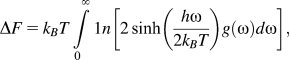 where only the difference of Gibbs free energies between the filled and unfilled phases are considered, and therefore only the contribution from rattling needs sincerely calculations. The competition with the secondary phases is not considered because the Ga-, In-, and Tl-related antimonides do not exist at elevated temperature. w is the rattling frequency of fillers and is calculated in the way as discussed in Ref. Reference Yang, Zhang, Bai, Mei and Chen28 The final Gibbs free energy changes of filling reaction is calculated as ΔG = ΔH + ΔF − TΔS − ΔGA, where ΔGA is free energy of filler in its pure element phase (such as Ga, In, and Tl), which is calculated in the Refs. Reference Chase, Davies, Downey, Frurip, McDonald and Syverud29 and Reference Dinsdale30, and ΔS is the configuration entropy by considering the random distribution of fillers in CoSb3.
B. Synthesis
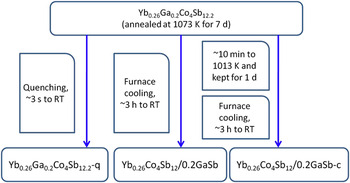
Samples with nominal composition YbxCo4Sb12/yGaSb (x = 0.21, y = 0; x = 0.26, y = 0, 0.1, 0.2, 0.3. Take the sample Yb0.26Co4Sb12/0.2GaSb as an example, the total element mol content of GaSb is estimated to be about 2.4% [= 0.4/(0.26 + 4 + 12 + 0.4)], and the total volume content of GaSb is about 2.9%) were prepared using a melting–quenching–annealing method. The constituent elements of high purity with stoichiometric mol ratio were loaded into a quartz tube with carbon depositing on the inner wall and sealed in vacuum. The samples were melted at 1393 K for 10 h and quenched in a salt-saturated ice water base rapidly. The quenched ingot of Yb0.26Co4Sb12/0.2GaSb was sliced into three parts and resealed in vacuum separately. Then all the ingots were annealed at 1073 K for 7 days. The cooling procedures of the annealing samples are different: one part of the Yb0.26Co4Sb12/0.2GaSb sample was quenched and labeled as Yb0.26Ga0.2Co4Sb12.2-q; one part of the Yb0.26Co4Sb12/0.2GaSb sample was cooled in the furnace gradually to 1013 K in about 10 min and kept for 1 day, subsequent with a furnace cooling to room temperature in about 3 h and labeled as Yb0.26Co4Sb12/0.2GaSb-c, as shown in Fig. 1. All the other ingots were cooled with a furnace cooling. The obtained ingots were grounded into fine powder and then consolidated by spark plasma sintering at 873 K for 8 min under a pressure of 60 MPa. All the weighing and sealing procedures were processed in a glove box full of high purity argon without oxygen and water.
Cooling process for the three samples with nominal composition Yb0.26Ga0.2Co4Sb12.2.

C. Measurements
The chemical compositions of bulk samples were characterized using electron probe microanalysis (JXA-8100, JEOL, Japan) with wavelength dispersive spectrometer. The morphology and microstructure were investigated by field emission scanning electron microscopy (FESEM; JSM-6700F, Japan) and transmission electron microscopy (TEM; JEM2010, Japan) with energy dispersive spectrometer (EDS).
The thermal diffusivity (λ) (300–850 K) was measured by laser flash method (LFA 427, NETZSCH, Germany) and converted into thermal conductivity κ. The κ values at low temperature (5–300 K) were measured using a conventional steady-state technique by using Chromel–Constantan thermocouple in a Reference Xie, He, Kang, Tang, Zhu, Laver, Wang, Copley, Brown, Zhang and Tritt4He cryostat.Reference Sun, Ono, Zhao, Pang, Abe and Ando31 The electrical conductivity (σ) and Seebeck coefficient (S) (300–850 K) were measured using commercial equipment (ZEM-3, ULVAC-RIKO, Japan) on the bar-type sample with a dimension of 2 mm by 2 mm in cross-section and 10 mm in length. The Hall coefficients (RH) at room temperature and σ values at low temperature (5–300 K) were determined on a physical property measurement system (Quantum Design, United States). A five-probe configuration and magnetic field sweeping from −5 to 5 T were used to measure the RH values. Carrier concentration (n) was calculated by n = −1/(eRH). Mobility (μH) was calculated by μH = σRH.
III. RESULTS AND DISCUSSION
A. Theoretical predication
With the help of ab initio calculations,Reference Shi, Zhang, Chen and Yang27 we selected a few elements with relative low heats of formation for filling the voids of CoSb3, and they are Ag, Cu, Zn, Cd, Ga, In, and Tl, as shown in Table I, which are potential candidates for metastable fillers. It is interesting to notice that those elements own relatively simple valence electron structure. Ag, Cu, Zn, and Cd have one or two s electrons, similar to alkaline or alkaline earth metals. Ga, In, and Tl have three valence electrons. All of them have fully filled d shell, implying that these potential high-temperature void fillers would show only +1, +2, or +3 charge states after filling, similar to the stable fillers.Reference Morelli, Meisner, Chen, Hu and Uher12, Reference Nolas, Kaeser, Littleton and Tritt21, Reference Pei, Yang, Chen, Zhang, Salvador and Yang24, Reference Yang, Hao, Wang, Lan, He, Minnich, Wang, Harriman, Varki, Dresselhaus, Chen and Ren25 Notice that the Ag, Cu, Zn, and Cd have relatively high heats of formation for filling, so we focused on Ga, In, and Tl.
Heat of formation ΔH for filling different fillers into the voids of CoSb3.Footnote a

a Ag and Cu show the results for 0.5 filling, whereas the others show the results for 0.125 filling.
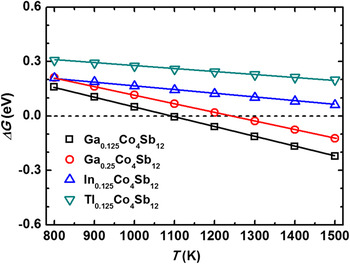
Figure 2 shows the temperature-dependent Gibbs free energies for Ga-, In-, and Tl-filled CoSb3 from ab initio calculations. The change of the Gibbs free energies of the pure phases of the fillers is also included based on their thermodynamic data. Our theoretical results show that the Gibbs free energy for the Ga-filled CoSb3 becomes negative around 1100 K and that for the In- and Tl-filled CoSb3 becomes close to zero at relatively high temperature. Considering the peritectic temperature of CoSb3 is about 1149 K, it means that Ga atoms can indeed fill the voids at a lower temperature close to that point, and leave the voids at reduced temperatures. Because of the very low positive values of Gibbs energies at high temperature for In- and Tl- filled systems, it seems possible that In and Tl may also be filled into the lattice voids at high temperature.
Predicted temperature-dependent Gibbs free energy ΔG in filled skutterudite AxCo4Sb12 (A = Ga, In, Tl). A negative value of ΔG implies a possible metastable void filling in CoSb3. The solid lines are guides for the eye.

The metastable Ga filling could be estimated to happen at around 1100 K based on our theoretical prediction, which accidently coincides with the formation temperature of filled CoSb3 phase. Based on this understanding, a rational procedure to synthesize filled CoSb3 was carried on at a temperature around 1100 K, which also guarantees the realization of the metastable Ga filling. After that, we could quench the sample very fast to keep the state of filling, or decrease temperature at a reasonable rate to control the growth of Ga-related dispersions, quick for small (even nano) or slow for large dispersions. Ga is also considered to be good for being inert to the cages at low temperature. Extra Sb was also introduced on purpose to drive the formation of Ga antimonide as dispersion phase. Due to the fact that the melting point of GaSb is as high as 985 K, GaSb dots are stable in the temperature range (500−850 K) of filled CoSb3 with optimized performance and durable to act as dispersions for practical applications. To make the performance of the composite appealing, we carried our work based on Yb-filled CoSb3. The final YbxCo4Sb12/yGaSb nanocomposite is also thermodynamically stable for application in the service temperature.
B. Microstructure investigation
Experiments were implemented on to quantify the effect of synthesizing and annealing procedure on the materials microstructure at first. As the experimental section described, the three samples with nominal composition Yb0.26Ga0.2Co4Sb12.2 were first annealed at 1073 K for 7 days to guarantee the formation of Yb and Ga dual-filled CoSb3, and then followed with different cooling procedures.
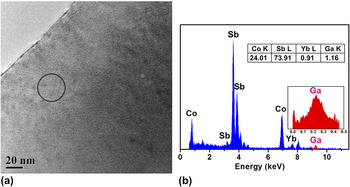
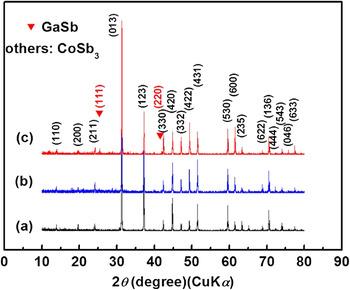
The sample Yb0.26Ga0.2Co4Sb12.2-q, obtained through the fast quenching, was expected to maintain its high-temperature microstructure of a single phase. This was confirmed by powder diffraction [x-ray diffraction (XRD)] (Fig. A1) and TEM analysis combining with EDS investigation [Figs. 3(a) and 3(b)]. The whole field of view looks uniform in the equipment resolution with no sign of any secondary phase, and the homogeneous compositions can be observed at any selected areas for this sample in TEM.
(a) Transmission electron microscopy (TEM) image for the quenched sample Yb0.26Ga0.2Co4Sb12.2-q. (b) The corresponding energy dispersive spectrometer (EDS) results for the marked circle in (a). The inset pattern is the local enlargement of Ga peak, and the inset table is the mol composition by EDS.

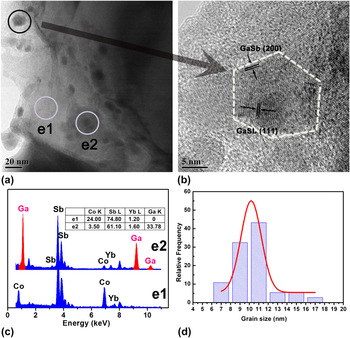
Figure 4(a) shows the TEM image for the Yb0.26Co4Sb12/0.2GaSb sample (furnace cooling) in which nanodispersions with an average grain size about 11 nm are observed. The nanodispersions are made of elements Ga and Sb with a proportion about 1:1 (subtracting the matrix of Yb filled CoSb3), whereas not any Ga can be detected for the matrix. Combining with XRD patterns (see Fig. A1), the nanodispersions are proved to be GaSb. The high-resolution TEM image [Fig. 4(b)] of one typical nanodispersion indicates that the (200) and (111) planes of GaSb phase are the most likely planes to match the matrix CoSb3. Generally speaking, the nanodispersions embedded in CoSb3 matrix distribute in a spatial homogeneous way.
(a) TEM image for the sample Yb0.26Co4Sb12/0.2GaSb nanocomposite. (b) High-resolution TEM image for selected nanodot in (a). (c) The corresponding EDS results for selected areas in (a). (d) Grain size distribution of the nanodispersions in (a).

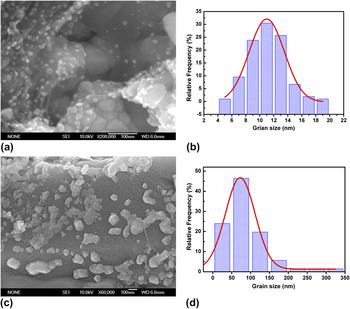
Since GaSb nanodispersions can be formed during the cooling period, the grain size of nanodispersions can also be manipulated by controlled cooling procedure. The Ga atoms as fillers were expected to leave the cages and form large size antimonide dispersions after the sample (Yb0.26Co4Sb12/0.2GaSb-c) was cooled to 1013 K and kept at that temperature for 1 day in the cooling process, which was truly observed on a fracture surface of the sample [Fig. 5(c)]. The grain size of nanodispersions were observed to coarsen to 20−300 nm because of the liquid phase coarsening of precipitated GaSb during the heat treatment at 1013 K, which is close to but above the GaSb melting point 985 K. Comparing with the two samples with quick and slow cooling rate, the grain size of precipitated nanodispersions is small and large, respectively, as shown clearly in the FESEM image in Fig. 5. The grain size distribution [Fig. 5(b)] of the SEM image [Fig. 5(a)] is similar like that of the TEM image [Fig. 4(d)], having an average grain size about 11 nm. For the sample Yb0.26Co4Sb12/0.2GaSb-c, the grain size of nanoinclusions is coarse to 88 nm (average size).
Field emission scanning electron microscopy images for fractured surface of the sample (a) Yb0.26Co4Sb12/0.2GaSb nanocomposite and (c) Yb0.26Co4Sb12/0.2GaSb-c nanocomposite with large GaSb dispersions. (b) and (d) are the corresponding grain size distribution for (a) and (c), respectively.

C. TE performance
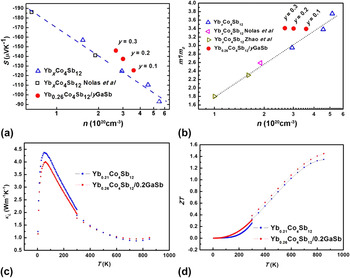
It is expected that the nanodispersions will influence the electron and phonon transport in a degree. Yb0.26Co4Sb12/0.2GaSb (with nanodispersions) and Yb0.21Co4Sb12 (without nanodispersions), were selected for a parallel investigation to look for novel effect of the nanodispersions on TE transport properties. The two samples have nearly the same carrier concentration (2.95 × 1020cm−3 for Yb0.21Co4Sb12 and 3.01 × 1020cm−3 for Yb0.26Co4Sb12/0.2GaSb) and are suitable for comparison. The absolute Seebeck coefficient (S) of Yb0.21Co4Sb12/0.2GaSb increases comparing with that of Yb0.21Co4Sb12, although they have the same carrier concentration. This can be observed clearly in the carrier concentration dependence of S at room temperature [Fig. 6(a)]. The S values of single-phase Yb-filled CoSb3 samples obey a general trend in the logarithmic coordinates and fall on the dashed line. Notice that there are S data from six Yb-filled CoSb3 without nanodispersions. Compared with these results, the S values of the Yb0.26Co4Sb12/yGaSb (y = 0.1, 0.2, 0.3) nanocomposites are obviously enhanced. Taking the nanocomposite with y = 0.2 as an example, the S is enhanced about 15% comparing with that of the single-phase Yb-filled CoSb3 at the same carrier concentration. For detailed analysis, we measured the X-ray photoelectron spectroscopy (XPS) spectrum of the samples with and without GaSb nanoparticle dispersions.Reference Xiong, Chen, Huang, Bai and Chen33 The larger slope of the XPS spectrum curve near the Fermi level for nanoparticle containing samples resulting in the increased Seebeck coefficient. Detailed analysis shows that the effective mass m*/m0 values of the samples containing nano-GaSb increase comparing with that of the pure Yb-filled CoSb3 samples [see Fig. 6(b)]. Generally speaking, the m*/m0 as a function of carrier concentration also falls on a straight line. The enhanced effective mass contributes to the increase of density of states (DOS), which result in the enhancement of S.
Carrier concentration (n) dependence of (a) Seebeck coefficients (S) and (b) effective mass (m*/m 0) at room temperature. The blue triangles represent the samples YbxCo4Sb12 by the authors, red circles represent the samples containing GaSb nanodispersions, and others represent the data in the Refs. Reference Zhao, Shi, Chen, Zhang, Bai, Pei, Li and Goto15, Reference Nolas, Kaeser, Littleton and Tritt21, and Reference Lamberton, Tedstrom, Tritt and Nolas32. Temperature dependence of (c) lattice thermal conductivity (κL) and (d) thermoelectric figure of merit (ZT). The triangles represent the sample Yb0.21Co4Sb12, and the circles represent Yb0.26Co4Sb12/0.2GaSb with nanodispersions.

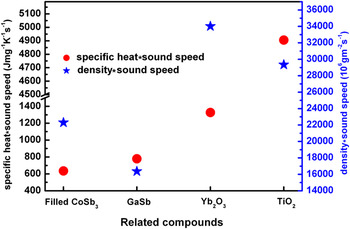
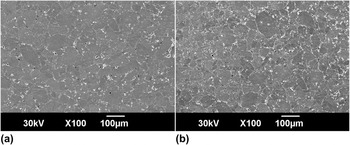
For filled skutterudite with nanodispersions, the phonon transport is dominated by grain boundary scattering, point defect (or large defect), rattling effects, and Umklapp processes. At very low temperatures (below 100 K), the boundary scattering is dominant. At temperatures between 100 and 400 K, the scattering from various defects including nanodispersions as large defects plays important roles in reducing κL. These two samples, Yb0.21Co4Sb12 and Yb0.26Co4Sb12/0.2GaSb, possess nearly the same grain size of matrix (see Fig. A2), and then the grain boundary scattering is the same; possess nearly the same Yb actual filling fraction (18% and 19% for Yb0.21Co4Sb12 and Yb0.26Co4Sb12/0.2GaSb, respectively), resulting in similar rattling effects. Therefore, the lowered κL in the temperature range from 50 to 400 K is ascribed to the GaSb nanodispersions, as shown in Fig. 6(c). With increasing temperature (above 450 K), the effect of grain boundary and nanoscattering is weakened, and the dominant scattering is the Umklapp processes, so the decreasing of κL is not obvious at high temperature. We herein calculated the materials parameters (see Fig. 7) that are usually applied to estimate the interface impedance of phonon transport, i.e., the product of specific heat and sound speed (specific heat × sound speed) for diffusive scattering and the product of mass density and sound speed (mass density × sound speed) for acoustic mismatch models. For either diffusive scattering or acoustic mismatch, the difference between GaSb and filled CoSb3, among the reported nanodispersions,Reference Zhao, Shi, Chen, Zhang, Bai, Pei, Li and Goto15, Reference Xiong, Chen, Zhao, Bai, Huang and Chen18 is always the lowest one, which may also be one of the factors that the κL reduction is little above room temperature in this system.
Some physical data for the related compounds.

As a result of the enhanced thermopowers, the ZT of Yb0.26Co4Sb12/0.2GaSb is increased comparing with that of the single-phase Yb-filled skutterudite Yb0.21Co4Sb12 in the whole temperature range 300–850 K. The highest ZT is obtained to be 1.45 at 850 K, and an average ZT of 0.99 in 300–850 K is achieved [Fig. 6(d)].
IV. CONCLUSIONS
In conclusion, we have presented a novel approach of realizing antimonide nanodots AmSbn in n-type filled skutterudite AxCo4Sb12 by using metastable fillers. These metastable fillers are able to fill the icosahedron cages of skutterudite at high temperature but driven out of the lattice voids and precipitate in the form of antimonides as temperature is lowered. Nanocomposite Yb0.26Co4Sb12/0.2GaSb was fabricated by GaSb particles with an average size of 11 nm majorly dispersed on grain boundary and inside grain of Yb0.26Co4Sb12 matrix. The nanosized particles do enhance thermopower for TE performance improvement. We expect that the approach of using metastable fillers can also be applied to other cage compoundsReference Guloy, Ramlau, Tang, Schnelle, Baitinger and Grin34, Reference Toberer, Christensen, Iversen and Snyder35 to form homogeneous dispersing nanodispersions in an in situ route.
ACKNOWLEDGMENTS
We thank Prof. F.F. Xu and Ms. M.L. Ruan (Shanghai Institute of Ceramics, Chinese Academy of Sciences) for their careful TEM characterization and helpful discussions and Prof. X.F. Sun (Hefei National Laboratory for Physical Sciences at the Microscale, University of Science and Technology of China) for his kind low temperature thermal conductivity measurements. This work was partially supported by the National Basic Research Program of China (2007CB607502), Natural Science Foundation of China project (No. 50821004), and Corning Inc.
APPENDIX
Powder x-ray diffraction patterns of the samples.

Scanning electron microscopy images for the polished surface after eroding.