Introduction
Under natural conditions, several macro- and micro-parasites can infect more than a single host species (Morgan et al., Reference Morgan, Milner-Gulland, Torgerson and Medley2004) creating multi-host systems (Malpica et al., Reference Malpica, Sacristán, Fraile and García-Arenal2006; McCormack & Allen, Reference McCormack and Allen2007). These complex systems are highly significant for the maintenance of infections, since parasites can persist independently in one host population in the absence of the other (Haydon et al., Reference Haydon, Cleaveland, Taylor and Laurenson2002; Gortázar et al., Reference Gortázar, Ferroglio, Höfle, Frölich and Vicente2007). However, a relevant distinction should be made between pathogens with a broad spectrum of infection (i.e. bovine tuberculosis or brucellosis (Godfroid, Reference Godfroid2002; Renwick et al., Reference Renwick, White and Bengis2007)) and those whose life cycle requires specific different host species (i.e. helminths (Poulin, Reference Poulin2001)). While in the former case the identification of reservoir and dead-end hosts (Haydon et al., Reference Haydon, Cleaveland, Taylor and Laurenson2002) among the affected hosts is required, in the latter case the need is to identify species acting as definitive, intermediate and paratenic hosts. In this regard, when there is spatial overlap between more than one definitive or intermediate or paratenic host the epidemiological issue increases, especially in the case of pathogens crossing the interface between wild and domestic animals (Miller et al., Reference Miller, Farnsworth and Malmberg2013; Guberti et al., Reference Guberti, Stancampiano and Ferrari2014; Turchetto et al., Reference Turchetto, Obber, Permunian, Vendrami, Lorenzetto, Ferré, Stancampiano, Rossi and Citterio2014). Moreover, when parasites shared between wildlife and livestock involve species with a high naturalistic value, such as top predators, conservation issues are raised to prevent impacts on endangered species. Taeniids represent an example of these issues.
Taeniids (Cestoda) are a family of tapeworms (Gori et al., Reference Gori, Armua-Fernandez, Milanesi, Serafini, Magi, Deplazes and Macchioni2015) with a generalized life cycle where the adult tapeworm infects the small intestines of the definitive host, characteristically a carnivore (Willingham et al., Reference Willingham, Ockens, Kapel and Monrad1996; Di Cerbo et al., Reference Di Cerbo, Manfredi, Trevisiol, Bregoli, Ferrari, Pirinesi and Bazzoli2008; Cantó et al., Reference Cantó, García, García, Guerrero and Mosqueda2011; Haukisalmi et al., Reference Haukisalmi, Lavikainen, Laaksonen and Meri2011; Lavikainen et al., Reference Lavikainen, Laaksonen, Beckmen, Oksanen, Isomursu and Meri2011), while the larval stage (cysticercus) occurs in the musculature (myocardium and skeletal muscle), lung, liver, brain, etc. (extraintestinal sites) of herbivores, which are the intermediate hosts (Goldová et al., Reference Goldová, Tóth, Letková, Mojžišová, Kožarová and Pomfy2008; Lavikainen et al., Reference Lavikainen, Haukisalmi, Lehtinen, Laaksonen, Holmström, Isomursu, Oksanen and Meri2010). Definitive hosts become infected through a predator–prey relationship; while foraging on pasture contaminated with eggs of this parasite, shed through definitive host faeces, is the primary cause of infection in the intermediate hosts. Traditionally, taxonomic identification of taeniid species has been performed by morphological analysis of cysticerci or adult tapeworms. However, in some cases taeniids are morphologically very similar, although genetically distinct from each other, i.e. cryptic species (Perkins, Reference Perkins2000; Chilton et al., Reference Chilton, O'Callaghan, Beveridge and Andrews2007; Nadler & Pérez-Ponce de León, Reference Nadler and Pérez-Ponce de León2011; Poulin, Reference Poulin2011; Galimberti et al., Reference Galimberti, Romano, Genchi, Paoloni, Vercillo, Bizzarri, Sassera, Bandi, Genchi, Ragni and Casiraghi2012). Therefore, traditional systematic methods may hardly differentiate these species, while molecular techniques can enable their taxonomic identification (Formenti et al., Reference Formenti, Gaffuri, Trogu, Viganò, Ferrari and Lanfranchi2016) and phylogenetic analysis can show their genetic diversity/relatedness.
Here we use the occasional molecular identification of Taenia ovis krabbei (cysticerci and adult tapeworm) in roe deer (Capreolus capreolus) and in a semi-stray dog (Canis lupus familiaris) in two model areas, as an example of the epidemiological complexity of monitoring this multi-host infection in areas with spatial overlap between wild and domestic definitive hosts.
Materials and methods
Collection and examination of hosts
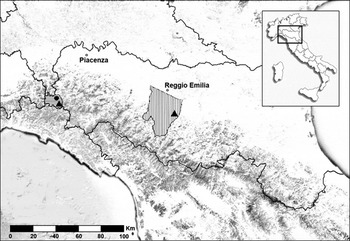
Roe deer and the dog were from two contiguous areas in the Italian northern Apennines – area 1 (44°37′N, 9°20′E) and area 2 (44°35′N, 10°44′E) (fig. 1) – which are hunting districts, spanning 15,400 ha and 43,573 ha, respectively.
Map of northern Italy to show sampling area 1 (horizontal lines) and area 2 (vertical lines) and locations of roe deer with cysticercosis (black triangles) and the dog with the adult tapeworm (black circle).

Several wild ungulates (wild boar (Sus scrofa), roe deer, fallow deer (Dama dama) and red deer (Cervus elaphus)), small game (pheasants (Phasianus colchicus), partridges (Perdix perdix) (only in area 2), red partridges (Alectoris rufa) and hares (Lepus europaeus)) and foxes (Vulpes vulpes) are present. Roe deer are the most abundant wild ruminants, with densities reaching 18 and 20 subjects/100 ha in areas 1 and 2, respectively. A recently re-established population of wolves (Canis lupus) is present in both areas.
In both areas, the hunting of ungulates and small game is a traditional and regulated activity. Indeed, hunters and their own dogs (pointing and searching dogs, bloodhounds) regularly attend the area. Moreover, in accordance with Italian Law (157 of 11/02/1992), hunters have to carry culled game to the control centres where, for each subject, age, sex, shooting site and morphobiometric measures are registered.
While, in both areas, the presence of hikers and walkers with their own domestic dogs cannot be excluded a priori, considering the proximity to built-up areas, in area 1 semi-stray and shepherd dogs have a stable presence associated with small farms and zoo–agricultural activities.
Following the field detection of parasites, an adult tapeworm and cysts (from both thigh and back muscles) were collected and stored at 4°C for successive parasite examination. In the laboratory, both adult and larval stages were analysed by visual examination under both optical and dissecting microscopes (40× magnification).
Molecular analysis
The DNA of both the adult tapeworm and cysts was extracted using a commercial kit according to the manufacturer's instructions (QIAmp DNA mini kit®, Qiagen, Hilden, Germany). A fragment of 450 bp of the mitochondrial cytochrome c oxidase I (cox1) gene was amplified with specific primers: JB3 (5′-TTTTTTGGGCATCCTGAGGTTTAT-3′) and JB4.5 (5′-TAAAGAAAGAACATAATGAAAATG-3′) (Bowles et al., Reference Bowles, Blair and McManus1992) and the polymerase chain reaction (PCR) protocol was performed according to Gasser et al. (Reference Gasser, Zhu and McManus1999) and Galimberti et al. (Reference Galimberti, Romano, Genchi, Paoloni, Vercillo, Bizzarri, Sassera, Bandi, Genchi, Ragni and Casiraghi2012). Amplicon size was assessed by electrophoresis in 1.5% agarose gels stained with ethidium bromide, and PCR products were purified with the Wizard® SV Gel and PCR Clean-Up System (Promega, Madison, USA) and directly sequenced. Sequencing was performed in an ABI Prism 3130 genetic analyser (Applied Biosystems, Waltham, Massachusetts, USA). Sequences were deposited in GenBank under accession numbers KY498632-4, and analysed by ClustalW and MegAlign software (DNAStar Inc., Madison, Wisconsin, USA). Sequences (335 nt) were compared with other cox1 sequences of Taenia spp. present in GenBank to evaluate sequence similarity, expressed as a percentage of nucleotide identity. In particular, the following sequences were analysed: T. krabbei (JX560319, EU544573, JF261321, JF261327, JF261322), T. multiceps (GQ228818), T. regis (AM503330), T. solium (AB086256), T. ovis (JX134122), T. arctos (GU252130), T. saginata (AB645845), T. serialis (AM503322), T. hydatigena (JN831308, EU544551) and T. taeniaeformis (AB221484). Echinococcus oligarthrus (AB208545) and T. mustelae (EU544571) were used as outgroups (Lavikainen et al., Reference Lavikainen, Laaksonen, Beckmen, Oksanen, Isomursu and Meri2011). Phylogenetic analysis was performed by using the neighbour-joining method, p-distance model and bootstrap test of 1000 replicates in MEGA 5 (http://www.megasoftware.net/).
Results
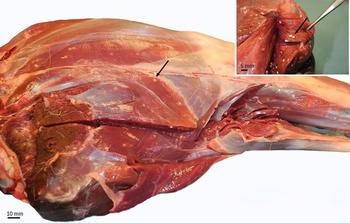
Two adult female roe deer, hunted in March 2015 and March 2016, respectively, in apparently good body condition, showed numerous oval, white cysts of approximately 2–4 mm in diameter (fig. 2) in the muscles of their whole body. In July 2015 an adult tapeworm was observed in the faeces of a semi-stray dog.
Cysticerci (arrowed) in the thigh muscle of a roe deer.

The adult tapeworm was damaged and thus morphologically indistinguishable; macroscopic analysis of roe deer thigh and back muscle samples showed cysticerci with a bladder membrane and watery, transparent fluid.
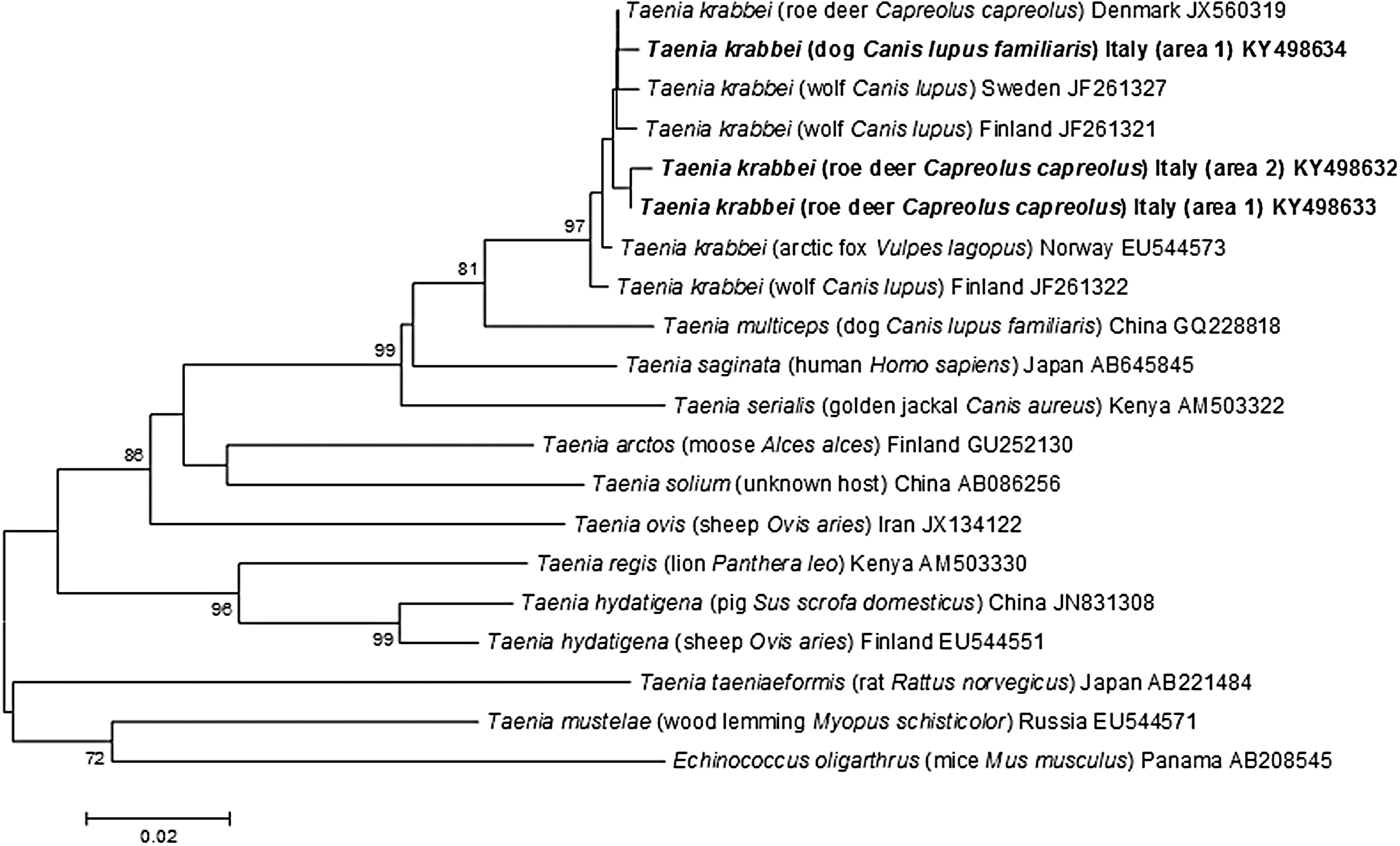
Taenia spp. DNA was isolated and the partial sequence of the cox1 gene was obtained. BLAST analysis showed T. krabbei for both cysticerci and the adult tapeworm. Phylogenetic analysis (fig. 3) showed that the Italian isolates grouped together with other isolates of T. krabbei from both intermediate (roe deer, Denmark) and definitive European hosts (wolves, Finland and Sweden, and arctic fox, Norway). This group was genetically similar to T. multiceps (nucleotide identity 95.2–95.8%), T. saginata (94.0–94.6%) and T. serialis (92.8–93.1%), while it was genetically distant from the morphologically similar T. ovis (87.2–87.5%) and T. arctos (88.7–89.3%). Sequence distances among Italian isolates of T. krabbei and the other Taenia species are reported in supplementary table S1.
Phylogenetic relationship based on the cox1 sequences of T. krabbei recorded in our study (bold type) and selected reference sequences of T. krabbei and other related taeniids. The phylogenetic tree was constructed using the neighbour-joining method in MEGA 5, and bootstrap values >70% (1000 replicates) are indicated. Reference sequences are identified by scientific name, host, country of origin and GenBank accession number. The scale bar indicates nucleotide substitutions per site.

Discussion
In the present study we identified cysticercosis of Taenia ovis krabbei (Moniez, Reference Moniez1879) for the first time in Italy, to the best of our knowledge. This Taenia species is morphologically similar to T. ovis, although they are biologically distinct (Priemer et al., Reference Priemer, Krone and Schuster2002). Indeed, wild Cervidae have been considered to be the principal intermediate hosts for T. krabbei (Al-Sabi et al., Reference Al-Sabi, Chriél, Holm, Jensen, Ståhl and Enemark2013), while cattle, goats, sheep and pigs have been shown to be refractory to the parasite (Al-Sabi et al., Reference Al-Sabi, Chriél, Holm, Jensen, Ståhl and Enemark2013; Lavikainen et al., Reference Lavikainen, Haukisalmi, Deksne, Holmala, Lejeune, Isomursu, Jokelainen, Näreaho, Laakkonen, Hoberg and Sukura2013). On the contrary, the life cycle of T. ovis includes Bovidae, preferably sheep but also goats (Flueck & Jones, Reference Flueck and Jones2006). Furthermore, this biological distinction is confirmed by the results of our phylogenetic analyses that showed the genetic distance between T. krabbei and T. ovis, as previously highlighted (Al-Sabi et al., Reference Al-Sabi, Chriél, Holm, Jensen, Ståhl and Enemark2013). On the other hand, the clustering of European T. krabbei isolates (Italy (present study), Denmark, Norway, Sweden and Finland) supports their common origin, although more loci and isolates of several geographical origins should be analysed to define the population genetics of this species (Lavikainen et al., Reference Lavikainen, Laaksonen, Beckmen, Oksanen, Isomursu and Meri2011).
The recorded T. krabbei cysticercosis supports the role of roe deer as the intermediate host of this parasite in Italy. In this regard, the occurrence of the adult parasite in a dog pointed out the epidemiological involvement of this species in the T. krabbei life cycle, as previously highlighted by other authors (Sawyer et al., Reference Sawyer, Cowgill and Andersen1976; Letková et al., Reference Letková, Lazar, Soroka, Goldová and Čurlík2008; Al-Sabi et al., Reference Al-Sabi, Chriél, Holm, Jensen, Ståhl and Enemark2013; Lavikainen et al., Reference Lavikainen, Haukisalmi, Deksne, Holmala, Lejeune, Isomursu, Jokelainen, Näreaho, Laakkonen, Hoberg and Sukura2013). Indeed, although the wolf (C. lupus) has been reported as the original definitive host of T. krabbei (Priemer et al., Reference Priemer, Krone and Schuster2002; Bagrade et al., Reference Bagrade, Kirjušina, Vismanis and Ozoliņš2009; Lavikainen et al., Reference Lavikainen, Haukisalmi, Deksne, Holmala, Lejeune, Isomursu, Jokelainen, Näreaho, Laakkonen, Hoberg and Sukura2013), domestic populations ‘at risk’ (i.e. hunting dogs, shepherd dogs) can be infected and contribute to spreading the infection (Otranto et al., Reference Otranto, Cantacessi, Dantas-Torres, Brianti, Pfeffer, Genchi, Guberti, Capelli and Deplazes2015). However, the coexistence of wild and domestic definitive hosts within the study areas does not allow us to determine which species has first introduced the parasite. On the one hand, the recent occurrence of the parasite's eggs in wolves from a contiguous area (Gori et al., Reference Gori, Armua-Fernandez, Milanesi, Serafini, Magi, Deplazes and Macchioni2015) supports their role. On the other hand, the increasing movements of dogs, particularly due to hunting trips to Eastern Europe, where the infection has been recorded for a long time (Goldová et al., Reference Goldová, Tóth, Letková, Mojžišová, Kožarová and Pomfy2008; Letková et al., Reference Letková, Lazar, Soroka, Goldová and Čurlík2008; Al-Sabi et al., Reference Al-Sabi, Chriél, Holm, Jensen, Ståhl and Enemark2013), may suggest a role for this species. Moreover, as this is the first report of T. krabbei in the study areas, to the best of our knowledge, alternative hypotheses about an old, undetected occurrence or a new introduction of T. krabbei in the study areas can be proposed. In particular, this parasite might have been present already but, until now, never detected. Minor infection can indeed often go unnoticed (Laaksonen & Paulsen, Reference Laaksonen and Paulsen2015). On the other hand, as morphological inspection of taeniid species can lead to misidentification, or to inconclusive results (Loos-Frank, Reference Loos-Frank2000; Priemer et al., Reference Priemer, Krone and Schuster2002; Flueck & Jones, Reference Flueck and Jones2006; Goldová et al., Reference Goldová, Tóth, Letková, Mojžišová, Kožarová and Pomfy2008; Lavikainen et al., Reference Lavikainen, Haukisalmi, Lehtinen, Laaksonen, Holmström, Isomursu, Oksanen and Meri2010; Lavikainen et al., Reference Lavikainen, Haukisalmi, Deksne, Holmala, Lejeune, Isomursu, Jokelainen, Näreaho, Laakkonen, Hoberg and Sukura2013) with both dog and roe deer serving as hosts for multiple Taenia species (Murai & Sugár, Reference Murai and Sugár1979; Letková et al., Reference Letková, Lazar, Soroka, Goldová and Čurlík2008), a misidentification with other taeniid species may have occurred. Indeed, a previous study based on morphological analyses highlighted T. ovis in wolves of the area (Guberti et al., Reference Guberti, Stancampiano and Francisci1993). In this regard, molecular techniques are useful tools to distinguish cysticerci of different species, but it is only in recent years that these methods have been performed routinely. Alternatively, a recent introduction of the parasite into the study areas cannot be ruled out. In particular, an infected definitive host may have spread T. krabbei eggs, and the parasite's life cycle may have been favoured by the abundance of the host species in the study areas, ascribed to a recent population increase of both intermediate (cervids) and definitive hosts (wolves, foxes). While our data do not allow us to determine which mechanism really occurred in our population, these occasional first findings of cysticerci highlight how passive surveillance is more likely than active surveillance to detect a ‘new’ wildlife disease (Guberti et al., Reference Guberti, Stancampiano and Ferrari2014).
Although T. krabbei is not a public health issue (Hoberg, Reference Hoberg2002), severe cysticercosis causes the rejection of the meat as a foodstuff for aesthetic reasons (Laaksonen & Paulsen, Reference Laaksonen and Paulsen2015). Considering the economic concerns for hunters and meat producers related to the damage of carcasses by cysticerci, our results highlight the need to define the spread of this parasite and to identify definitive and other intermediate host species involved in the local life cycle of T. krabbei. Moreover, a relevant sanitary education for hunters should be planned and implemented, in order to avoid the spread and maintenance of the parasite. Indeed, in addition to the feeding of dogs with raw viscera/meat, the risk of maintaining the parasite's life cycle is related to discarding the viscera of hunted animals in the ground.
Supplementary material
To view supplementary material for this article, please visit https://doi.org/10.1017/S0022149X17000177
Acknowledgements
We wish to thank all the hunters of Ottone (ATC PC10) and Casalgrande (ATC RE3) for their involvement in wildlife monitoring, and Ilaria Marangi for her suggestions during the editing process.
Financial support
This research received no specific grant from any funding agency, commercial or not-for-profit sectors.
Conflict of interest
None.
Ethical standards
The present work did not involve the use of laboratory animals. Samples were gathered from dead free-ranging roe deer which were legally shot by hunters in accordance with Italian Law (157 of 11/02/ 1992). Thus, no animals were killed specifically for this study.