Raising a child with autism spectrum disorder (ASD) is challenging and gives rise to persistent feelings of stress in most, if not all, parents (Hayes & Watson, Reference Hayes and Watson2013). As a group, parents of children with ASD are at risk for experiencing elevated parenting stress, compared to parents of typically developing children, but also compared to parents of children with other developmental disabilities (Hayes & Watson, Reference Hayes and Watson2013). Yet there still is daunting variability in families’ adaptation to raising children with ASD: whereas some families struggle severely in coping with the daily challenges, other families cope relatively well (Bayat, Reference Bayat2007).
Part of this variability in families’ adaptation is accounted for by child characteristics such as co-occurring problems (Osborne & Reed, Reference Osborne and Reed2009). All individuals with ASD have persistent deficits in social communication and interaction, along with restricted and repetitive patterns of behavior, interests, or activities (American Psychiatric Association, 2013). However, there remains wide heterogeneity in the manifestation of additional behavioral and emotional problems (Bauminger, Solomon, & Rogers, Reference Bauminger, Solomon and Rogers2010). These child characteristics are found to increase burden in parents (Osborne & Reed, Reference Osborne and Reed2009).
In contrast to the rich literature on affective experiences of parents raising a child with ASD, research is only starting to address the impact of parenting behaviors in children with ASD (e.g., Greenberg, Seltzer, Hong, & Orsmond, Reference Greenberg, Seltzer, Hong and Orsmond2006). Given the potential of parenting behaviors to be modified through interventions, it is of primordial importance to examine parenting in populations of children with special needs, including children with ASD (Whittingham, Sofronoff, Sheffield, & Sanders, Reference Whittingham, Sofronoff, Sheffield and Sanders2009). This study aims to evaluate the bidirectional longitudinal associations between parenting behaviors and child maladjustment in youth with ASD, across three waves, over a period of 9 years, and evaluates whether child gender and autism severity affect these bidirectional relations.
How Do Parenting and Child Maladjustment Affect Each Other in Youngsters With ASD?
Even though the important role of parenting was already discussed in the earliest theories on autism (Kanner, Reference Kanner1943), it is only in the past decade that researchers began to systematically address parenting in youngsters with ASD. This field has now moved away from the view that parents play a causal role in the origin of autism. Instead, parenting is now viewed as an important factor potentially affecting the quality of daily interactions with a child with ASD. In line with this changed vision, researchers began to examine whether and how parenting is related to the development of children with ASD, and to child maladjustment (e.g., behavioral problems) in particular.
Maljaars, Boonen, Lambrechts, Van Leeuwen, and Noens (2014), for example, explored cross-sectional correlations between parenting behavior and child behavioral problems in youngsters between 6 and 18 years with ASD. They found that rule setting, parental discipline (i.e., punishment of undesirable behavior), and harsh punishment (i.e., physical punishment of unwanted behavior) correlated positively with externalizing child problems. Using the same measurements in children with ASD aged 6 to 12, Boonen et al. (Reference Boonen, Maljaars, Lambrechts, Zink, Van Leeuwen and Noens2014) also found a significant positive association between parental negative control (i.e., a combination of parental discipline and harsh punishment) and externalizing problem behaviors. Due to their cross-sectional design, these two studies did not provide insight into the direction of effects in associations between parenting and child development. Whereas negative parental control may lead to more externalizing problems, it is equally plausible that externalizing problems may elicit more negative parental control.
Since the important theorizing by Bell (Reference Bell1968) and Sameroff (Reference Sameroff1975) on bidirectional and transactional parent–child effects, research on parenting in typically developing children increasingly shows that there is a complex and reciprocal interplay between parents and children across time. It is now well established that negative parenting behaviors (e.g., harsh or overreactive punishment) elicit more child behavioral problems over time and that problem behavior of the child, in turn, provokes more subsequent negative parenting behaviors (de Haan, Prinzie, & Deković, Reference de Haan, Prinzie and Deković2012; Soenens, Luyckx, Vansteenkiste, Duriez, & Goossens, Reference Soenens, Luyckx, Vansteenkiste, Duriez and Goossens2008). Similarly, positive parenting behaviors have been identified as a protective factor for child maladjustment (Kawabata, Alink, Tseng, van IJzendoorn, & Crick, Reference Kawabata, Alink, Tseng, van IJzendoorn and Crick2011; Serbin, Kingdon, Ruttle, & Stack, Reference Serbin, Kingdon, Ruttle and Stack2015).
A number of studies have begun to examine potential bidirectional associations between parenting and behavioral outcomes in children with ASD. Greenberg et al. (Reference Greenberg, Seltzer, Hong and Orsmond2006) investigated longitudinal relationships between negative parenting behaviors and behavioral problems in children with ASD (aged 11–49 years) across 18 months. Parenting was conceptualized as “expressed negative emotion,” which refers to high levels of parental criticism and/or emotional overinvolvement, and was measured through observation of parental speech (i.e., the Five-Minute Speech Sample). Maternal expressed emotion and child behavioral problems, as reported by the parents, were reciprocally related: high levels of expressed emotion predicted increases in externalizing and internalizing problems across time, and high levels of internalizing problems, in turn, predicted decreases in maternal expressed emotion. Baker, Smith, Greenberg, Seltzer, and Taylor (Reference Baker, Smith, Greenberg, Seltzer and Taylor2011) examined relationships between maternal criticism, as observed using the Five-Minute Speech Sample, and parent-reported behavioral problems (i.e., a composite score including both internalizing and externalizing problems) across 7 years. Criticism positively predicted increases in behavioral problems, but there was no child effect of behavioral problems on maternal criticism across time. Relying on a more homogeneous sample than the Greenberg et al. group, Bader and Barry (Reference Bader and Barry2014) replicated the detrimental effects of expressed emotion on externalizing problems in youngsters with ASD from 8 to 18 years across a 2-year interval. Parent-reported criticism/hostility predicted increases in externalizing behaviors of children with ASD 2 years later, even when controlling for parent-reported positive and negative parenting behavior, but no longitudinal child effects were detected.
Other studies evaluated the bidirectional relations between positive parenting behaviors and child adjustment. Using the same sample as Greenberg et al. (Reference Greenberg, Seltzer, Hong and Orsmond2006), Smith, Greenberg, Seltzer, and Hong (2008) reported no longitudinal relationships between observed maternal praise and warmth, and parent-reported internalizing and externalizing child problems. Woodman, Smith, Greenberg, and Mailick (2015) recently extended this study by examining the effect of maternal praise on maladaptive behaviors across 8.5 years. Increases in observed maternal praise were associated with decreases in parent-reported externalizing behaviors but not in internalizing problems. The impact of maladaptive child behaviors on subsequent parenting behavior, however, was not examined in this study.
Osborne, McHugh, Saunders, and Reed (2008) also examined longitudinal relationships (across a 10-month interval) between several features of parenting and child behavioral problems (i.e., a composite score including internalizing and externalizing problems) in youth with ASD (aged 5–16 years). In this study, parenting was conceptualized as involvement, communication, limit setting, and autonomy, and it was measured with a parental self-report questionnaire. Only poor limit setting (e.g., inconsistent discipline) was predictive of increases in child behavior problems, as reported by the parents, but no reciprocal relationship was found.
Even though this handful of longitudinal studies provides some evidence that reciprocal relationships exist between parenting behaviors and maladjustment in youth with ASD, the diversity of findings across studies is remarkable. While some studies documented bidirectional relationships between child behaviors and negative parenting (e.g., Greenberg et al., Reference Greenberg, Seltzer, Hong and Orsmond2006), others only reported parent effects (i.e., Bader & Barry, Reference Bader and Barry2014; Baker et al., Reference Baker, Smith, Greenberg, Seltzer and Taylor2011; Osborne et al., Reference Osborne, McHugh, Saunders and Reed2008). As more knowledge about the dynamic interplay between parenting and maladjustment of children with ASD is necessary to provide valuable keys for early modification and parent intervention, more longitudinal research is clearly needed.
Do Child Gender and Autism Severity Affect the Relationship Between Parenting and Child Maladjustment?
In addition, longitudinal research on the bidirectional effects between parenting and child maladjustment in youth with ASD should explicitly attend to the impact of child gender and autism severity. Research indicates that girls with ASD show more impairments (Holtmann, Bolte, & Poustka, Reference Holtmann, Bolte and Poustka2007) and follow more maladaptive developmental trajectories than boys with ASD (Billstedt, Gillberg, & Gillberg, Reference Billstedt, Gillberg and Gillberg2007). In addition, some research suggests that parents of girls with ASD experience higher stress than parents of boys with ASD (Zamora, Harley, Green, Smith, & Kipke, Reference Zamora, Harley, Green, Smith and Kipke2014), even though other studies have not reported gender differences in parental well-being (Lecavalier, Leone, & Wiltz, Reference Lecavalier, Leone and Wiltz2006). In general, research evaluating the impact of child gender on parent–child relationships in ASD is limited and has yielded mixed findings. Therefore, the possibility that gender moderates associations between parenting and child maladjustment (and, in particular, the possibility that these associations might be more pronounced among girls) requires further attention.
Similarly, the impact of autism severity remains understudied in longitudinal research on parenting–maladjustment relations. Studies indicated that autism severity impacts on parental well-being (Hoffman, Sweeney, Hodge, Lopez-Wagner, & Looney, Reference Hoffman, Sweeney, Hodge, Lopez-Wagner and Looney2009) and parenting behavior (Smith et al., Reference Smith, Greenberg, Seltzer and Hong2008). Smith et al. (Reference Smith, Greenberg, Seltzer and Hong2008), for example, showed that autism severity was predictive of decreased maternal praise across time. However, other studies indicated no impact of autism severity on parenting over and above other child characteristics such as problem behavior (Hastings et al., Reference Hastings, Kovshoff, Ward, Espinosa, Brown and Remington2005). Moreover, some studies controlled for the impact of autism severity without exploring its potentially moderating effect (e.g., Bader & Barry, Reference Bader and Barry2014). An important possibility to be considered is that autism severity exacerbates effects of child maladjustment on negative parental behavior. A child's problem behaviors might become even more worrisome to parents and, hence, elicit even more negative parental behavior, when the child generally displays more severe autism symptoms.
The Present Study
The few studies examining longitudinal bidirectional associations between parenting and maladjustment of children with ASD have yielded interesting, yet inconsistent, evidence regarding the direction of effects between parenting and child outcomes. Therefore, this study aims to examine longitudinal relationships between parenting behavior and child behavioral problems across a 9-year period, while also exploring the moderating role of child gender and autism severity on these relations. On the basis of theory (Bell, Reference Bell1968; Sameroff, Reference Sameroff1975) and research documenting bidirectional relationships between parenting and (mal)adjustment in children with and without ASD (Greenberg et al., Reference Greenberg, Seltzer, Hong and Orsmond2006), we anticipate to find both child-driven and parent-driven effects. On the basis of extant (yet inconclusive) evidence, we forward the possibility that these relationships might be more pronounced among girls and among children with more severe ASD symptoms. This study adds to the literature in three ways. First, while many studies focus on a short time interval (e.g., Osborne et al., Reference Osborne, McHugh, Saunders and Reed2008), this study evaluates relations throughout childhood, adolescence, and even into emerging adulthood. Second, as many studies examining these relationships draw from the same sample (e.g., Greenberg et al., Reference Greenberg, Seltzer, Hong and Orsmond2006; Smith et al., Reference Smith, Greenberg, Seltzer and Hong2008; Woodman et al., Reference Woodman, Smith, Greenberg and Mailick2015), this study adds new longitudinal evidence on the long-term reciprocal effects of parenting and child maladjustment. Third, this study is among the first to simultaneously include measures of positive as well as negative parenting behavior.
Method
Participants
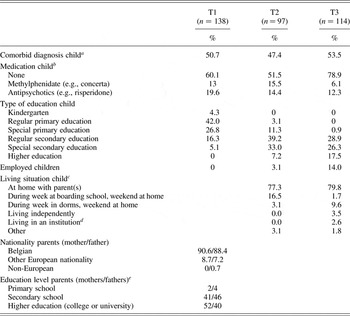
Participants included 139 parents of children with ASD. Informants were mainly mothers (98% at Time 1 [T1]). They provided information on family background and all study variables. At T1 the children were on average 10.2 years old (SD = 2.4 years, range = 5.1–16.2), at Time 2 (T2) the mean age was 16.0 years (SD = 2.3, range = 11.6–22.6), and at Time 3 (T3) the mean age was 19.0 years (SD = 2.3, range = 14.4–23.9). Consistent with the gender ratio typically found in children with ASD (Elsabbagh et al., Reference Elsabbagh, Divan, Koh, Kim, Kauchali, Marcin and Fombonne2012), the included children were predominantly male (sex ratio 5:1, 24 girls). Based on the demographic information provided by the parents at T3,Footnote 1 11% of the youngsters were reported to have intellectual disability (IQ < 70). At T1, mothers were on average 39.9 years (SD = 4.9) old, while fathers were on average 42.6 years (SD = 5.8) old. The majority of the mothers and fathers were married (80%) and employed (76% and 91%, respectively) at T1. At T1, 88% of the participating families reported that their children received some kind of counseling or treatment for ASD via a psychologist, a speech therapist, or other. At T2 and T3, 60% (T2) and 54% (T3) of the families reported to still receive one or more of these services. More demographic characteristics are summarized in Table 1.
Demographic information

Note: T1, Time 1; T2, Time 2; T3, Time 3.
a Reported by parents. Includes comorbidity with attention-deficit(/hyperactivity) disorder, specific learning disorders, motor disabilities, and so forth. Excludes intellectual disability (IQ < 70). Parents could indicate more than one comorbidity.
b Reported by parents.
c Only measured at T2 and T3.
d Child lives permanently or two-thirds of the time in the institution.
e Only measured at T1.
Procedure
At T1, parents of children with ASD were identified and asked to participate through two recruitment strategies. The largest part of the sample (75%) was recruited through the registries of four autism-services centers in Flanders, Belgium, that provide support at home and counseling to families of persons with ASD. These services are exclusively accessible for individuals who received a formal, psychiatric diagnosis of ASD based on the DSM criteria. The remaining parents were recruited by contacting teachers and by placing announcements on websites regarding ASD. Families had to meet the following inclusion criteria: the child (a) had received a formal diagnosis of autistic disorder, Asperger syndrome, or pervasive developmental disorder not otherwise specified based on DSM-IV-TR or ICD-10 criteria and (b) was at least 4 years old. Children with known genetic conditions such as Down syndrome were excluded from this study. The child's diagnostic status was established through written parent report and was verbally confirmed to a research assistant. Parents also indicated when and by whom the formal diagnosis was made. At T1, the ASD diagnosis was established for an average of 3.0 years (SD = 2.4). There were no significant differences between families recruited through the autism-services centers and families recruited through websites concerning autism severity (T1), time since diagnosis, parenting behavior, and child behavioral problems (all ps > .05).
At T1, initially 207 parents agreed to participate in the study. Six years later, in 2012, 197 parents were invited to participate in the follow-up study. The remaining 10 parents could not be contacted at T2 because they had moved away or did not provide sufficient contact information. In 2015, these 197 parents were contacted for the third time (regardless of participation at T2). Again, 17 parents could not be contacted because they had moved away. In 2012 (T2), 97 parents agreed to participate (response rate of 49%). In 2015 (T3), 114 parents participated again in the study (response rate of 63%). Only those parents who participated at least two of the three times were included in the study.Footnote 2 There were no significant differences between the dropout group (i.e., parents participating once) and the group of parents who participated on two or three assessment points in terms of demographic characteristics or in terms of parenting behavior and child behavior problems. Informed consent was obtained from all participants included in the study.
Measures
Autism symptoms
At T1, parents completed the Dutch version of the Social Communication Questionnaire Current Version (SCQ-Current; Rutter, Bailey, Lord, & Berument, Reference Rutter, Bailey, Lord and Berument2003; Warreyn, Raymakers, & Roeyers, Reference Warreyn, Raymakers and Roeyers2004). This parent-report questionnaire consists of 40 yes or no questions and probes symptoms in language/communication, social functioning, and repetitive/stereotyped behaviors over the most recent 3 months. The SCQ-Current assesses the current severity of autistic symptoms and should not be confused with the SCQ-Lifetime Version, which considers the child's entire developmental history. The Cronbach α of the SCQ-Current was 0.82.
We used the SCQ-current scores at T1 to divide our sample in two groups to reflect symptom severity at T1. Given that there are no normative cutoff scores to evaluate the SCQ-Current version, we applied the cutoff score suggested for the SCQ-Lifetime Version (Corsello et al., Reference Corsello, Hus, Pickles, Risi, Cook, Leventhal and Lord2007; Rutter et al., Reference Rutter, Bailey, Lord and Berument2003). Based on this conservative cutoff, 49% of the sample was assigned to a lower symptom group (total score <15), while 51% was assigned to the higher symptom group (total score ≥15).
Parenting behaviors
At all three assessment points, parents completed the Parental Behavior Scale (PBS; Van Leeuwen & Vermulst, Reference Van Leeuwen and Vermulst2004, Reference Van Leeuwen and Vermulst2010), a self-report questionnaire based on social-learning theories, tapping into concrete parenting behaviors. Parents rated the frequency of these behaviors on a 5-point Likert scale ranging from (1) never to (5) always. This study included four subscales of the PBS: positive parenting (11 items, i.e., involvement and problem solving with the child, e.g., “I make time to listen to my child, when he/she wants to tell me something”); rules (6 items, i.e., teaching the child to follow rules, e.g., “I teach my child to handle his/her things with respect”); discipline (6 items, i.e., punishment of undesirable behavior, e.g., “If my child does something that is not allowed, I give him/her a punishment”); and harsh punishment (5 items, i.e., physical punishment of undesirable behavior, e.g., “I spank my child when he/she is disobedient”). In line with previous studies (Boonen et al., Reference Boonen, Maljaars, Lambrechts, Zink, Van Leeuwen and Noens2014; Van Leeuwen & Vermulst, Reference Soenens, Vansteenkiste, Lens, Luyckx, Goossens, Beyers and Ryan2004), a principal component analysisFootnote 3 on all items (at T1) indicated that the items can be combined into two composite scores: positive parenting (combining the items for positive parenting and rules) and negative control (combining the items for discipline and harsh punishment). Because the discipline PBS subscale taps into a rather coercive and pressuring type of control (rather than into a more structuring type of control), it has been found to correlate highly with the harsh punishment subscale (Van Leeuwen & Vermulst, Reference Van Leeuwen and Vermulst2004). Consistent with several previous studies using the PBS (e.g., Boonen et al., Reference Boonen, Maljaars, Lambrechts, Zink, Van Leeuwen and Noens2014; Millones, Ghesquière, & Van Leeuwen, Reference Millones, Ghesquière and Van Leeuwen2014), we therefore combined the items for discipline and harsh punishment into an overall score for negative control.
The PBS has been validated for use in parents of children and adolescents with ASD (Lambrechts, Van Leeuwen, Boonen, Maes, & Noens, Reference Lambrechts, Van Leeuwen, Boonen, Maes and Noens2011), and factor analyses supported its structural validity (Meunier & Roskam, Reference Meunier and Roskam2007; Van Leeuwen & Vermulst, Reference Van Leeuwen and Vermulst2004). Convergent validity has been established by relating the PBS to other parenting concepts, such as psychological control, autonomy support, responsiveness (Janssens et al., Reference Janssens, Goossens, Van Den Noortgate, Colpin, Verschueren and Van Leeuwen2015), and parenting stress (Van Leeuwen & Vermulst, Reference Van Leeuwen and Vermulst2004). In this study, Cronbach αs of the two composite scores (positive parenting and negative control) were satisfactory at all assessment points (0.86 and 0.79 at T1, 0.86 and 0.81 at T2, and 0.76 and 0.79 at T3).
Child behavior problems
At all waves, parents completed the Child Behavior Checklist 4/18 (CBCL; Achenbach, Reference Achenbach1991), a parent-report questionnaire assessing emotional and behavioral problems, over the past 6 months, on a 3-point Likert scale ranging from (0) not true to (2) very true. Because this study aims to chart longitudinal relations and because previous studies confirmed the applicability of this measure in youngsters with ASD older than 18 years (e.g., Holtmann et al., Reference Holtmann, Bolte and Poustka2007), we also applied the CBCL 4/18 at T3. This study focuses on the two broadband factors Internalizing Problems (comprising anxious/depressive behavior, withdrawn/depressive behavior and somatic complaints) and Externalizing Problems (comprising delinquent behavior and aggressive behavior).Footnote 4 Excellent Cronbach αs were retrieved at all assessment points and were 0.86 and 0.91 at T1 and 0.91 and 0.92 at both T2 and T3 for internalizing and externalizing problems, respectively.
Results
Preliminary analyses
Prior to examining the longitudinal relationships between parenting and child behavioral problems, relationships between key demographic characteristics and the variables of interest were inspected. Specifically, we examined the role of age, gender, autism severity, level of maternal education, and type of medication as each of these characteristics have been suggested to affect parenting or child behavior in youth with ASD (Holtmann et al., Reference Holtmann, Bolte and Poustka2007; McCracken et al., Reference McCracken, McGough, Shah, Cronin, Hong, Aman and McMahon2002; Smith et al., Reference Smith, Greenberg, Seltzer and Hong2008).
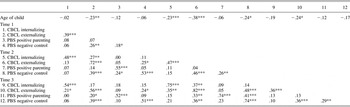
Correlational analyses (Table 2) indicated that child age was significantly related to child behavioral problems and parenting behavior. At all assessment points, older children showed fewer externalizing problems. At T2, older children also experienced fewer internalizing problems. The results also indicated a significant negative relationship between child age and negative parental control at T2. To explore the role of child gender and symptom severity (high vs. low), we evaluated group differences using the Mann–Whitney test. Results showed that gender was related to internalizing problems at T2 (U = 3,742.5, z = −2.44, p < .05) and at T3 (U = 4,396.5, z = −3.17, p < .01), with girls obtaining higher scores than boys. Symptom severity only had a significant effect on internalizing problems at T1 (U = 4,097.5, z = −2.38, p < .05), with children from the high-symptom group displaying more internalizing problems. To explore the role of level of maternal education and type of medication, we evaluated group differences using the Kruskal–Wallis test. Results showed that level of maternal education was related significantly to positive parenting at T1, H (2) = 7.10, p < .05, to negative parental control at T2, H (2) = 9.15, p < .05, and to negative control at T3, H (7) = 7.37, p < .05, with parents who obtained only primary education scoring higher on both positive parenting and negative control than parents who obtained secondary or higher education. Type of medication at T2 also had a significant effect on externalizing behavior at T2, H (2) = 10.86, p < .01, with children who were taking antipsychotics exhibiting more externalizing problems than children who were not taking medication.
Pearson correlations between demographic characteristics, behavioral problems, and parenting behaviors

Note: CBCL, Child Behavior Checklist; PBS, Parental Behavior Scale.
*p < .05. **p < .01. ***p < .001.
To examine the longitudinal relationships between parenting and child behavior while controlling for the impact of these demographic characteristics, we created residual scores for the parenting and the problem behavior variables. Residual scores were created by regressing each variable on the demographic variables that were found to be related to this specific variable and by saving the obtained unstandardized residual scores. The residual scores for negative control were controlled for the child's age and level of maternal education. The residual scores for positive parenting were controlled for level of maternal education only. The residual scores for externalizing problems were controlled for child's age and type of medication. The residual scores for internalizing problems were controlled for the child's age, gender, and for autism severity (low vs. high).
Mean-level changes in parenting and child maladjustment in youth with ASD
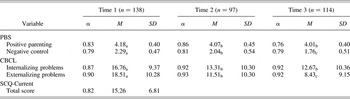
Table 3 presents the raw mean scores on the study variables and their standard deviations at all assessment points. Negative parental control decreased significantly across the three measurement points (Wilcoxon test; z = –5.19, p < .001 for T1–T2; z = –4.48, p < .001 for T2–T3). Positive parenting was also significantly higher at T1 than at T2 and T3 (z = –2.39, p < .05 for T1–T2; z = –3.24, p < .01 for T1–T3), whereas no significant differences emerged between T2 and T3 (z = –1.24, p = .12). Behavioral problems also declined across time. Externalizing problems declined across each of the three measurement points (z = –6.67, p < .001 for T1–T2; z = –2.34, p < .05 for T2–T3), while internalizing problems only declined significantly from T1 to T2 (z = –2.86, p < .01 for T1–T2; z = –1.35, p = .18 for T2–T3). Across the three waves, 62% (T1), 34% (T2), and 20% (T3) of the children scored in the clinical range for externalizing problems, while 70 % (T1), 44% (T2), and 44% (T3) of the children were rated with clinically elevated internalizing problems.
Internal consistencies and descriptive statistics of variables

Note: Raw scores are presented. PBS, Parental Behavior Scale; CBCL, Child Behavior Checklist; SCQ-Current, Social Communication Questionnaire Current Version. Values with different subscripts indicate statistical significant differences (p < .05) tested with the Wilcoxon test.
Longitudinal relationships between parenting and child maladjustment
Bivariate correlations between parenting and child maladjustment are presented in Table 2. Across all waves, negative parental control was related to externalizing problems, yet unrelated to internalizing problems. Within-time correlations between positive parenting and problem behavior were also not significant. However, externalizing problems at T1 and T2 were significantly and positively correlated with positive parenting at T3. All study variables showed moderate to strong stability across the 9-year interval.
Cross-lagged models with parenting behavior and child maladjustment
The first key objective of this study was to examine the longitudinal relationships between parenting and child maladjustment and to simultaneously examine the direction of effects. Therefore, we applied cross-lagged modeling, using maximum likelihood parameter estimators. All analyses were conducted with the statistical software package Mplus7 (Muthén & Muthén, Reference Muthén and Muthén1998–2012). As missing data were missing completely at random, Little's missing completely at random test: χ2 (164) = 153.08, p = .72, full information maximum likelihood was used.
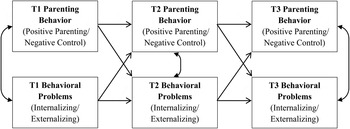
We estimated cross-lagged models for each parenting variable and for each indicator of child maladjustment. This resulted in a total of four models (two parenting variables: negative control and positive parenting × two child behavior problems: internalizing problems and externalizing problems). The conceptual model is presented in Figure 1. In each model, we included the residual scores controlling for the role of the demographic variables. To assess the model fit of the models, we examined the chi-square test, the ratio of chi-square/degrees of freedom, the comparative fit index, the root mean square error of approximation (RMSEA), and the standardized root mean square residual. An acceptable fit is indicated by a small chi-square, a ratio of chi-square/degrees of freedom of around 2 or lower, a comparative fit index value of 0.95 or higher, a RMSEA value of 0.06, and a standardized root mean square residual value of 0.08 or lower (Hu & Bentler, Reference Hu and Bentler1999; Kline, Reference Kline2010).
Conceptual model of the relationships between parenting behavior and children's behavioral problems. T1, Time 1; T2, Time 2; T3, Time 3.

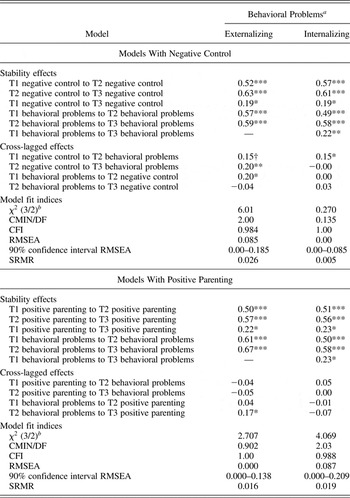
The fit indices and the path coefficients of the four cross-lagged models with parenting and behavioral problems are presented in Table 4.Footnote 5 Because the initial models resulted in a relatively poor model fit, we inspected modification indices. These indices suggested adding direct stability paths between T1 and T3 for positive parenting, negative control, and internalizing problems. These adjusted models had good fit, and the coefficients of these models are reported in Table 4.
Standardized path coefficients for the three-wave cross-lagged models with parenting and behavioral problems, using residual variables (n = 139)

Note: T1, Time 1; T2, Time 2; T3, Time 3; CFI, comparative fit index; CMIN/DF, ratio of the chi-square to degrees of freedom; RMSEA, root mean square error of approximation; SRMR, standardized root mean square residual. Residual scores are presented; negative control is controlled for the child's age and level of maternal education. Positive parenting is controlled for the level of maternal education only. Externalizing problems are controlled for child's age and type of medication. Internalizing problems are controlled for the child's age and gender and for autism severity (low vs. high).
a Raw scores were used in all analyses. Identical analyses using T scores instead of raw Child Behavior Checklist scores yielded highly similar results: all reported cross-lagged effects remained significant, and the coefficients remained highly similar. The results differed only for the cross-lagged relationship between T1 negative control and T2 externalizing problems. Although this relationship was not significant when using raw scores, it did become statistically significant when using T scores.
b Because of the addition of the stability between T1 and T3 for positive parenting, negative control, and internalizing problems but not for externalizing problems, the models with externalizing problems have 3 df, and the models with internalizing problems have 2 df.
†p < .10. *p < .05. **p < .01. ***p < .001.
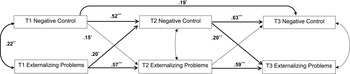
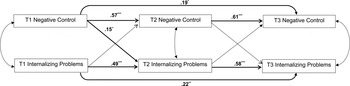
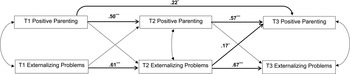
In all four models, all variables demonstrate significant levels of temporal stability across 9 years, with standardized coefficients (β) ranging from 0.19 to 0.67. In addition, we found evidence for four significant cross-lagged effects. Two cross-lagged effects emerged in the relations between negative control and externalizing problems (Figure 2), one in the relations between negative control and internalizing problems (Figure 3), and one in the relations between positive parenting and externalizing problems (Figure 4). No significant cross-lagged associations were detected between positive parenting and internalizing problems.
Model of the relationships between negative control and externalizing problems. Standardized path coefficients are presented. Significant relationships are presented in full lines; nonsignificant relationships are presented in dotted lines. T1, Time 1; T2, Time 2; T3, Time 3. †p < .10. *p < .05. **p < .01. ***p < .001.

Model of the relationships between negative control and internalizing problems. Standardized path coefficients are presented. Significant relationships are presented in full lines; nonsignificant relationships are presented in dotted lines. T1, Time 1; T2, Time 2; T3, Time 3. *p < .05. **p < .01. ***p < .001.

Model of the relationships between positive parenting and externalizing problems. Standardized path coefficients are presented. Significant relationships are presented in full lines; nonsignificant relationships are presented in dotted lines. T1, Time 1; T2, Time 2; T3, Time 3. *p < .05. **p < .01. ***p < .001.

As shown in Figure 2, a first significant cross-lagged effect indicated that higher levels of externalizing problems at T1 were associated with negative parental control at T2. The opposite relationship, however, was not significant, even though there was a trend indicating that negative parental control at T1 was positively associated with externalizing problems 6 years later (p = .06). It is interesting that a second cross-lagged effect showed that negative parental control at T2 predicted externalizing problems at T3, whereas the relationship between externalizing problems at T2 and negative control at T3 was not significant.
Figure 3 and Figure 4 depict the two cross-lagged effects that were found between negative parental control and internalizing problems, and between positive parenting and externalizing problems. Negative parental control at T1 significantly predicted internalizing problems 6 years later, while no other cross-lagged effects were found. For positive parenting, we found an unexpected cross-lagged effect indicating that higher levels of externalizing problems at T2 were predictive of positive parenting 3 years later, at T3.Footnote 6
The moderating role of gender and autism severity
Our second research question dealt with the moderating role of child gender and autism severity on the longitudinal relations. To this end, multigroup analyses were conducted evaluating whether similar cross-lagged relationships were found across child gender and the two autism severity groups (i.e., those with lower versus higher SCQ-current scores at T1). For both gender and autism severity groups, we compared constrained models (i.e., models in which the parameters for the cross-lagged paths were held constant across groups) to unconstrained models (i.e., models in which the parameters are allowed to vary across groups) evaluating the Satorra–Bentler scaled chi-square difference test (SBS χ2Δ).
Gender did not moderate the relationships between negative control and behavioral problems, SBS χ2Δ (8) = 14.890, p = .06 for externalizing, SBS χ2Δ (9) = 12.212, p = .20 for internalizing, nor the relationships between positive parenting and behavioral problems, SBS χ2Δ (8) = 12.377, p = .14 for externalizing, SBS χ2Δ (9) = 3.45, p = .94 for internalizing.
Similarly, membership of the lower or higher autism severity group was not found to moderate the longitudinal relationships between negative control and externalizing problems, SBS χ2Δ (8) = 5.67, p = .65, nor the relationships between positive parenting and behavioral problems, SBS χ2Δ (8) = 11.346, p = .18 for externalizing, SBS χ2Δ (9) = 11.86, p = .22 for internalizing. However, results revealed that autism severity played a moderating role in the cross-lagged model with negative control and internalizing problems, SBS χ2Δ (9) = 17.997, p < .05. Modification indices indicated that autism severity only moderated the within-time association between internalizing problems and negative control at T2. This association was positive in the low-symptom group (β = 0.40), whereas it was negative in the high-symptom group (β = –0.22). The relationship was also notably stronger in the low-symptom group than in the high-symptom group.
Discussion
This study contributes to research on parenting behaviors in parents raising a child with ASD by addressing longitudinal relationships between parenting and child behavioral problems, and by exploring the moderating role of child gender and autism severity.
The longitudinal interplay of parenting and child maladjustment
Based on theorizing by Bell (Reference Bell1968) and Sameroff (Reference Sameroff1975) and previous studies in both typically developing children and children with ASD, we hypothesized to find clear bidirectional relationships between parenting behavior and child development. Results, however, indicated limited evidence for bidirectional relationships. We only found evidence for both parent and child effects in the relationships between negative control and externalizing behavior. For positive parenting, a child effect was found, and the relationships between negative control and internalizing problems indicated a parent effect.
Relationships between parenting and externalizing problems
Three of the cross-lagged effects obtained in this study involved externalizing problems. First, externalizing problems significantly predicted increases in negative parental control 6 years later. This finding suggests that parents might perceive externalizing problems as particularly threatening. Because this type of problems is very visible and at the same time disruptive for the child's social environment, it is most likely to elicit worry and irritation in parents; feelings to which they respond by increasing negative control, probably as an attempt to alter the aggressive or delinquent behavior of the child (de Haan, Soenens, Dekovic, & Prinzie, Reference de Haan, Soenens, Dekovic and Prinzie2013).
The second cross-lagged effect indicated that negative control during adolescence (T2) predicted increases in externalizing problems 3 years later. This finding is in line with both theory (Patterson, Reid, & Dishion, Reference Patterson, Reid and Dishion1992) and empirical research (e.g., de Haan et al., Reference de Haan, Soenens, Dekovic and Prinzie2013; Serbin et al., Reference Serbin, Kingdon, Ruttle and Stack2015), and indicates that increasing negative control as a response to externalizing problems in youngsters with ASD has a detrimental impact upon their further development (i.e., leads to a proliferation of aggressive and rule-breaking behavior), even during emerging adulthood. The finding that negative parental control still impacts the development of youth when they reach early adulthood is in line with research in typically developing youth emphasizing the important, yet changing, role of parents during this period (Kins, Soenens, & Beyers, Reference Kins, Soenens and Beyers2011; Nelson, Padilla-Walker, Christensen, Evans, & Carroll, Reference Nelson, Padilla-Walker, Christensen, Evans and Carroll2011) and corroborates evidence that parents of children with ASD are playing an essential supporting role throughout their child's development, even during the transition to adulthood (Spiers, Reference Spiers2015).
It was surprising that the third cross-lagged effect revealed that externalizing problem behavior at T2 predicted positive parenting 3 years later. This finding suggests that, during adolescence, parents of children with ASD increase their level of positive involvement and respond to externalizing problems by helping their child with solving problems and by setting clear rules. This finding appears to be in contrast with previous studies in typically developing children (Kerr & Stattin, Reference Kerr and Stattin2003; Scaramella, Conger, Spoth, & Simons, Reference Scaramella, Conger, Spoth and Simons2002; Serbin et al., Reference Serbin, Kingdon, Ruttle and Stack2015), where parents more often appear to “back away” and decrease their level of positive involvement when confronted with externalizing problems. However, this finding is in line with a cross-sectional study by Baker, Messinger, Lyons, and Grantz (Reference Baker, Messinger, Lyons and Grantz2010), who found that that, only for preschool children with ASD but not for typically developing children, child behavior problems were positively associated with maternal sensitivity. Furthermore, Maljaars et al. (Reference Maljaars, Boonen, Lambrechts, Van Leeuwen and Noens2014) also found a concurrent positive association between parental rules (which is one element of the positive parenting factor of the PBS) and externalizing problems in children with ASD, and Boonen et al. (Reference Boonen, Maljaars, Lambrechts, Zink, Van Leeuwen and Noens2014) obtained a positive correlation between externalizing problems and positive parenting in children with ASD but not in typically developing children. Because the current study was the first to demonstrate this effect longitudinally, replication is needed. Future research should investigate to what extent this effect generalizes across other measurement approaches and examine possible mechanisms accounting for this effect. One possible explanation for this ASD-specific relationship between externalizing problems and positive parenting might relate to parents’ attributions. Based on their personal experiences or psychoeducation on ASD, parents of children with ASD might be less likely to attribute problem behaviors as controllable by the child or as intentional, prompting them to respond to these behaviors by setting rules or by helping with problem solving. Even though there is some evidence supporting this hypothesis (Reese, Richman, Belmont, & Morse, Reference Reese, Richman, Belmont and Morse2005), future research on parental attributions of externalizing problems in ASD is warranted.
The finding that externalizing problems during childhood (T1) elicit negative parental control 6 years later, whereas during adolescence (T2) externalizing problems are related with positive parenting behavior (T3) might suggest that, over time, parents of children with ASD accommodate to the child's externalizing problems and adjust their way of coping with these aggressive and delinquent behaviors. Possibly, parents increasingly recognize the adverse effects of exerting negative control on the further development of their child, which prompts them to react in a different way. Particularly parents who received parental psychoeducation on ASD or who acquired new parenting skills through parent interventions may respond differently to externalizing problems as the child grows older and as they themselves grow in their role as parent of a child with ASD. Unfortunately, we did not have detailed information concerning the specific form of interventions received by the parents, but future research could address this possibility.
Relationships between parenting and internalizing problems
Only one cross-lagged effect involved internalizing problems. This fourth cross-lagged effect showed that negative parental control (T1) predicted more internalizing problems 6 years later (T2). This finding is in line with previous studies in typically developing youth (Reitz, Dekovic, & Meijer, Reference Reitz, Dekovic and Meijer2006) and suggests that controlling parenting also has harmful effects on the inner psychological functioning of youngsters with ASD, leading to increased withdrawal, anxiety, or somatic problems. Of note, internalizing problems as reported by parents did not predict more negative parental control across time. This finding contrasts with the marked longitudinal effect of externalizing problems and may have to do with the fact that internalizing problems are less visible to parents. Although externalizing problems may elicit more reactions from parents because they are more visible and harmful, research in typically developing children does indicate that internalizing problems in children may have hidden costs on future parenting behavior such as an increased tendency to use psychological control, a more insidious and covert type of negative parental control (Soenens et al., Reference Soenens, Luyckx, Vansteenkiste, Duriez and Goossens2008). Accordingly, an important aim for future research is to examine relationships between internalizing problems and psychologically controlling parenting in ASD.
General conclusion
Overall, we found a number of interesting longitudinal associations between parenting and problem behaviors in children with ASD. Nevertheless, evidence for bidirectional associations was limited. More research is needed to further disentangle this longitudinal interplay and to evaluate similarities and differences between families with and without a child with ASD.
The role of child gender and autism severity
Our study also explored the moderating role of child gender and autism severity on the parent–child interplay. Overall, results indicated similarity of relations across boys and girls and across children's level of ASD symptoms. The lack of moderation by child gender suggests that girls and boys with ASD are equally sensitive to parenting and that the child effect on parenting behavior is similar across gender. However, caution is needed in interpreting this finding as our sample included few girls (n = 24). To estimate the role of child gender more reliably, longitudinal studies with larger and more balanced samples are needed. The lack of differences in the cross-lagged relationships for children with lower and higher ASD symptoms can be cautiously interpreted in line with previous studies indicating that symptom severity does not have an impact on parents over and above child problem behavior (Hastings et al., Reference Hastings, Kovshoff, Ward, Espinosa, Brown and Remington2005). However, more research, with larger samples, is needed to replicate this finding.
Clinical implications
As parents are often actively included in the treatment of children and adolescents with ASD, several findings of this study have clinical implications. First, our study suggests that externalizing behaviors in children with ASD seem to be a strong source of parental concerns, potentially provoking inadequate parenting reactions over time. Second, this study corroborates previous research in that negative parenting behavior further contributes to the development of both externalizing and internalizing problems across time, emphasizing the need to timely target maladaptive parenting behaviors in parents of youngsters with ASD. Hence, interventions for parents of youngsters with ASD should explicitly discuss the effects that externalizing problems can have on parents, explain possible consequences of negative parental control, aim to motivate and support parents to react without increasing negative control, and enhance parenting skills. It should be noted that many of these recommendations are already central to the curricula of interventions for families with ASD. For example, programs like Early Intensive Behavioral Intervention (McEachin, Smith, & Lovaas, Reference McEachin, Smith and Lovaas1993), Stepping Stones Triple P (Whittingham et al., Reference Whittingham, Sofronoff, Sheffield and Sanders2009), or Positive Behavior Support (Lucyshyn et al., Reference Lucyshyn, Albin, Horner, Mann, Mann and Wadsworth2007) emphasize the importance of replacing reactive punishment strategies with more positive structuring approaches in response to externalizing behaviors. Third, our longitudinal results demonstrate that negative parental control still has detrimental impact even when children with ASD reach adolescence or emerging adulthood. This implies that parent interventions targeting more adaptive strategies are also relevant throughout later developmental periods and beyond childhood.
Limitations and future directions
The generalizability of our findings is limited by two sample characteristics. First, the exclusion of children with identified genetic syndromes might bias our sample toward the higher end of ability. Second, this study had to rely on clinical judgment for ASD diagnosis for the largest part of our sample and on parent-based diagnoses for a smaller part of our sample. Moreover, as most of our families were recruited through autism-service centers, we were not able to examine whether parents in these families encounter more behavioral problems than parents of children with ASD who do not receive parental guidance or support. Future research should verify diagnoses with more standard and objective diagnostic assessment and apply more diverse recruitment strategies.
The generalizability of findings is also constrained by the specific choice of instruments and by relying on parents (mostly mothers) as the primary source of information. Future research could benefit from including alternative measures and more diverse assessment methods for both parenting and maladjustment. Parent self-report measures of parenting can be influenced by memory bias and social desirability and hence should be complemented with observational measures or with additional source information (e.g., child reports). Future research might also investigate the relationships between child functioning and other dimensions of parenting. In this regard, it should be noted that the PBS is only one of many possible instruments to capture the multidimensional construct of parenting. There exist many other parenting measures and constructs, some of which may reveal stronger links with child maladjustment across time. For instance, the absence of parent-driven effects of positive parenting in our data may be due to the PBS measure and does not imply that positive parenting does not affect youth with ASD at all. The positive parenting PBS scale contains rather specific behavioral items assessing rule setting, problem solving, and involvement with the child. Only a few items tap into the affective qualities of the child–parent interaction such as warmth and sensitivity (Carlo, Mestre, Samper, Tur, & Armenta, Reference Carlo, Mestre, Samper, Tur and Armenta2011; Kawabata et al., Reference Kawabata, Alink, Tseng, van IJzendoorn and Crick2011). In addition, the PBS scale does not include autonomy support (Grolnick, Ryan, & Deci, Reference Grolnick, Ryan and Deci1991; Soenens et al., Reference Soenens, Vansteenkiste, Lens, Luyckx, Goossens, Beyers and Ryan2007), a well-studied parenting strategy beneficial to child development. In addition, in further inquiring effects of positive parenting on youth with ASD, studies should not only focus on ill-being but also chart the effects on indicators of well-being in children with ASD. It is possible that positive parenting may primarily play a role in fostering positive outcomes (e.g., enhanced self-esteem) rather than protecting against maladaptive outcomes (Vansteenkiste & Ryan, Reference Vansteenkiste and Ryan2013). Moreover, it should be noted that the PBS scale for negative control measures a type of discipline that is inadequate and that focuses on coercion and physical punishment. This type of control should not be confused with more adequate, structuring types of discipline that have been recommended in parent interventions (e.g., Stepping Stones Triple P; Whittingham et al., Reference Whittingham, Sofronoff, Sheffield and Sanders2009).
The variable time intervals across measurement waves are an additional limitation of this study. Even though the 6- and 3-year interval allowed us to study the parenting–maladjustment interplay across childhood, adolescence, and emerging adulthood, these time intervals may not be ideal to detect bidirectional effects of parenting and child development. Possibly, such bidirectional effects manifest more clearly in the short term.
Finally, as this study focused on direct associations between parenting and child maladjustment, more work is needed to reveal the underlying mechanisms. For instance, parenting competence might be an interesting variable to include as a mediator or as a moderator in future research (Slagt, Dekovic, de Haan, van den Akker, & Prinzie, Reference Slagt, Dekovic, de Haan, van den Akker and Prinzie2012). Moreover, we acknowledge that parenting strategies are only one of the many factors and transactional processes that contribute to the development of problem behaviors in youth with ASD. Future research should explicitly test the relative contribution of parenting compared to other variables such as peer influences or temperament traits (De Pauw, Mervielde, Van Leeuwen, & De Clercq, Reference De Pauw, Mervielde, Van Leeuwen and De Clercq2011).
Conclusion
This study yields unique information about the interplay of parenting and problem behaviors of children, adolescents, and even emerging adults with ASD, across a period of 9 years. Externalizing problems were found to forecast adverse parent–child interactions that, in turn, led to a further increase of externalizing problems across time. As negative parental control also predicted internalizing problems, this study highlights the importance of parent interventions in ASD. Because of these findings and because this study also suggests that parents adjust their way of coping with externalizing child problems as their child reaches adolescence, we recommend that parent interventions for ASD focus not only on early childhood but also on adolescence and early adulthood.