Chitosan can be cited as an advantageous raw material alternative for the preparation of edible films due to its biodegradable nature, excellent capacity for gel formation and antimicrobial activity (Hafsa et al., Reference Hafsa, Smach, Khedher, Charfeddine, Limem, Majdoub and Rouatbi2016). Chitosan is obtained through the deacetylation of chitin, a polymer derived from biological sources such as the exoskeletons of crustaceans, the cell walls of fungi and arthropod cuticles. Chitin is insoluble in the most common solvents, while chitosan presents limited solubility, being only soluble in acid solutions (Priyadarshi et al., Reference Priyadarshi, Sauraj and Negi2018; Siripatrawan and Kaewklin, Reference Siripatrawan and Kaewklin2018). Acetic acid is the most commonly used solvent for the development of chitosan-based films, however, it has a strong, disagreeable smell. Due to its lack of bad odor and its antimicrobial activity, the use of citric acid as a solvent represents an alternative for films that will be in contact with foods (Qiu et al., Reference Qiu, Chen, Liu and Yang2014; Siripatrawan and Kaewklin, Reference Siripatrawan and Kaewklin2018).
Chitosan-based films have been applied to different types of cheeses to improve the quality of these products. Colonial cheese is produced by small- to medium-sized industries, mainly in southern Brazil. This type of cheese goes through a maturation process, which can vary from one to three months and, due to this process, the formation of crust is common. Colonial cheese can be made with raw or pasteurized milk, however, even when coming from healthy animals, raw milk may contain pathogenic microorganisms, varying according to the sanitary measures adopted during milking, transport, and storage (Silva et al., Reference Silva, Silva, Tonial and Castro-Cislaghi2015).
The cheese quality depends on many factors and the packaging should minimize or prevent changes in quality, resulting in product preservation (Youssef et al., Reference Youssef, El-Sayed, El-Sayed, Salama and Dufresne2016). Therefore, the use of a biodegradable film as primary packaging represents an additional advantage for colonial cheese. Thus, the objective of this work was to develop a film made from chitosan and citric acid for application on colonial cheese. For this purpose, analyses of the chitosan film and colonial cheese characterizations were performed.
Material and methods
Preparation of the chitosan and citric acid film
The film was formed by the addition of 2.5% chitosan (Polymar®, Brazil) (MW = 71.3 kDa, degree of deacetylation 94%) and 1.5% citric acid (Synth®, Brazil) in relation to the total volume of the filmogenic dispersion. Citric acid was initially added to distilled water, and chitosan was dissolved in citric acid solution. For appropriate dissolution, the mixture was magnetically stirred at room temperature (30°C ± 3°C) for 24 h. To prepare the film, the casting method was used, with a total drying period of 48 h at room temperature (30°C ± 3°C). Before the analyses, the dried films were equilibrated at 50% RH for 48 h.
Film characterization
Initially, the film was evaluated subjectively, according to the criteria proposed by Monterrey and Sobral (Reference Monterrey and Sobral1999). It was analyzed regarding three parameters: Tensile strength, that is, the capacity of the film to be handled without rupturing the material. Continuity, the absence of deformations (after drying). Homogeneity, the absence or presence of insoluble particles, bubbles, different coloration, and variations in the transparency of the film.
A digital micrometer (Mitutoyo Corp., Kanogawa, Japan, number 7326) with 0.001 mm precision was used to measure the thickness of the films. Five repetitions were performed, with measurements at five different points, to obtain the mean. The thickness of the film was used to determine the water vapor permeability (WVP). The moisture content of the film was determined according to Gontard et al. (Reference Gontard, Guilbert and Cuq1992). After drying, the moisture content was calculated based on the initial and final weight of the circles. Five repetitions were performed. WVP was determined based on the norm E96-80 of ASTM (American Society for Testing and Materials) (ASTM, 1980), described by Espitia et al. (Reference Espitia, Avena-Bustillos, Du, Teófilo, Soares and McHugh2014). FTIR analysis was performed using a NEXUS 670 spectrophotometer (Nicolet Instrument Corporation). The film was cut, macerated with potassium bromide, and pressed at high pressure, forming tablets. The FTIR spectra were obtained by registering 128 scans within the spectral region from 4000 to 400 cm−1 with a resolution of 2 cm−1. The film morphology was obtained using a computerized scanning electron microscope (sem) (ZEISS model EVO LS15), operating with voltage between 5,00 kV and 1000 kV. For analysis, the film sample was affixed to double-sided carbon tape in a sputter coater (Quorum, model Q150 T) and covered with a fine layer of gold.
Cheese production
Three treatments were used: Without film and without the addition of lactic culture (CON). With film and with the addition of lactic culture (FILC). Without film and with the addition of lactic culture (LC). The milk (3.0% fat) used in the processing of cheeses was collected in the city of Maringá, Brazil. The process followed the methodology proposed by Furtado and Lourenço (Reference Furtado and Lourenço1994). The lactic culture composed of Lactococcus lactis subsp. lactis and cremoris (ChoozitTM Ma Lyo 250 Dcu®, Danisco, France) were added to formulations FILC and LC. The chitosan film was applied directly to the surface of treatment FILC. After processing, the cheeses (14.5 cm in diameter and 7.5 cm tall) were stored in controlled biochemical oxygen demand at 12 °C ± 1°C for 30 d for ripening.
Analyses of cheeses
The microbiological, moisture and color analyses were performed at 0, 15, and 30 d. The pH and lactic acid acidity were monitored every 7 d. The sensorial analysis was performed after 15 d of maturation.
Moisture content, lactic acid acidity, pH, color, and weight loss
The moisture content of the cheeses was determined according to AOAC (2016). The analysis of lactic acid acidity was performed according to methodology proposed by Pereira et al. (Reference Pereira, Silva, Costa Junior and Oliveira2001). The pH was measured directly on the surface of the cheeses by using a pH meter (Digital Instruments, Bresso, Italy). The cited analyses were performed in duplicate. The weight loss was determined through periodic weighing of the cheeses using an analytical scale, according to Cerqueira et al. (Reference Cerqueira, Sousa-Gallagher, Macedo, Rodriguez-Aguilera, Souza, Teixeira and Vicente2010). The color analysis was performed using a colorimeter (Konica Minolta CR-400, Tokyo, Japan) for determination of the parameters given by the L* a* b* system of the International Illumination Commission (CIE). Measures of the external surfaces as well as the internal part of the cheese were performed in triplicate under the same geometric conditions.
Microbiological analysis
Petrifilm plates (3 M Company, St. Paul, MN, USA), were used for the determination of aerobic mesophilic bacteria (microbiological method 990.12: AOAC, 2016), total coliforms and Escherichia coli (microbiological method 991.14: AOAC, 2016) and Salmonella sp. (microbiological method 2014.01: AOAC, 2016). The analysis of positive Staphylococcus coagulase was performed according to Silva et al. (Reference Silva, Junqueira, Silveira, Taniwaki, Gomes and Okazaki2017). All analyses were performed in duplicate.
Consumer tests
The sensorial analysis was performed at Maringá State University (UEM) by 80 untrained adults. Treatments FILC and LC were evaluated with the intention of verifying whether the chitosan film influenced the sensory characteristics of the colonial cheese at a period of 15 d maturation. Samples were evaluated regarding attributes of flavor, color, texture, and overall appearance in consumer tests, using a hedonic structured scale of 9 points and in relation to the intention of buying the cheeses, in which 1 represents that the consumer would certainly not buy it, 2 that he or she would perhaps buy it or perhaps not buy it, and 3 that the consumer would certainly buy it. The acceptability index was calculated according to Teixeira et al. (Reference Teixeira, Meinert and Barbetta1987). The project was approved by the UEM's committee of ethics and research, according to CAAE: 25081613.8.0000.0104.
Statistical analysis
The results of moisture content, lactic acid acidity, pH, color, consumer tests and microbiological analysis were submitted to variance analysis (ANOVA) using GraphPad Prism 7.0 software (GraphPad software, San Diego, CA, USA), and the means of the treatments and times were compared using the Tukey test at a level of 5% significance (P < 0.05).
Results and discussion
Characterization of the film
The moisture content of the chitosan and citric acid film was 22.14%. This is lower than that reported by Hafsa et al. (Reference Hafsa, Smach, Khedher, Charfeddine, Limem, Majdoub and Rouatbi2016), with 27.16% moisture for the film containing only chitosan and acetic acid. Chitosan is a strong, hydrophilic natural polymer due to the presence of free hydroxyl groups and amines in its structure (Akter et al., Reference Akter, Khan, Tuhin, Haque, Nurnabi, Parvin and Islam2012). The use of crosslinkers such as citric acid can change the properties of the initial polymer. This method serves to connect the polymeric chains and to unite their chains to those of other polymers to reduce the availability of free hydroxyls and amines that may absorb water. When the covalent bond occurs between these hydrophilic groups of chitosan and citric acid, the interaction with the water molecules is limited, reducing the moisture content of the film. However, variations can be found in the literature, principally because the moisture content in the film depends on other factors, such as the degree of deacetylation, molecular weight and concentration of chitosan, the type of solvent used and its concentration, the use or non-use of plasticizers, the thickness of the film, the method employed, and the environmental conditions, such as relative humidity and temperature (Hafsa et al., Reference Hafsa, Smach, Khedher, Charfeddine, Limem, Majdoub and Rouatbi2016; Priyadarshi et al., Reference Priyadarshi, Sauraj and Negi2018).
Water vapor permeability analysis aims to measure the capacity of the packaging to permit water vapor to pass through based on the difference in relative humidity between the internal and external environments. The result found for the chitosan and citric acid film, 0.5 g.mm/m2.kPa.h, is lower than those cited by some authors who conducted analysis of chitosan films with acetic acid as the solvent, with values ranging between 1.15 and 7.20 g.mm/m2.kPa.h (Miranda et al., Reference Miranda, Garnica, Lara-Sagahon and Cárdenas2004; López-Mata et al., Reference López-Mata, Ruiz-Cruz, Silva-Beltrán, Ornelas-Paz, Zamudio-Flores and Burruel-Ibarra2013). The variations in the results found in the literature are due to the aforementioned factors, such as the degree of acetylation of the chitosan, thickness of the film, and experimental conditions. In addition, because it is a hydrophilic film with nonlinear water sorption isotherms, water molecules interact with chitosan's polymeric matrix, causing swelling in some regions of the film. This swelling induces changes in the film structure due to tensions generated inside the polymer during the sorption process, making prevision of the water transport complex (Miranda et al., Reference Miranda, Garnica, Lara-Sagahon and Cárdenas2004).
The citric acid used as a crosslinker is capable of binding to the hydroxyl and amine groups of water molecules, reducing its availability, as previously stated. As such, with the formation of a denser network, the water vapor permeability of chitosan is reduced, and swelling is avoided (Miranda et al., Reference Miranda, Garnica, Lara-Sagahon and Cárdenas2004; Priyadarshi et al., Reference Priyadarshi, Sauraj and Negi2018). For dairy products such as mature cheeses, the film used must protect the cheese in such a way that water loss to the environment is diminished. In addition to the increased yields of cheeses (less weight loss), another anticipated advantage of the use of chitosan and citric acid film is the fact that it inhibits the formation of an external crust around the cheese.
The spectrum of chitosan and citric acid film, obtained through infrared spectroscopy, is represented in Figure 1. According to the literature (Tonhi and Plepis, Reference Tonhi and Plepis2002), some characteristic peaks for chitosan are found at 3435/cm, corresponding to the stretching of NH2 and the OH group; 1649/cm, corresponding to the stretching of the C = O amine I bond; and 1083–1020/cm due to C—O stretching. All these bands can be observed in the spectrum (Fig. 1), showing that most of the molecular structure of chitosan was preserved. The peak in the region of 1720/cm corresponds to the stretching vibrations of C = O. This peak is attributed to the crosslinking action of citric acid in the chitosan chains (Alonso et al., Reference Alonso, Gimeno, Olayo, Vázquez-Torres, Sepúlveda-Sánchez and Shirai2009), showing the crosslinking formed between citric acid and chitosan. Priyadarshi et al. (Reference Priyadarshi, Sauraj and Negi2018) also noted the occurrence of this peak in his study of chitosan, citric acid, and glycerol films.
Fourier-transform infrared spectroscopy (FTIR) for chitosan and citric acid film.

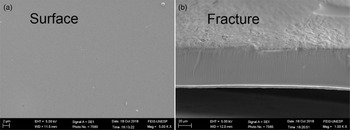
As seen in Figure 2, the chitosan-based film associated with citric acid has a smooth, homogenous appearance, without defects. Separations of phases are not observed either, indicating the formation of an ordered matrix. The smooth, homogenous surface of the films is a parameter indicative of sufficient solubilization of the solution and of the structural integrity of the films (Akter et al., Reference Akter, Khan, Tuhin, Haque, Nurnabi, Parvin and Islam2012). In other studies with chitosan film, similar micrographs were observed (Hafsa et al., Reference Hafsa, Smach, Khedher, Charfeddine, Limem, Majdoub and Rouatbi2016; Siripatrawan and Kaewklin, Reference Siripatrawan and Kaewklin2018).
Micrographs of chitosan and citric acid film obtained by scanning electron microscopy (sem), (a) surface, (b) fracture.

Cheese analyses
Table 1 shows the pH and lactic acid acidity values for the three treatments. A significant influence of the addition of the lactic culture on the reduction of pH (treatments FILC and LC) compared to treatment CON (without the addition of culture) can be observed. In the initial maturation period, no difference was observed between the treatments, but after 7 days, treatments FILC and LC differentiated themselves from treatment CON. The prevention of microbial contamination can perhaps be explained by the pH differences; as an example, reduction in pH to values of 4.5 and 5.5 inhibits the growth of pathogenic bacteria (Silva et al., Reference Silva, Silva, Tonial and Castro-Cislaghi2015). There was a gradual increase in the percentage of lactic acid in treatments FILC and LC, with a more accentuated increase during the period between 15 and 21 d. The use of chitosan-based film did not influence the lactic acid acidity and pH parameters, since no significant difference between treatments FILC and LC was observed.
Mean values for pH and lactic acid acidity of cheeses during maturation

CON, control cheeses without lactic culture of chitosan film; FILC, cheeses with chitosan film and with addition of lactic culture; LC, cheeses without chitosan film but with addition of lactic culture.
Mean ± standard error. Means in the same column with the same capital letters and those on the same line with the same lowercase letters are not statistically different (P > 0.05).
During the entire storage period, there was a reduction in moisture content for all the treatments (Fig. 3). Between the second and third periods of analyses, there was a more accentuated drop in moisture content. The moisture of the cheese with chitosan film after 15 d of storage was significantly greater than that of the cheeses without film (by approximately 4%). There was weight loss for all treatments with the increase in storage time; this loss was 34.1% for CON and LC and 28.9% for FILC, so treatment FILC represents 5.2% lower weight loss. This result is in accordance with what was observed for the moisture content of the cheeses. This lower weight loss compared to the other treatments can be explained principally by the water vapor permeability of the chitosan and citric acid film, which probably acted as a barrier of water loss to the environment.
Moisture content and count of aerobic mesophilic bacteria of the cheeses during the maturation period. C1: without film and without addition of lactic culture (●), FILC: with film and with addition of lactic culture (■), LC: without film and with addition of lactic culture (▴).

In the microbiological analysis, total coliforms, coagulase-positive Staphylococcus and Salmonella sp. were not detected for the three treatments at the evaluated time. The results for aerobic mesophilic bacteria are shown in Figure 3. It can be observed that there was a reduction in aerobic mesophilic count for treatments FILC and LC compared to the treatment without the addition of lactic culture. Additionally, treatment FILC (with film) was most effective in the reduction of these microorganisms. Lactic bacteria (LABs) are capable of generating antimicrobial substances as a result of their metabolism, examples being organic acids, carbon dioxide, hydrogen peroxide, bacteriocins, diacetyl, and acetaldehyde, in addition to the production of lactic acid, which is beneficial due to the increase in conditions unfavorable to pathogenic bacteria within the cheese (Hatti-Kaul et al., Reference Hatti-Kaul, Chen, Dishisha and Enshasy2018). According to a study by El-Sesi et al. (Reference El-Sesi, Gapr and Kamaly2015), the presence of chitosan does not affect the growth of LABs, which are responsible for the desirable characteristics of colonial cheese. Additionally, chitosan-based films are capable of reducing the rate of transference of oxygen to cheese, impeding the growth of aerobic mesophilic bacteria (Cerqueira et al., Reference Cerqueira, Sousa-Gallagher, Macedo, Rodriguez-Aguilera, Souza, Teixeira and Vicente2010). Another characteristic of chitosan is its antimicrobial activity noted in various studies (Hafsa et al., Reference Hafsa, Smach, Khedher, Charfeddine, Limem, Majdoub and Rouatbi2016; Youssef et al., Reference Youssef, El-Sayed, El-Sayed, Salama and Dufresne2016). Citric acid has also been reported as an antimicrobial agent (Qiu et al., Reference Qiu, Chen, Liu and Yang2014). The electrostatic interactions between the chitosan and the negative charge of the bacterial membranes are perhaps responsible for the restructuring of the membranes, with consequential cell death due to the loss of organelles. On the other hand, chitosan is also capable of crossing the cell wall of microorganisms, where it can bind to DNA, thus interfering with the synthesis of proteins and mRNA (Krajewska et al., Reference Krajewska, Wydro and Jánczyk2011). The microbial activity of citric acid is attributed to its power to penetrate the cell membrane and acidify the cytoplasm (Qiu et al., Reference Qiu, Chen, Liu and Yang2014).
Color analysis is presented in Figure 4. The analysis of the external surface of treatment FILC was performed directly on the film, with equivalent measurements of its coloration, presenting a significant impact on alterations in color. Lower luminosity of the film was observed compared to the other treatments at the end of the maturation period. Treatments CON and LC demonstrated a decline in luminosity during the entire storage period, while the luminosity of the cheese with the film presented a reduction only in the first 15 d for the external part of the cheese. For the internal part of the cheeses, greater luminosity compared to the external part was observed. For the green color (parameter a*), the external parts of treatments CON and LC presented a greater tendency toward green tones compared to sample FILC because of the film color. For the internal part, there was no significant difference between the treatments, even during storage. In relation to parameter b* (yellow coloration), an increase is observed in treatments CON and LC during the first 15 d. This tendency towards yellow coloration may be due to carotenoids present in the milk, which become more concentrated with the cheese dehydration process (McDermott et al., Reference McDermott, Visentin, McParland, Berry, Fenelon and De Marchi2016). The yellow coloring of the cheese with film did not suffer alterations, and at the end of 30 d, there was no significant difference from the other treatments. For the internal part, there was a minor increase in yellow coloration compared to the external part.
Changes in color of the cheeses during the maturation period. C1: without film and without addition of lactic culture (●), FILC: with film and with addition of lactic culture (■), LC: without film and with addition of lactic culture (▴).

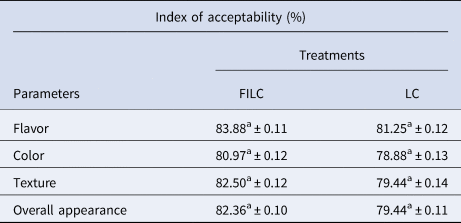
The results of the sensorial analysis and the purchase intention are presented in Table 2. There was no significant difference between any of the samples for the evaluated parameters, supporting the hypothesis that the chitosan film does not influence the sensorial characteristics of colonial cheese. For a product to be considered acceptable by consumers, the index of acceptability (IA) should be at least 70% (Teixeira et al., Reference Teixeira, Meinert and Barbetta1987), which was observed for all evaluated parameters. For intention to purchase the cheeses, there was also no significant difference between the evaluated treatments, with mean values of 2.54 for FILC and 2.56 for LC, indicating that the product has market potential.
Indexes of acceptability obtained through sensorial analysis

FILC, cheeses with chitosan film and with addition of lactic culture; LC, cheeses without chitosan film but with addition of lactic culture.
Mean ± standard error. Means on the same line with the same lowercase letters are not statistically different (P > 0.05).
We restricted our studies to a single cheese, but there is every reason to suppose that this chitosan film could also be applied to other types of cheeses. Zhang et al. (Reference Zhang, Zhang, Chen, Ma and Xia2021) evaluated the application of chitosan–procyanidin composite films in cheese and concluded that characteristics of cheese packaged with the chitosan films were better than those of the control groups. Lotfi et al. (Reference Lotfi, Tajik, Moradi, Forough, Divsalar and Kuswandi2018) evaluated nanostructured chitosan/monolaruim for ultrafiltered cheese and observed a suitable antibacterial activity being applicable to use as cheese packaging to control L. monocytogenes.
In conclusion, the application of the chitosan-based film, together with the addition of the lactic starter culture, played an important role in the improvement of the physical, chemical, and microbiological characteristics of matured cheese without influencing sensorial characteristics. Finally, the film with chitosan and citric acid can be considered a feasible, sustainable, nontoxic, and ecological material for primary packaging, with the potential to replace synthetic food packaging for matured cheese.
Acknowledgements
We would like to thank the National Council for Technological Development (CNPq), Fundação Araucária, São Paulo Research Foundation (FAPESP), and the Coordination for the Improvement of Higher Education Personnel (CAPES) in Brazil, for funding this research.