Background
Sexual Ageism
The term ageism was coined by Robert Butler (Reference Butler1969) and defined as discrimination based on age, which impacts both practice and personal behaviour towards older persons. Various manifestations of ageism include avoiding contact with older people, and discrimination in housing, hiring older applicants (Posthuma & Campion, Reference Posthuma and Campion2007), and in providing services. Ageism has a social and psychological impact on society and is evident in the media (Dennis & Thomas, Reference Dennis and Thomas2007; Kelchner, Reference Kelchner2000; Posthuma & Campion, Reference Posthuma and Campion2007). When internalized by older adults, ageist beliefs can have a detrimental effect on physical and psychological well-being (Levy, Reference Levy2009; Palmore, Reference Palmore2004) to the extent that Osgood (Reference Osgood and Tomer2000) found an association between ageism and suicide among older people.
Ageism is widespread at the societal level and among the helping professions (Nelson, Reference Nelson2005). Health care professionals (e.g., nurses and physicians) might have ageist beliefs because they tend to see and treat only frail and sick older people (Ben-Harush et al., Reference Ben-Harush, Shiovitz-Ezra, Doron, Alon, Leibovitz, Golander and Ayalon2017). Ageist beliefs and negative attitudes affect quality of care, and negatively impact social behaviours and institutional treatment towards older adults, such as differential treatment from physicians (Bouman & Arcelus, Reference Bouman and Arcelus2001; Gewirtz-Meydan & Ayalon, 2016). Studies conducted in the past decade indicate that professional care providers are more accepting, tolerant, and open-minded towards sexuality in later life (Bouman, Arcelus, & Benbow, Reference Bouman, Arcelus and Benbow2006; Freeman, Sousa, & Neufeld, Reference Freeman, Sousa and Neufeld2014) than in the past. However, they often consider older adults’ sexuality as outside their scope of practice and lack the knowledge and confidence to treat or refer to issues related to sexuality (Haesler, Bauer, & Fetherstonhaugh, Reference Haesler, Bauer and Fetherstonhaugh2016). This was referred to as sexual ageism, social expectations that the aged do not have and should not have sexual relationships (Hall, Selby, & Vanclay, Reference Hall, Selby and Vanclay1982). Knowledge about sexuality in later life among health care providers is often reported as limited (Dogan, Demir, Eker, & Karim, Reference Dogan, Demir, Eker and Karim2008; Mahieu, Van Elssen, & Gastmans, Reference Mahieu, Van Elssen and Gastmans2011; Snyder & Zweig, Reference Snyder and Zweig2010) or insufficient (Helmes & Chapman, Reference Helmes and Chapman2012; Mahieu et al., Reference Mahieu, de Casterlé, Acke, Vandermarliere, Elssen, Van Fieuws and Gastmans2016).
Demographic variables associated with individual differences in ageist behaviours have been studied. Most studies indicate age is positively associated with favorable attitudes towards older adults (Van Dussen & Weaver, Reference Van Dussen and Weaver2009). Rupp, Vodanovich, and Credé (Reference Rupp, Vodanovich and Credé2005) found that school-age children in various countries have a negative image of older people. Kite, Stockdale, Whitley, and Johnson (Reference Kite, Stockdale, Whitley and Johnson2005) conducted a meta-analytic review of 232 effect sizes and showed that middle-aged participants expressed more ageism than did participants in other age groups. Gender has also been reported to correlate with ageism. Men consistently demonstrate higher levels of ageism than do women (Bodner, Bergman, & Cohen-Fridel, Reference Bodner, Bergman and Cohen-Fridel2012; Chonody, Webb, Ranzijn, & Bryan, Reference Chonody, Webb, Ranzijn and Bryan2014; Rupp et al., Reference Rupp, Vodanovich and Credé2005). Women are more likely to report positive emotional rewards associated with caring for older adults and are less likely to view it as difficult or tedious (Van Dussen & Weaver, Reference Van Dussen and Weaver2009).
Research on the amount of contact with older adults and ageist beliefs is inconsistent. Although some researchers found no relationship between quantity of contact with older adults and ageist attitudes (Allan & Johnson, Reference Allan and Johnson2008; Boswell, Reference Boswell2012), others found that increased contact with older adults is related to positive attitudes (Luo, Zhou, Jin, Newman, & Liang, Reference Luo, Zhou, Jin, Newman and Liang2013; Van Dussen & Weaver, Reference Van Dussen and Weaver2009), and a close relationship with grandparents is related to reduced ageist beliefs as well (Drury, Hutchison, & Abrams, Reference Drury, Hutchison and Abrams2016; Tam, Hewstone, Harwood, Voci, & Kenworthy, Reference Tam, Hewstone, Harwood, Voci and Kenworthy2006).
Sexuality of older adults, moreover, is subject to ageism. Research indicates that the aged are not expected to have sexual relationships, and sexuality in later life is considered non-existent (Sharpe, Reference Sharpe2004), unimportant, inappropriate, or irrelevant (Cooley, Reference Cooley2002; Henry & McNab, Reference Henry and McNab2003). Although many people still hold beliefs about what is “normal” or “appropriate” sexual behaviour, studies conducted in the past decade indicate more liberal and tolerant attitudes regarding older adults’ sexuality (Bouman et al., Reference Bouman, Arcelus and Benbow2006; Freeman et al., Reference Freeman, Sousa and Neufeld2014). However, most of the discussion about older adults’ sexuality assumes heterosexuality and lacks awareness of lesbian, gay, bisexual, transgender, queer, and intersex (LGBTQI) issues. Some older LGBTQI individuals might need to return to the “closet” in later life (Hafford-Letchfield, Reference Hafford-Letchfield2008). Nonetheless, no significant differences were observed from undergraduate students regarding LGBTQI older adults or constraints to sexuality in long-term care facilities (Freeman et al., Reference Freeman, Sousa and Neufeld2014).
The Expression of Sexual Ageism
Studies indicate a gap between implicit and explicit attitudes towards sexuality in later life (Mahieu et al., Reference Mahieu, Van Elssen and Gastmans2011; Thompson, O’Sullivan, Byers, & Shaughnessy, Reference Thompson, O’Sullivan, Byers and Shaughnessy2014). Implicit attitudes are more difficult to detect and reveal a more negative and conservative perspective (Thompson et al., Reference Thompson, O’Sullivan, Byers and Shaughnessy2014). For example, in a study conducted among 53 staff members working in five long-term care facilities, discrepancies between professionals’ self-reported attitudes and those attributed to workmates suggested widespread negative reactions (Villar & Serrat, Reference Villar and Serrat2016). Although most participants believed that masturbation was acceptable and not interfering was by far the most common reaction, when asked about reactions attributed to co-workers, reprimanding the resident and gossiping/joking about the issue were mentioned more frequently than was acceptance. In another study conducted among 305 Canadian undergraduates, older adults were perceived to be less interested in sex overall than were the young, and the young were perceived to be more interested in traditional and experimental sex than the elderly, regardless of participant gender (Lai & Hynie, Reference Lai and Hynie2011). These studies might indicate that although recent studies imply more tolerant and accepting views of older adults’ sexuality, these views might be expressed explicitly because of the participant’s hesitation, reluctance, or fear of expressing politically incorrect opinions.
Sexual Ageism and Socio-Demographic Characteristics
Regarding socio-demographic variables, some studies indicate a positive relationship between conservative attitudes towards sexuality in later life and age (Langer-Most & Langer, Reference Langer-Most and Langer2010; Lee, Kwon, Kim, & Moon, Reference Lee, Kwon, Kim and Moon2007). Similarly, other studies found a positive correlation between age and knowledge about sexuality in later life, as it was significantly lower among younger participants (Dogan et al., Reference Dogan, Demir, Eker and Karim2008; Helmes & Chapman, Reference Helmes and Chapman2012; Mahieu et al., Reference Mahieu, de Casterlé, Acke, Vandermarliere, Elssen, Van Fieuws and Gastmans2016). However, other studies did not find correlations between age and attitudes and knowledge towards older adults’ sexuality (Bauer, McAuliffe, Nay, & Chenco, Reference Bauer, McAuliffe, Nay and Chenco2013; Flaget-Greener, Gonzalez, & Sprankle, Reference Flaget-Greener, Gonzalez and Sprankle2015). Some studies indicated that men tend to have less conservative attitudes than women do (Dogan et al., Reference Dogan, Demir, Eker and Karim2008; Lee et al., Reference Lee, Kwon, Kim and Moon2007) and are more knowledgeable about sexuality in later life (Dogan et al., Reference Dogan, Demir, Eker and Karim2008). Other studies did not find an association between attitudes and gender (Langer-Most & Langer, Reference Langer-Most and Langer2010) or knowledge (Snyder & Zweig, Reference Snyder and Zweig2010).
Attitudes towards sexuality of older adults differed according to marital status. Divorced or widowed individuals demonstrated the most conservative attitudes as compared with those who were single or married (Lee et al., Reference Lee, Kwon, Kim and Moon2007). In contrast, Snyder and Zweig (Reference Snyder and Zweig2010) found that those who were married or cohabiting had more conservative attitudes than did divorced or single students. Studies were inconsistent regarding the association between knowledge about sexuality in later life and marital status. Steinke (Reference Steinke1994) and Mahieu et al. (Reference Mahieu, de Casterlé, Acke, Vandermarliere, Elssen, Van Fieuws and Gastmans2016) reported that married people had less knowledge than did divorced or separated individuals, whereas Graf and Patrick (Reference Graf and Patrick2014) found that individuals in marital relationships had more age-related sexual knowledge than did divorcees and singles.
Other socio-demographic variables related to the subject include conservative attitudes associated with high perceived economic status and education (Lee et al., Reference Lee, Kwon, Kim and Moon2007). A greater degree of religiosity, ranging from high to low (and categorized in this study as religious [orthodox or ultra-orthodox], traditional, or non-religious), was also associated with conservative attitudes towards sexuality in later life (Bonds-Raacke & Raacke, Reference Bonds-Raacke and Raacke2011; McKelvey, Webb, Baldassar, Robinson, & Riely, Reference McKelvey, Webb, Baldassar, Robinson and Riely1999).
Those with limited experience in working and caring for older adults were found to lack knowledge about sexuality in later life (Mahieu et al., Reference Mahieu, de Casterlé, Acke, Vandermarliere, Elssen, Van Fieuws and Gastmans2016). Individuals who had frequent contact with older adults and close relationships with grandparents appeared to be more knowledgeable and have more positive attitudes towards sexuality in later life as did those who anticipated a career working with older adults (Allen, Petro, & Phillips, Reference Allen, Petro and Phillips2009; Ewen & Brown, Reference Ewen and Brown2012; Funderburk, Damron-Rodriguez, Storms, & Solomon, Reference Funderburk, Damron-Rodriguez, Storms and Solomon2006). Educational programs were influential in increasing the knowledge of staff in long-term care facilities and in improving attitudes regarding sexuality in later life, including sexual expression between same-sex older couples and among older people with dementia (Bauer et al., Reference Bauer, McAuliffe, Nay and Chenco2013; Walker & Harrington, Reference Walker and Harrington2002).
The relationship between knowledge and attitudes is inconsistent. Although most studies reported that increased knowledge was related to more positive and permissive attitudes (Helmes & Chapman, Reference Helmes and Chapman2012; Hillman & Strieker, Reference Hillman and Strieker1994; Mahieu et al., Reference Mahieu, de Casterlé, Acke, Vandermarliere, Elssen, Van Fieuws and Gastmans2016; White, Reference White1982), others indicated no correlation between respondents’ knowledge and attitudes (Langer-Most & Langer, Reference Langer-Most and Langer2010). Examining ageist beliefs, and knowledge and attitudes towards older adults’ sexuality, is especially important among students in human service and health care professions as these attitudes may influence their choice of professional specialization, the quality of treatment provided, and their interactions with older adults.
Aims of the Current Study
In the current study we sought to understand the degree to which nursing and social work students held ageist beliefs, were knowledgeable about sexuality in later life, and had favorable attitudes towards older adults’ sexuality; additionally, we explored factors that might explain variability. Two research questions were investigated: (1) Do social work and nursing students differ in ageist beliefs, knowledge, and attitudes towards sexuality in later life? (2) Which factors can explain ageist beliefs and attitudes and knowledge towards sexuality in later life among undergraduate social work and nursing students? Based on previous studies and on the literature, we hypothesized that (1) ageist beliefs would be positively correlated with more conservative attitudes towards older adults’ sexuality; (2) conservative attitudes towards older adults’ sexuality would be negatively correlated with knowledge about sexuality in later life; (3) prior sexual education would be positively related to greater knowledge and more permissive attitudes towards older adults’ sexuality; (4) contact with older adults and relationships with grandparents would be associated with fewer ageist beliefs and positively related to knowledge and permissive attitudes towards older adults’ sexuality; and (5) women would have fewer ageist beliefs yet more conservative attitudes towards older adults’ sexuality than would men. (6) Finally, knowledge would mediate between age and attitudes towards older adults’ sexuality.
Method
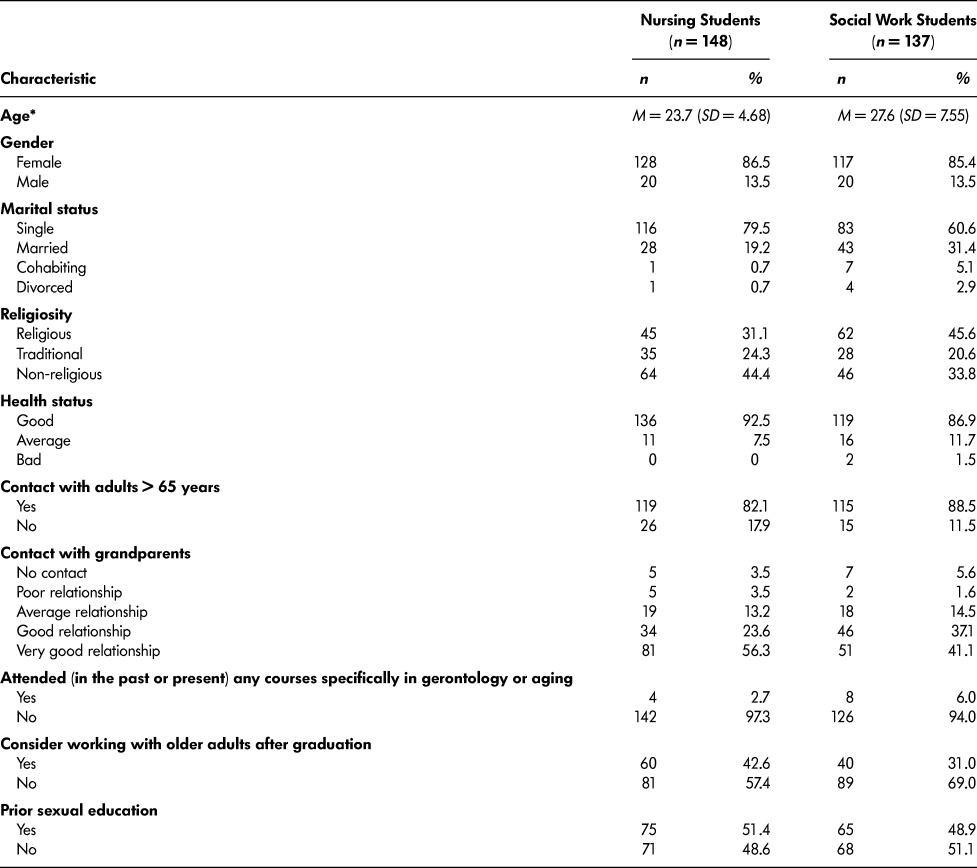
The study was composed of a convenience sample of 285 undergraduate students. The sample consisted of 137 first-year undergraduate students in social work and 148 nursing students. Both social work students and the nursing students (n = 285) were recruited from two institutions: a university in the centre of Israel and a college in northern Israel. Although this was a convenience sample, the power of sampling was good as the response rate was 74 per cent from the university and 64 per cent from the college. Sociodemographic variables are presented in Table 1.
Demographic characteristics of participants

* Reported in mean (standard deviation) years.
Most students who participated in the study were women and single. In addition, social work students were older (n = 135, M = 27.6, SD = 7.55) than the nursing students (n = 148, M = 23.7, SD = 4.68), df = 1(281), (t = 5.23, p < .001). This difference can be explained by the participation of undergraduate students, who are usually older than the mainstream program undergraduate students are, from a fast-track program in social work. Within the social work profession in Israel, there are two ways of obtaining a BSW (baccalaureate in social work): the regular program requires three years of study; the retraining (fast-track) program requires two years of college or university study after graduating in other academic disciplines. Therefore, students in the retraining program are older than students in the regular program (Gewirtz-Meydan & Even-Zohar, 2017).
Procedure
The university Ethics Committee approved the study. Confidentiality was assured and all participants provided written informed consent. Participation was voluntary, and no incentives were provided. Participants were informed they were free to withdraw from the study at any time. Students answered the questionnaire during regular class time. Those who did not want to participate were able to remain in the classroom. One of the researchers explained the study objectives to the participants (students) during class. Instructions were read aloud and questionnaires were then distributed. All questionnaires were collected by the end of class and inserted in an envelope to ensure participant confidentiality. The questionnaire was translated to Hebrew by a professional translator. Data were collected from November 2015 to May 2016.
Measures
Fraboni Scale of Ageism (FSA)
The Fraboni Scale of Ageism (Fraboni, Saltstone, & Hughes, Reference Fraboni, Saltstone and Hughes1990) is a 29-item scale aimed to assess ageism from a multidimensional perspective. The items represent three levels of prejudice towards older adults: antilocution (e.g., Many old people just live in the past), avoidance (e.g., It is best that old people live where they won’t bother anyone), and discrimination (e.g., Old people should find friends their own age). Respondents were requested to indicate their agreement with each item on a 5-point Likert scale ranging from strongly disagree (1) to strongly agree (5). Each participant’s score was calculated as a sum of all answers. Higher scores indicated more ageist beliefs. Prior research (Fraboni et al., Reference Fraboni, Saltstone and Hughes1990) showed that the FSA has adequate reliability (α = 0.86). In the current investigation, we used 24 items; five items were not included due to incompatibility with Israeli society. For example, the item in the original questionnaire There should be special clubs with sports facilities that will allow old people to compete at their level was incompatible because sports clubs for older adults are not common in Israel, and most of the participants would certainly have difficulty answering such an item (Bodner & Lazar, Reference Bodner and Lazar2008). The reliability in the present study was found to be adequate (α = 0.83).
Attitudes and Knowledge towards Older Adults’ Sexuality
The Aging Sexuality Knowledge and Attitudes Scale (ASKAS; White, Reference White1982) is a 60-item scale with two subscales (attitudes and knowledge). It is designed to measure attitudes and knowledge towards sexuality in later life. The attitudinal subscale consists of 26 items, with permissive attitude responses (e.g., Masturbation is an acceptable sexual activity for older females/males) and conservative responses (e.g., aged people have little interest in sexuality). Respondents used a 7-point Likert-type scale ranging from 1 (strongly disagree) to 7 (strongly agree) to indicate their level of agreement with the item stated. Negatively worded items were reverse scored and then all items were summed to reach the final score. A low attitude score reflects more permissive attitudes. The knowledge subscale consists of 34 items marked 1 (true), 2 (false), or 3 (do not know answer) indicating the extent to which the student is knowledgeable about sexuality in older age (e.g., Sexual activity in aged persons is often dangerous to their health; Sexuality is typically a life-long need). The score is the sum of the correct answers. Higher scores reflect greater knowledge. In previous studies, reliability of the ASKAS scale was high (α = .85 for the attitude items and α = .90 for the knowledge items; White, Reference White1982). In the present study, alpha values were high as well: attitudes towards aging and sexuality (α = .90) and knowledge (α = .85).
Contact with Older Adults and Sexual Education
To examine their acquaintance with older adults and sexuality (as two different areas), we asked respondents to note whether they had contact with older adults, the quality of their relationship with their grandparents, if they attended (in the past or present) any courses specifically in gerontology or aging, if they considered working with older people after graduation, and if they received sexual education (in any framework).
Socio-demographic Questionnaire
Respondents were asked to note their academic profession, gender, age, marital status, level of religiosity, economic condition, and health status.
Data Analysis
Data were analysed with SPSS, version 22, and we filled in the few missing data, using a linear interpolation. We conducted descriptive statistics and t-tests to determine differences between the socio-demographic variables of social work and nursing students and to investigate the research questions. Descriptive statistics were used to describe the scale measures, and t-test and Pearson tests were conducted to identify correlation between the study variables to validate the hypotheses. Multiple regression analysis models were conducted to determine which variables can explain ageist beliefs, attitudes, and knowledge towards older adults’ sexuality. Finally, we conducted a summary model on the basis of structural equation modelling (SEM).
Results
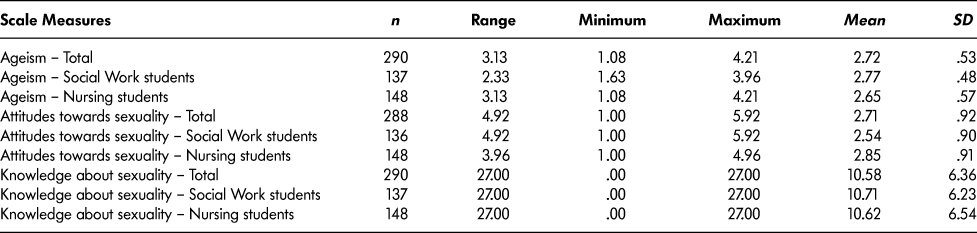
We conducted an independent t-test analysis to examine differences between social work and nursing students. The results indicated that nursing students have more conservative attitudes towards older adults’ sexuality (n = 148, M = 2.85, SD = .914) than do social work students (n = 137, M = 2.54, SD = .903), df = 1(283), (t = 2.879, p < .001). There were no significant differences between the groups regarding ageist beliefs and knowledge about sexuality in later life.
In both groups, we found moderate levels of ageist beliefs (on a scale of 1 to 6) and attitudes towards older adults’ sexuality (on a scale of 1 to 7), and low levels of knowledge about sexuality in later life of the total 34 items (Table 2).
Descriptive statistics of scale measures

The first hypothesis – that ageist beliefs are positively associated with more conservative attitudes towards older adults’ sexuality – was supported (n = 285, r = .309, p < .001). The second hypothesis – that conservative attitudes towards older adults’ sexuality are negatively correlated with knowledge about sexuality in later life – was supported as well (n = 285, r = –.307, p < .001). The third hypothesis, regarding the association between receipt of prior sexual education and having greater knowledge and more permissive attitudes towards sexuality in later life, was not supported. The fourth hypothesis – regarding the association between contact with older adults and relationship with grandparents and having fewer ageist beliefs, greater knowledge, and more permissive attitudes regarding sexuality in later life – was partially supported. Results indicated contact with older adults was associated with fewer ageist beliefs (n = 275, r = .151, p < .05), as was contact with grandparents (n = 268, r = .159, p < .01). Contact with older adults and with grandparents did correlate with knowledge or attitudes towards sexuality in later life. Additional analysis revealed that considering working with older adults after graduation was related to lower levels of ageist beliefs (n = 270, r = .224, p < .001). Age was positively correlated with greater knowledge about sexuality in later life (n = 283, r = .185, p < .001) and negatively correlated with conservative attitudes (n = 282, r = –.314, p < .001).
To test the fifth hypothesis – regarding the differences between men and women – we conducted an independent t-test analysis. The results indicated that the difference between men (n = 40, M = 2.86, SD = .638) and women (n = 245, M = 2.68, SD = .517) regarding ageist beliefs was borderline – df = 1(283), (t = 1.928, p = .055) – as men had slightly more ageist attitudes than women did. No significant differences were found between men and women regarding attitudes and knowledge towards sexuality in later life.
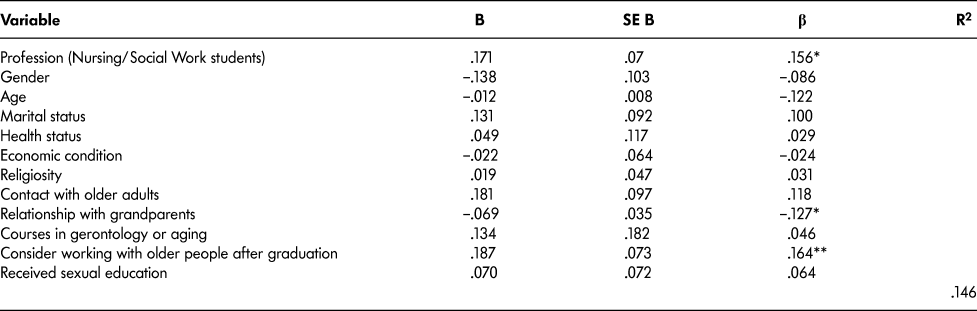
In an attempt to identify factors that explain ageist beliefs, we conducted a multiple regression analysis. The regression equations included the variables of gender, age, marital status, health condition, economic condition, level of religiosity, prior sexual education, maintaining a relationship with older adults and grandparents, and whether students considered working with older people after graduation. The academic profession (nursing or social work students) was added as a co-variate (Table 3).
Multiple regression analysis – Ageism (n = 290)

*p < .05, **p < .01.
The regression model shows that the explained variance was R 2 = 14.5 per cent, and the three variables – profession, relationship with grandparents, and consider working with older people after graduation – contributed significantly to the explained variance. That is, among nursing students, the better their relationship with their grandparents and the more they considered working with older adults, the fewer their ageist beliefs.
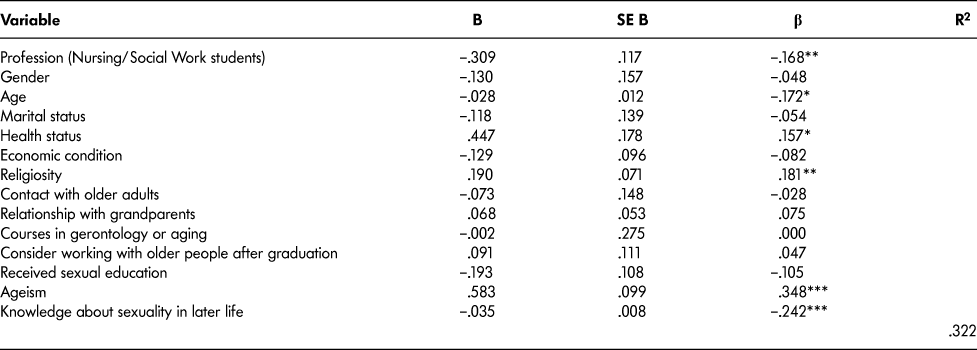
Table 4 reports the factors that explain attitudes towards older adults’ sexuality. We added the variables of ageism and knowledge about sexuality in later life to the regression equations.
Multiple regression analysis – Attitudes towards older adults’ sexuality (n = 290)

* p <.05, **p < .01, ***p < .001.
The regression model shows that the explained variance is R 2 = 32.2 per cent, and the variables of profession, age, health status, and level of religiosity contributed significantly to the explained variance. When examining socio-demographic variables that predict attitudes, we found that students studying social work, older in age and with better health status, reported more permissive attitudes towards older adults’ sexuality. However, those who were religiously observant indicated more conservative attitudes. In addition, the more the students had ageist beliefs and less knowledge regarding sexuality in later life, the more conservative were their attitudes.
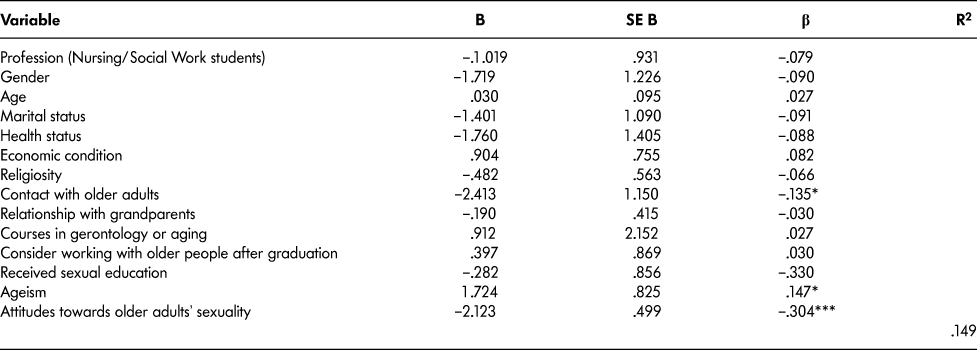
Table 5 reports the factors that explain knowledge about sexuality in later life. We added the ageism and attitudes towards older adults’ sexuality variables to the regression equations.
Multiple regression analysis – Knowledge about sexuality in later life (n = 290)

* p < .05, *** p < .001.
The regression model shows that the explained variance is R 2 = 14.9 per cent and the three variables – contact with older adults, ageism, and attitudes towards older adults’ sexuality – contributed significantly to the explained variance. That is, contact with older adults and more permissive attitudes towards older adults’ sexuality indicated greater levels of knowledge regarding sexuality in later life.
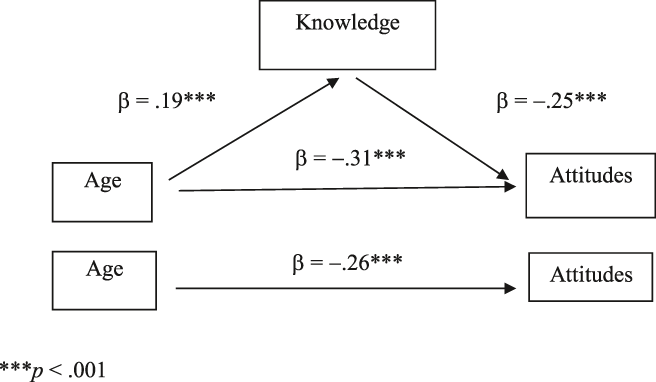
Knowledge was examined as a mediator between age and attitudes towards older adults’ sexuality (see Figure 1).
Knowledge as a mediator between age and attitudes towards sexuality in later life

The β-coefficient between age (the independent variable) and knowledge (the mediator) was .19 (p < .001), and between knowledge and attitudes (the dependent variable), β = –.25 (p < .001). The coefficient between age and attitudes was β = –.31 (p < .001). After we added the mediator variable to the regression equation, it was reduced to β = –.25, yet remained significant (p < .001). To test the significance of this mediation, we applied the Sobel test. The 0.05 decrease in the β-coefficient was significant (Z = –.2.67, p < .001). Thus, knowledge indicated a partial mediating effect on the relationship between age and attitudes towards older adults’ sexuality.
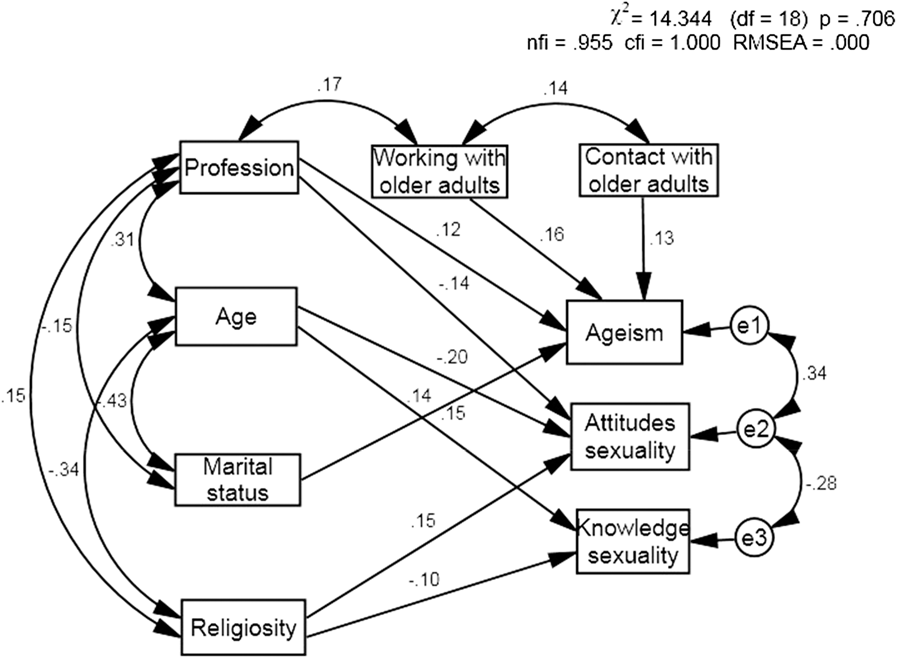
The model (see Figure 2) shows that the calculated goodness-of-fit measures were compatible with the data (χ2 = 14.34, p = .706, nfi = .955, cfi = 1.000, RMSEA = .000). The model indicates that the variables (profession, contact with older adults, consider working with older people, and marital status) related to the dependent variable, ageism. That is, nursing students, students who had contact with older adults, considered working with older people, and were married had fewer ageist beliefs. The variables profession, age, and religiosity related to the dependent variable: attitudes towards older adults’ sexuality. That is, social work students, older students, and less religious students had more permissive attitudes towards older adults’ sexuality. Regarding the dependent variable – knowledge about sexuality in later life – religious students had less knowledge, whereas older students had more knowledge. In addition, the results revealed that greater ageist beliefs correlated positively with conservative attitudes towards older adults’ sexuality. Conservative attitudes towards older adults’ sexuality was negatively correlated with knowledge about sexuality in later life.
SEM of relations between socio-demographic factors and ageism, attitudes towards older adults’ sexuality and knowledge about sexuality

Discussion
The current study, in which we used the same set of variables, assessed ageist beliefs, knowledge, and attitudes towards older adults’ sexuality among social work and nursing students. Conservative attitudes towards older adults’ sexuality were strongly correlated with ageist beliefs. Conservative attitudes might be formulated and maintained by these ageist perceptions (Bouman et al., Reference Bouman, Arcelus and Benbow2006; Cooley, Reference Cooley2002). In agreement with previous studies (Bauer et al., Reference Bauer, McAuliffe, Nay and Chenco2013; Miller & Byers, Reference Miller and Byers2009), knowledge about sexuality in later life was associated with more permissive attitudes towards older adults’ sexuality. Educational programs about later life sexuality might promote confidence and feelings of professional competency to address sexual topics with clients (Miller & Byers, Reference Miller and Byers2009). They might also support exploration of personal attitudes and ageist ideas and help dispel them (Allen et al., Reference Allen, Petro and Phillips2009; Bouman et al., Reference Bouman, Arcelus and Benbow2006; Mahieu et al., Reference Mahieu, de Casterlé, Acke, Vandermarliere, Elssen, Van Fieuws and Gastmans2016; Trotter & Leech, Reference Trotter and Leech2003).
The comparative data showed social work and nursing students did not differ in ageist beliefs and knowledge as both groups had average levels of ageism and limited knowledge about sexuality in later life. Yet nursing students had more conservative attitudes towards older adults’ sexuality. This finding corresponds with that of Helmes and Chapman (Reference Helmes and Chapman2012) who suggested that social workers in South Africa and Australia had more permissive attitudes than did South African nurses (the most conservative group). In addition, a study conducted among human service students reported social work students’ perceptions towards older adults’ sexual behaviours were somewhat less negative than were those of individuals in other human services professions (Kane, Reference Kane2008). Although both professions aim to increase well-being, different professional goals could have created the significant difference in attitudes towards older adults’ sexuality. Whereas social workers seek positive social change and defend clients’ rights, nurses seek to provide health care assistance to reduce patients’ suffering (Bagdonaite-Stelmokiene, Zydziunaite, Suominen, & Astedt-Kurki, Reference Bagdonaite-Stelmokiene, Zydziunaite, Suominen and Astedt-Kurki2016).
The results of the current study indicated that prior sexual education was not associated with current knowledge or attitudes regarding older adults’ sexuality. Perhaps prior sex education did not provide adequate information about aging and sexuality (Ewen & Brown, Reference Ewen and Brown2012), which can affect attitudes or enhance students’ knowledge about older adults’ sexuality. Similar to researchers’ findings in previous studies, we found that students who have a good relationship with their grandparents and students who have contact with older adults have fewer ageist beliefs. (Allen et al., Reference Allen, Petro and Phillips2009; Harwood, Reference Harwood2005; Luo et al., Reference Luo, Zhou, Jin, Newman and Liang2013). In contrast to Snyder and Zweig (Reference Snyder and Zweig2010), we found that contact with other older adults and not with grandparents was associated with knowledge towards sexuality in later life. A possible explanation is that students who have personal contacts with older adults, such as grandparents, rarely considered the concept of older adults’ sexuality. However, contact with older adults was not associated with attitudes towards older adults’ sexuality. An explanation is that attitudes towards older adults’ sexuality might be shaped by factors other than contact with older adults or prior sexual education, such as belief systems, personal values, or adherence to one’s socio-cultural norms. In addition, similar to results of previous studies (Allen et al., Reference Allen, Petro and Phillips2009; Ewen & Brown, Reference Ewen and Brown2012; Funderburk et al., Reference Funderburk, Damron-Rodriguez, Storms and Solomon2006; Mahieu et al., Reference Mahieu, de Casterlé, Acke, Vandermarliere, Elssen, Van Fieuws and Gastmans2016), we found that students who had contact with older adults and more positive attitudes towards sexuality in later life had more knowledge about sexuality in later life.
Additionally, similar to other studies’ findings, we found men had slightly more ageist beliefs than women did (Bodner et al., Reference Bodner, Bergman and Cohen-Fridel2012; Chonody et al., Reference Chonody, Webb, Ranzijn and Bryan2014; Rupp et al., Reference Rupp, Vodanovich and Credé2005). Previous studies found inconsistencies regarding the relationship between gender and attitudes and knowledge towards older adults’ sexuality. Contrary to our expectations, results indicated no differences between men and women regarding attitudes. Several studies support these findings (Bauer et al., Reference Bauer, McAuliffe, Nay and Chenco2013; Bouman et al., Reference Bouman, Arcelus and Benbow2006; Ewen & Brown, Reference Ewen and Brown2012; Flaget-Greener et al., Reference Flaget-Greener, Gonzalez and Sprankle2015; Langer-Most & Langer, Reference Langer-Most and Langer2010; Snyder & Zweig, Reference Snyder and Zweig2010).
In agreement with previous reports (Bodner & Lazar, Reference Bodner and Lazar2008; Bouman, Arcelus, & Benbow, Reference Bouman, Arcelus and Benbow2007; Helmes & Chapman, Reference Helmes and Chapman2012; Kite et al., Reference Kite, Stockdale, Whitley and Johnson2005), the multiple regression analysis and the summary model in our current study indicated that older students had more permissive attitudes and greater knowledge towards sexuality in later life than did younger students. Knowledge indicated a partial mediating effect. That is, older students had more knowledge about sexuality in later life and, therefore, had more permissive attitudes towards sexuality in later life.
Finally, the students who rated themselves as religious rather than traditional or non-religious had more conservative attitudes towards older adults’ sexuality. This is consistent with previous studies which indicated that religious observance was associated with more restrictive attitudes towards sexuality in later life (Allen et al., Reference Allen, Petro and Phillips2009; Di Napoli, Breland, & Allen, Reference Di Napoli, Breland and Allen2013; Mahieu et al., Reference Mahieu, de Casterlé, Acke, Vandermarliere, Elssen, Van Fieuws and Gastmans2016). Perhaps individuals who are more religiously observant conceptualize sex as a means for reproduction and are less likely to endorse sexual expression among older adults.
Several limitations should be considered when interpreting the results of this study. For one thing, it was conducted among first-year students. To examine changes due to educational programs, curricula, or practical training, a longitudinal study is recommended. In addition, we used a convenience sample from only two academic institutions, which limited our ability to generalize the findings. The results have potential bias as students were recruited from only two institutions. Examining the subject among students from more universities could have prevented this bias. Information regarding prior sex education might have been flawed, as descriptions of the type of sex education were not requested.
Despite these limitations, the present study emphasizes the importance of including education regarding sexuality in later life in the curriculum, as knowledge is considered intrinsically related to attitudes. Based on the study results, we recommend that social work and nursing education programs include practical training sessions and more knowledge on later-life sexuality, which can contribute to positive attitudes regarding sexuality in later life. It is important for students to acknowledge that sexual identity and activity are integral parts of older adults’ well-being and may be part of successful aging. Nursing students, who work primarily with adults with different diseases, should especially improve their knowledge regarding healthy and adaptive sexual behaviours in later life. It is also important for educators to be aware of their own and their students’ attitudes towards later-life sexuality and how it may impact their role as social workers and nurses or caregivers. Based on this understanding, educators should develop and implement curricula to include this training. Education should focus on increasing knowledge of sexual behaviours and biological and psychosocial aspects of sexuality in later life. Delivering education to students should involve examining personal biases and improving knowledge about sexuality and older people. It is also suggested that the views of all stakeholders – including families, long-term care residents, and staff – regarding this issue be included in educational programs so that students can deepen their knowledge and understanding of sexuality in later life and possibly become involved in advocacy or promoting policy guidelines in this sensitive area.
Educating students regarding sexual changes that occur with age and in the field of gerontology can challenge negative stereotypes and myths that are established at a young age, and lead to positive changes in attitudes towards aging and sexuality in later life. It is important to study university students because their knowledge and perceptions are likely to affect future interactions with older adults.
Future research should explore students’ attitudes and knowledge towards older adults, as well as those of the educators, and should include additional health professions (e.g., medicine and psychology). Attitudes should be examined not only explicitly but implicitly as well. Implicit tests may provide information that the participant is hesitant or reluctant to divulge for fear of being viewed as having politically incorrect opinions. Research regarding the attitudes and knowledge towards LGBTQI older adults would present a more comprehensive understanding of how sexuality in later life is viewed and addressed. Finally, further research is needed to assess whether and how far educational and teaching programs improve students’ attitudes and knowledge towards older adults’ sexuality.