Introduction
People use energy every day but very often have only a distant connection with energy production, while the opaque and complicated mechanisms shaping the energy market discourage discussion on this topic. Renewable energy sources (RES) technologies that are novel components in the local landscape and environment raise most concerns, or even fear (Pasqualetti, Reference Pasqualetti2000, Reference Pasqualetti2011). An opportunity to break this stalemate is to intensify social change grounded in education that gives people access to the knowledge needed to make energy choices and decisions (Thomas et al., Reference Thomas, Jennings and Lloyd2008; Jennings, Reference Jennings2009). Education has the potential to transform life; it is the cheapest and most effective driver of transformations in the energy sector (Dias et al., Reference Dias, Mattos and Balestieri2004). It enables people to develop, promotes the prosperity of communities and guarantees a sustainable future for children and youths. Nevertheless, in order to fully meet these goals, new perspectives for educational projects and innovative solutions must be sought (Chang & Kidman; Reference Chang and Kidman2020). Among the proposed changes in environmental education, researchers promote an increased number of practical and field classes of a discursive nature (Grodzińska-Jurczak, Reference Grodzińska-Jurczak2004; Wójcik, Reference Wójcik2004). Good environmental education should involve its participants (Tal, Reference Tal2010), also by means of participatory local educational projects linking various actors of the local environment (Ruiz-Mallén et al., Reference Ruiz-Mallén, Barraza, Bodenhorn and Reyes-García2009).
Newly established energy entities using RES, which include biogas plants, are of no small importance to their local environment, through education and the promotion of renewable energy, and more broadly in rural energy transition. As noted by Domański (Reference Domański and Domański1997), a company that stands out from other enterprises in a given spatial arrangement (e.g. in terms of technological advancement or within its sector) can be a form of power in society, shaping economic and social structures and processes. Considering that biogas plants are a novelty in rural areas, both in terms of their activities (RES-based electricity and heat production) and the innovative solutions applied in the production process (Chodkowska-Miszczuk et al., Reference Chodkowska-Miszczuk, Martinat and Cowell2019; Martinat et al., Reference Martinat, Cowell and Navrátil2020), they constitute the first movers of change in the energy transition. Due to the socio-economic position of biogas plants, their relationship with the environment can be hierarchical in nature. Nevertheless, the resulting benefits from these interactions can be consumed by both businesses and local society. From the perspective of a biogas plant, having the approval of the local community can mean wider access to the raw materials market and greater opportunities for the distribution of its products, including energy, heat or organic fertiliser. In turn, from a local community perspective, both material and nonmaterial benefits can be identified. The material ones include the chance to use cheap, locally produced heat and organic fertiliser, the sale of raw materials for biogas production, assistance in local initiatives, renovations, revitalisation and implementation of public services. The nonmaterial effects encompass the possibility of gaining attitudes, shaping ecological awareness and energy literacy. Biogas plants, as a proximate renewable system, can be a testing ground where locals can conduct experiments and experience their effects directly.
The term ‘first movers’ refers to companies that gain a competitive advantage by being the first to market a service or product. Their privileged position on the market and in the socio-economic environment is linked to novelty. Businesses meeting the first movers’ criteria and earning profits therefrom are also present in the green energy sector (Scott et al., Reference Scott, Sovacool and Brown2019). As pioneers, they are responsible for introducing a new component into the local structure. Apart from the profits resulting from their competitive advantage, such companies face challenges which include enabling locals to benefit from the effects of the company’s operations (Marius, Reference Marius2019). They perform the function of a mentor/teacher within their local communities with a narrative shaping pro-ecological awareness. These are extremely important initiatives from the point of view of a company’s success, because this success of new RES energy projects is deeply embedded in the socio-cultural context, dependent on the attitudes and behaviour of all stakeholders in the energy transition (Moloney et al., Reference Moloney, Horne and Fien2010; Kandpal & Broman, Reference Kandpal and Broman2014).
The energy transition process varies between different regions of the world. In Europe, the countries of Central Europe (CECs), including Poland, are a region in need of special support. This situation has its roots in the historical, political and economic past. The main energy characteristic of Poland as a country in the ongoing energy transition is the past defined by almost half a century of centrally planned economy under the socialist regime, including the centralisation of the energy sector and hegemony of entities related to coal mining (Baran et al., Reference Baran, Lewandowski, Szpor and Witajewski-Baltvilks2018). The main barriers to the transition from fuel energy to renewable energy are institutional and technological factors on the one hand, and socio-cultural factors on the other. Institutional and technological determinants include monoculture of conventional fuel (i.e. coal in Poland), dependence on fuel imports and outdated energy infrastructure (Lewandowska et al., Reference Lewandowska, Chodkowska-Miszczuk, Rogatka and Starczewski2020). The most important socio-cultural condition is the socialist legacy marked by suppressed and neglected formation of social awareness about the need for pro-environmental changes (Żuk & Szulecki, Reference Żuk and Szulecki2020). A contemporary slogan says ‘Poland stands on coal’ and the energy issue is presented mainly through the public narrative of ‘continuity of coal’ (Osička et al., Reference Osička, Kemmerzell, Zoll, Lehotský, Černoch and Knodt2020). Institutions are failing, leaving possible actions to non-governmental organisations (NGOs) – the only group of actors actively working for the development of a low-carbon economy in Poland. Their ventures revolve around reducing air pollution or, in some cases, other environmental issues (Brauers & Oei, Reference Brauers and Oei2020). Thus, we can see an important gap in creating a pro-environmental narrative and energy education to dynamise the energy transition, especially at the local level. The opportunity to fill it should be sought in the private sector. It is worth paying attention to energy producers who, as new (large) economic entities, have a certain position and social status enabling them to adopt an active attitude towards the changes taking place. As first movers, they have tremendous power in the local community. Are they therefore merely energy producers, or perhaps, using their position, are they actively involved in creating local energy behaviours? Indeed, the development of renewables projects requires not only access to technology, resources and funds but also to specialised knowledge closely related to a given type of renewable technology. Local communities rarely have access to advanced knowledge, especially under the specific conditions of carbon narrative dominance. The private sector can fill this gap and become a key source of knowledge and information (Eitan et al., Reference Eitan, Herman, Fischhendler and Rosen2019).
The aim of this study is to discuss the role of rural biogas plants as first movers in energy education, including raising energy awareness. Considering biogas plants from the perspective of their educational function requires answering two key questions: 1) What determines the educational function of biogas plants? 2) What are the manifestations and directions of educational activities fundamentally important for the success of the energy transition and the development of communities?
Theoretical and Conceptual Framework
First movers
The concept of ‘first movers’ is well developed in the field of economics and refers to a situation in which a company builds its position on the market by introducing a new, innovative product or service. It was shaped by the work of J. Schumpeter, who emphasised the key role of implementing innovation in creating competitive advantage of enterprises. Innovation here is not only a new product or service, but also a new production method, the development of new outlets and the use of new raw materials, for example, energy sources. Innovation has a socio-cultural impact by reshaping socio-economic relationships (Drucker, Reference Drucker1992; Mulgan, Reference Mulgan2006). This process is fostered by the evolving cooperation between various actors and entities involved in the activity, which may result in building trust and be the basis for lasting social change (Hitt et al., Reference Hitt, Ireland and Hoskisson2009; Harris & Albury, Reference Harris and Albury2009). As a result, pioneers play a leading role in the process of change taking place in rural areas today (Kaphengst & Velten, Reference Kaphengst and Velten2014).
Biogas plants meet the first movers’ criteria (Heng, Reference Heng2017). They are often the first power plants in rural areas. They are innovative and build a network of links with local actors. Due to the technology used at all stages of biogas plant operation, learning and understanding biogas production requires much more time and effort than other RES plants do, for example, well-known solar or wind power plants. To achieve this effect, as many highly committed partners as possible are needed to adapt existing knowledge (not only content but also forms of transfer) in order to better meet social needs in the field of energy education (Raufflet, Reference Raufflet2009). Using their position in the social structure and knowledge of the local context, biogas entrepreneurs have the opportunity to create a narrative that shapes the environmental awareness of communities, enabling them to participate in the benefits of the company’s presence among them.
In Poland as the country that has experienced by post-communist transition in the last three decades, the vast majority of energy consumption is covered by coal. Nevertheless, the share of renewables in the national energy mix is gradually increasing. When we consider biogas, especially agricultural biogas, this energy source is not as popular as biomass, wind or hydro energy. On the contrary, Polish biogas sector is a crucial component of the evolving energy market due to the clear potential of the final products obtained in biogas plants (energy, heat and organic fertilizer) and the possibility energy processing of biowaste, as well as rural development(Chodkowska-Miszczuk et al., Reference Chodkowska-Miszczuk, Martinat, Kulla and Novotny2020). Currently, in Poland, the number of agricultural plants oscillates around 100 entities (with the total installed capacity of 120 MW). For several recent years, the production of electricity from these power plants has been fluctuating between 600 and 700 GWh annually.
Narrative
The fossil fuel companies contribute to their hegemony in the policy sphere and consequently form the public narrative concerning the future of energy sector (Svobodova et al., Reference Svobodova, Owen and Harris2021). Thus, in seeking ways to destabilise ossified conventional energy regimes, a narrative-based approach was chosen for the present study, a narrative-based approach was chosen for the present study. A narrative is defined as a means of deliberately pushing for change (Becker & Müller, Reference Becker, Müller, Müller and Becker2013). Narrative is construed here as a structure of understanding focusing on direct experience and engagement (Brooks, Reference Brooks2016; Kuisma, Reference Kuisma2018). To experience a given situation means to understand it in a personal and direct way with the accompanying emotions. It takes into account the symbolic and cultural content characteristic of a given area. It is an active process that brings together different stakeholders – speakers and listeners. In addition to the integration of teamwork and engagement, a narrative requires the creation of a space for mutual understanding (Brown, Reference Brown2017; Moezzi et al., Reference Moezzi, Janda and Rotmann2017), as well as the participation of people with high narrative competence.
In such a case, sequences of connected events embedded in the local context and the personal experience gained in the course of these events form the basis for people’s awareness and attitudes. Hence, the narrative approach is used in pro-environmental and energy education (Brown, Reference Brown2017; Moezzi et al., Reference Moezzi, Janda and Rotmann2017; David & Schönborn, Reference David and Schönborn2018). In order to be fully aware of new phenomena and, most importantly, to react appropriately to them, people have to develop new skills through adaptive learning (Mychajliw et al., Reference Mychajliw, Kemp and Hadly2015). The key is a conscious and responsible society, because as Wong (Reference Wong1997) claims, awareness is the seed of future changes. With the above in mind, we should seek accelerators of pro-environmental and energy transformations to balance the one-way narrative created by public entities. It is worth considering the narrative created by the private sector – new renewable energy generators (first movers), especially in the context of mobilising bottom-up activities (Evans & Phelan, Reference Evans and Phelan2016). Energy actors emerging in rural communities and engaged in the local structure cocreate a platform of understanding and conditions for forming a plot as a configuration of events constituting the whole narrative. The interacting and continued locals experiencing the ongoing events related to the operation of new proximate energy companies is the focal point. As Dewey (Reference Dewey1998) concluded, interactions (between people and their environment) and continuity are two core factors of effective learning through experiences. This experience interacts with previous experiences and leads to building knowledge (Kuisma, Reference Kuisma2018).
RES entities in education process
Energy education has been consolidating as a research area since the late 20th century. It helps overcome the discontinuities between pro-conservation thinking and actions leaning towards efficient energy use, including the turn to renewables (Dias et al., Reference Dias, Rios de Paula, Rocha Rizol, Matelli, Rodrigues de Mattos and Perrella Balestieri2021). The educational function of enterprises using RES is a manifestation of a new model of renewable energy education gaining increasing importance in contrast to the formal education system, which, as concluded by Jennings (Reference Jennings2009), is not able to react quickly enough to the current needs related to the development of renewable energy and the formation of a low-carbon society. The research on education to date has pointed to the imperfection of formal education in the area of energy education and the need to promote proactive and utilitarian outdoor coherent education (Buldur et al., Reference Buldur, Bursal, Yalcin Erik and Yucel2020; Cole & Malone, Reference Cole and Malone2019; Dias et al., Reference Dias, Rios de Paula, Rocha Rizol, Matelli, Rodrigues de Mattos and Perrella Balestieri2021; Wagner, Reference Wagner2016). Equipping society with the right competencies to model attitudes and behaviour in the energy services market is crucial to the future of the global low-carbon economy. As researchers note (Ocetkiewicz et al., Reference Ocetkiewicz, Tomaszewska and Mróz2017; Wójcik, Reference Wójcik2004), school curricula do not respond to current needs in terms of educating for sustainability, while local experiences can provide effective education (Pike, Reference Pike2011). The way to mend the energy-epistemic disconnect is education through practice and participation using real-world oriented opportunities (Hermann & Bossle, Reference Hermann and Bossle2020), which can be found, for example, in newly formed RES entities. This is particularly important for regions of the world with a history of dominance by a single, conventional energy source with strong social legitimacy. At the core of these educational efforts is the ongoing interaction of local communities with proximate renewables systems (Gunderson & Yun, Reference Gunderson and Yun2021). It is important to note here that the education provided in non-educational entities, and therefore also in RES entities, is based on the principle of linking individual problems with social problems, so that people can consider energy systems issues as their own (Dias et al., Reference Dias, Rios de Paula, Rocha Rizol, Matelli, Rodrigues de Mattos and Perrella Balestieri2021). Entrepreneurs then act as civic (and political) actors. By educating, they influence the behaviour of local communities, create an informal ecosystem of sustainability and thus help create momentum for civic and political change (Veleva, Reference Veleva2021).
Initiatives improving public understanding of the mechanisms of the energy transition are vital (Kandpal & Broman, Reference Kandpal and Broman2014), especially in rural areas, where its success is closely linked to the local identity of the initiators (Frantzeskaki et al., Reference Frantzeskaki, Avelino and Loorbach2013). The non-formal education that we speak of here was also reflected in the OECD’s education recommendation for Poland for 2030 (Agenda, 2030), where the need to promote lifelong learning is pointed out. Lifelong learning must proportionally combine formal education with various manifestations of informal and incidental education (Wójcik, Reference Wójcik2004; Hermann & Bossle, Reference Hermann and Bossle2020). Knowledge acquired on the basis of everyday experience (incidental education) is directly related to the concept of place (Tuan, Reference Tuan1987) which is currently used in research on relations between people and their environment. A manifestation of this approach is place-based education that provides practical implications of knowledge (Measham, Reference Measham2007).
Rural areas are social systems characterised by strong links to place and the importance of neighbourly and family relations, suitable for place-based education (Gülümser et al., Reference Gülümser, Nijkamp, Baycan-Levent and Brons2009; Kaphengst & Velten, Reference Kaphengst and Velten2014). When the first movers enter the rural local system, it is essential to build ties based on trust, since approval is important for the success of new energy projects. The community’s involvement in local activities builds a platform for mutual recognition, and as entrepreneurs take on local social roles, that approval is feasible (Del Río & Burguillo, Reference Del Río and Burguillo2008; Francis et al., Reference Francis, Flora and King1990). Relations that are initiated, deepened and expanded help entrepreneurs to liaise between their biogas plants as installations using RES, and the communities these serve. In the spirit of place-based education, using the local context and network of relationships, the first movers convey their narratives effectively.
Materials and Methods
In order to trace first movers’ roles and understanding the main narrative, a combination of social research methods was used. As theory provides a starting point for looking at empirical evidence (Ragin, Reference Ragin2008), the author conducted reliable literature studies to enable qualitative research as a focal point of the selected research approach – the systematic combining. This is closer to an inductive approach than a deductive one, as it requires a continuous shift from one research activity to another and lies between empirical observations and theory (Dubois & Gadde, Reference Dubois and Gadde2002). According to this assumption, the theory cannot be understood without empirical observation. Therefore, the presented analysis is based on non-linear, non-positivistic deep-case studies and the in-depth interview method, as only such an approach allows comprehensive research of the community (Hammersley, Reference Hammersley1992). A contextual analysis was included, which allowed the author to gain insight into the socio-cultural context, as well as learn about the experiences, beliefs, tensions and mutual expectations of new energy companies and the local communities under their influence (Moezzi et al., Reference Moezzi, Janda and Rotmann2017; David & Schönborn, Reference David and Schönborn2018).
As attempts were made to find out about the educational initiatives carried out by biogas plants in their traditionally conservative rural environment (Chodkowska-Miszczuk et al., Reference Chodkowska-Miszczuk, Martinat, Kulla and Novotny2020), it was important to look for cases characterised by
-
a) innovation in applied technological solutions;
-
b) an external, supra-local origin of the biogas investor;
-
c) operation in local communities.
Considering previous studies on the educational function of energy entities including nuclear power in Korea (Gunderson & Yune, Reference Gunderson and Yun2021), or a solar power plant (Ottl, Broman & Blum, Reference Ott, Broman and Blum2018), a decision was made to recognise biogas plants and their role in shaping ecological awareness as RES entities characterised by the greatest social significance. No other RES installation requires permanent human labour and close cooperation with the environment (Chodkowska-Miszczuk et al., Reference Chodkowska-Miszczuk, Martinat and Cowell2019). Due to the fact that two modes of biogas plant formation were identified: (1) as separate entities and (2) as entities integrally linked to existing businesses, two biogas plants were selected for further analysis: (1) the biogas plant in Buczek (1.8 MW, Jeżewo commune, Kujawsko-Pomorskie Region, NUTS 2, Poland) acting as a separate economic entity and (2) a biogas plant in Działyń (0.999 MW, Kłecko commune, Wielkopolskie Region, NUTS 2, Poland) integrally linked to the agricultural enterprise in that location. The biogas plants are the result of investments carried out by external entities from outside the local environment. They stand out from the rest by the level of innovation of technologies used in the production of biogas. They are the first entities operating in the renewable energy sector in the studied local rural communities.
Based on the longitudinal study, measurement was performed twice with a two-year interval. During the first on-site query (in 2015), biogas plants owners were questioned and an analysis of the network of links between biogas plants and other local entities was performed. During the second on-site query (in 2017), interviews were repeated with representatives of biogas plants and other local entities: non-governmental organisations (NGOs), businesses and residents. The use of a time interval helped identify the narrative gaps, changes in the narrative, main aspects and crucial determinants of the narrative. Respondents were divided into four clusters represented local actors (Figure 1): (1) biogas entrepreneurs, (2) public entities, (3) private entities and (4) NGOs. Local actors are groups of people or institutions affecting the realisation of local development that include local authorities, non-governmental organisations, enterprises and local society. They are cross-sectoral entities engaged in the local activity, characterised by public trust; they provide unique added value in the socio-economic local development. Local actors supporting this process through their proximity, experience and the knowledge of the specific needs of local communities.
Structure of respondents.
Source: own elaboration, N = 18.

A total of 18 interviews were conducted (Table 1). The author anonymised the participants in the study. Each interview lasted between one and one and a half hours or until the topic was exhausted. The research focused on issues related to the interaction between biogas plants and the local environment, as well as education and promotional activities. Data were categorised as a result of the qualitative analysis of the transcribed interviews. The material obtained in study was analysed using the ATLAS.ti 8. software.
Structure of respondents by clusters

Source: own elaboration, N = 18.
Research Results
First movers and energy education – diagnosis and determinants
The prominent position of first movers (biogas plants) in the local community, as showcased by a diverse and dense network of relationships, allows for an outreach to various groups and social actors.
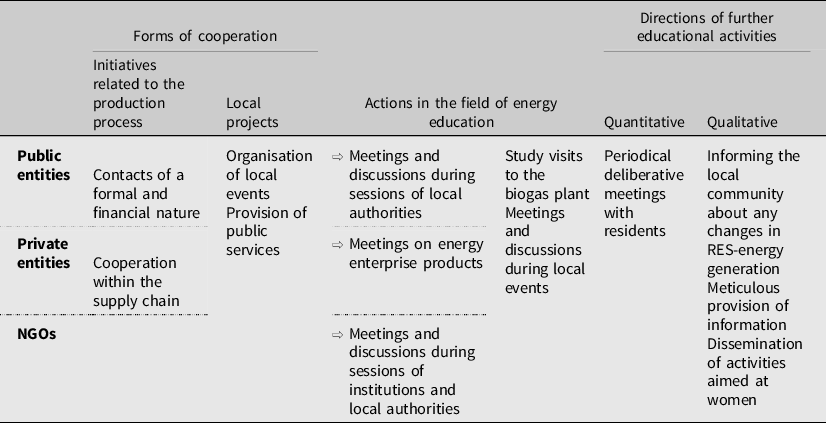
Energy transition is more likely to succeed if it is embedded in the local context (Chodkowska-Miszczuk et al., Reference Chodkowska-Miszczuk, Martinat and Cowell2019) and the same is true for education (Measham, Reference Measham2007). If first movers have contact with local and regional stakeholders, and if they declare their readiness to build strategic alliances (Frantzeskaki et al., Reference Frantzeskaki, Avelino and Loorbach2013), then they create a platform for residents to learn about their local environment, including its resources, ways to protect them, and above all new elements in the form of RES entities. The most important local actors with whom the analysed biogas plants, regardless of the adopted model of operation, have established lasting cooperation include (1) public entities: local authorities, other local institutions, schools and kindergartens, (2) private entities operating in the agri-food sector, (3) associations and NGOs – Volunteer Fire Department units (VFD), local sports clubs and local actors. These interactions result from the nature of the business of generating energy at the biogas plant and are related to the implementation of (non-energy) projects of local importance (Table 2).
Activities within energy education implemented by the energy first movers in cooperation with local entities

Source: own elaboration based on research results.
Contact with public entities, especially with local authorities, is valuable for both: biogas entrepreneurs and locals, because they have a trustworthy image in relation to new, innovative biogas entities, and they will improve communication between the new entity and other members of the local structure. From a material point of view, cooperation with local authorities is focused primarily on formal and financial issues. There were numerous visits of representatives of various administrative levels in both analysed biogas plants, which are included as priority entities in the implementation of the Low Emission Economy Plans (LEEP) prepared for both administrative units – communes (LAU2): LEEP for Jeżewo community (2016) and LEEP for Kłecko community (2016). As regards the biogas plant in Buczek, it is even stated that […] it is the flagship plant in the commune [PuE]. The goodwill of the authorities plays a key role in deepening cooperation with local stakeholders and citizens. One of the local leaders notes: The most important thing is that there is always someone from the communal office, because it gives stature; […] the importance of this handshake [NGO].
Institutionally supported integration with the local environment enables biogas entrepreneurs to act as experts. This function requires that biogas investors, while sharing their knowledge on the operation of biogas plants and renewable energy in general, taking into account the reliability of the information provided and the rationality of the commitments and the declarations made. Otherwise, not only biogas plants (and other RES-using entities) may experience a loss of trust, but in accordance with the principle of reciprocity, the consequences may be felt by other entities with which the enterprise is strongly connected in the opinion of the residents. These include local authorities: Of course, the assurance in the original version that it will not emit anything, and then later it turns out differently […], public dissatisfaction is directed not only towards the owner of such an investment, but also towards the representatives of the local authorities [PuE].
Schools are among other public entities that are of key importance in building a platform between first movers and the local environment. This is, on the one hand, because they enable contact with a large part of the locals, especially people of working age, and thus have a real impact on the development directions of a given area. These are the parents of the pupils. On the other hand, since the primary function of schools (and kindergartens) is education, including formal environmental education, school institutions located in rural areas enjoy the community’s trust, linking inhabitants to the new enterprise. The example of Działyń analysed in the present study shows the key role of local institutions in maintaining and developing a network of interactions between the local structure and the enterprise that is a new component of this structure. The closure of the school in this village caused a break in the continuity of this network of connections. The school was a node in this network, reconciling the different perspectives of the entrepreneur (an outsider) and the parents of the students (members of the local community). The biogas plants participate in local education, focusing on energy transition, mostly as part of festivals, organising competitions, attractions, mini-lectures, taking part in football competitions. And as Measham (Reference Measham2007) concludes, such events integrate the local community by providing a context for geographic and environmental education.
The position of biogas plants in the local social structure is also strengthened when they participate in the implementation of projects important for the residents (public investments), including the construction and renovation of local infrastructure. These manifestations of cooperation are highly valued by the inhabitants and local decision-makers, who confirm this in the following way: Certainly (…) the manager of the biogas plant takes part in [road repairs], because every entrepreneur takes part in it; (…) it is the form of cooperation most meaningful, most expected by society; (…) we lacked this cooperation here [PuE]. The involvement of enterprises in issues important for the local community is met with a positive reaction of the inhabitants. Following Fukuyama’s (Reference Fukuyama1999) statement regarding the radius of trust, there is a diversification of the circle of people sharing norms of trust, reciprocity, and cooperation, and thus an increasing number of overlapping radii of trust that guarantee greater influence and the strengthening of the role of the mentor.
Another example of strengthened biogas plants’ position in the local structure is the cooperation with private stakeholders that focuses mainly on contacts with supply chain partners in the agri-food sector. The selection of partners at the local level takes into account their leading position in the local structure so that they can legitimise biogas plants. The cooperation often goes beyond the formal framework, is of a long-term nature and is also transferred to the personal level. These informal interactions provide an opportunity to verify heard opinions, stereotypes about biogas plants and introduce new social roles for the first mover. Their effects are reflected in the opinions of local decision-makers: The manager (…) is a cool person and open to all activities and ideas. This is a person known here in society. I know him personally. I take him as a good co-operator [PuE]. Favourable opinions about the enterprise, which are the result of intensive and deepened relations, guarantee further cooperation.
The relation with the NGOs is most recognisable in rural areas, that is, VFD units are highly valued and noticed by the local society. This results from the fact that VFD is an important formula of social self-organisation in rural areas and thanks to its multi-functionality it concentrates most of the resources of social activity (Herbst, Reference Herbst and Halamska2008). As observed by Bednarek-Szczepańska (Reference Bednarek-Szczepańska2011), as a cohesive element of local identity, VFD plays an important role in strengthening local relations, and, being embedded in the local environment, it can play a pivotal role in initiating a variety of activities.
Considering the conditions under which biogas plant entrepreneurs play the role of educators, one should also pay attention to the social competences and personality traits of biogas plant managers, such as commitment, openness and communicativeness, generally characteristics of a responsive person who knows how to use deliberative methods aimed at modelling the behaviour and attitudes of the local community. These are highly narrative-competent people who adapt communication to the social situation, which is positively perceived and rewarded, for example, by local and regional authorities, and leads to social change (Soroko & Wojciechowska, Reference Soroko and Wojciechowska2015). This attitude can be described as 3R: reliable, responsive and responsible person.
Local education activities carried out by first movers
The need for biogas entrepreneurs to act as educators in the field of energy transition is articulated by the residents and local leaders themselves: engaging in the issues of residents through an open educational meeting, meetings in schools (…); for the company it would also mean prestige (they would act as a mentor), they could boast. (…). For the company it is a small cost and a big profit (trust of employees and residents) [NGO].These expectations are being met by biogas plants in two ways: (1) engaging in local community roles, networking and participation in local (cultural and sports) events, provision of public services; (2) involving the local community in the operation of the biogas plant: receiving trips, organising meetings on organic fertilizer (one of the products of a biogas plant) and creating a local renewable energy education centre. Initiating, deepening and diversifying interactions between biogas enterprises and the local community increase local awareness about these innovative business entities. The engagement of first movers in local roles (1) as well as the involvement of residents in the biogas plant (2) is a direct result of the biogas production process (e.g. cooperation within the supply chain) and follow corporate social responsibility (e.g. participation in the local initiatives, public services). Consequently, educational projects flow directly from all of these activities.
By building an (in)formal network of connections (based on above-mentioned interactions), biogas entities are conducive to the popularisation of the latest energy trends related to the energy transformation, as well as education in the field of transformations taking place in the energy sector. The basis for approval of the educational function of a biogas plant is building trust, reliability, loyalty and reciprocity – the components of creating interpersonal relationships.
The daily, continued experience of functioning in the vicinity of a biogas plant allows locals to achieve one of the key objectives of place-based education – strengthening the relationship with the place, local identity, empowerment and increased interest in the current situation of the local community, including that related to the operation of a new business entity in the vicinity. Awareness, including environmental and energy awareness of the residents, has reached such a level that they are currently acting as informal auditors for the operation of the biogas plants: (…) even if we don’t go there (to the biogas plant), the inhabitants will tell us. People know (…) they really know. And even if they don’t know, they will check and they know where to ask [PuE].
A visit to the biogas enterprise is a perfect opportunity to transfer knowledge on the functioning of a biogas plant and more broadly on issues related to renewable energy, gathering professional information and exchanging observations. There are social rooms on the company premises; one of them is adapted to serve as a conference room. According to the biogas entrepreneurs, the majority of visitors are local men with a university degree and a professional background. They emphasise that they like to explore new places, learn new things about renewable energy and biogas plants and they appreciate the competence of the manager of the biogas plant. Persons living in the vicinity of the biogas plant in Działyń stated that the facility may even be a kind of tourist attraction and thus contribute to the promotion of the studied area. The decision to visit the biogas plant (individually or in a group) is taken by people interested in the issue of generating biogas, wanting to see new facilities, learn about the production process but also those declaring a desire to verify stereotypes or the common (often negative) message about the biogas plant: “Such trips broaden knowledge and allow you to gain experience” [PrE]Men predominate among the inhabitants of the surveyed areas who confirm that they have visited the biogas plant, both in Buczek and in Działyń. Proof of the legitimacy of such study visits and educational campaigns is found in a bicycle trip to the Buczek biogas plant organised by one of the local associations. The trip was mainly attended by men interested in renewable energy issues and by children. The initiator of the trip pointed out that (…) the trip dispelled many doubts, (…) there were some men who took a bike trip only once, just to Buczek, to satisfy their curiosity, dispel doubts, to learn something more [NGO]. The youngest participants of the trip were very active, because as one of the respondents emphasised: ‘my son surprised me greatly (…) how much he knows about energy production, about renewable energy sources’ [PuE]. The biogas investor, as a guide for this tour, not only provided knowledge about the biogas plant but also about the operation of the national centralised energy system. The experience of this situation was reflected in the emotional statement of one of the participants: How is it possible that the electricity that is generated here cannot be consumed on the spot, but is sent God knows where! [NGO]. School trips and students also come to biogas plants as part of a comprehensive education based on study trips (Ruiz-Mallén et al., Reference Ruiz-Mallén, Barraza, Bodenhorn and Reyes-García2009).
As mentioned above, men are the chief beneficiaries of educational activities undertaken by biogas plants, with knowledge of issues directly related to biogas plant operations, while women’s awareness is more indirect, through institutions familiar and closer to them, for example, schools or VFD units. The reason for this difference should be sought in the traditional division of social roles between men and women common in rural areas in Poland and the resulting professional interests of both genders. This is because men are more likely to be the representatives of families in public forums. As working breadwinners, they are much more likely to establish social relationships, for example, when fulfilling their professional responsibilities. Nevertheless, this certainly requires further research, especially in the context of the conclusion of Bertsch et al. (Reference Bertsch, Hyland and Mahony2017), who state that the importance of gender is largely dependent on the energy technology used. However, the reconfiguration of the energy model requires shaping cognitive norms and environmental awareness of all social groups (Sovacool, Reference Sovacool2009; Stephenson et al., Reference Stephenson, Lawson, Carrington, Barton and Thorsnes2011). Therefore, the most appropriate way is broad-based education taking into account the needs and expectations of all inhabitants.
Discussion
There is a need to search for new forms and paths of energy education by creating possibilities to solve real problems (Chang & Kidman, Reference Chang and Kidman2020) and to engage new (extracurricular) entities in the education process that will provide new solutions and alternative points of view (Bladh, Reference Bladh2020). One option is to popularise the idea of non-formal place-based education (Measham, Reference Measham2007; Ollis, Reference Ollis2020; Slattery, Reference Slattery1999) involving various local entities, including local leaders, institutions and energy producers in the education process (Dias et al., Reference Dias, Mattos and Balestieri2004; Verlie, CCR 15, Reference Verlie2018). The basis for effective education lies in the creation of multi-actor networks involving scientists, activists, public institutions as well as renewable energy entrepreneurs, NGOs and local communities directly affected by energy activities (Adlong, Reference Adlong2012; Dunkley, Reference Dunkley2016; Jorgenson et al., Reference Jorgenson, Stephens and White2019; Ollis, Reference Ollis2020). Basing education on interaction with various actors, for instance RES plants, that play the role of energy educators, including providing an option to actively participate in the processes of system changes, guarantees the launch of utilitarian education and insight into specialist knowledge (Jennings, Reference Jennings2009; Watkinson et al., Reference Watkinson, Bridgwater and Luxmore2012; Jorgenson et al., Reference Jorgenson, Stephens and White2019). Contact with professionals – energy entrepreneurs – during formal and informal meetings, local events, and festivals, creates space for discussing current needs and expectations based on relational forms of action and the innovation necessary to stimulate energy transition, which is difficult to achieve during everyday practices and experiences (Verlie, CCR 15, Reference Verlie2018). Discursive initiatives are focal elements in building collective competencies to achieve synergy which is so desired to boost the success of sustainable development measures, particularly at the regional level, where renewables projects are most visible (Jorgenson et al., Reference Jorgenson, Stephens and White2019).
As the research shows, biogas plants as first movers carry out the educational activity of rural communities, which is part of the idea of place-based education, where local context, relation with the place and social integration are important (Measham, Reference Measham2007). In line with the call for a complementary role of energy companies in formal education and the provision of up-to-date and concrete knowledge (Dias et al., Reference Dias, Mattos and Balestieri2004), biogas investors also accept trips of pupils and students and serve as guides for these visits. An opportunity for effective education is contextualisation, embedding educators in the local social structure and including first movers – energy producers – in this process. Biogas entrepreneurs transpose the knowledge of renewable energy – a globally known issue – to the local level. They may be likened to educational agents creating narratives directly related to energy transition. Building bottom-up narratives is essential for such a multifaceted issue as energy transition (David & Schönborn, Reference David and Schönborn2018). At the same time, the mentor function cannot be fully performed without the participation of local entities (inhabitants, institutions, others) and relations between new energy enterprises and the local environment, which corresponds to the postulated increased participation of the society in the educational process (Dias et al., Reference Dias, Mattos and Balestieri2004). Biogas plants, as pioneer companies in rural areas, have a very strong impact on local communities which, as traditionally conservative with regard to innovation, can lead to socio-spatial conflicts in local systems (Frantal et al., Reference Frantál, Van der Horst, Martinát, Schmitz, Teschner, Silva, Golobic and Roth2018). That is why the narrative created by biogas first movers, based on the socio-cultural and spatial context, aimed at forming the attitudes and behaviour of communities, is so important. The role of entrepreneurs as knowledge multipliers requires building a network of links with the locals, becoming involved in the local structure, and as much as possible embedded in the local context. As Brown et al. (Reference Brown, Kraftl, Pickerill and Upton2012) concluded, narratives promote participatory energy community and highlight the role of civil society.
When considering recommendations for further development of the educational function of first movers, we should stress the need for quantitative and qualitative enhancement. The quantitative concerns the increase in the number of deliberative meetings with residents and the maintenance of a certain regularity. The qualitative refers on the one hand to the content of these meetings, taking care of the completeness of the information provided and taking into account any planned changes in the process of renewable energy production with their potential positive and negative effects. On the other hand, the organisation and course of these meetings should not exclude any social group from participation and, above all, should enable women to participate (Table 2).
Conclusions
This education is part of the idea of non-formal cross-sectoral place-based education. The role of biogas plants in raising energy awareness is evident through projects resulting from formal and informal cooperation of these companies with local stakeholders. First movers have a chance to influence the rest of the community through the cooperation platform created. By building a bottom-up narrative, they create the awareness and attitudes of locals directly affected by renewable energy investments. The study reveals that the educational role of first movers in the field of energy transition is based on contextualisation and a diversified and constantly deepened network of relations with locals. In addition to the factors related to building interactions with local actors, a prerequisite for strengthening the role of first movers in raising energy awareness is the involvement of local communities in the activities of biogas plants at every stage of the entity’s operation. Democratisation of energy decisions is key, especially when dealing with a hierarchical situation: a powerful external energy entity versus a local community.
Based on this study, it is recommended, on the one hand, to strengthen the formal education system by including periodical study visits to RES companies, promoting discursive meetings and taking advantage of the professional knowledge shared by entrepreneurs. Focus should also be placed on the dissemination of place-based education, including the contextualisation of education based on the relationship with the location. In both cases, the acquisition of knowledge is based on a narrative experience. This way of education is particularly important for rural communities characterised by strong geographical, neighbourly, and family relations. It results not only in educational outcomes but also in stronger social integration. At this point, it is important to remember that these types of education (and professional knowledge) should reach all, regardless of gender. The issues related to energy transition and biogas plants are only marginally known to women, even to those who have been living in the studied rural areas for a longer period of time. Taking into account the reproduction of social behaviours and attitudes, lifestyle, and more broadly the cultural capital of parents, there should be equal access to knowledge and new skills for parents regardless of gender. The most work in this area will cover creating conditions enabling women to learn about energy actors and proximate RES systems. The chance to meet this challenge is closer cooperation with schools and NGOs – the natural environment of rural female activities. The provision of comprehensive education requires institutional support focused on building partnerships between policy makers, teachers and practitioners, enabling not only trans-sectoral contact but also the exchange of experience.
Biogas plants play an important role in the energy, ecological and social transformation process. This special position of biogas plants results from the fact that as waste treatment sites they become crucial for the implementation of the circular economy (ecological transition), while as producers of green energy, heat, organic fertiliser they have great importance for local development and energy transition.
Acknowledgements
This work was supported by the National Science Centre, Poland, under Project no. 2016/21/D/HS4/00714: Biogas enterprises from the perspective of the embeddedness concept and the Nicolaus Copernicus University Centre of Excellence IMSErt – Interacting Minds, Societies, Environments.
Prof. UMK, Dr hab. Justyna Chodkowska-Miszczuk – Associate Professor at the Faculty of Earth Sciences and Spatial Management, Nicolaus Copernicus University in Toruń (Poland). A member of the international Energy SHIFTS RENEWABLES Working Group Horizon 2020. She has participated in national and international scientific conferences, inc.: Spain, USA. GB. Her research’s focal point is energy-related Social Sciences, ecological awareness, sustainable development and climate change adaptation. She is an author and co-author of more than 70 scientific publications, inc. in international cooperations.
See:
Web of Science ResearcherID: E-6019-2015
https://imsert.umk.pl/en/center/pse-team/
https://www.researchgate.net/profile/Justyna_Chodkowska-Miszczuk
https://publons.com/researcher/1370288/justyna-chodkowska-miszczuk/