Food Security, Rural Poverty and Smallholder Farms
Food security is broadly defined as having physical, social and economic access to sufficient quantities of safe and nutritious food to meet dietary needs for a healthy life1. Global poverty and food insecurity, particularly in rural populations, remain critical issues despite ongoing efforts to address these inequities2–Reference Dixon, Gulliver and Gibbon4. Seventy-five percent of the developing world's poor live in rural areas and rural populations depend primarily on agriculture for their livelihoodsReference Rahman and Westley5, 6. More than 820 million people in developing countries are undernourished, with hunger being concentrated in rural areas2. Development based on the principles of sustainable agriculture, fostering agricultural systems that require little capital and few external inputs and that maintain and improve their resource base, is a pragmatic approach for addressing these concerns6, Reference Devendra and Chantalankhana7.
About half of the world's hungry live in smallholder farming householdsReference Sanchez, Swaminathan, Dobie and Yuksel8. The definition of a smallholder depends on geographic location and social context6, Reference Devendra9, Reference Lind10. For this discussion we will consider smallholder farms to be farms that are ⩽2.0 ha in size, where labor is provided almost exclusively by family members that live on or near the farm, and a significant portion of the farm products—food, fiber and fuel—are consumed directly by the owner–operator family. Diversifying smallholder production to include animal husbandry is a promising strategy for reducing both food insecurity and poverty by providing consumable protein and marketable productsReference Devendra and Chantalankhana7, Reference Devendra9, Reference Hegsdijk, Guanghuo, Van den Bern, Jaingdi, Wolf, Changhe, Roetter and VanKeulen11, 12.
The quantity of available food resources affects food security in direct and indirect ways. Consuming grain-fed animals rather than directly consuming grain means that more total calories must be produced to achieve the same level of human caloric intake. This thermodynamic reality has served as the basis for calls to reduce and even eliminate animal protein from human dietsReference Lappé13. Vegetarian diets can be nutritionally adequate if sufficient attention is paid to nutritional needs and if a diversity of foodstuffs is availableReference Dwyer14–17. However, nutritional quality and diversity are also important factors of food security.
Foods of animal origin not only supply protein and energy, but also provide a variety of micronutrients that can be difficult to obtain in adequate quantities from plant sources aloneReference Murphy and Allen18. Because meat, milk and eggs have a greater concentration of nutrients with high biological availability, achieving a nutritionally balanced diet by consuming both plant and animal foods is easier and in many cases more practical to do than following vegetarianismReference Bradford19, Reference Abrams20. Evidence supports the conclusion that pre-historic humans healthfully consumed a mix of plant and animal foodsReference Abrams20–Reference Eaton, Eaton and Konner22. Given our ecologic niche and cultural heritage, human omnivory is likely to continue into the future and at least some animal protein will be consumed as meat.
Livestock play important roles in the lives of humans as converters, recyclers and banks of nutrients. Livestock can effectively convert plant material that humans cannot easily digest, such as crop residues and forages, or food that humans would prefer not to ingest, such as insect-infested grain or a variety of food wastes, into highly desirable animal products. Animal husbandry has long been associated with crop production because of complementary nutrient cycles such as feeding crop residues to livestock which in turn provide manure for crop productionReference Devendra, Morton, Rischkowsky, Thomas, Owen, Kitalyi, Jayasuriya and Smith23. Plant fertilizers in the form of manure and a means to utilize forages that are not well digested by humans are classic, multidimensional benefits of livestock husbandry. Manure is an important source of nutrients for smallholder's soils and cropsReference Mkhabela24. Manure not only supplies nutrients, particularly plant-available forms of nitrogen and phosphorus at the time of application but also provides long-term benefits such as improved soil organic matter content and enhanced soil fertility reservesReference Mkhabela24. Forage crops are typically perennials and provide significant ecological benefits such as reducing soil erosion potential, enhancing soil structure, improving water infiltration rates and increasing soil organic matter as compared to annual grain cropsReference Blair, Faulkner, Till and Crocker25, Reference Hartwig and Ammon26. Annual grains cultivated in rotation with leguminous forages such as alfalfa, clovers or vetch, produce larger grain harvests due to improved soil tilth and fertilityReference Blair, Faulkner, Till and Crocker25, Reference Hartwig and Ammon26.
The timing of nutrient availability is also a critical issue of food security. Seasonal fluctuations in grain availability throughout the year can be attenuated by keeping livestockReference Wilson, Pearson, Bradbear, Jayasuriya, Laswai, Mtenga, Richards, Smith, Owen, Kitalyi, Jayasuriya and Smith27. Livestock can serve as nutrient banks for crops that would be lost due to spoilage or insect and animal predation during storage. Feeding these crops to livestock effectively preserves perishable calories and nutrients in a form that will be available at a later date. Finally, crops are seasonal and harvest does not necessarily coincide with need for cash incomeReference Kitalyi, Mtenga, Morton, McLeod, Thornton, Dorward, Saadhullah, Owen, Kitalyi, Jayasuriya and Smith28. Alternatively, livestock can be sold throughout the yearReference Kitalyi, Mtenga, Morton, McLeod, Thornton, Dorward, Saadhullah, Owen, Kitalyi, Jayasuriya and Smith28. Animal agriculture can thus provide income to rural smallholders at critical timesReference Devendra and Chantalankhana7, Reference Bradford19, Reference Kitalyi, Mtenga, Morton, McLeod, Thornton, Dorward, Saadhullah, Owen, Kitalyi, Jayasuriya and Smith28. Keeping livestock can add greater diversity, stability and ultimately security to food supply and livelihood of smallholdersReference Devendra, Morton, Rischkowsky, Thomas, Owen, Kitalyi, Jayasuriya and Smith23, Reference Wilson, Pearson, Bradbear, Jayasuriya, Laswai, Mtenga, Richards, Smith, Owen, Kitalyi, Jayasuriya and Smith27, Reference Randolph, Schelling, Grace, Nicholson, Leroy, Cole, Demment, Omore, Zinsstage and Ruel29. It is clear that incorporating livestock into smallholder operations can be beneficial for the entire farm unit, especially if the livestock consumes forage crops or food wastes.
Livestock Species
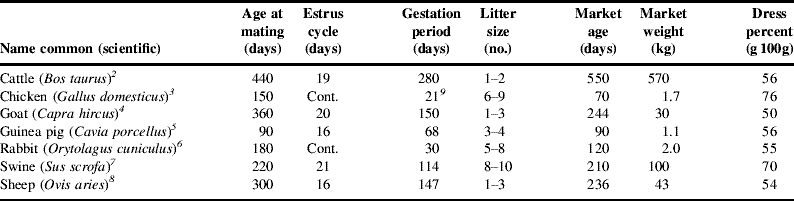
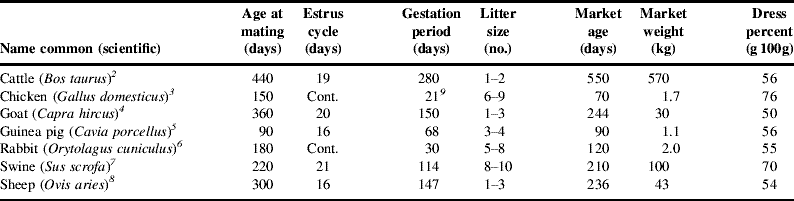
Smallholders raise a diversity of livestock species and often raise multiple species simultaneously. Table 1 presents expected reproductive and growth characteristics of selected livestock species under smallholder conditions. Each livestock species has attributes that are desirable. The purpose of this paper is not to identify the best livestock option for rural smallholders. Livestock species selection by producers is affected by a myriad of influences and conditions that are often specific to a given time and place. Thus identifying one, best species is not only impossible but also irresponsible. Examining the potential of species to fill certain niches is less problematic and that is the purpose of this paper. We first discuss several common species of livestock kept by smallholders under the context of improving food security through meat production. We highlight potential issues with each species that might limit their utility for meat production under smallholder conditions. We then examine the management and performance of guinea pig (Cavia porcellus) and discuss the potential this less-common species has for improving the food security of the rural smallholder.
Reproductive and growth characteristics of selected livestock species for meat productionFootnote 1.
1 Growth and performance are heavily influenced by nutrition, environment and genetics. Characteristics presented are general guidelines for smallholder farms.
2 Reference Darre, Sulik, Kinsman and Putnam52, Reference Patterson, Perry, Kiracofe, Bellows, Staigmiller and Corah66–Reference Steen, Lavery, Kilpatrick and Porter68
6 38, Reference Darre, Sulik, Kinsman and Putnam52, Reference Lukefahr, Cheeke, McNitt and Patton75, Reference Lukefahr, Nwosu and Rao76
7 Reference Pond, Mersmann, Pond and Mersmann31, Reference Lammers, Kerr, Weber, Bregendahl, Lonergan, Prusa, Ahn, Stoffregen, Dozier and Honeyman32, Reference Honeyman and Harmon77, Reference Kyriazakis and Whittemore78
9 Incubation period.
Ruminant livestock—cattle (Bos taurus), goats (Capra hircus) and sheep (Ovis aries)—have a proven ability to convert fibrous non-starch polysaccharides into highly digestible animal proteins. These species of livestock typically supply draft power, milk and fiber to smallholders. Ruminants are valuable components of mixed crop and livestock farming systems, however, their lengthy reproductive cycle and growth period limit their utility for production of meat for home consumption and sale under smallholder conditions.
Swine (Sus scrofa) is a species that is quite common throughout the world and pork is the most widely consumed meat in both developing and developed nations30. Swine produce multiple litters of 8–12 young annuallyReference Pond, Mersmann, Pond and Mersmann31. In the United States, growing swine fed typical corn–soybean meal diets will reach 130 kg live weight in less than 170 days, producing a 96 kg carcassReference Lammers, Kerr, Weber, Bregendahl, Lonergan, Prusa, Ahn, Stoffregen, Dozier and Honeyman32. Under smallholder conditions, management of swine's nutritional requirements and environment is likely to be less controlled. Performance of swine raised by smallholders may more realistically match benchmarks presented in Table 1 than North American production statistics. The existing body of research indicates that although swine can survive and grow on diets containing forages or other sources of non-starch polysaccharides, growth rates and performance of swine fed those diets are less than those exhibited by swine fed corn–soybean meal diets. For smallholders, production of swine for sale and ultimate consumption outside of the home might be hindered by potential human–swine competition for highly digestible starches and amino acids. Swine provide valuable recycling functions to a smallholder farm by consuming food and agricultural wastes, but those feedstuffs are generally not available to smallholders in sufficient quantities to support raising swine to regularly sell to others.
Chicken (Gallus domesticus) is another species of livestock commonly raised by rural smallholders. Growth and performance of chickens, a non-ruminant animal, is maximized when fed highly digestible starches and amino acids33. These sources of nutrients—grains and animal proteins—are also valuable foods for humans. Chickens can grow on diets containing non-starch polysaccharides, but at the cost of reduced net feed conversionReference Fraga, Ramos, Cino, Martinez, Venereo and Rodriguez34. Feeding exogenous non-starch polysaccharide enzymes to chickens may with time be an effective strategy to improve utilization of this feedstuff by chickens, but this approach has not yet been successfulReference Buchanan, Hott, Kimbler and Moritz35, Reference Buchanan, Kimbler, Parsons, Seidel, Bryan, Felton and Moritz36. Exogenous enzymes to improve forage utilization by non-ruminants would most likely have to be purchased and so may conflict with the larger goal of reducing reliance on external inputs for food production. Many chickens raised by smallholders are allowed to scavenge and are only fed limited amounts of feed by the producer37. Scavenge-fed chickens are certainly an effective strategy to harvest available resources in many situations, particularly when laying hens are kept and eggs are consumed37. However, higher mortality rates, slower growth rates and reduced net feed conversion limit the utility of this strategy for producing consistent supplies of meat for consumption and sale37.
Rabbit (Orytolagus cuniculus) is another species that may enhance the food security of rural smallholders. Rabbits are non-ruminant animals, but are able to utilize fermentation products of the cecum through coprophagy38. This adaptation enables rabbits to thrive on a variety of vegetation. Because of their legendary capacity for reproduction and their ability to thrive on forage, collectively rabbits can produce as much meat per unit of forage as larger ruminant animals, despite their considerably smaller size38. Rabbits are ideally sized for husbandry by women and children near the home. Unfortunately, their powerful hind legs allow rabbits to jump over barriers that would keep other small mammals confined. They also move relatively fast, making them difficult to recapture. In some areas, escaped rabbits have become a serious threat to crops and native vegetation38. In many situations, rabbits are well suited for production of meat under smallholder conditions. However, the potential for feral rabbits decimating natural and cultivated landscapes remains a barrier.
Cattle, goats, sheep, swine, chickens and rabbits all play important roles in the lives of rural smallholders. Under the context of meat production for both sale and home consumption, smaller species that reproduce rapidly and thrive on forage-rich diets are highly desirable. Of the species examined thus far, rabbits are particularly well suited for this role. Because increasing options for the smallholder is generally desirable, another less common species of livestock, guinea pig, will be the focus of the remaining discussion.
Guinea Pig
Guinea pigs (C. porcellus) are native to the Andes region of South America where they have been a valuable source of animal protein and income for centuriesReference Archetti39, Reference Morales40. Guinea pigs are well suited to produce meat for home consumption and for marketing in the context of rural smallholders. They are prolific animals—expressing non-seasonal estrus, have a gestation length that allows for multiple litters per year, and produce multiple young per birth event. Guinea pigs grow and reproduce on a flexible diet and are adaptable to a wide range of climates. They are also herd animals that respond favorably to husbandry and management.
Although most commonly raised in Latin America, guinea pig production has spread to parts of Asia and Africa41, Reference Numanyakpa, Lukefahr, Gudahl and Ngoupayou42. The guinea pig is a herbivorous mammal with molar teeth, which continuously erupt and are well suited for grinding rough plant materialsReference Hirsch43, Reference Navia, Hunt, Wagner and Manning44. The guinea pig is classified as a non-ruminant animal with a functional cecumReference Navia, Hunt, Wagner and Manning44. It has been demonstrated that adult guinea pigs can maintain body weight and young guinea pigs continue to grow normally on a cellulose-rich dietReference Hirsch43. Basal diets were diluted with 50% cellulose resulting in a calculated caloric density decrease of 40%, yet the guinea pigs' growth curves were maintained without a corresponding increase in feed intakeReference Hirsch43. This demonstrates that guinea pigs may be able to derive more energy from cellulose than most non-ruminant livestock species. The cecum of the guinea pig has been shown to contain concentrations of short-chain fatty acids similar to those in the bovine gastro-intestinal tractReference Henning and Hird45. Absorption and metabolism of these short-chain fatty acids is likely the mechanism by which the guinea pig utilizes cellulose and other non-starch polysaccharides. Together these findings support accounts that guinea pigs can derive significant amounts of energy and essential nutrients from fibrous materials. The similarities between the cecum of the guinea pig and rabbit (Oryctolagus cuniculus) suggests that the rabbit's practice of recycling intestinal contents through coprophagy and thus harvesting B vitamins and indispensable amino acids synthesized by mircroorganisms in the hindgut may also occur in the guinea pigReference Navia, Hunt, Wagner and Manning44, 46.
The biology of the guinea pig supports rapid increase in numbers of animals (Table 1). Guinea pigs used in research laboratories are typically 3 months or 400–600 g in body weight at the time of first matingReference Ediger, Wagner and Manning47. Commercial meat growers in Ecuador first mate improved animals selected for meat production at 3.5 months of age or about 1000 gReference Martinez48. Following a 68-day-gestation period, female guinea pigs will give birth to a litter of 1–8 live young41, Reference Martinez48, Reference Charbonneau49. For guinea pigs raised for meat, litters of 3–4 young that are weaned at 15 days of age are typical41, Reference Martinez48, Reference Charbonneau49. Estrus is displayed immediately post-partum and if not impregnated the female will ovulate again in approximately 16 daysReference Ediger, Wagner and Manning47, Reference Adu, Patterson, Rojas, Laswai, Fielding, Osafo, Owen, Kitalyi, Jayasuriya and Smith50. This intense prolificacy can be obtained in commercial meat producing herds41, Reference Martinez48 although typical output per breeding female is closer to 4 litters of 3 animals annuallyReference Martinez48–Reference Adu, Patterson, Rojas, Laswai, Fielding, Osafo, Owen, Kitalyi, Jayasuriya and Smith50. Improved guinea pigs typically reach a market weight of 1000 g at 10–13 weeks of age with carcass weight ranging from 715–800 g41, Reference Martinez48, Reference Charbonneau49. Although there are multiple reports of these reproduction and growth rates being supported by a diet predominantly composed of grasses or alfalfaReference Morales40, 41, Reference Martinez48, Reference Charbonneau49, Reference Numbella and Valencia51, precise determination of grain use by these animals under meat production conditions have not been fully quantified.
Suitablity for Smallholders
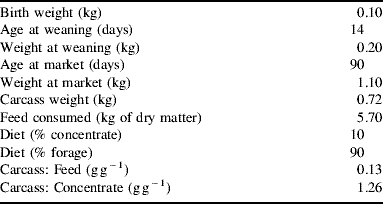
Table 2 presents detailed growth and performance characteristics of growing guinea pigs raised under smallholder conditions. Of greatest interest is the carcass yield per quantity of grain fed. Precise use of grain by guinea pigs under meat-production conditions has not been fully quantified. However, a commercial grower in Ecuador is currently feeding a diet of 90% forage and 10% grain on a dry matter basis and reports his animals achieve 1100 g of bodyweight at 10–13 weeks of ageReference Martinez48. In this case, guinea pigs produce 1.26 g of carcass for every 1.0 g of grain consumed. Other reports suggest that for maximal meat production, up to 40% of the diet should be a concentrated feed such as grainReference Adu, Patterson, Rojas, Laswai, Fielding, Osafo, Owen, Kitalyi, Jayasuriya and Smith50. By comparison, swine and chickens in the United States consume diets that are almost entirely grain-based and produce 0.3 and 0.5 g of carcass for every 1.0 g of grain consumedReference Darre, Sulik, Kinsman and Putnam52.
Growth and performance characteristics of guinea pig (C. porcellus) raised for meat production.
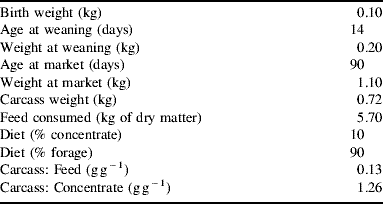
Carcass weight includes not only lean meat and fat, but also bone, which does not supply protein or energy to humans. Dissected laboratory guinea pigs have been shown to have a body composition of 40–62% lean tissue, 10–22% adipose tissue and 8–9% boneReference Breazile, Brown, Wagner and Manning53, Reference Pitts54. Dissection6 of guinea pigs selected for meat production have not been performed making it difficult to compare the relative amounts of muscle, fat and bone produced by guinea pigs with other more extensively studied species of livestock. Size is also a consideration in the actual harvesting of the animal. A guinea pig can be easily harvested by a single young adult in as few as 10 min, processing a much larger goat or swine requires more labor and time.
Diets consisting of primarily forage support high fecundity and rapid growth by guinea pigs41, Reference Martinez48, Reference Numbella and Valencia51. Livestock enterprises using feedstuffs that humans cannot or do not use are more appropriate for smallholders seeking to increase their income through the sale of meat. Under smallholder conditions it is common to feed guinea pigs kitchen wastes and other foods that are judged unfit or inappropriate for human consumption. Because guinea pigs are relatively small animals that grow very well on little grain, they make excellent kitchen waste recyclers for smallholders.
Traditionally, guinea pigs were kept within the home of rural smallholdersReference Archetti39, Reference Morales40, Reference Martinez48. Typically, the guinea pigs would have free-range of the kitchen area or be confined to a corner near the stove or fire. Under commercial meat production, 10–15 growing guinea pigs are typically kept in 1×1 m pensReference Martinez48. Guinea pig pens are simple square structures with 0.6-m high walls surrounding a solid floor. Pens are located within a larger building that often also serves as a storage shed for food, feedstuffs and agricultural tools. A bedding pack of absorbent material, most commonly small grain straw or rice hulls, approximately 7 cm thick is placed directly on the ground and the guinea pigs maintain distinct areas for sleeping, eating and defecatingReference Martinez48. Water is provided via fresh forage and supplemental grains are fed using a simple trough.
Zoonoses—diseases transmitted from other animals to humans—are a risk to human health associated with keeping livestockReference Randolph, Schelling, Grace, Nicholson, Leroy, Cole, Demment, Omore, Zinsstage and Ruel29. The magnitude of this risk for each species and how to address zoonoses most effectively is not fully understoodReference Randolph, Schelling, Grace, Nicholson, Leroy, Cole, Demment, Omore, Zinsstage and Ruel29. Given that guinea pigs have been raised by humans for centuries it is likely that in many cases mutual resistance or tolerance has developed, although this does not preclude the possibility of novel and epidemic zoonoses arising in the future. When raised in a clean environment under normal feeding conditions, guinea pigs are healthy and productive animals41, Reference Adu, Patterson, Rojas, Laswai, Fielding, Osafo, Owen, Kitalyi, Jayasuriya and Smith50, Reference Numbella and Valencia51. As with other species, when stressed by unsanitary conditions, inadequate nutrition, drafts and pathogens, guinea pig performance is depressed. Guinea pigs are susceptible to pneumonia and salmonella as well as internal and external parasites41, Reference Adu, Patterson, Rojas, Laswai, Fielding, Osafo, Owen, Kitalyi, Jayasuriya and Smith50, Reference Numbella and Valencia51. Guinea pigs can also be carriers of Chagas' disease41 and coccidiosis is sometimes common41, Reference Numbella and Valencia51. Similar to other species of livestock, avoiding contact with disease vectors, good hygiene and adequate nutrition results in healthy guinea pigs.
Development through livestock can occur in several ways6. One model locates production within smallholder farms where families raise animals for both home consumption and sale outside of the home. Benefits and costs of production are immediately enjoyed or felt by the smallholder owner operator, thus encouraging the evolution of effective strategies to address a given situation. The economic and social advantages of a community composed of self-determining yet interconnected citizen-producers has long been hailed as cornerstones of responsible civilizationReference Schumacher55 and democracyReference Lind10. Another very different approach involves industrialized production directed by an individual or group able to secure investment and operating capital. Smallholder and rural poor can be employed as wage labor by these firms, generating needed income for the household. Increased income can lead to greater food security through increased ability to purchase available food6. However, in situations of market shortage and price increases those whose access to food is limited to buying it are generally less able to obtain adequate nutrition than producers of food.
Livestock have long been used as ‘living savings accounts’ providing protection against risks of economic, social and environmental instabilitiesReference Kitalyi, Mtenga, Morton, McLeod, Thornton, Dorward, Saadhullah, Owen, Kitalyi, Jayasuriya and Smith28, Reference Doran, Low and Kemp56, Reference Moll57. Livestock can be sold and transformed into cash as needed, providing liquidity and consumption smoothing to seasonal income from crop productionReference Kitalyi, Mtenga, Morton, McLeod, Thornton, Dorward, Saadhullah, Owen, Kitalyi, Jayasuriya and Smith28. Livestock can be sold in times of crisis, thereby serving as insurance to a family with limited assestsReference Kitalyi, Mtenga, Morton, McLeod, Thornton, Dorward, Saadhullah, Owen, Kitalyi, Jayasuriya and Smith28, Reference Hoddinott58. The size and growth rate of guinea pigs make them excellent means of generating both food for the table and cash income while continuing to sustain the ability to generate income into the future. For example, consider a producer who has resources to produce one 120-kg swine or one hundred, 1100-g guinea pigs per year. The guinea pigs could be managed in such a way that small but steady income and nutrition streams flow from the guinea pig herd. Alternatively a single swine produces one large pulse of nutrition or income. The larger number of guinea pigs also provides security from disease and other risks—if the one swine owned by the producer contracts a disease and fails to grow, the entire income/nutrition benefit is imperiled. Alternatively if half the guinea pigs fail to grow they represent only a portion of the herd. With more individuals, the guinea pig herd itself is more likely to survive unpredictable impediments to production and recover to full capacity more quickly.
Gender often plays an important role in rural poverty and food insecurityReference Aromolaran59–Reference Engle62. When women control the production and marketing of crops and livestock, the results are more likely to improve the family's nutritional status or address other critical family needs such as school fees or medical expensesReference Blumberg60–Reference Engle62. When higher percentages of total family income are controlled by mothers, children's nutritional status improvesReference Engle62. BlumbergReference Blumberg60 reviewed multiple studies conducted in several developing countries and found that income managed by women was more likely to be devoted to sustaining the family unit than income managed by men. While in some cases, increasing the income level of men resulted in improving nutritional status and overall well being of the family, in others it did notReference Blumberg60. Women and children are typically responsible for guinea pig production under smallholder conditionsReference Morales40. A herd of guinea pigs large enough to produce both meat for the table and cash income can easily be kept near the family dwelling and managed entirely by family laborReference Morales40, 41, Reference Charbonneau49.
Improving the livelihood of the rural poor through increased meat animal production should be coupled with enhanced market access and informationReference Aklilu, Almekinders, Udo and Van der Zijpp63. Guinea pig cooperatives as described by MoralesReference Morales40 can enhance marketing power of smallholders by pooling production of multiple producers together. The expanding mobile phone network within developing countriesReference Selanikio64 also enhances the marketing position of smallholders by increasing access to critical market information across large geographical distancesReference Aker65. The ability to communicate verbally with calls to prospective buyers before undertaking day-long or more journeys to market gives smallholders the opportunity to more effectively use their time and direct their product.
Conclusions
Production of meat animals can improve family nutrition and income of smallholder farms. The guinea pig is a valuable species that can improve the livelihood of smallholders. As a species that performs well on diets consisting primarily of forages, the guinea pig does not compete with humans for sources of nutrition. The management and care of guinea pigs is often performed by women and children, which may offer additional development benefits. Awareness and acceptance of the guinea pig as a source of nutrition and income is less than ubiquitous. The biological, ecological and economic advantages of guinea pigs deserve further attention by those working to alleviate global poverty and food insecurity.
Acknowledgements
This paper was supported by the Hatch Act, State of Iowa funds, Iowa State University College of Agriculture and Life Sciences Agriculture Study Abroad Program, Department of Animal Science, Department of Agronomy, Graduate Program in Sustainable Agriculture and Practical Farmers of Iowa.