For many the House of Lords is an arcane and archaic institution, with its greatest relevance to social policy in recent times having been as an exemplar of social inequality. However, in addition to its role as the ultimate court of legal appeal in the United Kingdom, the House has played a part in examining and revising legislation, providing a forum for debate and deliberation on issues of current concern, and scrutinising government, including the European Union. At the same time, the powers of the Lords have been limited: the Parliament Act of 1911 removed its power to delay or amend money bills; the Parliament Act of 1949 reduced its ability to delay non-money bills to one parliamentary session; and since 1945 the Salisbury doctrine, or convention, has meant that the Lords does not defeat bills passed in the House of Commons that have been foreshadowed in the governing party's general election manifesto. It is perhaps not surprising, therefore, that the House has barely figured in most analyses of the processes of making and scrutinising social policy.
Since 1997 there have, however, been a number of changes which make some reconsideration of the role of the House of Lords appropriate. Labour's reforms of the Lords sought to make the upper chamber more representative and legitimate with the removal of the bulk of hereditary Peers. Whilst there has been no consensus on further reform, the work of the ‘transitional house’ has led some to argue that the chamber has already begun to develop a new and more assertive role (Russell, Reference Russell2003; Howe, Reference Howe2007). There have also been suggestions from MPs that, as a result, the House of Lords is now playing a more substantial role in the formulation and scrutiny of social policy and legislation (Bochel and Defty, Reference Bochel and Defty2007a). In addition, the creation of the House of Lords Appointments Commission, which has responsibility for making recommendations for non-party political Peers, has led to the appointment of a number of people with backgrounds in social welfare and related areas. While the extent to which the background and subject expertise of Peers impacts upon the scrutiny of government policy and legislation remains unclear, a possible shift in the complexion of the Crossbench Peers has added another dimension to the scrutiny of policy and legislation in the Lords.
This article therefore examines the views of members of the contemporary House of Lords, drawing upon a series of face-to-face interviews to examine Peers’ attitudes towards a range of social policy issues. The research was designed to allow comparisons between the views of Peers and those of MPs, and indeed of the wider population. If the House of Lords is becoming more assertive, then the extent of agreement within it, and between it and the House of Commons, on key issues may be crucial to governments’ ability to successfully deliver their legislative programmes. Moreover, the extent to which Peers’ attitudes reflect public opinion may impact upon claims that the non-elected upper House, is nevertheless, more ‘democratic’ than an elected house dominated by party (Putnam, Reference Putnam1999).
The sample interviewed comprised 78 Peers (10 per cent of the current House), balanced to reflect the political make-up of the Lords: 24 Labour Peers, 18 Conservatives, ten Liberal Democrats, 23 Crossbenchers and three Bishops. It was also broadly representative of the upper chamber in a number of other ways: the bulk of those interviewed were life Peers, but 11 per cent were elected hereditary Peers, a group which comprises 13 per cent of the House as a whole; they represented a diverse range of parliamentary experience, including individuals who first entered the Lords between 1971 and 2006, while eight of the Crossbench Peers interviewed (11 per cent of the sample, and 6 per cent of the House as a whole) had been appointed since 2001 by the House of Lords Appointments Commission. Women were over-represented in the sample at 34 per cent, compared to only 20 per cent for the House as a whole, while only 14 per cent of those interviewed had previously served as MPs, compared with 24 per cent of the current House.
The ‘transitional’ House of Lords
When New Labour entered government in 1997, in addition to substantive policies their proposals for ‘modernisation’ included aspects of policy making and the constitution, one part of which was reform of the House of Commons and House of Lords, with a commitment to making the upper chamber more ‘democratic and representative’ (Labour Party, 1997: 32) and effective and legitimate (Cabinet Office, 1998). In 1999, the bulk of the hereditary Peers were removed, leaving behind 92 elected by their peers. This resulted in a significant rebalancing of the strength of parties in the House of Lords, and in May 2005 Labour became, for the first time, the largest party in the Lords, although still far short of an overall majority. In addition, the House of Lords Appointments Commission (HOLAC) was created in 2000 to consider nominations for non-party political appointments to the Lords and by the end of 2008 had been responsible for the creation of 49 new Crossbench Peers. The result of these reforms has been the creation of an upper chamber in which no party has an overall majority, and in which there is a significant body of non-party political Peers. As at 1 July 2009, the Lords was composed of 196 Conservatives, 214 Labour, 71 Liberal Democrats, 201 Crossbenchers, 26 bishops and 14 ‘others’.
Despite the lack of progress on further reform, there is evidence to suggest that the ‘transitional’ House of Lords has become more assertive and more willing to challenge the government. Labour has continued to suffer significant and increasing numbers of defeats on votes, with 108 defeats during the 1997–2001 Parliament, 245 in the 2001–2005 Parliament and a further 136 between 2005 and 2008, compared to 62 defeats in the House of Lords for the Conservatives in the longer 1992–1997 Parliament (House of Commons Library, 2008), with Cowley, for example, claiming that ‘Of the two Houses . . . it was the Lords that was more of a block on the government throughout the Blair Era’ (Reference Cowley and Seldon2007: 31). Moreover, Russell and Sciara's research (Reference Russell and Sciara2006b) has shown that around two-fifths of government defeats in the upper chamber are not reversed, and thus that there is considerable scope for the Lords to have a significant impact upon legislation. This has led some, such as Russell (Reference Russell2003; Russell and Sciara, Reference Russell, Sciara, Rush and Giddings2006a) and Howe (Reference Howe2007), to argue that the chamber has become a more effective and powerful body, with not only no party being close to an overall majority, but also the removal of the bulk of the hereditary Peers in itself enhancing the Lords’ belief in its own legitimacy, a view that was expressed by a large number of Peers in interviews. However, Peers also suggested a number of other explanations for their assertiveness. Both Conservative and Labour Peers noted that the House was now more assertive because there was a Labour Government in power and that, despite the balance of the parties, attitudes in the House remained predominantly conservative. Some suggested that Peers felt threatened by plans for further reform, and as a result were more prepared to attack the Government; many also stressed that they were forced to make changes by the poor quality of legislation being sent up from the Commons.
The House of Lords and social policy
While there has recently been a growth in scholarship about the House of Lords, little research has yet focused upon the views or impact of the Lords on specific policy areas. As noted above, whilst the House has not generally been viewed as playing a significant role in relation to social policy, nevertheless in recent years it has been willing to challenge the government on a wide range of topics, including many that have been key elements of the government's reform agenda. Government defeats in the House of Lords have included high profile issues such as university tuition fees (1998), foundation hospitals (2003) and ID cards (2006) as well as a range of other topics, including social policy-related issues such as the age of consent for gay men (1998), the abolition of community health councils (2001), the rights of unmarried couples to adopt (2002), the education of asylum seekers’ children (2002), proposals to outlaw incitement to religious hatred (2005), buying extra ‘qualifying years’ for state pensions (2007), offender management (2007), the detention and treatment of people with mental health problems (2007) and the welfare of children passing through the immigration system (2008). Whilst some of these defeats have later been reversed by the House of Commons, in many instances they have stood or the government has made concessions.
There have been other ways in which the role of the Lords appears to have been changing, including an increase in the number of government bills that are being introduced in the Lords, again including on social policy issues (Bochel and Defty, Reference Bochel and Defty2007a). Around one-third of bills now start life in the Lords, including, for example, the Mental Health Bill in the 2006/7 session, which saw six defeats for the government and a total of 66 amendments made in the upper chamber. It is also the case that defeating the government in the division lobbies is often the last recourse for those who seek to amend legislation or influence policy (Russell and Sciara, Reference Russell and Sciara2006b). Issues are commonly raised at early stages of legislation and are only pressed to a vote if ministers refuse to reconsider their approach. Government concessions are therefore much more common than defeats, although given the range of bodies attempting to exert influence (these include the House of Commons as well as the House of Lords, interest groups and the media), it can be difficult to definitively apportion change to particular sources. Perhaps unsurprisingly therefore, Cowley (Reference Cowley2005) and Bochel and Defty (Reference Bochel and Defty2007a) have also found some evidence that the government's difficulties with each chamber were effectively reinforcing each other, so that significant potential or actual opposition in both chambers may have encouraged the government to make concessions on its legislation, sometimes even before it is introduced. Taken together, these developments suggest that the views of the House of Lords are now impacting significantly, both directly and indirectly, on government proposals and legislation.
The apparent increase in attention paid by the Lords to social legislation in terms of votes is, however, not yet mirrored in the scrutiny work of its select committees, in large part because the chamber's two longest standing committees focus on science and technology and the EU (although the latter does include the social dimensions of the European Union), with the Commons select committees continuing to play the major role in scrutinising the work of government departments.
Finally, it is often asserted that the House of Lords is influenced by the expertise of its members. This was a view frequently echoed by Peers in interviews, with several asserting that in many cases expertise was more important than party loyalty, and that a well-informed speech by a recognised expert in some cases is sufficient to carry a debate irrespective of party positions. However, examples to support this are largely anecdotal, and in relation to social policy, the breadth and depth of expertise in the House perhaps remains open to question.
Peers’ attitudes to welfare policy
As noted above, it is often suggested that Peers are less constrained by Party and by the Whips than are MPs, and are more likely to draw upon their personal experience and attitudes, and the views of their fellow Peers who they consider to be experts, when scrutinising policy and legislation. Consequently understanding Peers’ attitudes may be central to explaining behaviour in the House of Lords, and in attempting to predict the likely response of the House to future government social policy proposals and legislation.
Research on MPs’ attitudes to welfare (Bochel and Defty, Reference Bochel and Defty2007a and Reference Bochel and Defty2007b) found some evidence to support the view that there is an emerging consensus on approaches to welfare, with a general convergence in MPs’ attitudes around the idea of a more selective and targeted approach to welfare provision, and support for a mixture of public and private provision. However, the level of consensus around an active role for the state in enabling people to lift themselves out of poverty was much more limited among Peers than MPs, whilst at the same time there was greater support among Peers’ than MPs for the opposing poles of a minimal safety-net or a re-distributive role for the state (Table 1), in many respects closer to the political positions of the parties in House of Commons in the 1980s (Bochel, Reference Bochel1992; Taylor-Gooby and Bochel, Reference Taylor-Gooby and Bochel1988). Sixty-five per cent of Conservative Peers believed that the state should provide only a minimum safety-net and/or support the extension of private provision, a view expressed by 84 per cent of Conservative MPs in the 1980s, but only 54 per cent of Conservative MPs today. This group suggested, for example, that the role of the state should be ‘Minimal’. ‘The government is no good at running everything. The voluntary sector is better than the government and the private sector is better than the voluntary sector’, and that ‘The government should support those who can't support themselves and the rest would prosper in a lower tax regime.’ Among Labour Peers, 69 per cent believed that the state should provide universal provision and/or facilitate the redistribution of wealth, a position held by 85 per cent of Labour MPs in the 1980s, but only 51 per cent today. Many were unapologetic about their views, with one noting, for example, ‘I'm not old Labour, I'm primeval Labour . . . As a socialist I want to see good public services.’ There was also some support for redistribution among Liberal Democrats.
Peers’ views on the role of the state in welfare, 2007–8 (percentage of valid responses by group)

Whilst there were considerable divisions across parties, there were nevertheless a significant proportion of Peers across the House whose views coincided around the desirability of an active welfare state helping people into work, expressing views such as: the state should be ‘an enabler, promoting an active labour market’ (Liberal Democrat), should ‘lift up those who are not able and encourage others back to work’ (Labour), and there should be provision by public, private and not-for-profit sectors, so that ‘The government should enable private provision . . . It should work hand in hand and recognise the private sector as a partner’ (Labour), ‘There is no magic alternative to state funding. You can't rely on the private sector . . . the profit motive means some people won't be supported’ (Conservative) and ‘I am fully paid up to the idea of the public and private sector’ (Liberal Democrat). A number of Peers from all sides of the House explicitly recognised that their views had changed in recent years.
In the past, it was often argued that most Crossbenchers tended to sympathise and vote with the Conservatives, and as a group they still tend to vote against Labour (Crewe, Reference Crewe2005). However, it has been suggested that the Crossbenchers have, in recent years become a more diverse group, particularly since the creation of the House of Lords Appointments Commission, and in response to this question they did express the widest range of views. The idea that there has been something of a shift on the Crossbenches was also supported by a number of those interviewed; and among the eight Crossbenchers interviewed who had been appointed through HOLAC, views ranged from support for a limited safety-net, similar to that expressed by many Conservatives, to a rigorous redistribution of wealth, closer to the views expressed by some Labour Peers. In general therefore, the evidence available tends to support the view that the removal of the hereditaries and the work of the Appointments Commission is indeed serving to create a more heterogeneous group of Peers.
Funding welfare
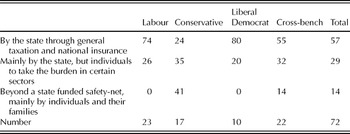
Where perceptions of how welfare services should be financed were concerned, again significant divisions appeared both across and within parties (Table 2). The overwhelming majority of Labour and Liberal Democrat Peers, and most Crossbenchers, plus a minority of Conservatives, believed that provision should be financed through general taxation and national insurance. However, substantial minorities in each grouping felt that whilst the state should take primary responsibility for funding, individuals should take on more of the burden (‘We have reached the limit of what is acceptable and sensible in terms of levels of taxation’ (Liberal Democrat); ‘I don't think that you can get much more from the taxpayer . . . There is therefore an obligation on families to do more’ (Crossbencher)), and, reflecting more general beliefs, two-fifths of Conservative Peers argued that, beyond a basic safety-net, individuals and their families should be responsible for supporting themselves (‘We should be encouraging self-reliance as a concept people should take on board’).
Peers’ views on how welfare services should be financed, 2007–8 (percentage of valid responses by group)

In recent years, and prior to the economic crisis that emerged in late 2008, the policies of each of the three main parties had settled around a broad consensus on spending, based on the view that the public would not tolerate tax increases to pay for improved public services, but that there was also little public support for significant cuts in taxes and services. Whilst MPs from all parties showed some divergence from party policy on this point, the views of Peers were somewhat bolder and more polarised than their colleagues in the Commons. Half of Labour and Liberal Democrat Peers advocated increases in taxation to pay for increased provision (‘We need to make the argument for tax increases. If we want valuable services we will need to pay for them’ (Labour); ‘Tax the super-rich more’ (Liberal Democrat)), as did one-third of Crossbenchers, while, in contrast, one-third of Conservative Peers advocated making substantive tax cuts.
Challenges and priorities
When Peers were questioned about challenges to the welfare state, there was again both agreement and division across the party groups. Peers of all parties and Crossbenchers referred to the ageing population and the costs of welfare (in terms of rising costs, balancing costs against people's expectations, and the perceived pressure not to increase taxes) as the main challenges, but Conservatives were more likely than others to identify the need to avoid dependency and ‘draw a line’ in terms of the responsibility of the state, so that ‘The main challenges are the same as they've always been – identifying who has needs and targeting help towards them’, whilst their Labour counterparts were more likely to talk about poverty and related issues such as affordable housing (‘. . .if you read Polly Toynbee's book about living on the minimum wage you realise it's bad’). A number of Crossbenchers strongly defended the welfare state (‘The biggest challenge is its survival, this is a genuine fight’), and some New Labour policies (‘SureStart is brilliant and brave because we won't get the results for twenty years, and it involves local communities’), although others were less positive, frequently identifying problems of cost and poor value for money. Among the Crossbenchers, and arguably representing a significant strand within the House of Lords, one-fifth identified the criminal justice and penal systems as major challenges facing the welfare state. This is in marked contrast to MPs’ responses in which criminal justice was rarely mentioned in terms of social policy.
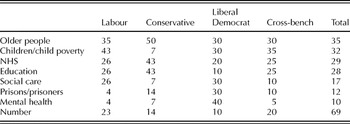
Asked about priorities for additional spending, older people, children, the NHS and education were the areas most commonly identified by Peers (Table 3). Again there were significant divisions across parties, although the nature of these might not have been anticipated. Conservative Peers, for example, were the most likely to identify the NHS and education as priorities, and despite some of the views voiced by the Party leadership, by far the least likely to mention children or child poverty. Among Labour Peers, children and older people came in front of traditional areas such as the NHS and education, although that may have been because this group were aware of significant increases in expenditure on those services since 1997. The views of Crossbenchers, and to a lesser extent their Liberal Democrat colleagues, were fairly evenly spread. Interestingly, while a number of Peers had identified the problems of the criminal justice and penal systems as significant challenges for the welfare state, only a small number said that these should be priorities for spending.
Peers’ views on priorities for extra welfare spending, 2007–8 (percentage of valid responses by group)

Consensus?
Whilst the views of Peers were considerably more polarised than those of their colleagues in the House of Commons, there was some evidence of a convergence of attitudes on a centre ground similar to that identified among MPs. For example, one third of Labour Peers dismissed the idea of universalism and advocated a more selective targeted approach to welfare, whilst a quarter of Conservative Peers stressed that the state had a duty to ensure that people were supported in a broad range of areas, even if it was not responsible for providing that support. In at least some cases, this appears to represent a genuine shift in Peers’ attitudes rather than generational differences. For example, one long-serving Labour Peer, who had served as an MP under Harold Wilson, stated there was now ‘no logic in universalism’. Similarly, a Conservative Peer ennobled by Margaret Thatcher, observed that ‘the debate has moved on from does the state have a role or not, to how do the state and the private sector work together?’, whilst another expressed grave reservations about the quality of private sector provision and argued that ‘the state should provide good quality services across the board’.
There was also a widespread view among many Peers from all parties and the Crossbenches that employment is important, and that it is better to get people into work, or keep them in work, than to support them on benefits (although there were fundamental differences of opinion in the best way to achieve this, with some Conservatives emphasising the need to limit benefits and lower taxes to encourage employment, whilst some Labour Peers stressed the importance of tax credits, and the minimum wage as a means of making work more attractive). This debate was summarised by a Liberal Democrat Peer, and former MP, who observed that:
There is a consensus in terms of people agreeing on a big strategic level that access to work is the best route out of poverty. This used to be a highly contentious issue, because of the issue of conditionality. There is now a large measure of consensus on an active labour market, but as soon as you get into implementation of strategy, you fall out with each other rather grandly.
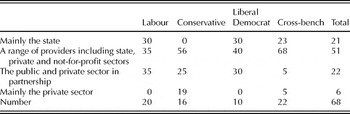
Secondly, as in the Commons, there was strong support among Peers’ from all parties for a role for a mixture of providers in the delivery of services (Table 4). Whilst, as noted earlier, there were differences of opinion over who should finance welfare services, on the question of who should provide services there was a strong consensus around the idea of mixed provision by the public, private and not-for-profit sectors.
Peers’ views on who should be responsible for providing welfare services, 2007–08 (percentage of valid responses by group)

Substantial majorities of both Labour and Conservative Peers stated that services should either be provided by the public and private sector, or by a range of providers, including the state, private and not-for-profit sectors. However, as in the Commons, a larger proportion of Labour Peers stated that services should be provided by the public and private sector in partnership, whilst a larger proportion of Conservative Peers identified a role for a wider range of providers, including the voluntary and not-for-profit sectors. This emphasis on mixed provision, which is also seen by some as a key part of any ‘new consensus’ on approaches to welfare, appears to reflect in particular a shift in the Labour Party's attitude to the private sector (Bochel and Defty, Reference Bochel and Defty2007a). Labour Peers, like their counterparts in the Commons, were much less concerned about the involvement of the private sector in the delivery of services than were Labour MPs in the 1980s, none of whom saw a role for the private sector. Many Labour MPs and Peers now expressed themselves as ‘relaxed’ about the private sector, or no longer viewed the private sector as ‘all bad’. Indeed, the extent to which attitudes have shifted was indicated by one Labour Peer who observed that, contrary to current Labour Party thinking, he did not consider ‘the public sector to be all bad, and the private sector all good’.
Power without representation?
Interestingly, a number of Peers argued that as they were less constrained by Party, and because the House was becoming more diverse, their attitudes more closely reflected those of the general public, and that in this respect the House was perhaps more democratic and representative than the House of Commons. To some extent the support among significant proportions of Labour, Liberal Democrat and Crossbench Peers for a strong and redistributive welfare state would appear to fit well with apparent public support for state welfare provision, at least when measured by surveys such as the British Social Attitudes series. Similarly, those Conservative Peers who advocated more limited provision and a desire for cuts in taxation also reflect a hardening of public attitudes towards benefits recipients evident in recent surveys (for example, Taylor-Gooby, Reference Taylor-Gooby, Park, Curtice, Thomson, Bromley and Phillips2004).
However, although ‘representation’ in the House of Lords is a complex issue, there is little evidence to suggest that the House is becoming, either through its composition or its attitudes, more representative. Despite the government's intention to create a more representative House, the Lords remains far from representative of the population in social terms: for example, only around 3 per cent of Peers are non-white while 20 per cent are female; the average age of members is 69; and the Sutton Trust (2005) found that 62 per cent of Peers had attended private schools. Moreover, when asked who, if anyone, they felt that they ‘represented’, whilst Peers claimed to represent or consult with a diverse range of interests, including charities, trades unions, professional bodies, and local interests, around a quarter claimed that they did not represent anyone. Crucially, unlike MPs, members of the House of Lords do not have to submit themselves for election and therefore do not have to translate their views into an electoral platform to test the views of the public at the ballot box. They are therefore able to voice positions which their elected colleagues in the House of Commons might fear to be electorally unpalatable, a point conceded by several Peers.
Conclusions
Whilst some of the work of Westminster, particularly that which goes on out of the public eye, means that it remains unclear how the attitudes of Peers in particular, and to some extent the differences between MPs and Peers, impact upon the scrutiny of welfare policies and legislation, it is possible to outline a number of observations about the impact of the House of Lords on welfare policy.
Firstly, there is a range of evidence that the ‘transitional’ House of Lords is, perhaps increasingly, willing to challenge the government, particularly during the passage of bills, including major social policy legislation. This appears to be underpinned by a number of factors, including the chamber's perception of its own greater legitimacy, the weakened position of the government and the views of Peers on particular issues.
Secondly, the relative lack of support for any particular approach to welfare, together with the greater independence of Peers that arises from the weaker party discipline in the upper chamber, may help to explain the frequency of government defeats in the House of Lords, including in the passage of social policy legislation. With a smaller centre ground, and considerably greater opposition from the poles of the two major parties, there are likely to be fundamental differences in the attitudes of many Peers to the direction of any government's reform agenda. Moreover, given the greater importance of the Liberal Democrats in holding something close to the balance of power in the Lords, the extent to which a significant proportion of Liberal Democrat Peers (and indeed many Crossbenchers) oppose the government's approach, suggests that other attempts to pursue welfare reform, particularly with an emphasis on retrenchment and selectivity, are likely to meet continued opposition.
Thirdly, although the voting behaviour of Liberal Democrat Peers has suggested a shift in support away from Labour and towards the Conservatives, this may in large part simply have been a response to a weaker and less popular government, and the behaviour of this group is likely to prove as problematic for a Conservative government as for Labour; and, in relation to social policy at least, the attitudes of Liberal Democrat Peers appear to be considerably closer to their colleagues on the Labour benches than to the Conservatives. Moreover, whilst in the past the Conservatives have been able to rely upon the support of a significant proportion of Crossbench Peers, it seems that the Crossbenchers are now more heterogeneous, in part because of the removal of the bulk of the hereditaries, and in part as a result of the appointments made by the House of Lords Appointment Commission, reducing the likelihood of regular and solid support for the Conservatives from this group. The reality might now be that a government of any party may experience difficulties getting major social policy legislation through the Lords, particularly if it is not outlined in its election manifesto and therefore covered by the Salisbury convention.
Acknowledgements
The authors are grateful for the support of the Nuffield Foundation for this research from the Small Grants Scheme (SGS/34825).