INTRODUCTION
Implicit within traditional strategies of protected area (PA) management is the assumption that enforcement of PA regulations by PA guards is a direct deterrent to resource damage (Lausche Reference Lausche1980; Terborgh Reference Terborgh2000; Brown Reference Brown2002). This assumption is based on the belief that the risk of being caught inhibits would-be offenders from violating PA regulations. The success of such strategies thus hinges upon the effectiveness of authorities to detect and punish offenders, or at least perceptions thereof. This traditional management paradigm casts potential offenders of PA regulations as purely rational actors, aiming to maximize their own personal utility functions in light of perceived risks (Becker Reference Becker1968; Rabinowitz Reference Rabinowitz1999), largely ignoring that some might exercise voluntary restraint rather than having to be coerced into compliance.
Numerous shortcomings have been uncovered in this traditional paradigm of PA management. Even in areas where capacity exists and efforts are well-funded, enforcement has not proven entirely effective on its own as a deterrent to natural resource exploitation and other forms of opposition toward PAs (Salafsky & Margoluis Reference Salafsky, Margoluis, Terborgh, Davenport, van Schaik and pp2002; Negi & Nautiyal Reference Negi and Nautiyal2003; Robbins et al. Reference Robbins, McSweeney, Waite and Rice2006; Stern Reference Stern2008). This can be due to the size or geography of the PAs, the ingenuity of offenders, time limitations on the work weeks of park guards, a lack of political will to mandate strong enforcement efforts and legal structures that inhibit effective sanctioning, among other factors (Dourojeanni Reference Dourojeanni, Terborgh, Davenport, van Schaik and Rao2002; Jimenez Reference Jimenez2002; Salafsky & Margoluis Reference Salafsky, Margoluis, Terborgh, Davenport, van Schaik and pp2002; Lundquist & Granek Reference Lundquist and Granek2005). Moreover, enforcement, when viewed as illegitimate by local populations, can be the cause of sometimes violent conflicts between PAs and the people living around them, particularly in developing countries (Gadgil & Guha Reference Gadgil and Guha1992; Roy & Jackson Reference Roy, Jackson and Kemf1993). As a result, voluntary compliance with PA regulations may play a critical role in the conservation of the resources within.
Mechanisms for achieving voluntary compliance with PA regulations have been hotly debated. Many have argued for more people-oriented approaches, including stronger emphases on environmental education strategies, integrated conservation and development projects (ICDPs) and community-based natural resource management (CBNRM). Such strategies generally aim to incorporate the participation and empowerment of local residents in natural resource-based decisions and management (Gurung Reference Gurung and McNeely1995; Wells & McShane Reference Wells and McShane2004; Moorman Reference Moorman2006; Baral et al. Reference Baral, Stern and Heinen2007). Meanwhile, others have cited failures in such approaches to call for a continued reliance upon more traditional coercive measures, suggesting that relying on voluntary compliance, even in exchange for some benefits, fails to account for people's desires to maximize their take of common resources (Rabinowitz Reference Rabinowitz1999; Terborgh Reference Terborgh1999; van Schaik & Rijksen Reference van Schaik, Rijksen, Terborgh, Davenport, van Schaik and Rao2002).
Ambiguous findings regarding the relative successes and failures of both coercive and people-oriented strategies suggest that neither strategy is consistently effective. The field's understanding of the most consistent precursors to compliance with PA regulations (voluntary or coerced) is rather limited. This study aims to deepen this understanding, hypothesizing that local opposition toward neighbouring PAs can be assuaged by two potential mechanisms: (1) deterrence through coercive enforcement strategies, or (2) voluntary compliance through the development of perceptions of legitimacy. It aims to uncover the relative importance of each potential mechanism in predicting the behaviour of PA neighbours. The study breaks new ground by moving beyond the measurement of attitudes and intentions to measurements of actual human behaviour impacting PAs.
Local perceptions of the effectiveness of PA enforcement are referred to as ‘deterrence factors’ in this study. These perceptions allow would-be offenders to gauge the risk of being punished for performing prohibited activities. If the risk is perceived to be too high in relation to the potential benefits of violating PA regulations, then compliance is likely to be enhanced (Nielsen Reference Nielsen2003).
Voluntary compliance, on the other hand, is not necessarily associated with risk, but rather with general agreement about the legitimacy of PA rules (Honneland Reference Honneland2000). Brechin et al. (Reference Brechin, Wilshusen, Fortwangler and West2002, p. 46) define legitimacy as ‘any behavior or set of circumstances that society defines as just, correct, or appropriate.’ Numerous studies have found that perceptions of legitimacy generally enhance voluntary compliance (Tyler Reference Tyler1990; Honneland Reference Honneland2000; Gezelius Reference Gezelius2002; Viteri & Chavez Reference Viteri and Chavez2007).
Legitimacy can be conceptualized in a number of ways. While Suchman (Reference Suchman1995, p. 582) suggests that legitimacy can often come about through a ‘taken-for-grantedness’ of existing authority, what Suchman (Reference Suchman1995) terms ‘cognitive legitimacy,’ this may rarely apply in situations in which tensions run high between PAs and their neighbours. Tyler (Reference Tyler1990) found that legitimacy is made up of multiple facets, which can be differentially important to different people in different situations. His research showed that views of legitimacy can be influenced by social relations (the influence of other people's judgments), normative values (ethical views, personal morality and views about legal authority in general), consistent adequate performance or reliability of the authority, procedural justice and distributive justice. Procedural justice refers to the perceived fairness of processes, which can be based on representation, responsiveness, consistency, impartiality, honesty, fairness, correctability, quality of decisions and ethics (Tyler Reference Tyler1990; Sunshine & Tyler Reference Sunshine and Tyler2003). Distributive justice, meanwhile, refers to the equitable treatment of all parties (Tyler Reference Tyler1990). Tyler's findings are more or less representative of a literature spanning numerous disciplines and subject matters (Suchman Reference Suchman1995; Levi & Stoker Reference Levi and Stoker2000; Gezelius Reference Gezelius2002; Sunshine & Tyler Reference Sunshine and Tyler2003; Murphy Reference Murphy2005; Reisig et al. Reference Reisig, Bratton and Gertz2007).
Perceptions of legitimacy around PAs, and therefore voluntary compliance, may also be related to local perceptions of the benefits and disadvantages associated with the existence of the PA. Because evaluations concerning legitimacy are largely based on the degree of accord with a person's values and beliefs, it may also be expected that personal evaluations of benefits and disadvantages associated with a given management system may be linked to views of legitimacy. These rational evaluations of pros and cons may form a strong basis for individuals' attitudes toward the management institution (Fiallo & Jacobson Reference Fiallo and Jacobson1995; Ajzen Reference Ajzen2001). This instrumental view of legitimacy, which is largely based on acceptance of authority for reasons of self-interest, has been termed ‘pragmatic legitimacy’ by Suchman (Reference Suchman1995). Multiple people-oriented strategies, such as ecotourism or ICDPs, which focus upon bringing benefits to PA neighbours, reflect this logic (Munro Reference Munro and McNeely1995; Well & McShane Reference Wells and McShane2004; Baral et al. Reference Baral, Stern and Heinen2007).
In this study, ‘legitimacy factors’ hypothesized to influence voluntary compliance mirror those found in prior research. They include personal relationships between respondents and PA officials, the degree of concordance between respondents' environmental values and those reflected in PA policies, and respondents' perceptions of the equity or inequity of the application of enforcement actions, of the identities of enforcement officials as local or foreign, of the receptiveness of PA managers to local input, of the relative advantages and disadvantages associated with PA presence, of the attitudes of their peers toward the PAs, of how well PA managers understand the local culture and of the trustworthiness of PA managers to be fair and honest with local residents. The paper examines each of these factors as potential independent variables explaining voluntary compliance around three national parks.
The study focuses upon individuals living within the immediate vicinities of three national parks with explicit desires to do something that park policies and regulations prohibit. It aims to explain why some of these people exercised restraint from actively opposing their neighbouring parks, while others did not. By exploring this issue in three very different contexts, the research sought to understand whether certain variables might take precedence over others in different conditions or whether consistent trends would be found across differing social, ecological, and management contexts. The study examines the actions of local residents only, though myriad other factors have been shown to influence the success of such areas (Dugelby & Libby Reference Dugelby, Libby, Brandon, Redford and Sanderson1998; Terborgh et al. Reference Terborgh, van Schaik, Davenport and Rao2002; Fearnside Reference Fearnside2003).
Following a description of the study's methods, including discussion of the study sites, measurement of concepts and sampling techniques, the paper examines the relationships between deterrence factors, legitimacy factors and the park-related behaviours of local residents, and explores how perceptions of legitimacy come about through qualitative coding of open-ended responses to interview questions. The paper concludes with a discussion of the theoretical and practical implications of the findings for enhanced PA management.
METHODS
I conducted 420 scripted interviews with local residents living within the immediate vicinities of Great Smoky Mountains National Park (GSMNP) in Tennessee and North Carolina (USA), Virgin Islands National Park (VINP) on the island of St John (US Virgin Islands) and Podocarpus National Park (PNP) in Loja and Zamora-Chinchipe (Ecuador) between June 2003 and December 2004. The results described herein are derived from 214 of these interviews, reflecting the sample of respondents who expressed a specific desire to commit an illegal action within their neighbouring park and were in a position to act upon that desire. I conducted all interviews, which averaged 53 minutes in length, in the local language (English at GSMNP and VINP and Spanish at PNP) in one-on-one settings with respondents who lived in the settlements closest to each PA. These interviews were complemented by over three months of participant observation, informal interviews with key informants and attendance of meetings between PA officials and local residents at each site (a total of over 11 months of fieldwork). These techniques helped to triangulate and ground-truth the actual activities of respondents. Interviews with 95 employees of the Parks and affiliated organizations also provided additional context for interpreting the results.
Study areas
The settlements included in the study provided variability in PA management, outreach and enforcement strategies, as well as the social, economic, political and ecological contexts in which respondents lived. In this way, the study could include respondents exposed to similar forms of PA management in different settings as well as those exposed to different forms in both similar and different settings, enhancing the potential generalizability of the findings (see Collier Reference Collier and Finifter1993). The discussion that follows further explains this strategy by describing the key similarities and differences between study sites.
GSMNP, the most visited park in the USA (over nine million visitors per year), encompasses 208 400 ha straddling the border between the states of Tennessee and North Carolina. The Park is surrounded by populations of recent migrants to the area, a Cherokee Indian Reservation and centuries-old communities of Appalachian highlanders, many of whom were removed from Park lands around the time of its establishment in 1934 and its later expansion in 1943. These removals were hard fought by many landowners, and numerous disputes still exist between their descendents and the Park (Brown Reference Brown2000). Since the 1930s, a tremendous tourism industry has built up in certain areas around the Park. Interviews were conducted in settlements that ranged from entirely tourist-dependent to almost entirely tourist-absent.
At the time of the research, the Park employed nearly 70 enforcement rangers who regularly patrolled both the front and back country portions of the Park. These rangers carried firearms and had full authority to make arrests within the Park. About 90% of the Park's permanent employees were originally from outside the geographic region, while about 70% of the Park's temporary employees (for example maintenance staff and trail crews) were hired locally. Other Park outreach, including formal public meetings, educational programmes, press releases and other forms of community involvement by Park officials, varied considerably from community to community, reaching near zero in some of the settlements adjacent to the Park.
VINP covers nearly two-thirds of the land area of the tiny island, as well as a portion of the sea (a total of about 6000 ha). VINP has around 650 000 visitors per year, and its establishment in 1956 punctuated a shift from a subsistence culture of freed Afro-Caribbean slaves to a booming tourism and real-estate industry (Olwig Reference Olwig1985). This transition presented a rather difficult adjustment to many native St Johnians, as a wealthy leisure class was attracted to the island, and land that had commonly been shared by residents to raise crops and graze livestock became restricted (Olwig Reference Olwig1985; Fortwangler & Stern Reference Fortwangler and Stern2004). While some residents supported the Park's creation, others viewed it as an act of neo-colonialism, which would privilege wealthy mainlanders from the continental USA while taxing locals through increased costs of living, cultural changes and restrictions on their use of the land and sea (Fortwangler & Stern Reference Fortwangler and Stern2004). At the time of the study, the island was home to a population that was about one-third native St Johnian, one-third white mainlander (mostly from the USA) and one-third down islander (from other Caribbean islands). While many residents relied heavily on fishing, the vast majority were somehow involved in the tourism industry (US Census Bureau 2005).
At the time of the study, the Park employed six enforcement rangers who regularly patrolled both land and sea, each with the same authorities as the rangers at GSMNP. However, rangers on sea patrols at VINP were often unable to disguise their approach toward potential offenders, giving them ample opportunity to hide any illegal catch. About 75% of permanent staff were originally from the Virgin Islands, though the Superintendent's position was occupied by a mainlander from the USA. Outreach strategies at VINP, also managed by the US National Park Service, mirrored those at GSMNP to some degree, incorporating formal public meetings and other types of communications. As such, the incorporation of VINP into the study allowed for the inclusion of respondents exposed to similar management strategies employed in conditions dissimilar to those of the GSMNP.
Including PNP within the study provided a ‘developing country’ context. Spanning over 146 280 ha of cloud forests and páramo (Andean alpine grasslands) in a remote part of the southern Ecuadorian Andes, annual visitation to PNP averaged fewer than 3000 people. Local settlements included two urban centres as well as numerous small villages, most of which were nearly entirely natural-resource dependent, and many of which were rather remote. Some were made up of recent migrants, who arrived seeking vacant lands for agriculture, others of indigenous residents and others of long-term residential mestizo (people of mixed native American and European ancestry) populations. When the Park was established in 1982, residents in some of the more remote settlements around it were informed that the lands they had been encouraged to settle by earlier agrarian reform laws of the 1960s and 1970s would now be illegal to use. The use of Park lands for hunting, gathering and timber harvest continued through the time of this research. Most residents in the study resented what they felt to be the criminalization of these acts brought on by the creation of the Park.
PNP's organizational structure was one of co-management, with over 50 local organizations partnering with the Ecuadorian Ministry of the Environment and a Dutch agency that (until recently) directed the structure. The primary focus of these organizations was to pursue various forms of ICDPs to provide alternatives for local residents who were exploiting Park resources.
Enforcement practices in and around the Park were sparse and sporadic, with only four full-time staff, all from nearby parts of the two provinces, occasionally patrolling only certain portions of the Park. These Park guards carried no weapons and had no authority other than to submit reports of violations to Ministry of the Environment officials in the provincial capitals. Although they had managed to seize chainsaws and illegally harvested wood from violators on a few occasions, no fines had yet been collected nor arrests made since the creation of the Park. The number of ICDPs underway in the region provided an excellent opportunity to interview residents exposed to both similar and different forms of outreach in a wide variety of settlements. The combination of these sites around PNP and the sites around the other two parks provided a diverse set of circumstances in which to explore local responses to PA management.
Concepts and measurement
Opposition to the Parks was measured in two ways, each coded as binary variables. A general measure of park opposition, termed ‘active opposition’, was measured as any instance of intentional resource damage or illegal harvesting, the conscious violation of other PA regulations, harassing PA guards, filing lawsuits, or active protesting against the Parks. A more specific measure of ‘natural resource opposition’ included any conscious and intentional illegal resource damage or illegal harvesting performed by the respondent. These actions were measured not only through self-reporting, but also triangulated through iterative interviews and informal conversations with multiple key informants within each community and direct field observation. ‘Restraint’ is defined as a respondent's lack of opposition when they have reported a desire to do something the PA prohibits.
Two major aspects of local perceptions of PA enforcement activities were considered: deterrence factors and legitimacy factors. Deterrence factors included local perceptions of the consistency with which PA regulations were enforced and of their effectiveness, each represented by a dichotomous variable. For enforcement consistency, a score of zero indicates a respondent's belief that enforcement was sporadic, while a score of one indicates a perception that enforcement was consistent. For enforcement effectiveness, a score of zero indicates the respondent's belief that PA regulations were commonly broken, while a score of one indicates the perception that they were not. Legitimacy factors directly associated with PA enforcement included perceptions of whether PA enforcement officials would treat all people in the same way, with a zero indicating inequitable treatment and one indicating equitable treatment. The perceived ratio of enforcement officials from the local area versus those from elsewhere (measured on a 6-point scale) was also hypothesized to have a positive influence upon respondents' perceptions of legitimacy of the authority (Ite Reference Ite1996).
Other legitimacy factors included local residents' assessments of the benefits versus disadvantages associated with the PA (rational assessments), PA managers' receptiveness to local input, the attitudes of their neighbours (peer assessments), how well PA managers understood local cultures, the trustworthiness of PA managers (trust assessments) and their environmental values. Demographic variables recorded included household income, ethnicity, gender, tenure and age. Open-ended responses to various questions regarding respondents' perceptions of PA presence and PA management further informed the study.
Rational assessments were gauged by asking open-ended questions about the benefits and disadvantages associated with the presence of each national park. Respondents were then asked whether the benefits outweighed the disadvantages or vice-versa and to what degree. A five point-scale (1 to 5) was used, indicating whether the disadvantages or benefits strongly or slightly outweighed the other, with 3 indicating a neutral assessment.
An index was developed to represent local perceptions of PA managers' receptiveness to local input. The index included responses to three questions measuring the degree to which respondents felt that local residents had any power to influence decisions made by PA managers, whether they felt that local residents should have more power in this respect and the degree of attention they felt their own personal input would receive should they provide it to PA authorities. Each response was equally weighted in the index. The total index score ranged from 0 to 3 (Cronbach's α = 0.75, 0.73 and 0.67 for GSMNP, VINP and PNP, respectively).
Perceptions about peer attitudes were measured first by asking respondents to estimate the proportion of their peers with positive attitudes toward the PA. A seven-point ordinal scale was used to represent different reported proportions. To gauge normative connections with PA authorities, respondents were asked to rate the PA managers on a scale from one to five on how well they believed that managers understood the local culture. The existence of personal relationships with people who worked for each park in different capacities was recorded as a series of binary variables.
Perceptions about trustworthiness were measured by asking respondents whether they trusted PA managers to be fair and honest with local people. A five-point ordinal scale was used to represent incremental degrees of trust for PA managers, with five indicating complete trust and one indicating complete distrust. A follow-up open-ended question explored respondents' reasons for their trust or distrust of PA managers.
To gauge environmental values, respondents were read a list of potential uses of the areas within each PA and asked to comment on whether they would be in favour of or opposed to each. Examples of such activities included nature preservation, hunting, commercial development and other extractive uses. The list of extractive uses varied somewhat at each PA, based upon the resources available and regulations of each. Responses were used to create an index measuring the level of agreement between respondents' land use preferences and PA policies (Cronbach's α = 0.69, 0.75 and 0.74 for GSMNP, VINP and PNP, respectively).
Sampling
Respondents were selected in an attempt to maximize the potential for diversity in local reactions to each PA in as unbiased a fashion as possible. A two-staged sampling technique was employed, beginning with a random sample of local residents. Through these interviews and interviews with additional key informants, specific subgroups were identified to target individuals with potentially meaningful impacts on each PA. In all cases, individuals commonly identified as major PA advocates or adversaries were targeted, as were those who were consistently reported by others to be community leaders. At VINP, additional subgroups included fishers, residents owning private lands within the Park and concessionaires involved in recent conflicts with the Park. At GSMNP, additional subgroups included hunters, descendents of families removed from the Park, and recipients of specific forms of outreach. At PNP, additional subgroups included timber harvesters, hunters and participants in various programmes designed to reduce pressures on Park resources. Within each subgroup, random sampling was employed in cases where clear sampling frames could be developed. Opportunity sampling was employed out of necessity in some cases within subgroups when sampling frames were unavailable.
At VINP, I interviewed 55 randomly-selected respondents and 60 targeted respondents; at GSMNP, 70 random respondents and 70 targeted respondents; and at PNP, 110 random and 55 targeted respondents (for more details on the study's overall sampling procedures, see Stern Reference Stern2008). The sample analysed in this study was formed by only those within the larger sample expressing a desire to do something prohibited by the PAs (n = 214). Comprising this sample were 34 random and 38 targeted respondents at VINP, 38 random and 38 targeted at GSMNP, and 36 random and 30 targeted in the final analysed sample at PNP. No noteworthy differences existed in analyses of the best predictors of opposition or restraint between the random and targeted samples (see Supplementary Table S1 at http://www.ncl.ac.ukd/icef/EC.Supplement.htm).
RESULTS
Opposition and restraint
Two-hundred and fifty-five respondents (76 at GSMNP, 72 at VINP and 107 at PNP) reflected some desire to commit illegal actions within their neighbouring national park. At PNP, the sample was divided prior to analysis. Some respondents did not consider themselves in a position to make a free choice regarding PA opposition. Some felt compelled to continue illegal activities because of a lack of alternatives, while others were not actually able to actively oppose the PA, usually because of the nature of their occupation or insufficient capabilities to reach it. Of the 107 respondents who expressed some desire to commit an illegal activity within PNP, only 68 were in a position to actually make a free choice about doing so. Triangulation techniques failed to verify the park-related behaviours of two of these respondents. The remaining 66 respondents, deemed ‘free actors’ in this study, were included in the analysis. At GSMNP, 51% of those expressing a desire to oppose the Park in some way refrained from doing so, at VINP, 49% refrained and at PNP, 42% refrained (Table 1).
Number of interviewees actively opposing the Parks.

At GSMNP, respondents reported desires to take part in the following prohibited activities: hunting, illegal harvesting, illegal fishing, prohibited recreational activities, open access to specific places and business/concession activities. Actual instances of active Park opposition recorded in the study at GSMNP included hunting, illegal harvesting, illegal fishing and various forms of protest. While recreation-related violations were observed, in no case was this opposition recorded in isolation of at least one other form of opposition listed above. At VINP, respondents reported desires to take part in prohibited recreational activities, illegal fishing, harvesting, anchoring, mooring, business activities, hunting and free access to specific areas. Actual instances of active Park opposition recorded at VINP included illegal fishing, hunting, harvesting, anchoring, dumping, direct resource damage through illegal forms of recreation (such as jet-skiing or tying boats to mangrove trees) and various forms of protest, ranging from speaking out against VINP in public to legal actions against the Park. At PNP, prohibited activities in which respondents reported a desire to take part included natural resource use/harvest, land clearing, recreational activities, sale of land and other forms of development. Actual instances of Park opposition recorded at PNP included clearing of land for agriculture, illegal grazing, timber harvest, illegal mining, hunting, harvesting of orchids and other prohibited species, squatting and various forms of protest, ranging from speaking out against PNP in public meetings to taking Park officials hostage.
Demographic factors, including income, ethnicity, age, gender, land tenure and length of residence showed no statistically significant relationships to active opposition at PNP or VINP. However, at GSMNP, respondents who were born in the area and respondents who reported having ancestors that formerly lived on lands now encompassed by the Park proved more likely to actively oppose the Park (χ2 = 6.6 and 6.4; p = 0.010 and 0.012, respectively). Moreover, respondents with lower incomes were more likely to actively oppose the Park (t-statistic = 2.1; p = 0.035). Males were more likely to report a desire to violate park regulations across the three sites. At GSMNP, 58% of the males in the larger sample reflected this desire versus 48% of females; at VINP, 66% of males versus 58% of females; and at PNP, 47% of males versus 27% of females. Gender was not related to exercised restraint, however.
Deterrence versus legitimacy factors in predicting restraint
Chi-square analyses revealed no significant relationships between perceptions of the consistency or effectiveness of enforcement and local opposition or restraint toward VINP or PNP. At VINP, only seven respondents reported both that enforcement was consistent and that regulations weren't commonly broken. At PNP, only nine respondents reported that enforcement was a deterrent in any sense. Of these nine respondents, eight were violating PNP regulations.
Only at GSMNP were those who perceived enforcement to be more consistent less likely to commit natural resource violations in the Park or to oppose the Park in general (χ2 = 5.1 and 3.9; p = 0.023 and 0.047, respectively). However, those perceiving that regulations were commonly broken at GSMNP were no more likely to oppose the Park than others. While nearly two-thirds (n = 49) of the GSMNP sample reported that Park enforcement was consistent, only nine reported that GSMNP regulations were not commonly broken.
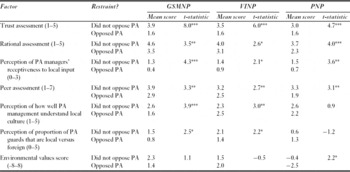
Legitimacy factors showed far more consistent significant relationships to local opposition and restraint toward neighbouring PAs (Table 2). Those refraining from PA opposition exhibited significantly higher trust assessments, rational assessments, peer assessments and perceptions of PA managers' receptiveness to local input at all three parks. Perceptions of how well PA managers understood local culture and of the proportion of PA guards that were from the local area only showed significant relationships to restraint at GSMNP and VINP. Meanwhile, environmental values scores were only significantly related with restraint at PNP.
Mean comparisons between those who opposed the PA versus those who exercised restraint (independent sample t-tests). *p < 0.05, **p < 0.01, ***p < 0.001.

Two binary variables showed significant relationships with restraint at GSMNP and PNP. At GSMNP, those perceiving equitable treatment by PA guards of all entities were less likely to oppose the GSMNP (χ2 = 4.7, p = 0.030). In addition, those who reported that they personally knew a member of GSMNP's management team were significantly less likely to oppose the Park than those who did not (χ2 = 7.0; p = 0.008). At PNP, while perceptions of equity showed no statistically significant relationships with restraint, respondents with personal relationships with either PA-related non-governmental organization workers or PA employees, were significantly less likely to oppose the PNP than others (χ2: 5.2; p = 0.023). None of these factors exhibited statistically significant relationships with restraint at VINP.
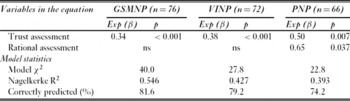
All independent variables were entered into forward conditional binary logistic regression to determine the best predictor(s) of restraint amongst would-be offenders at each PA (Table 3). Trust assessments proved the most consistent predictor of exercised restraint across the PAs, predicting with 81.6% accuracy at GSMNP and 79.2% accuracy at VINP, those within the samples who were actively opposing the Parks. At PNP, both trust assessments and rational assessments remained within the equation, predicting active opposition with 74.2% accuracy.
Binary logistic regression on active opposition toward GSMNP, VINP and PNP of those with desire to oppose the PA. ns = not significant at p < 0.05.

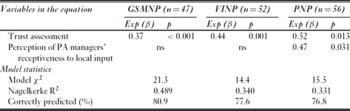
Despite the relatively small sample sizes, forward conditional binary logistic regression analyses were performed to explore restraint amongst the subsamples at each PA expressing specific desires to commit natural resource violations. At GSMNP, 47 respondents specifically expressed such a desire, 20 (43%) of whom refrained from those actions. At VINP, 28 out of 52 (54%) respondents with these specific desires refrained from committing natural resource infractions. At PNP, 20 out of 56 (36%) refrained from committing desired natural resource violations (Table 4). Trust remained the most consistently important variable across the PAs for predicting restraint amongst would-be natural resource violators. At PNP, perceptions of Park managers' receptiveness to local input was the only other statistically significant independent variable in the model.
Binary logistic regression on natural resource opposition toward GSMNP, VINP and PNP of those with desire to commit natural resource violations. ns = not significant at p < 0.05.

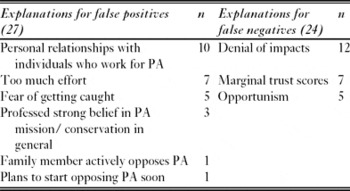
To better understand the weaknesses of these predictive models, notes and transcripts from interviews with respondents whose actions were incorrectly predicted by the models were examined carefully (Table 5). Ten of 27 respondents who were predicted by the overall model to actively oppose the PAs but did not (false positives) cited personal relationships with an individual or individuals associated with the PAs. At GSMNP and VINP, these individuals were PA employees, while at PNP they also included members of non-governmental organizations. Seven respondents did not act upon their desires because of the amount of effort required. These explanations included not feeling physically capable, being too busy with other things, or living too far away from the resources they wished to exploit. Only five respondents reported refraining from violating PA regulations for fear of being caught (two at GSMNP and three at VINP).
Explanations for the behaviour of those incorrectly predicted by the logistic regression models.

Twelve respondents who actively opposed the PAs though they were predicted by the models to exercise restraint (false negatives) justified their opposition by denying the significance of their impacts. At VINP and GSMNP, these respondents explained that they felt their actions caused no significant harm to PA resources. At PNP, this explanation was complemented by respondents who absolved themselves of guilt in some cases by only violating PA regulations either very far from the portions of PA closest to their homes or while working for others. Seven respondents who were falsely predicted by the model to exercise restraint reported only marginal trust for PA officials (the cut point for trust scores in the models was two, indicating near complete distrust).
What brings about trust and legitimacy?
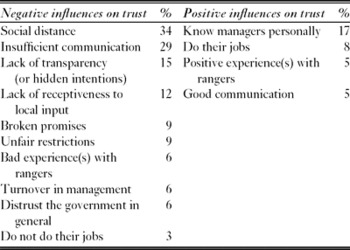
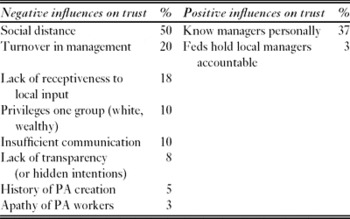
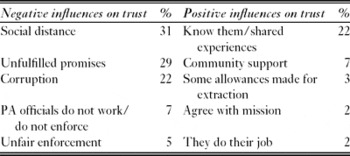
Open-ended explanations given by respondents for their reported levels of trust were coded and tallied (Tables 6, 7 and 8). The most common explanation for distrust of PA officials involved a lack of meaningful positive interactions with local residents, termed ‘social distance’ (Tables 6, 7 and 8). ‘They just don't get out and mix a lot with the general public. That's the problem,’ explained one GSMNP respondent. At VINP, respondents also cited absent and/or inappropriate treatment of local culture and history in Park interpretation as further evidence of social distance between PA managers and local residents. Other common explanations for distrust included insufficient communications, lack of receptiveness to local input, and the perception of promises made but not kept. Respondents at the Parks in the USA commonly cited whether or not PA officials would explicitly respond to their comments at public meetings, whether they demonstrated respect for local histories and culture, and whether they appeared to be forthcoming in sharing their intentions and/or internal analyses on new PA initiatives as key elements influencing trustworthiness.
Most common explanations for higher or lower levels of trust toward GSMNP managers (n = 65).

Most common explanations for higher or lower levels of trust toward VINP managers (n = 60).

Most common explanations for higher or lower levels of trust toward PNP managers (n = 58).

The consistency of park/people interactions, or lack thereof, was also commonly related to each of these complaints. This was particularly acute in rural settlements around PNP. The fates of similar ICDPs in different settlements, even those run by the same conservation organization, were often largely dependent upon the organization's ability to muster a consistent presence in the area. Agents would typically enter a settlement and conduct some preliminary participatory rural appraisals, then return to their offices to write grant proposals. These events would raise the hopes of local residents for community support and inform them of international aid dollars intended for such purposes. If the proposals were unsuccessful, the agents might not return, and broken promises were commonly perceived. The average duration of successful grants was less than 13 months, many of which would be spent in organizations' central offices preparing for fieldwork and/or writing reports. Travel time and often treacherous routes further cut back on field time, leading to many projects only just beginning before they would draw to a close. These cycles commonly led to feelings of strong distrust of all conservation-related entities associated with PNP. Some respondents reported that although they had acceptable alternatives to the exploitation of PA resources for their livelihoods, they explicitly would target the park in retribution, based on their perceptions of PA proponents intercepting funds from international sources intended for local villagers and using the money for themselves. Some reports of corruption amongst PA officials fortified these perceptions.
In areas where conservation agents lived or were able to spend more consistent or extended periods of time, attitudes toward these entities and toward the PA in general were far more positive. One respondent explained, ‘They have suffered with us in their own skin,’ to describe why he had stopped exploiting PA resources.
The importance of perceptions of consistency in communications and treatment of locals was also demonstrated at GSMNP and VINP. Common complaints included favouritism of the residents living closest to Park headquarters at GSMNP and of wealthy donors to the Park at VINP, and conflicting messages and inconsistent enforcement and procedures at both PAs.
The most consistent positive influences on trust involved personal relationships or positive experiences with PA officials and effective performance of their jobs. At each PA, multiple respondents cited a singular positive or negative experience with a PA employee or partner organization as justification for their actions. At PNP, instrumental concerns also entered into explanations, as some cited direct support for community development (through ICDPs) as an explanation for higher degrees of trust and unfair restrictions as a reason for distrust. However, the dominant factors at each PA proved to be relationship-based.
Is enforcement related to trust?
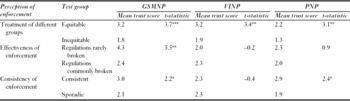
To examine the relationship of enforcement variables upon trust and legitimacy, independent samples t-tests were performed on the entire sample of would-be offenders to determine whether significant differences in trust scores existed given different perceptions of enforcement at each PA (Table 9). The equitable treatment of all entities encountered within the PA was consistently related to trust across the three sites. The significance of deterrence factors varied across cases. Perceptions of consistent enforcement showed positive relationships with trust at both GSMNP and PNP. Meanwhile, perceptions of the proportion of locally hired Park rangers showed positive correlations with trust scores at GSMNP and VINP (r = 0.423 and r = 0.392; p < 0.001 and p = 0.010, respectively).
Relationship of trust assessments (1–5 scale) to differing perceptions of enforcement (independent sample t-tests). *p < 0.05, **p < 0.01, ***p < 0.001.

DISCUSSION
The results of the study suggest that voluntary compliance is likely critical for resource protection within national parks. Few respondents cited a fear of being caught as a reason for exercising restraint against breaking PA regulations. Rather, voluntary compliance was most consistently associated with perceptions of the trustworthiness of PA managers to be fair and honest with local populations. Perceptions of consistent enforcement more commonly functioned to enhance would-be offenders' perceptions of PA managers' trustworthiness, and these perceptions, in turn, improved the likelihood of voluntary compliance. This mediating effect of trust aligns well with theories in which performance and reliability enhance trust and legitimacy (Tyler Reference Tyler1990; Jennings Reference Jennings, Braithwaite and Levi1998).
Respondents' open-ended explanations of their trust or distrust for PA managers reveal that meaningful personal exchanges between PA managers and the local population, or lack thereof, may be the most significant drivers of trust assessments. Other key explanatory factors included respondents' perceptions of PA managers' receptiveness to local input and respect for local populations, their assessments of the benefits and disadvantages associated with PA presence, and their beliefs about the equity with which PA officials treat different groups.
Average environmental values scores, which measured respondents' degree of accord with PA policies, were near neutral at each park, underscoring that the cases selected largely reflect situations in which cognitive legitimacy, or legitimacy based upon taken-for-granted agreement about the appropriateness of the rules (Suchman Reference Suchman1995), is atypical. Because the study targeted would-be offenders, a baseline of some pre-existing disagreement with established regulations can be assumed. As this type of situation may be quite common in areas surrounding PAs (Terborgh et al. Reference Terborgh, van Schaik, Davenport and Rao2002; Ormsby & Kaplin Reference Ormsby and Kaplin2005), the study highlights the importance of developing other forms of legitimacy, particularly those based upon personal relationships, cultural respect and other elements of procedural and distributive justice, to counter these disagreements in areas where park/people conflicts exist.
While rational assessments of the benefits and disadvantages associated with PA presence were significantly related to restraint at each PA, their significance was overpowered by trust assessments at the two USA PAs in the study. At PNP, rational assessments and trust assessments shared roughly equivalent power in predicting restraint. This suggests that pragmatic legitimacy, or legitimacy based on self-interest, cannot on its own consistently explain the behaviours of would-be offenders around PAs. Even in the developing country context, where economic concerns might be expected to be paramount in impoverished communities, elements of procedural and distributive justice and respectful interpersonal relationships between PA officials and local communities were critical to encouraging voluntary compliance. Thus, while rational assessments are clearly relevant, they do not provide an entirely adequate explanation of why people living around PAs behave in the ways they do.
At each PA in this study, respondents were more likely to trust PA officials and, therefore, refrain from PA opposition, when they felt they could identify with the PA through its caretakers. Local residents around many national parks commonly feel that these areas have been imposed upon them by primarily external entities, whether wealthy urbanites seeking recreational havens, international interests seeking to protect biological diversity, or others. PA managers are often imported from outside local areas. Many burdens are borne locally while many PA-related benefits accrue only to a much broader society or are shared inequitably locally (Olwig Reference Olwig1985; Brown Reference Brown2000; Chapin Reference Chapin2004). Thus, lack of common ground can often be the basis for a relationship lacking trust. This study suggests that this distrust may be the highest hurdle to effective PA management in populated areas and that it can potentially be overcome through positive and respectful interactions or exacerbated by casting the issues in a primarily rational and impersonal light.
CONCLUSIONS
Something is missing from the debates regarding the most appropriate ways to manage PAs. Those arguing for more coercive measures or additional enforcement rangers may be right in some cases, while those arguing for the need to empower local residents and/or provide alternative livelihoods may be right in others. This study suggests that either strategy has the potential to be effective in different contexts. The critical elements leading toward greater compliance with PA regulations, namely meaningful and respectful communications between PA entities and local residents, receptiveness to local input, consistent and honest performance, benefits for local people associated with PA presence and equitable treatment of different groups, may be present within either management paradigm. The local context will dictate the mechanisms through which each of these elements might be achieved.
ACKNOWLEDGEMENTS
Funding for this research was provided by the Canon National Parks Science Scholars Program. I would also like to thank Bill Burch, Lisa Curran, Laura Freeman, Jonathan Reuning-Scherer and Steve Kellert for their support on this project and the Editor-in-Chief and three anonymous reviewers for their comments which helped to improve the manuscript.