INTRODUCTION
Breathlessness is the most common devastating symptom of advanced chronic obstructive pulmonary disease (COPD) affecting both patient and family (Rocker et al., Reference Rocker, Sinuff and Horton2007). Breathlessness is underreported by patients, and clinicians are uncertain how to manage chronic intractable breathlessness and do not actively assess it (Roberts et al., Reference Roberts, Thorne and Pearson1993; Booth et al., Reference Booth, Silvester and Todd2003). There is increasing evidence that a multi-professional approach using both pharmacological and non-pharmacological interventions can reduce the impact of the symptom and improve quality of life (Bredin et al., Reference Bredin, Corner and Krishnasamy1999; Booth et al., Reference Booth, Farquhar and Gysels2006).
The results of a Phase II evaluation of the Breathlessness Intervention Service (BIS) based on this approach are described here. Although there is an evidence base for each intervention used by the service, the clinical and cost-effectiveness of the complex intervention provided by such a service has not been formally evaluated in patients with COPD. In a Phase I qualitative study of BIS, patients and carers reported liking: the positive, educational approach of the service which emphasised what was possible, not what lost; non-pharmacological strategies (some of which were new to them for example a handheld fan); open access to advice; and, being seen in their own homes. Referrers valued its educational role and the opportunity for a second opinion on the management of patients with complex conditions (Booth et al., Reference Booth, Farquhar and Gysels2006).
Phase II was a pilot investigation of BIS with patients with advanced COPD. It also tested the feasibility of a single-blind, fast-track, pragmatic, randomized controlled trial (RCT) design of BIS versus standard care (ClinicalTrials.gov: NCT00711438) to enable planning of a definitive, fully-powered RCT. Although BIS cares for people with breathlessness of any etiology, COPD is the most common respiratory disease associated with breathlessness in the United Kingdom. It will be the third most common cause of mortality across the world by 2020 (Murray & Lopez, Reference Murray and Lopez1997), and is less researched than advanced cancer; thus Phase II focused on patients with COPD.
METHOD
The feasibility trial's methodology is described in detail in a separate paper (Farquhar et al., Reference Farquhar, Higginson and Fagan2009a). Ethics and R&D approvals were obtained (REC reference no. 05/Q0108/471), and informed consent was obtained from participants. The fast track trial design (Higginson et al., Reference Higginson, Vivat and Silber2006; Farquhar et al., Reference Farquhar, Higginson and Booth2009b) made it possible to combine the baseline pre-intervention data for both arms of the trial (i.e. all t1s) and the follow-up post-intervention data for both arms (i.e. t3 for the fast track arm and t5 for waiting list arm), so converting the data set from a randomized one to a pretest —posttest non-randomized one. This increased the sample receiving the intervention and completing outcome measures from seven to 13.
Breathlessness Intervention Service (BIS)
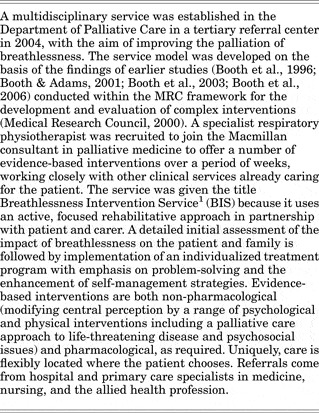
The intervention, the Breathlessness Intervention Service (BIS) is described in Table 1.
The Breathlessness Intervention Service

1by PF, first physiotherapist on the team
Outcome Measures
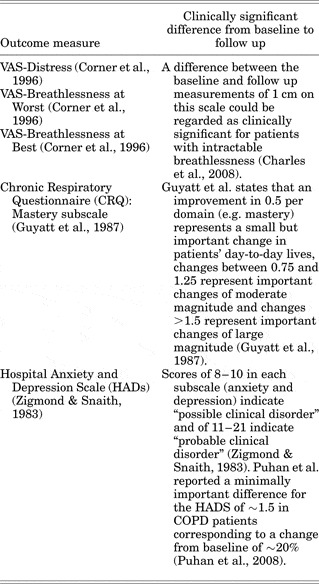
The primary outcome measure was “distress due to breathlessness” measured using a Visual Analogue Scale (VAS-Distress; anchors “no distress”/ “extreme distress”). Existing trials of interventions for patients with COPD (e.g. of pulmonary rehabilitation) focus on physiological outcomes (e.g. clinical measures of breathlessness), however our earlier work suggested the need to look beyond these and consider other outcomes. VAS-Distress was used by Bredin et al.'s multi-center RCT of a breathlessness intervention clinic for patients with lung cancer (Bredin et al., Reference Bredin, Corner and Krishnasamy1999). The outcome measures are summarized in Table 2.
Reported quantitative outcome measures and clinically significant changes for Phase II evaluation of Breathlessness Intervention Service

Sample
A cohort of consecutive patients with advanced COPD referred to the pilot BIS.
Analysis
The data set was analyzed as a non-randomized group. Descriptive statistics were computed for baseline (pre-intervention) and follow up (post-intervention) data across the entire sample. Data are presented as summary statistics and plots of individual scores to show within-patient changes. No statistical testing was conducted due to the small sample size. Plotting scores against time is recommended for serial measurements in small samples (Matthews et al., Reference Matthews, Altman and Campbell1990). As this was a feasibility study and comparative analysis was not our primary objective, it was not powered for statistical testing. Missing data are reported elsewhere (Farquhar et al., Reference Farquhar, Higginson and Fagan2009a). Extracts of qualitative follow-up interviews are presented in two illustrative case studies.
RESULTS
Response Rates
Twenty consecutively referred patients met the inclusion criteria, 16 agreed to participate, two were withdrawn before recruitment due to acute deterioration, and 13 completed the protocol (one died on protocol). Data are reported for the 13 patients who completed the protocol.
Demographics
The age range of responding patients was 53–80 years (median 69 years). The majority of patients were male (8/13); three lived alone. Most recent FEV1s ranged from 0.68–1.28 L/min and % predicted ranged from 12.6–28.9% (indicating severe COPD). Four patients had probable clinical anxiety disorders and three had probable clinical depression disorders at baseline, per Hospital Anxiety and Depression Scale (HADS), reflecting a typical pattern for patients with severe advanced COPD (a further seven and three had ‘possible’ clinical anxiety and depression respectively).
Primary Outcome Measure — VAS-Distress
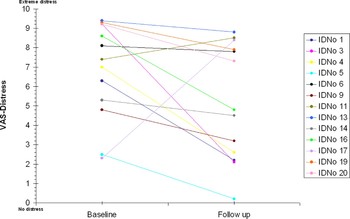
Group mean VAS-Distress scores decreased (improved) between baseline and follow up from 6.88 (SD = 2.50) to 5.25 (SD = 2.99): a clinically significant improvement. Figure 1 presents plots of individuals' scores.
(Color online) Changes in individuals' scores on VAS-Distress due to Breathlessness from baseline to follow up (Phase II Evaluation of Breathlessness Service Intervention).

For individuals, 11 patients showed a decrease in their distress due to breathlessness, and for eight this was clinically significant (range of all decreases 0.3–7.1 cm).
Secondary Outcome Measures
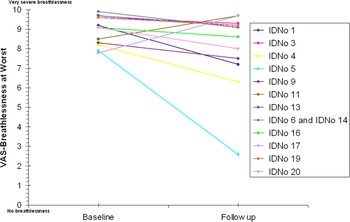
Group mean VAS-Breathlessness at Worst scores decreased (improved) between baseline and follow up from 8.95 (SD = 0.76) to 8.12 (SD = 1.96): not a clinically significant improvement. Figure 2 presents plots of individuals' scores.
(Color online) Changes in individuals' scores on VAs-breathlessness at worst from baseline to follow-up (Phase II evaluation of Breathlessness Intervention Service).

For individuals, 11 patients showed improved Breathlessness at Worst scores, and for four this was clinically significant. Two patients' scores deteriorated (range of changes 0.3–5.3 cm for improvers, 1.2–1.9 cm for deteriorators).
Group mean VAS-Breathlessness at Best scores increased (deteriorated) between baseline and follow up from 2.75 (SD = 1.60) to 2.92 (SD = 1.87); not a clinically significant deterioration. For individuals, seven patients showed improved Breathlessness at Best scores, and for five this was clinically significant. Five patients' scores increased representing deterioration and one showed no change (range of changes 0.6–3.2 cm for improvers, 0.6–4.8 cm for deteriorators).
Group mean Chronic Respiratory Questionnaire (CRQ) Mastery scores improved between baseline and follow up from 3.38 (SD = 0.97) to 3.83 (SD = 1.50), but not at the level suggesting small but important changes in patients' day-to-day lives. For individuals, eight patients improved their scores: in two instances this represented a small but important change in patients' day-to-day lives (+0.5), in three instances this represented important changes of moderate magnitude (+0.75–1.25) and in two instances changes were of a large magnitude (1.5+). One improver did not reach clinical significance (improvement of 0.25). Four patients' scores decreased: three by 0.5 and one by 2.75. One patient's score remained unchanged.
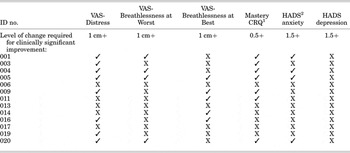
Table 3 summarizes clinically significant improvements on key quantitative outcome measures, by individual. Four respondents made significant improvements across four or more measures (001, 004, 005 and 020), and three made no significant improvements on any (006, 013 and 017).
Clinically significant improvements by individuals from baseline to follow up; Phase II evaluation of Breathlessness Intervention Service

1CRQ = Chronic Respiratory Questionnaire
2HADS = Hospital Anxiety and Depression Scale
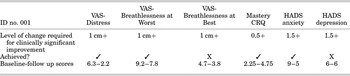
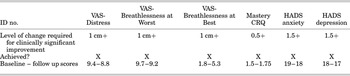
Table 4 presents a case study of a patient who made a clinically significant improvement on four of the measures; Table 5 presents a case study of a patient who made no significant improvements on any of the measures.
Case study 001 (clinically significant improvement). This gentleman was able to use relaxation therapy (self-hypnosis training), the handheld fan, and an individual exercise plan very successfully, and was also able to make use of information and education. He had minimal social support and a carer with chronic illness. He had previously had numerous hospital admissions with little apparent change in condition. These attributes seem to be typical of those patients who respond well to the Breathlessness Intervention Service

Extracts from follow up interview:
P [BIS] told me […] that breathlessness…. I won't die from breathlessness. [Recently] I knew I was bad. I phoned the doctor. I got an appointment, went to see her and she put me on steroids and antibiotics. Now if it hadn't have been for what [BIS] told me in here I would have said to [my wife] ‘get me an ambulance!’. […] That made me less panicky. I knew I was ill. I knew I had to see my doctor. [But] I didn't have to go to [hospital]. Yeah.
I Has nobody ever said that to you before?
P No. Nobody's ever said to me ‘you won't die from breathlessness’. I panicked and panicked. I sat in the club one day with my mates playing cards and I'd bought a pint of Guinness, hadn't even touched it. Sat playing cards and I just said to my mate ‘phone me… phone me an ambulance, can't get me breath’. So that was it. That was the kind of thing that was happening to me.
I Right. But if that happened now…
P I would relax, take in a breathing session. Relax. Once I was a bit [calmer] say ‘get me a taxi. Don't get me an ambulance, get me a taxi, I'm going home’ [and use my machine].
[…]
P The paperwork that [BIS] gave me… it gave me a lot to think about and it also gave me a lot of relief. It stopped me panicking. It really helped (taps side of head) up here. […] on the leaflet… if I'm going up the stairs, find somewhere sort of half way up where I could take a rest and things like that. […] how to sit up and relax your shoulders, get your breath and then if I am walking, when I want to stop, lean against the wall or something and relax. But I think the biggest thing she's done for me, setting my mind at rest, is saying to me I'm not going to die. If I'm going to die it's going to be a heart attack or something. It's not going to be because of me breathing. That has always been my panicking. […] The symptoms are still there, but I can manage them better I think.
I Right. So it's your ability to cope with them that's improved?
P Yeah.
I And has that made life better in general?
P Yeah I think so. It's stopped me panicking. It's stopped… I can sense it and say ‘hey relax, calm down’. Yeah.
Case study 013 (no clinically significant improvement). This lady, supported but socially isolated and well known to respiratory services, did not use the information or handheld fan and was poorly motivated to exercise on her own. At that time there was poor provision of rehabilitation in her area. With review, her psychological status was a barrier to her use of the service

Extracts from follow up interview:
P Oh, well the thing is nothing changes, you know. I can't… you know, she said, ‘How do you feel?’ I still feel the same as when I sort of seen her before.
I […] So do you feel that seeing the service was any benefit, or not?
P I think it's nice to talk to someone about it, you know, but erm… I don't want to waste people's time.
I Well you're not doing that at all. But did… so speaking about it is helpful you think?
P Yeah, I think so. I don't think the hypnotism…
I No, you don't think it made any difference/
P /No.
I What is it about talking about it that's helpful? How does that help you?
P Well they seem to understand what you're going through.
I Right. I understand. And do you think they made any difference to your breathlessness?
P No.
I No. But it was useful to have someone to talk to?
P Mmm.
I Did they tell you, teach you anything that you didn't know already about breathlessness?
P […] She gave me a fan and told me to, you know, put it on… and then blow out. I do try to do it, but I get so out of breath doing it. I give up. Yeah.
I Oh right. Does the fan help at all?
P Well if I'm really hot I've got air-conditioning in my bedroom. I go in there and put that on and it does it full.
[…]
P Well to be… I knew really [they] couldn't really help me.
DISCUSSION
This Phase II study shows various beneficial trends for patients with advanced COPD referred to BIS. Mean distress due to breathlessness decreased at a clinically significant level and this level of improvement was apparent for eight of the 13 patients. Mean Breathlessness at Worst scores decreased although not at a clinically significant level; however 4/11 improvers made clinically significant improvements. Mean Breathlessness at Best scores increased (deteriorated) although not at a clinically significant level; however for 5/7 patients who reduced their scores (improved) this was clinically significant. Mean mastery scores (CRQ) improved but not at a level suggesting important changes in patients' day-to-day lives; however 7/8 individual improvers had clinically significant changes.
Although mean changes (improvements) were identified, and were clinically significant for distress due to breathlessness, the small sample size prevented statistical testing. Further, a small sample size has the potential to lead to type ii errors (false-negative findings). Plotting individuals' changes enabled exploration of trends that summary statistics can hide (Matthews et al., Reference Matthews, Altman and Campbell1990). Further, charting clinically significant changes across measures identifies patients who responded to the intervention and those who did not, e.g., four made clinically significant improvements across four or more measures whereas three made no significant improvements on any. Exploration of individual level data, together with qualitative data on the experience of using BIS, enables optimization of the intervention by examining cases in which a clinically significant change has and has not occurred, and consideration of what could have been done differently for this latter group, e.g., active screening for anxiety and depression given the high HADS scores of Case Study 013 and the known relationship between anxiety and COPD (Brenes, Reference Brenes2003).
Overall the data suggests that BIS reduced the impact of intractable breathlessness for some patients. A Phase III fully-powered definitive RCT is warranted and underway for all referrals to BIS i.e. patients with malignancies as well as those with non-malignant conditions (NCT00678405; ISRCTN04119516). Phase III is based on methods piloted in Phase II, and includes an economic evaluation and an embedded analysis of those who benefit more from the service and those who do not in order to enable targeting.
ACKNOWLEDGMENTS
We thank all participants who took part in and supported this study and this paper: the patients, carers, referrers and BIS staff; Stephanie Vo (University of Cambridge); the palliative care administrative staff at Addenbrooke's NHS Trust and King's College London; the Addenbrooke's NHS Trust Clinical Trials' Team for randomization; Dr Gail Ewing for locum interviewing; and the funders (Gatsby Charitable Trust and Cicely Saunders International).