Introduction
Anisakidosis (formerly Anisakiasis) is a zoonotic disease caused by the third-stage (L3) larvae of nematodes belonging to the families Anisakidae and Raphidascarididae (Chai et al. Reference Chai, Murrell and Lymbery2005). Human infections have been attributed to several species within these families, with the genera Anisakis – particularly A. simplex sensu stricto (s.s.) and A. pegreffii (Rudolphi, 1809), and Pseudoterranova decipiens identified as the most common etiological agents (Mattiucci et al. Reference Mattiucci, Fazii, De Rosa, Paoletti, Salomone Megna, Glielmo, de Angelis, Costa, Meucci, Calvaruso and Nascetti2013; Rahmati et al. Reference Rahmati, Jamshidi and Yousefi2020). These parasites are particularly prevalent in regions where the consumption of raw, undercooked, or marinated fish is customary, such as in Japan and other parts of East Asia (Nonković et al. Reference Nonković, Ivanovic and Pavlovic2025).
Anisakis larvae have traditionally been morphologically classified into two types. However, advancements in molecular tools enabled further subdivision into four genetically distinct types (Murata et al. Reference Murata, Suzuki, Sadamasu and Kai2011; Quiazon et al. Reference Quiazon, Yoshinaga and Ogawa2011). Morphological differentiation was primary based on tail structure, including variations in the presence or absence of a mucro and shape of the tail, which were key diagnostic features (Quiazon et al. Reference Quiazon, Yoshinaga and Ogawa2011).
The life cycle of Anisakis is complex and involves multiple hosts. Planktonic crustaceans serve as the first intermediates host, ingesting the eggs or free-swimming larvae. These crustaceans are subsequently consumed by fish or cephalopods, which act as intermediate or paratenic hosts. In these hosts, the larvae penetrate the gut and encyst on visceral organs or, less commonly, within muscle tissues (Køie and Fagerholm Reference Køie and Fagerholm1995). The definitive hosts – typically marine mammals or piscivorous birds – become infected upon consuming infected intermediate or paratenic hosts, where the larvae develop into adult worms (Baird et al. Reference Baird, Gasser, Jabbar and Beveridge2014; Chai et al. Reference Chai, Murrell and Lymbery2005).
Humans become accidental hosts through the consumption of raw or undercooked infected seafood. In such cases, the larvae cannot develop further and often die within the human gastrointestinal tract, sometimes triggering an acute or chronic inflammatory response (Nonković et al. Reference Nonković, Ivanovic and Pavlovic2025).
The global prevalence of Anisakidosis has increased over the past two decades, primarily due to changing dietary preferences that favour the consumption of raw or minimally processed seafood, including sushi, sashimi, ceviche, and pickled or salted fish (Nonković et al. Reference Nonković, Ivanovic and Pavlovic2025). Additional contributing factors include increased consumer awareness of seafood as a health-promoting dietary choice, the spawning migration patterns of marine species, and seasonal variations in fish consumption (Fæste et al. Reference Fæste, Dooper, Egge-Jacobsen and Christians2014; Ikejima et al. Reference Ikejima, Wada, Hoshimoto and Takeuchi2025).
Anisakidosis poses significant diagnostic challenges due to nonspecific clinical presentation. The condition often mimic common gastrointestinal disorders, including gastric ulcers, Crohn’s disease, appendicitis, and even malignancies (Ikejima et al. Reference Ikejima, Wada, Hoshimoto and Takeuchi2025). Typical symptoms – include abdominal pain, nausea, vomiting, and diarrhoea – further obscure its identification (Ikejima et al. Reference Ikejima, Wada, Hoshimoto and Takeuchi2025). Additionally, Anisakis allergens can trigger immunoglobulin E (IgE)-mediated allergic responses, ranging from urticaria and angioedema to anaphylaxis (Baird et al. Reference Baird, Gasser, Jabbar and Beveridge2014; Chai et al. Reference Chai, Murrell and Lymbery2005; Fæste et al. Reference Fæste, Dooper, Egge-Jacobsen and Christians2014; Ikejima et al. Reference Ikejima, Wada, Hoshimoto and Takeuchi2025). These dual pathologies (invasive and allergenic) contribute to frequent misdiagnosis or delayed (Chai et al. Reference Chai, Murrell and Lymbery2005; Mattiucci et al. Reference Mattiucci, Fazii, De Rosa, Paoletti, Salomone Megna, Glielmo, de Angelis, Costa, Meucci, Calvaruso and Nascetti2013).
The global distribution of anisakidosis reflects regional dietary practices. Over 90% of reported cases are from East Asia – notably Japan, where raw seafood consumption is culturally entrenched, and diagnostic capabilities are advanced (Rahmati et al. Reference Rahmati, Jamshidi and Yousefi2020; Nonković et al. Reference Nonković, Ivanovic and Pavlovic2025). In Europe, Spain emerges as a hotspot, with cases linked to marinated anchovies, while endemic regions of South America (Chile and Peru) are associated with ceviche consumption (Mladineo Reference Mladineo2019; Nonković et al. Reference Nonković, Ivanovic and Pavlovic2025).
Traditional culinary practices, such as pairing fish fillet with Wasabi (Wasabia japonica) as a condiment, are thought to mitigate infection risk (Park et al. Reference Park, Kim, Lee and Kang2022). Allyl isothiocyanate (AITC) is a hydrolysis product of glucosinolates from wasabi plants that confers antimicrobial and nematocidal properties (Fahey et al. Reference Fahey, Zalcmann and Talalay2001; Rajakumar and Pugalendhi Reference Rajakumar and Pugalendhi2024). AITC is concentrated in the rhizome, containing up to 89.33 mg/100 g of fresh weight (Fahey et al. Reference Fahey, Zalcmann and Talalay2001).
Despite widespread use and anecdotal beliefs, the nematocidal effects of wasabi on Anisakis larvae remain understudied. This study investigates the nematocidal effects of wasabi substitute paste (WSP) and AITC, and characterizes stress responses on A. pegreffii L3 larvae. Heat shock proteins (HSPs), particularly HSP70 and HSP90, serve as biomarkers of cellular stress. These molecular chaperones regulate protein folding, degrade misfolded proteins, and modulate immune responses under thermal or chemical stress (Jeyachandran et al. Reference Jeyachandran, Mariappan and Ramakrishnan2023; Richter et al. Reference Richter, Haslbeck and Buchner2010). Their induction in Anisakis larvae could elucidate mechanisms of wasabi-mediated nematocidal activity.
Material and method
Procurement of wasabi substitute paste and allyl-isothiocyanate
Wasabi substitute paste (WSP) was commercially obtained from local convenience stores in Taipei, Taiwan. Allyl-isothiocyanate (AITC; purity ≥93%) was purchased from Sigma-Aldrich (Germany). Phosphate-buffered saline (PBS) and commercial blended cooking oil were used as solvents for WSP and AITC, respectively.
Anisakis L3 collection, maintenance, and toxicity assay
The A. pegreffii L3 were collected from Trichiurus lepturus as previously stated (Sonko et al. Reference Sonko, Chou, Hsu, Lye and Fan2020). WSP was diluted in PBS to final concentrations of 1 g/mL and 2 g/mL. AITC was serially diluted 10-fold in blended cooking oil to achieve working concentration. Controls group consisted of PBS alone (for WSP) or oil alone (for AITC) experiments. Only actively motile larvae were selected for experiments. For each treatment, five live larvae were placed in 3.5 cm Petri dishes (n = 3, replicates per treatment) and incubated at room temperature. The larvae were exposed and observed in WSP (1, 6, 12, 18, 24, 30 mins) and AITC (1, 2, 4, 6, 8, 12 mins). Viability was assessed by gentle stimulation under a dissecting microscope. Survival rate and median lethal time (LT₅₀) were determined using Kaplan–Meier survival analysis.
RNA and protein preparation
Larvae exposed to WSP and AITC were immediately snap-frozen in liquid nitrogen and stored at –80°C, with untreated larvae serving as a control. For each group, five larvae were homogenized and divided for RNA and protein extraction. Total RNA was extracted using TRIzol reagent (Invitrogen, USA) and resuspension in RNase-free water, and the concentrations were measured using a NanoDrop ND-1000 (PegLab, Germany).
Proteins were extracted using RIPA buffer, followed by protein quantification using Bradford assay (Sigma-Aldrich, UK). RNA samples were stored at –80°C and protein at –20°C.
mRNA and protein expression
The mRNA analysis and primers were designed based on previously published (Chen and Shih Reference Chen, Cheng and Shih2015). The quantitative PCR (qPCR) was performed in a 25 μL qPCR reaction containing 10 μL LightCycler® 480 SYBR Green I Master (Roche), 1 μL of each primer (10 μM), 3 μL distilled water, and 10 μL diluted cDNA using a LightCycler® Nano system (MyGo Pro, Roche) using established conditions (Chen and Shih Reference Chen, Cheng and Shih2015). All reactions were conducted in triplicate. Western blotting was performed by separating 35 μg total protein on 10% SDS-PAGE gels and transferring it to nitrocellulose membranes. Membranes were incubated overnight at 4°C with the following primary antibodies (GeneTex Inc., USA): anti-HSP70 (GTX111088, 1:2000 dilution) and anti-HSP90 (GTX109753, 1:1000 dilution); anti-GAPDH (GTX100118, 1:1000 dilution) against HSP70 and HSP90. Membranes were washed with TBS-T and incubated with HRP-conjugated anti-rabbit secondary antibody for 1 h at 37°C. GAPDH served as loading control for normalization.
Statistical analysis
All experimental data were presented as mean ± standard deviation (SD) of three independent biological replicates. Statistical comparisons for qPCR and Western blot were performed using one-way ANOVA followed by a one-sample t-test. Larval survival and toxicity were analyzed using Kaplan–Meier survival curves and compared with the Gehan–Breslow–Wilcoxon and log-rank (Mantel–Cox) tests. A p-value <0.05 was considered statistically significant.
Results
Nematocidal effects of wasabi substitute paste and allyl-isothiocyanate
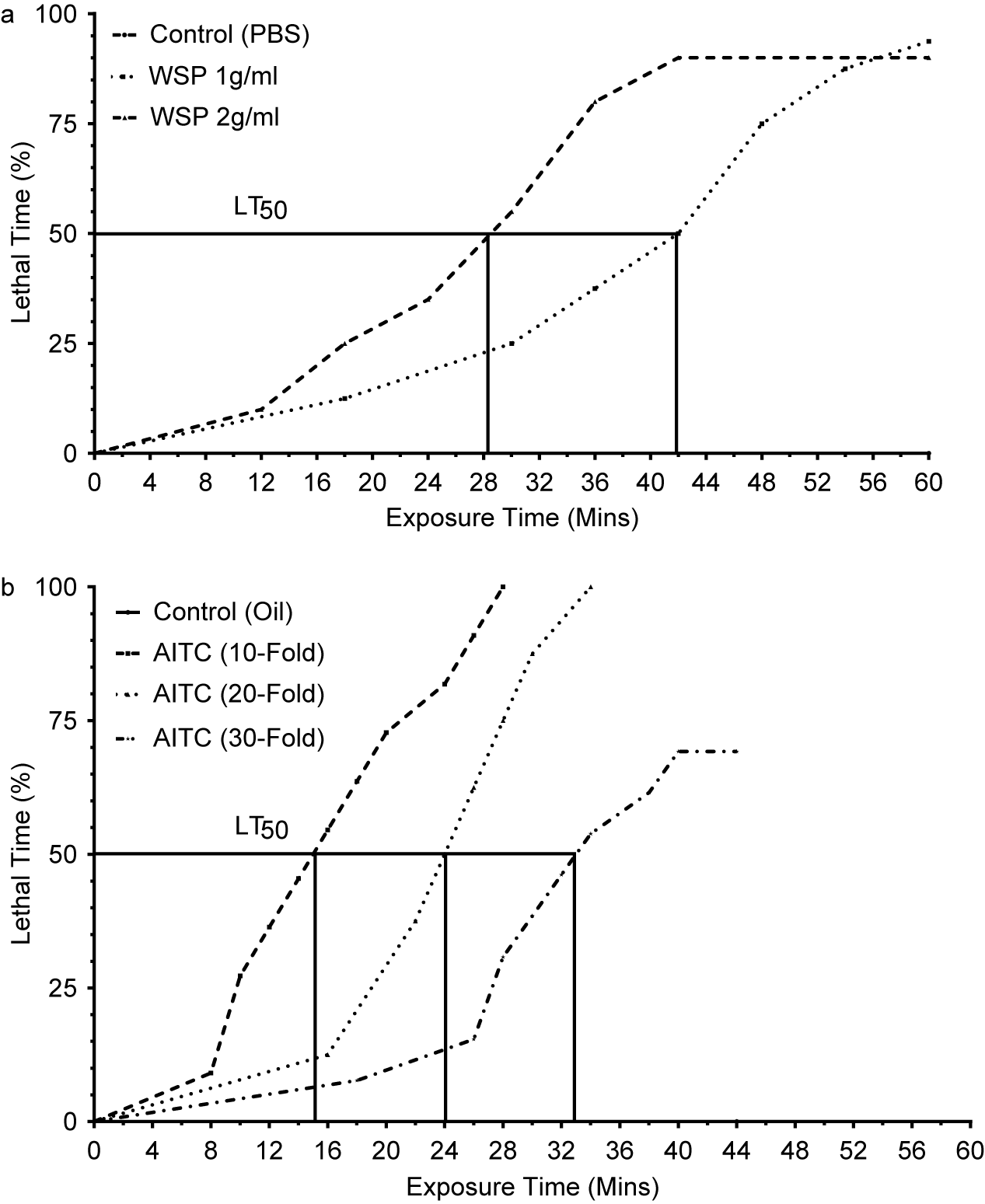
The survival rate of Anisakis larvae treated with WSP showed a significant, dose-dependent survival rate compared to PBS controls. Treatment with 1 g/mL and 2 g/mL WSP resulted in hazard mortality rates of 3.1% and 3.8% per minute, with mean lethal times were 45 minutes (p = 0.0227, χ2 = 5.189, Gehan–Breslow–Wilcoxon test). Both concentrations differed significantly from the PBS control (p < 0.0001) (Fig 1A). The 10-fold AITC dilution in vegetable oil demonstrated the strongest nematocidal effect with a mean lethal time of 16 minutes compared to the oil control (p = 0.0001), while 20× and 30× dilutions showed progressively reduced efficacy (p = 0.0003 and p = 0.0108, respectively) (Fig 1B). These findings demonstrated that both WSP and its active component – AITC – exert significant concentration-dependent nematocidal activity against Anisakis larvae, with toxicity developing in a time-dependent manner.
Larval cytotoxicity of Anisakis larvae. (A) Nematocidal effect of wasabi substitute paste (WSP); (B) nematocidal effect of allyl isothiocyanate (AITC). The effects of WSP and AITC on larval viability were evaluated at 6-minute and 2-minute intervals, respectively. Median lethal time (LT₅₀), defined as the time at which 50% of larvae were nonviable, was calculated using Kaplan–Meier survival analysis (n = 3; p < 0.05). Data are presented as mean ± standard error of the mean (SEM).

WSP induces cellular stress through differential regulation of HSP70 and HSP90 expression in A. pegreffii
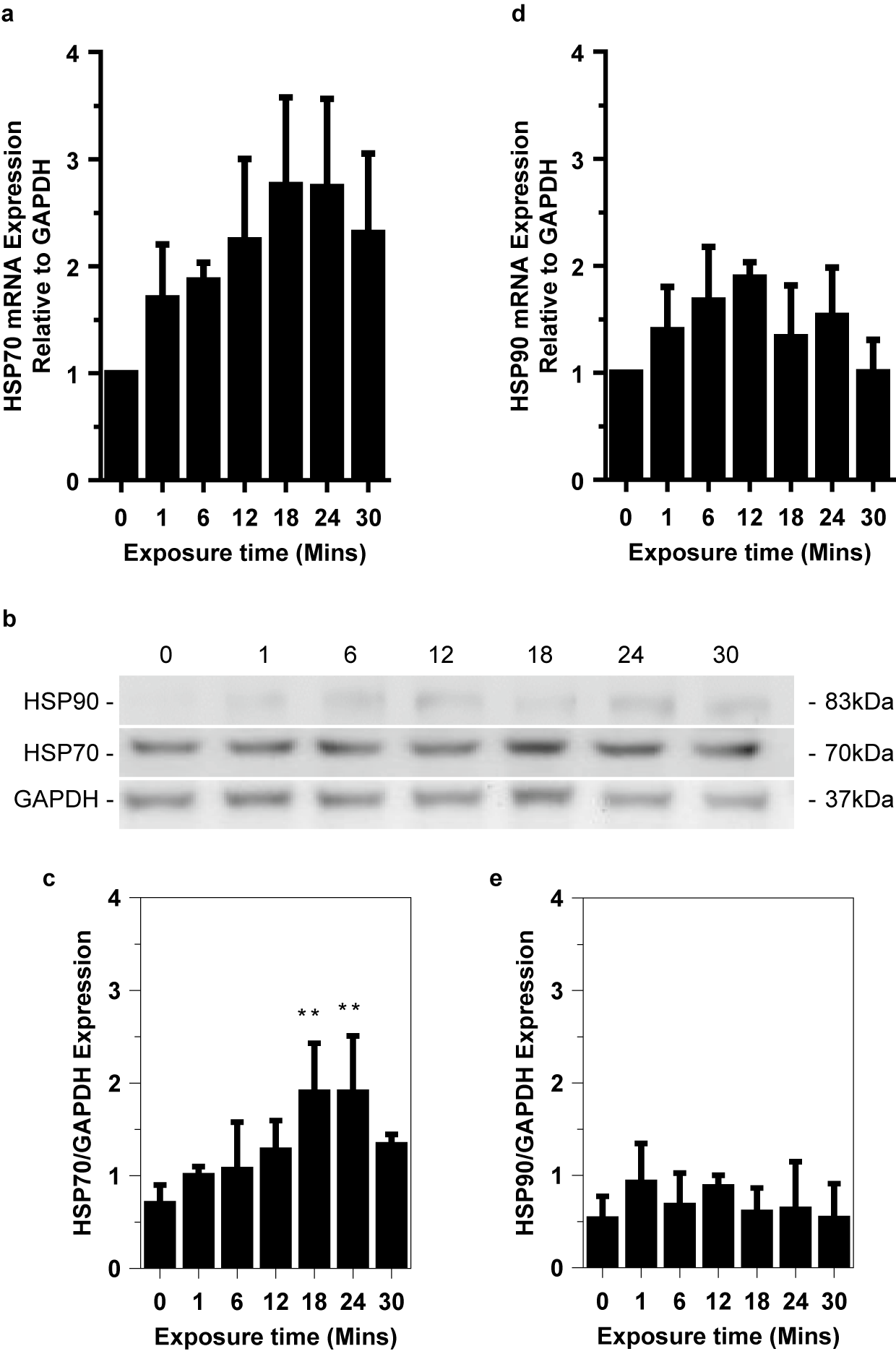
To determine whether the WSP-induced nematocidal effects were associated with cellular stress, we analyzed HSP70 and HSP90 expression profiles. WSP-treated A. pegreffii larvae exhibited progressive upregulation of HSP70 mRNA, with peak expression occurring at 18 minutes (p = 0.0095) post-treatment (Fig 2A). The transcriptional activation aligns with significant upregulation of HSP70 protein level, which peaked between 18 and 24 minutes (p = 0.0128) (Fig 2B, 2C), coinciding with the observed mean lethal time. In contrast, HSP90 mRNA showed transient elevation and peaked at 12 minutes before being downregulated (Fig. 2D), while protein levels remained minimally expressed (Fig. 2B, 2E). The progressive correlation between HSP70 and A. pegreffii larval mortality, coupled with the lack of sustained HSP90 response, suggested that HSP70-mediated pathways play a predominant role in managing proteotoxic stress during WSP exposure, whereas attenuated HSP90 response may indicate system overload or targeted pathway disruption, revealing fundamental differences in these molecular chaperones.
Differential regulation of heat shock protein (HSP) expression in Anisakis pegreffii L3 larvae following exposure to wasabi substitute paste (WSP). (A) Quantitative RT-PCR analysis showed progressive upregulation of HSP70 mRNA, peaking at 18 minutes post-treatment (p = 0.0095), indicating activation of a proteotoxic stress response. (B) Corresponding HSP70 protein levels, assessed by western blot and normalized to GAPDH, increased significantly between 18 and 24 minutes (p = 0.0128), aligning with the observed mean lethal time. (C) Representative immunoblot showing protein expression patterns of HSP70 and HSP90 over time. (D) HSP90 mRNA levels exhibited transient elevation, peaking at 12 minutes before declining. (E) Densitometric analysis revealed minimal expression of HSP90 protein throughout the exposure period. Data represent the mean ± standard deviation from three biological replicates. Asterisks denote significant differences compared to untreated control (p < 0.05).

AITC triggers divergent HSP70 and HSP90 stress responses in A. pegreffii Larvae
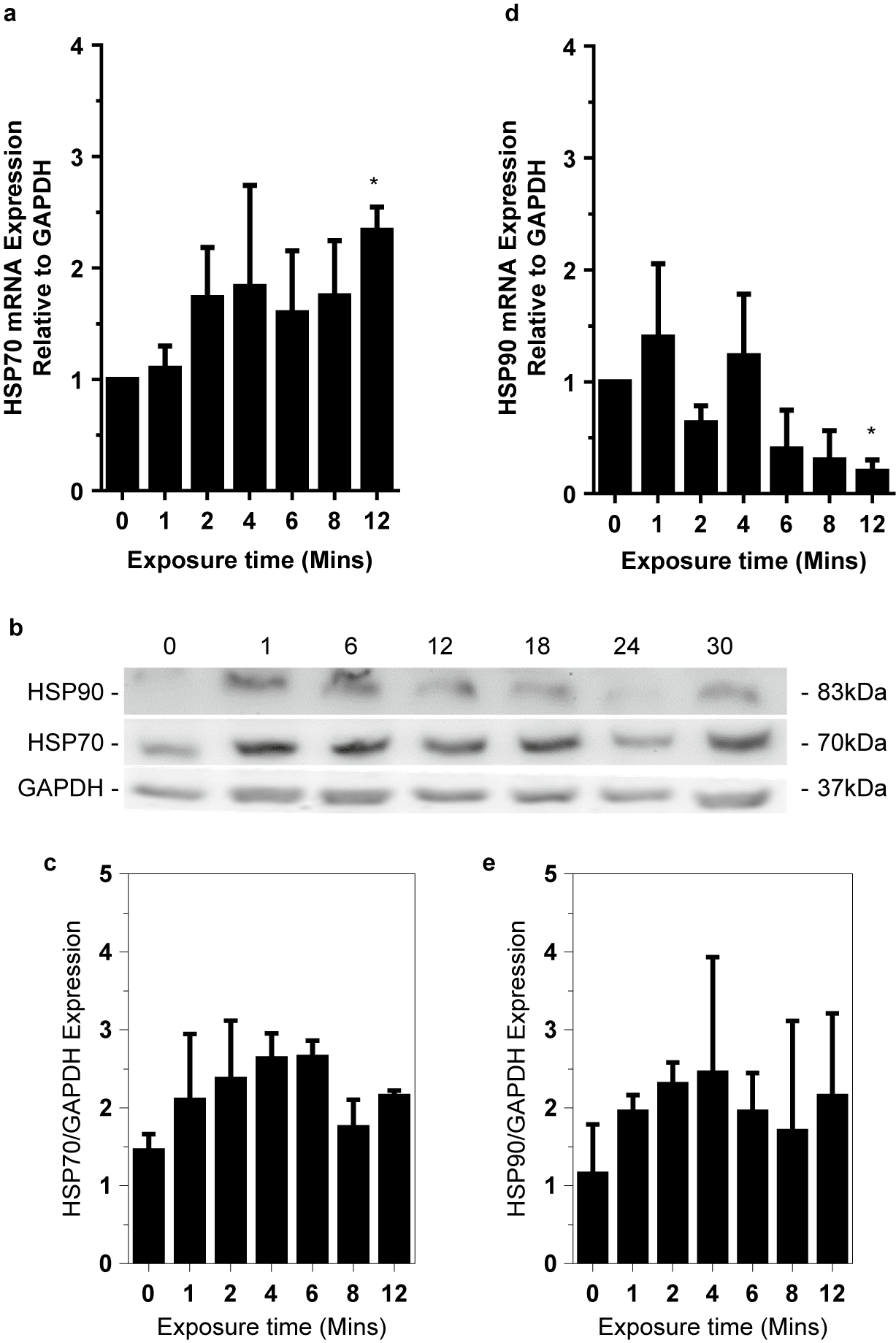
Exposure of A. pegreffii larvae to 10-fold diluted AITC (the bioactive component of wasabi) elicited significant stress responses, mirroring the effects observed with WSP. HSP70 exhibited limited upregulation, with mRNA expression upregulated at 12 minutes post-treatment (p = 0.0389) (Fig. 3A) and no significant HSP70 protein accumulation across 2–12 minutes, despite rapid lethality (Fig. 3B, 3C). The constant activation underscores HSP70’s critical role in mitigating AITC-induced proteotoxic stress.
Heat shock protein (HSP) expression profiles in Anisakis pegreffii L3 larvae following treatment with allyl isothiocyanate (AITC). (A) Quantitative RT-PCR analysis revealed significant upregulation of HSP70 mRNA at 12 minutes post-treatment (p = 0.0389), indicating an early stress response. (B) Representative western blot showing protein expression of HSP70 and HSP90 following AITC exposure. (C) Densitometric quantification confirmed progressive accumulation of HSP70 protein from 2 to 12 minutes. (D) In contrast, HSP90 mRNA expression was significantly downregulated at 12 minutes (p = 0.0113), suggesting a suppression of HSP90-mediated stress pathways. (E) HSP90 protein expression exhibited only transient elevation, with no sustained accumulation over time. Protein levels were normalized to GAPDH as a loading control. Data are presented as mean ± standard deviation from three biological replicates. Asterisks indicate statistically significant differences compared to untreated control (p < 0.05).

In contrast, HSP90 mRNA expression was markedly suppressed with significant downregulation observed at 12 minutes (p = 0.0113) (Fig. 3D), while protein showed only transient upregulation (Fig. 3B, 3E). The divergent regulation of these chaperones – with HSP70 compensation coinciding with HSP90 suppression – suggests that AITC specifically targets HSP90-dependent pathways. These results confirm AITC as the primary mediator of wasabi’s nematocidal effects, acting through selective disruption of larval stress response systems.
Discussion
Wasabi (Wasabia japonica), a highly pungent plant, is well known for its antimicrobial and anticarcinogenic properties. It is commonly used as a spicy condiment in food industries and contains active phytochemicals such as AITC, which is of particular interest due to its bioactivity (Fahey et al. Reference Fahey, Zalcmann and Talalay2001; Rajakumar and Pugalendhi Reference Rajakumar and Pugalendhi2024). Our study demonstrated that WSP and its bioactive component AITC exhibited potent nematocidal activity against A. pegreffii larvae through distinct stress responses upon exposure. Consistent with findings from previous studies (Vidaček et al. Reference Vidacek, Brcko and Vukic2010), we observed morphological changes – including larval coloration, deformation, and noticeable shrinkage – which confirmed comprehensive larval integrity disruption. WSP showed dose-dependent toxicity pattern with mean lethal times of 30–45 minutes, while diluted AITC formulations achieved lethality within 16–34 minutes, suggesting superior bioactivity of the purified compound. Our solvent optimization using cooking oil rather than toxic alternatives represents a methodological advance for studying lipophilic anthelmintics. These findings support potential applications in seafood safety and anthelmintic development, though further studies should address potential resistance development and in vivo efficacy.
Heat shock proteins are highly conserved molecular chaperones responsible for protein quality control under stress conditions (Jeyachandran et al. Reference Jeyachandran, Mariappan and Ramakrishnan2023; Vos et al. Reference Vos, Kanon, Kampinga and Kabakov2016). HSP90 is known for stabilizing proteins; it is implicated in various disease processes and as a therapeutic target (Albakova Reference Albakova2024; Schopf et al. Reference Schopf, Biebl and Buchner2017). Studies have shown that knockdown of HSP90 adversely affects nematode viability (Lourenço-Tessutti et al. Reference Lourenço-Tessutti, Dias-Arieira, Ribeiro and Freitas2015) and cellular survival (Pandey et al. Reference Pandey, Sung and Aggarwal2016). Structurally, HSP70 contains a characteristic ATP-binding domain and a C-terminal substrate-binding domain (Zhao et al. Reference Zhao, Li, Wang and Zhang2023), with conserved amino acid sequence across medically significant parasites, such as Wuchereria bancrofti and Plasmodium falciparum (Chen et al. Reference Chen, Cheng and Shih2015). The functional motifs mediate interactions with co-chaperones (Zhao et al. Reference Zhao, Li, Wang and Zhang2023).
To explore the cellular stress responses induced by WSP and AITC, we evaluated the expression of HSP70 and HSP90. As previously established, HSPs serve as crucial mediators of cellular stress responses (Jeyachandran et al. Reference Jeyachandran, Mariappan and Ramakrishnan2023). Our results demonstrated distinct HSP70 activation coupled with HSP90 suppression, suggesting that HSP70 plays a role in proteotoxic stress response that is vital for facilitating stress adaptation and protein homeostasis, while HSP90 suppression resembles the effects of known HSP90 inhibitors (Bagatell et al. Reference Bagatell, Whitesell, Marek and Neckers2005) and leads to the stabilization of damaged cellular proteins.
Interestingly, while Anisakis HSP90 mRNA levels increased under thermal stress in previous studies (Chen et al. Reference Chen, Yeh, Wang and Shih2014; Vos et al. Reference Vos, Kanon, Kampinga and Kabakov2016), no such response was noted during cold exposure. The apparent disconnect between mRNA and protein levels for HSP90 suggests the involvement of a potential post-transcriptional regulatory motif. The consistent downregulation of HSP90 mRNA in response to AITC raises the possibility of an AITC inhibitory mechanism similar to established HSP90 inhibitors like cisplatin and geldanamycin derivatives (Bagatell et al. Reference Bagatell, Whitesell, Marek and Neckers2005; Xiao et al. Reference Xiao, Lu and Ruden2006).
The early induction of HSP70 mRNA expression we observed is likely attributable to the maintenance of homeostasis in response to pungency and acute toxicity of WSP (Schopf et al. Reference Schopf, Biebl and Buchner2017) and the HSP90 knockdown explains the high mortality rates (Lourenço-Tessutti et al. Reference Lourenço-Tessutti, Dias-Arieira, Ribeiro and Freitas2015).
Protein expression analysis corroborated the transcriptional findings, with HSP70 showing progressive accumulation that mirrored mRNA patterns. HSP90 protein levels remained unchanged despite mRNA fluctuations. Following AITC treatment, we observed transient HSP90 protein elevation preceding its decline, while HSP70 demonstrated sustained increases throughout the exposure period.
The divergence between WSP and AITC, however, likely reflects exposure kinetics and chemistry. AITC is hydrophobic (log P ≈ 2.1), sparingly water-soluble, and volatile, and in an oil vehicle partitions into lipid phases at the larval surface, creating a rapid toxic pulse that can initiate HSP70 transcription yet preclude measurable protein accumulation before lethality (or translation slowdown). By contrast, WSP is an aqueous matrix that generates a mixture of isothiocyanates upon hydration – including AITC and wasabi-enriched long-chain analogs such as 6-(methylsulfinyl)hexyl ITC (6-MSITC) – with differing volatility and bioactivity. Such compositional and vehicle differences plausibly sustain stress signalling long enough to yield coherent HSP70 mRNA and protein increases with WSP, versus mRNA-only changes under AITC (Depree et al. Reference Depree, Howard and Savage1998; Ioannou et al. Reference Ioannou, Burka and Matthews1984; Lewis et al. Reference Lewis, Götting, Anttila, Kanerva, Prokkola, Seppänen, Kolari and Nikinmaa2016; Pavoni et al. Reference Pavoni, Pavela, Cespi, Bonacucina, Maggi, Zeni, Canale, Lucchi, Bruschi and Benelli2019; Zhang et al. Reference Zhang, Kim, Park and Chung2010).
This comprehensive analysis reveals fundamental differences in how these molecular chaperones respond to wasabi compounds, providing insights into their mechanisms of toxicity and potential applications in Anisakis control. The opposing regulation of HSP70 and HSP90 highlights their complementary roles in stress response and suggests potential targets for future therapeutic development.
Conclusion
WSP and AITC both exert potent, rapid nematocidal effects on A. pegreffii L3; however, only WSP elicited coordinated HSP70 mRNA-protein upregulation, while AITC produced modest transcriptional activation without protein-level accumulation, indicating compound-specific stress-response kinetics and can be a potential candidate for anisakiasis management.
Acknowledgements
This research was supported by the Ditmanson Medical Foundation Chia-Yi Christian Hospital Research Program (R104-017) and the Dr. Deh-Lin Cheng Memorial Medical Foundation’s 2014 Summer Medical Student Research Program. The authors gratefully acknowledge Dr. Solomon C.C. CHEN for his collaboration.
Competing interests
None declared.