


Highlights
-
ߦ Depression and anxiety are highly prevalent in cervical and oromandibular dystonia.
-
ߦ Psychiatric comorbidities significantly worsen quality of life, correlating with motor severity and pain.
-
ߦ Targeted psychiatric assessment and management are essential for improving patient outcomes in dystonia.
Introduction
The basal ganglia, essential for the regulation of motor control, emotions, mood, motivation and cognition, play a crucial role in both motor function and neuropsychiatric conditions. Reference Leisman, Braun-Benjamin and Melillo1 While their contribution to motor control is well established, the role of basal ganglia dysfunction in neuropsychiatric disorders is less explored. Dystonia, a common disorder linked to basal ganglia dysfunction, is characterized by sustained muscle contractions that result in twisting, repetitive movements and abnormal postures. Reference Albanese, Bhatia and Bressman2 Among dystonias, primary focal dystonias such as primary cervical dystonia (CD) and oromandibular dystonia (OMD) often lead to significant disability, impairing physical, social and psychological well-being. Reference Lencer, Steinlechner and Stahlberg3–Reference Fabbrini, Berardelli, Moretti, Pasquini, Colosimo and Berardelli7
Neuropsychiatric disturbances, including depression, anxiety, obsessive-compulsive disorder (OCD) and psychosis, are prevalent in dystonia patients and are frequently associated with worsening quality of life (QoL). Reference Lencer, Steinlechner and Stahlberg3,Reference Barahona-Corrêa, Bugalho, Guimarães and Xavier8–Reference Jahanshahi and Marsden10 Depression and anxiety, for instance, have been reported in 25%–50% of dystonia patients, with some studies indicating the prevalence of generalized anxiety disorder (GAD) in up to 40%. Reference M.11–Reference Lauterbach, Freeman and Vogel13 Depression, characterized by somatic symptoms such as irritability and dissatisfaction, often correlates with the severity of dystonia, affecting both the emotional and physical aspects of patients’ lives. Reference Lewis, Butler and Jahanshahi14 Similarly, OCD and psychosis, though less frequently studied, have been observed in smaller proportions of dystonia patients. Reference M.11,Reference Reddy, Rao and Khanna15 While some research has highlighted the impact of psychiatric comorbidities on the QoL of dystonia patients, the need for further studies to understand these associations, particularly in different subtypes of dystonia, remains urgent. Reference Page, Butler and Jahanshahi16 Emotional well-being and pain were shown to have a greater influence on QoL in CD patients than motor symptoms themselves. Reference Klingelhoefer, Kaiser and Sauerbier17
Our study aims to assess the prevalence of major psychiatric disorders – depression, anxiety, OCD and psychosis – alongside QoL in patients with primary CD and OMD. Identifying and treating these comorbidities can play a vital role in improving the QoL for these patients.
Methodology
This was a single-center, cross-sectional case-control study conducted at the Department of Neurology at a tertiary care hospital. Patients were recruited consecutively from outpatient clinics over the period of 18 months. Age- and gender-matched healthy controls were recruited from volunteers and hospital staff. All participants provided informed consent, and the study was approved by the institute’s ethics committee.
A total of 140 patients with primary CD and OMD, along with 71 age- and gender-matched healthy controls, were recruited from the neurology outpatient department of All India Institute of Medical Sciences, New Delhi, India. Patients with an age less than 18 years, secondary dystonia, a history of alcohol or substance abuse, psychiatric disorders preceding the onset of dystonia or concurrent significant comorbidities were excluded. Ethical approval was obtained from the institute’s ethics committee.
The severity of dystonia was assessed using the Fahn-Marsden Dystonia Rating Scale (FMDRS), Toronto Western Spasmodic Torticollis Rating Scale (TWSTRS) and Oromandibular Dystonia Questionnaire. Reference Burke, Fahn, Marsden, Bressman, Moskowitz and Friedman18–Reference Merz, Deakin and Hawthorne20
Primary psychiatric diagnoses (depression, anxiety disorders, OCD, psychosis) were assigned using the Mini International Neuropsychiatric Interview (MINI) (structured diagnostic interview) – these diagnoses were DSM-compatible and used as the primary categorical outcomes, and disorders were further evaluated using rating scales such as the Hamilton Depression Rating Scale (HAM-D), Hamilton Anxiety Rating Scale (HAM-A), Yale-Brown Obsessive Compulsive Scale and the Brief Psychotic Rating Scale. Reference Lecrubier, Sheehan and Weiller21–Reference Overall and Gorham25 For descriptive severity categories, we used conventional cutoffs: HAM-D: 0–7 = no/minimal, 8–16 = mild, 17–23 = moderate, ≥24 = severe; HAM-A: 0–17 = mild, 18–24 = moderate, ≥25 = severe. However, diagnostic classification in our analyses is based on MINI rather than scale cutoffs; scales were used to quantify severity and for correlation analyses. QoL was assessed using the World Health Organization Quality Of Life – BREF (WHOQOL-BREF). Reference Nedjat, Montazeri, Holakouie, Mohammad and Majdzadeh26 All the assessment slates were used after due permission from the relevant authorities.
Results
A total of 211 participants (140 cases and 71 controls) were screened. The average age of participants with dystonia was 49 (SD ± 12.56), with 66% male, while in the control group, the average age was 47 (SD ± 15.32), with 80.5% male.
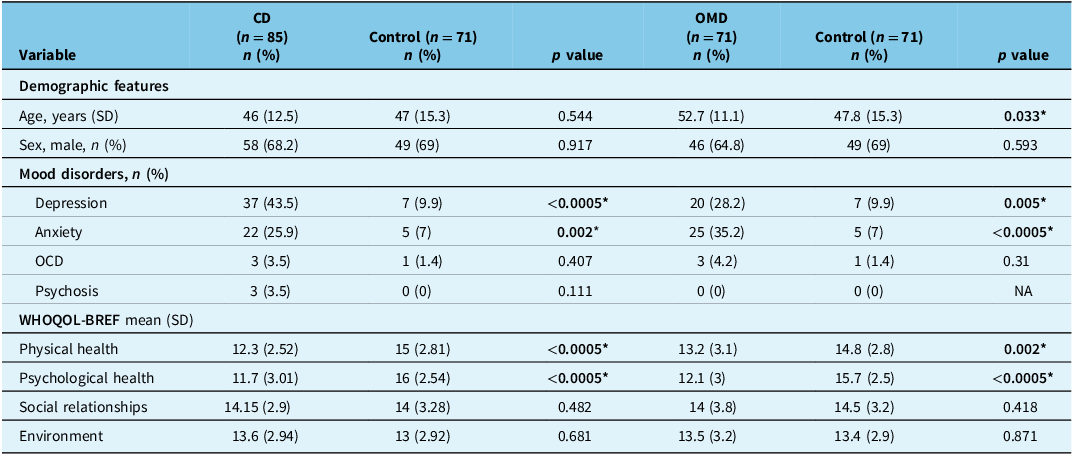
A total of 140 patients with idiopathic focal dystonia (IFD) (85 with CD and 71 with OMD) were enrolled in the study. The prevalence of depression, anxiety, OCD and psychosis in the IFD group was 37.9%, 29.3%, 4.3% and 2.1%, respectively (Table 1). In healthy controls, the prevalence was significantly lower at 9.9%, 7%, 1.4% and 0%.
Comparison of clinical features of patients with dystonia

IFD = idiopathic focal dystonia; OCD = obsessive-compulsive disorder; TWSTRS = Toronto Western Spasmodic Torticollis Rating Scale; WHOQOL-BREF = World Health Organization Quality Of Life – BREF.
Significantly higher rates of depression and anxiety were observed in patients with CD compared to healthy controls (p < 0.0005) (Table 2). When evaluating QoL, both the physical and psychological domains were significantly worse in the IFD group (p < 0.0005), though social and environmental domains did not reach statistical significance (Table 1).
Comparison of dystonia types with controls

CD = cervical dystonia; OCD = obsessive-compulsive disorder; OMD = oromandibular dystonia; WHOQOL-BREF = World Health Organization Quality Of Life – BREF.
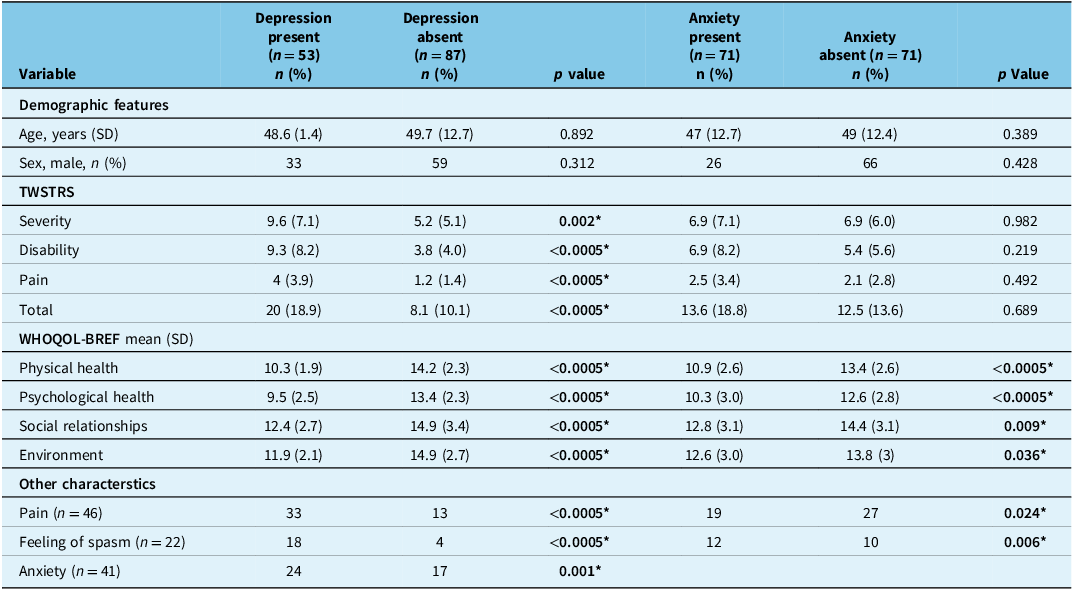
Of the 140 patients, 53 (37.9%) had depression, and 41 (29.3%) had anxiety; 24 patients (17.1%) had both disorders, 29 had depression only, 17 had anxiety only and 70 had neither (Table 3).
Comparison of depression and anxiety with IFD characteristics

Table 3 Long description
The table compares depression and anxiety with IFD characteristics among 140 patients. It has 12 rows and 8 columns. The columns are labeled as follows: Variable, Depression present (n = 53), Depression absent (n = 87), p value, Anxiety present (n = 71), Anxiety absent (n = 71), and p Value. The rows are grouped into Demographic features, TWSTRS, WHOQOL-BREF mean (SD), and Other characteristics. Each row provides specific data points for each category. For example, the Age row shows the mean age and standard deviation for each group. The table also includes p values to indicate the statistical significance of the differences observed. Notable trends include higher severity, disability, and pain scores in patients with depression and anxiety compared to those without. Additionally, patients with depression and anxiety report lower quality of life in physical health, psychological health, social relationships, and environment.
IFD = idiopathic focal dystonia; TWSTRS = Toronto Western Spasmodic Torticollis Rating Scale; WHOQOL-BREF = World Health Organization Quality Of Life – BREF.
Both depression and anxiety were significantly associated with dystonia severity and self-reported pain and spasm (p < 0.003) (Table 3). Depression and anxiety had lower WHOQOL-BREF scores in all domains compared to healthy controls (p < 0.05) (Table 3).
In multivariable regression analyses, depression emerged as a consistent independent predictor of poorer QoL across all WHOQOL-BREF domains. For the physical domain, depression was associated with a 30.9-point decrease in scores (β = −30.9, 95% CI −58.6 to −3.1, p = 0.031). In the psychological domain, both depression (β = −16.8, 95% CI −23.1 to −10.5, p < 0.001) and anxiety (β = −11.1, 95% CI −17.2 to −5.0, p = 0.001) independently predicted lower QoL, together explaining 68% of variance (R2 = 0.68). Depression also significantly affected the social (β = −16.2, p = 0.011) and environment (β = −16.8, p = 0.001) domains, while motor severity (TWSTRS total) and pain were not significant in any model. These findings suggest that reduced QoL in CD is primarily driven by psychiatric comorbidity – especially depression – rather than motor severity or pain alone.
Subgroup analysis revealed similar trends in mood disorders and QoL between CD and OMD groups. The prevalence of psychiatric disorders in CD was higher, with depression at 43.5% and anxiety at 25.9% (Table 2). In OMD, the prevalence of depression was 28.2%, and anxiety was 35.2% (Table 2).
Discussion
This study highlights the prevalence of psychiatric comorbidities, particularly depression and anxiety, in patients with primary CD and OMD. The higher prevalence of depression (37.9%) and anxiety (29.3%) in dystonia patients, particularly in CD, is consistent with findings from previous studies, which reported depression and anxiety in 25%–50% of dystonia patients. Reference Lencer, Steinlechner and Stahlberg3,Reference Fabbrini, Berardelli, Moretti, Pasquini, Colosimo and Berardelli7,Reference Kuyper, Parra, Aerts, Okun and Kluger27–Reference Ozel-Kizil, Akbostanci, Ozguven and Atbasoglu29 Notably, the prevalence of GAD in dystonia patients has been shown to range from 25% to 40%, as corroborated by our study. Other psychiatric disorders such as OCD and psychosis were less prevalent but still noteworthy in the IFD group, highlighting the potential underestimation of psychiatric burden in dystonia research.
Neuropsychiatric manifestations in dystonia are increasingly recognized as core non-motor symptoms (NMSs) rather than mere secondary reactions to visible movement disorder. Reference Kuyper, Parra, Aerts, Okun and Kluger27 Pathophysiologically, focal dystonias are associated with dysfunction of cortico-striato-thalamo-cortical circuits and altered sensorimotor integration, which are also implicated in mood and anxiety disorders. Reference Leisman, Braun-Benjamin and Melillo1 Abnormalities in dopaminergic, GABAergic and serotonergic neurotransmission within these circuits may contribute to co-existing psychiatric symptoms. Reference Gündel, Wolf and Xidara28 Network-level changes and maladaptive plasticity likely underlie both motor and non-motor phenotypes, providing a plausible biological basis for the observed psychiatric comorbidities. Reference Leisman, Braun-Benjamin and Melillo1,Reference Gündel, Wolf and Xidara28,Reference Gündel, Busch, Ceballos-Baumann and Seifert30
Our findings also echo previous literature demonstrating that the severity of dystonia, as measured by specific rating scales such as the FMDRS, is significantly associated with psychiatric symptoms. Reference Naber, Weinberger, Bullinger, Polsby and Chase6,Reference Lewis, Butler and Jahanshahi14,Reference Scheidt, Heinen and Nickel31 Depression and anxiety were particularly correlated with the severity of dystonia in both CD and OMD subgroups. Reference Naber, Weinberger, Bullinger, Polsby and Chase6,Reference Lewis, Butler and Jahanshahi14,Reference Scheidt, Heinen and Nickel31 This supports the notion that the psychosocial impact of visible dystonia symptoms, such as muscle spasms and abnormal postures, exacerbates psychiatric distress and negatively affects patients’ QoL. This is consistent with findings of multicenter case-control study by Klingelhoefer et al. (2021), who reported that 95% of CD patients had at least one NMS, with significantly higher NMS scores than controls (5.62 ± 3.33 vs. 1.74 ± 1.52; p < 0.001). Reference Klingelhoefer, Kaiser and Sauerbier17 Pain, insomnia and stigma were most prevalent, and health-related quality of life (HRQoL) was markedly impaired.
Our multivariable regression analysis revealed that depression had the strongest and most consistent negative impact on QoL across all domains, even after accounting for age, sex, pain and motor severity. Anxiety affected only the psychological domain. In contrast, motor severity and pain were not significant predictors. These results suggest that poor QoL in CD is mainly driven by psychiatric factors, particularly depression, rather than by motor symptoms alone. Routine screening and treatment of depression may therefore be essential to improve patient well-being. These findings align with those of earlier studies, where dystonia patients reported lower QoL scores, particularly in areas related to physical and social functioning. Reference Page, Butler and Jahanshahi16,Reference Camfield, Ben-Shlomo and Warner32–Reference Skogseid35 The association between pain, spasm and psychiatric symptoms is a critical finding, as it suggests that effective pain management and symptom alleviation could improve both motor and psychiatric outcomes in dystonia patients. Reference Coelho, Valadas, Mestre and Ferreira36,Reference Chan, Brin and Fahn37 A dystonia-specific non-motor symptoms questionnaire (DNMSQuest) was validated by Klingelhoefer et al., who found that DNMSQuest scores correlated significantly with HRQoL measures in 194 patients with CD. Reference Klingelhoefer, Chaudhuri and Kamm38 In a separate study, Martino et al. identified stress and prolonged fixed posture as the most frequent and impactful pain triggers, with women reporting greater pain severity using the Pain in Dystonia Scale. Reference Martino, Achen and Morgante39 These findings align with our data, which also show higher self-reported pain scores among affected individuals.
Additionally, this study highlights the importance of focusing on the distinct neuropsychiatric characteristics of CD and OMD.
In our cohort, neuropsychiatric symptoms were more prominent in the CD group than in the OMD group. We postulate that this may be related to the higher prevalence of pain in CD (as reflected by higher TWSTRS pain scores), which could contribute to greater depression and anxiety. Additionally, differences in the underlying network involvement between cervical and craniofacial motor circuits may lead to distinct NMS profiles.
While prior work has documented psychiatric comorbidities in focal dystonia, the current study expands the literature by directly comparing two common focal subtypes (CD and OMD) in a single, well-characterized cohort, using a standardized diagnostic interview plus severity scales, and by quantifying the independent impact of psychiatric diagnoses and pain on WHOQOL-BREF domains. This comparative and QoL-focused approach provides new insight into subtype-specific patterns and targets for holistic management.
Despite the valuable insights from this study, there are limitations to consider. The study’s design as a single-center, observational case-control study limits the generalizability of the findings. Additionally, the use of healthy controls from a hospital setting may not fully capture the differences between dystonia patients and the general population. Pooling different focal dystonia subtypes may reduce specificity and obscure subtype-specific non-motor patterns; our mixing of CD and OMD may therefore have affected the ability to detect subtype-specific associations for rarer outcomes.
Conclusion
This study underscores the significant prevalence of psychiatric comorbidities in primary CD and OMD, with depression and anxiety being the most common. These psychiatric disorders correlate with dystonia severity and significantly affect QoL. Effective management of psychiatric symptoms, alongside motor symptom treatment, is essential for improving the overall well-being of dystonia patients.
Future directions
Psychiatric comorbidities severely affect QoL in dystonia patients, yet current rating scales focus only on motor symptoms. A multidimensional scale that includes mood and anxiety assessments would be valuable. Future research should explore whether treating psychiatric conditions can improve motor function and overall well-being in dystonia.
Data availability statement
Anonymized data supporting the conclusions of this article are available from the corresponding author upon reasonable request, subject to institutional review board approval and patient privacy regulations.
Acknowledgments
We acknowledge the patients and their families who participated in this study.
Author contributions
Neha Rai: Conceptualization, Methodology, Software, Writing – original draft preparation, Writing – reviewing and editing. Kamalesh Tayade: Conceptualization, Methodology, Data curation, Writing – original draft preparation, Writing – reviewing and editing. Vinod Rai: Visualization, Investigation. Vinay Goyal: Supervision, Software, Validation, Writing – original draft preparation, Writing – reviewing and editing. Madhuri Bihari: Writing – reviewing and editing. Chanchal Gayal: Writing – reviewing and editing. Karolina Poplawska-Domaszewicz: Writing – reviewing and editing. Vinod Metta: Writing – reviewing and editing. K Ray Chaudhuri: Writing – reviewing and editing.
Funding statement
None.
Competing interests
All authors have completed and submitted the ICMJE Conflict of Interest Disclosure Forms. The authors declare that they have no financial or nonfinancial competing interests related to the content of this manuscript. All authors reports no support for the submitted work; no grants or contracts; no royalties; no consulting fees; no honoraria; no payments for expert testimony; no support for travel; no patents; no participation on Data Safety Monitoring Boards or advisory boards; no leadership roles; no stock or stock options; no receipt of equipment, materials or other services; and no other interests. The disclosures listed here match those provided in their individual COI forms.
Ethical standards
Institutional review board or ethics committee approval obtained. Informed patient consent was obtained. We confirm that we have read the journal’s position on issues involved in ethical publication and affirm that this work is consistent with those guidelines.
Declaration of generative AI and AI-assisted technologies in the writing process
No AI software or assistance has been used for the preparation of the manuscript.




Target article
Highlighting the Psychiatric Burden: Depression and Anxiety Drive Poor Quality of Life in Focal Dystonia
Related commentaries (1)
Reviewer Comment on Rai et al. “Highlighting the Psychiatric Burden: Depression and Anxiety Drive Poor Quality of Life in Focal Dystonia”