Introduction
Facilitating processing of emotions is an important goal of experiential and cognitive-behavioral treatments (Castonguay et al., Reference Castonguay1996; Greenberg et al., Reference Greenberg and Korman1993). Emotional processing is defined as the degree to which clients orient to their emotions and thoughts and use them as information to solve their problems (Greenberg, Reference Greenberg2002; Greenberg & Pascuale Leone, Reference Greenberg and Pascual-Leone2006; Greenberg & Safran, Reference Greenberg and Safran1984; Klein et al., Reference Klein, Mathieu and Gendlin1969; Watson & Bedard, Reference Watson and Bedard2006). In therapy, individuals can improve emotional processing by becoming aware of emotions, acknowledging the information they contain, becoming aware of thoughts and beliefs associated with them, verbalizing them, and ultimately understanding their meaning. In the highest stages of emotional processing, new meanings emerge, and feelings or experiences are used solve problems (Greenberg & Safran, Reference Greenberg and Safran1984). Research shows a relationship between levels of emotional processing across therapy sessions and better therapy outcomes (Orlinsky & Howard, Reference Orlinsky, Howard, Garfield and Gergin1986; Watson & Bedard, Reference Watson and Bedard2006). Greater increases in emotional processing over the course of both experiential and cognitive-behavior therapy are associated with greater posttreatment reductions in symptomatology (Feldman et al., Reference Feldman2009; Hunt, Reference Hunt1998; Pos et al., Reference Pos2003).
As noted previously, emotional awareness is considered the first step in emotional processing. According to Lane and Schwartz (Reference Lane and Schwartz1987), awareness develops through five levels. At Level 1, awareness is focused on physical sensations (e.g., “My head hurts”). At Level 2, emotions are described as physical sensations and action tendencies (e.g., “I wanted to scream”). At Level 3, emotions are characterized as one-dimensional (e.g., “I am angry.”). At Level 4, descriptions include feelings that are opposed to and/or different from each other (e.g., “I feel both angry at him and sad because I understand his pain”). At Level 5, feelings of varying qualities and intensities are blended into new patterns and subtle distinctions are made between emotional nuances (e.g., “I'd feel disappointed that I didn't win but glad that if someone else did, that person was my friend…My friend would feel happy but slightly worried that my feelings might be hurt”).
Because of its important role in emotional processing, facilitating emotional awareness is a common goal across therapy modalities. Cognitive-behavioral therapy, emotion-focused therapy, process experiential therapy, mindfulness, and acceptance-based treatments (Gendlin, Reference Gendlin1996; Greenberg, Reference Greenberg2002; Greenberg & Korman, Reference Greenberg and Korman1993; Greenberg & Pascual-Leone, Reference Greenberg and Pascual-Leone2006; Hayes et al., & Wilson, Reference Hayes, Strosahl and Wilson1999; Roemer & Orsillo, Reference Roemer, Orsillo, Orsillo and Roemer2005) consider attending to and recognizing emotions as cornerstones of these approaches. Despite its proposed importance in successful therapy outcomes, there has been little research examining emotional awareness during psychotherapy. It has been studied in various clinical populations, including somatoform disorders (Subic-Wrana et al., Reference Subic-Wrana2010), generalized anxiety disorder (Novick-Klein et al., Reference Novick-Kline2005), and posttraumatic stress disorder (Frewen et al., Reference Frewen2008). Studies showed lower awareness among individuals with somatoform disorders and posttraumatic stress disorders but higher levels among individuals with anxiety disorders (Frewen et al., Reference Frewen2008; Novick-Klein et al., Reference Novick-Kline2005; Subic-Wrana et al., Reference Subic-Wrana2010). A link between emotional awareness and therapy outcomes has been found in studies, indicating that greater awareness is associated with greater distress reduction in both psychodynamic and cognitive-behavioral therapy (Beutel et al., Reference Beutel2013).
In our prior work, we examined components of emotional processing during psychotherapy sessions of women newly diagnosed with gynecologic cancer. We studied the construct using therapy session tapes from a study evaluating the efficacy of two psychotherapy interventions: a coping and communication intervention (CCI) and a supportive counseling intervention (SC). Gynecologic cancer is challenging because of its poor prognosis, difficult treatment regimens, and adverse treatment side effects (Hwang et al., Reference Hwang, Cho and Yoo2016). Between 19% and 52% of women reported moderate to severe levels of anxiety during and after treatment (Watts et al., Reference Watts2015). The diagnosis and treatment of cancer is typically linked with both negative (Kulpa et al., Reference Kulpa2017) and positive (Ciere et al., Reference Ciere2017) emotional responses. Whether and how patients manage and use their emotions has been linked to psychological adaptation (Classen et al., Reference Classen1996; Manne et al., Reference Manne2008; Stanton et al., Reference Stanton2000).
Our two prior studies used data from a previously published randomized clinical trial (RCT) (Manne, et al., Reference Manne2017). In the first study, we characterized emotion episodes (EEs), which are indicators of emotional expression in psychotherapy (Myers Virtue et al., Reference Myers Virtue2015) and the methods used to code and analyze in-session emotional processing (Greenberg & Korman, Reference Greenberg and Korman1993; Korman, Reference Korman1998). An EE is a segment of psychotherapy in which patients express any emotions in response to a situation. Identifying EEs provides information about the frequency, types, and content of emotions. We examined EEs during early and late psychotherapy sessions and differences between CCI and SC. We had four key findings: (1) patients experienced at least one EE in the majority of early and late sessions, (2) most EEs focused on negative emotions and cancer-related topics, (3) there was a decrease in total EEs across sessions and an increase in positive EEs, and (4) there were more total EEs in SC than CCI.
In the second study (Manne et al., Reference Manne2017), we characterized levels of emotional processing during EEs at the beginning, middle, and end of SC and CCI sessions using the experiencing scale (Klein et al., Reference Klein, Mathieu and Gendlin1969). Emotional processing was rated from EEs. Findings indicated that patients discussed events, emotional reactions, and private experiences during sessions. A small proportion had high levels of processing, indicating deeper exploration of the meaning of their feelings. Women in SC achieved higher levels of emotional processing during the middle and later sessions. Emotional processing was not significantly associated with patient's perceived therapy progress in SC. In CCI, higher levels of emotional processing were associated with greater session progress, suggesting that it may play an important role in patient-rated treatment outcomes.
The current study builds upon this work by measuring emotional awareness, the proposed first step to emotional processing, during therapy sessions. Transcripts of EEs were coded for emotional awareness using a computerized system called the Program for Open-Ended Scoring (POES) (Barchard et al., Reference Barchard2010). The POES was developed to score a paper-and-pencil measure of emotional awareness, the Levels of Emotional Awareness Scale (LEAS) (Lane & Schwartz, Reference Lane and Schwartz1987). The LEAS consists of emotionally provoking vignettes, and participants are asked to describe their own and others’ feelings. The LEAS uses hypothetical situations that are not cancer-specific and does not code emotional episodes during therapy sessions. The POES assigns numerical values to the emotion words used in the responses based upon complexity and diversity of words used. We adapted the POES to score transcribed EEs from therapy sessions, rather than administering the LEAS. To our knowledge, this is the first study to use the POES from actual therapy session tapes.
The current study had three aims. The first aim was to describe levels of emotional awareness across sessions and to examine differences between two different approaches to therapy. Because SC used techniques to facilitate emotional exploration and CCI did not target emotional exploration, we hypothesized that emotional awareness would be higher and increase at a higher rate in SC. The second aim was to examine the correspondence between emotional awareness and emotional processing. Consistent with the model (Greenberg & Safran, Reference Greenberg and Safran1984), we hypothesized that higher in-session emotional awareness would be associated with higher in-session emotional processing. The third aim was to examine baseline psychosocial factors associated with in-session emotional awareness. Because promoting emotional awareness is often a goal in therapy (Greenberg & Pascual-Leone, Reference Greenberg and Pascual-Leone2006), identifying factors that influence awareness can provide guidance for clinicians. Prior work found that younger age was associated with higher emotional processing (Manne et al., Reference Manne2017). Emotional awareness is considered a necessary part of successful emotional processing; therefore, we hypothesized that younger women would exhibit greater awareness. Because low levels of emotional awareness focus on bodily sensations, we hypothesized that those with lower physical well-being may focus more on physical sensations rather than feelings, thus receiving lower awareness scores. We hypothesized greater dispositional emotional expressivity would be related to greater emotional awareness. Emotional arousal is an important step in emotional awareness, but there is a tendency to avoid expressing emotions, which can interfere with productively using emotions to create meaning (Greenberg & Pascual-Leone, Reference Greenberg and Pascual-Leone2006). Individuals who are more likely to express those emotions have more opportunities to develop emotional awareness. Finally, we hypothesized that greater cancer-specific distress would be associated with greater in-session emotional awareness. Researchers suggest that greater rumination and intensity of emotion may prompt more awareness (Novick-Kline et al., Reference Novick-Kline2005). Intrusive cancer-related thoughts may prompt intense experiences that facilitate greater emotional awareness.
Methods
Participants and procedures
This study is a secondary data analysis of baseline and psychotherapy data from a published, multisite RCT that evaluated the efficacy of two individual psychotherapy interventions: CCI and SC (clinicaltrials.gov # NCT01951807) (Manne et al., Reference Manne2017). The control condition was a usual care arm. Both interventions consisted of seven 1-hour in-person psychotherapy sessions and a telephone booster session. Inclusion criteria were the following: (1) ≥18 years of age, (2) diagnosed with gynecologic cancer within the past six months at the time of recruitment, (3) a Karnofsky Performance Status of ≥80 or an Eastern Cooperative Oncology Group score of 0 or 1, (4) lived within a two-hour commuting distance from recruitment center, (5) English speaking, and (6) no hearing impairment. Eligible women were mailed a letter describing the study and contacted by research assistants in-person or by phone. Interested women signed an informed consent document approved by the institutional review board at each site. Participants completed a baseline survey and were randomly assigned to CCI, SC, or usual care. Participants were paid $15 for completing the baseline survey and a total of $215 for attending all psychotherapy sessions. Sessions were video and/or audio recorded.
In the RCT, 1,147 women were approached to participate and 352 (30.7%) consented, completed a baseline survey, and were randomized. Further recruitment information is found in the publication (Manne et al., Reference Manne2017). This substudy used baseline survey and psychotherapy session data from 246 RCT participants who were randomized to CCI (n = 121) or SC (n = 125).
Measures
Session data
Psychotherapy session data were coded from video/audio recordings. Data were obtained from the first session, the sixth session, and a middle session, which was selected between the second and fifth sessions. The first session was chosen to gather baseline data. The sixth session was chosen to capture emotion data toward the end of treatment, consistent with prior emotional process studies, which suggested that the penultimate session better captures end of treatment processing than the last session (Missirlian et al., Reference Missirlian2005; Pos, et al., Reference Pos2003). The middle session was chosen by selecting the session with the highest patient-rated emotional arousal using the Positive and Negative Affect Schedule (Watson et al., Reference Watson, Clark and Tellegen1988), consistent with prior research (Missirlian et al., Reference Missirlian2005).
EEs
We used the EE coding system (Greenberg & Korman, Reference Greenberg and Korman1993; Korman, Reference Korman1998) to select in-session segments when patients expressed emotion. EEs were used as a unit of coding the level of emotion processing in numerous psychotherapy research studies (Missirlian et al., Reference Missirlian2005). Four trained research assistants completed coding. Criterion coders rated one-third of all cases for fidelity. Agreement was 90.6%. See prior work (Myers Virtue et al., Reference Myers Virtue2015) for further details about coding. EEs were transcribed for further coding.
Emotional awareness
The POES (Leaf & Barchard, Reference Leaf and Barchard2010) assessed emotional awareness during EEs as described previously. The POES scanned transcripts for emotion words. EEs were given scores based on complexity of emotion words. Scores range from 1 to 5, with higher scores indicating greater emotional awareness. An average session score was calculated. Training in using the system was provided before and during the study as needed.
Emotion processing
The Experiencing Scale (EXP) (Klein et al., Reference Klein, Mathieu and Gendlin1969) assessed emotional processing during EEs. This scale is widely considered the “gold standard” of experiential processing and remains one of the most extensively studied and validated measures. The scale provides a mode (average across segment) and peak (highest in segment) rating on a 7-point scale. Higher ratings indicate higher processing. Seven trained research assistants completed coding. Coders had to reach an 80% agreement on master recordings to be considered reliable and ready to code. Fidelity was monitored by coding one-third of all cases. Agreement was acceptable (κ mode = 0.813; κ peak = 0.784). Further detail on coding can be found in prior work (Manne et al., Reference Manne2017).
Preintervention predictors
Demographic and medical information
Baseline surveys assessed age, race, marital status, income, and education level. Medical chart review assessed primary cancer diagnosis, cancer stage, time from diagnosis, and type of treatment. The 26-item Cancer Rehabilitation Evaluation System (Schag et al., Reference Schag, Ganz and Heinrich1991) assessed functional impairment. Items included physical symptoms associated with cancer. Reliability was acceptable (α CCI = .94, α SC = .92).
Cancer-specific distress
The 15-item Impact of Events Scale (Horowitz et al., Reference Horowitz, Wilner and Alvarez1979) assessed intrusive thoughts and avoidant behaviors associated with distress specific to cancer. Sample items include, “Other things kept making me think about it (the cancer).” Scores range from 0 to 75 with greater scores indicating more distress. Reliability was acceptable (α CCI = 0.91, α SC = 0.9).
Dispositional emotional expressivity
The Emotional Expressiveness Questionnaire (King & Emmons, Reference King and Emmons1990) assessed patients’ tendency to express positive and negative emotions. Nine items assessed positive emotional expression (e.g., “I often tell people that I love them”). Seven items assessed negative emotional expression (e.g., “When I am angry, people around me usually know”). Higher scores indicate greater tendency toward emotional expression. Reliability was acceptable for positive emotional expression (α CCI = 0.79, α SC = 0.73) and not ideal for negative emotional expression (α CCI = 0.61, α SC = 0.6).
Physical well-being
The physical well-being subscale of the Functional Assessment of Cancer Therapy (Cella et al., Reference Cella1993) assessed physical well-being on a 5-point scale, with higher scores indicating greater well-being. Reliability was acceptable (α CCI = 0.9, α SC = 0.89).
Data analysis
To address the first aim, we calculated average emotional awareness scores (sum of all emotional awareness scores in the session/total number of EEs in the session) for the first, middle, and sixth session. We used independent-samples t-tests to examine mean differences in emotional awareness scores at each session between conditions (SC and CCI). We modeled change continuously, using the time since the middle and sixth session surveys were completed after the first session. To address the second aim, correspondence between emotional awareness scores and EXP ratings was evaluated with Pearson correlations.
To address the third aim, categorical demographic and medical characteristics (race, marital status, education, cancer stage) were entered into one-way analyses of variance predicting the first, middle, and sixth session emotional awareness scores. Bivariate relationships between continuous demographic and medical characteristics (age, income, time since diagnosis, functional impairment) and baseline factors (cancer-specific distress, positive emotional expressivity, negative emotional expressivity, physical well-being) and the first, middle, and sixth session scores were examined with Pearson correlations. Baseline characteristics and factors that were significantly associated with emotional awareness scores (p < 0.05) were simultaneously entered into a multiple regression model to determine independent predictors of emotional awareness scores. Categorical demographic and medical characteristics were dummy-coded for entry into multiple regression models.
Results
Demographic and medical characteristics
Most women were Caucasian (81.6%SC, 76%CCI), married (65.6%SC, 65.3%CCI), had completed college (63.2%SC, 62.8%CCI), and were approximately 55 years of age (M = 55.60SC, SD = 9.91SC; M = 53.77CCI, SD = 10.99CCI) (Table 1). Most were diagnosed as stage III (50.4%SC, 43%CCI) almost four months before study participation (M = 3.57SC, SD = 1.58SC; M = 3.92CCI, SD = 1.86CCI).
Demographic and medical characteristics of participants

CCI, coping and communication intervention treatment condition; EXP, The Experiencing Scale; SC, supportive care treatment condition.
Changes in emotional awareness and group differences
The average emotional awareness scores across all participants for the first, middle, and sixth sessions were 3.66 (SD = 0.32), 3.77 (SD = 0.28), and 3.72 (SD = 0.32), respectively, indicating moderate awareness. Scores were significantly higher in the first (t (207.6) = 3.37, p < 0.001) and sixth session (t(200) = 3.25, p < 0.002) in SC compared with CCI (Table 1). Change in emotional awareness across sessions was modeled continuously for each condition, using the time since the middle and sixth surveys were completed after the first session. There was not a significant increase in emotional awareness across sessions in either condition.
Correspondence between emotional awareness and emotional processing
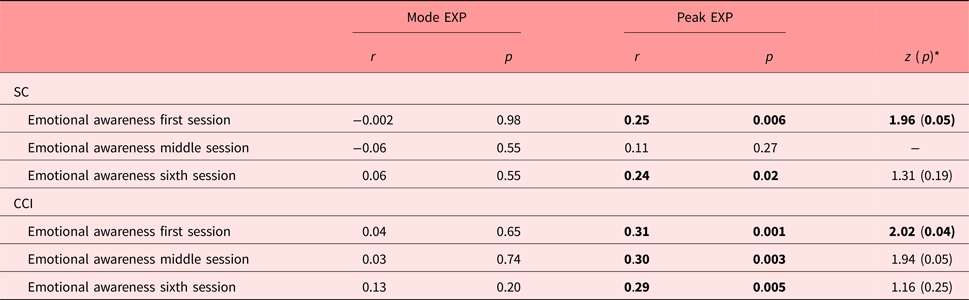
Pearson correlations between emotional awareness and EXP for the first, middle, and sixth sessions can be found in Table 2. Mode EXP was not significantly associated with emotional awareness scores in any session in either treatment condition (all p > 0.20). However, peak EXP was significantly associated with emotional awareness scores in the first (r = 0.25, p = 0.006) and sixth (r = 0.24, p = 0.02) sessions in SC and all sessions in CCI (all r = 0.29–0.31, all p < 0.002).
Correspondence between emotional awareness scores and EXP mode and peak ratings

Significance at p < 0.05 level is signified in bold.
*Significance test of the difference between Pearson correlations for mode and peak EXP ratings.
CCI, Coping and Communication Intervention treatment condition; SC, supportive care treatment condition.
Preintervention predictors of emotional awareness
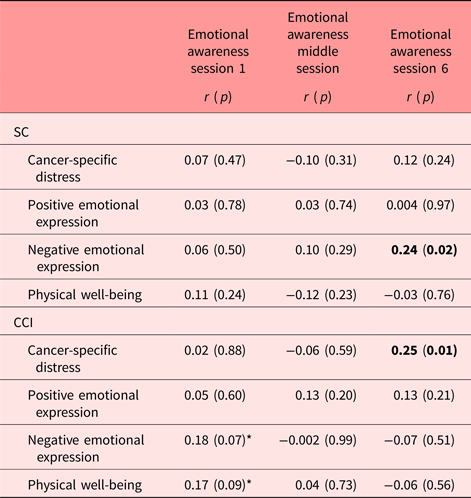
First, we examined univariate demographic, medical, and baseline predictors of emotional awareness scores in the first, middle, and sixth sessions. Predictors were examined within each condition (CCI and SC) separately (Table 3). No demographic, medical, or baseline predictors were significantly associated with emotional awareness scores in the first and middle sessions within either treatment condition (all p > 0.05). In SC, married women had significantly lower emotional awareness scores in the sixth session (M = 3.74, SD = 0.26) compared with unmarried women (M = 3.88, SD = 0.21), t (102) = −2.71, p < 0.008. Also in SC, greater baseline negative emotional expression was associated with greater emotional awareness scores in the sixth session, r = 0.24, p < 0.02. In CCI, greater cancer-specific distress was associated with greater emotional awareness scores in the sixth session, r = 0.25, p < 0.02. No other baseline variables were significantly associated with emotional awareness in the sixth session in either condition.
Univariate correlations between baseline predictors and emotional awareness scores

Significant correlations (p < .05) are depicted in bold.
CCI, Coping and Communication Intervention treatment condition; SC, supportive care treatment condition.
*Marginally significant correlation (p < 0.10).
Second, we entered significant demographic and psychological predictors of emotional awareness scores in the sixth session into multiple regression models to determine salient baseline predictors of emotional awareness for each condition, separately (Table 4). In SC, women who reported greater negative emotional expressivity at baseline (β = 0.19) and those who were unmarried (β = −0.25) had greater emotional awareness scores (all p < 0.05) in the sixth session, while controlling for the first (β = 0.17, p = 0.07) and middle (β = 0.10, p = 0.32) session emotional awareness scores. In CCI, women who reported greater cancer-specific distress at baseline had greater emotional awareness scores (β = 0.26, p < 0.01) while controlling for the first (β = 0.13, p = 0.20) and middle (β = 0.07, p = 0.51) session emotional awareness scores.
Multiple regression models predicting sixth session emotional awareness scores for SC and CCI condition

Significant predictors of sixth session emotional awareness scores are depicted in bold.
CCI, Coping and Communication Intervention treatment condition; SC, supportive care treatment condition.
*Marital status is dummy-coded such that unmarried women are coded as 0 (reference group).
Discussion
This study explored levels of emotional awareness during therapy sessions delivered to women who were newly diagnosed with gynecologic cancer. We expanded our prior work (Manne et al., Reference Manne2017; Myers Virtue et al., Reference Myers Virtue2015) by describing emotional awareness and its correspondence with emotional processing. The study had four key findings. We will discuss each along with their clinical implications. First, the average level of emotional awareness across all sessions suggested that patients identified emotions (e.g., “I feel sad about my diagnosis”) and approached levels where they recognized opposing emotions at the same time (e.g., Level 4: “I feel both angry that I was diagnosed and grateful for the medical care I received”). Most patients discussed their emotions beyond physical sensations (e.g., Level 2: “I was in pain”).
Second, as hypothesized, there was a significant difference in levels of emotional awareness between patients in SC and CCI. Higher levels of emotional awareness in SC may reflect the techniques aimed at facilitating emotional awareness and processing (e.g., therapist reflecting an expressed feeling). When therapists use those techniques during therapy with patients, patients may achieve greater awareness of their feelings; however, differences were small (i.e., less than one level difference). Contrary to hypotheses, emotional awareness did not increase over SC or CCI sessions, possibly because the interventions were short-term. Studies examined emotional processing during 20 or more therapy sessions (Pos et al., Reference Pos2003). In the RCT, CCI achieved greater symptom reduction compared with SC (Manne et al., Reference Manne2017). Future research may consider whether longer term SC sessions lead to greater increases in emotional awareness and whether this leads to comparable outcomes with CCI.
Third, consistent with our predictions and the literature, emotional awareness corresponded with emotional processing. Emotions provide valuable information about whether needs and values are met, and higher emotional awareness should be linked with higher emotional processing (Levenson, Reference Levenson, Ekman and Davidson1994). Increasing conscious awareness of feelings may guide decisions and create meaning. We did not assess emotional awareness before beginning therapy. Thus, we cannot make conclusions about whether baseline emotional awareness predicts in-session emotional processing. Level of emotional awareness was associated with peak EXP but not mode EXP. Peak EXP scores represent the highest level of processing that patients were able to achieve within an EE. Mode EXP score can be considered the “average” level of processing. Although higher levels of emotional awareness may not translate to consistently processing emotions at a higher level, patients with higher levels of emotional awareness tended to reach higher levels of emotional processing during psychotherapy. Emotional awareness was not associated with emotional processing in the middle session in SC. Sometimes, patients might display high awareness of their emotional experience but are not deeply processing that information. Future research may examine therapeutic factors that affect the link between emotional awareness and processing.
Fourth, no baseline demographic, medical, or psychological factors were associated with emotional awareness in the first and middle sessions, but they were in the sixth session. Among SC participants, the level of emotional awareness in the sixth session was associated with greater baseline negative emotional expressivity and not being married. In sessions with patients who have a greater tendency to express negative emotions, therapists may have more opportunities to ask about emotions, thus leading to opportunities for patients to become aware of emotional experiences. Married patients may process more emotions with their partners, pointing to a greater need for single patients to pursue emotions in therapy. Among CCI participants, greater cancer-specific distress was associated with greater emotional awareness. Researchers suggest that individuals with anxiety disorders may experience more intense emotional experiences, leading to greater awareness (Novick-Kline et al., Reference Novick-Kline2005). Similarly, patients who experience frequent intrusive thoughts and feelings about cancer may be more aware of those emotions.
Study limitations
The first limitation is that the majority of women were Caucasian, well-educated, diagnosed with ovarian cancer, and diagnosed with advanced disease. Patterns of emotional awareness may differ in more diverse populations, especially male cancer patients. Second, patients were part of an RCT. They did not seek out therapy. Third, we examined emotional awareness in the first, sixth, and a middle session. Different patterns might have emerged in different sessions, particularly the seventh session, when therapy progress was reviewed. Fourth, using the POES to code therapy transcripts has not been tested for validity. Further research is needed to determine the validity of using the POES in assessing in-session emotional awareness, and correspondence with the paper-and-pencil version of the LEAS would provide valuable information. Finally, changes in awareness were small in magnitude, and their clinical significance is unclear.
Clinical implications
There are clinical implications from our study. We observed moderate levels of emotional awareness in the first session. Since there is evidence that greater baseline emotional awareness is related to psychotherapeutic outcomes in psychodynamic and CBT treatments (Beutel et al., Reference Beutel2013), clinicians working with this population may foster baseline emotional awareness through various therapeutic techniques, including focusing exercises in emotion-focused therapy, connecting thoughts, feelings, and behaviors in CBT, or emotional exploration. Emotional awareness corresponded with emotional processing. Considering emotional awareness when facilitating emotional processing with patients may be important. Negative emotional expression was related to in-session emotional awareness in SC where patients were encouraged to freely discuss feelings. Patients who tend to express negative emotions may have greater awareness, which can be therapeutically used by exploring the meaning behind those feelings. Finally, cancer-specific distress was related to emotional awareness in the CCI intervention. It is not clear whether greater distress led to greater awareness or vice versa, but clinicians may consider this relationship in therapeutic settings.
Finally, to our knowledge, POES has not been previously used to code transcripts of therapy sessions. This approach to coding in-session emotional awareness is novel but time-consuming and not practical for clinicians. Use of the paper-and-pencil LEAS or an online version of it (www.eLEAStest.net) may be more practical.
Disclosures
The authors declare that they have no conflicts of interest.
Acknowledgments
We acknowledge Sara Frederick, Tina Gadja, Shira Hichenberg, and Kristen Sorice for study management; and Jamie Betancourt, Joanna Crincoli, Katie Darabos, Lauren Faust, Rebecca Henderson, Sloan Harrison, Travis Logan, Kellie McWilliams, Marie Plaisme, Danielle Ryan, Caitlin Scally, Arielle Schwerd, Kaitlyn Smith, Nicole Teitelbaum, and Amanda Viner for collection of study data. We thank the oncologists and nurses at all five cancer centers for allowing access to patients. Finally, we thank the study participants and therapists for their time. This work was supported by grant R01CA85566 (PI: Manne).