Antisocial behavior constitutes an issue of significant social, clinical, and practice concern, with evidence highlighting increasing rates of antisocial behavior problems among children and adolescents internationally (Collishaw, Maughan, Goodman, & Pickles, Reference Collishaw, Maughan, Goodman and Pickles2004; Ford, Reference Ford2008). The role of interparental conflict and negative parenting practices as indices of family socialization influences on children's externalizing behavior problems, including antisocial behavior, is well established (Harold & Conger, Reference Harold and Conger1997; Rhoades et al., Reference Rhoades, Leve, Harold, Neiderhiser, Shaw and Reiss2011). The intergenerational transmission of antisociality, such that elevated symptom problems among parents serve as a predisposition for elevated symptom problems among children, also accords a well-established evidence base (Harold et al., Reference Harold, Rice, Hay, Boivin, van den Bree and Thapar2010; Silberg, Maes, & Eaves Reference Silberg, Maes and Eaves2011).
Historically, research examining family socialization and intergenerational transmission hypotheses underlying childhood psychopathology has typically occupied two relatively independent avenues of investigation. Advocates of a family socialization perspective emphasize the importance of contextual influences, such as harsh parenting practices, as antecedents of children's antisocial behavior problems (Belsky, Reference Belsky1981; Patterson, Reference Patterson1982; Stover et al., Reference Stover, Connell, Leve, Neiderhiser, Shaw and Scaramella2012). Advocates of an intergenerational transmission perspective emphasize the importance of parent psychopathology as a point of origin in understanding the expression and development of psychopathology in children (Connell & Goodman, Reference Connell and Goodman2002). Yet each perspective offers a complement to the other in examining the family origins of childhood psychopathology.
Common to both family socialization and intergenerational transmission perspectives is the increasing application of a process-oriented perspective, such that emphasis is placed on the identification of mediating and moderating processes underlying specific family-level factors and indices of parent psychopathology on offspring symptoms. For example, interparental conflict is associated with disrupted parenting practices, which in turn is associated with elevated externalizing problems among children and adolescents (Harold & Conger, Reference Harold and Conger1997; Shaw, Gilliom, Ingoldsby, & Nagin, Reference Shaw, Gilliom, Ingoldsby and Nagin2003). Parental depression and antisociality have also been shown to place children at elevated risk for related symptom problems (Silberg, Maes, & Eaves, Reference Silberg, Maes and Eaves2010; Silberg et al., Reference Silberg, Maes and Eaves2011; Singh et al., Reference Singh, D'Onofrio, Slutske, Turkheimer, Emery and Harden2011; Tully, Iacono, & McGue, Reference Tully, Iacono and McGue2008), with harsh parenting practices identified as an important mediator of risk for antisocial behavior, but less consistently so for depression (see Harold et al., Reference Harold, Rice, Hay, Boivin, van den Bree and Thapar2010). A complementary body of evidence suggests that genetic factors may mediate intergenerational links between parent and offspring psychopathology (Silberg et al., Reference Silberg, Maes and Eaves2010; Meyer et al., Reference Meyer, Rutter, Silberg, Maes, Simonoff and Shillady2000; Plomin, Reference Plomin1990) and between family socialization processes and offspring psychopathology (see Moffitt, Reference Moffitt2005; Rutter, Reference Rutter2006).
Until recently, a limitation of past research in each of these theoretical domains relates specifically to a reliance on biologically related parents and offspring in examining family- and parent-level indices of dysfunction on childhood psychopathology. That is, in examining the relative role of genetic and environmental factors on offspring psychopathology, genes may affect not only the specific index of psychopathology considered but also the rearing environment that children experience. This overlap of influences has been defined as gene–environment correlation (rGE; see Plomin, DeFries, & Loehlin, Reference Plomin, DeFries and Loehlin1977). Two primary configurations of rGE have been highlighted in past research: evocative rGE and passive rGE. Evocative rGE suggests that genetically influenced child characteristics may evoke patterned responses such as negativity from a parent (Ge et al., Reference Ge, Conger, Cadoret, Neiderhiser, Yates and Troughton1996). Passive rGE suggests that associations between parent and child characteristics may result from common underlying genetic factors that simultaneously influence the trait in both parent and child (Jaffe & Price, Reference Jaffee and Price2007).
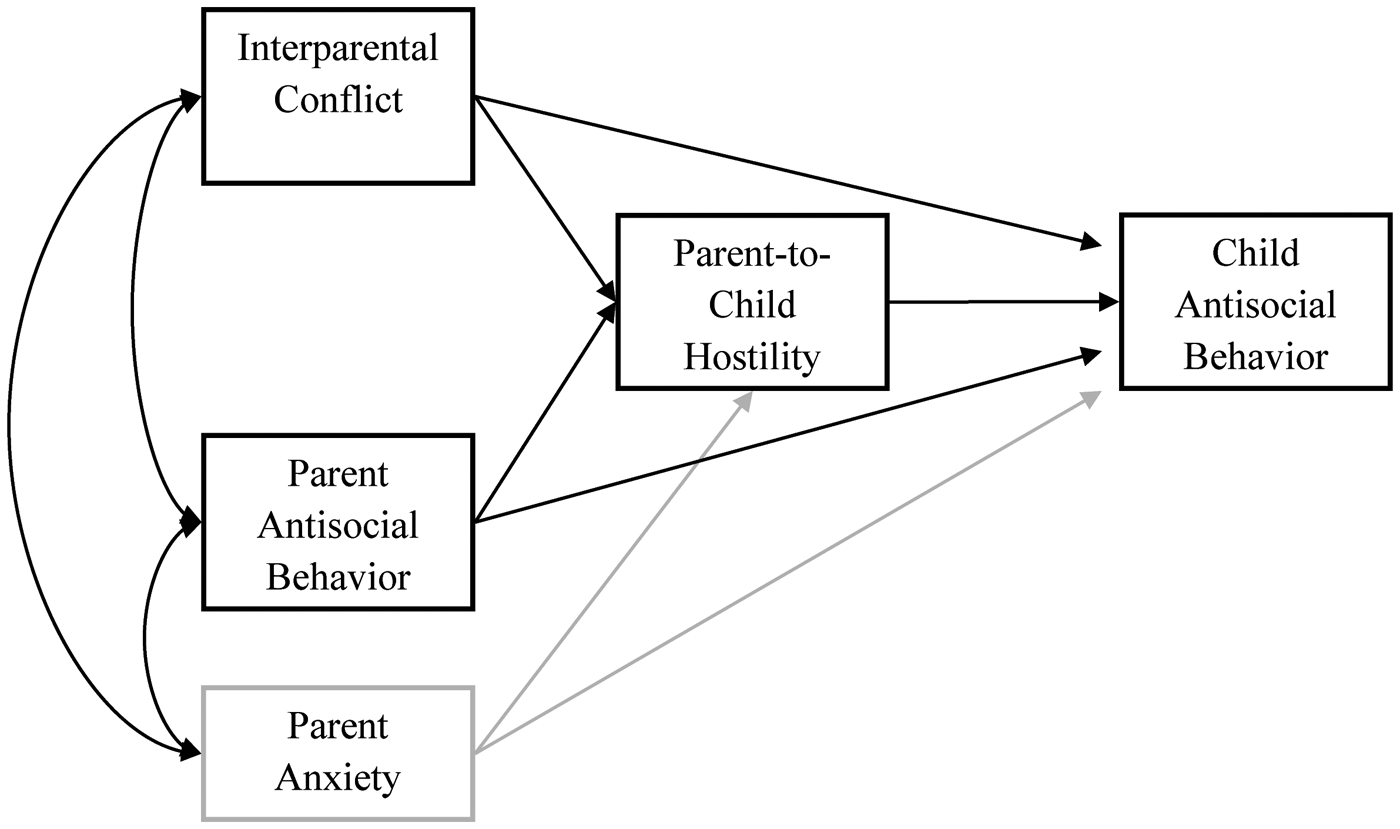
The present study addresses prior gaps in the areas of family socialization and intergenerational transmission research by examining an integrative theoretical model whereby interparental conflict, parent antisocial behavior, and parent anxiety symptoms are examined relative to hostile parenting as a mediating factor underlying children's antisocial behavior problems (see Figure 1). Previous genetically informative studies have considered the contribution of parent depression (Harold et al., Reference Harold, Rice, Hay, Boivin, van den Bree and Thapar2010; Silberg et al., Reference Silberg, Maes and Eaves2010; Singh et al., Reference Singh, D'Onofrio, Slutske, Turkheimer, Emery and Harden2011; Tully et al., Reference Tully, Iacono and McGue2008) but not anxiety, despite this being a common adult psychopathology, on offspring psychological symptoms. Thus, we further considered the role of parent anxiety relative to interparental conflict and parent antisociality in accounting for disrupted parenting practices and associated influences on child antisocial behavior. The present study employs a research design comprising a sample of parents and children conceived through assisted reproductive technology, specifically in vitro fertilization (IVF), thereby offering an innovative methodological approach to examining the potential confounding influence of passive genotype–environment correlation underlying hypothesized theoretical pathways among genetically related and genetically unrelated parent–child groupings.
The proposed theoretical model.

Interparental Conflict, Hostile Parenting Practices, and Child Psychopathology
Interparental conflict is recognized as a significant source of stress for children, with evidence from cross-sectional (Grych, Fincham, Jouriles, & McDonald, Reference Grych, Fincham, Jouriles and McDonald2000), longitudinal (Harold, Shelton, Goeke-Morey, & Cummings, Reference Harold, Shelton, Goeke-Morey and Cummings2004), and experimental (Davies & Cummings, Reference Davies and Cummings2002) studies suggesting that children who witness conflict between parents that is frequent, intense, and poorly resolved are at elevated risk for a variety of negative psychological outcomes, including depression, aggression, hostility, antisocial behavior, and criminality, as well as deficits in academic attainment (Harold, Aitken, & Shelton, Reference Harold, Aitken and Shelton2007). A prominent theoretical perspective aimed at explaining the association between interparental conflict and children's psychopathology suggests that conflict between parents indirectly leads to adjustment problems for children through a “spillover” of emotion from the couple relationship, leading to disrupted parenting practices, which in turn affect children's psychopathology (Erel & Burman, Reference Erel and Burman1995). A large volume of evidence supports this perspective, with intervention studies also highlighting the role of parenting as an important mediator in the link between interparental conflict and child behavior problems (Cowan & Cowan, Reference Cowan and Cowan2002).
However, important questions remain as to the relative role of interparental conflict and harsh parenting practices as family socialization influences on childhood psychopathology. Notwithstanding concerns relating to a reliance on biologically related parents and children as previously outlined, a fundamental limitation of past research in this area is that examination of disrupted parenting in the context of interparental conflict has primarily focused on maternal behaviors or a composite of maternal and paternal behaviors (e.g., parent-to-child hostility), to the neglect of examining relative mother–child and father–child behavior in mediating associations between interparental conflict and children's psychological adjustment. However, it is increasingly recognized that differential pathways may exist through mother–child and father–child relationships in accounting for interparental conflict effects on children's emotional and behavioral problems (Shelton & Harold, Reference Shelton and Harold2008; Stover et al., Reference Stover, Connell, Leve, Neiderhiser, Shaw and Scaramella2012). The present study advances further this dearth of past research by separately examining genetically related and genetically unrelated maternal and paternal reports of interparental conflict, parent psychopathology, and negative parenting practices on children's antisocial behavior problems.
Intergenerational Transmission of Psychopathology
Studies of the intergenerational transmission of externalizing behavior, including antisocial behavior and conduct disorder, have been relatively consistent in finding associations between parent disorder and child disorder across generations (Capaldi, Pears, Patterson, & Owen, Reference Capaldi, Pears, Patterson and Owen2003; Conger, Neppl, Kim, & Scaramella, Reference Conger, Neppl, Kim and Scaramella2003). Recent studies have indicated that parental antisocial behavior is associated with a wide range of problem behaviors in offspring, such as negative emotionality, poor inhibitory control, and externalizing behavior problems across childhood and adolescence (Capaldi, Pears, Kerr, & Owen, Reference Capaldi, Pears, Kerr and Owen2008; Feinberg, Button, Neiderhiser, Reiss, & Hetherington, Reference Feinberg, Button, Neiderhiser, Reiss and Hetherington2007; Jaffee, Belsky, Harrington, Caspi, & Moffitt, Reference Jaffee, Belsky, Harrington, Caspi and Moffitt2006). Several potential mechanisms of such intergenerational transmission of psychopathology have been proposed, including genetic transmission, effects of maternal psychopathology and problem behaviors on prenatal development, maladaptive parenting behavior (e.g., harsh and inconsistent discipline), exposure to parental depressive and anxious affect (Forbes, Cohn, Allen, & Lewinsohn Reference Forbes, Cohn, Allen and Lewinsohn2004), and family-level contextual stress (e.g., low socioeconomic status and poor neighborhood characteristics; Connell & Goodman, Reference Connell and Goodman2002). Specifically relating to genetic transmission, recent molecular genetic studies have reported allele Gene × Environment (specifically child maltreatment) interactions predicting antisocial behavior/conduct disorder (Caspi et al., Reference Caspi, McClay, Moffitt, Mill, Martin and Craig2002; Kim-Cohen et al., Reference Kim-Cohen, Caspi, Taylor, Williams, Newcombe and Craig2006; Rutter, Thapar, & Pickles, Reference Rutter, Thapar and Pickles2009). The direction of the interaction effects suggests that the risk alleles investigated lead individuals to be more sensitive to environmental risk (Feinberg et al., Reference Feinberg, Button, Neiderhiser, Reiss and Hetherington2007). However, it is imperative that specific features of the environment relative to genetic risk are identified. A range of studies have suggested family risk factors as having important effects on child psychopathology that are not entirely attributable to underlying genetic influences. For instance, in an extended twin model, Meyer and colleagues (2000) reported that family dysfunction marked by harsh parenting practices was a shared environmental factor involved in the intergenerational transmission of antisocial behavior. In previous research by our group, parental hostility was shown to mediate links between parent and offspring antisocial behavior across genetically related and genetically unrelated parent–child pairs, illuminating the role of negative parenting as an environmental mediator of intergenerational transmission of psychopathology (Harold et al., Reference Harold, Rice, Hay, Boivin, van den Bree and Thapar2010; see also Silberg et al., Reference Silberg, Maes and Eaves2011).
Consonant with research in the area of family socialization influences on childhood psychopathology, research in the area of intergenerational transmission is similarly limited by a primary focus on maternal or paternal influences specific to the index of psychopathology considered. Studies that focus on depression and anxiety often focus only on maternal influences, whereas studies that focus on antisocial and related behaviors typically focus on paternal influences (Kim, Capaldi, Pears, Kerr, & Owen Reference Kim, Capaldi, Pears, Kerr and Owen2009). As Connell and Goodman (Reference Connell and Goodman2002) highlight, this approach is severely limited in that it fails to account for influences of both parents on offspring adjustment given that both parents contribute to the genetic and environmental context in which offspring develop, and it may partially explain the relatively modest associations found in extant prospective intergenerational research (Kim et al., Reference Kim, Capaldi, Pears, Kerr and Owen2009). The present study addresses this limitation by examining both maternal and paternal antisocial behavior, relative to interparental conflict and harsh parenting practices, on offspring antisocial behavior.
The present study also addresses a central limitation inherent to both the family socialization and intergenerational transmission perspectives in examining offspring antisocial behavior problems: the potentially confounding role of passive genotype–environment correlation.
The Role of Passive Genotype–Environment Correlation
Past research examining associations between family socialization factors and indices of parent psychopathology on offspring outcomes has typically been conducted with biologically related parents and children (Combs-Ronto, Olson, Lunkenheimer, & Sameroff, Reference Combs-Ronto, Olson, Lunkenheimer and Sameroff2009; Shaw, Bell, & Gilliom, Reference Shaw, Bell and Gilliom2000; Teti & Gelfand, Reference Teti and Gelfand1991). However, it is difficult to ascertain whether associations among parent behaviors, parent symptoms, and child outcomes represent environmental effects or shared genetic influences in studies of biologically related family members (Plomin et al., Reference Plomin, DeFries and Loehlin1977; Scarr & McCartney, Reference Scarr and McCartney1983). In biological families, associations between a characteristic of the parent and a characteristic of the child may result from an underlying shared genetic characteristic that simultaneously influences both the trait in the parent and the trait in the child (e.g., passive genotype–environment correlation), even if the parent and child traits have quite different behavioral manifestations (e.g., parental anxiety and child antisocial behavior). Precisely because these shared genes influence the behaviors of both parent and child, and by extension, influence the family environment (e.g., parenting), it is not possible to disentangle whether the association between parent and child characteristics is genetic or environmental in origin when studying biological families. Thus, designs that permit the separation of passive genotype–environment correlation from environmental main effects may have important implications for understanding the mechanisms underlying associations between parent and child characteristics and family-level influences. Few researchers have quantified the magnitude of passive genotype–environment correlation effects (Neiderhiser et al., Reference Neiderhiser, Reiss, Pedersen, Lichtenstein, Spotts and Hansson2004; Price & Jaffee, Reference Price and Jaffee2008), given methodological challenges in doing so with regard to examining family socialization and intergenerational transmission hypotheses specific to children's antisocial behavior problems. Estimates of cumulative effects of passive genotype–environment correlation, taking into account the entire genotype, require adoption designs (e.g., Leve et al., Reference Leve, Neiderhiser, Ge, Scaramella, Conger and Reid2007) or variants of this methodology (e.g., children of twin designs; see D'Onofrio et al., Reference D'Onofrio, Turkheimer, Eaves, Corey, Berg and Solaas2003). We offer a complementary methodology to that of an adoption at birth design, by employing a sample of parents and children conceived through IVF.
Assisted reproductive technologies are an increasingly common means of conception (Anderson, Gianaroli, Felberbaum, de Mouzon, & Nygren Reference Anderson, Gianaroli, Felberbaum, de Mouzon and Nygren2006). Children conceived via these methods may be genetically related to both parents (homologous IVF), the mother only (sperm donation), the father only (egg donation), or neither parent (embryo donation). A further category exists where both parents are genetically related to the child but the intrauterine environment is provided by a genetically unrelated surrogate (gestational surrogacy). Fundamentally, the research design facilitated by this study constitutes an adoption at conception design, such that rearing parents who are genetically unrelated to offspring “adopt” genetic information to facilitate childbirth. By comparing the association between two theoretically relevant variables across parents and children that are genetically related (mothers: homologous IVF, sperm donation, surrogacy; fathers: homologous IVF, egg donation, surrogacy) and genetically unrelated (mothers: egg and embryo donation; fathers: sperm and embryo donation), it is possible to ascertain whether the magnitude of any association between parent and child is primarily genetically mediated, environmentally mediated, or a combination of the two. For example, where an association is noted between parent symptoms and child symptoms among genetically related parent and child groupings, but not between genetically unrelated parent and child groupings, the association is attributable to genetic mediation. Where the association is present among genetically related and genetically unrelated groupings, the association cannot be entirely genetically mediated. Furthermore, where significant associations are found among genetically unrelated family members (in which passive genotype–environment correlation is controlled), the primacy of environmental mechanisms underlying any such association is apparent, thereby offering opportunity to target specific environmental factors underlying links among family socialization, parent psychopathology, and child psychopathology in the context of intervention studies.
Controlling for the Role of Anxiety Among IVF Parents in Family Socialization and Intergenerational Transmission Processes
An important factor consonant with examining family socialization and intergenerational transmission perspectives on offspring psychopathology among a sample of parents and children conceived through IVF is the relative role of anxiety as an underlying factor salient to both family- and individual-level parent and offspring variables. Past research suggests that couples attempting to conceive a child through IVF treatment have high levels of state anxiety and depression compared with community norms (Freeman et al., Reference Freeman, Rickels, Tausig, Boxer, Mastroianni and Tureck1987; Harlow, Fahy, Talbot, Wardle, & Hull, Reference Harlow, Fahy, Talbot, Wardle and Hull1996) and that IVF couples may experience psychological problems during pregnancy that may impact negatively on later parenting practices (McMahon, Ungerer, Tennant, & Saunders, Reference McMahon, Ungerer, Tennant and Saunders1997; Raoul-Duval, Bertrand-Servais, Letur-Könirsch, & Frydman, Reference Raoul-Duval, Bertrand-Servais, Letur-Könirsch and Frydman1994). Therefore, anxiety as a factor may at least covary with, if not account for, associations between family socialization and parent psychopathology variables on offspring outcomes, particularly among parents whose children have been conceived through IVF. No previous study, to our knowledge, has examined the role of maternal and paternal anxiety symptoms on parenting practices and offspring antisocial behavior problems relative to disrupted interparental relations and parent psychopathology among genetically related and genetically unrelated parent–child groupings. The present study addresses this limitation directly.
The Present Study
In the present study we examined the role of parent-to-child hostility as a mediating mechanism underlying links between interparental conflict (family socialization) and parent antisocial behavior (intergenerational transmission) on children's antisocial behavior problems among genetically related and genetically unrelated parent–child pairs. We additionally controlled for parent anxiety symptoms across all analyses. Further, analyses were conducted separately by parent gender to allow examination of the pathways that are both common and unique to mother–child and father–child relationships, thereby addressing the dearth of evidence relating to differential examination of parental influences on child outcomes across family socialization and intergenerational transmission research perspectives (see Figure 1).
Method
Participants
The sample includes parents and children who had full or partial information on the study variables of interest (mother genetically related, N = 664; mother genetically unrelated, N = 207; father genetically related, N = 436; father genetically unrelated, N = 170). Parents reported for an approximately even proportion of boys (46.9%) and girls (52.7%) who were aged between 4 and 10 years (M = 6.72 years, SD = 1.27). Parent age at the birth of the child ranged from 21 to 54 years for mothers (M = 35.21 years, SD = 4.77) and from 23 to 71 years for fathers (M = 38.13 years, SD = 6.22). The number of families in each conception group for mothers was 435 homologous IVF, 207 IVF with sperm donation, 172 IVF with egg donation, 35 IVF with embryo donation, and 22 IVF with gestational surrogacy. The number of families in each conception group for fathers was 307 homologous IVF, 148 IVF with sperm donation, 116 IVF with egg donation, 22 IVF with embryo donation, and 13 IVF with gestational surrogacy. Comparisons between the present sample and UK national norms suggest minimal differences in mean levels of behavior (Shelton et al., Reference Shelton, Boivin, Hay, van den Bree, Rice and Harold2009). Further, no appreciable differences were noted between the IVF subgroups for parent-rated adjustment problems.
Procedure
Families who had conceived a child through one of the assisted reproductive methods were recruited for this project through a number of different fertility clinics that agreed to participate (18 clinics in the UK and 1 in the US). The feasibility of identifying and recruiting an assisted reproduction sample and the willingness of families to engage in future research was evaluated before the sample collection was completed (Thapar et al., Reference Thapar, Harold, Rice, Ge, Boivin and Hay2007). Families with children born between 1994 and 2002 (child aged 4 to 10 years) following successful artificial reproductive treatment from any of the five conception groups were considered eligible for the study and were contacted by mail sent from the clinic on behalf of the research team. For the purpose of comparison among conception groups, it was required that gamete donors and surrogates were unrelated to either rearing parent. Questionnaire measures on a range of health and mental health variables and child outcomes were assembled. All data were collected by postal questionnaires, which were sent to families by each participating clinic. Questionnaires assessed a range of features including sociodemographic information, pregnancy information (mothers only), parents' physical and psychological health, couple relationship quality, parent–child relations, children's life events, and children's psychological well-being. Data were also obtained from antenatal medical records.
Measures
Interparental conflict
Levels of interparental conflict experienced by mothers and fathers were assessed using the Spousal Hostility subscale of the Iowa Youth and Families Project Rating Scales (Melby et al., Reference Melby, Conger, Book, Rueter, Lucy and Repinski1993; item scale range = 1–7). Mothers and fathers, respectively, reported on the level of hostility expressed by their spouse/partner toward them during the past 3 months. Sample items include “How often does your partner get angry at you?” “How often does your partner argue with you when you disagreed about something?” and “How often does your partner criticize you?” Internal consistency estimates were good (mothers: α = 0.90; fathers: α = 0.89).
Parent antisocial behavior
Parental antisocial behavior was assessed using the Symptom Check List-90—Revised hostility subscale (Derogatis, Reference Derogatis1994; item scale range = 0–4). Parents were asked to rate how often they had engaged in a certain range of behaviors during the past 3 months. Items included “having urges to break or smash things,” “shouting or throwing things,” and “having urges to beat, injure or harm someone.” Mother and father report of antisocial behavior were both moderately skewed and were square root transformed to reduce skewness. Internal consistency estimates were good (mothers: α = 0.82; fathers: α = 0.84).
Parent anxiety
Parent anxiety was assessed using the anxiety subscale of the Hospital Anxiety and Depression Scale (Zigmund & Snaith, 1983; item scale range = 1–4). Parents were asked to rate how often they had experienced a range of anxiety symptoms during the past 3 months. Items included “I feel tense or wound up,” “worrying thoughts go through my mind,” and “I get sudden feelings of panic.” Internal consistency estimates were good (mothers: α = 0.80; fathers: α = 0.83).
Parent-to-child hostility
The hostility subscale of the Iowa Youth and Families Project Family Interaction Rating Scales (Melby et al., Reference Melby, Conger, Book, Rueter, Lucy and Repinski1993; item scale range = 1–7) assessed parents' negative behaviors expressed toward their child during the past 3 months. Items included “How often did you get angry at him/her?” “How often did you criticize him/her?” and “How often did you argue with him/her when you disagreed about something?” Internal consistency estimates were good (mothers α = 0.80; fathers α = 0.82).
Child antisocial behavior
Mothers and fathers reported on children's conduct problems using five items from the Strengths and Difficulties Questionnaire (Goodman, Reference Goodman1997; item scale range = 0–2) and children's oppositional disorder using six items from the Diagnostic and Statistical Manual of Mental Disorders, Fourth Edition, Text Revision (American Psychiatric Association, 2000; item scale range = 0–2). Scores from the two subscales were significantly correlated (r = .69 and .54 for mothers and fathers, respectively) and summed to create a child antisocial construct for each parent. Items from the five-item conduct problems subscale included “often has temper tantrums” and “often lies or cheats,” and the six-item oppositional disorder subscale included “often angry/resentful” and “often argues with adults.” Internal consistency estimates were good for mothers and fathers (α = 0.80, α = 0.78). The combined child antisocial construct was moderately skewed and square root transformed to reduce skewness. Internal consistency was good (mothers: α = 0.67; fathers: α = 0.66).
Statistical analyses
Path analysis using structural equation modeling (SEM; Muthén & Muthén, Reference Muthén and Muthén2007) was used to conduct all primary statistical analysis. All relevant statistical assumptions inherent to the application of SEM (e.g., multivariate normalcy) were examined and affirmed in preliminary analyses. Correlations between primary theoretical constructs were initially examined across genetically related and genetically unrelated mother–child and father–child groupings. Mothers and fathers provided information regarding interparental conflict, their own symptoms of psychopathology, and their own parenting behavior, but the other parent provided information on child antisocial behavior problems. This approach was employed to remedy reliance on a single reporter across each theoretical measure, potentially leading to inflated correlations as a result of self-report bias (Harold et al., Reference Harold, Rice, Hay, Boivin, van den Bree and Thapar2010).
Results
Correlational analysis
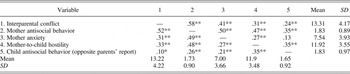
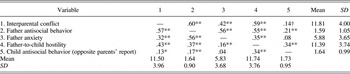
Intercorrelations, means, and standard deviations are presented for genetically related and genetically unrelated mother–child (Table 1) and father–child (Table 2) pairs. Significant associations were apparent between both mothers' and fathers' reports of interparental conflict and child antisocial behavior across genetically related and genetically unrelated pairings (r = .10–.24, p < .01). Significant associations were also apparent between mothers' and fathers' antisocial behavior and child antisocial behavior across genetically related (r = .26 and .17, p < .01) and genetically unrelated (r = .35 and .21, p < .01) groups. Interparental conflict was significantly correlated with mother-to-child and father-to-child hostility (genetically related: r = .33 and .43, p < .01; genetically unrelated: r = .31 and .59, p < .01), as was mothers' and fathers' antisocial behavior (genetically related: r = .48 and .37, p < .01; genetically unrelated: r = .47 and .55, p < .01), with maternal and paternal hostility in turn associated with child antisocial behavior (r = .35 and .34, p < .01). Associations between parent anxiety and child antisocial behavior were not significant for genetically related and genetically unrelated groupings, with the exception of the association between genetically related mothers' anxiety and children's antisocial behavior (r = .21, p < .01).
Intercorrelations, means, and standard deviations among constructs for genetically related (lower diagonal, n = 664) and genetically unrelated (upper diagonal, n = 207) mothers and children

*p < .05. **p < .01.
Intercorrelations, means, and standard deviations among constructs for genetically related (lower diagonal, n = 436) and genetically unrelated (upper diagonal, n = 170) fathers and children

†p < .07. *p < .05. **p < .01.
Path analysis
Path analysis was used to examine the pattern of association linking maternal and paternal reports of interparental conflict, antisocial behavior, parent anxiety, parent-to-child hostility, and child antisocial behavior (opposite parent report). Model tests were conducted using Mplus 5.2 (Muthén & Muthén, Reference Muthén and Muthén2007), which uses full information maximum likelihood to estimate parameters when data are missing. Full information maximum likelihood produces unbiased estimates when data are missing at random. For all variables included in the current study, there was less than 13% missing. The Little's test of missing data indicated that the data were missing completely at random (MCAR) for variables within the mother SEM models, for example, Little's MCAR χ2 (44) = 43.08, p = .51, as well as for variables within the father SEM models, for example, Little's MCAR χ2 (27) = 36.12, p = .11. Results of model tests are presented separately for genetically related and genetically unrelated mother–child and father–child pairings.
The role of the mother–child relationship: Family socialization versus intergenerational transmission
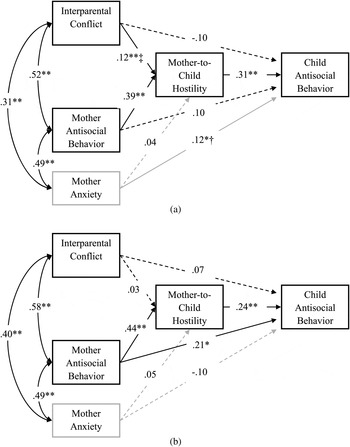
Figure 2a and b illustrates the results for genetically related and genetically unrelated mother–child pairings. For genetically related mothers and children, significant paths were found between interparental conflict and mother–child hostility (β = 0.12, p < .01) and between mothers' antisocial behavior and mother–child hostility (β = 0.39, p < .01). Mother–child hostility in turn predicted child antisocial behavior (β = 0.31, p < .01). Preliminary tests of this model confirmed that a significant association existed between mothers' antisocial behavior and children's antisocial behavior, but not interparental conflict (β = 0.26, p < .01, and β = 0.06, p >.10, respectively). Because the association between interparental conflict and child antisocial behavior was not statistically significant when considered relative to mothers' antisocial behavior, the data do not meet the criteria that Baron and Kenny (Reference Baron and Kenny1986) described as necessary to define a mediational pathway. However, an independent variable can have an indirect effect on a dependent variable even if the variables are not correlated, if the independent variable influences a third, intervening variable, which in turn affects the dependent variable (MacKinnon, Krull, & Lockwood, Reference MacKinnon, Krull and Lockwood2000; MacKinnon, Lockwood, Hoffman, West, & Sheets, Reference MacKinnon, Lockwood, Hoffman, West and Sheets2002). If the independent and dependent variables are each related to the proposed intervening variable, the significance of the indirect association between the independent and dependent variables can then be assessed statistically. We examined whether interparental conflict and parents' antisocial behavior had an indirect effect on child antisocial behavior through the intervening variable of parent-to-child hostility, using procedures outlined by Sobel (Reference Sobel and Leinhardt1982) to test the significance of all indirect effects. The respective indirect effects from interparental conflict and mothers' antisocial behavior on child antisocial behavior via mother–child hostility was significant for both theoretical pathways (family socialization, β = 0.04, p < .05; intergenerational transmission, β = 0.12, p < .01). In addition, a significant path was noted between mothers' anxiety and child antisocial behavior (β = 0.12, p < .05), but not from mothers' antisocial behavior on child antisocial behavior, suggesting that maternal anxiety rather than antisocial behavior may influence offspring antisocial behavior even when negative parenting is considered among genetically related mothers and children. Differences in the magnitude of specific associations across all models were tested for significance using stacked modeling procedures. This involves comparing the chi-square statistic derived from a model where a specific pathway is treated as equivalent across groups to that derived from a model where the path in each subgroup model (e.g., genetically related vs. genetically unrelated mother–and father–child pairings) is allowed to freely vary. The difference in these chi-square statistics provides an estimate of the statistical significance of any genetically related versus unrelated difference in the specific pathways considered. The association between genetically related mother anxiety and child antisocial behavior was significantly stronger when respectively compared to genetically related fathers (Δχ2 = 5.07, df = 1, p < .05) and genetically unrelated mothers (Δχ2 = 3.93, df = 1, p < .05).
The model results for (a) genetically related and (b) genetically unrelated mothers and children. *p < .05. **p < .01. †A significant difference across genetically related versus unrelated groups.

For genetically unrelated mothers, the path from mothers' antisocial behavior to mother–child hostility was statistically significant (β = 0.44, p < .01), with the path from mother–child hostility to child antisocial behavior also statistically significant (β = 0.24, p < .05). However, the path from interparental conflict to mother–child hostility was not statistically significant (β = 0.03, p >.10), negating the significance of an indirect pathway linking interparental conflict, mother–child hostility, and child antisocial behavior. The indirect effect from mothers' antisocial behavior on child antisocial behavior through mother–child hostility was statistically significant (β = 0.11, p < .05), thereby providing support for an intergenerational transmission hypothesis relative to a family socialization perspective in accounting for parent-level influences on offspring antisocial behavior among genetically unrelated mother–child pairings. The association between mothers' antisocial behavior and child antisocial behavior was statistically significant (β = 0.21, p < .05), with the association between mothers' anxiety and child antisocial behavior not statistically significant (β = –0.10, p > .10). This pattern of association between indices of maternal psychopathology and child antisocial behavior reverses the pattern noted for genetically related mothers and children, thereby suggesting possible genetic mediation of this pathway for genetically related mother–child pairings relative to environmental mediation for genetically unrelated mother–child pairings. Further, as the pattern of results for genetically related mother–child pairings does not control for the possible confounding influence of passive genotype–environment correlation, we cannot conclude that the hypothesized mediating pathways (family socialization vs. intergenerational transmission) offer a salient environmental transmission mechanism relative to underlying common genetic influences. However, for genetically unrelated mother–child pairings the role of passive genotype–environment correlation is controlled, thereby adding confidence that the transmission mechanism from mothers' antisocial behavior to child antisocial behavior is environmentally mediated.
The role of the father–child relationship: Family socialization versus intergenerational transmission
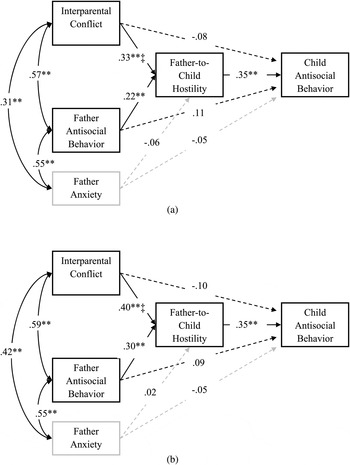
Figure 3a and b illustrates results for genetically related and genetically unrelated father–child pairings. For genetically related fathers and children, significant paths were found between interparental conflict and father–child hostility (β = 0.33, p < .01) and between fathers' antisocial behavior and father–child hostility (β = 0.22, p < .01). Father–child hostility in turn predicted child antisocial behavior (β = 0.35, p < .01). The path from interparental conflict to father–child hostility was significantly stronger when compared to the parallel path for genetically related mothers and children (Δχ2 = 13.35, df = 1, p < .05). Consistent with results for genetically related mothers, the indirect effects from interparental conflict and fathers' antisocial behavior through father–child hostility were statistically significant (β = 0.12 and .08, p < .01), supporting both a family socialization and an intergenerational transmission perspective in accounting for effects on child antisocial behavior problems. Contrary to findings for genetically related mothers, however, neither path from fathers' antisocial behavior nor from fathers' anxiety on child antisocial behavior was statistically significant.
The model results for (a) genetically related and (b) genetically unrelated fathers and children. *p < .05. **p < .01. †A significant difference across genetically related versus unrelated groups.

For genetically unrelated fathers, the pattern of findings replicates exactly the pattern of findings observed for genetically related fathers and children. Once again, significant paths were found between interparental conflict and father–child hostility (β = 0.40, p < .01) and between fathers' antisocial behavior and father–child hostility (β = 0.30, p < .01), with father–child hostility also predicting child antisocial behavior (β = 0.35, p < .01). The association between interparental conflict and father-to-child hostility was also significantly stronger when compared to genetically unrelated mothers and children (Δχ2 = 12.11, df = 1, p < .05). Indirect pathways through father–child hostility were also statistically significant (family socialization, β = 0.14, p < .01; intergenerational transmission, β = 0.11, p < .01). Findings across both genetically related and genetically unrelated father–child pairings suggest that father-to-child hostility serves as a mediating mechanism through which interparental conflict and fathers' antisocial behavior influence children's antisocial behavior. Further, because the confounding role of passive genotype–environment correlation is controlled in the results pertaining to genetically unrelated father–child pairings, we may be confident that, for fathers and children, father's parenting may be a distinct environmental factor underlying family- and parent-psychopathology-sourced influences on children's antisocial behavior.
Each of the models tested across genetically related and genetically unrelated parent–child groupings represent fully saturated statistical models. Fit statistics therefore artifactually suggest a perfect fit between the proposed theoretical model and the underlying pattern of variance and covariance observed between each theoretical variable (χ2 = 0.00, df = 0, goodness of fit = 1.00) and are thus not reported in the figures.
Discussion
The present study utilized an IVF research design to examine the role of mother–child and father–child hostility as a mediating mechanism underlying the transmission of parent antisocial behavior (intergenerational transmission) and interparental conflict (family socialization) influences on children's antisocial behavior problems. Aside from the unique opportunity accorded by this research design to examine hypothesized processes across genetically related and genetically unrelated parent–child groupings, prior work in this area has been advanced in two primary respects. First, past research has tended to examine intergenerational transmission hypotheses separate from family socialization hypotheses and family socialization hypotheses separate from intergenerational transmission hypotheses. The present study integrates these two theoretical traditions by allowing the examination of an index of parent psychopathology (antisocial behavior) that is consonant with an index of family socialization (interparental conflict) that have each been evidenced to adversely affect children through disruptions at the level of the parent–child relationship. Researchers examining the role of interparental conflict on child psychopathology have hypothesized that highly conflicted relations between couples places increased emotional strain on parents, such that emotion expressed in the couple relationship may “spill over” to the parent–child relationship, leading to elevated levels of parent–child hostility that in turn affect children's psychopathology (Erel & Burman, Reference Erel and Burman1995). Researchers examining the intergenerational transmission of psychopathology have also identified the role of negative parenting as a mediating factor underlying parent stress and child distress links. Several researchers have highlighted the role of disrupted parenting practices as a mechanism through which antisocial behavior in parents affects conduct problems and antisocial behavior in children (Capaldi et al., Reference Capaldi, Pears, Patterson and Owen2003; Jaffee et al., Reference Jaffee, Belsky, Harrington, Caspi and Moffitt2006), with studies suggesting that inherited factors, psychosocial adversity, and gene–environment interplay contribute to transmission mechanisms underlying childhood antisocial behavior and that negative parenting is an important mediator of risk (Harold at al., 2010; Meyer et al., Reference Meyer, Rutter, Silberg, Maes, Simonoff and Shillady2000).
Few studies have simultaneously examined a family-level variable such as interparental conflict with an individual-level variable such as parent antisocial behavior in examining the mediating role of hostile parenting underlying children's psychopathology. Yet it would seem congruent to examine an index of aggression at the individual level (antisocial behavior) with a factor marked by aggression and hostility at the family level (interparental conflict) in examining transmission mechanisms through hostile parenting on children's antisocial behavior. Analyses reported in the present study examined genetically related and genetically unrelated mother–child and father–child groupings separately, thereby remedying the dearth of evidence relating to father–child versus mother–child influences on childhood psychopathology (Ramchandani & Psychogiou, Reference Ramchandani and Psychogiou2009). Past research focusing on family socialization and the intergenerational transmission of psychopathology on children has predominantly focused on the mother–child relationship to the relative neglect of the father–child relationship. However, the role of fathers is increasingly recognized as an important influence on children (Lamb, Reference Lamb2004), with evidence suggesting that differential pathways may exist through mother–child and father–child relationships in accounting for family- and parent-level influences on children's psychopathology (Shelton & Harold, Reference Shelton and Harold2008; Stover et al., Reference Stover, Connell, Leve, Neiderhiser, Shaw and Scaramella2012). Results from the present study affirm this emerging body of evidence. Taken together, results suggest differences in the mechanisms of genetic versus environmental risk underlying family socialization and intergenerational transmission pathways on childhood antisocial behavior. In addition, different mechanisms of transmission may operate for mother–child and father–child pairs.
Although there is significant evidence in past research of the spillover hypothesis accounting for interparental conflict effects on children through hostile parenting (Harold et al., Reference Harold, Shelton, Goeke-Morey and Cummings2004), children share 50% of their genes with each biological parent, thereby potentially creating an association that is an artefact of passive genotype–environment correlation rather than a direct effect of caregiving (Stover et al., Reference Stover, Connell, Leve, Neiderhiser, Shaw and Scaramella2012). Results from the present study suggest that pathways from interparental conflict to children's antisocial behavior problems through parent-to-child hostility are present for genetically related and genetically unrelated fathers and children, but these pathways only exist for genetically related mothers and children. Because pathways for genetically unrelated fathers and children preclude the role of passive genotype–environment correlation as a confound to interpreting results, we may conclude that the spillover hypothesis linking interparental conflict, father-to-child hostility, and child antisocial behavior is a salient environmental transmission mechanism rather than an artifact of common genetic influences. Results from the present study suggest, for the first time, as far as we are aware, that pathways from interparental conflict, through parenting, on child antisocial behavior for mother–child pairings may not represent environmental transmission only, because effects are present for genetically related mothers and children and not for genetically unrelated mothers and children. Furthermore, the significantly stronger associations linking interparental conflict and hostile parenting for genetically related fathers compared to genetically related mothers and for genetically unrelated fathers compared to genetically unrelated mothers suggests that the spillover mechanism may operate to a greater degree within the context of the father–child relationship relative to the mother–child relationship and that effects may be explained as more than common genetic influences. This finding is distinctly noteworthy given the historical paucity of research disaggregating mother–child and father–child relationship influences on childhood psychopathology.
Building on results specific to family socialization influences on children, past research also suggests that parents pass on a general vulnerability for externalizing disorders, including antisocial behavior, that is highly heritable and is equally transmittable from biological mothers and fathers (Hicks, Krueger, Iacono, McGue, & Patrick, Reference Hicks, Krueger, Iacono, McGue and Patrick2004). The present study examined the role of parent antisocial behavior, while controlling for levels of interparental conflict, across genetically related and genetically unrelated mother–child and father–child groupings. Results suggest that mothers' and fathers' antisocial behavior affects offspring antisocial behavior through maternal and paternal hostile parenting across genetically related and genetically unrelated parent–child groupings, thereby suggesting environmental transmission of parent psychopathology on child psychopathology through hostile parenting relative to genetic transmission. These results add to an emerging body of evidence highlighting the role of parenting in the context of parent psychopathology on child psychopathology where the confounding influence of passive genotype–environment correlation has been controlled (Harold et al., Reference Harold, Rice, Hay, Boivin, van den Bree and Thapar2010; Stover et al., Reference Stover, Connell, Leve, Neiderhiser, Shaw and Scaramella2012).
An additional ingredient in the present study was to include mothers' and fathers' anxiety symptoms in tests of the proposed theoretical model. Past research suggests that couples who conceive a child through IVF may have higher levels of anxiety compared with community controls (Harlow et al., Reference Harlow, Fahy, Talbot, Wardle and Hull1996) and that IVF couples may experience manifestations of anxiety during and following pregnancy that could impact negatively on later parenting practices (Raoul-Duval et al., Reference Raoul-Duval, Bertrand-Servais, Letur-Könirsch and Frydman1994). When anxiety levels were controlled in the present study, effects were apparent only for genetically related mothers and children, such that maternal anxiety symptoms were significantly associated with offspring antisocial behavior problems. Furthermore, this association was significantly stronger when compared to genetically related fathers and genetically unrelated mothers, suggesting that the link between anxiety symptoms and offspring psychopathology may be genetically informed and of greater salience among genetically related mothers and children compared to other mother–child and father–child groupings.
Limitations and recommendations for future research
Although the present study offers several noteworthy advantages in examining relative genetic and environmental mediation of links between interparental conflict, parent antisocial behavior, parent anxiety symptoms, and hostile parenting on child antisocial behavior, several limitations also merit mention. First, reliance on parent-only reports of each primary theoretical construct would ordinarily limit conclusions relating to the observed magnitude of association across constructs. However, a cross-rater approach was used such that mothers and fathers reported on their own symptoms and parenting behavior with the other parent's report of child symptoms in each instance. Second, cross-sectional data were used in the present study, thereby precluding cause-and-effect conclusions. However, the pattern and direction of associations hypothesized in the proposed theoretical model are consistent with past longitudinal studies utilizing biologically related parents and children (Harold et al., 1997, Reference Harold, Shelton, Goeke-Morey and Cummings2004). Estimation of the pattern of associations using a longitudinal research design would substantively advance insight into the hypothesized direction of effects across genetically related and genetically unrelated groupings. It will also be important to undertake analyses in older children, given that there are important developmental changes in the prevalence and etiology of antisocial behavior across childhood and adolescence. Another limitation, as is the case for all genetically informative designs (including twin and adoption studies), is that relationships between family variables and psychopathology may differ for low-risk groups. However, greater confidence is achieved when there is convergence of findings across studies using a complement of research designs (Rutter, Reference Rutter2007), as has been outlined throughout the presentation of results contained within this study. As with adoption at birth studies, however, potential age-related differences in the expression or measurement of phenotypes between parents and offspring may be a potential limitation of this research design. Finally, an examination of additional mediators theorized to be associated with child psychopathology would augment the current study. The results suggest the presence of unmeasured environmental mediators for the case of mothers but not fathers in the present study, as evidenced by the significant association for the unrelated group between mother–child antisocial behavior, with mothers' hostile parenting offering a partially mediated route through which this association may be explained. Examination of additional dimensions of parenting behavior that may mediate this association (e.g., parental rejection) may help augment understanding of this association in future studies.
These limitations notwithstanding, the present study illustrates the unique attributes of an IVF research design in disentangling genetic and environmental influences on child psychopathology. Perhaps most notably, the study is among the very first of its kind to disaggregate pathways in terms of genetic versus environmental transmission while also separately examining father–child and mother–child transmission mechanisms on childhood antisocial behavior. Findings support the further study of prevention and intervention initiatives that target multiple domains of the family environment in ameliorating offspring antisocial behavior. Programs that aim to remediate the rising rates of antisocial behavior problems across childhood and adolescence would benefit from systematic assessment of mothers and fathers parenting in the context of disrupted interparental relations and parent psychopathology.