Introduction
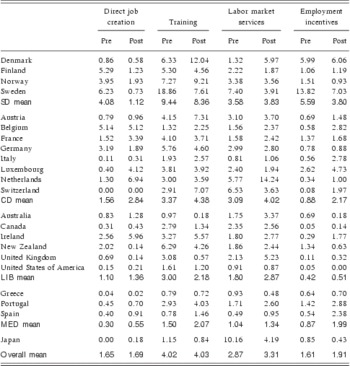
Bouts of high and often prolonged unemployment began to plague advanced industrialized countries in the early 1980s. Active labor market policies consist of diverse policy tools with which to address joblessness, and the degree to which governments invest in various policies as a response to rising unemployment varies widely.Footnote 1 Spending on training and employment incentives peaked in the late 1980s and the mid-1990s. Spending on direct job creation remained relatively high until the late 1990s before dropping sharply. Spending on labor market services increased over time. Besides over time trends, wide variations exist among countries. The literature suggests that dynamics in total spending are driven by political and economic factors. Fleshing out the determinants by policy type holds the promise of illuminating contestation over activation more clearly (for another recent study that disaggregates spending see Vlandas, Reference Vlandas2011). As achieving high employment rates becomes a norm shared by all advanced industrialized countries, the methods used to attain this goal deserve more attention.
This study analyzes the role of partisanship as well as welfare state regimes and the economy on spending patterns. Political parties in government are able to enact legislative change and thereby influence the mix of active labor market policies at work in any given context.Footnote 2 At the same time, examining the relationship between partisanship and spending on different types of policies calls for a more nuanced view of party preferences than exists in quantitative literature. In discussions over active measures, partisan competition is often reduced to a willingness to use government intervention to assist the reintegration of the unemployed. On these grounds, active labor market policies are often deemed ‘leftist’ and contrasted with the ‘rightist’ approach of retrenchment or deregulation. Such an oversimplification leads one to overlook the distinct ways in which active policies are reshaping reintegration markets for the unemployed. Understanding spending effort by policy type therefore calls for a new vocabulary for characterizing different types of active labor market policies and using this vocabulary to formulate and test partisan hypotheses.
We begin by detailing a theoretical framework for understanding variation in active labor market policies. Bonoli (Reference Bonoli2011a, Reference Bonolib) categorizes active labor market policies according to their market orientation and emphasis on human capital investment. In a study of social service reforms, Gingrich (Reference Gingrich2011) explains how all parties employ market-based reforms to empower some groups over others. To take this insight into account, the discussion considers how types of active labor market policies influence the power of the unemployed vis-à-vis other workers as well as employers. These theories are then used to derive partisan hypotheses for direct job creation, training, labor market services, and employment incentives. The role of welfare state regimes and economic conjunctures (including paradigmatic as well as more short-term effects) are also taken into consideration.
Hypotheses for the four main types of active labor market policies are tested with a regression analysis of 22 countries between 1985 and 2008. High spending on direct job creation, a non-market oriented policy type, is marginally higher in the social democratic regime and left governments prior to the activation turn. Left governments spend significantly more than other governments on training policies and after the activation turn these policies also become a distinct feature of the social democratic welfare state. The same trend exists for employment incentives, and this finding underscores the interest of left parties in seeking out cooperation with business actors and the strong capacity to do so within the social democratic regime. Center-right governments and those within the Christian democratic regime also spend marginally higher sums on training policies before the activation turn, which is explained by results for deindustrialization. No partisan or regime effects are found for labor market services, supporting the view that all countries rely on these policies. The literature also suggests that a composite measure masks political conflict, since this policy type encompasses quite diverse policies.
We proceed as follows. The first section analyzes differences in types of active labor market policies. The second section reviews the literature on the role of partisanship to develop hypotheses by policy type. The third section lays out the method and data before the fourth section analyzes the results. The fifth section concludes.
Exploring types of active labor market policies
Comparing types of active measures has become easier largely due to the extensive data collection efforts of the OECD. The first data were published in 1978 and included measures for six categories of ‘employment and manpower policies’ in 1975 for 13 countries (OECD, 1978), and a database was launched in the 1980s. Since the late 1990s, the OECD has merged its efforts with Eurostat. Using the terminology coined by Eurostat, the analysis focuses on four main policy types that constitute 80% of all spending: direct job creation, training, labor market services, and employment incentives.
In an important contribution to the study of policy type, Bonoli (Reference Bonoli2011a, Reference Bonolib) defines two theoretical dimensions along which these policies vary, including pro-market employment orientation (hereafter: market orientation) and investment in human capital. Market orientation refers to whether labor market policy should place individuals in non-subsidized jobs in the private or public sector. Market orientation became particularly important after the onset of the activation turn in the late 1990s. Bonoli speaks of the implied goal of policies rather than their actual labor market consequences, an issue that goes far beyond the scope of this study.
The second dimension of human capital investment builds on a larger debate over how to reintegrate the unemployed into the labor market. The literature can be seen to identify two broad reintegration trajectories, a low quality path and a high quality path. The low quality path exhibits a workfare character (King, Reference King1995; Peck, Reference Peck2001) and related policies sanction the unemployed for not accepting a job even if that job corresponds weakly to the individual's pre-unemployment occupation or offers relatively lower pay. On the other hand, policies reflect the human capital development approach, the high quality path, when they promote the acquisition of marketable skills and strive to place workers in jobs that make use of their skills (Lødemel and Trickey, Reference Lødemel and Trickey2001; Peck and Theodore, Reference Peck and Theodore2001; Dean, Reference Dean2003). Bonoli's second dimension captures the degree to which policies align with this approach. While some policies strongly reflect human capital development, however, remaining policies do not necessarily exhibit a strong workfare orientation. In fact, distinguishing policies by their workfare orientation is not feasible with these data because more information is needed about the sanctions involved (e.g. in terms of access to unemployment benefits).
Market orientation and human capital investment are useful concepts because they illuminate different understandings of how active measures structure labor market processes. In a study of public service reforms in education, health, and elderly care, Gingrich (Reference Gingrich2011) underscores the point that market reforms hold distinct distributional consequences. She explains that ‘[v]ariation in market structures is not a matter of chance, or of long-standing historical trajectories, but of particular reform choices politicians make in taking power away from one group of actors – incumbents – and giving it to the state, users, or new producers’ (3). In this perspective, active labor market policies can be seen as structuring the reintegration market of the unemployed and therefore influencing the power of the unemployed vis-à-vis other workers and potential employers in two ways. First, policies may help unemployed workers move up the ‘job queue’ (Thurow, Reference Thurow1975). That is, the unemployed become more competitive relative to other workers. Second, some policies require assistance from private firms and in this way call on employers who would not otherwise have hired an unemployed worker to help reintegrate these workers in the labor market.
Before using these theoretical concepts to derive hypotheses, a brief overview of each main policy can clarify how the theories speak to each policy type. Direct job creation in the public sector constitutes a policy area that is, in Bonoli's view (Reference Bonoli2011a, Reference Bonolib), weak in terms of both market orientation and investment in human capital. Another description of direct job creation programs supports the view that they are not market oriented and do not go far in investing in participant's skills:
The goal of direct job creation programmes is to increase the available number of jobs while satisfying needs that are not met by the private sector. Such job creation schemes are generally characterized by restrictions on the type of employer (belonging to the public or nonprofit sector) and, usually, the type of employment, which must be of wider social benefit (e.g. benefit achieved through social, cultural or environmental projects. The employment must also usually be ‘additional’, which means that it would not have existed without public intervention) (Schmid et al., Reference Erhel, Gautié, Gazier and Morel1996, 283–284).
While such policies may be somewhat punitive (workfare oriented), if non-attendance implies a loss of benefits, they may also be rather advantageous if participants retain motivation or soft skills they otherwise would have lost (closer to human capital development). From a distributional perspective, while such policies rely on taxes they hold few consequences for other workers and employers.
The remaining three types of policies are all market oriented but differ in their investment in human capital. Training policies for the unemployed clearly invest in participants’ skills and thereby align with the human capital development approach rather than workfare. The positive effects of investing in the human capital of the unemployed lead scholars to classify training as an ‘offensive’ approach (Torfing, Reference Torfing1999) and ‘positive’ activation (Taylor-Gooby, Reference Taylor-Gooby2004). Just as employers and the economy more generally benefit from a more skilled labor force, unemployed workers gain a stronger position in the job search since they are better positioned to find a high quality job. From Gingrich's distributive perspective, training policies can also be seen to improve the position of the unemployed vis-à-vis other workers by helping them move up the ‘job queue’. This view tempers the presumed unambiguous positive effect of training policies.
Labor market services are strongly market oriented and weakly emphasize human capital investment. These policies essentially condition the access of the unemployed to social benefits and define the character of the assistance provided to job seekers. It should be noted, however, that this group encompasses quite different policies. Such policies may be more workfare oriented if they involve heavy sanctions for refusing employment. Conversely, labor market services may align more closely with the human capital development approach when they strive to place individuals in jobs that make full use of their skill set or promote skill acquisition. In this way, labor market services constitute a set of policies with diverse distributional consequences.
With no direct influence on human capital of the unemployed, employment incentives provide subsidies to firms that retain or otherwise hire unemployed workers. These policies are clearly market oriented since the policies create jobs for the unemployed in competitive firms. Such policies carve out a new responsibility for private business in addressing the social problem of unemployment. Similar to training policies, employment incentives also advantage the unemployed over other workers by providing work experience and thereby helping them move up the ‘job queue’.
Hypotheses for policy type
Having described variation among types of active labor market policies, the discussion now turns to deriving hypotheses with particular attention to the role of political parties. The main question driving the analysis is whether political parties systematically differ in their investment by policy type while in government. Identifying systematic differences lends insight into the role of partisanship in setting countries on distinct reform trajectories.
The study focuses on left parties and center-right parties, and their preferences are seen to derive from their voter bases as well as their ideological stances on redistribution and labor market policy. Left parties mainly grew out of workers’ movements and advocate social change and the reduction of social inequality (Fuchs and Klingemann, Reference Fuchs and Klingemann1990; Jost et al., Reference Jost, Federico and Napier2009). Structural economic changes (Hellwig, Reference Hellwig2008) and the emergence of a new value dimension based on social rather than economic issues (Inglehart, Reference Inglehart1990; Kitschelt, Reference Kitschelt1994; Hooghe et al., Reference Hooghe, Marks and Wilson2002) increases the heterogeneity of their voter bases, providing fodder for the argument that left parties favor those in stable jobs over marginalized workers (Rueda, Reference Rueda2005, Reference Rueda2006). The empirical research nevertheless suggests a consistent trend in left support for both passive and active social policies. Strong left incumbency is significantly related to the expansion of traditional passive policies (Stephens, Reference Stephens1979; Korpi, Reference Korpi1983) as well as public services such as education policies and, not least, active labor market policies (Martin and Swank, Reference Martin and Swank2004; Busemeyer, Reference Busemeyer2007; Huo et al., Reference Huo, Nelson and Stephens2008).Footnote 3
Center-right parties have long exhibited a diverse constituency, relying on lower and middle classes as well as elites (Middlebrook, Reference Middlebrook2000). More right-leaning parties are seen to favor system maintenance, conservatism and individualism (Fuchs and Klingemann, Reference Fuchs and Klingemann1990; Jost et al., Reference Jost, Federico and Napier2009), and ‘cooperation with the private sector, public order, clean government, morality, or the priority of growth over distribution’ (Middlebrook, Reference Middlebrook2000). Non-secular center-right parties, or Christian democratic parties, have been tied to higher levels of social spending on transfers (Huber et al., Reference Huber, Ragin and Stephens1993; van Kersbergen, 1995) and a reliance on labor-shedding policies until the last decade or so (Palier, Reference Palier2010). Center-right parties more generally have been found to support new forms of social policies that promote high employment such as daycare (Morgan and Zippel, Reference Morgan and Zippel2003).
In order to develop valid hypotheses, two contextual factors also need to be taken into account. First, short-term partisan effects need to be distinguished from the role of welfare state regimes. The long-term incumbency of social democratic and Christian democratic political parties led to the formation of welfare states by the same name (Esping-Andersen, Reference Esping-Andersen1990). In each regime, the partisan ideology of the dominant party permeated the entire policy-making system (Huber and Stephens, Reference Huber and Stephens2001) leading to the legitimation of various policy mixes largely independent of short-term changes in government. The literature on production regimes demonstrates how welfare state institutions exhibit affinities with other aspects of the economy such as training and corporate governance (Soskice, Reference Soskice1999).
Second, the literature suggests that the policy preferences of parties and welfare state regimes differ before and after the activation turn. Scholars speak of a shift from a Keynesian welfare state that prioritizes full employment and low social inequality to a Schumpeterian welfare state that subordinates social issues in the name of stimulating economic competitiveness and innovation (Jessop, Reference Jessop1999; Peck, Reference Peck2001; Peck and Theodore, Reference Peck and Theodore2001; Vis, Reference Vis2007). While transitions towards more market oriented labor market policies began earlier in many countries, the mid to late 1990s is seen by many as a turning point. In 1997, social democratic parties in the United Kingdom and Germany announced their commitment to the ‘Third-Way’ and the European Commission published a communication entitled ‘Towards Common Principles of Flexicurity: More and better jobs through flexibility and security’. These steps denote a new consensus that social policies and labor market regulations should facilitate labor market participation and therefore play a productive function.
The rest of this section draws on the literature to derive hypotheses by policy type.
Direct job creation
Direct job creation includes policies which are, according to Bonoli's (Reference Bonoli2011a, Reference Bonolib) characterization, weakly market oriented. Occupying the unemployed by placing them in subsidized employment in non-competitive sectors corresponds to the ‘consumption smoothing’ objective of passive labor market policies (Hemerijck, Reference Hemerijck2011). Christian democratic welfare states tend to promote this objective by facilitating labor market exit (Kersbergen and Hemerijck, 2004). While neoliberal thinking began to spread in the early 1980s, contexts with generous welfare states did not deregulate as fervently as more liberal countries and responses to rising unemployment initially relied on old recipes. As a case in point, Bonoli (Reference Bonoli2011a) notes a strong dependence on direct job creation in both social democratic and Christian democratic regimes in the 1980s. At the same time, the emphasis on labor shedding in Christian democratic countries until the late 1990s leaves some ambiguity as to whether this regime spends highly on direct job creation rather than, say, early retirement policies.
One might still expect partisan effects. Given that right governments suffer electorally for high inflation, whereas left governments lose more votes for high unemployment (Powell and Whitten, Reference Powell and Whitten1993), the latter might invest more highly in direct job creation. At the same time, center-right parties in countries with dominant left parties face immense pressure to support the welfare state due to its popularity and the power of vested interests (Jensen, Reference Jensen2010). As a case in point, at the height of neoliberal thinking in the 1980s bourgeois parties in power in Denmark actually expanded the welfare state in a social democratic direction (Green Pedersen, Reference Green Pedersen1999).
By the onset of activation turn, however, all parties had shifted towards more market-orientated agenda. Traditional social democratic egalitarianism gave way to a focus on productive solidarity and inclusion through labor market participation (Huo, Reference Huo2009: 7–21). Even in contexts where they historically experienced the strongest levels of support, left parties pursued market-orientated reforms as a method for retaining the legitimacy of welfare state institutions in the context of higher demand for individual choice (Klitgaard, Reference Klitgaard2007) albeit in a distinctly social democratic manner (Gingrich, Reference Gingrich2011). Even Christian democratic parties, traditionally partial to enabling labor market exit, shifted gears (Palier, Reference Palier2010). Changes in thinking by social and Christian democratic parties freed up other parties in the respective regime to pursue more market-friendly policies.
Based on the discussion above, we expect spending on direct job creation to be driven by partisan and regime specific factors. Resistance to recommodification was high in Christian democratic and social democratic regimes before the activation turn. At the same time, the Christian democratic regime exhibits a tendency to reduce participation altogether. Regime effects aside, left parties demonstrate a particular predilection for keeping employment high. The activation turn led parties in all welfare states to focus on social and labor market policies that facilitate employment in regular jobs, leading us to expect no partisan or regime effects later on.
H1: The social democratic welfare state regime should spend significantly more than other regimes on direct job creation before the activation turn.
H2: Left governments should spend significantly more than other governments on direct job creation before the activation turn.
Training
While the activation turn undermined support for non-market oriented policies, market-oriented policies were of relevance throughout the period. Not least, deindustrialization created demand for retraining programs by making many workers redundant. Given that left and center-right parties draw support from workers we might therefore expect both to support training policies. Case study evidence lends support to this expectation for center-right parties. Party manifestos of the British conservative party mention the need for education and training throughout the 1990s (Childs et al., Reference Childs, Webb and Marthaler2010) and other research shows that levels of spending on training were comparable to other EU countries until the early 1990s (Clasen, Reference Clasen2005, Reference Clasen2011). Mario Baldassarri, when deputy minister of economy and finance of the center-right National Alliance party in Italy, is quoted as saying that ‘those who lose their job cannot be let alone, there must be a subsidy or paid training courses that can help them to find a new work’ (Baglioni et al., Reference Baglioni, della Porta and Graziano2010). Christian democrats in the Netherlands were also vocal about their support for training (Seeleib-Kaiser et al., Reference Baglioni, della Porta and Graziano2010). Moreover, a comparative study of Austria, Germany, and the Netherlands finds convergence in the employment policy preferences of social democratic and Christian democratic parties (Seeleib-Kaiser et al., Reference Seeleib-Kaiser, van Dyk and Roggenkamp2010) and other research shows convergence between left and center-right parties more generally (Glyn, Reference Glyn2001; Ladrech, Reference Ladrech2002).
At the same time, the literature also emphasizes human capital investment as a more distinctly leftist policy (Boix, Reference Boix1998; Huo, Reference Huo2009). In this vein of thought, even though center-right parties support workers, the level of support from left parties is simply greater. As a case in point, while British conservatives maintained support for training policies on the basis of voluntarism, for example Career Development Loans, the Labour Party went much further in espousing human capital investment in all workers (Stedward, Reference Stedward2003). Also, while historically encouraging the accumulation of high quality skills through apprenticeship training, Christian democratic parties tend to defer authority over the management of training to firms, which corresponds to their belief in subsidiarity or the idea that ‘higher authorities, such as the state, should intervene only where individuals or smaller communities are not competent’ (Kalyvas and Kersbergen, Reference Kalyvas and van Kersbergen2010: 187). Employment policies in particular are seen as the responsibility of the social partners (van Kersbergen, 1995: 174–191; Huber and Stephens, Reference Huber and Stephens2001). Quantitative studies on active labor market policies shows that left party incumbency relates to higher spending, whereas there is no effect for Christian democratic parties (Hicks and Kenworthy, Reference Hicks and Kenworthy1998). Besides respect for the church and the traditional family, non-secular parties’ preference for subsidiarity stems from a desire to respect existing class structures, a desire they share with secular center-right parties. Since center-right parties wish to appease their diverse constituency, they are likely to avoid policies that advantage some voters over others. To the extent that training policies move the unemployed up the job queue and thereby make them competitive for positions sought by other employed workers, center-right parties should be agnostic towards these policies.
While the discussion leaves some ambiguity about party preferences, the literature suggests larger distinctions between regimes. Whereas both Christian democratic and social democratic regimes support the human capital development of skilled workers only the latter exhibits a strong public commitment to education and focuses particular attention on unskilled workers (Iversen and Stephens, Reference Iversen and Stephens2007; Ó Riain, Reference Ó Riain2011). Studies denote a singular Nordic approach to increasing employment, which builds on training for the unemployed (Rubenson, Reference Rubenson2006; for a dissenting view see Meager, Reference Meager2009). All the same, the distinction of this group is a relatively recent phenomenon. Though Sweden and to some extent Denmark exhibit a long tradition of state involvement in training jobless adult workers, support for the unemployed via training policies was strengthened across all Nordic countries during the 1990s (Kuhnle, Reference Kuhnle2000) and the regime established itself in this way by the late 1990s (Kvist, Reference Kvist2003). Initially pursuing a labor-shedding approach to high unemployment (Kersbergen and Hemerijck, 2004; Palier, Reference Palier2010) the Christian democratic regime can be seen to move toward promoting labor market participation by the late 1990s, though there is little evidence that human capital investment constitutes a central component of reforms (Palier, Reference Palier2010).
In sum, we expect partisan and regime effects for spending on training policies. Left governments should spend more than other governments throughout the period under investigation and we tentatively extend this expectation to center-right governments as well. The social democratic regime should also be related to higher spending after the activation turn.
H3: Left governments should spend significantly more on training than other governments before and after the activation turn.
H4: Center-right governments should spend significantly more on training than other governments before and after the activation turn.
H5: The social democratic regime should spend significantly more on training than other regimes after the activation turn.
Labor market services
So far, the concepts of market orientation and human capital investment have been quite fruitful in deriving hypotheses for spending patterns on direct job creation and training policies. And, at first glance, the classification of labor market services as market oriented and weakly focused on human capital investment suggests that expectations about partisan influence may be similar to those for training.
At the same time, the earlier description of policy types exposed the diversity among labor market services. Whereas some types of labor market services invest in or protect the skills of the unemployed, thereby approximating the human capital development approach, other policies aim at placing the individual in any job as quickly as possible, usually through sanctions, and therefore come closer to workfare. Both these components are found in reforms of labor market services (Dingeldey, Reference Dingeldey2007; Lindsay et al., Reference Lindsay, McQuaid and Dutton2007), which frustrates efforts to discern the distributive effects from a composite measure and thus derive partisan hypotheses.
Aside from ambiguous distributive consequences, partisan differences are unlikely to be detected in spending levels. First, all countries rely on these policies to some extent. Harking from labor exchanges in earlier times (Janoski, Reference Janoski1990) labor market services are now well developed in all advanced industrialized countries. Second, these policies tend to be relatively low cost, which implies low increasing returns and thereby narrow room for partisan distinctions to appear. Third, reforms in labor market services tend to reflect paradigmatic changes so that similar patterns of reforms are evident across diverse welfare states (Weishaupt, Reference Weishaupt2010). We therefore do not expect spending on labor market services to exhibit partisan divisions.
H6: Governments of different partisan shades and welfare state regimes should not spend significantly different amounts on public employment services either before or after the activation turn.
Employment incentives
Similar to labor market services, the dimensions of market orientation and human capital investment employed by Bonoli (Reference Bonoli2011a, Reference Bonolib) are less useful in deriving hypotheses for employment incentives. Therefore, this section relies more on the role of distributive effects highlighted by Gingrich, drawing on the two points: employment incentives advantage the unemployed by moving them up the job queue and call on employers to expend resources to hire from a particular group of workers.
Employment incentives, as with training, advantage the unemployed by moving them up the job queue, which is a characteristic shared with training. Therefore, in a similar way, employment incentives may be seen to present challenges to politicians from center-right and, to a lesser extent, left parties that draw support from diverse groups of workers. Namely, supporting such policies risks alienating those in more stable employment positions. Despite these caveats, left governments, center-right governments, and the social democratic regime (after the activation turn) were hypothesized to address the needs of marginalized workers through high spending on training policies.
Employment incentives exhibit another unique feature however. They call on employers in the private sector to assist in the reintegration of the unemployed by providing them with job experience. Center-right parties have long cultivated a close relationship with and protected the interests of employers (Cioffi and Höpner, Reference Cioffi and Höpner2006). Given that hiring decisions are a core competency of firms, center-right parties should shy away from imposing obligations on firms. Left parties, on the other hand, aim at ‘constraining business while relying on it to maintain high investment’ (Glyn, Reference Glyn1998: 16). Swedish social democrats have long nurtured close ties to big business (Israel, Reference Israel1978). In a study of German and Swedish social democrats, Swenson (Reference Swenson1991) talks of the attempts of leaders to fashion ‘tacit alliances with powerful employer interests’ (380). Therefore, all parties seek alliances with business to broaden their support coalition, although they differ in terms of their willingness to impose on business to achieve social objectives.
With respect to welfare state regimes, the Varieties of Capitalism approach highlights the strong coordinative capacity among socio-economic actors, including parties and employers, within Coordinated Market Economies, which consist of the same countries as the social democratic and Christian democratic regimes (Hall and Soskice, Reference Hall and Soskice2001). Despite strong coordination over training for young people, however, the role of employers and their commitment to a social agenda differs between the welfare regimes. The social democratic regime has retained a form of solidaristic capitalism, whereas the Christian democratic regime has become more segmentalist (Martin and Thelen, Reference Martin and Thelen2008).
H7: Left governments should spend significantly more on subsidies to private firms than other governments before and after the activation turn.
H8: The social democratic regime should be related to higher spending on employment incentives than other regimes after the activation turn.
Before turning to the methodology and analysis, we briefly discuss the control variables. The number of veto points arguably impedes policy change by allowing minority groups to block legislation (Immergut, Reference Immergut1990). The compensation hypothesis maintains that high levels of trade openness trigger welfare state expansion by increasing income volatility (Cameron, Reference Cameron1978; Ruggie, Reference Ruggie1982; Katzenstein, Reference Katzenstein1985; Rodrik, Reference Rodrik1998). The logic of industrialization contends that welfare state development is driven by new risks brought on by economic development (Wilensky, Reference Wilensky1975), motivating the inclusion of controls for openness, growth, and deindustrialization.
Data, measurement, and analytic techniques
The data set is unbalanced and stretches from 1985 to 2008. The 22 countries included in the analysis are Austria, Australia, Belgium, Canada, Denmark, Finland, France, Germany, Greece, Ireland, Italy, Japan, Luxembourg, the Netherlands, New Zealand, Norway, Portugal, Spain, Sweden, Switzerland, the United Kingdom, and the United States. The models can be expressed in the following way
 $$\displaylines{ {{I}_{t{\rm{ - (}}t{\rm{ - 1)}}}}\,{\rm{ = }} & \,{{B}_{\rm{0}}}\,{\rm{ + }}\,{{B}_{\rm{1}}}{}{{I}_{t{\rm{ - 1}}}}\,{\rm{ + }}\,{{B}_{\rm{2}}}{{L}_{{}t{\rm{ - 1}}}}\,{\rm{ + }}\,{{B}_{\rm{3}}}{{C}_{{}t{\rm{ - 1}}}}\,{\rm{ + }}\,{{B}_{\rm{4}}}S\,{\rm{ + }}\,{{B}_{\rm{5}}}R\,{\rm{ + }}\,{{B}_{\rm{6}}}{{V}_{{}t{\rm{ - 1}}}}\,{\rm{ + }}\,{{B}_{\rm{7}}}{{O}_{{}t{\rm{ - 1}}}}\, \cr & \;{\rm{ + }}\,{{B}_{\rm{8}}}G{{{}}_{t{\rm{ - 1}}}}\,{\rm{ + }}\,{{B}_{\rm{9}}}P{{{}}_{t{\rm{ - 1}}}}\,{\rm{ + }}\,{{B}_{{\rm{10}}}}D{{{}}_{t{\rm{ - 1}}}}\,{\rm{ + }}\,{\epsilon} \cr}$$
where I refers to investment in different policy types, L refers to left government, C is center-right government, S stands for social democratic regime, R for Christian democratic regime, V is veto points, O is openness, G is GDP growth rate, P is growth per capita, and D is deindustrialization.
To take the activation turn into consideration, models are run from 1985 to 1997 and then from 1998 to 2008. Demarcating the onset of the activation turn is somewhat subjective. Some scholars note that the activation turn began ‘in the mid-1990s’, whereas others use a communication from the EU in late 1997. Using 1996 and 1997 as alternative cut-off points did not contradict the results presented here.
The dependent variables include measures for active labor market policy spending (see Table 1). Each of the five policy types is measured as a percentage of GDP divided by the unemployment rate in order to control for policy demand. This procedure is relatively standard in the field since spending effort is intrinsically motivated by unemployment. Four measures for policy types are tested and the policy types include labor market services, training measures, incentives to private firms, and direct job creation. The data on active labor market policies were retrieved from the OECD Stat.extracts database.
Means of country and regime spending, pre- and post-activation turn

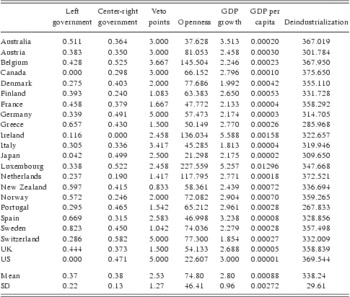
All the independent variables are lagged by one year. Left and center-right partisanship is measured as the percentage of cabinet posts held by each respective group of parties. For left parties, the coding follows the classification scheme from the Comparative Parties Dataset. The coding for the center-right parties is based on myriad sources from the literature.Footnote 4 Veto points are an additive index of federalism (none, weak, strong), bicameralism (absent, weak, strong), presidentialism (absent, present), and use of popular referenda. Trade openness is the total volume of imports and exports as a percentage of GDP. GDP growth is the change in the rate of growth from year t − 1 to year t. GDP per capita is the total volume of goods and services produced by national residents measured in current US dollars per capita. Deindustrialization follows Iversen and Cusack (Reference Iversen and Cusack2000) and is ‘100 minus the sum of manufacturing and agricultural employment as a percentage of the working-age population’. The analysis uses a 5-year measure to capture trends. All of the independent variables as well as the measure for unemployment used to weigh the dependent variable are derived from the Comparative Political Data Set I compiled at the University of Berne, and are presented in Table 2 below.
Means of independent variables

While spending data are the only comparable data available for active labor market policies, a number of drawbacks are linked to this type of data and deserve attention. First, spending levels, though a measure of effort, do not say anything about the quality of services provided to the unemployed. Moreover, although disaggregating by policy type does provide some traction on interpreting what political parties are indeed trying to accomplish, the policy types, especially for labor market services, remain quite broad and there are therefore strong limits to what one can say about how spending is in fact allocated. Third, there are issues of consistency in how the OECD measures various data (De Deken and Kittel, Reference De Deken and Kittel2007).
Difficulties in estimating models with pooled data arise because the error structures of such models tend to be autocorrelated, cross-sectionally heteroskedastic, and cross-sectionally correlated (Hicks, Reference Hicks1994). Comparative data often exhibits non-stationarity as well. Two steps are taken to address these issues. First, the dependent variable was measured as a change variable in order to deal with autocorrelation and non-stationarity.Footnote 5 Second, country and time dummies (FE(CT)) are also included to control for unit and time effects. Plümper et al. (Reference Plümper, Troeger and Manow2005: 330) have argued that country dummies absorb the explanatory power of time invariant variables and those where the variation is predominantly cross-sectional. In this data set, however, there is a high level of within-group variation, which lessens the likelihood that effects are suppressed. Joint F-tests of country and time dummies are also significant in most models, which shows that their inclusion is necessary to estimate unbiased parameters. All models are estimated using version 11.0 of the STATA econometrics program.
Results
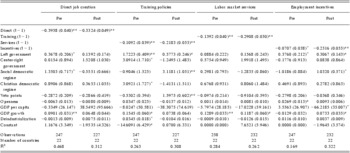
Table 3 displays the results of the cross-sectional time series analysis. The results for direct job creation are in line with expectations. Arguably because of their predisposition to maintaining high employment, left governments and the social democratic regime are related at the 0.1 level to higher spending before the activation turn. There are no regime or partisan effects detected afterwards, a finding which lends support to the argument that all parties lack incentives to systematically invest in these policies after consensus that social policies should serve a productive function arose.
Determinants of spending on different types of active labor market policies

Standard errors in parentheses; *P<0.05, **P<0.01, +P<0.1.
Also upholding the expectations for training policies and employment incentives, the results show left parties to spend significantly more on both types of policies throughout the period under investigation, whereas the social democratic regime spends a marginally more significantly amount on both policies after the onset of the activation turn. These findings support the view that left parties are avid supporters of policies that invest in workers’ human capital and engage business in social issues. The findings for the social democratic regime can be elucidated by a previous study tying high spending on active labor market policies in these countries to their solidaristic socio-economic systems (Martin and Thelen, Reference Martin and Thelen2008), which foremost consist of a strong state and, largely a product thereof, centralized business organizations.
Moreover, the results for the social democratic regime demonstrate the ability of this regime type to reinvent itself in the face of changing socio-economic conditions. The findings reaffirm the focus of the social democratic regime on promoting high employment as well as low equality (Esping-Andersen, Reference Esping-Andersen1990), since training and incentives to private firms help place marginalized workers in regular employment. Whereas Sweden long used active labor market policies as part of a broader industrial policy, the other Nordic countries only adjusted in more recent times. For instance, Danish unemployment insurance remained of unlimited duration for most of the 1980s. Starting in 1994 and continuing for the rest of the decade, reforms dramatically made Danish unemployment policy one of the most activating in Europe. In line with the results here, the Danish activation approach predominantly involves training policies and incentives to private firms.
These results also suggest an alternative view of path dependency to that forwarded by Pierson (Reference Pierson1996, Reference Pierson2000). Pierson explains path dependency by the logic that over time ‘the costs of exit – of switching to some previously plausible alternative – rise’ (2000: 252), which, he argues, leads to a status quo bias in institutions. One might apply this lesson to policy objectives as well. Countries within the social democratic regime have long held the goal of maintaining high employment. To the extent that this objective constitutes a focal point in the policy-making process, one might speak of it as exhibiting path dependent characteristics. This leads to a slightly counter-intuitive reinterpretation of Pierson's idea: path dependency in policy objectives (i.e. high employment) may actually facilitate flexible, adaptive change in institutions (policy outcomes). As a case in point, while the social democratic regime was related to higher spending on direct job creation earlier on, it shifted course towards more market-oriented policies after the activation turn.
Although significant only at the margins and before the activation turn, center-right governments and the Christian democratic regime also spend highly on training policies. Whereas center-right governments were expected to expand training policies to help workers, the diversity of these parties’ voting bases along with their penchant for protecting class structures shed doubt on this hypothesis. Similar expectations for the Christian democratic regime preempted the derivation of any hypothesis at all. Given these expectations, the results raise questions about why conservative legacies were overcome and policies expanded that helped both lower and middle class workers. The result for deindustrialization partially explains this puzzle. High levels of deindustrialization, however, indicate an erosion of the core industrial workforce. The vast industrial closures of the 1980s and early 1990s were indeed an exceptional occurrence, leaving many workers without jobs and few prospects of finding employment. These results demonstrate how the state of the economy can moderate long-standing ideological positions on redistributive policy and the preferred extent of state intervention.
The findings for labor market services are in line with the expectation of no significant regime or partisan effects. However, as touched upon earlier, labor market services encompass a broad array of policies. Null results may therefore demonstrate a shared belief in investment in services to move the unemployed into jobs quickly, but nevertheless mask important differences in the way that different parties and regimes prefer to go about doing this.
The controls did not produce many significant results. GDP growth was significantly positively related to spending as expected. The findings for veto points and GDP per capita were mostly insignificant and in one model significant in the wrong direction. The results for openness and deindustrialization were also rather weak.
Overall, the results nuance existing theories on the politics of active labor market policies in at least two ways. First, types of active labor market policies function quite differently in that party preferences vary importantly by policy type. In fact, the results show that some types of policies are rather partisan (e.g. training), whereas others are not (e.g. labor market services). Of course, one might disaggregate further or in new ways to gain leverage to explain the variation in activation regimes in Europe.
Second, party preferences are not static but change over time in response to economic transformations. The activation turn represents the deep shift in thinking about the appropriate structure of labor market policy and the findings suggest that the mix of policies that parties prefer differed importantly before and after the turn. The rate of deindustrialization constitutes another important contextual factor and was argued to modify the center-right parties’ hesitation to expand policies with clear distributive consequences. Economic changes thereby alter not only what parties want but the degree of alignment between various actors over particular policy initiatives.
Conclusion
This study disaggregated active labor market policies in order to gain leverage in explaining partisan contestation over activation. Studies from Bonoli (Reference Bonoli2011a, Reference Bonolib) and Gingrich (Reference Gingrich2011) were used to theorize and derive hypotheses for partisan effects by policy type, and three concepts were used to differentiate policies, including market orientation, human capital investment, and distributive consequences. Market orientation became highly relevant for all parties after the activation turn and denotes whether policies place participants in regular jobs. Direct job creation policies are only weakly market oriented, whereas remaining policies are more so. Training policies clearly promote human capital investment, and left parties as well as, to some extent, center-right parties also have incentives to promote such policies. Only left parties were expected to invest heavily in incentives to private firms, due to their interest in addressing distributive issues. Labor market services remain a black box, since all parties hold an interest in providing these though the diversity within this policy type likely masks important partisan divides. These ideas were the basis for eight hypotheses derived in the second section.
The results largely confirmed the hypotheses. While left parties remain the strongest advocates of active labor market policies, in line with the extant literature, the results suggest that the nature of left support varies importantly across time and policy type. Before the activation turn, left parties and the social democratic regime were weakly significantly related to direct job creation, a non-market oriented policy type. In this earlier period, left parties in government also spent more on training and incentives to private firms. Center-right parties were also found to spend highly on training policies as did the Christian democratic regime, a finding corroborated by the qualitative literature and explained with reference to the high level of deindustrialization. This finding illuminates the relevance of the economy in moderating partisan ideology and regime legacies.
After the activation turn, partisan and regime effects for direct job creation fell away, upholding the expectation that the activation turn shifted attention to more market-oriented policies. Left governments and countries within the social democratic regime distinguished themselves by spending more on training policies and incentives to private firms. The broader literature on activation points to the strong capacity for continued solidarity within the social democratic regime, not least due to a strong state and centralized business associations. The important differences before the activation turn as compared to after underscore the capacity of the social democratic regime to reinvent itself and motivated a reinterpretation of Pierson's path dependency to apply to policy objectives rather than institutions.
A central lesson of this study is that disaggregating policies allows researchers to analyze aspects of a given policy area that are conflated if a composite measure is used. While this study disaggregated active measures by policy type, future research could continue this approach to look, for instance, at variation in preferences over the provision of labor market services (e.g. public vs. private, federal vs. local).
Acknowledgments
An earlier version was presented at the SASE 23rd Annual Conference, Transformations of Contemporary Capitalism: Actors, Institutions, Processes, Universidad Autónoma de Madrid June 23–25, 2011.