INTRODUCTION
Many cytoplasmic parasites have evolved strategies of host sex ratio distortion that lead to increased production of female offspring to ensure their own transmission, because transmission to a male host is a dead end for the parasite. These strategies include induction of parthenogenesis, male killing and feminization (Bandi et al. Reference Bandi, Dunn, Hurst and Rigaud2001). Among crustacean hosts, cytoplasmic parasites frequently have been observed to induce feminization (converting males to females, which transmit the parasites). Besides the well-described Wolbachia bacteria commonly found in isopods (Bouchon et al. Reference Bouchon, Rigaud and Juchault1998), a variety of feminizing microsporidia have been recently identified in amphipods (Terry et al. Reference Terry, Smith, Sharpe, Rigaud, Littlewood, Ironside, Rollinson, Bouchon, MacNeil, Dick and Dunn2004). Feminization may be common in amphipods because of great plasticity in their sex determination system, which rarely has well-differentiated sex chromosomes (Lécher et al. Reference Lécher, Defaye and Noel1995). Instead, sex is often influenced by environmental factors or sex-distorting elements (Bulnheim, Reference Bulnheim1978; Terry et al. Reference Terry, Smith and Dunn1998; Dunn et al. Reference Dunn, Hogg, Kelly and Hatcher2005; Rodgers-Gray et al. Reference Rodgers-Gray, Smith, Ashcroft, Isaac and Dunn2004).
We studied sex ratio distortion in Corophium volutator, an intertidal amphipod (Crustacea: Amphipoda) commonly found at coastal mudflats of North America and Europe (Meadows and Reid, Reference Meadows and Reid1966). For populations of this species in Great Britain and Canada, strongly female-biased sex ratios have been described in adult and juvenile cohorts (Watkin, Reference Watkin1941; Peer et al. Reference Peer, Linkletter and Hicklin1986; Schneider et al. Reference Schneider, Boates and Forbes1994). Factors that have an influence on population sex ratio in C. volutator include primary sex ratio and differential mortality of males and females. Primary sex ratios at the time of release from the mother's brood pouch appear to indicate an already existing skew towards female offspring (Schneider et al. Reference Schneider, Boates and Forbes1994). Higher mortality of mate-searching males compared to more sedentary adult females occurs, although it fails to explain strong sex ratio bias in juveniles, which are not yet subjected to differential predation (Forbes et al. Reference Forbes, Boates, McNeil and Brison1996). Little is known about sex determination mechanisms in C. volutator, but so far no evidence for sex chromosomes has been reported. The strongly female-biased sex ratios in adult as well as juvenile cohorts (Schneider et al. Reference Schneider, Boates and Forbes1994) suggest that a parasitic sex ratio distorter might be present and prevalent.
In this study, we explored whether female-biased sex ratios of C. volutator amphipods at Bay of Fundy sites might be explained by parasitism by a microsporidian parasite. We first compared parasite prevalence in male and female hosts, by screening ovarian and testicular tissue with microsporidian specific primers, after confirming successful DNA extraction, as detailed below. Screening gonadal tissue also provided an indication of whether the parasite might be transmitted vertically if, for example, it is present or prevalent in ovaries but rare or absent from testes. We generated 16S rDNA sequence data to characterize the parasite and determine if it was related to other known microsporidians. We then determined the prevalence of infection, across four mudflat sites sampled in 2 time-periods to assess how widespread infections were in Bay of Fundy populations. These sites were known to have female-biased sex ratios, based on previous work (Forbes et al. Reference Forbes, McCurdy, Lui, Mautner and Boates2006 and references therein). Finally, we assessed whether infected females brought in from the field and allowed to release their young in the lab gave rise to more female-biased broods than did uninfected females treated in the same fashion. We tested for any influence the parasite might have on female fitness by measuring size and fecundity of infected and uninfected females from subsamples, as well as survivorship of their offspring.
MATERIALS AND METHODS
Comparison of microsporidian prevalence in gonads of male and female C. volutator
We first compared the frequency of microsporidian parasite infection in 27 female and 39 male C. volutator collected at Blomidon (45°13′N; 64°22′W) in the Bay of Fundy in June 2002. In June 2003, we collected additional 306 females and 65 adult males from this site and also screened them for microsporidians. Samples were kept frozen until ovaries and testes were excised out and then screened for parasite infection. All dissecting instruments were sterilized between individuals to avoid cross-contamination.
Genomic DNA was extracted by standard phenol-chloroform purification (Sambrook et al. Reference Sambrook, Fritsch and Maniatis1989), following a 2 h digestion step at 65°C in CTAB buffer and proteinase K. All samples were amplified using invertebrate cytochrome c oxidase subunit I primers (LCO1490 5′-ggtcaacaaatcataaagatattgg-3′, HCO2198 5′-taaacttcagggtgaccaaaaaaatca-3′) to confirm successful DNA extraction (Folmer et al. Reference Folmer, Black, Hoeh, Lutz and Vrijenhoek1994). The PCR reaction had a total volume of 25 μl and contained 20 ng of DNA extraction, 10X PCR buffer, 160 μm of each dNTP, 1·5 mm MgCl2, 0·8 pmol of each primer and 1·5 units of Taq polymerase (Invitrogen). The standard PCR programme included 40 amplification cycles at an annealing temperature of 50°C. Reactions were scored as positive if a single band was visualized on an ethidium bromide-stained agarose gel and if size was in accordance with published band sizes of cytochrome oxidase I of other amphipods (e.g. Gammarus duebeni, Ironside et al. Reference Ironside, Smith, Hatcher, Sharpe, Rollinson and Dunn2003a). We sequenced this 710 bp fragment to confirm it was amphipod cytochrome oxidase I (COI). We had collected additional amphipods, but either failed to excise the ovaries or testes completely or failed to extract DNA. Thus our samples for examining infection rates in amphipods were based on ca. 95% of samples we collected and successfully extracted DNA from: a total of 333 females and 104 males across 2 sampling dates.
Microsporidian-specific primers 18sf (5′-gttgattctgcctgacgt-3′) and 964r (5′-cgcgttgagtcaaattaagccgcaca-3′) (Terry et al. Reference Terry, MacNeil, Dick, Smith and Dunn2003) were used to amplify part of the parasitic 16S rDNA. We used the following PCR reaction: a total volume of 25 μl containing 20 ng of DNA, 10× PCR buffer, 160 μm of each dNTP, 0·75 mm MgCl2, 0·8 pmol of each primer and 1·5 units Taq polymerase (Invitrogen). After an initial denaturation at 95°C for 5 min, samples were subjected to 40 cycles of denaturation at 95°C for 50 sec, annealing for 60 sec at 50°C and extension at 72°C for 90 sec. Finally, there was 1 extension cycle at 72°C for 10 min. All PCR reactions were scored on a 1·5% agarose gel. Our PCR was stringent and the annealing temperature we used is within the range used by others (e.g. Hogg et al. Reference Hogg, Ironside, Sharpe, Hatcher, Smith and Dunn2002; Terry et al. Reference Terry, Smith, Sharpe, Rigaud, Littlewood, Ironside, Rollinson, Bouchon, MacNeil, Dick and Dunn2004). More importantly, we note that PCR with microsporidian specific primers was scored as positive if a single characteristic band of 900 bp could be identified on ethidium bromide-stained agarose gels. We did not observe any different sized bands. Therefore, we did not expect there to be another parasite in our samples of amphipod gonads (confirmed with sequence data as detailed below). An individual was thus scored as infected if it produced this characteristic band; and only those individuals with successful DNA extraction were screened for infection.
We tested for differences in prevalence of infection using Fisher's exact texts, which are appropriate for 2-sample comparisons, and calculated confidence limits around prevalence estimates, using the Clopper-Pearson method (Zar, Reference Zar1996). The Clopper-Pearson method has the advantage over normal approximation in that estimates cannot go below zero or above 100%, which is biologically meaningless. Even when the estimate of prevalence is zero, the Clopper-Pearson upper confidence limit can be thought of as the upper limit of prevalence that might still result in returning with no infected individuals for a given sample size.
Characterization of the microsporidian parasite
For sequencing purposes, we randomly chose 9 females that had strong bands at the characteristic location and excised these bands for subsequent cloning and sequencing. PCR fragments were cloned into a pCR 2.1 vector (TOPO TA cloning kit, Invitrogen) and the inserts sequenced with vector-specific M13F and M13R primers by the chain-terminating dideoxy method on ABI PRISM automated sequencers (Macrogen, Seoul, Korea). DNA sequences were aligned using BIOEDIT (Hall, Reference Hall1999) and analysed using NCBI's discontiguous MEGABLAST service (Ma et al. Reference Ma, Tromp and Li2002).
Prevalence of infection at four field sites over two time-periods
We next assessed how widespread this microsporidian might be at Bay of Fundy sites and the degree of heterogeneity in prevalence across samples. Samples were collected on 14–16 June 2003 and 25–27 July 2003 in the Bay of Fundy at Avonport (45°07′N; 64°14′W), Blomidon, Grande Anse (45°49′N; 64°30′W) and Peck's Cove (45°47′N; 64°26′W). Comparisons of infection rates in the field were based on 50 adult females (>5·5 mm) which had their ovaries excised and screened with microporidian-specific primers. We used 50 females for each site-by-time sample, but based prevalence estimates again on only those females for which we successfully excised ovarian tissue and amplified amphipod cytochrome oxidase I using PCR. Comparisons between site-by-time samples were done with X2-tests (Zar, Reference Zar1996), and Clopper-Pearson confidence intervals were calculated.
Infection status of mothers and offspring sex ratio and fitness measures
The possibility of sex ratio distortion in broods was studied further by collecting ovigerous females from Blomidon in June 2003. Females carrying stage A broods (or recently fertilized eggs, following the classification of Peer et al. Reference Peer, Linkletter and Hicklin1986) were brought back to the lab alive, and housed individually in 250-ml cups lined with 0·5 cm of autoclaved mud in 18% artificial seawater (Instant Ocean). Early or stage A broods were used in this comparison to ensure that brood loss had not yet occurred, which is a widespread phenomenon in amphipods (Llodra, Reference Llodra2002). Cups were placed on shelves in Conviron® environmental rooms on a 16:8 h (L:D) cycle at 15°C. Cups also contained 100 μg of penicillin-G and streptomycin sulfate because this reduces mortality of amphipods in the lab (Pelletier and Chapman, Reference Pelletier and Chapman1996). After releasing their broods, 84 females that had released 10 or more young were killed in 99% ethanol and screened for parasite infection as above. For those females, we also measured their length (in mm) from the tip of the rostrum to the telson, using digital calipers.
We used females with 10 or more young because we wanted to obtain an estimate of proportion of young surviving that was not biased by small brood sizes. The number of young in each brood was counted and each brood was split, as needed, into groups with a maximum number of 10 young per cup. Water was exchanged once a week and 0·05% of fish food (Liquifry) dissolved in artificial seawater was added to each cup twice a week. At 3 months of age, the surviving young were counted and sexed based on secondary sexual characters (penial papillae or oostegites, following the protocol of Schneider et al. Reference Schneider, Boates and Forbes1994).
We explored whether infection status was associated with the proportion of daughters produced by females. We were concerned that broods with low survivorship might bias our estimates of proportion of daughters produced by females. For one reason, we were uncertain whether death in the laboratory might fall disproportionately on one sex of the young. If, for example, males were more likely to perish before they could be sexed, female-biased broods might also characterize broods of uninfected females. For this reason, we used an analysis (detailed below) that accounts for the fact that better estimates are obtained from larger samples. We also applied this logic to our comparison of whether mortality rates of broods differed between infected and uninfected mothers. Infected and uninfected mothers were next compared for fertility and for their body lengths (using ANOVAs) and for the relation between these two variables (using an ANCOVA). All of these statistical analyses were done using JMP 5·0.
We used generalised linear models (GLM) to test for associations between infection status of females and both proportion of offspring surviving and sex ratio of surviving offspring, using R (Ihaka and Gentleman, Reference Ihaka and Gentleman1996). A GLM detailed below was determined to be the most appropriate test for the proportional data of survival and sex ratio, as it is semi-parametric and encompasses models that have non-normally distributed deviations (Wilson and Hardy, Reference Wilson, Hardy and Hardy2002). While arcsine-squareroot transformation may normalize proportional data, heavily biased ratios are not transformable (Wilson and Hardy, Reference Wilson, Hardy and Hardy2002). Both the survival and sex ratio data is strongly skewed and therefore non-transformable.
The GLMs performed consisted of a quasibinomial error function, a linear predictor and a logit-link function. Quasibinomial errors were specified as the residual mean deviance was larger than 1·5 for both the survival and sex ratio GLMs. For the survival GLM, the linear predictor was specified as the proportion of surviving individuals with respect to infection status of the mother. As indicated, the proportion of surviving offspring was the number of offspring surviving to 3 months of age, divided by the number of offspring initially recovered at time of hatching. The logit-link function of the GLM makes the model linear and has asymptotes at 0 and 100% (Wilson and Hardy, Reference Wilson, Hardy and Hardy2002). The linear predictor of the sex ratio GLM was defined as the number of female offspring divided by the total number of surviving offspring. Using the number of surviving offspring rather than the initial number of offspring allows for consideration of sex-specific mortality. Further, broods with very high mortality (>50%) were removed and another analysis performed. In so doing, we could ask whether female-biased sex ratios might have resulted from feminization of males for broods with high survivorship, rather than simply male mortality.
RESULTS
Comparison of microsporidian prevalence in male and female C. volutator
Seven of the 27 female gonads (prevalence 25·9%, confidence interval 11·1–46·3%) sampled at Blomidon in 2002 were infected by a microsporidian parasite. Of the testes from 39 males from the same population, none was found infected (confidence interval 0–9%). In the following year, 83 of 306 gonads from females were infected (27·1%, confidence interval 22·2–32·4%). That same year, 1 of 65 males tested positive when testicular tissue was screened (1·5%, confidence interval 0·04–8·2%). These results indicate a significantly higher prevalence of microsporidian parasites in female gonads than in male gonads (Fisher's exact tests, P-values <0·001).
Characterization of the microspordian parasite
A discontiguous MEGABLAST search (Ma et al. Reference Ma, Tromp and Li2002) confirmed the microsporidian origin of the parasitic 16S rDNA extracted from C. volutator ovaries (GenBank Accession number: DQ521753) but revealed no close matches to known amphipod sex ratio distorters. The analysis further showed the following: along the entire length, the partial sequences (NCBI's query coverage) aligned from 83–93% with 4 other species. Our sequence showed 81–94% maximum identity with those species along aligned regions. These species are as follows (sorted by maximum identity: Pseudonosema cristatellae, Bryonosema plumatellae, Schroedera airthreyi and Trichonosema pectinatellae). All of those species are microsporidians and all are parasites of freshwater bryozoans (cf. Canning et al. Reference Canning, Refardt, Vossbrinck, Okamura and Curry2002). As it stands, our sequence data confirm that we are dealing with a microsporidian and one that aligns fairly closely with microsporidian parasites of freshwater bryozoans, but also has diverged from this group. The discontiguous MEGBLAST is useful for such occurrences where alignment is possible, but considerable divergence within aligned regions, has occurred. Using BLASTn (Altschul et al. Reference Altschul, Madden, Schäffer, Zhang, Zhang, Miller and Lipman1997) to search for similar sequences, the closest homologue was the partial 16S rDNA sequence of Flabelliforma magnivora, a microsporidian parasite isolated from Daphnia (Refardt et al. Reference Refardt, Canning, Mathis, Cheney, Lafranchi-Tristem and Ebert2002).
For several reasons, we think we were dealing with only 1 parasite species from our sample. First, these parasites were largely isolated only from ovarian tissue. We also note that we amplified 1 fairly large piece of parasite DNA in a single PCR reaction. It is unlikely that another microsporidian species would amplify such a large fragment with the exact same size under the same conditons. The PCR with microsporidian-specific primers was scored as positive if a single characteristic band of 900 bp could be identified on ethidium bromide-stained agarose gels. We did not observe any different sized bands. Most importantly, a ClustalW alignment (Thompson et al. Reference Thompson, Higgins and Gibson1994) of the 900 bp sequences (from the 9 parasite sequences obtained) showed 99–100% identity. Definition of a bacterial species requires at least 97% sequence identity of 16 S rDNA, according to Doolittle (Reference Doolittle2006).
Prevalence of infection at four sites over two time-periods
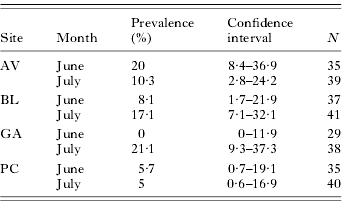
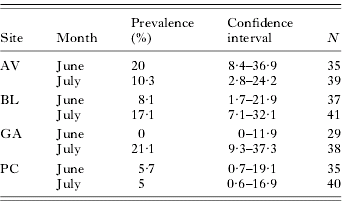
Parasite prevalence at the 4 sites varied between zero and 21%, but confidence limits showed considerable overlap for those estimates taken at different sites in June and July (Table 1). At 1 site (GA) the proportion of infected females increased from zero in June to 21% in July (Chi2=3·24, d.f.=1, P=0·072), suggesting a seasonal effect on prevalence at that site. Prevalence was relatively stable from June to July at all other sites over time (Chi2-values ranged from 0·02 to 1·39, P-values ranged from 0·24 to 0·89). When June and July samples were combined for each site, we did not find significant heterogeneity of prevalence values across sites (Chi2=5·72, d.f.=3, P=0·12).
Prevalence of infection and Clopper-Pearson confidence intervals for infections of adult female Corophium volutator by a novel microsporidian
(Sampled at 4 Bay of Fundy sites over 2 time-periods, AV, Avonport; BL, Blomidon; GA, Grand Anse; PC, Peck's Cove; SP, Starrs Point. Sample sizes or N refer to the numbers of females, which produced successful cytochrome oxidase I amplification at the same time gonadal samples were screened for microsporidians.)
Infection status of mothers and offspring sex ratio and fitness measures
After screening the females in the breeding experiment for infection, offspring from 38 infected and 46 uninfected females were compared for survival to sexual maturity. We found no differences in the mean proportion (±1 s.e.) of offspring surviving (F1,82=0·036, P=0·85). Approximately 74±4% of the young from broods of uninfected mothers survived to 3 months of age compared to a near equal 72±4% of the young from broods of infected mothers. Infected females had a significantly higher proportion of female offspring in their broods (83±5%) compared to uninfected females (at 70%±4%, F1,82=83·9, P<0·001). When we just examined broods with 50% survivorship or higher (64 of 84 broods), we found essentially the same result: i.e. infected females produced an average of 86% female offspring compared to 69% female offspring for uninfected mothers (F1,62=91·0, P<0·001).
There was no difference in mean body lengths (±1 s.e.) of infected and uninfected mothers (6·9+0·1 mm and 7·0+0·09 mm, respectively; F1,83=1·97, P=0·16). Infected and uninfected mothers also did not differ in the mean number of offspring released from the brood pouch (22·9±1·8 young versus 19·1±1·7 young; F1,83=2·42, P=0·12). Curiously, the number of young was dependent on infection status, after controlling for body length of the female as a covariate. Although the interaction between infection status and the covariate of body length was not significant (F1,82=1·74, P=0·19), body length did account for significant variation in number of young (F1,82=8·31, P=0·005) with larger females having more young. Furthermore, infected females had more young than uninfected females after controlling statistically for body length (F1,82=4·46, P=0·037). Infected mothers averaged 5 more offspring than did uninfected mothers, after controlling for body length (least squares mean=23·7 young versus 18·8 young).
DISCUSSION
In this paper, we describe the occurrence of a microsporidian parasite in the intertidal amphipod Corophium volutator. We include a first indication that this novel parasite plays an important contributing role in the strongly female-biased sex ratios found in local field populations of C. volutator in the Bay of Fundy, Canada.
Several species of microsporidia have been described from amphipods previously and they fall into diverse lineages of the Microspora (Terry et al. Reference Terry, Smith, Sharpe, Rigaud, Littlewood, Ironside, Rollinson, Bouchon, MacNeil, Dick and Dunn2004). However, the sequence described from the microsporidium found in C. volutator is not closely related to any previously described microsporidia of amphipods. The closest homologies appeared to be microsporidian parasites of freshwater bryozoans, although we note that while certain regions aligned up to 94%, there was still considerable divergence within other regions (even those regions that could be aligned using discontiguous MEGABLAST). We therefore conclude that the sequence comes from a novel species of microsporidian parasite. Terry et al. (Reference Terry, Smith, Sharpe, Rigaud, Littlewood, Ironside, Rollinson, Bouchon, MacNeil, Dick and Dunn2004) reported 5 microsporidian species in amphipods that infect female hosts significantly more often than male hosts and are therefore considered to be able to cause a sex ratio distortion. The novel parasite herein described is only distantly related to other sex ratio distorting microsporidia and so our data also support the hypothesis that sex ratio distortion has arisen several times in the Microspora (Terry et al. Reference Terry, Smith, Sharpe, Rigaud, Littlewood, Ironside, Rollinson, Bouchon, MacNeil, Dick and Dunn2004).
The presence of the parasite in gonads of female and rarely of male hosts and the parasite's apparently low virulence provide supporting evidence for vertical parasite transmission (Terry et al. Reference Terry, Smith, Bouchon, Rigaud, Duncanson, Sharpe and Dunn1999; Galvani, Reference Galvani2003). However, other information is needed to confirm this mode of transmission and exclude horizontal transmission (see Ironside et al. Reference Ironside, Dunn, Rollinson and Smith2003b). The parasite does not seem to be associated with female size, at least for those females with 10 or more offspring that were used in the brood rearing study. In general, fitness of the transmitting host sex should not be reduced greatly by uniparentally inherited sex-distorting parasites, because their transmission depends on host survival and successful reproduction (Dunn and Smith, Reference Dunn and Smith2001). If anything, infected females averaged 25% more young, after controlling for female body size, than did uninfected females. Selection on the parasite should favour such a mutualistic effect as it could enhance/accelerate the spread of the parasite (Bandi et al. Reference Bandi, Dunn, Hurst and Rigaud2001; Dobson et al. Reference Dobson, Rattanadechakul and Marsland2004). Similarly, it has been demonstrated that female mosquitoes (Aedes albopictus) infected with cytoplasmic incompatibility bacteria produce more eggs than do uninfected females (Dobson et al. Reference Dobson, Rattanadechakul and Marsland2004). However, this is to our knowledge the first observation of increased fertility as a result of microsporidian infection.
In the lab, females infected with the microsporidian parasite gave rise to a significantly higher proportion of female offspring. There was no difference in offspring survival of infected and uninfected mothers. We cannot completely rule out killing of infected male embryos very early in development. However, a similar number of reared offspring from infected and uninfected females makes feminization of infected males into females a likely factor explaining our results, especially when only those broods with 50% or better survivorship were considered.
Perhaps surprisingly, a few uninfected females produced all-female broods. A low parasite burden in small amounts of gonadal tissue can remain undetected, although PCR techniques have been shown to be highly effective for detection of microsporidian DNA (Fayer et al. Reference Fayer, Santin and Palmer2003). Furthermore, other sex-determining mechanisms also could influence offspring sex ratio in C. volutator. Interestingly, 2 infected females produced a male-biased brood (46% and 37% females) in contrast to all other highly female-biased broods in this group. Male-biased sex ratios in broods of infected females could be caused by autosomal suppressors that have evolved due to a genetic conflict between autosomal genes and cytoplasmic factors (Rigaud and Juchault, Reference Rigaud and Juchault1993). Also, we lack information about parasite transmission rates from mother to offspring and therefore cannot exclude the possiblity of incomplete feminization in a brood, due to a low parasite burden. Such incomplete feminization has been observed to cause the occurrence of intersex individuals in the amphipod Gammarus duebeni (Kelly et al. Reference Kelly, Hatcher and Dunn2004). Incidences of intersex (around 2·5% of adults) have been reported for C. volutator in the Bay of Fundy populations (Barbeau and Grecian, Reference Barbeau and Grecian2003; McCurdy et al. Reference McCurdy, Forbes, Logan, Kopec and Mautner2004).
Our laboratory studies indicate potential feminization of the host by a novel microsporidian parasite infecting C. volutator. However, how important is this novel parasite to influencing sex ratios of adults in nature? In fact, 3 of 4 local populations around the Bay of Fundy all had this microsporidian parasite at similar frequencies over 2 sampling periods. Overall, parasite prevalence averaged around 11% which is relatively low compared to previously described parasitic sex-ratio distorters (Hatcher, Reference Hatcher2000). We did not examine associations between parasite prevalence and sex ratios of both juveniles and adults in nature. Although parasite prevalence is low and the parasite does not seem to have detrimental effects on fitness or reproductive output of individual females, sex-distorting parasites are hypothesized to have a strong impact on local populations (Hatcher, Reference Hatcher2000). While infection with a feminizing parasite can be beneficial on a population level because it enables increased population growth, it is thought to increase the risk of local population extinction due to male limitation (Hatcher et al. Reference Hatcher, Taneyhill and Dunn1999; but see Moreau and Rigaud, Reference Moreau and Rigaud2003).
Both settings are important in C. volutator where local populations can be heavily depleted by migratory shorebirds each year and adult male amphipods are more likely to be eaten than adult females, thus increasing the potential for male limitation (Forbes et al. Reference Forbes, Boates, McNeil and Brison1996). Male limitation appears to occur late in the breeding season of C. volutator and might be exacerbated by limited male mating capacity (Forbes et al. Reference Forbes, McCurdy, Lui, Mautner and Boates2006). Infection with a feminizing parasite enables a necessary increase in the proportion of females to support population growth but a low prevalence also avoids a too severe lack of males, which could have further detrimental effects on local populations.
The authors acknowledge financial support from the Austrian Science Fund, the National Sciences and Engineering Research Council of Canada and the Hewlett-Mellon fund for faculty development at Albion College. We thank Sherman Boates, Sean Logan, Mike Kopec and Diane Lancaster for their help with fieldwork and Beth McClymont for technical assistance. We also acknowledge two anonymous reviewers for their helpful comments.