1. Introduction
Similarities in Lower Palaeozoic lithostratigraphy and faunal successions of the coastal NE Appalachians, Wales and southern England were known by the late 19th and early 20th century (e.g. Walcott, Reference Walcott1890, Reference Walcott1900). Early plate tectonic syntheses (Rast, O'Brien & Wardle, Reference Rast, O'Brien and Wardle1976) suggested that Walcott's (Reference Walcott1900) ‘Atlantic Province’ is a fragmented exotic terrane in the Acadian–Caledonian orogen. This Avalon ‘platform’, ‘zone’, ‘terrane’ or ‘superterrane’ (e.g. Nance & Thompson, Reference Nance, Thompson, Nance and Thompson1996) is characterized by: a deformed, intruded and metamorphosed Cryogenian – Middle Ediacaran basement; an unconformably overlying, siliciclastic-dominated terminal Ediacaran – Early Palaeozoic cover sequence with similarities from eastern Massachusetts to southern England; and provincially distinct marine biotas (Williams, Reference Williams1964, Reference Williams, Bose and Leake1978; Williams & Hatcher, Reference Williams and Hatcher1982). The Avalon platform collided with the Laurentia and Baltica palaeocontinents in the Late Silurian – Devonian Acadian–Caledonian orogeny and was fragmented by left-lateral shear in the Alleganian–Hercynian orogeny (Rast, O'Brien & Wardle, Reference Rast, O'Brien and Wardle1976; Nance & Thompson, Reference Nance, Thompson, Nance and Thompson1996).
An early interpretation followed in many later reports shows Early Palaeozoic Avalonia as part of the high south latitude to polar West African margin of West Gondwana (e.g. Scotese et al. Reference Scotese, Bambach, Barton, Van der Voo and Ziegler1979; Smith, Hurley & Briden, Reference Smith, Hurley and Briden1981; McKerrow, Scotese & Brasier, Reference McKerrow, Scotese and Brasier1992). The separation of Avalonia from Gondwana is claimed in many reports to have begun in the late Early Ordovician (Floian), with West Gondwana later crossing the South Pole and Avalonia moving into the tropics by the terminal Ordovician (e.g. Fortey & Cocks, Reference Fortey and Cocks2004). Other reconstructions show Avalon as a number of isolated ‘peri-Gondwana’ microcontinents located offshore of the high-latitude–polar West African and/or South American margins of West Gondwana by the Cambrian (e.g. Dalziel, Reference Dalziel1997; Keppie & Ramos, Reference Keppie, Ramos, Ramos and Keppie1999; Steiner et al. Reference Steiner, Li, Qian, Zhu and Erdtmann2007).
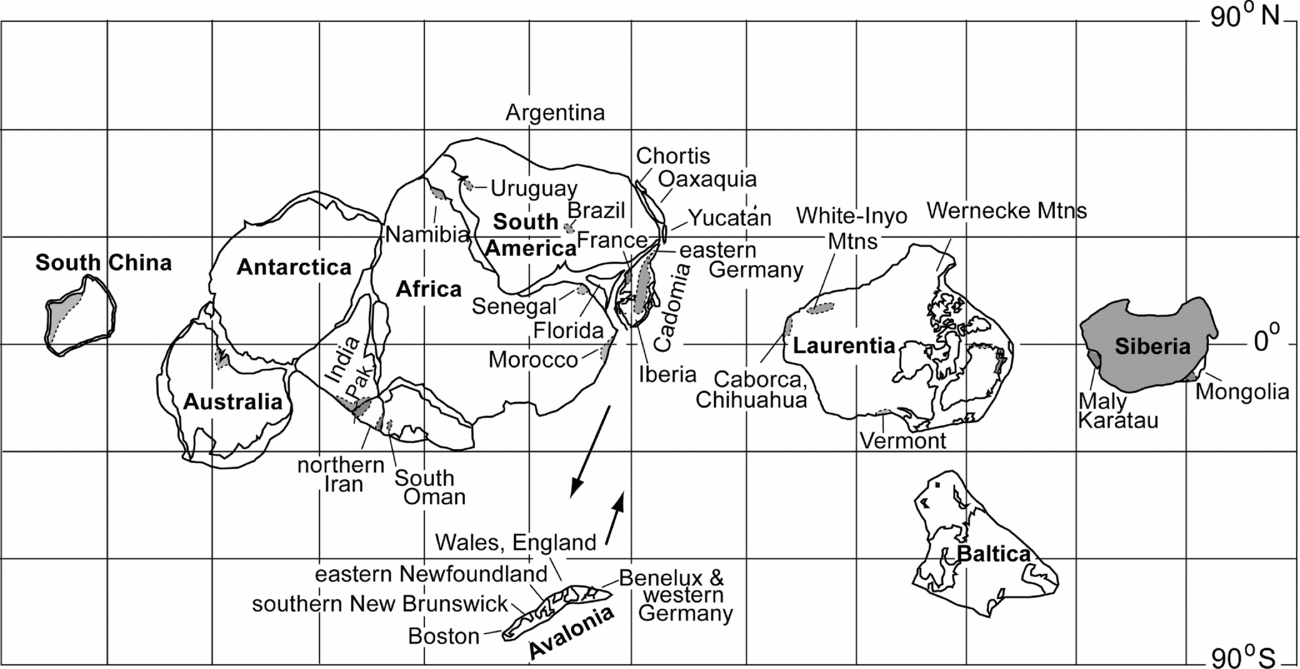
Despite repetition of these two quite distinct ‘antarctocentric’ Early Palaeozoic palaeogeographic reconstructions, no biotic or lithofacies evidence supports either interpretation (Landing, Reference Landing, Nance and Thompson1996a , Reference Landing2005). In addition, available palaeomagnetic evidence is of low quality (95% confidence limits often >20° and up to >40° with ‘acceptable’ age uncertainties of c. 10% on individual poles), meaning that there are common ‘misfits’ between calculated palaeolatitude and apparent polar wandering paths with Early Palaeozoic bio- and lithofacies (Smith, Reference Smith, Zhuravlev and Riding2001). Thus, the terminal Ediacaran – Early Cambrian succession of the Moroccan margin of West Gondwana cannot be high temperate or polar in latitude; it features a tropical carbonate platform sequence up to 2.5 km thick with evaporitic minerals, desiccation cracks, tepee structures and abundant thrombolites (Adoudou and Lis de Vin formations) and higher oospatites (upper Igoudine Formation) in the Anti-Atlas Range (e.g. Geyer & Landing, Reference Geyer, Landing, Geyer and Landing1995, Reference Geyer, Landing, Geyer and Landing2006; Maloof et al. Reference Maloof, Schrag, Crowley and Bowring2005). The Moroccan–Iberian successions of West Gondwana have bigotinoids and fallotaspoids as their oldest trilobites and abundant, reef-constructing archaeocyathans. By comparison, the terminal Ediacaran – Early Cambrian successions of Avalonia are dominated by shallow-water, siliciclastic-dominated successions with thin tempestite and nodular limestones representative of cool-water higher latitudes; show an earliest Cambrian glaciation; lack thrombolites or archaeocyathans; and have earliest trilobite faunas dominated by olenelloids (e.g. Landing & Benus, Reference Landing, Benus, Landing, Narbonne and Myrow1988; Landing et al. Reference Landing, Myrow, Benus and Narbonne1989; Landing Reference Landing, Lipps and Signor1992, Reference Landing, Nance and Thompson1996a , Reference Landing2004, Reference Landing2005; Myrow & Landing, Reference Landing, Lipps and Signor1992; Palmer & Repina, Reference Palmer and Repina1993; Landing & Westrop, Reference Landing, Westrop, Lipps and Wagoner2004; Landing & MacGabhann, Reference Landing and MacGabhann2010). For these reasons, Avalonia must be regarded as a higher south latitude palaeocontinent distinct from West Gondwana by the terminal Edicacaran. A proposal by which Avalonia was ‘latitudinally separated’ from the Armorican (or Cadomian) margin of West Gondwana (Fig. 1) as a way to explain the lithofacies distinctiveness of these two regions (Cocks & Fortey, Reference Cocks, Fortey and Bassett2009) produces an obvious conundrum: a latitudinal separation of tropical West Gondwana (and Armorica) from the cool-water successions of Avalonia simply means the two regions comprised latitudinally separate palaeocontinents by the terminal Ediacaran. The lithologic and biotic similarity of Avalonia and West Gondwana only began in the terminal Early Cambrian and persisted into the Floian as West Gondwana moved into proximity with Avalonia in cooler southern latitudes, and the two regions exchanged biotas (Landing, Reference Landing, Nance and Thompson1996a ; Landing & Westrop, Reference Landing, Westrop, Lipps and Wagoner2004) (Fig. 1).
Revised terminal Ediacaran – Early Cambrian palaeogeographic map. Figure shows dominant tropical distribution of major continents, preserved extents of tropical carbonate platform and evaporite-rich successions (grey areas), and movement of Avalonia and Moroccan margin of West Gondwana through the Early Cambrian; expanded from Landing & Westrop (Reference Landing, Westrop, Lipps and Wagoner2004, fig. 1). Selected sources for geographic regions: Avalonia (Landing, Reference Landing, Nance and Thompson1996a , Reference Landing2004, Reference Landing2005; Landing & Westrop, Reference Landing, Westrop, Landing and Westrop1998a ); Baltica (Nielsen & Schovsbo, Reference Nielsen and Schovsbo2011); Caborca and Chihuahua regions, Mexico (Sánchez-Zavala et al. Reference Sánchez-Zavala, Centenero-García, Ortega-Gutiérrez, Ramos and Keppie1999); France (Doré, unpub. Ph.D. thesis, 1969; Pillola, Reference Pillola1993); Iran (Hamdi, Reference Hamdi1995); Germany (Geyer et al. Reference Geyer, Elicki, Fatka, Żylinska and McCann2008); Greenland (Cowie, Reference Cowie and Holland1971); Iberia (Liñán et al. Reference Liñán, Perejón and Sdzuy1993, Reference Liñán, Gámez Vintaned, Gozalo, Dies and Mayoral2006); Maly Karatau, Kazakhstan (Missarzhevsky & Mambetov, Reference Missarzhevsky and Mambetov1981); Mongolia (Brasier et al. Reference Brasier, Shields, Kuleshov and Zhegallo1996); Morocco (Geyer & Landing, Reference Geyer, Landing, Geyer and Landing1995, Reference Geyer, Landing, Geyer and Landing2006); Oman (Schröder et al. Reference Schröder, Grotzinger, Amthor and Matter2007); Siberia (Brasier et al. Reference Brasier, Rozanov, Zhuravlev, Corfield and Derry1994; Rozanov & Zhuravlev, Reference Rozanov, Zhuravlev, Lipps and Signor1996); South China (Steiner et al. Reference Steiner, Li, Qian and Zhu2004, fig. 13); Uruguay and Brazil (Gaucher et al. Reference Gaucher, Boggiani, Sprechmann, Sial and Fairchild2003, Reference Gaucher, Sial, Ferreira, Pimental, Chiglino and Sprechmann2007); Vermont (Landing et al. Reference Landing, Peng, Babcock and Moczydłowska-Vidal2007; Landing, Reference Landing2012); White-Inyo Mountains, California–Nevada (Mount & Signor, Reference Mount, Signor, Lipps and Signor1992).

2. Purpose of study
Detailed lithofacies and sequence stratigraphic similarities in coeval successions in North American and British Avalonia are regarded as evidence for a regionally extensive, Ediacaran – Early Palaeozoic geological history in a unified Avalonia palaeocontinent (Landing, Reference Landing, Nance and Thompson1996a ). The re-evaluation of even small Avalonian areas, such as the Pembrokshire, South Wales, field area of this report, therefore has a regional significance in that it contributes to the Early Palaeozoic geological synthesis of Avalonia. Furthermore, such a re-evaluation serves to document just how strongly Avalonian successions differ lithologically and biotically from those of any coeval West Gondwanan region.
In this report, the Lower Cambrian succession at Caerfai Bay and adjacent areas in South Wales is examined in terms of its stratigraphic continuity, biostratigraphy and depositional environments. In addition, the relationship of its U–Pb zircon geochronology both to the later stages of the Cambrian evolutionary radiation and to the Early Cambrian history of the Avalonian inner platform is evaluated.
Note that in this report Lower/Early, Middle/Middle and Upper/Late Cambrian are informal subsystem and subperiod divisions that are equivalent to the Terreneuvian + Series/Epoch 2 (Fig. 2), Series/Epoch 3 and Furongian Series/Epoch, respectively (Landing, Reference Landing and Landing2007). In accordance with stratigraphic recommendations, the two or three major divisions of a system or period must be capitalized (North American Commission on Stratigraphic Nomenclature, 1983; Salvador, Reference Salvador1994).
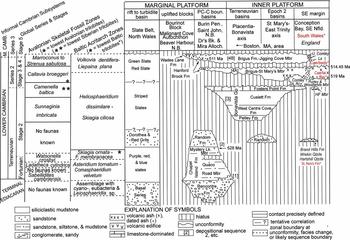
Correlation of terminal Ediacaran – Lower Cambrian rocks of North American and British Avalonia. North American Avalonian stratigraphic nomenclature and depositional sequence numbers from Landing (Reference Landing, Nance and Thompson1996a ) and Landing & Westrop (Reference Landing, Westrop, Landing and Westrop1998b ). Westrop & Landing (Reference Landing2012, fig. 2) discussed how Fletcher's (Reference Fletcher2003, Reference Fletcher2006) lithostratigraphic names are junior synonyms and are abandoned by the rules of the North American Commission on Stratigraphic Nomenclature (1983). ‘Broad Cove Member’ (Fletcher, Reference Fletcher2006) replaced the previous name ‘Clifton Member’ (Fletcher, Reference Fletcher2003); but Landing & Westrop (Reference Landing, Westrop, Landing and Westrop1998a , b) specified that the thin, condensed limestones of the so-called ‘Broad Cove’ form the base of the St Mary's Member of the Brigus Formation. ‘Smith Point Limestone’ of Fletcher (Reference Fletcher2006) is split by a major depositional sequence 3–4A boundary, and comprises the Fosters Point Limestone and condensed limestone beds at the base of Brigus Formation. Wades Lane Formation of Landing, Johnson & Geyer (Reference Landing, Johnson and Geyer2008). Right figure column distinguishes English units (italics) and those from South Wales (*; in red). Welsh Slate Belt correlation of Landing (Reference Landing, Nance and Thompson1996a ) and McIlroy, Brasier & Moseley (Reference McIlroy, Brasier and Moseley1998). Non-fossiliferous Caerbwdy Formation may be a sandstone-rich upper part of Caerfai Bay Formation depositional sequence. Question marks (?) indicate uncertainty of figured hiatus. 528 Ma zircon date (Compston et al. Reference Compston, Zhang, Cooper, Ma and Jenkyns2008) recalculated from 530 Ma date of Isachsen et al. (Reference Isachsen, Bowring, Landing and Samson1994). Anomalously early appearance of Baltic trilobites based on association with lower Tommotian-equivalent or older Skiagia ornata-Fimbriaglomerella membranacea Zone acritarchs (e.g. Mozcydłowska, Reference Moczydłowska1991); however, Schmidtiellus Zone trilobites are morphologically derived and are likely late Early Cambrian (Palmer & Repina, Reference Palmer and Repina1993). Abbreviations: Bk – brook; Fm – Formation; HF Mbr – Home Farm Member; L. Comley Ss Ac2 – Red Callavia Sandstone bed on Lower Comley Sandstone; Lk – Lake; Mbr – Member; N. B. – New Brunswick; Nfld – Newfoundland; Pen. – peninsula.

3. Geological setting and South Wales localities
Lower – lower Upper Cambrian Avalonian cover sequence rocks form small, highly folded and faulted outcrop areas in Pembrokeshire. Coastal cliffs provide excellent exposures in this low-grade (chlorite) metamorphic succession (Fig. 3). In South Wales, Cambrian rocks unconformably overlie volcanic and intrusive rocks of the Pebidian Supergroup (Patchett & Jocelyn, Reference Patchett and Jocelyn1979). The Pebidian Supergroup has not been dated, but is intruded by the Early Ediacaran St David's granophyre (c. 587 Ma). Available evidence suggests the Pebidian Supergroup is a late Cryogenian (perhaps >800 Ma) succession (Gibbons et al. Reference Gibbons, Tietzsch-Tyler, Horák, Murphy, Gibbons and Harris1994).
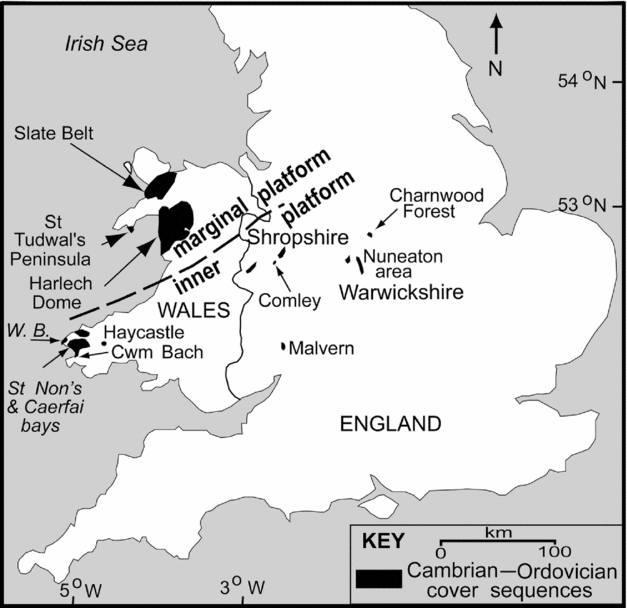
Generalized locality map shows location of Caerfai Bay, South Wales and Cambrian–Ordovician cover sequence rocks on the Avalonian basement (in black).

Deformed volcanic and volcaniclastic basement rocks of this type in North America and British Avalonia were considered to record a Late Proterozoic ‘Avalonian/Pan-African orogeny’ (Rast, O'Brien & Wardle, Reference Rast, O'Brien and Wardle1976). However, these rocks have been reinterpreted as subduction/arc successions that were replaced by Late Ediacaran rift-magmatism, -volcanism and -depositional environments after ridge-trench collision (Keppie et al. Reference Keppie, Nance, Murphy and Dostal2003). Latest Ediacaran – Tremadocian environments in Avalonia featured a relatively passive tectonic setting in which transtensional basins opened successively to the southeast and were filled with siliciclastic sediment (Woodcock, Reference Woodcock1984, Reference Woodcock1990; Landing & Benus, Reference Landing, Benus, Landing, Narbonne and Myrow1988; Landing, Reference Landing, Lipps and Signor1992, Reference Landing, Nance and Thompson1996a ). Mixed volcanism in this transtrensional setting and later volcanism with Ordovician (Floian and younger) subduction mean that volcanic ashes from fossiliferous successions in south Wales and elsewhere in Avalonia provide an Early Palaeozoic geochronologic standard.
Most of the localities discussed below are located along St Bride's Bay and just NW of St David's at Whitesand Bay (i.e. Porth Selau section). The localities are detailed by Stead & Williams (Reference Stead, Williams, Bassett and Bassett1971), Williams & Stead (Reference Williams, Stead and Bassett1982) and Prigmore & Rushton (Reference Prigmore, Rushton, Rushton, Owen, Owens and Prigmore1999). St Non's and Caerfai bays are separated by a narrow headland with Caerfai Bay on the east side (Fig. 3).
4. Early Cambrian cover succession in South Wales: deposition and ages
4.a. Conglomerate
The Avalonian cover sequence in Pembrokshire includes a relatively thin Lower Cambrian succession, much of which is well exposed on the east side of Caerfai Bay (Figs 3, 4a). Not exposed at Caerfai Bay but unconformably overlying the Pebidian Supergroup is a 10–50-m-thick pinkish-coloured ‘Conglomerate’ or ‘Conglomerate Division’ (Hicks, Reference Hicks1877; Green, Reference Green1908, Reference Green1911; Williams, Reference Williams1934; Rushton, Reference Rushton and Holland1974; Loughlin & Hillier, Reference Loughlin and Hillier2010; Fig. 2). ‘Conglomerate’ is something of a misnomer for this heterolithic unit with its coarse-grained quartz arenite beds (Thomas & Jones, Reference Thomas and Jones1912) and finer-grained sandstones with Skolithos Haldemann, Reference Haldeman1840 burrows high in the unit (Crimes, Reference Crimes1970a ; Williams & Stead, Reference Williams, Stead and Bassett1982; Siveter & Williams, Reference Siveter and Williams1995).
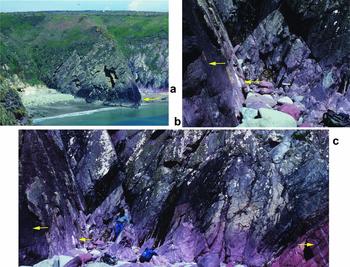
Location and lithology of Early Cambrian caliche on NE side of Caerfai Bay, South Wales. (a) St Non's – lower Caerfai Bay formation succession, arrow at top of St Non's Formation. (b) Detail of St Non's – Caerfai Bay contact, left arrow on top of uppermost massive, purple sandstone of St Non's Formation; right arrow shows basal, white weathering, Caerfai Bay crystic caliche overlain by dusky-white burrow mottled horizon (a). (c) St Non's – Caerfai Bay contact, left and central arrows as in Figure 3b, left arrow shows light bluish-white weathering ashes in purplish-red, fine-grained sandstone.

4.b. Deposition and age of the Conglomerate
Beds of granule- to boulder-sized, rounded clasts of vein quartz, quartzite and intrusive and extrusive rocks occur in the Conglomerate, and it been regarded as an alluvial fan facies with a SSW provenance (A. Rees in Brenchley et al. Reference Brenchley, Rushton, Howells, Cave, Brenchley and Rawson2006, p. 67; A. Rees in Loughlin & Hillier, Reference Loughlin and Hillier2010, p. 241). Our examination of the Conglomerate and the presence of burrowed sandstone beds suggest an alternative depositional environment. It may represent a high-energy shallow-marine terrace deposited on a wave-cut platform, with rock falls from subaerial cliffs supplying Precambrian basement blocks.
Skolithos from the Conglomerate indicates an age no older than earliest Cambrian (Narbonne et al. Reference Narbonne, Myrow, Landing and Anderson1987; earliest Terrenuvian of Landing et al. Reference Landing, Peng, Babcock and Moczydłowska-Vidal2007; Fig. 2), and is the eponymous genus of the shallow-water (littoral) Skolithos ichnocommunity (Seilacher, Reference Seilacher, Imbrie and Newall1964; Crimes, Reference Crimes, Crimes and Harper1970b ). Skolithos can occur in deeper facies (Crimes & Fedonkin, Reference Crimes and Fedonkin1994), but its presence in this conglomerate-rich unit, whether interpreted as a marine terrace or alluvial fan, is consistent with a shallow-water interpretation. ‘Ichnocommunity’ (or ‘ichnocoenosis’) is preferred to ‘ichnofacies’ in this report as it refers to an association of trace fossil producers that form a biological community. Unlike ‘ichnofacies,’ ichnocommunity does not imply any characteristic sedimentary lithofacies (Judice & Mazzullo, Reference Judice and Mazzullo1982; Buatois & Mángano, Reference Buatois and Mángano2011, p. 6).
4.c. Massive sandstone
The Conglomerate is presumed to pass upwards conformably into the St Non's Sandstone, a dominantly olive-green, fine- to medium-grained typically thick-bedded sandstone with reported thicknesses of 120–150 m (Green, Reference Green1908; Crimes, Reference Crimes1970a ; Cowie, Rushton & Stubblefield, Reference Cowie, Rushton and Stubblefield1972, p. 31; Rushton, Reference Rushton and Holland1974, p. 86; Williams & Stead, Reference Williams, Stead and Bassett1982; Rushton & Molyneux, Reference Rushton, Molyneux, Rushton, Brück, Molyneux, Williams and Woodcock2011). Stead & Williams (Reference Stead, Williams, Bassett and Bassett1971) described the sandstone as feldspathic (15%) and attributed its green colour to chlorite and epidote. Loughlin & Hillier (Reference Loughlin and Hillier2010, p. 241) recorded ‘burrow fills’ in the green sandstone and Williams & Stead (Reference Williams, Stead and Bassett1982) noted Skolithos at an unspecified horizon.
Our work on the east side of Caerfai Bay recorded 34.4 m of cliff-forming, generally massive, sandstone with a dominantly olive-green colour. Williams & Stead (Reference Williams, Stead and Bassett1982) correctly described the upper part of the massive sandstone (30.5–34.4 m) as purple (Fig. 4a, b). At Caerfai Bay, the sandstone has abundant Teichichnus Seilacher, Reference Seilacher, Schindewolf and Seilacher1955 burrows at 10.9 m, 24.9–27.9 m, 29.9–34.4 m and, in calcareous nodule horizons, at 20.2–20.4 m. Skolithos occurs at 11.6 m with polygonal, apparently desiccation-cracked, sandstone clasts, some of which are imbricated. Volcanism is recorded by a burrow-churned ashy interval at 20.2–20.4 m. Because of intense burrowing, the massive green sandstone has few primary sedimentary structures; these include a few centimetres of parallel-laminated sandstone at 3.5 m and a horizon of low-angle bidirectional (roughly E–W) trough cross-beds at 12 m. Loughlin & Hillier (Reference Loughlin and Hillier2010) also noted planar lamination and current ripples in the massive green sandstone at Caerfai Bay, as well as graded, laminated sandstones and less-common trough cross-beds at Porth Selau and Porthstinian c. 4 km to the west.
4.d. Deposition and age of the massive sandstone
Skolithos and abundant Teichichnus, the latter an element of the shallow sublittoral Cruziana ichnocommunity (Seilacher, Reference Seilacher, Imbrie and Newall1964; Crimes, Reference Crimes1970a , b); the apparent dessication-cracked clasts; and bidirectional cross-beds all conform with interpretation of the green sandstone as an episodically high-energy shallow-marine facies with local channels (Crimes, Reference Crimes1969, Reference Crimes1970a ; Prigmore & Rushton, Reference Prigmore, Rushton, Rushton, Owen, Owens and Prigmore1999). A maximum age of the massive sandstones is provided by Teichichnus, a broad U-shaped spreiten-burrow that records behaviourly complex activity by coelomates and appears no earlier than the early but not earliest Terreneuvian (Narbonne et al. Reference Narbonne, Myrow, Landing and Anderson1987; Fig. 2).
The paucity of sedimentary features complicates the interpretation of the depositional environment of the massive sandstone. However, a number of important features are present: the bidirectional cross-set; the polygonal sandstone pebbles possibly formed by subaerial lithification of quartz sands by syndepositional cementation or binding by cyanobacteria or a muddy matrix (Selleck, Reference Selleck1978; Landing, Reference Landing2011); the low-diversity ichnofauna; and the report of channels. These features are known in middle Terreneuvian tidalites of the Random Formation in Avalonian SE Newfoundland (Hiscott, Reference Hiscott1982), Cape Breton Island and mainland Nova Scotia (Landing, Reference Landing1991) and southern New Brunswick (Landing & Westrop, Reference Landing, Westrop, Landing and Westrop1998a , b; Landing Reference Landing2004; Fig. 2). Even the reddish–purplish weathered cap of the Random Formation, which is known throughout North American Avalonia (Myrow, Narbonne & Hiscott, Reference Myrow, Narbonne and Hiscott1988), resembles the purplish colour of the upper massive sandstone.
Loughlin & Hillier (Reference Loughlin and Hillier2010, p. 241, 242) are less accepting of a shallow-water depositional setting for the massive sandstone. They reconstruct a seemingly deeper setting with waves periodically reaching the bottom to produce wave ripples, but consider that some of the ‘massive bedding is primary. . .reflecting deposition from debris flows. . .on a steep fronted delta system’. However, no evidence for such submarine slope depositional features as turbidites, the stratigraphic cut-outs associated with debris flows or the semi- to well-lithified clasts common in debris flows is present in the massive sandstone. Similarly, we did not recognize any features that might characterize a ‘steep slope’ delta in the massive sandstone at Cwm Mawr valley, Caerfai Bay, St Non's Bay just east of Caerfai Bay, Porth Clais harbour and the path to Porth Selau at Whitesands Bay (Williams & Stead, Reference Williams, Stead and Bassett1982; Fig. 3). Features present in ‘steep slope’ deltas could include a number of developments which were not observed: channels with unidirectional flow cross-beds and channel-bed clasts that may show upwards fining; interdistributary mudstones; bar-finger sands; large delta-front decollement surfaces and slumps; diapiric sands; or interfingering of the massive sandstones with muddy, prodelta facies (e.g. Gould, Reference Gould and Morgan1970; Winkler & Edwards, Reference Winkler, Edwards, Stanley and Moore1983).
4.e. Purple and red ‘shales’
The thin fine-grained Caerfai Bay Shales (15-m-thick by Rushton, Reference Rushton and Holland1974) with lower purple and upper reddish-purple colour overlies the massive St Non's Sandstone and is, in turn, succeeded by the Caerbwdy Sandstone, the latter comprising 150 m of purplish and greenish, fine-grained sandstone (Fig. 2). Although traditionally termed a ‘shale’ (Cowie, Rushton & Stubblefield, Reference Cowie, Rushton and Stubblefield1972; Rushton, Reference Rushton and Holland1974; Turner, Reference Turner1979; Loughlin & Hillier, Reference Loughlin and Hillier2010; Harvey et al. Reference Harvey, Williams, Condon, Wilby, Siveter, Rushton, Leng and Gabbott2011; Rushton & Molyneux, Reference Rushton, Molyneux, Rushton, Brück, Molyneux, Williams and Woodcock2011), the Caerfai Bay is not a ‘shale’ because it is not a fissile mudstone and its minor mudstones are cleaved and comprise slates. The so-called Caerfai Bay Shales is actually a heterolithic unit with fine- to medium-grained, white to light-purple tuffs up to 10.5 cm in thickness (Fig. 4b) and fine-grained, planar-laminated to normally graded sandstones (Loughlin & Hillier, Reference Loughlin and Hillier2010, fig. 5A–C).
The ‘red’ colour traditionally assigned to this unit should be qualified by comparison with the mudstone and fine-grained sandstone colours of the Lower – Middle Cambrian of Avalonian North America. As shown by Loughlin & Hillier (Reference Loughlin and Hillier2010, figs 4, 5A–E), the dominant colour of the Caerfai Bay Shales is really a purplish red. As noted in the following section, this seemingly trivial distinction is an important feature in palaeoenvironmental analysis of Avalonian mudstones.
Evidence of volcanism is pervasive through the unit. Turner (Reference Turner1979) reported 16 feldspathic tuffs at Caerfai Bay, and Loughlin & Hillier (Reference Loughlin and Hillier2010) counted 35 ashes. In our study at Caerfai Bay, we logged 48 ashes up to 10.5 cm in thickness above the massive St Non's Sandstone and below the Caerbwdy Sandstone. Many of the thin (1–3 cm) ashes lens out within a few metres, while others were obscured by mixing into the sandstones by burrowing organisms.
4.f. Deposition and age of the purple and red ‘shale’
Landing et al. (Reference Landing, Bowring, Davidek, Westrop, Geyer and Heldmaier1998) noted erosive bases, planar lamination and burrowed tops of the volcanic ashes and the presence of Teichichnus through the Caerfai Bay Shales. Loughlin & Hillier (Reference Loughlin and Hillier2010) concluded that these normally graded ashes, which show small ball-and-pillow structures and diapirs, are turbidites. In addition, much of the ‘shale’ consists of 5–20-cm-thick normally graded, fine-grained sandstone turbidites (Loughlin & Hillier, Reference Loughlin and Hillier2010, fig. 5A).
Loughlin & Hillier (Reference Loughlin and Hillier2010, p. 244) proposed that the turbidites accumulated on a ‘steep delta front’, as shown by accordion-like folding of some ashes by down-slope creep. They suggested the low diversity of the ichnofossil community, primarily Teichichnus (but with Skolithos; Rhizocorallium Zenker, Reference Zenker1836; and Palaeophycus Hall, Reference Hall1847), associated with the ashes (Loughlin & Hillier, Reference Loughlin and Hillier2010, p. 248) might record environmental factors such as brackish or ‘upper dysoxic zone’ conditions, but did not develop a palaeoxygenation model for the purple and red facies.
A more suitable depositional environmental interpretation of this Avalonian purple and reddish mudstone and fine-grained sandstone unit has long been documented in the literature on the Lower Palaeozoic of North American Avalonia. To begin with, the dominance of Teichichnus is characteristic of the shallow, sublittoral Zoophycos ichnocommunity (Seilacher, Reference Seilacher, Schindewolf and Seilacher1955; Crimes, Reference Crimes1970a , b). The upper Caerfai Bay Shales environment was sufficiently shallow that our study noted wave ripples on an ash 24 m above the top of the massive sandstone and near the base of the Caerbwdy Sandstone.
The relationship of mudstone colour to relative distance offshore and to a palaeooxycline is well documented in so-called ‘Avalonian shale basins’ (Landing & Benus, Reference Landing, Benus, Landing, Narbonne and Myrow1988). An onshore–offshore spectrum in Avalonian shale basins includes red – purplish red – purple – olive green – grey – black as primary colours (Landing & Benus, Reference Landing, Benus, Landing, Narbonne and Myrow1988; Landing et al. Reference Landing, Myrow, Benus and Narbonne1989; Myrow & Landing, Reference Myrow and Landing1992; Landing & Westrop, Reference Landing, Westrop, Lipps and Wagoner2004). Red mudstones are often structureless because of thorough burrowing and indicate high oxygen levels at the sediment–water interface (Landing et al. Reference Landing, Myrow, Benus and Narbonne1989; Myrow & Landing, Reference Landing, Lipps and Signor1992). The turbiditic sandstones at Caerfai Bay fall in a ‘purplish-red field’ and also represent a relatively shallow-water but only slightly less oxygenated facies. Particular carbonate types are related to the reddish end of the colour spectrum with condensed fossil grainstones deposited on the shoreline and in the intertidal, fossil pack- and wackestones in the shallow sublittoral and nodular-bedded to isolated nodules of sparse fossil wackestone to mudstone in the transition from red to purple siliciclastic mudstone. At the other end of the colour spectrum, large lime mudstone to sideritic nodules occur in green, grey and black mudstone (Myrow & Landing, Reference Myrow and Landing1992; Landing & Westrop, Reference Landing, Westrop, Lipps and Wagoner2004; Landing & Fortey, Reference Landing and Fortey2011).
The lack of nodules in the purplish-red facies at Caerfai Bay and presence of several small nodules at Porth Selau at Whitesands Bay are comparable to the somewhat more offshore, purplish-red mudstone facies of the Bonavista Group and Brigus Formation in North American Avalonia (Landing & Westrop, Reference Landing, Westrop, Lipps and Wagoner2004). It is instructive for depositional environment reconstruction that bedding planes of the lower (St Mary's Member) of the Brigus Formation (Fig. 2) can be walked for c. 0.5 km along the coast at the Brigus South section in Trinity Bay, eastern Newfoundland (Westrop & Landing, Reference Landing2012). Over this distance, trilobite packstone beds (tempestites) in red slaty mudstone at the north gradually change into sparsely fossiliferous, isolated lime mudstone nodules in purplish-red siliciclastic mudstone to the south. By comparison, the similarly coloured reddish-purple-dominated facies at Caerfai Bay probably does not record a far offshore depositional site.
The low diversity ichnofossils of the Caerfai Bay Shale reported by Loughlin & Hillier (Reference Loughlin and Hillier2010) are comparable to those seen in the Bonavista Group and Brigus Formations of SE Newfoundland (Landing, Reference Landing, Lipps and Signor1992) and provide little information about the palaeoenvironment. Indeed, the low diversity of the Caerfai Bay ichnofauna, as those of other red–reddish-purple mudstones or fine-grained sandstones in Avalonia, is largely an artefact of preservation (i.e. both burrow-homogenization of sediment and a lack of an appropriate sediment for casting them) and provides no information appropriate for reconstructing the palaeosalinity, nutrient or oxygen levels as suggested by Loughlin & Hillier (Reference Loughlin and Hillier2010).
This ‘artefact of preservation’ also reflects the fact that few bedding planes are exposed in the slaty Caerfai Bay mudstones and sandstones. Relatively rapid deposition was likely responsible for the soft substrate deformation illustrated by Loughlin & Hillier (Reference Loughlin and Hillier2010), a feature that reduced the potential for discovery and preservation of trace fossils and did not provide a firm substrate for preserving the activity of Cruziana and Rusophycus producers (e.g. Crimes, Reference Crimes1970a ; Landing & Brett, Reference Landing and Brett1987). Loughlin & Hillier (Reference Loughlin and Hillier2010) equated the greater variety of traces associated with ashes with increased nutrient supply for infaunal filter feeders. Alternatively, the churning of whitish ashes into the mudstone simply allowed the burrows to be preserved and observed.
We disagree with Loughlin & Hillier (Reference Loughlin and Hillier2010), a ‘steep slope’ is not required to form turbititic, contorted or mass-movement structures, and very gentle slopes (1–4°) have decollements and slides (Lewis, Reference Lewis1971). Indeed, sea-level fall at the depositional sequence 4A–B boundary in the Brigus Formation in eastern Newfoundland (Fig. 2) led to development of a debris flow composed of trilobite packstone cobbles in a red mudstone matrix at the base of the Jigging Cove Member (Westrop & Landing, Reference Landing2012, p. 259), even though the succession appears to be a ‘level bottom’ facies.
5. Lithostratigraphic nomenclature
5.a. Restoring original definitions
The original definitions of the Lower Cambrian formations along St Bride's and Whitesand bays were progressively altered in successive reports so that a stratigraphically unbroken succession seemed to be present. Originally, Cowie, Rushton & Stubblefield (Reference Cowie, Rushton and Stubblefield1972, p. 31, 32) described a ‘basal Cambrian conglomerate’ overlain by their newly named St Non's Sandstone, a ‘fine-grained, well bedded feldspathic sandstone’ with its upper beds ‘purplish in hue’. Although a spartan definition, the St Non's Sandstone lithology was distinct from that of the overlying, newly named ‘Caerfai Bay Shales’, which they described as ‘dull purplish-red shales and sandstones, current cross-bedded in the lower part and containing beds of crystal tuff’ (Cowie, Rushton & Stubblefield, Reference Cowie, Rushton and Stubblefield1972, p. 27).
The distinctive lithologic change between the massively bedded St Non's Sandstone and Caerfai Bay Shales was altered by Turner (Reference Turner1979, p. 271), who seems to have differentiated the formations by colour with the top of the St Non's purple and the Caerfai Bay beginning with a reddish colour and apparently having the lowest ashes. Turner (Reference Turner1979) specified a ‘gradational contact’ with an interval of ‘purple-coloured siltstones, 9 cm thick, which are extensively bioturbated and which represent the top of the St Non's Sandstone’. Turner (Reference Turner1979) also noted a drab white calcite cementation of the purple, burrowed interval that he assigned to the top of the St Non's.
Loughlin & Hillier (Reference Loughlin and Hillier2010, p. 241) followed Turner's (Reference Turner1979) interpretation of a gradational St Non's – Caerfai Bay contact, and stated that the top of the St Non's was a 5–7 m unit of purple, ‘extensively bioturbated’ silty beds with abundant soft-sediment deformation, Teichichnus, and nine thin ashes. Their upper St Non's lacked any of the ‘well bedded’ (i.e. massive) sandstones described by Cowie, Rushton & Stubblefield (Reference Cowie, Rushton and Stubblefield1972) and was finer grained. As for Turner (Reference Turner1979), Loughlin & Hillier (Reference Loughlin and Hillier2010) seemed to assign all rocks with a purple colour, despite lithology, to the St Non's.
Landing et al. (Reference Landing, Bowring, Davidek, Westrop, Geyer and Heldmaier1998) followed Cowie, Rushton & Stubblefield (Reference Cowie, Rushton and Stubblefield1972) in placing the contact of the St Non's and Caerfai Bay formations at an abrupt change from massive sandstone into a finer-grained facies. They reported a caliche as evidence for an unconformity between the two formations. In a lapsus, they thought Turner's (Reference Turner1979) reference to ‘9 cm’ of ‘purple-coloured siltstones’ meant that he had assigned a very thin siltstone interval to the top of the St Non's. Indeed, the obvious, natural break in the succession is a wave-cut embayment that separates massive, resistant, St Non's-type sandstone from overlying, less-resistant, slaty, fine-grained, burrowed, purplish-red, very fine-grained sandstone and mudstone (Fig. 4b, c). Thus, the reported caliche occurs on the uppermost, massive St Non's Sandstone bed (Fig. 4b). Loughlin & Hillier (Reference Loughlin and Hillier2010, p. 241) stated they did not locate the caliche, and concluded ‘no evidence for this hypothesis [i.e. an unconformity] was observed in [their] study’.
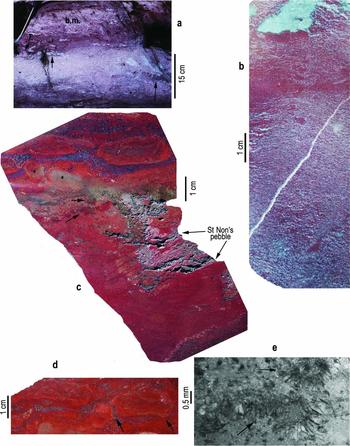
The locally bright white-weathering caliche is a prominent lithology at the Caerfai Bay section and caps the highest, massive bed of the St Non's sandstones (Fig. 5a). The caliche reaches 20 cm in thickness (Figs 4b, c, 5a) and overlies a thin, non-calcified, weathered horizon on the purplish St Non's. As noted above, this weathered horizon was thought by Landing et al. (Reference Landing, Bowring, Davidek, Westrop, Geyer and Heldmaier1998) to be Turner's (Reference Turner1979) ‘purple-coloured siltstones.’
Caliche at base of Caerfai Bay Formation, east side of Caerfai Bay, South Wales; top of each illustration is stratigraphically up. (a) Thickest and densest development of crystic caliche; right arrow marks clast of purple St Non's Formation sandstone; left arrow indicates clasts of crystic caliche next to calcified Teichichnus burrow (arrow with T.); b.m. is burrow-mottled, calcified, fine-grained sandstone of Caerfai Bay Formation. (b) Displacive, coarse-grained, calcite spar crystals form caliche with undifferentiated crystic plasmic structure in lower half of image and with spar crystals developed along curved fractures in upper part of slab, NBMR 1828. (c) Etched slab with undifferentiated crystic plasmic structure forming brick-red, weathered, ‘punky’ rock at right base of slab; overlying, fine-grained displasive nodular caliche with discoidal and rounded glaebules that coalesce to form a ‘curdled’ fabric surrounded by coarser sediment; non-displaced caliche nodules or fragmented lamellar caliche crust marked by asterisks (*); top of slab a marine-deposited glauconitic (now chlorite), feldspathic sandstone with reworked caliche nodules or fragmented caliche crusts; arrows in middle of slab mark Palaeomicrodium colonies in Fig. 5e, NBMR 1829. (d) Caliche nodules or lamellar caliche crust fragments show displacive fragmentation (left arrow) and suggestion of downward growth (right arrow), NBMR 1830. (e) Arrows mark rosettes of Palaeomicrodium with curved calcite crystals, enlarged from etched area marked by arrows in (c), NBMR 1829.

5.b. Revisions in stratigraphic nomenclature
A caliche (as detailed in Section 6) on the highest massive St Non's sandstone bed has a number of consequences. The first is that a stratigraphic break from marine to subaerial and back to marine deposits, not a gradational contact, defines the top of the massive St Non's sandstones.
Thus, Cowie, Rushton & Stubblefield's (Reference Cowie, Rushton and Stubblefield1972) definition of the St Non's – Caerfai Bay contact is restored in this report to emphasize that massive (their ‘well bedded’) sandstones form the top of the St Nons. Eleven metres (our measurement) of purplish, burrowed, very fine-grained sandstones and mudstones with ashes overlie the caliche, and were termed upper St Non's by Loughlin & Hillier (Reference Loughlin and Hillier2010). These purplish strata are faulted against overlying reddish, laminated fine sandstones with thin volcanic ashes (Fig. 4c). Both the purplish and reddish fine-grained sandstones and mudstones must be assigned to the Caerfai Bay Shales as they obviously do not comprise the ‘massive sandstones’ of the St Non's. This makes the type section of the Caerfai Bay at least 30 m thick (our measurement) and thicker than that reported previously (15 m by Rushton, Reference Rushton and Holland1974 and Loughlin & Hillier, Reference Loughlin and Hillier2010)
Restoration of the original lithostratigraphic definition of the Caerfai Bay interval must be accompanied by a change in the unit-status (Salvador, Reference Salvador1994). We propose a slight revision to the nomenclature and minor redefinition of the Caerfai Bay Shales.
For the nomenclature of the unit, the British Geological Survey (BGS) on-line Lexicon of Named Rock Units (January 2013) refers to a ‘Caerfai Bay Shales Formation’. However, this particular designation is not appropriate; despite traditional usage, no ‘shales’ (fissile mudrocks) occur in this heterolithic unit. The Caerfai Bay includes purplish (non-fissile) mudstone and purple slate, but is dominantly reddish-purple, fine-grained, slaty sandstone with volcanic ashes and a basal caliche that overlies a thin weathered zone on the St Non's. As the Caerfai Bay is a heterolithic unit, the proper unit-term is ‘Formation’, not ‘Shales’. The recommendation by Rawson et al. (Reference Rawson, Allen, Brenchley, Cope, Gale, Evans, Gibbard, Gregory, Hailwood, Hesselbro, Knox, Marshall, Oates, Riley, Smith, Trewin and Zalasiewicz2002, p. 7) that the designation of a British lithostratigraphic unit include its lithologic descriptor (i.e. ‘shale’) along with its rank (i.e. ‘formation’) is particularly inappropriate for a unit as lithologically variable as the Caerfai Bay. Thus, Salvador's (Reference Salvador1994) recommendation in the International Stratigraphic Code that a lithological descriptor (i.e. ‘shales’) not be included with the rank (i.e. ‘formation’) of a unit is very appropriate for the heterolithic Caerfai Bay. We therefore propose the simple, non-confusing and accurate term: ‘Caerfai Bay Formation’.
The minor redefinition of the Caerfai Bay Formation reaffirms Cowie, Rushton & Stubblefield's (Reference Cowie, Rushton and Stubblefield1972) definition of the unit by assigning to it the finer-grained purplish and purplish-red mudstones and sandstones with volcanic ashes that overlie the highest massive, purplish sandstone bed of the St Non's Formation. The only difference in our definition is that the base of the Caerfai Bay Formation is specified as a very thin weathered zone of purplish St Non's sandstone and an overlying caliche. The type section of the Caerfai Bay Formation remains as the section along the east side of Caerfai Bay and extends above the highest St Non's massive sandstone bed to the lowest, medium-grained turbidite sandstone bed at the base of the Caerbwdy Sandstone.
For the interval under the Caerfai Bay Formation, we follow Salvador's (Reference Salvador1994, p. 22, 23) recommendation to maintain the established lithostratigraphic nomenclature. The BGS online Lexicon of Named Rock Units (January 2013) groups the basal ‘Conglomerate’ (10–50 m) with the overlying, dominantly green, massive sandstones (up to 150 m) into a St Non's Sandstone Formation. We accept the BGS’ revision in this definition of the stratigraphic range of a unit termed ‘St Non's.’ Again, however, the recommendation by Rawson et al. (Reference Rawson, Allen, Brenchley, Cope, Gale, Evans, Gibbard, Gregory, Hailwood, Hesselbro, Knox, Marshall, Oates, Riley, Smith, Trewin and Zalasiewicz2002, p. 7) that a lithological descriptor (e.g. ‘sandstone’) be included with the rank (e.g. ‘formation’) in the naming of British lithostratigraphic units is not appropriate. The term ‘St Non's Sandstone Formation’ indicates that the unit is a sandstone but this is not so; it is a sandstone and a lower conglomerate. The best designation for the St Non's also draws from Salvador's (Reference Salvador1994, p. 22) recommendation in the International Stratigraphic Code. Not only is the term ‘Sandstone Formation’ an unnecessarily doubled unit-term that includes lithology and lithostratigraphic rank that should be avoided, but it is incorrect to refer to the St Non's as simply a ‘sandstone’. Rather than propose a more accurate ‘St Non's Conglomerate and Sandstone and Calcareous Nodule Formation’, we propose a simpler ‘St Non's Formation’ for this c. 200-m-thick heterolithic unit.
A conformable contact between the St Non's and Caerfai Bay formations is shown in many illustrations of the Cambrian stratigraphy of South Wales and Avalonian Britain (i.e. Rushton, Reference Rushton and Holland1974, fig. 2; Williams & Siveter, Reference Williams and Siveter1998, fig. 3; Loughlin & Hillier, Reference Loughlin and Hillier2010; fig. 2; Harvey et al. Reference Harvey, Williams, Condon, Wilby, Siveter, Rushton, Leng and Gabbott2011, fig. 3; Rushton & Molyneux, Reference Rushton, Molyneux, Rushton, Brück, Molyneux, Williams and Woodcock2011). As discussed below, the caliche at the base of the Caerfai Bay Formation marks a lengthy hiatus, and this unconformity must be shown in overviews of the Cambrian stratigraphy of South Wales (Fig. 2).
5.c. Palaeoenvironmental and epeirogenic consequences
The definition of the St Non's – Caerfai Bay interformational contact at a sharp lithologic break marked by an unconformity has another important consequence. The formations appear to differ significantly in age because a subaerial lithology (a caliche) reflecting an interval of relative sea-level fall followed by transgression separates two marine units. Thus, Loughlin & Hillier's (Reference Loughlin and Hillier2010) Waltherian model of a vertical (and lateral) genetic relationship between massive sandstones and overlying fine-grained sandstones in a deltaic model cannot be maintained. The formations are better regarded as temporally distinct depositional sequences.
The stratigraphic break at the top of the St Non's Formation proposed by Landing et al. (Reference Landing, Bowring, Davidek, Westrop, Geyer and Heldmaier1998) and shown by Brenchley et al. (Reference Brenchley, Rushton, Howells, Cave, Brenchley and Rawson2006, fig. 3.11) is present, and the duration of the hiatus is argued below to be considerable. Such a stratigraphic break required changes in Avalonian basin tectonics or eustatic levels. This reinterpretation of geological history is likely appropriate well beyond South Wales because of the detailed similarities in terminal Ediacaran – Early Palaeozoic cover sequence stratigraphy within and between Avalonian regions (Landing, Reference Landing, Nance and Thompson1996a ; Fig. 2). It should be noted that development of important unconformities/depositional sequence boundaries in the Avalonian cover sequence did not involve intense tectonism (Landing, Reference Landing, Nance and Thompson1996a ). It is therefore puzzling that Brenchley et al. (Reference Brenchley, Rushton, Howells, Cave, Brenchley and Rawson2006, p. 67) and Rushton & Molyneux (Reference Rushton, Molyneux, Rushton, Brück, Molyneux, Williams and Woodcock2011, p. 26) argued against a St Non's – Caerfai Bay unconformity as there is no evidence for an ‘angular unconformity’ at Caerfai Bay. Indeed, Landing et al. (Reference Landing, Bowring, Davidek, Westrop, Geyer and Heldmaier1998) never stated that an angular unconformity is present between the formations at Caerfai Bay.
6. St Non's – Caerfai Bay unconformity
6.a. Basal Caerfai Bay Formation crystic caliche
Most St Non's – Caerfai Bay contacts are faulted (Williams & Stead, Reference Williams, Stead and Bassett1982). However, Harvey et al. (Reference Harvey, Williams, Condon, Wilby, Siveter, Rushton, Leng and Gabbott2011, p. 714) were incorrect in noting that this contact at Caerfai Bay ‘is complicated by a fault’. Rather, a simple, structurally uncomplicated succession exists through the St Non's – Caerfai Bay boundary interval. The uppermost massive purple sandstone bed of the St Non's Formation is capped by a lenticular, white-weathering mass that thins from 20 cm in thickness just above the beach boulders to several centimetres slightly higher on the steep dip slope (Fig. 4b, c). A recess under the resistant whitish bed (Fig. 5a) consists of soft, purplish, weathered sandstone.
The whitish mass consists dominantly of large, blocky, bluish-grey calcite crystals in a purplish-red to brick-red, fine-grained sandstone matrix (Fig. 5b). Scattered pebbles of purple St Non's sandstone are also present (Fig. 5a, left arrow). The white-weathering mass thins laterally, and is replaced by a thinner (5–10 cm), brick-red, fine-grained sandstone with smaller euhedral calcite crystals that weather out to produce a soft, ‘punky’ rock (Fig. 5c, lower right).
The blocky calcite crystals of the white-weathering mass are arranged randomly in the sandstone matrix (Fig. 5b, lower part) or form lines that appear to fill parallel, subhorizontal cracks (Fig. 5b, middle part of figure). Except for their very large size (to 2.0×1.5 mm), the randomly arranged crystals are comparable to Brewer's (Reference Brewer1964) displacive calcrete fabric termed ‘undifferentiated crystic plasmic fabric’. Similarly, calcite crystal-filled subhorizontal fractures are common in calcretes (Allen, Reference Allen and Wright1986, fig. 14d).
Euhedral, coarse-grained (sand-sized or coarser) calcite crystals are rarely developed in pedogenesis, but are a common product of early diagenesis in subaerial environments at some depth within sediments. The key factor for development of coarse calcite crystals in caliche is calcium and bicarbonate supersaturation. This type of calcite spar-forming environment includes shoreline muds of high salinity lakes (Hay & Kyser, Reference Hay and Kyser2001). However, calcretes with displacive calcite spar are common in dry regions at horizons in shallow subterranean environments that lack significant biological activity. Their growth is promoted where fluctuating groundwater levels regularly wet porous, soft sediment (Watts, Reference Watts1978; Nash & Smith, Reference Nash and Smith2003; Bainóczi et al. Reference Bainóczi, Z. Horváth, A. Demény and Mindszenty2006; Sedov et al. Reference Sedov, Solleiro-Rebolledo, Fedick, Pi pulg, Vallejo-Gómez, de Lourdes Flores-Delgadillo and Kapur2008). The local 20 cm thickness, large crystal size and dominance of calcite spar over the sandstone matrix in the large, whitish caliche mass is associated with a depression, probably erosional, on the St Non's. This depression likely featured frequent flooding and drying out that promoted the growth of displacive calcite crystals.
6.b. Basal Caerfai Bay nodular caliche
A 5–10 cm thick, somewhat finer-grained crystic caliche with a higher proportion of purple-red to brick-red sandstone matrix (Fig. 5c, lower) overlies several centimetres of weathered St Non's sandstone only several metres along the dip slope from the thick, white crystic caliche mass. This porous-weathering caliche is overlain by 5–7 cm of orange-reddish rock with a nodule-like fabric (Fig. 5c, left middle part of image). The rounded, nodule-like structures are calcareous, very fine grained, nearly spherical to discoidal and range up to several centimetres in width when discoidal. The nodule-like structures are separated by coarser-grained sandstone, and enclose pebbles of St Non's sandstone (Fig. 5c, right middle). No evidence, such as size-sorting, grading or winnowing and loss of a fine-grained matrix, suggests that these nodular structures were transported or deposited by water.
These nodular structures are locally coalesced and produce a curd-like appearance because the coarser sand is displaced to the margins of the nodules. They are not clasts and lack the concentric lamination that a cyanobacterial pisolite may have. Rather, they are fine-grained, internally homogeneous structures that have displaced a coarser matrix (Fig. 5c, left-middle of slab). These structures are comparable to the fine-grained glaebules of nodular caliche, which develops in the vadose zone in subarid climates or in regions with alternating wet and dry seasons (Read, Reference Read and Walter1976; Esteban & Klappa, Reference Esteban, Klappa, Scholle, Bebout and Moore1983).
6.c. Palaeomicrocodium
The upper part of the nodular caliche has poorly preserved, moldic specimens of the enigmatic cryptobiont Palaeomicrocodium Mamet & Roux, Reference Mamet and Roux1983, a Cambrian–Permian form known from rosette-like aggregates of tiny (to 1 mm long), solid, radial calcite spar plates with curved surfaces (Fig. 5c, e). Microcodium Glück, Reference Glück1912, earlier described as Paronipora Capeder, Reference Capeder1904, is a similar Devonian(?)–Quaternary cryptobiont that consists of corncob-like or palisade-like aggregates of straight calcite crystals with central cavities. Palaeomicocodium and Microcodium are subaerial, subterranean forms, possibly produced by bacteria or fungi, and are known from caliche and karst. Only Microcodium is known from palaeosols, which are invariably calcareous. Both cryptobionts were thoroughly reviewed by Kabanov et al. (Reference Kabanov, Anádon and Krumbein2008).
6.d. Calcrete nodules or lamellar caliche srust
A second type of rounded, nodular structure overlies the nodular caliche. These are large (to 5 cm long), flattened, discoidal structures of calcareous and hematitic composition. They either lack concentric lamination or have vague, discontinuous laminae. Their cores consist of disk-like sandstone pebbles or are formed of the same reddish lithology as the rest of the nodule-like structure. In situ fragmentation occurs (Fig. 5d, centre) and a suggestion of downwards growth is seen in some of these structures (Fig. 5d, lower right of right pisolite). As these structures overlie a nodular caliche, show no evidence of mechanical transport, exhibit fragmentation and lack the distinctive lamination of caliche pisolites, they are interpreted as calcrete nodules or a fragmented, lamellar caliche crust (e.g. Read, Reference Read and Walter1976; Esteban & Klappa, Reference Esteban, Klappa, Scholle, Bebout and Moore1983).
6.e. Marine onlap across basal Caerfai Bay caliche
Erosive contacts exist at the top of the caliche. The top of the white weathering crystic caliche is locally fragmented into pebbles. These pebble clasts lie next to calcified Teichichnus burrows in fine-grained reddish sandstone and are overlain by burrow-mottled purplish-red, fine-grained sandstone (Fig. 5a). The transition from subaerial to a shoreline facies is marked by erosive surfaces in which the pisolites are detached and reworked into a matrix of feldspathic and glauconitic (now metamorphosed to chlorite) sandstone (Fig. 5c, upper part). Evidence for a soil on the caliche was likely eroded with the transgression.
7. St Non's and Caerfai Bay formation onlaps
7.a. Differing basin tectonics
A uniform Early Cambrian sequence exists in the St Bride's – Whitesand Bay region with the St Non's Formation (emended, inclusive of the basal ‘Conglomerate’) forming a c. 200-m-thick unit that non-conformably overlies volcanic rocks. The St Non's – Caerfai Bay – Caerbwdy succession is present in the Haycastle anticline (Fig. 3), although the obviously identical lithologic subdivisions are unnamed in some reports or referred to as the local ‘Welsh Hook beds’ (Williams & Stead, Reference Williams, Stead and Bassett1982; Rushton & Molyneux, Reference Rushton, Molyneux, Rushton, Brück, Molyneux, Williams and Woodcock2011).
With a non-conformable base and evidence at Caerfai Bay that subaerial exposure followed its deposition, the St Non's is an unconformity-bounded or type 1 depositional sequence (van Wagoner et al. Reference Van Wagoner, Posamentier, Mitchum, Vail, Sarg, Louitt, Hardenbol, Wilgus, Posamentier, Ross and Kendall1988) that is entirely older than the Caerfai Bay Formation. The St Non's and Caerfai Bay formations were not lateral equivalents in a ‘steep fronted delta system’ (Loughlin & Hillier, Reference Loughlin and Hillier2010) or any other depositional setting. The formations represent distinct types of Avalonian facies with the St Non's recording a shallow-marine higher-energy current- and wave-dominated ‘Avalonian sand basin’ and the Caerfai Bay representing a lower-energy ‘Avalonian shale basin’ (Landing & Benus, Reference Landing, Benus, Landing, Narbonne and Myrow1988; Landing, Reference Landing, Lipps and Signor1992, Reference Landing, Nance and Thompson1996a ).
The formations reflect different epeirogenic regimes. The St Non's shows little evidence of volcanic activity and was a shallow-water sand sheet that extended across southern Pembrokeshire. By comparison, repeated volcanic episodes characterized Caerfai Bay deposition and diminished in frequency in the overlying Caerbwdy Sandstone (Fig. 2); both the Caerfai Bay and Caerbwdy formations represent turbiditic deposition on a slope (Loughlin & Hillier, Reference Loughlin and Hillier2010; E. Landing & S. R. Westrop, unpub. data).
An increased tempo of volcanism with submergence of a subaerial unconformity and development of a shallow turbidite basin mark a change in basin tectonics, perhaps due to a change in rate of transtensional faulting and down-dropping of this part of the Avalonia palaeocontinent (e.g. Woodcock, Reference Woodcock1984, Reference Woodcock1990; Landing, Reference Landing, Nance and Thompson1996a ). No evidence for an unconformity or a distinctive change in depositional environments exists between the Caerfai Bay Formation and the heterolithic Caerbwdy Sandstone, the key difference being an increase in somewhat coarser-grained turbiditic sandstones into the Caerbwdy. The two formations may represent continuous Early Cambrian deposition (Fig. 2), with the uppermost Caerbwdy with clasts of Pebidian Supergroup intrusive rock and an abrupt contact with the Middle Cambrian Solva Group (e.g. Rushton, Reference Rushton and Holland1974).
7.b. Generalized faunal and geochronologic correlations
The few known trace fossils of the St Non's Formation (Skolithos and higher Teichichnus) merely indicate the unit is younger than earliest Cambrian and referable to the second ichnofossil zone of the Avalonian Cambrian (Rusophycus avalonensis Zone of Narbonne et al. Reference Narbonne, Myrow, Landing and Anderson1987) or to a younger interval. In the context of the geochronology and fossils from the unconformably overlying Caerfai Bay, the St Non's is likely referable to the ‘subtrilobitic’ Terreneuvian Epoch, or early Early Cambrian (i.e. Landing et al. Reference Landing, Peng, Babcock and Moczydłowska-Vidal2007; Fig. 2).
The upper age bracket for emergence and subaerial exposure of the St Non's Formation, caliche development and transgression of the Caerfai Bay marine facies is c. 519 Ma, with a 519 ± 1 Ma U–Pb zircon age on a tuff 11.1 m above the St Non's – Caerfai Bay unconformity at Caerfai Bay (Landing et al. Reference Landing, Bowring, Davidek, Westrop, Geyer and Heldmaier1998). Harvey et al. (Reference Harvey, Williams, Condon, Wilby, Siveter, Rushton, Leng and Gabbott2011) reported a comparable 519.3 ± 0.23 Ma zircon age from a fault-isolated block of the Caerfai Bay at Cwm Bach (Fig. 3).
Body fossils, absent from the St Non's Formation, are sparse in the Caerfai Bay Formation and provide loosely resolved correlations. Landing et al. (Reference Landing, Bowring, Davidek, Westrop, Geyer and Heldmaier1998) found unidentifiable trilobite pleural sclerites in cut slabs of purplish, fine-grained sandstones of the lower Caerfai Bay, and confirmed Harkness & Hick's (Reference Harkness and Hicks1871) claim of the presence of trilobites. Siveter & Williams (Reference Siveter and Williams1995) illustrated a possible trilobite sclerite with the stratigraphically long-ranged, elongate, tube-like conchs of Coleoloides Walcott, Reference Walcott1889. Both the trilobite fragments and the c. 519 Ma age of the Caerfai Bay Formation indicate that the Caerfai Bay was deposited about halfway through the Cambrian and in Epoch 2, or the trilobitic late Early Cambrian (Landing et al. Reference Landing, Bowring, Davidek, Westrop, Geyer and Heldmaier1998).
8. Caerfai Bay Formation and Avalonian correlations
8.a. Proposed bradoriid-based correlation and 519 Ma dates
An aid for Caerfai Bay Formation correlation was provided by study of the bradoriid arthropod Indiana lentiformis (Cobbold, Reference Cobbold1931) and the collection of specimens from the Caerfai Bay at Cwm Bach (Fig. 1) and Cwm Crow c. 1 km to the NE (Siveter & Williams, Reference Siveter and Williams1995; Williams & Siveter, Reference Williams and Siveter1998). The other known occurrence of I. lentiformis is in the calcareous Red Callavia Sandstone (c. 0.75 m thick) in the Comley area of Shropshire (Figs 2, 3; horizon Ac2). These bradoriid occurrences suggested correlation of part of the Caerfai Bay Formation with the Red Callavia Sandstone (Siveter & Williams, Reference Siveter and Williams1995).
This correlation was used by Landing et al. (Reference Landing, Bowring, Davidek, Westrop, Geyer and Heldmaier1998) to suggest that 519 Ma was appropriate for the marine onlap of the Caerfai Bay Formation and approximately corresponded to the age of the oldest diverse trilobite faunas in Avalonia (Callavia broeggeri Zone in North America and traditional Callavia Zone in England). Landing et al. (Reference Landing, Bowring, Davidek, Westrop, Geyer and Heldmaier1998) also proposed that a c. 519 Ma date was likely for marine onlap that brought the oldest trilobite-bearing rocks of the lower Brigus Formation across unconformities with units as old as the sandstones of the Lower Cambrian Random Formation or late Cryogenian – Early Ediacaran basement in eastern Newfoundland (Landing & Benus, Reference Landing, Benus, Landing, Narbonne and Myrow1988; Landing & Westrop, Reference Landing, Westrop, Landing and Westrop1998a ).
8.b. Faunal correlations and a 514.45 Ma date
A direct Caerfai Bay Formation – Red Callavia Sandstone correlation was countered by Harvey et al. (Reference Harvey, Williams, Condon, Wilby, Siveter, Rushton, Leng and Gabbott2011, p. 709, 714). They calculated a 514.45±0.36 Ma zircon date from the Green Callavia Sandstone (Ac1) just below the Red Callavia Sandstone (Fig. 2) and concluded that biostratigraphic correlation of the Caerfai Bay Formation and Red Callavia Sandstone ‘could not be sustained’. Although the Green Callavia Sandstone date was based on two euhedral zircon grains presumed to have retained all daughter lead, while an associated euhedral zircon with a c. 517 Ma date was presumed to be reworked, the c. 514.45 Ma date can be used for discussion.
A bradoriid-based correlation of the Caerfai Bay Formation and Red Callavia Sandstone could only be tentative as Indiana lentiformis is presently known only from short stratigraphic intervals in the Caerfai Bay and Comley areas, and the complete stratigraphic and temporal ranges of the species remain unknown. The likelihood was that facies control and the vagaries of preservation and discovery limited the resolution of this fossil-based correlation. In addition, observed stratigraphic ranges of taxa even in well-studied stratigraphically continuous sections that record uniform depositional environments always underestimate their total ranges (Marshall, Reference Marshall1990).
More significant for correlation, most bradoriids and early trilobites are facies-controlled and can be nearly mutually exclusive in distribution. Bradoriids such as Indiana Matthew, Reference Matthew1902 are primarily near-shore elements (Siveter & Williams, Reference Siveter and Williams1997). In the littoral, lower Middle Cambrian Dugald Formation of Cape Breton Island, Indiana and Bradoria Matthew, Reference Matthew1899 occur to the exclusion of trilobites (Hutchinson, Reference Hutchinson1952). The abundance and diversity of early bradoriids in shallow-water environments likely reflect the group's shallow-water origin (e.g. Landing & Westrop, Reference Landing, Westrop, Lipps and Wagoner2004).
Trilobites were a more offshore faunal element through their existence (Westrop et al. Reference Westrop, Trembley and Landing1995) and have been interpreted to be the only mineralized metazoan group to originate in the offshore in the last phase of the Cambrian Evolutionary Radiation (Landing & Westrop, Reference Landing, Westrop, Lipps and Wagoner2004). Abundant Indiana lentiformis specimens and a near absence of trilobite remains suggest that a shallow-water near-shore habitat is preserved in the Caerfai Bay Formation. The paucity of I. lentiformis (five known specimens) in the trilobite-bearing Red Callavia Sandstone (Siveter & Williams, Reference Siveter and Williams1995; Williams & Siveter, Reference Williams and Siveter1998) emphasizes a near segregation in distribution of these two arthropod groups and the limited utility of I. lentiformis (or trilobites) for highly resolved correlation along onshore–offshore facies tracts and between lithofacially distinct areas.
9. Earliest appearance of trilobites in Avalonia
9.a. Bradoriids and trilobites in the Cambrian Evolutionary Radiation
A c. 514.45 Ma date on the Green Callavia Sandstone (Harvey et al. Reference Harvey, Williams, Condon, Wilby, Siveter, Rushton, Leng and Gabbott2011) demonstrates a c. 4.5 Ma range of Indiana lentiformis, a lengthy range known in many other Early Cambrian small metazoans (Landing, Reference Landing, Lipps and Signor1992, Reference Landing1994). However, their age at Comley does not diminish the significance of the 519 Ma date of the Caerfai Bay Formation for providing an upper age limit on the events that led to the St Non's – Caerfai Bay hiatus and on the age of the earliest Avalonian trilobites.
The date 519 Ma is a bracket within the third and last stage of the Cambrian Evolutionary Radiation, a stage that featured the oldest trilobites (Landing et al. Reference Landing, Myrow, Benus and Narbonne1989; Landing & Westrop, Reference Landing, Westrop, Lipps and Wagoner2004). No evidence shows that the earliest history of trilobites is recorded in the lower Caerfai Bay Formation, but the oldest bradoriids can be related to this last phase of the Cambrian Evolutionary Radiation. The oldest-known Avalonian bradoriid, Ovaluta salopiensis (Cobbold in Cobbold & Pocock, Reference Cobbold and Pocock1934), has its lowest occurrence in unit Ac3 of the Lower Comley Sandstones, which is the same interval that has yielded a fragmentary trilobite (Williams & Siveter, Reference Williams and Siveter1998) (Fig. 2). All other reports of early bradoriids and phosphatocopids associate them with trilobite-bearing or -equivalent Lower Cambrian rocks in Avalonia, Laurentia and other palaeocontinents (Siveter & Williams, Reference Siveter and Williams1997). The evidence suggests that the lowest appearance of these two bivalved arthropod groups is a proxy for an interval within the trilobite-bearing Lower Cambrian (i.e. Epoch 2 in Peng & Babcock, Reference Peng and Babcock2005).
9.b. Correlation of oldest Avalonian trilobites
The earliest diverse trilobite assemblages in Avalonia (the Callavia broeggeri Zone in North American successions and traditional Callavia Zone in English sections; Fig. 2) are much younger than the oldest Siberian trilobites that appear at the base of the Atdabanian Stage. Small shelly fossils (SSFs) from North American Avalonia show that a trilobite-free uppermost Camenella baltica Zone limestone unit (Fig. 2, Fosters Point Formation) is equivalent to the trilobite-bearing lower Atdabanian, while SSFs from the lower C. broeggeri Zone suggest an upper Atdabanian – lower Toyonian Stage equivalency (Landing, Reference Landing1988, Reference Landing, Lipps and Signor1992, Reference Landing, Nance and Thompson1996a , b; Landing & Benus, Reference Landing, Benus, Landing, Narbonne and Myrow1988; Landing et al. Reference Landing, Myrow, Benus and Narbonne1989).
Comparable SSF faunas from the Home Farm Member in England (Brasier, Reference Brasier1986; Fig. 2) demonstrate that an uppermost subtrilobitic limestone unit extends throughout Avalonia (Landing et al. Reference Landing, Myrow, Benus and Narbonne1989; Landing, Reference Landing1996b ). In corroboration of this biostratigraphic and lithostratigraphic correlation, Brasier, Anderson & Corfield (Reference Brasier, Anderson and Corfield1992) showed that the strong positive carbon excursion of the Fosters Point Formation and Home Farm Member (Fig. 2) corresponds to excursion IV of the lower, but not lowermost, Atdabanian in Siberia (Margaritz, Holser & Kirschvink, Reference Margaritz, Holser and Kirschvink1986; Kaufman et al. Reference Kaufman, Knoll, Semikhatov, Grotzinger, Jacobsen and Adams1996). This carbon isotope correlation also corroborated the SSF-based correlation of the lowest Callavia-bearing Avalonian trilobite faunas as an upper Atdabanian – lower Botoman equivalent (e.g. Landing et al. Reference Landing, Myrow, Benus and Narbonne1989).
Both the SSF- and carbon isotope-based correlations are consistent with Palmer & Repina's (Reference Palmer and Repina1993) proposal that the presence of olenelloids demonstrates the relatively late age of the oldest trilobite faunas of the high latitude palaeocontinents of Avalonia and Baltica (Fig. 1). The reason for the late appearance of trilobites in Avalon relative to Siberia is unclear, although it could reflect isolation of Avalonia in high-temperate latitudes for much of the Cambrian (Landing, Reference Landing2005).
The earliest trilobites of Avalonian North America commonly appear in transgressive condensed limestones or siliciclastic mudstones at the base of a depositional sequence (St Mary's Member of the Brigus Formation) that unconformably overlies the Fosters Point Formation or older units (Landing, Reference Landing1988, Reference Landing, Lipps and Signor1992, Reference Landing, Nance and Thompson1996a ; Landing & Benus, Reference Landing, Benus, Landing, Narbonne and Myrow1988; Landing et al. Reference Landing, Myrow, Benus and Narbonne1989; Landing & Westrop, Reference Landing, Westrop, Lipps and Wagoner2004; Fletcher, Reference Fletcher2006). The same lithological and faunal break is present in the Nuneaton area of England (e.g. Rushton et al. Reference Rushton, Brück, Molyneux, Williams and Woodcock2011, fig. 11, column 17) where the Home Farm Member (Brasier, Hewitt & Brasier, Reference Brasier, Hewitt and Brasier1978) is overlain unconformably by a depositional sequence marked by the base of the Woodland Member (Brasier, Hewitt & Brasier, Reference Brasier, Hewitt and Brasier1978; McIlroy, Brasier & Moseley, Reference McIlroy, Brasier and Moseley1998).
Elsewhere in Avalonian England, the oldest, diverse trilobite faunas of the thin Green and Red Callavia sandstones (Ac1 and Ac2) at the top of the Lower Comley Sandstone in Shropshire have long been correlated with the lowest Callavia broeggeri Zone of Newfoundland (Hutchinson (Reference Hutchinson1962, p. 15) (Figs 2, 3). More recent reports have claimed to equate these English Callavia sandstones with somewhat younger strata of the upper C. broeggeri Zone (Fletcher, Reference Fletcher2006; Harvey et al. Reference Harvey, Williams, Condon, Wilby, Siveter, Rushton, Leng and Gabbott2011). Unfortunately, high-resolution trilobite-based correlation between the Lower Cambrian successions of Avalonian North America and Britain is problematical. Aside from Rushton's (Reference Rushton1966) seminal work in the Nuneaton area, the British faunas are effectively unknown because they have only been described and illustrated in relatively older studies. The taxonomic assessment of many species still relies upon drawings or photographs published by Cobbold (Reference Cobbold1910, Reference Cobbold1931) and Lake (e.g. Reference Lake1932). Progress has been made on revision of the North American faunas (e.g. Westrop & Landing, Reference Westrop and Landing2000, Reference Westrop and Landing2012; Fletcher & Theokritoff, Reference Fletcher and Theokritoff2008), but many taxa are documented only by outdated photographs (e.g. Hutchinson, Reference Hutchinson1962) or dorsal views in postage-stamp-sized images (Fletcher, Reference Fletcher2006).
Fletcher (Reference Fletcher2006) and Fletcher & Theokritoff (Reference Fletcher and Theokritoff2008) treated Callavia broeggeri Walcott, Reference Walcott1890 and C. callavei (C. Lapworth in Walcott, Reference Walcott1890) as synonyms. We agree that these species are congeneric (see Lieberman, Reference Lieberman2001 for an alternative view), but consider synonymy premature. Lake's (Reference Lake1936, pl. 32, figs 1, 6, 7) drawings showed that the eye of C. callavei is located relatively far from the lateral cephalic margin. In contrast, the eye is positioned much closer to the margin in a similarly sized cephalon of C. broeggeri from Newfoundland (Hutchinson, Reference Hutchinson1962, pl. 14, fig. 7a, b). In our view, this difference indicates that caution is needed in interpreting the published record of Callavia, and further evaluation of the genus must await revision of material from North America and England.
Harvey et al. (Reference Harvey, Williams, Condon, Wilby, Siveter, Rushton, Leng and Gabbott2011) used the stratigraphic distribution of sclerites of Hebediscus attleborensis (Shaler & Foerste, Reference Shaler and Foerste1888), which is assigned to Dipharus by Fletcher (Reference Fletcher2006) and Fletcher & Theokritoff (Reference Fletcher and Theokritoff2008), to equate the Callavia Sandstones of Shropshire to the upper subzone of the C. broeggeri Zone as defined by Fletcher (Reference Fletcher2006) in SE Newfoundland. However, H. attleborensis is best regarded as a nomen dubium that should be restricted to Shaler & Foerste's (Reference Shaler and Foerste1888) types from eastern Massachusetts (Westrop & Landing, Reference Landing2012). There are several species of Hebediscus in the St Mary's Member of the Brigus Formation in Newfoundland and none of these can be compared adequately with the poorly known material from England (e.g. Cobbold, Reference Cobbold1931, pl. 38, figs 1–5). As in England, Hebediscus appears at the base of the Callavia-bearing succession in SE Newfoundland (Landing & Westrop, Reference Landing, Westrop, Landing and Westrop1998a , b; Westrop & Landing, Reference Landing2012; Fig. 3), a horizon earlier reported by Hutchinson (Reference Hutchinson1962, p. 61) as the top of the ‘Smith Point Limestone’. Hebediscus, as Callavia, currently allows only a general correlation to be made between these two regions. Westrop & Landing (Reference Landing2012) also documented that a form illustrated by Fletcher (Reference Fletcher2006) and Fletcher & Theokritoff (Reference Fletcher and Theokritoff2008) as Dipharus attleborensis occurs as low as 3.5 m above the base of the St Mary's Member and in the lowest C. broeggeri Zone in SE Newfoundland. Certainly, there is no firm evidence to correlate the lower Callavia Zone in England with the upper Callavia broeggeri Zone in Newfoundland.
9.c. Fallotaspis Zone in Avalonia?
The middle part of the Lower Comley Sandstone (Ab3; Fig. 3) has yielded a single cephalon that has been variously identified as a species of Fallotaspis? Hupé, Reference Hupé1952; Kjerulfia Kiaer, Reference Kiaer1917; or Holmia Matthew, Reference Matthew1890 (see Bergström, Reference Bergström1973). Its biostratigraphic significance cannot be ascertained until it is restudied, and it does not permit the identification of the Fallotaspis Zone as suggested by Harvey et al. (Reference Harvey, Williams, Condon, Wilby, Siveter, Rushton, Leng and Gabbott2011, fig. 3).
The succession in Avalonian North America, where the Brigus Formation and its trilobite faunas may unconformably overlie tidalites of the Random Formation, provides some guidance on the likely correlation of the Lower Comley Sandstone and suggests that it need not be any older than the Callavia Zone. The Random–Brigus unconformity is suggested here to be comparable to the abrupt lithologic change between the wave-influenced tide-dominated shelf facies of the Wrekin Quartzite (Wright et al. Reference Wright, Fairchild, Moseley and Downie1993) and overlying greenish-grey, somewhat calcareous, lowest part of the Lower Comley Sandstone (Fig. 2). The Wrekin – Lower Comley contact has been interpreted as an unconformity (Brasier, Anderson & Corfield, Reference Brasier, Anderson and Corfield1992; McIlroy, Brasier & Moseley, Reference McIlroy, Brasier and Moseley1998). As discussed below, this interpretation also implies a lengthy hiatus in the Comley area, and supporting evidence comes from Lower Cambrian trace fossils and sparse acritarchs in the Wrekin (Wright et al. Reference Wright, Fairchild, Moseley and Downie1993) and correlation of the Lower Comley Sandstones.
Harvey et al. (Reference Harvey, Williams, Condon, Wilby, Siveter, Rushton, Leng and Gabbott2011) discussed the history of correlation of the lower Lower Comley Sandstone. They proposed several conclusions: that the Lower Comley Sandstone is referable to a Fallotaspis Zone, that the Camenella baltica Zone is coeval with strata with fallotaspidoid trilobites in Morocco and Siberia (e.g. Fletcher, Reference Fletcher2006) and that there is a ‘doubtful’ (i.e. unproven) relationship of the C. baltica Zone to the ‘downward extension’ of the Callavia-bearing intervals at Comley and Nuneaton (Fig. 2). Evaluations of these proposed correlations are available in the literature.
The lower part of the Lower Comley Sandstone and the interval with a Fallotaspis?/Kjerulfia/Holmia specimen therefore cannot be referred to a Fallotaspis Zone as suggested by Harvey et al. (Reference Harvey, Williams, Condon, Wilby, Siveter, Rushton, Leng and Gabbott2011, fig. 3). Fallotaspis or any elements of the locally oldest fallotaspidoid-bearing trilobite zones – the Eofallotaspis and overlying Fallotaspis tazemmourtensis zones originally defined in West Gondwana or the Profallotaspis jakutensis Zone of SE Siberia – are not known from the Lower Comley Sandstone (e.g. Geyer & Landing, Reference Geyer and Landing2004). Similarly, a ‘Fallotaspis Zone’ does not comprise the lowest trilobite-bearing interval on a number of Cambrian palaeocontinents (i.e. Baltica and Australian and South China margins of East Gondwana) and the oldest trilobites globally cannot be assumed to belong to a Fallotaspis Zone. It should be noted that Fallotaspis ranges well above the named Fallotaspis zones in Morocco (Geyer Reference Geyer1996), and the presence of a specimen of Fallotaspis does not imply the oldest interval with trilobites. Alternatively, if the Lower Comley Sandstone trilobite is actually Kjerulfia or Holmia, it represents a morphologically derived, late Early Cambrian olenelloid best regarded as indicative of a correlation with Callavia-bearing faunas (Palmer & Repina, Reference Palmer and Repina1993).
It has long been known that the proposal by Fletcher (Reference Fletcher2006) (which was repeated by Harvey et al. Reference Harvey, Williams, Condon, Wilby, Siveter, Rushton, Leng and Gabbott2011) that the Camenella baltica Zone might be coeval with fallotaspidoid trilobites is only partly correct. As discussed above, the uppermost C. baltica Zone correlates with post-fallotaspidoid lower Atdabanian faunas of Siberia on the basis of SSF and carbon isotopic correlation.
The argument for a lengthy Wrekin – Lower Comley Sandstone hiatus is supported by a sparse acritarch and organic-walled microplankton biota from a fine-grained shaly interval in the upper part of the c. 34-m-thick Wrekin Quartzite (Wright et al. Reference Wright, Fairchild, Moseley and Downie1993). The Wrekin Quartzite is a heterolithic unit similar to the St Non's Formation in having a lower conglomerate and pebbly sandstone interval and an upper sandstone-dominated interval. Although Wright et al. (Reference Wright, Fairchild, Moseley and Downie1993) correlated the Wrekin with the second Cambrian acritarch assemblage of Baltica (Skiagia ornata – Fimbriaglomerella membranacea Zone; see Moczydłowska, Reference Moczydłowska1991; Fig. 3), the shorter-ranged, more biostratigraphically useful taxa they list do not allow such a highly resolved correlation.There are only two such taxa. The first is the acritarch F. membranacea (Kiryanov, Reference Kiryanov1974) which ranges through the S. ornata – F. membranacea (S.–F.) Zone and succeeding Heliosphaeridium dissimilare – Skiagia ciliosa (H.–S.) zones as defined in Baltica (Moczydłowska, Reference Moczydłowska1991; Fig. 2). The second is Ceratophyton vernicosum Kiryanov in Volkova et al. (Reference Volkova, Kiryanov, Piskun, Paskeviciene and Yankaukas1979), a probable microscopic metazoan (Vanguestaine & Léonard, Reference Vanguestaine and Léonard2005). Mens & Pirrius (Reference Mens and Pirrius1986) and Moczydłowksa (Reference Moczydłowska1991) said that C. vernicosum is limited to the Baltic terminal Ediacaran – lowest Cambrian Asteridium tornatum Zone through the Lower Cambrian S.–F. Zone. However, C. vernicosum ranges higher in the Lower Cambrian of Sweden (Gislöv Formation), and its association with the trilobites Proampyx and Calodiscus places it relatively high in the H.–S. Zone and in Atdabanian-equivalent rock (Vidal, Reference Vidal and Taylor1981, fig. 1). Consequently, the Wrekin microphytoplankton assemblage is ambiguously referable to the S.–F. or H.–S. Zone solely on the basis of F. membranacea. It should be noted that the eponymous species H. dissimilare of the H.–S. Zone is reported in the Siberian middle Tommotian Dokidocyathus regularis Zone (archaeocyathans) (Moczydłowska, Reference Moczydłowska1991; Vidal, Rudasvkaya & Moczydłowska, Reference Vidal, Rudavskaya and Moczydłowska1995). It is unclear how low the H.–S. Zone ranges in the Siberian Lower Cambrian and whether it persists into the lowest Tommotian Stage or the underlying Manykaian (i.e. ‘Nemakit-Daldynian’) Stage. What is clear in Avalonian North America (discussed in Section 10) is that H.–S. Zone acritarchs occur just above an ash dated to 528 Ma; the H.–S. Zone therefore ranges below the calculated c. 526 Ma age of the lowest Tommotian (Maloof et al. Reference Maloof, Schrag, Crowley and Bowring2005, Reference Maloof, Porter, More, Dudás, Bowring, Higgins, Fike and Eddy2010).
Sparse fossils from the lowest Comley Sandstone (Ab1) (Brasier, Reference Brasier, Cowie and Brasier1989a ) include Camenella baltica (Bengtson, Reference Bengtson1970), which ranges in Avalonia from the subtrilobitic (middle Tommotian-equivalent) lowest C. baltica Zone and into the upper Atdabanian – lower Botoman Callavia broeggeri Zone, and the hyolithid Burithes Missarzhevskii, Reference Missarzhensky and Raaben1969, which occurs no lower than the upper C. baltica Zone (Landing, Reference Landing1988, Reference Landing, Lipps and Signor1992, Reference Landing, Nance and Thompson1996a ). Perhaps more significant for correlation was the recovery from the lowest Comley Sandstone of four specimens of a mobergellan (Rushton, Reference Rushton1972), an Early Cambrian skeletalized metazoan group known from operculum-like phosphatic microfossils. The utility of mobergellans for Lower Cambrian correlation is limited as they are best known from glacial erratics in the southern Baltic type region of the genus. A few in situ occurrences led to the proposal of a Mobergella or Mobergella holsti Zone as the lowest skeletal fossil zone in the condensed southern Baltic sections (e.g. Bengtson, Reference Bengtson1968).
Although generally occurring below the lowest Baltic trilobites, Mobergella holsti Moberg, Reference Moberg1892 occurs with the lowest olenelloid trilobite Schmidtiellus cf. mickwitzi (Schmidt, Reference Schmidt1888) in southern Norway (Skjeseth, Reference Skjeseth1963). Brasier (Reference Brasier, Cowie and Brasier1989a , b) is correct in noting that the Baltic mobergellans occur at about the level of the derived, and presumably late appearing, Baltic olenellid trilobites (Palmer & Repina, Reference Palmer and Repina1993). Thus, the lowest Lower Comley Sandstone with Mobergella cf. turgida Bengtson, Reference Bengtson1968, from Ab1 (Brasier, Reference Brasier, Cowie and Brasier1989a ) may be referable to the upper C. baltica Zone (i.e. Fosters Point Formation – Home Farm Member-equivalent, Fig. 2) (Brasier, Reference Brasier, Cowie and Brasier1989b ).
Alternatively, a lack of evidence for unconformity within the Lower Comley Sandstone, comparable to that between the Fosters Point and Brigus formations and Home Farm and Woodland members, may mean that the Lower Comley Sandstones is completely referable to the Callavia Zone and represents a very near-shore siliciclastic facies without trilobites (Fig. 2). Mobergellans and the paterinid lingulates from Ab1 are best known in near-shore conglomerates or shallow-water sandstones (e.g. Hutchinson, Reference Hutchinson1952; Martinsson, Reference Martinsson and Holland1974), which suggests that palaeoenvironmental factors may explain the near absence of trilobites through all but the uppermost Lower Comley Sandstone. By this interpretation, the lowest Lower Comley Sandstone is tentatively assigned to an upper Lower Cambrian interval that has Callavia-bearing faunas in more offshore environments (Fig. 2), an interpretation that is strengthened by the record that paterinid brachiopods with high pedicle valves are unknown elsewhere in Avalonia below the Callavia broeggeri Zone (e.g. Landing, Johnson & Geyer, Reference Geyer, Elicki, Fatka, Żylinska and McCann2008).
10. Middle Terreneuvian tidalite sandstone in Avalonia
10.a. Random Formation in Avalonian North America
The sandstone-dominated Random Formation, first named in eastern Newfoundland (Walcott, Reference Walcott1900), is a key unit for reconstructing the extent and geological history of the Avalonia. The Random has traditionally received different names or been assigned to parts of different formations in separate political divisions of Avalonian North America (i.e. within parts of E Newfoundland, in each of the Maritime Canadian Provinces, and even has different names in E and SE Massachusetts; Landing, Reference Landing, Nance and Thompson1996a ). The unifying features of the Random are its lithology (a medium- to coarse-grained, somewhat feldspathic, whitish to greenish to pinkish, siliceous quartz arenite with thinner mudstone lenses); sedimentary structures that indicate a wave-influenced macrotidal sandstone (e.g. Hiscott, Reference Hiscott1982; Myrow, Narbonne & Hiscott, Reference Myrow, Narbonne and Hiscott1988); and an ichnofauna without associated skeletalized fossils. The Random's ichnofauna indicates reference to the lower, but not lowermost, subtrilobitic Lower Cambrian (Narbonne et al. Reference Narbonne, Myrow, Landing and Anderson1987). The Random invariably has an unconformity at its top.
10.b. Random Formation on Avalonian outer platform
In the Burin Peninsula, SE Newfoundland and the Saint John and Beaver Harbour areas, southern New Brunswick (Landing, Johnson & Geyer, Reference Geyer, Elicki, Fatka, Żylinska and McCann2008), the Random Formation forms the top of a several kilometre-thick, deepening-shoaling succession at the base of the Avalonian cover succession (terminal Ediacaran – Lower, but not lowermost, Cambrian; Fig. 2). This succession has a lowest rift-facies (Rencontre Formation); a middle wave-dominated shelf unit (Chapel Island Formation) with the oldest small shelly fossils of the Watsonella crosbyi Zone appearing just below or above a depositional sequence boundary; and the conformably overlying Random Formation, with its lowest tidalite sandstones interbedded with wave-dominated Chapel Island facies (Landing et al. Reference Landing, Myrow, Benus and Narbonne1989; Landing & Westrop, Reference Landing, Westrop, Landing and Westrop1998a ; Landing, Reference Landing2005). A comparable succession is recognized in the lower part of the Welsh Slate Belt (Figs 2, 3) where the Dorothea and Red grits are considered the likely correlative of the Random Formation (Landing, Reference Landing, Nance and Thompson1996a ; McIlroy, Brasier & Moseley, Reference McIlroy, Brasier and Moseley1998). These thick terminal Ediacaran – lowest Cambrian successions define the ‘marginal platform’ of Avalonia (Landing, Reference Landing, Nance and Thompson1996a , b).
10.c. Avalonian inner platform in North America
Of the thick Rencontre–Random succession on the marginal platform, only the Random Formation onlaps SE across the Cryogenian – Middle Ediacaran ‘basement’ of Avalonia. This SE area with the Random as the oldest cover sequence unit is the Avalonian inner platform (Landing, Reference Landing, Nance and Thompson1996a , b; Fig. 3). Landing & Benus (Reference Landing, Benus, Landing, Narbonne and Myrow1988, figs 35, 36) showed significant, earliest Cambrian epeirogenic uplift after Random onlap. This uplift allowed deep erosion of the Random Formation before deposition of the unconformably overlying Bonavista Group and Brigus Formation (Fig. 2). The Random Formation (up to 225 m thick) is erosionally thinned and even removed from many areas of the c. 125 km wide inner platform of eastern Newfoundland.
On the inner platform of eastern Newfoundland, the Random only occurs in two linear fault-bounded syndepositional basins or ‘axes’. These NNE-trending basins include a western, older (late Terreneuvian age) Placentia Bay – Bonavista axis and an eastern, younger (terminal Terreneuvian/early Epoch 2–Epoch 3) St Mary's – east Trinity axis (Landing & Benus, Reference Landing, Benus, Landing, Narbonne and Myrow1988; Westrop & Landing, Reference Landing2012). The Random did not form a transgressive cover unit that is laterally equivalent to (unconformably) overlying upper Terreneuvian or Epoch 2 red mudstones or thin limestones in eastern Newfoundland as proposed by Anderson (Reference Anderson1981). Rather, the Random comprises a completely older sandstone unit that forms the top of Avalonian depositional sequence 2 (Fig. 2). In areas further east of the St Mary's – east Trinity axis, as along Conception Bay, the Random is absent and higher units such as the Fosters Point Formation or lower Brigus Formation non-conformably overlie units as old as the Cryogenian Holyrood granodiorite (Landing & Benus, Reference Landing, Benus, Landing, Narbonne and Myrow1988; Westrop & Landing, Reference Landing2012).
A biostratigraphical and geochronological bracket exists for the onlap of the Random Formation from the outer platform onto the inner platform. These brackets are based on acritarchs and a U–Pb zircon age from just below the Random Formation in the Saint John, New Brunswick, area. In this region, the Rencontre – Chapel Island succession was traditionally grouped into a single ‘Ratcliffe Brook Formation’. The Random Formation and an unconformably overlying ‘Black Sandstone’, the latter now referred to the basal Hanford Brook Formation, were termed the ‘Glen Falls Formation’ (Hays & Howell, Reference Hayes and Howell1937; designations in quotation marks abandoned by Landing, Reference Landing, Nance and Thompson1996a , Reference Landing2004; Landing & Westrop, Reference Landing, Westrop, Landing and Westrop1998a , b).
Isachsen et al. (Reference Isachsen, Bowring, Landing and Samson1994) reported a 530±1 Ma U–Pb zircon date from a distinctive, thick purple ash at Somerset Street in Saint John near the top of the Chapel Island Formation and just below the Random, a date later recalculated to 528 Ma (Compston et al. Reference Compston, Zhang, Cooper, Ma and Jenkyns2008) and indicating a pre-Tommotian equivalency (e.g. Maloof et al. Reference Maloof, Schrag, Crowley and Bowring2005, Reference Maloof, Porter, More, Dudás, Bowring, Higgins, Fike and Eddy2010). The statement by Palacios et al. (Reference Palacios, Jensen, Barr, White and Miller2011, p. 54) and accepted by Moczydłowska & Yin (Reference Moczydłowska, Yin, Zhao, Zhu, Peng, Gaines and Parsley2012) that the ‘dated ash bed on Somerset Street may correspond to one of the lower ash beds in the lower part of the Hanford Brook section’ and would be stratigraphically much lower than claimed by Isachsen et al. (Reference Isachsen, Bowring, Landing and Samson1994) is incorrect. Indeed, the distinctive purple 528 Ma ash occurs just below the Random on Somerset Street and nearby Gooderich Street. This ash also occurs well above the intra-Chapel Island sequence boundary and in the upper Chapel Island Formation at the Mystery Lake section in eastern Saint John (Landing Reference Landing2004). Finally, the purple marker ash occurs again in the upper Mystery Lake Member of the Chapel Island just below the Random Formation at 184 m in the section on Ratcliffe Brook 30 km NE of Saint John (Landing, Reference Landing2004).
Palacios et al. (Reference Palacios, Jensen, Barr, White and Miller2011) recovered a Heliosphaeridium dissimilare – Skiagia ciliosa Zone (H.–S. Zone) acritarch fauna just below the Random Formation and c. 10 m above the 528 Ma ash on the SW side of Somerset Drive. As noted above in a discussion of the Wrekin Quartzite acritarchs, an H.–S. Zone acritarch assemblage occurs in the middle Tommotian Dokidocyathus regularis Zone in Siberia (Moczydłowska, Reference Moczydłowska1991; Vidal, Rudavskaya & Moczydłowska, Reference Vidal, Rudavskaya and Moczydłowska1994). However, the presence of the 528 Ma ash just below an H.–S. Zone assemblage in New Brunswick means this acritatch zone is long-ranging stratigraphically and appears in sub-Tommotian-equivalent strata.
These data are significant in that they indicate that Random Formation deposition began on the Avalonian marginal platform in the Saint John, New Brunswick, area at c. 528 Ma and c. 2Ma before the beginning of the Tommotian Stage in Siberia (e.g. Maloof et al. Reference Maloof, Schrag, Crowley and Bowring2005, Reference Maloof, Porter, More, Dudás, Bowring, Higgins, Fike and Eddy2010). The significance of the 528 Ma date is that the influx of large amounts of feldspathic quartz sand across the Avalon platform and onlap of Random Formation sandstones onto the inner platform was no earlier than the late Manykaian (= ‘Nemakit–Daldynian’) of Siberia. The 528 Ma date is well above the lowest occurrence of a Watsonella crosbyi Zone fauna in New Brunswick with a Skiagia ornata – Fimbriaglomerella membranacea Zone acritarch fauna (Landing, Reference Landing2005; Palacios et al. Reference Palacios, Jensen, Barr, White and Miller2011). The Random Formation in New Brunswick and other North American occurrences of the formation would therefore be placed in the upper Terreneuvian, a conclusion strengthened by the correlation of the younger Sunnaginia imbricata Zone of Avalon with the lower Tommotian of Siberia (Landing et al. Reference Landing, Myrow, Benus and Narbonne1989; Brasier, Anderson & Corfield, Reference Brasier, Anderson and Corfield1992) (Fig. 2).
10.d. Avalonian inner platform in England and Wales
McIlroy, Brasier & Moseley (Reference McIlroy, Brasier and Moseley1998) discussed Lower Cambrian successions in England where an often massive feldspathic shelf sandstone forms the base of the Avalonian cover sequence, and is unconformably overlain by younger Lower Cambrian rocks. All of their examples allow reference of the English successions to the Avalonian inner platform.
The clearest example is in Warwickshire where the somewhat-feldspathic sandstones of the lower Hartshill Formation unconformably overlie the Late Cryogenian Caldecote volcanics (603±2 Ma; Brasier & McIlroy, Reference Brasier and McIlroy1998; Figs 2, 3). The Park Hill – Jees members of the Lower Hartshill feature a succession from beach through tidalite sandstones with sparse Lower Cambrian ichnofaunas. The base of the overlying Home Farm Member has a thin, cross-bedded, quartzose conglomerate with a low-diversity phosphatic fauna overlain by a few metres of Camenella baltica Zone limestones (Brasier, Hewitt & Brasier, Reference Brasier, Hewitt and Brasier1978; Brasier & Hewett, Reference Brasier and Hewitt1979). As discussed above, the Home Farm Member limestones are lithologically comparable and coeval with the Fosters Point Formation. The basal conglomerate of the Home Farm Member therefore marks the Avalonian depositional sequence 2–3 boundary (Fig. 2) as developed in eastern St Mary's Bay, SE Newfoundland, where the Random is unconformably overlain by the Fosters Point Formation (Landing & Benus, Reference Landing, Benus, Landing, Narbonne and Myrow1988, fig. 36; Landing & Westrop, Reference Landing, Westrop, Landing and Westrop1998a ).
As detailed above, the Lower Cambrian cover sequence further east in the Comley area of Shropshire (Fig. 2), although biostratigraphically less resolved, is also referable to the Avalonian inner platform. The Wrekin Quartzite, non-conformable on Cryogenian igneous rocks with Skiagia ornata-Fimbriaglomerella membranacea or Heliosphaeridium dissimilare-Skiagia ciliosa Zone acritarchs and representing a tide-dominated sandstone shelf facies (Wright et al. Reference Wright, Fairchild, Moseley and Downie1993), is comparable lithologically (and likely biostratigraphically) to the Random Formation. The probable Wrekin – Lower Comley unconformity (Brasier, Reference Brasier, Cowie and Brasier1989a ; McIlroy, Brasier & Moseley Reference McIlroy, Brasier and Moseley1998) may bring rocks as high as the Callavia Zone onto this Terreneuvian sandstone (discussed in Section 9.c, Fig. 2).
Further north in the structurally complex, poorly exposed Charnwood Forest area, McIlroy, Brasier & Moseley (Reference McIlroy, Brasier and Moseley1998) suggested a correlation of the Brand Hills Formation with the Random Formation (Figs 2, 3). They detailed the likelihood of an unconformity of the Brand Hills with the underlying Hanging Rocks Formation with its magmatic arc volcanic rocks and apparent turbidites. Mudrock clasts from the Hanging Rocks occur in the Brand Hills Formation, which has coarse-grained quartz arenites and ichnofossils no older than earliest Cambrian. Indeed, an outcrop of the Brand Hills Formation at the Stable Pit in Bradgate Park (Watts, Reference Watts1947) is a massive white quartzite identical to the Random and is a facies unknown in the Avalonian basement. Above the sandy Brand Hills Formation are purple and red slates of the Swithland Formation with prominent Teichichnus burrows (Bland & Goldring, Reference Bland and Goldring1995). Although no longer exposed in quarries, slabs of Swithland Formation are best seen as gravestones in the Leicester region (E. Landing, unpub. field observations, 1984), and represent characteristic lithologies known in the Bonavista Group or Brigus Formation above the Random Formation in North American Avalon (Fig. 2). As body fossils are unknown, the Swithland Slates could represent the lateral equivalent of the Bonavista Group and/or Brigus Formation. However, ashes were noted to be common in the lower Swithland Slates (Watts, Reference Watts1947, p. 15). Volcanic ashes have not been observed in the Bonavista Group in American Avalon (Landing, Reference Landing, Nance and Thompson1996a ), but are present in the American Brigus Formation and British Caerfai Bay Formation while the Lower Comley Sandstone has yielded euhedral volcanic zircons (discussed in Sections 8.b, 9.a; Fig. 2). The shared evidence for volcanism in these units suggests that the Brand Hills – Swithland contact, although unknown in outcrops or boreholes (McIlroy, Brasier & Moseley, Reference McIlroy, Brasier and Moseley1998), represents the depositional sequence 2–4A unconformity as known in Avalonian North America (Landing, Reference Landing, Nance and Thompson1996a ).
The Pembrokeshire, South Wales region formed part of the Avalonian inner platform. The St Non's Formation, with a lower conglomerate and higher wave- and, apparently, tide-influenced feldspathic sandstone, non-conformably overlies a volcanic and intrusive igneous succession here. The St Non's is comparable to the Random Formation in age on the basis of its trace fossils, stratigraphic position, general lithology and depositional setting. In addition, both units have an unconformity at their top that developed with uplift and erosion presumably associated with basin reorganization, and are overlain by a significantly younger Cambrian marine unit. The purplish colour of the upper massive sandstones of the St Non's reflects a change from olive green likely with weathering, and the basal Caerfai Bay Formation caliche shows subaerial exposure prior to subsidence and marine transgression associated with repeated volcanic episodes. The c. 519 Ma age of the lower Caerfai Bay and its bradoriids and very rare trilobite remains suggest an approximate correlation with the trilobite-bearing lower Brigus Formation in Avalonian North America. A further similarlity between the Caerfai Bay Formation and Brigus Formation in SE Newfoundland sections is the evidence of volcanism in both units. The numerous ashes of the Caerfai Bay are mirrored by sparse ashes in the lower Brigus Formation (St Mary's Member, Callavia broeggeri Zone) on the east side of Conception Bay in SE Newfoundland (E. Landing, unpub. data). Ashes are common in the uppermost Brigus Formation (upper Jigging Cove Member) on the east side of St Mary's Bay (Landing & Westrop, Reference Landing, Westrop, Landing and Westrop1998a ) and further SW at Redland Point (Westrop & Landing, Reference Landing2012, appendix 4). All of the SE Newfoundland localities with Brigus Formation ashes either lie on or just east of the St Mary's – east Trinity axis (Landing & Benus, Reference Landing, Benus, Landing, Narbonne and Myrow1988; Westrop & Landing, Reference Landing2012).
The hiatus represented by the St Non's – Caerfai Bay unconformity is also comparable to the depositional sequence 2–4A unconformity on the outer (i.e. northwestern) part of the Avalonian inner platform in southern Cape Breton Island (Landing, Reference Landing1991). The depositional sequence 2–4A unconformity extends outboards onto the Avalonian marginal platform in SE Newfoundland (Random – Brigus Formation unconformity) and southern New Brunswick (Random – Hanford Brook unconformity) (Landing et al. Reference Landing1988; Landing & Benus, Reference Landing, Benus, Landing, Narbonne and Myrow1988; Landing, Reference Landing, Nance and Thompson1996a , Reference Landing2004; Westrop & Landing, Reference Westrop and Landing2000; Landing & Westrop, Reference Landing2006). By comparison with Avalonian North America, southern Pembrokeshire, with a Random-like unit as the lowest Avalonian cover sequence unit and a depositional sequence 2–4A unconformity at its top, is therefore best regarded as lying on the Avalonian inner platform (Fig. 3).
10.e. Duration of the St Non's – Caerfai Bay hiatus
The development of the St Non's – Caerfai Bay/depositional sequence 2–4A hiatus can be placed in the context of a three-part history: (1) onlap of Random and Random-type sandstones onto the inner platform began shortly after the influx of quartz sand and the appearance of Random tidalites (c. 528 Ma) in the later part of Avalonian depositional sequence (ADS) 2 on the marginal platform; (2) an approximate 2 Ma interval for deposition of the conglomeratic to medium–coarse-grained tidalite sandstone (Random and equivalents) that reaches thicknesses of 225 m (e.g. Sadler, Reference Sadler1981; Hiscott, Reference Hiscott1982) and its onlap across the Avalonian inner platform as the lowest cover sequence unit; and (3) a speculative several-million-year-long period bracketed two epidodes of basin reorganization driven by the Avalonian transtensional regime (Woodcock, Reference Woodcock1984, Reference Woodcock1990; Landing & Benus, Reference Landing, Benus, Landing, Narbonne and Myrow1988; Landing, Reference Landing, Nance and Thompson1996a ).
The first post-Random basin reorganization interval uplifted the inner platform, led to erosional bevelling and even locally complete removal of the Random and coeval British Avalonian sandstones, and formed a fault-bounded, linear basin on the inner platform (e.g. Placentia–Bonavista axis in SE Newfoundland; Fig. 2). Subsidence of this fault-bounded inner platform basin allowed accumulation of relatively thick ADS 3 units (to 160 m thick) that form the Bonavista Group, Home Farm Member and possibly Swithland Formation in the late Terreneuvian – earliest Epoch 2 (Fig. 2). Accumulation of ADS 3 was followed by another episode of basin reorganization that again uplifted the inner platform and eroded and truncated ADS 3 and older units. It is at this time of subaerial exposure that the caliche formed on the St Non's Formation as the lowest unit of the Caerfai Bay Formation.
Faulting and subsidence took place again in the late Early Cambrian (early Epoch 2) as elongate, fault-bounded basins developed even further SE on the inner platform (e.g. St Mary's – east Trinity axis of SE Newfoundland). These SE basins originated and subsided at the same time as the oldest trilobites and bradoriids appeared in Avalonia and allowed accumulation of as much as 220 m of the mudstone-dominated Brigus Formation (Landing, Reference Landing, Nance and Thompson1996a ). What distinguished this interval of basin reorganization is its locally prominent volcanism. Units deposited in the early Epoch 2 basins include the volcanic-rich Caerfai Bay Formation and, probably, overlying Caerbwdy Formation in south Wales; sparsely volcanic Brigus Formation in North American Avalon; and Comley Sandstones and Limestones, Woodlands Member and Purley Shale in England (e.g. Westrop & Landing, Reference Landing2012).
The c. 528 Ma date just below the lowest Random Formation in New Brunswick and the 519 Ma dates on the lower Caerfai Bay Formation in South Wales provide brackets in the Early Cambrian geological history of the North American and British Avalonian inner platform. Only loose time estimates can be assigned to the periods of uplift and erosion after the c. 528 Ma influx of Random quartz arenites and prior to the 519 Ma date on the onset of accumulation of depostional sequence 4a in South Wales. All that can be said is that a lengthy hiatus, perhaps lasting several million years, must exist at ADS 2–4a unconformities in Avalonia (Fig. 2) in order to accommodate the complex post-Random and post-St Nons and pre-Brigus and pre-Caerfai Bay depositional history detailed above.
11. Conclusions
Re-examination of the tiny Cambrian outcrop area in Pembrokeshire, South Wales emphasizes the regional stratigraphic similarities of the Avalonian cover succession from north-eastern North America to southern Britain. Detailed similarities in stratigraphic succession and depositional history show that Avalonia was a unified Lower Palaeozoic continent latitudinally separate from the coeval tropical successions of the Moroccan and Iberian margins of West Gondwana (e.g. Landing, Reference Landing2005).
Marine transgression of the eroded igneous basement allowed deposition of lower conglomerates and overlying massive, greenish shelf sandstones of the St Non's Formation (name emended), which forms the upper part of the middle Terreneuvian Avalonian depositional sequence (ADS) 2. Subsequent basin reorganization included uplift and subaerial exposure of the St Non's, weathering of its upper massive sandstones to a purplish colour and formation of a caliche on the St Non's. This massive shelf sandstone closely resembles the roughly coeval Random Formation both lithologically and in terms of depositional environment. The Random and St Non's are the oldest Avalonian cover sequence unit SE of the Avalonian marginal platform, and the unconformity at the top of the St Non's indicates that South Wales had a depositional and tectonic setting comparable to the inner platform in Avalonian North America.
Evidence for an important unconformity on an Early, but not earliest, Cambrian lower conglomerate and gradationally overlying tidalite sandstone interval exists in the North American Avalonian cover sequence from Rhode Island through SE Newfoundland, as well as in Britain from South Wales to the Charnwood Forest area in England (e.g. Landing, Reference Landing, Nance and Thompson1996a ; McIlroy, Brasier & Moseley, Reference McIlroy, Brasier and Moseley1998). For this reason, stratigraphic continuity and approximately similar ages cannot be presumed to exist between basal Cambrian tidalites and overlying, more fossiliferous, Lower Cambrian units (compare correlations in Rushton et al. Reference Rushton, Brück, Molyneux, Williams and Woodcock2011). The basal Lower Cambrian sandstone of Avalonian cover sequences should not be portrayed as a facies that reflects long-term transgression; available evidence indicates the top of the tidalite forms the top of subtrilobitic Lower Cambrian despositional sequence 2 (Fig. 2).
The caliche on the St Non's forms the base of the Caerfai Bay Formation (unit-term change). Overlying Caerfai Bay marine facies includes c. 11 m of Teichichnus-churned, purplish, fine-grained sandstone (incorrectly assigned in some earlier reports to the St Non's) and higher purplish-red, sparsely burrowed, turbiditic, fine-grained sandstones with numerous volcanic ashes. Approximate 519 Ma dates and the presence of bradoriids and rare trilobite fragments show that the Caerfai Bay Formation was deposited at the end of the Cambrian Evolutionary Radiation. The St Non's – Caerfai Bay unconformity is comparable to the depositional sequence 2–4A unconformity as recognized in Avalonian North America. The St Non's and Caerfai Bay formations represent temporally and tectonically distinct Avalonian sand and mudstone basins that cannot be interpreted as depositionally related Waltherian facies.The hiatus at the St Non's – Caerfai Bay unconformity likely represents at least several million years of time.
Depositional sequence unconformities between a Lower, but not lowermost, Cambrian shelf sandstone that is the lowest Avalonian cover sequence unit and overlying Lower Cambrian units allow the designation ‘inner platform’, as defined in North American Avalon, to encompass South Wales and the Cambrian outcrop areas of England. The Avalonian inner platform in southern Britain is therefore much larger than the traditional ‘Midlands microcraton’ (e.g. Tucker & Pharaoh, Reference Tucker and Pharoah1991) in including the Charnwood Forest, Comley area and all of South Wales (Fig. 3).
The ‘Midlands microcraton’ is treated in some reports as a sort of roughly triangular-shaped Early Palaeozoic microcontinent (e.g. Steiner et al. Reference Steiner, Li, Qian, Zhu and Erdtmann2007). However, ‘Midlands microcraton’ is considered here to be a misnomer as its Lower Palaeozoic rocks are folded and faulted and are not comparable to the non-tectonized successions that define a craton. Tectonic lineaments defined by the Acadian/Caledonian orogen to the east, north and west and the Alleganian/Hercynian/Variscan orogen to the south form the outline of the ‘Midlands microcraton’.
A ‘Midlands microcraton’ did not exist in the Early Palaeozoic because stratigraphically similar Cambrian shelf successions extend beyond the outlines of the ‘Midlands microcraton’ from the English Midlands through the Charnwood Forest and Comley areas, and into the South Wales area of this report. This region has a Lower, but not lowest, Cambrian conglomerate and overlying massive sandstone as the lowest cover sequence unit and is referable to the Avalonian inner platform. This British region was coterminous with western inner platform regions of the Avalon and Bonavista peninsulas; SE Newfoundland; the Cradle Brook area, southern New Brunswick; and eastern Massachusetts and Rhode Island (Landing, Reference Landing, Nance and Thompson1996a , b). Similarly, the thicker cover successions that extend down into the terminal Ediacaran in the Welsh Slate Belt, Burin Peninsula of SE Newfoundland, southern New Brunswick, Antigonish Highlands of mainland Nova Scotia and southern New Brunswick all have the Random Formation (or an apparent equivalent in the Welsh Slate Belt) and form the marginal platform part of the terminal Ediacaran – Early Palaeozoic Avalonia palaeocontinent.
Acknowledgments
EL gratefully acknowledges previous support from the National Science Foundation. B. Slater, New York State Museum, photographed the slabs. Illustrated specimens are reposited in the New Brunswick Museum Geology (NBMR) collection. A. Brasier and S. Jensen are thanked for constructive reviews.