INTRODUCTION
Alaska is a world-class, sea-kayaking destination where kayakers paddle by calving tidewater glaciers and spot migrating whales. In this extreme wilderness setting it is crucial for guides to quickly establish a trusting rapport with their clients, people whom they have never met before and whose wellbeing they are instantaneously responsible for. While beautiful and enticing, potential real life-and-death situations can occur. Calm seas and blue skies can rapidly escalate into choppy waves and gale-force conditions, and the frigid, icy waters make for a dangerous rescue situation in the event of a capsized kayak. Even on land, a hike to a vantage point can transform into an unexpected grizzly bear encounter, as two Sitka-based guides experienced in August 2016 while leading a group of twenty-two clients up a well-trodden trail (Shedlock Reference Shedlock2016). In 2017 alone, the US Coast Guard reported 138 deaths from kayak/canoe vessels (ACO 2017). Thus, it is crucial that guides communicate effectively with clients so that they can hear, understand, and feel accountable to comply with their directives. Ultimately, guides must trust clients to follow their instructions, and clients must trust guides to lead them competently. Examining interactions in this understudied setting is unique not only for its high stakes environment, but also in capturing first interactions in one-off encounters between participants who begin the day as strangers, participate in an intense ten-hour joint activity, and then typically never see each other again.
This study unpacks the practices guides use to deploy verbal directives in a manner that transmits the necessity and immediacy of the demanded future action while also attending to the face-threatening nature of directives (Goffman Reference Goffman1967; Brown & Levinson Reference Brown and Levinson1987). The objectives of this study are two-fold. The first is to investigate the practices (Schegloff Reference Schegloff2007; Levinson Reference Levinson2013) guides use to initiate and design directives while leading a joint activity. Second, this study investigates the conditions under which guides include accounts, either before or after the directive, to explain its necessity. Both objectives seek to recognize the underlying motivations that influence guides to design directives in a particular way, given the multiple options from which they may select. This analysis uses a mixed-methods approach by relying on Conversation Analysis, ethnography, and statistics.
Guiding and role strain
Outdoor recreational guides facilitate excursions for paying clients, and guides experience role strain (Goode Reference Goode1960) within this identity as their work entails conflicting objectives. Guides are both entertainers and enforcers: roles that involve distinct and inconsistent lines that are difficult to reconcile and hence threaten the consistency of guides’ interactional face (Goffman Reference Goffman1967). Guides aim to build a friendly rapport with clients and lead excursions that are fun, informative, and safe. Similar to other service-type work in the US, guides rely on tips to more than double their summer earnings. Nevertheless, while guides are performing this affable persona, they simultaneously need to enforce and maintain excursion safety protocol.Footnote 1 If guides come across as too stringent, clients can become resentful, leave without tipping, and post disparaging online reviews. Conversely, if guides are too lenient they can set themselves up to be ignored, and this can result in an accident.
When guides encounter situations that necessitate giving clients directives (i.e. telling them what to do), the issue of managing the competing demands of their guide role translates itself directly into the concrete design of the directive. Therefore, knowing when and how to deliver a directive is an interactionally skilled undertaking, as guides hope to facilitate both an enjoyable experience while also keeping deadly consequences at bay.
BACKGROUND
Directives are ‘utterances designed to get someone else to do something’ (Ervin-Tripp Reference Ervin-Tripp1976; M. Goodwin Reference Goodwin2006:515) and are recognizable as such because they display no orientation to the recipient's ability or desire to comply (Craven & Potter Reference Craven and Potter2010). Guides possess epistemic and deontic authority over the excursion, which holds clients responsible to comply to their instruction. Epistemic authority is the right to know, assess, or describe a particular domain of experience (Drew Reference Drew, Markova and Foppa1991; Heritage & Raymond Reference Heritage and Raymond2005, Reference Heritage, Raymond and de Ruiter2012; Heritage Reference Heritage2012a,Reference Heritageb). This background knowledge of the gear, environment, group dynamics, and so forth imbues guides with deontic authority, the right to determine future courses of action (Stevanovic & Peräkylä Reference Stevanovic and Peräkylä2012; Stevanovic & Svennevig Reference Stevanovic and Svennevig2015). Ecotourism companies, who hire and train guides, instill them with authoritative status, advertising guides as accredited professionals on their websites and brochures. It is because of this epistemic status that a guide's utterance, “Let's try to paddle faster”, is interpreted as an order to enact, and not as a request that could be accepted or rejected (Heritage Reference Heritage2012b).
While directives are done for the clients’ own good, because of the epistemic disparity between participants about what it takes to lead a smooth and safe excursion, it is unclear if clients can ever fully realize what potentially dangerous situations they faced, and thus clients may never grasp the extent of the benefit received. Clayman & Heritage (Reference Clayman, Heritage, Drew and Couper-Kuhlen2014) have discussed the fungibility of benefits, which comes to bear on this kayaking data because, while directives directly benefit clients (e.g. not flipping their kayak), there is a secondary benefit to guides as well (e.g. having ‘dry and happy’ clients, a mantra guides often recite).
By including an account into a directive's turn-design, guides can inform clients (who otherwise may be unaware) of the directive's benefit and/or its justification. Scott & Lyman (Reference Scott and Lyman1968:46) define an account as ‘a statement made by a social actor to explain unanticipated or untoward behavior’. The ‘untoward behavior’ for our purposes is the client having to perform the behavior that the directive mandates. Baranova & Dingemanse's (Reference Baranova and Dingemanse2016) analysis of Russian ordinary talk teases apart which requests include accounts and found that requests that are embedded with an implicit cultural understanding of why it should be granted can standalone. However, when cultural norms do not infuse implicit justification for the request, it should be stated explicitly through an account. In physician-patient interactions, Peräkylä (Reference Peräkylä1998) found that physicians treat themselves as accountable to their patients to provide the evidential basis for their diagnosis. In many ways, guides and physicians share a similar balancing act of controlling others’ future actions while also recognizing that even though their institutional identities imbue them with authority, they are ultimately interacting with adults who are in charge of their own behavior and need to be treated with respect. Hence, sharing the rationale behind decision-making is an effective way of righting the epistemic and deontic disparity between expert and client and can help increase adherence.
Directives have been studied in a variety of settings including the institution of the family (M. Goodwin Reference Goodwin2006; Craven & Potter Reference Craven and Potter2010; Aronsson & Cekaite Reference Aronsson and Cekaite2011; Kent Reference Kent2012; Rossi Reference Rossi2012, Reference Rossi2020; M. Goodwin & Cekaite Reference Goodwin and Cekaite2013; Ogiermann Reference Ogiermann2015) and work: workplace colleagues (Vine Reference Vine2004), physiotherapist/patient (Parry Reference Parry2009), adult caregiver/intellectually impaired resident (Antaki & Kent Reference Antaki and Kent2012); however, despite their varied settings no prior research has yet focused on how directives are used in first-time interactions between strangers and, moreover, participants who are not oriented to building a long-term relationship with one another.
Research on requests provides additional insight into guide/client relationships because of the authoritative component, who has the right to direct another and how this becomes evident in turn design (Curl & Drew Reference Curl and Drew2008). Recent research has focused on issues of entitlement and contingency in requests to explicate turn design of deontic speech acts (Heinemann Reference Heinemann2006; Curl & Drew Reference Curl and Drew2008; Craven & Potter Reference Craven and Potter2010; Antaki & Kent Reference Antaki and Kent2012; Drew & Couper-Kuhlen Reference Drew, Couper-Kuhlen, Drew and Couper-Kuhlen2014; Zinken Reference Zinken2015). For this analysis on directives, entitlement refers to guides’ rights to control clients’ future actions while contingency is not oriented to in directives, by definition.
Lastly, directives have been regarded as an inherently face-threatening action since they impinge on the recipient's negative face, the desire to be free and unrestricted (Brown & Levinson Reference Brown and Levinson1987). Because directives are an assertion of authority over another, they are normatively designed and oriented to as a dispreferred action (cf. Pomerantz Reference Pomerantz, Maxwell Atkinson and Heritage1984; Schegloff Reference Schegloff2007). Recent work challenges this a priori assumption and believes that temporal and sequential progression of larger activities at hand can play a role in face-threat (or not) of directives (Sorjonen, Raevaara, & Couper-Kuhlen Reference Sorjonen, Raevaara and Couper-Kuhlen2017).
METHODS
The data
The data come from videos gathered in an ethnographic study about the work of kayak guides (White Reference White2013). I collected video and wrote daily fieldnotes over the course of two consecutive summers, during which time I was also fully employed as a guide. In accordance with IRB protocol, I obtained verbal consent from all guides and clients before filming began; 100% of guides and clients asked agreed to participate in the study. A total of five guides, including myself, gathered video by wearing a Go Pro camera attached to a baseball cap while actively guiding excursions. As there was only one Go Pro, one guide was able to document their excursion per day. In total, guides recorded twenty-five full-day excursions, capturing approximately three hours of each due to battery-life limitations. A full-day excursion lasted approximately ten hours (8am–6pm). Filming was deliberately staggered to capture different stages of the day, from gearing up, to paddling, taking snack breaks, and so on, and there was no observable difference in how guides gave directives between these stages. Guides led excursions either alone or with a co-guide, and the guide to client ratio was 1:6, with a maximum group size of two guides and twelve clients.
The decision to study directives was made after data was collected and transcribed. I decided to code all phases of the excursion except for the ‘safety talk’, a two-to-five minute extended-telling guides relay at the beginning of each trip, akin to an airplane safety talk before takeoff. This sequence is effectively a rote telling that most importantly instructs clients on how to react to accidentally capsizing their kayak. Because directives comprise almost the entirety of a safety talk and pertain to a hypothetical future, this portion was not coded. In the remaining seventy-four hours of video collected, 576 directives were found. Because of the limited auditory distance of first generation Go Pro microphones and the limited lens perspective, client response was inconsistently discernable and could not be systematically analyzed. In examples in which client behavior was evident, it was included in the qualitative analysis.
Mixed-methods and coding
I conducted ethnographic observations to help situate the talk in the environment in which it occurs (Emerson, Fretz, & Shaw Reference Emerson, Fretz and Shaw2011), Conversation Analysis (CA) to analyze the design of the directives while considering key themes of the field (e.g. recipient design, social action, sequence; Sidnell & Stivers Reference Sidnell and Stivers2013), and statistics to depict aggregate level patterns and associations.
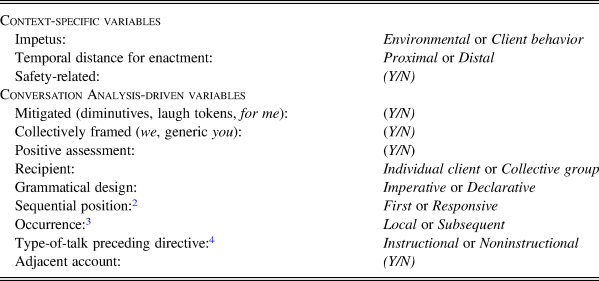
My seven summers of guiding experience provided the ‘unique adequacy requirement for methods’ (Garfinkel & Wieder Reference Garfinkel, Lawrence Wieder, Watson and Seiler1992) to answer the question, ‘Why that now?’. It was this direct membership to the profession that allowed me to understand the environmental situation and group context that a directive was embedded in. From this perspective, I identified three reoccurring and context-specific variables that influences how guides instruct clients: impetus, temporal distance, and safety-related. The two distinct impetuses for directives that guides responded to were (a) client-behavior (e.g. paddling issues, wearing gear incorrectly, not staying hydrated) or (b) changes in the environment (e.g. shallow water, steep landing beaches, oncoming fishing boats). Second, the temporal urgency of the directive impacted its design, so I evaluated each context to determine if guides needed clients to enact the directive immediately (proximally) or at some point in the future (distally). Lastly, I coded whether the directive was directly related to the safety of the trip. For example, instructing clients to stay alert from incoming boats was considered pertinent to safety, while telling to clients to pair up as partners before picking out their kayak was not. These context-specific variables would not be noticeable or decipherable to a non-guide-expert, and by combining my personal work experience, fieldnotes, and video ethnography, I was able to provide an inductive and in-depth analysis of the data.
Subsequently, I used the method of Conversation Analysis to recognize other practices that help reveal how interactions unfolded in real time. I transcribed conversations according to the CA conventions (Jefferson Reference Jefferson and Lerner2004), and after reviewing the transcripts alongside the video, I found eight CA-driven variables that played a reoccurring role in directive design. After forming a comprehensive set of variables (Table 1), I then coded all 576 directives.
Comprehensive list of coded variables.

Lastly, I analyzed the data at the aggregate level by using statistical analysis to conduct bivariate analysis and ran a generalized linear mixed model in order to predict under which conditions guides design directives with an adjacent account.
ANALYSIS
Entertainer vs. instructor roles
While most CA work distinguishes between institutional and ordinary talk, there can be more nuance to an identity than enacting a professional role that produces a singular type of institutional talk. Indeed, guides embody two distinct institutional identities and include (a) the entertainer role, when guides spot and identify wildlife, share local stories, tell jokes, prepare food, and take photos, and (b) the instructional role, when guides orient to the task of leading clients through a series of activities in order for the excursion to progress on time and safely. It is during this instructional role that guides issue directives and assert their authority. Guides weave in and out of these two institutional roles, and how they build their talk, not just the content, helps delineate one role from another.
Clients orient to guides being in an authoritative position as soon as they arrive, as guides usher clients through the preparatory stages of getting ready to paddle (e.g. outfitting them in gear, fitting them for kayaks, delivering a safety talk). Guides try to streamline this process in order to maximize the group's time on water and predominantly assume the instructional role during this phase. Once the excursion is underway, however, conversations are heavily intertwined with noninstructional talk as well.
While there are different phases of kayaking excursions and one role is more likely to occur during a certain part rather than another, unanticipated factors frequently arise that require the guide to quickly switch roles. How do guides switch into the instructional role, and how do clients know when they will be held accountable for listening? Since clients are not held accountable to pay attention to everything guides say—for instance, an excursion's success is not reliant on clients carefully listening to a guide's description on how to discern a Dall's porpoise from a harbor porpoise—guides must design their directives to signal that what is being said is crucial to be listened to. It is critical that clients listen to and act upon directives, as these are not optional nor open for negotiation, part of what defines them as directives (Craven & Potter Reference Craven and Potter2010).
Example (1) illustrates a guide switching into the instructional role from the entertainer role. The guide is describing another full-day excursion their company offers, and after an assessment that reaches topic-completion (line 3), the guide transitions into the instructional role due to unforeseen shallow water, a potential peril for flipping kayaks. This transition begins with the shift implicative “^Alright.” in line 3.

There are several turn-initial practices guides use to help separate directives from previous turns-at-talk, which demonstrate that what is about to be said is different than what came before. These practices include shift implicative discourse particles, pitch rises, stress, and summonings and are used to capture clients’ attention. They also delineate between directives and the guide's previous talk (Heritage & Sorjonen Reference Heritage and Sorjonen2018), since it is important for clients to pay attention in order to implement it. In example (1), the guide uses two shift implicatives “^Alright.” (Beach Reference Beach1993) and “so” (Bolden Reference Bolden2009), together with high onset pitch and stress (Couper-Kuhlen Reference Couper-Kuhlen2001) at the beginning of a directive to help boundary off the entertainment role and project the instructional role. The “so” (line 3) also demonstrates that the talk is of recent origin, or is “emerging from incipiency” (Bolden Reference Bolden2009), since it is responsive to the guide just noticing shallow water. If clients were not paying attention before, they should now. Clients can interpret the turn as forward projecting, which lends itself to the client needing to produce a new, responsive action as well.
MINIMIZING FACE-THREAT
When guides issue directives, they have an indefinite number of turn-design options from which to select. There are times when leading a safe and timely excursion take precedence over other talk and activities, and guides must take a more authoritative-stance vis-à-vis their clients. Over the course of the production of a single directive, the severity can be both dialed-up and dialed-down depending on context and the sequential environment in which the directive is situated. These seemingly small, turn-level adjustments can have implications for how clients perceive their guide and how they feel they are being treated as individuals.
While CA research often analyzes recipient responses as part of the sequential proof-procedure of analyzing first-pair parts (Schegloff Reference Schegloff2007), because client responses were often too far from the microphone to be picked-up, nonverbal, and/or occurred outside the camera frame, client responses and movements could not be systematically analyzed to gain insight into how directives were responded to. Instead, this analysis concentrates on how guides formulate the directive (depending on context, audience, etc.) and orient to the dispreferred nature of this social action in situ.
Guides were found to use four common practices to minimize the face-threat of a directive. First, guides include diminutives such as just (2a,c), try (2b), real quick (2c), or a little bit (2d) to perform mitigating work. Verbs such as pop (2e) can also diminish the effort of the directed action, further reducing the directive's interactional costs (Clayman & Heritage Reference Clayman, Heritage, Drew and Couper-Kuhlen2014). In addition, guides can include the phrase for me (2f), which creates a request-like format and implies that clients are actually doing the guide a favor, a neat reversal of roles of who is helping whom. These practices can occur alone or combined and work to counteract the guides’ dilemma of telling another what to do.

Second, guides can mitigate directives with laugh tokens. In example (3) the group has just landed on a rocky beach for a break after paddling for two hours, and as the clients exit their kayaks and begin to stretch their legs, disgruntled kittiwake seabirds begin to cry loudly and aggressively swoop at everyone's heads. The guide tells everyone to stop walking (line 3) in order to avoid stepping on bird eggs hidden under rocks and explains that these birds can attack if they feel their nesting grounds are threatened (not included in this excerpt). The combination of telling clients to limit their movement after hours of being constrained in a kayak because of the guide's decision to break near a nesting ground (which could be perceived as a guide misstep), works to make these directives (lines 3, 8) part of a troubles telling. After describing this situation, the guide includes laugh tokens in the directive to help transition out of this troubles talk (Jefferson Reference Jefferson and Dijk1985; Haakana Reference Haakana2001).

Third, similar to laugh tokens that attempt to switch focus, guides can build assessments or compliments around directives, which work to affirm clients’ positive faces (the desire to be appreciated, approved of, and liked; Brown & Levinson Reference Brown and Levinson1987). In example (4), the guide cushions the directives with affirmations as she tries to help Mary and Lee, kayak partners who are struggling to keep pace with the group. Guides vigilantly monitor the entire group while on water, which is easier to accomplish if clients paddle ahead of the guide or close enough behind that they remain in earshot. However, if guides cannot hear a kayak behind them, this requires them to swivel their head and torso, which then inhibits themselves from being able to paddle. This is what has happened right before line 1 in (4), as the guide rotates and notices one kayak significantly behind the group. After several seconds of silently watching Mary, the front paddler, moving very slowly and her partner Lee working hard to compensate, it is clear that they will continue to fall further behind with no intervention. While they have not solicited help, their difficulty in keeping up has become a safety issue. The guide initiates these directives with the hope to be able to instruct them on how to paddle faster without shaming them for needing help. The initial encouragement (line 1) and assessment closing (line 10) work to bridge into and out of what is essentially a troubles-telling sequence (Jefferson Reference Jefferson and Dijk1985), even though the trouble is never explicitly stated—just the procedure to rectify it.

In order to first summon Mary and Lee's attention the guide yells an encouragement, “You got it gi:rls.” and waits for the clients to look her direction (line 2) before continuing with the directives (lines 3–4), which are also mitigated with the conditional format. Mary quickly adjusts and paddles faster (during lines 4–5), and the guide compliments this positive change in behavior (lines 6, 8) before providing one more directive, to paddle at the same time. After another second of observing them now paddling more quickly and synchronized (line 9), the guide shouts a final cheer and assessment, bringing the sequence to a close. The guide then looks forward and resumes her own paddling to keep pace with the group ahead.
The fourth practice guides use to soften the blow of directive is to frame it as applicable to everyone, not just to a particular client or kayak. This collective framing can also encompass the guide, which seemingly equalizes the participants and neutralizes the directive's face-threat. This framing is commonly done by selecting we as the subject (see (1) and (2a,c)) or the generic you (see (3)). In example (5), the guide self-repairs (Schegloff, Jefferson, & Sacks Reference Schegloff, Jefferson and Sacks1977) the subject by cutting off the second person pronoun you (line 3) and replaces it with people. The client, Rachel, has been offered a hot beverage during a snack break, which she declines.

The context for this interaction is that the group has just begun their snack break after two hours of paddling and still has another two hours ahead, in addition to a two-hour water taxi ride back to the mainland. It is a miserably cold and wet day, and the guide is trying hard to facilitate a pleasant break on the beach despite the environmental conditions. Rachel's unmitigated and unaccounted for declination of a beverage is symptomatic of a potentially larger problem, since in these harsh conditions clients often shut down, not wanting to eat, drink, or take care of other bodily needs. On such days, guides watch for signs of this downward spiraling behavior and is most likely why the guide encourages Rachel to drink. The guide attempts to reframe the counter to Rachel's rejection not just as personal rebuttal for Rachel, but instead as a larger issue and lesson that is applicable to the whole group standing nearby.
Lastly, guides can also frame a directive with let me (6a,b), which places the burden of the directive action on themselves and not clients. Let me places the client into a passive role, as the recipient of an action the guide will perform. This is seemingly a generous practice for the client's benefit and paints the guide as being helpful. However, much like amusement park workers who ostensibly appear ‘helpful’ when assisting patrons off of a rollercoaster, it really is for the facilitator's benefit to hasten the process (cf. Clayman & Heritage Reference Clayman, Heritage, Drew and Couper-Kuhlen2014).

As demonstrated, there are numerous practices guides can use to help balance the conflicting agendas of being a guide, including using diminutives and other minimizing lexical items, laugh tokens, positive assessments, collective framing, and placing clients in a passive role. Even though it is the guide's job to tell clients what to do, this analysis exposes the interactionally delicate work guides perform when deciding how to design directives. Accounts, also a key practice used by guides, are discussed in a later section.
SELECTING A GRAMMATICAL DESIGN: IMPERATIVES VS. DECLARATIVES
Research on requests often delineates between imperative vs. interrogative grammatical designs (see Heinemann Reference Heinemann2006; Curl & Drew Reference Curl and Drew2008; Rossi Reference Rossi2012, among others); however, this division is not applicable for this study since guides almost never design directives as an interrogative. This aligns with Rossi's (Reference Rossi2012) finding that interrogatives are rarely used during already established joint projects, which kayaking excursions also are. Thus, the distinction most relevant for this analysis is the imperative (n = 300) vs. declarative (n = 276) grammatical design. These two designs are distinguishable by the inclusion of a subject (declarative) or not (imperative).
When analyzing individual cases, it appears that guides tend to use the imperative format when they want clients to respond immediately to a directive. This grammatical design is used to convey the necessity and urgency of a quick response. Example (7) illustrates the guide's use of an imperative design for a proximal directive. This excerpt begins with the guide discussing other seasonal work she has done (noninstructional talk) when the group unexpectedly encounters shallow water, and the guide needs everyone to “go right.” instantly. If a wave hits kayakers paddling in shallow water, kayaks can easily be flipped.

The guide quickly transitions into instructional talk (line 3) to address the perilous situation. An elevation in pitch is used to mark this switching of roles, “^We:”, and to indicate that the forthcoming talk differs from what came before (Couper-Kuhlen Reference Couper-Kuhlen2001). The guide cuts herself off after “going” and self-repairs (Schegloff, Jefferson, & Sacks Reference Schegloff, Jefferson and Sacks1977) to a description of the current status, “getting really shallo:w” (which serves as an account, discussed later) for the directive to “go right.”. This imperative design is used to conjure immediate action, and this behavior aligns with Brown & Levinson's (Reference Brown and Levinson1987) perspective on imperatives being a face-threatening design. Not only does the directive change the type of interaction being had and what the client is now a recipient of (from a story-recipient to directive-respondent), it imposes the immediate enactment of the directive as more important than any other activity clients are presently engaged in (picture-taking, resting, paddling towards the left, etc.). While it is unclear which comes first—the imperative is face-threatening because it is demanding immediate response or the immediate response desired causes the imperative to be face-threatening—either way, guides appear to understand this relationship and make use of it.
Guides appear to use the declarative format more often when relaying distal directives, as shown in examples (8) and (9). This future temporal dimension is evident with “so when we leave” ((8), line 1) and the present perfect formulation “we're going to have” ((9), line 1). Both examples occur while paddling after a sustained period of silence, which occurs often in these full-day excursions.


Another implication of the declarative format is that because it includes a subject (by definition), it enables the guide to tailor it to an individual recipient or collective audience. Both of these examples have we as the subject, which is useful to make sure that the group knows that it applies to everyone in (8) or to soften a directive in (9) (discussed below).
These two examples differ, however, because in (8) the directive's impetus is an environmental stimulus, a fishing boat headed towards the group. The guide issues this directive as a preemptive warning for everyone to stay alert for fishing boats when making the future crossing. In contrast, in (9) the guide's directive is a direct reaction to something the client Sam is doing, paddling towards a creek outlet even though the guide already explicitly instructed the group to stay away from it (not shown). As evident when watching the video and seeing how far Sam still is from the shore, he is safe paddling a bit farther in the direction he is headed and does not need to change course immediately. Having a directive shouted at him from fifty yards away that everyone can overhear may seem too extreme in proportion to how much time Sam still has to veer away. The guide backs down from this almost scolding-like turn-beginning by switching from an individually framed directive to collectively framed we, which helps to no longer single Sam out, diminishes its urgency, and softens the directive. Allowing Sam to choose exactly when he wants to turn his kayak allows him to maintain some degree of control over his actions and lessens the threat to his negative face. Thus, the interactional work that guides perform to balance urgency with authority becomes evident when examining the grammatical formulations of directives.
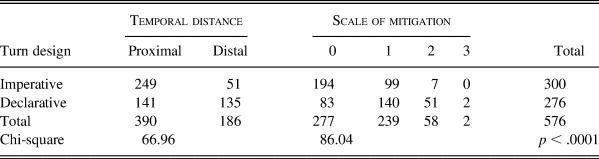
In order to test this association of grammatical design and face-threat at the aggregate level, I conducted Chi-square tests to examine the relationship between (a) grammatical design and temporality and (b) grammatical design and mitigating practices (Table 2). The hypotheses are that if imperatives are the more face-threatening grammatical design, then guides will use them for cause, to help convey the urgency of proximal directives. Relatedly, guides will mitigate imperatives less as to preserve the affordance of the design. Each directive received a score (0–4) for each mitigating practice found present: diminutives, laugh tokens, positive assessment, and collective framing (three was the maximum score found). The results indeed revealed a strong bivariate relationship between the grammatical design and temporal distance of enactment and the grammatical design and mitigation practices.
Grammatical design vs. temporal distance and mitigating practices.

Thus, guides use the imperative design to help to transmit the urgency of the situation while, reflexively, the urgency of a proximal directive warrants the use of an imperative. Even though guides minimize imperatives less frequently, a third of imperatives were found to include at least one type of mitigation, which arguably points to guides not wanting to come across as too harsh and wanting clients to give them tips. Conversely, when the situation is less temporally urgent, guides more frequently select the declarative design and include more mitigating practices. This pairing of declaratives with mitigating practices suggests guides view the declarative formulation as the more relaxed and less face-threatening design. As these results show, guides tailor the grammatical design of a directive to best fit that moment of interaction. Even though guides are imbued with the same authority status throughout the trip, they adjust their authoritative stance as context dictates. This helps guides effectively communicate their expectations with clients and helps to maintain their relationship.
What is the impetus for guides giving directives?
From my seven seasons of guiding, I can attest that there is almost always at least one client doing something incorrectly at any given time. However, this does not result in guides nitpicking every client misdeed, as guides learn to manage their directive threshold. Instead, guides often wait to correct a client misdeed only when they perceive a significant consequence that warrants interference (e.g. Mary and Lee's paddling difficulties, (4)). In other words, guides try to withhold correcting clients until it becomes absolutely necessary for clients to change behavior, and this is an interactional gamble for guides. If guides wait and the client self-corrects, then guides win by avoiding having to issue a directive. Indeed, this preference for self-correction mirrors the preference for self-repair in conversation (Schegloff, Jefferson, & Sacks Reference Schegloff, Jefferson and Sacks1977). If, however, clients do not self-correct, then guides may have to confront a situation that needs to be dealt with immediately, resulting in a high face-threat, proximal directive.
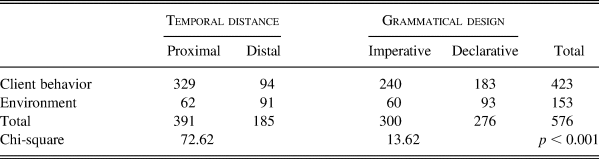
The difficulty of assessing this gamble is that recorded data only capture articulated directives and cannot show those that remain unsaid because clients resolved the issue on their own. However, this interactional gambling seemingly explains why guides issue proximal directives related to client behavior at a higher frequency than they do when dealing with environmental stimuli, even though overall distal directives (n = 186) occurred only about half as often as proximal directives (n = 390). Indeed, there was a strong bivariate relationship between temporal distance and impetus (see Table 3).
Impetus vs. temporal distance and grammatical design.

Because environmental stimuli are unlikely to self-correct and it is advantageous to avoid obstacles before the situation becomes critical, this can explain why distal directives were more likely to be used for environmental stimuli than for client behavior (note (9) is a hybrid of correcting client behavior after being warned about an environmental stimuli). Thus, guides must evaluate when and how to best design a directive, and by teasing apart the warrant for invoking their instructional role, we can see how impetus plays a role in how guides design directives in terms of temporality.
Lastly, connecting the last two sections, a bivariate relationship was also found between a directive's impetus and grammatical design. Imperatives were more likely to be used when guides were responding to client behavior. An affordance of the imperative format when addressing a specific client is that it allows the guide to avoid using the client's name specifically. This is useful if the guide does not want to draw extra attention to the client or does not remember the client's name. This is only possible, however, if the guide is able to capture the appropriate client's attention without using their name. Furthermore, even if a directive is directed to a specific recipient, other clients may overhear it, and a subject-less directive can have a second-hand learning effect. Changes in the environment were more likely to use the declarative format. Because environmental impetuses almost always pertain to the whole group (including the guide), this lends to the collective we being used, which then makes it a declarative directive (see (8)).
DOING ACCOUNTING
We now move to our second objective, investigating the conditions under which guides include accounts. We analyze the face-saving benefits of including an account in the directive's design, but also reveal that accounts do not always contribute to social-affirming work. In fact, in different situational and sequential contexts, accounts could actually heighten the face-threatening nature of a directive. Because guides and clients most likely do not share a cultural understanding about what is expected when kayaking (in general and/or in Alaska specifically) and what is expected when taking on the role of a client in a paid guided excursion (an atypical activity for many), it would not be unexpected to find a predominance of accounts in this context. Indeed, of the 576 total directives, about one-third of the directives (n = 204) were found to have an adjacent account.
Guides and clients have extended interactions that can span anywhere from three hours to eight days, which often entail guides repeating the same directive numerous times. If accounts are supposed to help provide insight into the rationale why a directive is necessary, once guides share this information, clients are no longer in an epistemic-minus position, and according to Sacks (Reference Sacks, Jefferson and Schegloff1992), one should not tell another something that they already know. Indeed, guides appear to follow Sacks’ tenet as they often included accounts the first time they issued a directive as a way to justify and/or explain the instruction and then dropped the account in subsequent positions. Indeed, repeating the account in subsequent positions may undercut the account's mitigating effects and instead come across potentially as patronizing. Instead of reissuing both the directive and account, it appears guides choose to omit the account and only articulate the directive, seemingly the most crucial part of the turn. Guides can also forefront a subsequent positioned directive with remember, inviting clients to recollect what they already know, which also flattens the epistemic gradient between them.
The following two examples illustrate the difference between locally initial directives that include accounts and their subsequent directives that lack accounts. In example (10a) (repeat of (8) but with different emphasis), the guide first tells the group what the plan is before educating the clients about the rationale for it.

A few minutes later, the guide reissues the same instructions (10b) in response to clients not paddling in single file, but this time omits the account.
The next example, taken from a different excursion, also shows the guide instructing the clients and then providing an account for its rationale.

A few moments later the client lets go of the dock and the kayak begins to drift. For this repeated directive, the guide reissues the directive but omits the account.
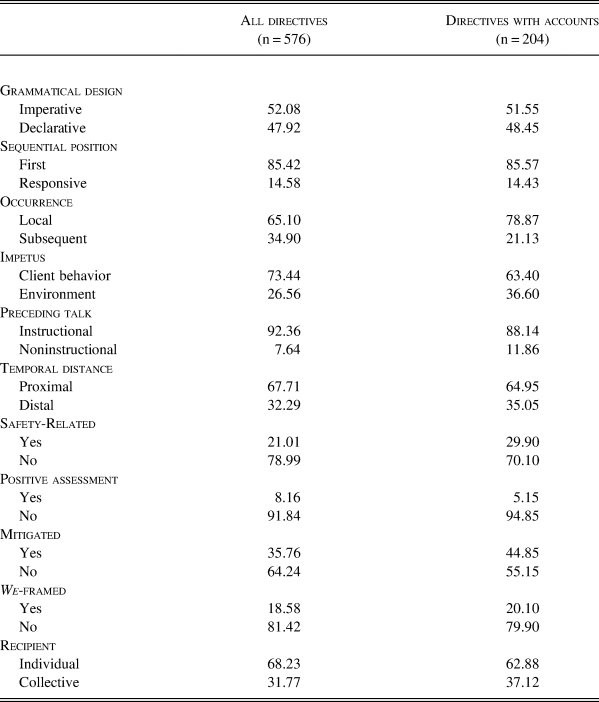
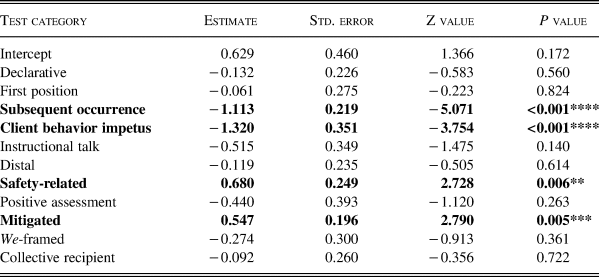
To further assess which factors affected the likelihood of a directive having an account, I conducted a generalized linear mixed model (GLMM) (Baayen Reference Baayen2008). Initially, I assessed the relationship of all independent variables of interest on the outcome variables using a full model and compared it with a null model comprising only the random effect using a likelihood ratio test (Dobson & Barnett Reference Dobson and Barnett2008). The comparison between the full model and the null model was significant (GLMM: p < 0.001, N = 576, χ 214 = 66.19). See Table 4 for frequency and Table 5 for the results.
Distribution of directives with accounts by predictor (data given as percentages).

Results, directive with account = 1, standalone directive = 0
(p < .10 *; p < .05 **; p < .01 ***; p < .001****).

These results affirm Sack's tenet since guides were more likely to include accounts if the directive was in a locally initial position (i.e. the first time issued) and was already mitigated (with diminutives, laugh tokens, for me). Thus, when used in the appropriate sequential position, accounts can perform face-saving work and work in conjunction with other mitigating practices guides also include.
This analysis also exposed that the directive's impetus and relevance to safety were significant predictors of accounts being used. Guides were more likely to include an account if the directive was not responsive to a client misdeed (in other words, environmental impetuses were more likely to have accounts) and pertained to a safety matter. By sharing their ‘professional visions’ (C. Goodwin Reference Goodwin1994) with clients, guides level the epistemic playing field, treating clients more as equals than as subordinates (cf. Peräkylä Reference Peräkylä1998). Accounts can help bridge the knowledge gap clients have, which is expected when embodying an unfamiliar role, performing an unfamiliar activity, and navigating an unfamiliar landscape (i.e. being a tourist).
For instance, example (12) has an environmental impetus and deals with a safety issue—not flipping kayaks in shallow water. It is near the end of the trip and it is a windless, sunny afternoon with flat water. The group has been paddling mainly in silence for the last half hour and has begun to drift apart. The guide breaks the quiet in order to corral the group closer to where she is paddling, as some kayaks are venturing too close to shore. This account-fronted directive provides clients with the ability to see the water as a guide does by telling them to look for breaking waves.

By providing accounts, guides can transform a directive from being an action solely focused on getting someone to do something into a larger activity, that of an educational experience. Furthermore, this behavior parallels social psychology research that claims participants are more likely to follow rules when they understand the rationale behind them (Jacobs Reference Jacobs2017), which is vital in situations that deal with safety matters.
While accounts can be educational in certain contexts like safety matters and environmental issues, there are times when overt explications may in fact increase the face-threat. This can occur when the account itself fixates too much attention on a client fault and potentially could increase, rather than mitigate, the face-threat to the client. Take for instance example (4) discussed earlier with the paddling partners Mary and Lee struggling to keep pace. The account for why the guide is giving these directives would be akin to, ‘Because you're going slow’ and could likely hurt the clients’ faces since it highlights fault. It is not too surprising that in cases like this, guides do not include them.
While infrequent in this data, guides sometimes break from their professional role, and this next example (13) shows an instance of a guide providing an account in reaction to a client misdeed that comes across as scolding. It occurs at the end of the paddling day, and the group is standing on a fly-ridden low-tide beach. The two guides are hustling to prepare the kayaks to be loaded onto the water taxi and have already instructed the clients more than once to grab whatever dry bags they can to help move gear onboard. As one guide rapidly walks towards the water taxi to push it into deeper water before it gets beached on shore, a client approaches, swings his gloves towards the guide, gesturing for the guide to take them. Not only does this go against the explicit instruction of helping carry all gear onto the boat, it also interferes with the guide's current mission.

By asking the guide a question and presenting his gloves to him, the client holds the guide accountable to respond (Stivers & Rossano Reference Stivers and Rossano2010). The guide provides a type-conforming response to this polar-question (Raymond Reference Raymond2003), but without any of the turn-initial practices that often help soften dispreferred responses (Pomerantz Reference Pomerantz, Maxwell Atkinson and Heritage1984; Schegloff Reference Schegloff2007). In fact, the guide counters with an imperative for the client to do what he's already been instructed to do—to help with gear. The account for why the guide cannot take the proffered gloves is a nonaccount. While it occurs where an explanation might typically occur, it does not actually provide information for why the guide cannot accept the gloves and comes off as a scolding—that the client should not have imposed on the guide in this way—and the client does not pursue any further response from the guide and walks away. Now we have the evidence for what exactly about this guide's response seemed unprofessional—he included an account in a subsequent directive for a client misdeed, and the face-threat to the client is palatable.
DISCUSSION
Overall, one-third of guides’ directives were found to have an account and this aligns with Schegloff's (Reference Schegloff2007:83) findings that requests are regularly accompanied by explanations. However, this propensity looks significantly different from Antaki & Kent's (Reference Antaki and Kent2012) study of adult caregivers and institutionalized intellectually impaired adults in which accounts almost never accompanied directives (only about a dozen out of 230+ directives had an account). I hypothesize one reason for the lack of accounts in Antaki & Kent's data is that they might not have captured locally initial directives due to the more long-term type relationships caregivers have with their clients. In this kayaking data, however, these first interactions were documented. I argue that it is useful when examining directives across different contexts, both in mundane and institutional interactions, to consider where directives occur in relation to the participants’ relationship history.
Another distinction between this study and previous research is the unique dynamic between participants because guides straddle the line between their overarching duties of keeping clients safe while also embodying a service role that works for tips. I believe these two dimensions work together to explain the relatively high frequency of accounts as a way to mitigate guides’ deontic authority over clients. If guides can explain why they are telling clients to do something, then perhaps guides can perform face-saving work to protect their potential tip. The account can reveal the guide's epistemic rationale behind the deontic directive, and by sharing the reasoning for a certain directive, guides show respect to their clients. Furthermore, while guides hold clients accountable for following orders, guides represent their own directives as accountable actions by sharing why the directive is necessary. By doing the additional interactional work of providing accounts (in appropriate contexts), guides strive for pleasant, informative, and respectful interactions.
CONCLUSIONS
While acknowledging that differences exist depending on social context, this analysis focuses on a single type of an institutional relationship, that of sea kayak guides and their clients on Alaska-based excursions. Through their talk, guides are able to handle the institutional dilemma of controlling clients’ future movements while not coming off as unjustifiably demanding. By examining how guides get into directives, when they use them, and how they design their turns-at-talk, it is evident that guides are actively shaping their interactions with clients as not to highlight the difference in their epistemic and deontic positions vis-à-vis one another.
Guides work to mitigate the face-threats of directives by using diminutives, laugh tokens, positive assessments, collective framing, and placing clients in a passive role with “let me”. Depending on the temporal urgency, guides were found to use the imperative design more frequently for proximal directives, while declaratives were used more often for distal directives. In addition, grammatical design was also motivated by impetus. If client behavior served as such, then guides were more likely to use imperatives, while environmental stimuli had a more equal distribution of imperatives and declaratives. Furthermore, guides were found to include accounts in about a third of directives, and statistical analysis showed that directives were more likely to include accounts if the directive was in a locally initial position, was not responsive to client behavior, was a safety matter, and already contained some form of mitigation. While accounts can help mitigate a directive's face-threat, this is not uniform in all contexts. Indeed, accounts can infringe on the client's face when used in subsequent directives or when addressing client behavior, and thus are more likely to be absent in those contexts.
The role of being a guide must be ‘talked into being’ (Heritage Reference Heritage1984), as it is through language that guides perform their job. Their role is talked into being at a micro-interactional level, on a turn-by-turn basis, and must be negotiated and re-negotiated throughout the excursion. The glacially carved bays and icy waters of Alaska are a unique setting to study how guides perform their work because the issue of safety is the undercurrent that constantly runs through guides’ minds, shaping their perception of how an excursion is unfolding and how they interact with clients. Nobody likes to be told what to do, but there are social situations in which participants’ prescribed roles make relevant giving or receiving orders. These binary relationships, in which one party possesses more authority in regard to another, can be entered into in a variety of ways: naturally, as in a parent/child; coerced, as in a hostage/victim; and institutional as in a doctor/patient or guide/client. Depending on the relationship-type, the events that led to its configuration, the shared-understanding of the situation, and the history of participants’ interactions, how the authoritatively positioned member delivers directives has a distinct array of turn designs and social actions. While one objective of this study is to shed light on how directives are formulated in this ecotourism setting, it also advocates for future work to adapt a mixed-method analysis of other types of relationships and contexts.