Great responsories, or responsoria prolixa, are characterised by their formulaic structure. Some well-known studies that demonstrate this by identifying recurrent melodic elements have displayed the responsory repertory found in one particular manuscript. In his introduction to the facsimile of the Sarum antiphoner, Walter Howard Frere labels hundreds of these recurrent musical ‘phrases’Footnote 1 and Hans-Jørgen Holman's study of the great responsories in Worcester F 160 takes a similar approach.Footnote 2 My own work centres on the responsories in the twelfth-century antiphoner from Saint-Maur-des-Fossés, Paris Bibliothèque Nationale de France lat. 12044. I entered each musical phrase of the responds in this manuscript into a computer database. In order for the computer to interpret musical notes as data, I used the Volpiano font, developed at the University of Regensburg's Musicology department. Melodies are entered according to the ‘a’ to ‘p’ alphabetic series associated with William of Volpiano and appear on the screen as notes on the staff. The completed database contains just over 6,800 phrases entered in this way. I am able to search for any phrase, which the computer understands as a string of letters, in the responsories of Paris 12044. However, my goal is not simply to add the Saint-Maur repertory to existing chant taxonomies. I wish to go on and compare the use of melodic elements in the Saint-Maur tradition with their use in other sources. By doing this, one can gain new insights into the role these recurrent elements play in oral composition and transmission.
Form and structure
Before examining the individual melodic elements themselves, it is helpful to examine the musical context in which we find them. The responsory is divided into two main sections: the respond and the verse. I shall not be speaking about the verse, which is usually sung to one of eight mode-specific verse tones.
Most of the responds have a ternary structure,Footnote 3 with three periods, each divided into two phrases. Usually, the first phrase cadences on a pitch that contrasts with the final, while the second phrase (the end of the first period) cadences on the final. In the next period, the third phrase may also cadence on the final as an interior resting point before coming to a significant cadence at the end of the fourth phrase on a pitch that contrasts with the final. The last period, the fifth and sixth phrases, usually has the fifth phrase cadencing on a contrasting pitch before returning to the final at the end of the sixth phrase. With this overall structure in mind, it is interesting to see how melodic elements are used again and again in particular positions to achieve tonal goals.
In parentheses, it should be mentioned that a small number of responds, mostly set to psalm texts, consist of only two main phrases, the first of which cadences on a tone contrasting with the final, while the second phrase cadences on the final.
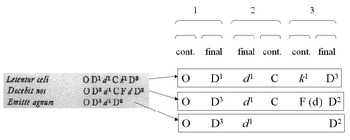
Frere also noted the repeated use of certain melodic elements in a particular succession and labelled these with a system of letters and numbers (as shown in Figure 1). Responds composed by employing the same recurrent material in the same order were described by Frere as having the same formula, just as a string of chemical elements in the same order is called a chemical ‘formula’. However, Frere's formulas do not fit effortlessly into a three-period, six-phrase system. If we understand a musical phrase as something relatively self-sufficient, with a beginning, a middle and an end, then many of Frere's ‘phrases’ are too short. One might describe them as melodic ‘elements’, which do indeed recur in different chants but do not constitute a full unit in the six-phrase system. Many responsories consist of more (or fewer) than six phrases in Frere's interpretation. Figure 1 demonstrates how Frere's formulas may nevertheless be re-analysed in terms of the six-phrase structure. While Letentur celi happens to be divided into six phrases by Frere, consistent with the six-phrase tonal structure outlined above, Docebit nos consists of seven phrases in Frere's analysis, and Emitte agnum of only four.
Frere's IIa formula within a three-period structure (‘cont.’ for ‘contrasting’).

To fit the structural system, the penultimate d phrase in Docebit nos should be seen as an insertion before the final phrase, anticipating the return to the final. Textual and melodic divisions should be used to determine whether an addition (like this d phrase) should be seen as an appendix after phrase 5 or a precursor to phrase 6. In the case of Emitte agnum, the phrases that end on contrasting pitches seem to have been omitted, perhaps because this text is shorter than the other two. Even though Frere rightly divides this respond into four phrases rather than six, it is still possible to analyse it using the larger, six-phrase structural system.
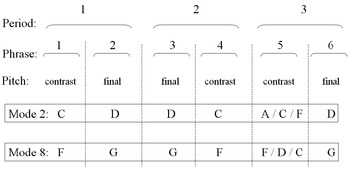
Two well-known groups of responsories are constructed of similar melodic material in identical order. Peter Wagner describes the result of this construction as a ‘scharf ausgeprägten, feststehenden Grundriss mit Eckpfeilern’.Footnote 4 We might call these the most ‘formulaic’ of all responsories because of their consistent composition. Helmut Hucke referred to them as ‘Responsorienweisen’ and, alternatively, ‘Gestaltmodelle’.Footnote 5 One group is found in mode 2 and the other in mode 8. In Frere's study, the mode 2 group contains fifty-one responds – over 44 per cent of the responds in this mode, while sixty-seven chants (42 per cent) are members of the formulaic group found in mode 8. Figure 2 shows how both groups follow the formal outline of three binary periods.
Responsories in modes 2 and 8 corresponding to the six-phrase responsory structure.

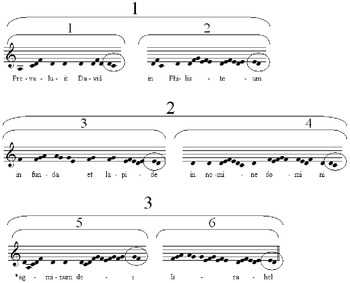
These theoretical observations are applied to a practical example in the mode 2 responsory, Prevaluit David (from De Regis), shown in Example 1.
Prevaluit David (De Regis).

The first phrase ends with a cadence that contrasts with the final. Then there is a return to the final at the end of the second phrase. The third phrase remains oriented towards the final, before concluding the second period with a strong contrasting cadence. The last period is bisected with another cadence on a contrasting pitch, before returning to the final at the end of the respond.
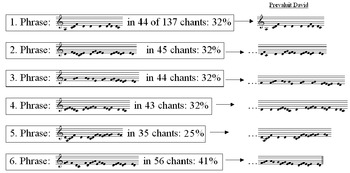
Using the database of recurrent, or ‘standard’, melodic material in Paris 12044, it is possible to get a sense of which material is most likely to be found in certain positions. Figure 3 shows how frequently used phrases, or their variants, can make up a whole respond, again using Prevaluit David as an example. Here, the most frequently used material for phrase 1 (in responsories in mode 2) is the phrase ending on C shown in Figure 3, which begins forty-four out of 137 chants in the mode. This phrase can be adjusted to set texts with six to ten syllables by expanding the initial recitational passage on D. Three-quarters of the responds which use this phrase set a text with proparoxytonal accentuation (that is, the syllable third from the end receives the accent as in ‘domine’). This is accomplished by inserting a single D before the final D–C clivis. Prevaluit David is an exception to this, as the phrase sets a paroxytonal accent, ‘David’, and therefore, the single D is not found in the example in Figure 3. Phrase 2 and Phrase 3 are used to set texts of between six and eleven syllables and have similar cadences. Phrase 2 sets texts with proparoxytonal and paroxytonal (that is, accent falls on the second-last syllable, as in ‘deus’) accentuation by inserting or omitting a single D before the melisma immediately preceding the closing E–D clivis. Phrase 3 makes similar adjustments for various accentuations by separating the F–G pes from the melisma that follows or by joining the pes to the following melisma. Phrase 4 can be expanded to accommodate texts up to twelve syllables in length by extending the reciting passage on D at the beginning of the phrase (comparable to the extension in Phrase 1). Phrase 4 is used in approximately the same number of chants as the previous three phrases. This is not to say that they are all used in the same forty-four responds. Even though all these phrases are used in about a third of the responsories in mode 2, the individual responds making up that third do not have the same melodies throughout. The phrase in the fifth position in Prevaluit David appears in a quarter of all mode 2 responsories. It usually sets texts of between five and eight syllables with paroxytonal accentuation.
Positions of standard material in mode 2; Prevaluit David.

The final position is one of the most stable positions for all responsories, regardless of mode. Prevaluit David has the most frequently used phrase in final position in mode 2, found in just under half of the responds in this mode. In this example, the phrase is set to a very short text. In the database, however, it is mostly found in setting texts of between five and nine syllables with paroxytonal accentuation. To accommodate proparoxytonal accentuation, a single D is inserted before the melisma preceding the final E–D clivis. (Even though the example presented here has proparoxytonal accentuation, it sets too short a text to necessitate the added D.)
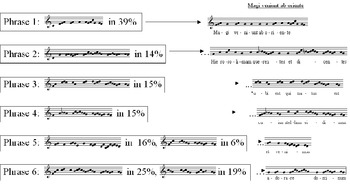
In the responsories in mode 8 there is less overall consistency, but it is still possible to gather information about a typical mode 8 respond by mining the database. Magi veniunt ab oriente (Epiphany) is a good example of the principal type of mode 8 respond, since it is made up entirely of the most frequently found phrases in each position, as Figure 4 demonstrates.Footnote 6
Positions of standard material in mode 8; Magi veniunt ab oriente.

These examples represent the most formulaic responds in the repertory. However, even when the entire body of responsory repertory – formulaic or otherwise – has been taken into account, it can be demonstrated that recurrent melodic elements (or ‘phrases’ in Frere's terms) function as points of reference placed throughout the melody. The more frequently a particular section of musical material is used, the more likely it is to be found in a particular location within the melody; the more common the melodic element, the more stable its placement. In general, recurrent melodic material is associated with the mode, the position in the melody in which it is most often found, and its relationship with other melodic elements in the singer's mind. In this way, recurrent or ‘standard’ elements act as self-generating cues that stimulate the serial recall of a melody, starting at the beginning of a respond and continuing to its end. They are employed in conjunction with knowledge about melodic structure, the divisions in the text, and melodic formulas (if any) in the mode.
The more comprehensive study, from which these examples were taken, has found that recurrent melodic elements are most often found in the second and the sixth phrases regardless of mode or degree of formulaicism.Footnote 7 These phrases are typically used to bring the melody to a cadence on the final of the mode, having cadenced significantly on a contrasting pitch previously. Therefore, the singer or scribe might rely on standard elements to bring him/her to the appropriate pitch at the end of the phrase, since there is little doubt about melodic goal or the length of text at these points. Similarly, opening phrases are used to signal whether the subsequent melody will follow a well-known melodic outline or not.
Results from the larger study also show that phrases in fourth and fifth position are the most likely to contain unique melodic material. Choices concerning pitch-goal and textual declamation are not as clear-cut in these positions as they usually are in the second and final phrases. Therefore, a singer might be more likely to use rare melodic material and cadence on any contrasting pitch-goal that seems appropriate.
It should be noted here that medieval singers or scribes would not have approached this repertory in the manner presented in this study. The analysis presented here is based on computerised data as well as theories about melodic structure and modes. The results are the product of a sort of ‘reverse engineering’, where the whole is examined as the sum of its parts. While this kind of information is admittedly not the same as the contents of the mind of a medieval singer, his/her years of experience singing responsories (in an oral or written context) must have amounted to a similar kind of global understanding about tonal structure and the applicability of certain restrictions or norms.
Structure and transmission
Studying the deployment of recurring melodic material throughout the repertory in one manuscript sheds light on the oral composition process within one tradition. Moving a step further, comparing the use of these melodic materials across manuscript traditions shows the kind of musical scope singers in different traditions may have had when performing a responsory according to the previously mentioned mental points of reference. When scribes notated a preferred version in a manuscript, they would be engaged in a similar exercise. A comparison of many different readings of one chant may also help to uncover its underlying structure. By taking our focus off individual note groupings and considering the tonal goals and melodic contour within the overall structure instead, we gain a sense of that referential framework in the mind of the singer.
As part of my doctoral dissertation, I have recently compared over 400 responsories in Paris 12044 with the versions in Toledo 44.2, Benevento 21, Lucca 601, Utrecht 406, Cambridge Mm 2.9 (used as the basis of Frere's facsimile edition, referred to as the ‘Sarum Antiphoner’), Saint Gall 390–391, Karlsruhe 60 and Worcester F 160. Several types of common differences are thrown up by the comparison. A manuscript may substitute one standard phrase for another. A manuscript may consistently show a different version of the same standard phrase: we might regard it as part of the ‘house style’ of the source. At other times, a standard phrase may have been omitted or replaced with original musical material. It has been interesting to note that nearly 13 per cent of the responds compared have been set by at least one of the comparison manuscripts to a different melody in a different mode. I have chosen as examples two responsories from the time shortly after Christmas – one in mode 2 and the other in mode 8.
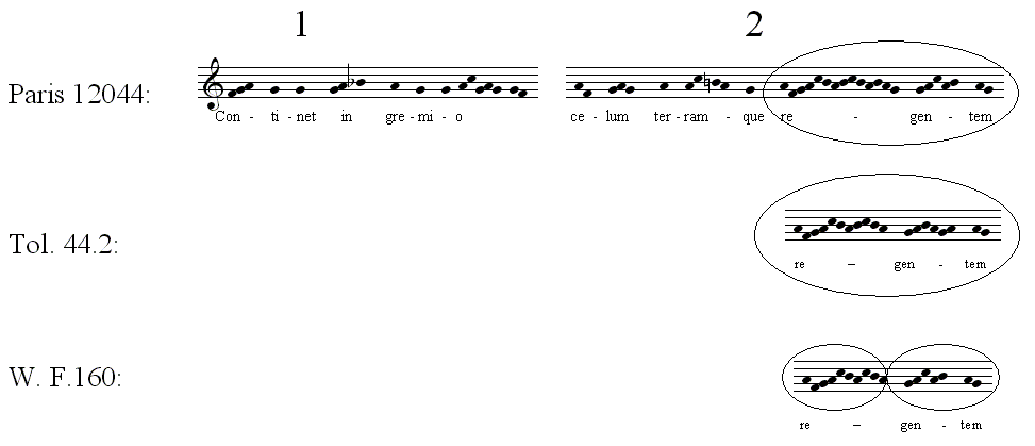
The mode 8 responsory Continet in gremio contains both common melodic elements and some which are less frequently used. Example 2 shows the parallel transcription of the first period of Continet in gremio as found in Paris 12044, Toledo 44.2 and Worcester F 160. At the outset, all sources have the same first phrase. This is not surprising, as this phrase marks the beginning of a very well-known and frequently used melody type. At the end of the second phrase, however, Toledo 44.2 shows a different and much more frequently used cadence than the one appearing in Paris 12044.
Continet in gremio, phrases 1 and 2, in Paris 12044, Toledo 44.2 and Worcester F 160.

The Paris 12044 ending, extending the scalar melisma on ‘re-’ of ‘regentem’ and then skipping the B natural on ‘gen’, is rare and found in less than 3 per cent of all responds in mode 8. The cadence found in Toledo 44.2, on the other hand, is found in this position over 20 per cent of the time in other responsories in Paris 12044. It is unclear why the Paris 12044 version of Continet in gremio avoids what might be called the ‘expected’ cadence at this point. At the same place in Worcester F 160, the short melisma on ‘re-’ corresponds to the very common phrase found in Toledo 44.2, before proceeding to the same rare penultimate figure found in Paris 12044.
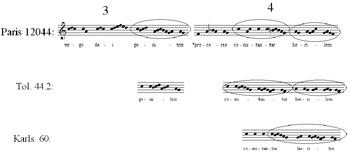
In the third and fourth phrases, more differences appear, shown in Example 3. In phrase 3, Toledo 44.2 differs by using material not found in any of the Paris 12044 responds. At the end of the second period, Toledo again differs from Paris 12044. While the cadence at the end of phrase 4 in Paris 12044 is made of unique material, the material used for the word ‘comitantur’ suggests to the Toledo scribe the beginning of a standard melodic element that appears forty times in the Paris 12044 responds. Toledo goes on to set the final word in the fourth phrase, ‘herilem’ in a way that resembles the material in Paris 12044. The reading in Karlsruhe 60 shows the standard material in the Toledo version, but now transferred to the final word of the phrase.
Continet in gremio, phrases 3 and 4, in Paris 12044, Toledo 44.2 and Karlsruhe 60.

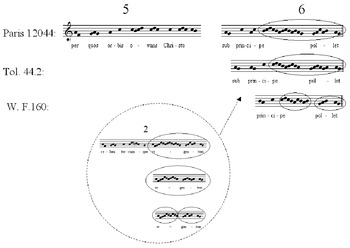
Example 4 shows the final period of Continet in gremio, as found in Paris 12044, Toledo 44.2 and Worcester F 160. All sources are in agreement through the fifth phrase, but the ending of the final phrase exposes many of the same differences that were seen in the second phrase. This sixth phrase differs from phrase 2 (shown within a dotted-line circle) only in that it begins one pitch higher, on a D instead of a C. Worcester F 160 and Toledo 44.2 set the final syllable of ‘principe’ almost identically leaving Paris 12044 to its extended version of the same. Toledo 44.2 uses the standard cadence that closes 90 per cent of mode 8 responds in Paris 12044. In this case, however, Paris 12044 again uses a rare variation of this cadence (G–A–C–A–B). This time Worcester F 160 does not show the same version as the one found in Paris 12044, choosing instead a skeletal version of the general shape.
Continet in gremio, phrases 5 and 6, in Paris 12044, Toledo 44.2 and Worcester F 160.

Taking a wider view, we could say that all three manuscripts present different interpretations of the same underlying melodic structure. The same melodic contour, ambitus and tonal goals are maintained in all three sources even though the exact musical figures may vary from source to source. The fact that these versions are internally consistent (that is, they match the material used in the second phrase with the material in the final phrase) points to the singer's understanding of the structure of the melody on a more abstract level. It would be therefore unsatisfactory to explain the differences between sources as scribal error.
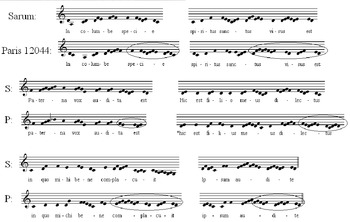
The second example of variations between manuscripts concerns the mode 2 responsory, In columbae specie. Example 5 shows this responsory as it is found in the Sarum antiphoner, Cambridge Mm 2.9, compared with the version in Paris 12044. In most sources, In columbae specie is a member of the group of highly formulaic chants in mode 2. Most of the phrases found in Sarum's reading of this chant occur frequently throughout the database and as such it represents the highly formulaic version of this melody.
In columbae specie in the Sarum Antiphoner and Paris 12044.

In Paris 12044, however, this chant does not employ the typical phrases for mode 2 and could instead be described as a ‘variation on a well-known theme’; it replaces standard phrases with rare material and it does not cadence on pitches corresponding to the usual tonal structure. The first phrase remains relatively close to the standard material, if slightly ornamented. At the end of the second phrase, however, Paris 12044 substitutes material that is found in only three other instances in the entire Paris 12044 repertory (one of which occurs later in this chant) whereas the standard version seen here in Sarum uses a phrase found in this position in over 45 per cent of other mode 2 responsories in Paris 12044. The third phrase is an abbreviation of the frequently used material found in the Sarum antiphoner, but ends on E instead of the final, D. Even though this is not much of a difference, in terms of musical material, it is worth taking note of it because we would expect a D cadence at this point in the chant. At the end of the second period, Sarum cadences with standard material, also found 36 per cent of the time in this position in Paris 12044. But Paris 12044 uses an ornamented version of this phrase, which goes beyond the contrasting pitch, C, and ends on a D, which is, again, quite contrary to the expected tonal structure.
In Paris 12044's fifth phrase, the second phrase's material appears again, and once again deviates from the prescribed tonal structure by concluding on the final instead of on a contrasting pitch, as shown in Sarum's formulaic version of the melody. Finally, the last phrase shows Paris 12044's substitution of a different standard ending for the one found in Sarum. While Sarum's ending concludes 41 per cent of mode 2 responds, the database shows that 20 per cent of mode 2 responds end with the version shown in Example 6, taken from Paris 12044.
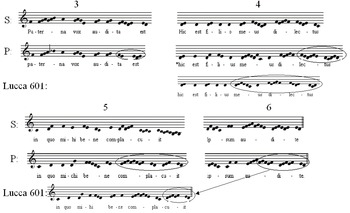
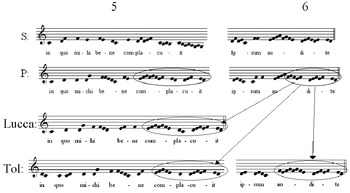
In columbae specie, phrases 3–6, in the Sarum Antiphoner, Paris 12044 and Lucca 601.

Adding Lucca 601's reading of this responsory seems to agree completely with Sarum's more popular version but for two items. Example 6 shows these differences.
The first difference is the less significant. At the end of the second period, Lucca 601 technically ends on a D instead of on a contrasting pitch, as would be expected in this position. However, since the rest of the phrase is practically identical to Sarum's formulaic version, the additional D at end of this phrase may be seen as an ornament rather than a tonal shift to the final of the mode. The second difference is a more important one: Lucca 601's version stops short of the final phrase, ‘ipsum audite’. The material used to cadence on the final, D, can be seen as a combination of the fifth and sixth phrases in Paris 12044's version, as shown. While Lucca 601 is mostly in agreement with the Sarum version, elements which can also be found in Paris 12044 turn up here as well.
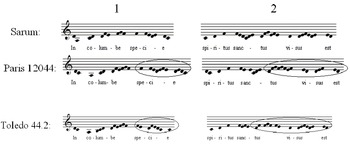
The version of this chant in Toledo 44.2, shown in Example 7, Example 8 and Example 9, combines readings found in several of the other manuscripts. Example 7 shows the first period of In columbae specie in Toledo 44.2. The first phrase reads more like Paris 12044 than Sarum, with a scalar passage from F to C instead of the standard ending found in Sarum. However, the second phrase shows almost complete agreement with the formulaic version in Sarum again.
In columbae specie, phrases 1 and 2, in the Sarum Antiphoner, Paris 12044 and Toledo 44.2.

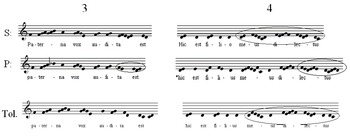
In columbae specie, phrases 3 and 4, in the Sarum Antiphoner, Paris 12044 and Toledo 44.2.

In columbae specie, phrases 5 and 6, in Sarum Antiphoner, Paris 12044, Lucca 601 and Toledo 44.2.

Example 8 shows the second period of this responsory in the Sarum Antiphoner, Paris 12044 and Toledo 44.2. In the third phrase, Toledo 44.2 uses unique material instead of Sarum's standard phrase and Paris 12044's abbreviated version of the same. Toledo's melody does imply a short cessation on the final, D, at the end of this unique material, thereby keeping to the overall tonal structure of the respond. At the end of the fourth phrase, Toledo again uses the standard material found in Sarum.
In the last period, shown in Example 9, Toledo 44.2's version seems to combine two of the other manuscripts' readings.
First, at the end of the fifth phrase, it uses the standard material found at the end of the sixth phrase in Paris 12044 and at the end of the final (fifth) phrase in Lucca 601. This goes against the formulaic version, shown in Sarum, by cadencing on the final on the fifth phrase instead of on a contrasting pitch. However, instead of ending the chant on the D reached at the end of this phrase, as Lucca 601 does, Toledo 44.2 repeats this musical material in the next (final) phrase, so that its reading agrees with the rare version found in Paris 12044.
Lucca's version of this respond ends after the fifth phrase, explaining its cadence on the final, D, in this position. However, this explanation cannot hold for this cadence in the same position in Paris 12044 and Toledo 44.2, since they continue past the fifth phrase and cadence on D at the end of the sixth phrase, using more or less standard material. While the other manuscripts consulted in this study contained Sarum's version (cadencing on a low G) in the fifth phrase, the fact that these three manuscripts depart from the normal version raises the question as to whether two competing versions of this chant might have existed: one which was consistent with the normal tonal structure, as shown by Sarum, and one which based its melody on the shorter version of the text, shown in Lucca 601, which treated ‘ipsum audite’ as a kind of musical afterthought when it occurs.
The more comparative study of the use of standard or non-standard material in responsories has observed several aspects of transmission that seem to be consistent.Footnote 8 First, when two different standard elements are found in the same position in a respond's melody, it is very likely that the tonal goal of the phrase is maintained. However, when unique melodic material is found in a place where standard material is normally found, it is likely to alter the tonal goal of the phrase. Since standard elements are usually used to achieve the goal-pitches that are consistent with the overall tonal structure of the melody (as shown in Figure 1 and Figure 2), when non-standard elements are found in these positions, they are likely to alter the melody in such a way that it deviates from the normal structure. This can be seen in Example 5 and Example 6 in the fourth and fifth phrases of the melodies in Paris 12044 and Lucca 601. Toledo's version of this melody uses standard elements to conclude each period but non-standard material at less significant cessations, thereby adding individual elements while remaining true to the overall tonal structure. This type of variation implies the presence of a mental, musical framework or structural outline into which the respond fits, rather than difficulties in a process of note-for-note recall.
Conclusions
Studying how recurrent material is used within one manuscript tradition may clarify the compositional process at one time and place. Composition in an oral culture may have occurred something like this: given the text for a respond, the singer decides upon the mode in which to construct the melody. He/She then engages memory and experience to meet the main structural requirements of the melodic outline (that is, relies on standard material). Between these structural points, he/she might feel free to set appropriate sections of text to new melodic figures. It appears that, over time, some of the individual melodic elements were increasingly used in other responds, eventually becoming part of the repertory of ‘standard’ material. This might help to explain why the modes in which the most responds are set (that is, modes 1, 2, 4, 7 and 8) are also the modes with the highest proportional use of standard material.
Comparing how standard and non-standard material is used in several sources throws additional light on the transmission of the chant repertory. Since standard material is used to achieve the tonal goals inherent in the structure of a respond, its presence ensures that the melody remains consistent. The use of a non-standard element in place of a standard element often tonally ‘re-routes’ a respond. At the core of the difference between the standard and non-standard elements is the singer's ability/desire to conform to the norms imposed by experience and memory of the repertory as a whole. Where the singer deems it is necessary for a structural or modal reason to use a musical signal, a standard element is most likely to be used. If the singer prefers creativity to reliance on memory, non-standard elements are found. The use of a non-standard element (where a standard element is usually found) might also be considered the result of a memory lapse on the part of the singer. Also, certain elements that began as individual melodic segments might have gained enough popularity to become the norm in a melodic position. Most likely, both processes took place more or less simultaneously, as the repertory was created and codified. Instabilities in transmission have implications for future editions of the Office repertory. More importantly, such a study increases our knowledge of the processes and capabilities of the oral transmission of chant.