


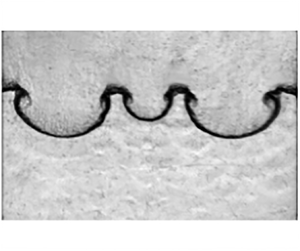

1. Introduction
The Richtmyer–Meshkov (RM) instability (Richtmyer Reference Richtmyer1960; Meshkov Reference Meshkov1969) occurs when an interface separating two fluids of different acoustic impedance is impulsively accelerated by a shock wave. Then bubbles (lighter fluids penetrating heavier ones) and spikes (heavier fluids penetrating lighter ones) arise, and turbulence might be finally induced (Zhou et al. Reference Zhou, Clark, Clark, Glendinning, Skinner, Huntington, Hurricane, Dimits and Remington2019). The RM instability plays an essential role in various industrial and scientific fields, such as inertial confinement fusion (ICF) (Lindl et al. Reference Lindl, Landen, Edwards, Moses and Team2014), supersonic combustion (Yang, Kubota & Zukoski Reference Yang, Kubota and Zukoski1993) and supernova explosions (Kuranz et al. Reference Kuranz2018). For example, the RM instability enhances the mixing of hot fuel with cooler material in an ICF target, reducing and even eliminating the thermonuclear yield. However, in supersonic air-breathing engines, the RM instability increases the mixing area between fuel and air and thus enhances the combustion efficiency. Moreover, the RM instability shapes the filament structures in the Crab Nebula, the remnant of the historical supernova of 1054. Therefore, it is crucial to study the suppression or promotion of mixing induced by the RM instability due to its significant applications (Brouillette Reference Brouillette2002; Ranjan, Oakley & Bonazza Reference Ranjan, Oakley and Bonazza2011; Zhou Reference Zhou2017a,Reference Zhoub; Zhai et al. Reference Zhai, Zou, Wu and Luo2018; Livescu Reference Livescu2020; Zhou et al. Reference Zhou2021; Liang Reference Liang2022).
A typical but simple RM instability is that on a single-mode interface, which has been extensively studied due to its fundamental significance (Richtmyer Reference Richtmyer1960; Meshkov Reference Meshkov1969; Zhang & Sohn Reference Zhang and Sohn1997; Sadot et al. Reference Sadot, Erez, Alon, Oron, Levin, Erez, Ben-Dor and Shvarts1998; Vandenboomgaerde, Gauthier & Mügler Reference Vandenboomgaerde, Gauthier and Mügler2002; Niederhaus & Jacobs Reference Niederhaus and Jacobs2003; Jacobs & Krivets Reference Jacobs and Krivets2005; Mariani et al. Reference Mariani, Vandenboomgaerde, Jourdan, Souffland and Houas2008; Vandenboomgaerde et al. Reference Vandenboomgaerde, Souffland, Mariani, Biamino, Jourdan and Houas2014; Zhang & Guo Reference Zhang and Guo2016; Liu et al. Reference Liu, Liang, Ding, Liu and Luo2018; Zhang, Deng & Guo Reference Zhang, Deng and Guo2018; Mansoor et al. Reference Mansoor, Dalton, Martinez, Desjardins, Charonko and Prestridge2020). However, the initial perturbation in reality, such as that seeded on the surface between diverse materials in an ICF target, is essentially multi-mode with wavenumbers spanning many orders of magnitude (Miles et al. Reference Miles, Edwards, Blue, Hansen, Robey, Drake, Kuranz and Leibrandt2004). Past studies have shown that when the perturbation amplitude on a multi-mode RM unstable interface becomes comparable to its wavelength at the nonlinear regime, the competition between these multiple modes has a vital influence on instability development (Haan Reference Haan1991; Ofer et al. Reference Ofer, Alon, Shvarts, McCrory and Verdon1996; Rikanati, Alon & Shvarts Reference Rikanati, Alon and Shvarts1998; Sadot et al. Reference Sadot, Erez, Alon, Oron, Levin, Erez, Ben-Dor and Shvarts1998; Vandenboomgaerde et al. Reference Vandenboomgaerde, Gauthier and Mügler2002; Niederhaus & Jacobs Reference Niederhaus and Jacobs2003; Balasubramanian, Orlicz & Prestridge Reference Balasubramanian, Orlicz and Prestridge2013; Di Stefano et al. Reference Di Stefano, Malamud, Kuranz, Klein and Drake2015a,Reference Di Stefano, Malamud, Kuranz, Klein, Stoeckl and Drakeb; Pandian, Stellingwerf & Abarzhi Reference Pandian, Stellingwerf and Abarzhi2017; Elbaz & Shvarts Reference Elbaz and Shvarts2018; Mohaghar et al. Reference Mohaghar, Carter, Pathikonda and Ranjan2019). Our recent work (Luo et al. Reference Luo, Liu, Liang, Ding and Wen2020; Liang et al. Reference Liang, Liu, Zhai, Ding, Si and Luo2021a) further revealed that mode coupling is closely related to the initial spectra (including the wavenumber, phase and initial amplitude of constituent modes) and plays an essential role in RM flows from the very beginning if the initial amplitudes of the modes are large.
Moreover, at the turbulent regime, it is evident that perturbation increases following a self-similar law and is proportional to  $t^{\theta }$ as a result of bubble competition and bubble merging (Alon et al. Reference Alon, Hecht, Mukamel and Shvarts1994, Reference Alon, Hecht, Ofer and Shvarts1995; Dimonte & Schneider Reference Dimonte and Schneider2000). Recent studies indicated that the growth factor
 $\theta$ is dependent on the initial spectra (Zhou Reference Zhou2017a). For instance, an initial broadband perturbation leads to a larger
 $\theta$ than narrowband perturbation (Ramaprabhu, Dimonte & Andrews Reference Ramaprabhu, Dimonte and Andrews2005; Thornber et al. Reference Thornber, Drikakis, Youngs and Williams2010; Youngs Reference Youngs2013; Thornber Reference Thornber2016; Groom & Thornber Reference Groom and Thornber2020). Although the values of
 $\theta$ in many RM instability experiments and high-fidelity simulations, including the large collaborations of the
 $\theta$-group (Thornber et al. Reference Thornber2017), have not been unified, it is widely accepted that the values of
 $\theta$ for bubbles and spikes are different due to different drag forces. For instance, the Atwood number (
 $A$, defined as
 $(\rho _2-\rho _1)/(\rho _2+\rho _1)$ with
 $\rho _1$ and
 $\rho _2$ denoting the density of the lighter fluid and heavier fluid, respectively) has a limited influence on
 $\theta$ for the bubble, but when
 $A\rightarrow 1$,
 $\theta$ for the spike is larger than its bubble counterpart (Youngs Reference Youngs1991; Dimonte & Schneider Reference Dimonte and Schneider2000; Cheng, Glimm & Sharp Reference Cheng, Glimm and Sharp2020). Therefore, the developments of instability of bubbles and spikes show different nonlinear behaviours in RM flows related to the initial spectra and density ratio.
Bubble competition is believed to have an important influence on the multi-mode RM unstable interface evolution at the nonlinear regime (Hecht, Alon & Shvarts Reference Hecht, Alon and Shvarts1994). In this process, larger bubbles, which have a higher velocity, rise and expand, while smaller bubbles shrink. In this study, we define the bubble-competition effect on the multi-mode RM instability as the deviation of the amplitude growths of bubbles from their single-mode counterpart. A simple configuration for a bubble-competition study is the so-called two-bubble configuration (see figure 1a) which is composed of adjacent bubbles initialised as neighbouring cosine waves of different wavelengths and amplitudes and is regarded as a classical multi-mode RM unstable interface. There are a few two-bubble RM instability studies focusing on bubble competition. Theoretically, based on the single-mode potential flow model (Layzer Reference Layzer1955), Hecht et al. (Reference Hecht, Alon and Shvarts1994) derived a merger model for describing the bubble-competition effect on the Rayleigh–Taylor (RT) instability (Rayleigh Reference Rayleigh1883; Taylor Reference Taylor1950) and RM instability of a two-bubble interface with an infinite density ratio (i.e.  $A=1$ ) between incompressible fluids. Subsequently, Rikanati et al. (Reference Rikanati, Alon and Shvarts1998) considered the bubble-competition effect on the multi-mode RM instability in the limit of two fluids of similar densities (i.e.
 $A\rightarrow 0$) and proposed a statistical merger model based on the point vortices assumption (Jacobs & Sheeley Reference Jacobs and Sheeley1996) to quantify the time-varying amplitude growths of the two bubbles. Rikanati et al. (Reference Rikanati, Alon and Shvarts1998) also found that the asymptotic bubble amplitude growth rate at
 $A=0$ is different from that derived by Hecht et al. (Reference Hecht, Alon and Shvarts1994) at
 $A=1$ due to the added mass in the
 $A=0$ case. Experimentally, Sadot et al. (Reference Sadot, Erez, Alon, Oron, Levin, Erez, Ben-Dor and Shvarts1998) performed the first shock-tube experiment to investigate two-bubble competition and confirmed that the growth of the long-wavelength bubble is promoted but the short-wavelength bubble is suppressed in comparison with the single-mode RM instability. Recently, Guo et al. (Reference Guo, Zhai, Si and Luo2019) experimentally explored the RM instability of a chevron two-bubble interface containing sharp corners. It was found that as the initial size difference between the two bubbles increases, the bubble-competition effect occurs earlier, and the smaller bubble is affected more evidently. Numerically, Wadas & Johnsen (Reference Wadas and Johnsen2020) utilised a high-order accurate discontinuous Galerkin code solving the Euler equations to simulate the RM instability of a two-bubble interface and observed vortex escape and bubble re-acceleration phenomena at the late nonlinear regime.
Initial configurations of two-bubble (a) and two-spike (b) RM instability experiments, where  $\lambda _{{L}}$ and
 $\lambda _{{S}}$ denote the wavelengths of long-wavelength portions and short-wavelength portions, respectively;
 $a_{{L}}^0$ denotes the initial amplitude of the long-wavelength structure;
 $a_{{S}}^0$ denotes the initial amplitude of the short-wavelength structure; and
 ${\rm \Delta} h^0$ denotes the initial height difference between the two bubbles or two spikes.

Although significant progress on the two-bubble RM instability has been made, the quantitative relation between the initial conditions and bubble competition is still unclear mainly because a general nonlinear theory for quantifying the bubble-competition effect considering arbitrary initial spectra and density ratio is absent. Moreover, compared with bubble-competition studies, spike competition has been rarely explored since it was challenging to distinguish the spike contours in previous experiments, and the growths of spikes of various sizes were considered to be independent at large  $A$ (Dimonte & Schneider Reference Dimonte and Schneider2000). However, the symmetry between bubbles and spikes is not broken at a low
 $A$ (Niederhaus & Jacobs Reference Niederhaus and Jacobs2003). Furthermore, the Kelvin–Helmholtz instability along the two sides of a spike promotes the effect of drag forces on the spike (Sharp Reference Sharp1984), which is more pronounced at a low
 $A$. Therefore, spike competition should exist, especially when the density ratio is limited, and should show a different behaviour from that of bubble competition in RM flows. In addition, the penetration of spikes in lighter fluids is generally more prominent than the penetration of bubbles in heavier fluids, which is adverse to the ignition of hot fuel in ICF. Overall, it is significant to explore the existence of spike competition, examine the differences between the bubble-competition effect and spike-competition effect on the RM instability and utilise these two competition mechanisms to reduce the mixing in ICF. These motivate the present study.
This study focuses on the bubble-competition effect on a two-bubble interface and the spike-competition effect on a two-spike interface. The existence of spike competition is reported for the first time. The soap film technique that has been widely utilised in our recent multi-mode RM instability studies (Liu et al. Reference Liu, Liang, Ding, Liu and Luo2018; Liang et al. Reference Liang, Zhai, Ding and Luo2019, Reference Liang, Liu, Zhai, Ding, Si and Luo2021a,Reference Liang, Liu, Zhai, Si and Luob; Luo et al. Reference Luo, Liang, Si and Zhai2019, Reference Luo, Liu, Liang, Ding and Wen2020) is extended to form various two-bubble and two-spike interfaces. The contours of both bubbles and spikes are clearly distinguished, and evident quantitative data can be extracted. The differences between bubble competition and spike competition are highlighted. A nonlinear, analytical model is established to quantify the RM instability of two-bubble and two-spike interfaces with various spectra and density ratios.
2. Experimental configuration and method
The central part of a two-bubble (or two-spike) interface always consists of an initial short-wavelength ( $\lambda _{{S}}$) bubble (or spike) flanked by two initial long-wavelength (
 $\lambda _{{L}}$) bubbles (or spikes), and the two sides are completed by partial short-wavelength bubbles (or spikes), as sketched in figure 1(a) (or figure 1b). The initial amplitudes of the long-wavelength bubble and spike (
 $a_{{L}}^0$) and the short-wavelength bubble and spike (
 $a_{{S}}^0$) are chosen such that the Richtmyer growth rates (Richtmyer Reference Richtmyer1960) of all bubbles and spikes are the same (i.e.
 $a_{{L}}^0/a_{{S}}^0=\lambda _{{L}}/\lambda _{{S}}$). This, too, is consistent with previous two-bubble RM instability studies (Rikanati et al. Reference Rikanati, Alon and Shvarts1998; Sadot et al. Reference Sadot, Erez, Alon, Oron, Levin, Erez, Ben-Dor and Shvarts1998; Guo et al. Reference Guo, Zhai, Si and Luo2019; Wadas & Johnsen Reference Wadas and Johnsen2020).
The detailed physical parameters in all two-bubble cases (BC-) and two-spike cases (SC-) are listed in table 1, in which  $\delta$ (
 $=\lambda _{{L}}/\lambda _{{S}}$) is the wavelength ratio of two bubbles and two spikes relative to the initial spectra. Overall, we investigate seven two-bubble interfaces and seven two-spike interfaces considering diverse
 $\delta$ and
 $A$, as listed in table 1. The Fourier expansions of two-bubble and two-spike interfaces with diverse
 $\delta$ are, respectively, expressed as
 \begin{equation} y=a_{{L}}^0[{-}C_1\cos(kx)+\sum_{n>1}C_n\cos(nkx)], \quad n=2,3,4\ldots, \end{equation}
and
 \begin{equation} y=a_{{L}}^0[C_1\cos(kx)-\sum_{n>1}C_n\cos(nkx)], \quad n=2,3,4\ldots, \end{equation}
where  $k$ (
 $=2{\rm \pi} /(\lambda _{{L}}+\lambda _{{S}})$) is the wavenumber of the first-order mode of the two-bubble and two-spike configurations and
 $C_n$ is the dimensionless coefficient of the
 $n$th-order mode. The first five modes are presented in figure 2 in the
 $\delta =3.0$ case for instance. It is found that the long-wavelength structure and short-wavelength structure are formed by the peak or valley of various constituent modes. Furthermore, it is evident that although the two-bubble and two-spike interfaces are multi-mode ones with an infinite number of constituent modes, the interface configuration can be easily described by the superposition of the first several-order modes (see the solid black line in figure 2 as a superposition of the first five modes).
Physical parameters of single-mode, two-bubble and two-spike RM instability experiments, where  $\delta =\lambda _{L}/\lambda _{S}$;
 ${\rm \Delta} h^0$ denotes the initial height difference between two bubbles or two spikes; MF denotes the mass fraction of SF
 $_6$ in the test gas;
 ${\rm \Delta} v$ and
 $A$ denote the post-shock flow velocity and Atwood number, respectively;
 $v_{{R}}$ denotes the Richtmyer growth rate; and
 $\tau _{{\rm \Delta} h}^*$ denotes the dimensionless criterion time when the competition mechanism occurs. The units for length, wavenumber and velocity are mm, m
 $^{-1}$ and
 ${\rm m}\,{\rm s}^{-1}$, respectively.

The superimposed interface by the first five modes when  $\delta =3.0$, where LB (or LS) denotes the long-wavelength bubble (or spike) and SB (or SS) denotes the short-wavelength bubble (or spike).

The values of  $C_n$ of the first five modes in different
 $\delta$ cases are shown in figure 3. It is found that the proportions of the high-frequency modes with orders higher than two are limited and decrease as the order increases. Therefore, the first two modes dominate the morphologies of the two-bubble and two-spike interfaces. Moreover, as
 $\delta$ increases,
 $C_1$ increases, but
 $C_2$ decreases, indicating that the first-order mode becomes more significant and the second-order mode tends to be secondary, and the long-wavelength bubble (or spike) progressively dominates the two-bubble (or two-spike) interface. Overall, the two-bubble and two-spike interfaces are essentially quasi-dual-mode interfaces consisting of two dominant modes and an infinite number of residual higher-order modes.
Coefficients of the  $n$th-order mode in diverse
 $\delta$ cases.

The soap film technique is extended to generate a shape-controllable discontinuous interface to separate SF $_{6}$ from air, which can largely eliminate additional short-wavelength perturbations, diffusion layer and three-dimensionality (Liu et al. Reference Liu, Liang, Ding, Liu and Luo2018; Liang et al. Reference Liang, Zhai, Ding and Luo2019, Reference Liang, Liu, Zhai, Ding, Si and Luo2021a; Luo et al. Reference Luo, Liu, Liang, Ding and Wen2020). Figure 4(a) shows that two transparent devices with an inner height of 7.0 mm and a width of 140.0 mm are first made using acrylic plates (3.0 mm in thickness). A groove (0.7 mm in thickness and 0.5 mm in width) with a two-bubble or two-spike shape is manufactured on each plate's inner side by a high-precision engraving machine. Then, two thin filaments (1.0 mm in thickness and 0.5 mm in width, as marked in green in figure 4) with the same shape are mounted into the grooves of the upper and lower plates, respectively, to produce desired constraints. Therefore, the bulging of the filament into the flow is less than 0.3 mm and has a negligible effect on the flow field. A small rectangular frame wetted by soap solution (78 % distilled water, 2 % sodium oleate and 20 % glycerine by mass) is pulled along the filaments, and a quasi-two-dimensional (2-D) soap film interface is immediately generated, as shown in figure 4(b). Subsequently, the auxiliary framework is gently inserted until it is completely connected to the corresponding device. After that, the framework with a soap film on its surface is slowly inserted into the test section of the shock tube.
Schematic of soap film interface formation. (a) Two transparent devices with two-bubble shaped boundaries. (b) The soap film interface made by a rectangular frame.

To form an air–SF $_6$ interface, the air on the right-hand side of the soap film interface is partially replaced by SF
 $_6$. The surrounding gas is pure air, and the test gas is a mixture of SF
 $_6$ and air. The mass fractions of SF
 $_6$ in the test gas in various cases are different, as listed in table 1. The Mach number and velocity (
 $v_s$) of the incident shock wave are
 $1.18\pm 0.01$ and
 $409\pm 3\ {\rm m}\,{\rm s}^{-1}$, respectively. The post-shock flow velocity (
 ${\rm \Delta} v$) and
 $A$ are listed in table 1. The ambient pressure is 101.3 kPa, and the temperature is
 $299.5 \pm 1.0$ K. The flow field is monitored by schlieren photography combined with a high-speed video camera (FASTCAM SA5, Photron Limited) with a frame rate of 62 500 frames per second and a spatial resolution of
 $0.4\ {\rm mm}\,{\rm pixel}^{-1}$.
3. Experimental observation
Figure 5(a–e) shows the schlieren images of the shocked two-bubble air–SF $_6$ interface evolution in five typical cases. For each two-bubble case, the moment when the shock contacts the downstream pole of the long-wavelength bubble is defined as the initial time (
 $t_{{B}}=0$). In the example case BC-
 $\delta$3.0
 $A$0.68, we can see that immediately after the transmitted shock leaves the interface, the shocked interface retains the initial interface shape (0.166 ms). Then, the symmetry between the bubble and spike in each cosine period is destroyed due to the development of the even-order modes (0.726 ms). Particularly, the second-order mode provides a constant acceleration for the bubble and the spike, which move in opposite directions, and, therefore, is the lowest order for asymmetry of the bubble and spike evolutions (Velikovich, Herrmann & Abarzhi Reference Velikovich, Herrmann and Abarzhi2014; Luo et al. Reference Luo, Liang, Si and Zhai2019). Meanwhile, vortices appear on the spike due to the Kelvin–Helmholtz instability. Later, the competition and coalescence of large coherent structures drive the bubble-competition process (Oron et al. Reference Oron, Arazi, Kartoon, Rikanati, Alon and Shvarts2001; Srebro et al. Reference Srebro, Elbaz, Sadot, Arazi and Shvarts2003) as the high-order modes with orders larger than one develop, eventually leading to the spikes skewing towards the long-wavelength bubble (1.366 ms). As
 $\delta$ increases, the orientations of spikes become more pronounced as the long-wavelength bubble expands and the short-wavelength bubble is almost occupied by the long-wavelength bubble (case BC-
 $\delta$6.0
 $A$0.68 at 1.360 ms, for instance). As
 $A$ decreases, the density gradient is smaller, the interface contour is more indistinct and the interface velocity is larger (as in the example case BC-
 $\delta$6.0
 $A$0.42 at 0.720 ms).
(a–e) Schlieren images of the shock-induced two-bubble interface evolutions, where TS denotes the transmitted shock, SI denotes the shocked interface and LB and SB denote the long- and short-wavelength bubbles. Shock wave moves from top to bottom. Numbers denote time in milliseconds, and similarly hereinafter.

Figure 6(a–e) shows the schlieren images of the shocked two-spike air–SF $_6$ interface evolution in five typical cases. For each two-spike case, the moment when the shock contacts the upstream pole of the long-wavelength spike is defined as the initial time (
 $t_{{S}}=0$). In the example case SC-
 $\delta$3.0
 $A$0.68, as the two-spike interface evolves, the vortices roll up on the heads of all spikes, the stems of the long-wavelength spike and the short-wavelength spike become narrower and the orientations of all spikes maintain streamwise, agreeing well with the ordered, coherent pattern predicted by the group theory (Abarzhi Reference Abarzhi2008, Reference Abarzhi2010; Pandian et al. Reference Pandian, Stellingwerf and Abarzhi2017). As
 $\delta$ increases, the vortices on the short-wavelength spike disappear (case SC-
 $\delta$6.0
 $A$0.67 at 1.381 ms, for instance), and the bubbles on the two sides of the short-wavelength spike occupy its space. As
 $A$ decreases, the short-wavelength spike is almost swallowed by the two-side bubbles completely (as in the example case SC-
 $\delta$6.0
 $A$0.37 at 1.381 ms). Overall, the evolving two-spike interface shows a significantly different morphology from its two-bubble counterpart.
(a–e) Schlieren images of the shock-induced two-spike interface evolutions. LS and SS denote the long- and short-wavelength spikes.

4. Quantitative results
The amplitude histories for the two bubbles (or spikes) of the two-bubble (or two-spike) interface are quantitatively compared. To distinguish the bubble amplitude from its spike counterpart, the movement of the unperturbed interface obtained by the one-dimensional gas dynamics theory (Drake Reference Drake2018) with the initial conditions of each case is provided as a moving reference. The amplitudes of the long-wavelength bubble ( $a_{{LB}}$), short-wavelength bubble (
 $a_{{SB}}$), long-wavelength spike (
 $a_{{LS}}$) and short-wavelength spike (
 $a_{{SS}}$) are defined as the distances between the tips of bubbles or spikes with the moving references, as sketched in figure 7. The time-varying dimensionless amplitudes of
 $a_{{LB}}$,
 $a_{{SB}}$,
 $a_{{LS}}$ and
 $a_{{SS}}$ are calculated, as shown in figure 8.
Sketches of the characteristic lengths measured in the two-bubble (a) and two-spike (b) RM instability experiments, where  $a_{{LB}}$,
 $a_{{SB}}$,
 $a_{{LS}}$ and
 $a_{{SS}}$ denote the time-varying amplitudes of the long-wavelength bubble, short-wavelength bubble, long-wavelength spike and short-wavelength spike, respectively;
 $w_{{L}}$ and
 $w_{{S}}$ denote the time-varying widths of the long-wavelength and short-wavelength structures, respectively; and
 ${\rm \Delta} h$ denotes the time-varying height difference between the two bubbles or two spikes. Red and green dashed-dot lines represent the moving references calculated by the one-dimensional gas dynamics theory for the long-wavelength and short-wavelength structures, respectively.

The time-varying dimensionless (a) two-bubble amplitudes and (b) two-spike amplitudes. Symbols represent the experiments and solid lines with colours corresponding to symbols represent the theoretical prediction calculated with (4.12).

For two-bubble cases, time is scaled as  $\tau _{B}=2{\rm \pi} v_{{R}}t_{B}/\lambda _{{L}}$ (or
 $\tau _{B}=2{\rm \pi} v_{{R}}t_{B}/\lambda _{{S}}$) for the long-wavelength (or short-wavelength) bubble, where
 $v_{{R}}$ (
 $=2{\rm \pi} Za^0_{{L}}{\rm \Delta} vA/\lambda _{{L}}$) denotes the Richtmyer growth rate (Richtmyer Reference Richtmyer1960), and
 $Z$ (
 $=1-{\rm \Delta} v/v_s$) denotes the shock compression factor; amplitude is scaled as
 $\eta _{{B}}=2{\rm \pi} (a_{{LB}}-Za_{{L}}^0)/\lambda _{{L}}$ (or
 $\eta _{{B}}=2{\rm \pi} (a_{{SB}}-Za_{{S}}^0)/\lambda _{{S}}$) for the long-wavelength (or short-wavelength) bubble. For two-spike cases, time is scaled as
 $\tau _{S}=2{\rm \pi} v_{{R}}t_{S}/\lambda _{{L}}$ (or
 $\tau _{S}=2{\rm \pi} v_{{R}}t_{S}/\lambda _{{S}}$) for the long-wavelength (or short-wavelength) spike; amplitude is scaled as
 $\eta _{{S}}=2{\rm \pi} (a_{{LS}}-Za_{{L}}^0)/\lambda _{{L}}$ (or
 $\eta _{{S}}=2{\rm \pi} (a_{{SS}}-Za_{{S}}^0)/\lambda _{{S}}$) for the long-wavelength (or short-wavelength) spike. The values of
 $v_{{R}}$ are listed in table 1. To highlight the effects of bubble competition and spike competition, the RM instability of a single-mode interface is shown with black diamond symbols in figures 8(a) and 8(b) for comparison. The Richtmyer growth rates of the two bubbles are the same, and the short-wavelength bubble reaches the asymptotic linear growth rates earlier than its long-wavelength bubble counterpart due to its short startup time (Lombardini & Pullin Reference Lombardini and Pullin2009), and, therefore, the short-wavelength bubble grows slightly more than the long-wavelength bubble at the very early times, as shown in the zoomed inset of figure 8(a).
Four observational findings, in particular, are noteworthy. First, the amplitudes of two bubbles and two spikes experience a linear growth at an early time. However, the criterion time between the linear and nonlinear regimes of the RM instability of the two-bubble interface (about 0.5) is less than that of its two-spike counterpart (around 1.0). Because the development of a bubble is suppressed by the second- and third-order harmonics generated by the bubble itself (Velikovich & Dimonte Reference Velikovich and Dimonte1996; Zhang & Sohn Reference Zhang and Sohn1997; Vandenboomgaerde et al. Reference Vandenboomgaerde, Gauthier and Mügler2002; Nishihara et al. Reference Nishihara, Wouchuk, Matsuoka, Ishizaki and Zhakhovsky2010; Velikovich et al. Reference Velikovich, Herrmann and Abarzhi2014), whereas the development of a spike is promoted by the second-order harmonics but suppressed by the third-order harmonics produced by the spike itself, the spike amplitude growth shows a more prolonged linear regime than its bubble counterpart.
Second, the bubble competition and spike competition suppress the nonlinear growths of the short-wavelength bubble and spike, respectively. However, the suppressions imposed by the bubble competition and spike competition are different. For instance,  $a_{{SB}}$ saturates in the BC-
 $\delta$1.5
 $A$0.68 case after dimensionless time 3.5, but
 $a_{{SS}}$ still grows in the SC-
 $\delta$1.5
 $A$0.68 case, indicating that the effects of bubble competition and spike competition on the RM instability are different.
Third, the bubble-competition effect on the short-wavelength bubble is dominated by the initial spectra of the two-bubble configuration but is weakly dependent on the density ratio. In contrast, the spike-competition effect on the short-wavelength spike is determined by both the initial spectra and density ratio. As  $\delta$ increases, both
 $a_{{SB}}$ and
 $a_{{SS}}$ decrease evidently, indicating that both the bubble-competition effect and spike-competition effect are more substantial. However, as
 $A$ decreases,
 $a_{{SB}}$ increases slightly, but
 $a_{{SS}}$ decreases obviously, indicating that bubble competition and spike competition have different dependencies on the density ratio.
Fourth, compared with the single-mode RM instability, the bubble competition slightly promotes the nonlinear amplitude growths of the long-wavelength bubble. In contrast, the spike competition has a limited influence on the long-wavelength spike. Overall, the influences of bubble competition and spike competition on the long-wavelength structures and short-wavelength structures are different.
In this study, we explain the observational findings in two ways. One is based on the physics-related buoyancy–drag model and the other is according to the modal analysis of the interface contour.
First, the buoyancy–drag model is a simple physics model for describing the RT and RM instabilities (Cheng, Glimm & Sharp Reference Cheng, Glimm and Sharp2000; Dimonte Reference Dimonte2000; Oron et al. Reference Oron, Arazi, Kartoon, Rikanati, Alon and Shvarts2001; Srebro et al. Reference Srebro, Elbaz, Sadot, Arazi and Shvarts2003; Youngs & Thornber Reference Youngs and Thornber2020). Briefly, the buoyancy–drag model is an equation of motion that balances inertia, buoyancy and Newtonian drag forces. Here, we adopt the extended buoyancy–drag model covering all instability regimes (Dimonte Reference Dimonte2000; Oron et al. Reference Oron, Arazi, Kartoon, Rikanati, Alon and Shvarts2001; Youngs & Thornber Reference Youngs and Thornber2020):
 \begin{equation} (\rho_i+C_a\rho_{i'})\frac{\mathrm{d}v_i}{\mathrm{d}t}= (\rho_2-\rho_1)g-C_d\rho_{i'}\frac{v_i^2}{\lambda_i}, \end{equation}
with  $i=1$ for the bubble and
 $i=2$ for the spike,
 $i'=3-i$,
 $v_i$ (
 $=\mathrm {d}a_i/\mathrm {d}t$) is the amplitude growth rate,
 $\lambda _i$ is the perturbation wavelength,
 $g$ is the acceleration,
 $C_a$ is an added mass coefficient and
 $C_d$ is a drag coefficient. Assuming that both
 $C_a$ and
 $C_d$ are independent of
 $A$ (Oron et al. Reference Oron, Arazi, Kartoon, Rikanati, Alon and Shvarts2001; Srebro et al. Reference Srebro, Elbaz, Sadot, Arazi and Shvarts2003),
 $C_a=2$ for 2-D perturbations and 1 for three-dimensional perturbations, and
 $C_d=6{\rm \pi}$ for 2-D perturbations and
 $2{\rm \pi}$ for three-dimensional perturbations. By introducing a self-similar geometric parameter
 $\beta _i$ (
 $=a_i/\lambda _i$), equation (4.1) is rewritten as
 \begin{equation} \frac{\mathrm{d}v_i}{\mathrm{d}t}=\frac{\rho_1+\rho_2}{\rho_i+C_a\rho_{i'}}Ag -C_d\frac{\rho_{i'}\beta_i}{\rho_i+C_a\rho_{i'}}\frac{v_i^2}{a_i}. \end{equation}
For the RM instability with an impulsive acceleration ( $g=0$),
 $v_i$ and
 $t$ are scaled as (Cheng, Glimm & Sharp Reference Cheng, Glimm and Sharp2002; Cao, Chow & Fong Reference Cao, Chow and Fong2011)
 \begin{equation} v_i^{*}=\frac{v_i}{\sqrt{Aa_i}}, \quad \mathrm{d}t^{*}=\sqrt{\frac{A}{a_i}}\mathrm{d}t. \end{equation}
Substituting equation (4.3a,b) into (4.2), we have
 \begin{equation} \frac{\mathrm{d}v_i^{*}}{\mathrm{d}t^{*}}={-}\frac{1}{2}+ \frac{C_d\rho_{i'}\beta_iv_i^{*2}}{\rho_i+C_a\rho_{i'}}. \end{equation}
Integrating equation (4.4), the solution for the RM instability is
 \begin{equation} a_i=a_{i}^{o}\left[1+\frac{v_{i}^{o}}{a_{i}^{o} \theta_i}(t-t^{o})\right]^{\theta_i}, \end{equation}
with  $a_{i}^{o}$ and
 $v_{i}^{o}$ denoting the amplitude and the amplitude growth rate at
 $t^{o}$ (i.e. arbitrary time at the self-similar regime), respectively, and
 \begin{equation} \theta_i=\frac{\rho_i+C_a\rho_{i'}}{\rho_i+(C_a+\beta_iC_d)\rho_{i'}}. \end{equation}
Therefore, the expressions for  $\theta _1$ and
 $\theta _2$, respectively, are
 \begin{equation} \theta_1=\frac{1}{1+a_1C_d/[\lambda_1(C_a+1/R)]} \end{equation}
and
 \begin{equation} \theta_2=\frac{1}{1+a_2C_d/[\lambda_2(R+C_a)]}, \end{equation}
with  $R=\rho _2/\rho _1$. Notably,
 $a_1$ and
 $\lambda _1$,
 $a_2$ and
 $\lambda _2$ are instantaneous values in (4.7) and (4.8), respectively. In this study, the widths of the long-wavelength structure (
 $w_{{L}}$) and the short-wavelength structure (
 $w_{{S}}$) are defined as the spanwise lengths of the moving references within a period of the structure, as sketched in figure 7.
For the two-bubble studies, the time-varying widths of the long-wavelength bubble and short-wavelength bubble in the BC- $\delta$3.0
 $A$0.68 case are measured from the experiments and shown in figure 9(a), for instance. It is evident that the dimensionless
 $w_{{L}}$ is larger than 1.0 and progressively increases, whereas the dimensionless
 $w_{{S}}$ is lower than 1.0 and gradually decreases. In other words, the long-wavelength bubble expands while the short-wavelength bubble shrinks and, therefore,
 $\lambda _1$ increases for the long-wavelength bubble and decreases for the short-wavelength bubble in (4.7). From a physical perspective, the drag per unit volume (i.e.
 $C_d/\lambda _1$) of the long-wavelength bubble is reduced, but that of the short-wavelength bubble is increased. As a result,
 $\theta _1$ is increased for the long-wavelength bubble but suppressed for the short-wavelength bubble on comparing with the single-mode RM unstable bubble.
The time-varying wavelengths of the long-wavelength and short-wavelength structures in the (a) BC- $\delta$3.0
 $A$0.68 case and (b) SC-
 $\delta$3.0
 $A$0.68 case.

For the two-spike studies, the time-varying widths of the long-wavelength spike and short-wavelength spike in the SC- $\delta$3.0
 $A$0.68 case are shown in figure 9(b), for instance. It is found that the dimensionless
 $w_{{S}}$ is lower than 1.0 and progressively decreases. Although the dimensionless
 $w_{{L}}$ also decreases, the decrease of
 $w_{{L}}$ is limited (less than 20 %) during the whole experimental time. In other words, the two-side bubbles have different influences on the two spikes, leading to the competition between the two spikes. The two-side bubbles of a two-spike interface swallow the space of the short-wavelength spike but have a limited influence on the long-wavelength spike and, therefore, the drag per unit volume (i.e.
 $C_d/\lambda _2$) of the short-wavelength spike is increased while that of the long-wavelength spike is limitedly influenced. As a result,
 $\theta _2$ is kept or slightly suppressed for the long-wavelength spike but evidently suppressed for the short-wavelength spike on comparing with the single-mode RM unstable spike.
Moreover, as  $A$ (or
 $R$) increases, it is found that the drag force imposed by heavier fluids on the bubble (i.e.
 $C_dR$) increases, whereas the drag force imposed by lighter fluids on the spike (i.e.
 $C_d/R$) decreases. Therefore,
 $\theta _1$ decreases, but
 $\theta _2$ increases. In addition, due to
 $1/R<1\leq C_a$ in (4.7) and
 $R\geq C_a$ in (4.8), the variation of
 $R$ has a larger influence on
 $\theta _2$ than on
 $\theta _1$. Therefore, the spike-competition effect is more dependent on the density ratio than the bubble-competition effect. As a result, the spike competition is dependent on both the initial spectra and density ratio. Still, the bubble-competition effect depends more on the initial spectra than the density ratio.
The growth trends of both the long-wavelength and short-wavelength structures can be qualitatively explained based on the buoyancy–drag model and experimental observation. However, it is challenging to adopt the buoyancy–drag model to quantify the time-varying amplitude growths of the two bubbles and two spikes since the quantitative relation between the self-similar factor  $\beta _i$, i.e. the ratio of
 $a_i$ to
 $\lambda _i$, with the initial conditions remains an open problem (Oron et al. Reference Oron, Arazi, Kartoon, Rikanati, Alon and Shvarts2001; Zhou, Zhang & Tian Reference Zhou, Zhang and Tian2018). Previous theoretical and experimental studies have identified inconsistent values of
 $\beta _1$, including
 ${\approx}2.5$ (Mikaelian Reference Mikaelian1989),
 ${\approx}4/(1+A)$ (Dimonte & Schneider Reference Dimonte and Schneider2000; Dimonte et al. Reference Dimonte, Youngs, Dimits, Weber and Zingale2004),
 ${\approx}0.5/(1+A)$ in 2-D RT flow (Alon et al. Reference Alon, Hecht, Mukamel and Shvarts1994, Reference Alon, Hecht, Ofer and Shvarts1995), and
 ${\approx}0.26-0.4$ in 2-D RM flow (Hecht et al. Reference Hecht, Alon and Shvarts1994; Rikanati et al. Reference Rikanati, Alon and Shvarts1998). The expression for
 $\beta _2$ is still unknown.
Second, according to the Fourier expansions of the two-bubble and two-spike configurations (see figure 2), the phase of the first-order mode is opposite to the phases of the higher-order modes at the tips of the short-wavelength bubble and spike (i.e.  $x=0$), whereas the phase of the first-order mode is the same as the phases of even-order modes at the tips of the long-wavelength bubble and spike (i.e.
 $x={\rm \pi} /k$). As a result, on the one hand, the first-order mode suppresses but the higher-order modes promote the amplitude growths of the short-wavelength bubble and spike; while the first-order mode and even-order modes (e.g. second- and fourth-order modes) promote but the higher odd-order modes (e.g. third- and fifth-order modes) suppress the amplitude growths of the long-wavelength bubble and spike.
Referring to the findings in figures 8(a) and 8(b), it is evident that the RM instability of short-wavelength structures is suppressed by the lowest frequency mode. In other words, the spanwise flow field suppresses the short-wavelength perturbation growths. As  $\delta$ increases, the proportion of the first-order mode in the initial interfacial morphology is larger. Therefore, the suppression imposed by the lowest frequency mode on the short-wavelength perturbation growth is larger. Moreover, the RM instability of the long-wavelength structures is decided by the competition between the promotion imposed by the first-order mode and even-order modes with the suppression induced by the higher odd-order modes. Our experiments demonstrate that the RM instability of the long-wavelength bubble is slightly promoted, indicating that the promotion induced by the first-order mode and even-order modes is larger than the suppression imposed by the higher odd-order modes. Differently, the RM instability of the long-wavelength spike is influenced limitedly, indicating that a balance between the competition of the constituent modes is achieved for the long-wavelength spike. Overall, the constituent modes of the two-bubble and two-spike interfaces significantly influence the bubble competition and spike competition, especially the RM instability of short-wavelength structures.
Since the two-bubble and two-spike interfaces consist of two dominant modes and an infinite number of secondary modes, it is significant to examine the couplings between these multiple modes. The captured interface morphology is distinct such that the interface contours in all cases can be extracted by an image-processing program, as indicated by the insets in figures 10(a) and 10(b). The mean  $y$ coordinate in each image is taken as the average position of the local interface. Spectrum analysis is then performed on the extracted interface displacement on the certain
 $x$–
 $y$ plane before the interface becomes multi-valued, and the time-varying magnitudes of the first five modes (
 $a_n$) are acquired, as shown in figure 10(a) for the BC-
 $\delta$3.0
 $A$0.68 case and figure 10(b) for the SC-
 $\delta$3.0
 $A$0.68 case, for instance. It is evident that the constituent modes of a two-bubble interface grow in a direction opposite to that of its two-spike interface counterpart. To highlight the mode coupling effect on the development of each constituent mode, the potential flow model, proposed by Dimonte & Ramaprabhu (Reference Dimonte and Ramaprabhu2010) (DR model) for predicting the 2-D single-mode RM instability considering various amplitude-to-wavelength ratios, shock intensities and density ratios, is modified to quantify the magnitude growth rate of the
 $n$th mode (
 $v_{n}(t)$) without couplings as
 \begin{equation} v_{n}(t)=[v_{n{B}}(t)+v_{n{S}}(t)]/2, \end{equation}
with the bubble/spike magnitude growth rate of the  $n$th mode,
 $v_{n{B}/n{S}}(t)$, calculated by
 \begin{equation} v_{n{B}/n{S}}(t)=\frac{({-}1)^iv_{n}^0[1+(1\mp A)nkv_{n}^0 t_{{B/S}}]}{1+G_{{B/S}}nkv_{n}^0t_{{B/S}}+(1\mp A)F_{{B/S}}(nkv_{n}^0 t_{{B/S}})^2}, \end{equation}
in which  $i=1$ for the first-order mode and
 $i=0$ for the other modes of a two-bubble interface; and
 $i=0$ for the first-order mode and
 $i=1$ for the other modes of a two-spike interface, and
 \begin{equation} \left.\begin{array}{c} v_{n}^0=Znk{\rm \Delta} vAC_na_{{L}}^0,\\ G_{{B/S}}=\dfrac{4.5\pm A+(2\mp A)ZnkC_na_{{L}}^0}{4},\\ F_{{B/S}}=1\pm A. \end{array}\right\} \end{equation}
The upper (or lower) sign of  $\pm$ and
 $\mp$ applies to the bubble (or spike) in all equations of this work. The predictions of the modified DR model, as shown in figures 10(a) and 10(b) with colour lines corresponding to the symbols, agree well with the experiments, especially the two dominant modes with the lowest frequencies. The agreement indicates that the mode coupling can be reasonably neglected, which is not surprising since each constituent mode satisfies the small-perturbation prerequisite (i.e.
 $nkC_na_{{L}}^0\ll 1$) in this study and the coupling among modes is limited at the weakly nonlinear regime (Luo et al. Reference Luo, Liu, Liang, Ding and Wen2020; Liang et al. Reference Liang, Liu, Zhai, Ding, Si and Luo2021a).
The time-varying magnitudes of the first five modes obtained from the (a) BC- $\delta$3.0
 $A$0.68 case and (b) SC-
 $\delta$3.0
 $A$0.68 case. The solid lines represent the predictions of the modified DR model (equations (4.9)–(4.11)). The insets show the interface contours for the spectrum analysis.

Furthermore, a simple, analytical nonlinear model is established to quantify the RM instability of the two-bubble and two-spike interfaces based on the modified DR model. According to the tip positions of the long-wavelength and short-wavelength structures, a universal expression for the nonlinear amplitude growth rates of the long-wavelength bubble ( $v_{{LB}}(t)$) and spike (
 $v_{{LS}}(t)$) and the short-wavelength bubble (
 $v_{{SB}}(t)$) and spike (
 $v_{{SS}}(t)$) is
 \begin{equation} v_{{LB/LS/SB/SS}}(t)=\sum_{n}\frac{({-}1)^jv_{n}^0 [1+(1\mp A)nkv_{n}^0t_{{B/S}}]}{1+G_{{B/S}}nkv_{n}^0t_{{B/S}} +(1\mp A)F_{{B/S}}(nkv_{n}^0t_{{B/S}})^2}, \end{equation}
in which  $n=1,2,3,\ldots$;
 $j=0$ for the first-order mode and even-order modes and
 $j=1$ for the higher odd-order modes of the long-wavelength bubble and spike;
 $j=1$ for the first-order mode and
 $j=0$ for the other modes of the short-wavelength bubble and spike. The predictions of the nonlinear model with consideration of the sum of the first five modes are presented with corresponding colour lines in figures 8(a) and 8(b), agreeing well with all experimental results. The differences in the effects of bubble competition and spike competition on the RM instability can be explained by the different nonlinear behaviours of bubbles and spikes of diverse order modes. For the two-bubble interface, the first-order mode saturates much later than the higher-order modes. Therefore, the suppression of the first-order mode on the short-wavelength bubble becomes dominant, even leading to the short-wavelength bubble growing in the opposite direction when
 $\delta$ is large. Differently, for the two-spike interface, all constituent modes maintain a long-time linear growth. As a result, although the first-order mode suppresses the short-wavelength spike growth, the higher-order modes still result in the short-wavelength spike being more unstable.
Last, the height differences between the two bubbles and two spikes (as sketched in figure 7), which are critical parameters for quantifying the effects of bubble competition and spike competition, are discussed in this study. The time-varying height differences ( ${\rm \Delta} h$) in all cases are shown in figure 11. Time for the two-bubble/two-spike interface case is scaled as
 $\tau _{{\rm \Delta} h}=2{\rm \pi} ^2t_{{B/S}}Z{\rm \Delta} h^0{\rm \Delta} vA/(\lambda _{L}+\lambda _{S})^2$ and height difference is scaled as
 $\eta _{{\rm \Delta} h}={\rm \pi} ({\rm \Delta} h-Z{\rm \Delta} h^0)/(\lambda _{L}+\lambda _{S})$, with
 ${\rm \Delta} h^0$ denoting the initial height difference and the values of which are listed in table 1. It is found that before a dimensionless criterion time,
 $\tau _{{\rm \Delta} h}^*$, the dimensionless
 ${\rm \Delta} h$ remains zero, indicating that the two bubbles and two spikes grow independently. The values of
 $\tau _{{\rm \Delta} h}^*$ in all cases are listed in table 1. It is evident that
 $\tau _{{\rm \Delta} h}^*$ in two-bubble studies is smaller than in the corresponding two-spike studies, indicating that the bubble-competition effect on the RM instability occurs earlier than its spike-competition counterpart. As
 $A$ decreases, the differences in
 $\tau _{{\rm \Delta} h}^*$ between the two-bubble and two-spike studies become smaller.
Comparisons of the time-varying height differences between the two bubbles and two spikes in all cases.

Moreover, the dimensionless  ${\rm \Delta} h$ in the two-spike studies is smaller than in the corresponding two-bubble studies, demonstrating that the bubble-competition effect on the RM instability is stronger than its spike-competition counterpart. As
 $A$ decreases, the dimensionless
 ${\rm \Delta} h$ in two-spike studies increases significantly and is slightly lower than that in two-bubble studies, indicating that the spike-competition effect becomes stronger, and the effects of bubble competition and spike competition on the RM instability are more similar when the densities of the two fluids are comparable. Overall, bubble competition suppresses the short-wavelength perturbations more than spike competition, especially under conditions of high density ratio. Therefore, the two-bubble configuration is more desirable in an ICF target design than the two-spike configuration to reduce the mixing of high-frequency perturbations.
5. Conclusions
In this work, various 2-D two-bubble and two-spike interfaces with diverse initial spectra and density ratios are first formed by the extended soap film technique. Then elaborate shock-tube experiments are performed to explore the differences between bubble competition and spike competition. The spike competition in RM flows, which is caused by the different influences of the two-side bubbles on the long-wavelength spike and short-wavelength spike of a two-spike interface, is investigated for the first time.
Compared with the RM instability of a single-mode interface, the bubble competition obviously suppresses the short-wavelength bubble growth, which strongly depends on the initial spectra of the two-bubble configuration and weakly depends on the density ratio. Differently, the suppression of the spike competition on the short-wavelength spike growth is dependent on both the initial spectra and density ratio. Moreover, bubble competition slightly promotes the RM instability of long-wavelength bubbles, while spike competition has a limited influence on the RM instability of long-wavelength spikes.
The buoyancy–drag model is derived to establish a relation between the growth factors for bubbles and spikes and the initial spectra and density ratio. As the size ratio of the long-wavelength structure to the short-wavelength structure, i.e.  $\delta$, increases, the drag per unit volume imposed on the short-wavelength bubble and spike increases, but that imposed on the long-wavelength bubble decreases and that imposed on the long-wavelength spike remains unchanged. As the density ratio increases, heavier fluids induce a larger drag force on bubbles while lighter fluids impose a smaller drag force on spikes.
The lowest frequency mode of the initial spectra, i.e. the spanwise flow field, suppresses the short-wavelength structure development, especially when  $\delta$ is large. The differences between bubble competition and spike competition are ascribed to the different nonlinear behaviours of bubbles and spikes of the constituent modes in RM flows. The bubble-competition effect occurs earlier and is stronger than the spike-competition effect, especially under conditions of high density ratio. As a result, the short-wavelength bubble is suppressed more than the short-wavelength spike. This suggests that one should adopt the two-bubble configuration rather than the two-spike configuration in ICF target design to reduce the mixing of high-frequency perturbations.
Acknowledgements
The authors appreciate the valuable suggestions of the reviewers.
Funding
This work was supported by the Natural Science Foundation of China (nos. 91952205 and 11625211) and Tamkeen under NYU Abu Dhabi Research Institute grant CG002.
Declaration of interests
The authors report no conflict of interest.



