Introduction
China’s rise is one of the most dynamic events in world politics in the 21st century. While China insists that its ascendancy will be peaceful, others are worried about a ‘hegemon on the horizon’ (Roy, Reference Roy1994).Whether the rise of China will be peaceful largely depends on the strategic interactions between China and other states in the Asia-Pacific. After the Cold War a most surprising Chinese foreign policy change is its pro-multilateralist behavior, characterized by the gradual embrace of multilateral institutions. Since 1991, China has become an active member of a series of multilateral institutions in the Asia-Pacific, such as Asia Pacific Economic Cooperation (APEC), the Association of South East Asian Nations (ASEAN) Regional Forum (ARF), ASEAN Plus Three, Shanghai Cooperation Organization, East Asia Summit, and the Six Party Talks on the North Korean nuclear crisis.
Why did China so actively engage in multilateral institutions, especially security institutions? It is a highly debated question in both academic and policy circles. There are basically two major schools of thought. While rationalists suggest that China’s participation in multilateral institutions is based on some rational deliberations in order to adapt to the changing international environment, constructivists insist that the major reason for China’s change of course in foreign policy is the result of successful socialization, through which Chinese decision makers are socialized by the norm of multilateralism.Footnote 1
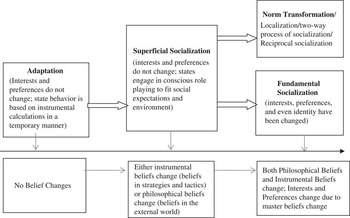
In this paper we suggest how to transcend the debate between rationalism and constructivism over China’s policy change toward multilateral institutions in the international system. Based on current scholarship of a cross-paradigm socialization theory, we suggest that socialization is an ongoing process for states to engage in, or be inducted into, the norms and rules of the existing world or community. The process of socialization can be driven by both rational strategic calculation and constitutive norm internalization. Borrowing Checkel’s conceptualization of two types of socialization (Checkel, Reference Checkel2005: 804) and Thies’s (Reference Thies2013) socialization game, we further categorize a bi-directional, three-stage, socialization process: adaptation (strategic calculation), superficial socialization (Checkel’s Type I), and fundamental socialization (Checkel’s Type II).Footnote 2 We suggest that states can move in two different directions at the superficial socialization stage. On the one hand, states can continuously internalize norms moving in the direction of fundamental socialization. On the other hand, they can localize or transform norms by resisting old norms in order to fit the new reality (Acharya, Reference Acharya2004; Terhalle, Reference Terhalle2011; Epstein, Reference Epstein2012; Pu, Reference Pu2012).
Using operational code analysis as an empirical testing tool, we link leader belief changes with various stages of state socialization and examine which stage of socialization leads to state policy changes. Through examining the operational code beliefs of Chinese leaders, we argue that China’s pro-multilateralist behavior is a product of ‘superficial socialization’, in which Chinese foreign policy elites change their beliefs about the outside world and regarding the future realization of their political goals in multilateral institutions. However, our operational code analysis of Chinese foreign policy elites and their belief systems also shows that Chinese policy makers have not changed their instrumental beliefs regarding strategies even in multilateral institutions. China is indeed socialized through multilateral institutions, but its scope is still far from the ‘fundamental socialization’ stage when state interests, preferences, and even identities change. We conclude that an engagement policy, that is, embracing China through multilateralism, has indeed changed China’s behavior toward a cooperative direction, but it is dangerous to overestimate the socialization effect of the engagement policy. Nevertheless, for Chinese leaders, engaging multilateral institutions is the right way to integrate into the international society. The rise of China in the context of socialization through multilateral institutions, may well be more peaceful than widely predicted.
China’s pro-multilateralist policy and state socialization processes
China is a newcomer in modern international society.Footnote 3 Compared to its initial reluctance and suspicion about multilateral institutions, China has gradually set multilateral diplomacy through institutions as one of the cornerstones of Chinese foreign policy after the Cold War, especially after the mid-1990s (see Lanteigne, Reference Lanteigne2005; Kent, Reference Kent2007; Olson and Prestowitz, Reference Olson and Prestowitz2011). Why did China embrace multilateral institutions? Although scholars traditionally like to divide their explanations into two schools of thought, that is, rationalism vs. constructivism, recent scholarship on socialization has shed new light on this highly debated question.
The rationalist-based adaptation argument suggests that China’s pro-multilateralist policy is a rational decision to adapt to the changing external environment and exogenous constraints. It is an adaptation behavior, because China’s state interests and preferences remain the same after joining multilateral institutions (Yuan, Reference Yuan2000; Goldstein, Reference Goldstein2003, Reference Goldstein2005; Wang, Reference Wang2004; Sutter, Reference Sutter2005a, Reference Sutterb; Christensen, Reference Christensen2006; He, 2009).
Constructivists challenge the rationalist view regarding state interests. A state’s preferences and interests are not given by the materialist-rooted, international system but socially constituted by ideas and norms. For example, Alastair Iain Johnston (Reference Johnston2003, 2008) argues that China’s activism in multilateral institutions is a result of a successful socialization process, in which Chinese diplomats, strategists, and analysts gradually internalized certain counter-realpolitik norms, ideas, and practices through participating in these institutions. Johnston’s agent-focused, socialization theory is indeed a path-breaking work, which indicates a new direction for the constructivist research program.Footnote 4
The key problem in the debate of China’s pro-multilateralist policy lies in the unfortunate dichotomy between rationalism and constructivism. State policy changes can be caused by both rational strategic calculations and constructive norm transformations. For example, Schimmelfennig (Reference Schimmelfennig2000, 2005) suggests that the policy changes or the integration of the post-communist ‘New Europe’ into the western community is a product of rational self-interest action in a normatively institutionalized, international environment. As Checkel suggests, a social-theoretic choice of an ‘either/or’ type between rationalism and constructivism indeed limits our understanding of state socialization processes and policy changes. Therefore, Checkel and other scholars advocate a ‘both/and’ logic to transcend the unfortunate dichotomy between rationalism and constructivism in explaining state socialization in the system (Johnston, Reference Johnston2005; Zurn and Checkel, Reference Zurn and Checkel2005).
Socialization is normally considered as a sociological term referring to the process of ‘inducting actors into the norms and rules of a given community’ (Checkel, Reference Checkel2005: 804). However, recent literature on socialization suggests that both the rational logic of consequentialism and the constructivist logic of appropriateness can apply in explaining state socialization processes. Cameron Thies (Reference Thies2010b), for instance, uses role theory to demonstrate how material capabilities, a key element of rationalism, shape the process of state socialization in a neorealist world. Martha Finnemore and Kathryn Sikkink (Reference Finnemore and Sikkink1998: 909) also admit that there is ‘an intimate relationship between norms and rationality’ in their study of the dynamics of international norms and policy change.
In the Chinese case, Goldstein suggests that China’s multilateral diplomacy through institutions is part of its ‘peaceful rise’ strategy, because institutions could help China alleviate suspicions and discourage military balancing from other countries (Goldstein, Reference Goldstein2003, Reference Goldstein2005). It is an apparent rationalist argument. However, this explanation is similar to Johnston’s ‘mimicking’ and ‘social influence’ micro-processes of socialization in which states do what others do in response to the mechanism of rewards and punishments (Johnston, Reference Johnston2003, Reference Johnston2008). According to Johnston’s socialization theory, persuasion is another micro-process through which China is further socialized into the normative system through institutions (Johnston, Reference Johnston2008).
Although scholars agree that both constructivism and rationalism can contribute to our understanding of the process of state socialization, three unsolved problems remain. First, there is still no consensus on the processes or procedures of socialization. For example, Finnemore and Sikkink (Reference Finnemore and Sikkink1998) suggest that the three stages of a norm’s ‘life cycle’ are: norm emergence, norm cascade, and internalization. Wendt (Reference Wendt1999) suggests three different degrees of norm internalization: coercion, self-interest, and legitimacy. Although these scholars imply a similar pattern of state socialization from rational calculation to norm internalization, they disagree how the processes of socialization really occur and do not specify how to measure them.
Second, most existing research shares a similar bias assuming that socialization is a top-down approach, in which the normative system plays the dominant role in teaching how a ‘novice’ state should do. Consequently, there are only two results of state socialization: success or failure. For example, Trine Flockhart (Reference Flockhart2006) suggests a ‘complex socialization’ model to explain why liberal democratic norms prevailed in Czech Republic, but not in Belarus, through opening up the black box of social identity between state/elite and nation/people. However, if socialization is an ongoing process, this should be more dynamic than existing research has suggested. In other words, norms can not only change state behavior, but can also change a state’s social interaction. For example, Acharya (Reference Acharya2004) suggests that states can play a ‘localization’ role in selecting and changing global norms to fit regional reality. In addition, both Xiaoyu Pu’s (Reference Pu2012) ‘two-way process of socialization’ and Maximilian Terhalle’s (Reference Terhalle2011) ‘reciprocal socialization’ discuss how states can also transform universal norms through a bottom-up approach. As Charlotte Epstein (Reference Epstein2012) points out, the so-called socializer in the international society should ‘stop telling us [states] how to behave’ because socializees are not ‘infants’ and norms should be dynamic in nature. In the same vein, Cameron Thies’s state socialization game is a two-way, strategic interaction process in which socializer and socializee can engage in ‘altercasting’ each other into different roles (Thies, Reference Thies2012, Reference Thies2013).
The third problem lies in the evidence of socialization. Even though scholars can intellectually categorize the processes or stages of socialization despite their different classifications, it is still empirically difficult to test whether states are really socialized or at which stage they are socialized. For example, Checkel (Reference Checkel2005) introduces two types of socialization: type I socialization in which a state’s behavior changes but not its interests and type II socialization, when the state’s interests and even identity changes. It is truly innovative in theory, but in practice, how could we differentiate these two types of socialization? Moreover, how can scholars distinguish type I socialization from a purely rational calculation, in which states change their behavior for the pure logic of consequentialism, without even engaging in the ‘conscious role playing’ that Checkel suggests is an important sign of type I socialization (Johnston, Reference Johnston2005; Zurn and Checkel, Reference Zurn and Checkel2005).
Three-stage, two-direction socialization and operational code analysis: beliefs in motion
In order to address these three problems, we introduce a bi-directional, three-stage socialization model through linking the model with operational code analysis. This socialization model is intended to integrate both rationalism and constructivism within the same analytical framework of socialization, and operational code analysis provides an empirical testing tool to examine when, and what type of, socialization really happens through gauging the belief changes of leaders.
First, our three stages of socialization are built on Checkel’s two types of socialization that we have discussed above. We echo Thomas Risse and his research group to argue that instrumental action dominates the first stage of the process of socialization (cited by Schimmelfennig, Reference Schimmelfennig2000: 115). Similarly, Wendt (Reference Wendt1999: 250) also puts ‘coercion’ – a rationalist-based action – as the first degree of norm internalization. Therefore, we suggest that ‘adaptation’ is the first stage of socialization, in which states only change their behavior based on the logic of consequentialism and instrumental calculation.
The second stage of socialization is called ‘superficial socialization’, which has the same definition as Checkel’s type I socialization. It means that states engage in conscious role-playing to meet the social expectations of a given setting or community without changing their fundamental interests, preferences, and identity. The third stage of socialization is named ‘fundamental socialization’, referring to Checkel’s type II socialization when states change both interests and preferences, even identity. It is worth noting that this new categorization of state socialization is mainly based on existing socialization scholarship for analytical convenience. It is open for further contestation and debate.Footnote 5
Inspired by Thies’s (Reference Thies2013) socialization game, we suggest that there will be two possible outcomes or directions in the socialization process. At stage 2 (Checkel’s type I), states face two possible options. If states successfully change their interests and preferences, that is, to internalize the norms, they shall move to the third stage of fundamental socialization. However, if states resist the existing norms, they can move to a new direction – norm transformation through either localizing or creating new norms – an effort that may or may not be successful (Thies, Reference Thies2012, Reference Thies2013).
The key to distinguishing these three stages of socialization is to see whether state interests really change. If state interests and preferences are transformed along with behavioral changes, then we can say that states experience ‘fundamental socialization’. However, regarding adaptation vs. superficial socialization, it is still difficult to make a clear distinction because neither requires a change of interests. One possible way to differentiate these two types of socialization is to see how long the behavioral change can last. Adaptation is purely based on instrumental calculations and may be easily altered when external or internal conditions change. However, ‘superficial socialization’ has gone beyond the instrumental calculations and has entered into the role-playing stage under the logic of appropriateness, although state interests may not conform to the existing norms and rules. The key is the states ‘knowing what is socially accepted in a given setting or community’ (Checkel, Reference Checkel2005: 804). Therefore, behavioral changes under superficial socialization should last longer than under adaptation. However, constructivists in general, and socialization theorists in particular, still face a difficult time in finding evidence to test changes of state interests as well as measuring the durability of behavioral changes.
In the Chinese case, China’s pro-multilateralist behavior is an outcome of state socialization through institutions because institutions provide social environments for states to learn what they should do (Johnston, 2008). However, the question is, at which stage has China been socialized? The three-stage socialization model suggests that we need to know both whether and when states have changed the way they define their interests in institutions. We introduce the operational code analysis, a psychological approach in leadership studies, to examine whether Chinese leaders have changed their interests through examining their beliefs. Operational code analysis follows the cognitivist proposition that a leader’s beliefs, as ‘subjective representations of reality’, can shape how states define their interests (Snyder et al., Reference Snyder, Bruck and Sapin1954; Steinbrunner, Reference Steinbrunner1974; Vertzberger, Reference Vertzberger1990; Schafer and Walker, Reference Schafer and Walker2006a). In other words, through examining Chinese leader’s belief changes we can test whether and how much international institutions have changed these leader’s beliefs when they define their interests.
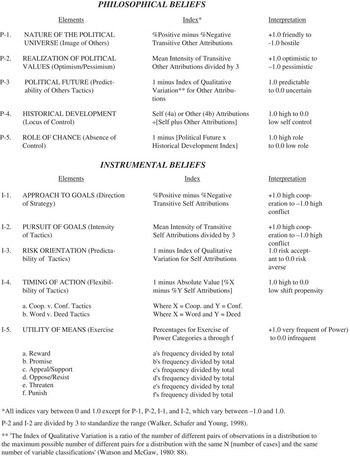
Based on Nathan Leites’ (1951, Reference Leites1953) prototypical studies of the Bolshevik operational code, Alexander George (Reference George1969, 1979) formalized Leites’ operational code analysis of the 1950s by suggesting ten questions as a tool to gauge and analyze any individual’s beliefs. George (Reference George1969, 1979) suggested that a policy maker’s ‘operational code’ is conceptualized as a political belief system, in which two major elements are philosophical beliefs and instrumental beliefs. While philosophical beliefs refer to a leader’s diagnostic perceptions regarding the external environment and the context of action, instrumental beliefs prescribe the most effective strategy for achieving their political goals. The following presents George’s ten questions for the identification of a leader’s philosophical beliefs and instrumental beliefs:

Based on George’s 10 questions, Ole Holsti (Reference Holsti1977) constructed six types of operational codes for leaders. Stephen Walker (Reference Walker1977, 1983) later revised the Holsti’s typology into four types of belief systems with the three master beliefs as (P-1) nature of the political universe, (I-1) strategic approach to goals, and (P-4) ability to control historical development. Based on Holsti and Walker’s typology, scholars use the Verbs in Context System (VICS) of content analysis to quantify a leader’s belief system through examining public speeches and statements. Many scholars have applied operational code analysis in foreign policy analysis through unpacking a decision maker’s belief system (e.g. Walker et al., Reference Walker, Schafer and Young1998; Feng, Reference Feng2005; Malici and Malici, Reference Malici and Malici2005; Schafer and Walker, Reference Schafer and Walker2006a, Reference Schafer and Walkerb).
We integrate operational code beliefs with the three stages of socialization and employ operational code analysis to test the levels or stages of socialization. As Figure 1 shows, adaptation (behavioral change) does not require any belief changes. Therefore, at the ‘adaptation’ stage of socialization, neither the philosophical nor the instrumental beliefs of leaders should change. At the second stage of socialization – ‘superficial socialization’, states have started to play a role that they think is appropriate, given their social constraints and expectations. It is also similar to Johnston’s (Reference Johnston2008) suggestion that the first two micro-processes of socialization are: mimicking and social influence. It means that states start to do what others do, or what others expect them to do, either due to attraction by reward or fear of punishment. At this superficial socialization stage, leaders in a state that is to be socialized, will be very sensitive to the external environment and their possible strategies. Philosophical beliefs in operational code analysis, focus on policymaker’s beliefs about the external environment and the context of action, while instrumental beliefs stress the best strategy (I-1), tactics (I-2), or means (I-5) to achieve political goals. Therefore, if we observe a change of either philosophical or instrumental beliefs, we can infer that superficial socialization has happened because the state’s leaders have changed either the self-strategies (instrumental beliefs) or perceptions regarding others (diagnostic beliefs). It means that a state’s behavioral change is not only an adaptive reaction toward exogenous impacts, but rooted in the change of their leader’s belief systems.
Three stages and two directions of socialization measured by operational code belief changes. Note: States will face two directions at the superficial socialization stage.

As mentioned before, states have two options at the ‘superficial socialization’ stage. If they accept the prevailing norms in the system, they will move to the next stage of ‘fundamental socialization’. This means that states have gradually internalized the norms, which will lead to the change of both behavior and interests/preferences, even identity. However, if states resist prevailing norms, they can go in a new direction, in which they will try to transform the norms to fit their expectation and local reality.
A detailed analysis of norm transformation and a leader’s belief system is beyond the scope of this research project. We limit our focus here on the state’s internalization of existing norms, which is the last stage of socialization – ‘fundamental socialization’. At this stage, we should expect that both philosophical and instrumental beliefs, in our operational code analysis, have to be changed. If fundamental socialization occurs, then the three master beliefs (P1, P4, and I1) change the self’s strategy and also the expectations of others, leading to a change in an actor’s role, and corresponding policy defined by changes in interests and preferences.Footnote 6
Applying this operational code-socialization framework to the case of China, we can generate three hypotheses about China’s pro-multilateralist behavior:
-
1. Stage I. If the instrumental and philosophical beliefs of Chinese leaders do not have significant changes within multilateral institutions, then China’s pro-multilateralist behavior is a product of ‘adaptation’ to the external environment.
-
2. Stage II. If either the instrumental or philosophical beliefs of Chinese leaders have significant changes within multilateral institutions, then China’s pro-multilateralist behavior is a result of ‘superficial socialization’.
-
3. Stage III. If both the philosophical and instrumental beliefs of Chinese leaders have significant changes within multilateral institutions, then China’s pro-multilateralist behavior may reflect a change in policy, or international role, as a product of ‘fundamental socialization’ in the form of changes in P-1, P-4, and I-1, resulting in socialization (adoption of new interests and preferences).
Operational codes of Chinese decision makers: how much have they been socialized?
We use Chinese leader’s belief changes inside vs. outside multilateral institutions as an analytical tool to measure the level or stage of China’s socialization processes through multilateral institutions. There are two reasons for this research design. Belief changes normally take place either before, or at the same time, as behavioral changes. Ideally, we should examine Chinese leader’s belief changes before and after joining multilateral institutions. However, since China’s participation in multilateral institutions did not happen overnight, China’s gradual involvement of multilateral institutions through the 1990s, blurred the dividing line of Chinese leader’s belief changes. As we shall show later, Chinese leader’s belief changes are also not significant over time.
Therefore, we perform a proxy test for Chinese leader’s belief changes by comparing them in different settings. If China’s multilateral behavior is really a result of socialization, we should be able to observe Chinese leader’s belief changes in multilateral institutions, where the effects of socialization are the strongest. If we do not observe any belief changes in multilateral institutions, we can confidently conclude that China’s behavioral change toward multilateralism is a result of pure adaptation or instrumental calculation.
If we observe some belief changes of Chinese leaders inside multilateral institutions vs. outside these institutions, we can only partly conclude that these belief changes may contribute to China’s behavioral change toward multilateral institutions since other reasons, such as audience effects or impression management, may explain a false or temporary change of beliefs in different settings. However, the more belief changes we can observe, that is, regarding both instrumental and philosophical beliefs in different settings, we can conclude more confidently that these differences really reflect the socialization effects of multilateral institutions. By using different settings to test belief changes, we can at least provide a first cut at gauging the level of China’s socialization through multilateral institutions.
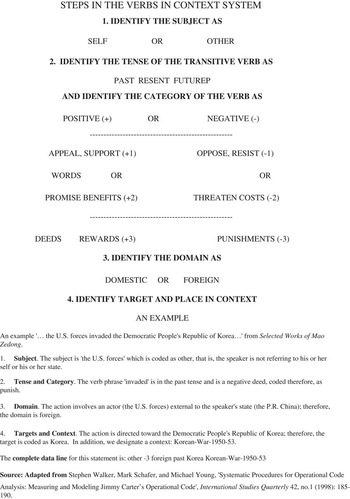
In order to examine the operational code beliefs of Chinese policy makers/leaders, we use Profiler+ (an automated content analysis software) to employ the VICS of content analysis to code and analyze the public statements and speeches of leaders. Profiler+ can retrieve the transitive verbs from each speech and public statement. Based on an operational code dictionary of transitive verbs attributed to self or others, Profiler+ can provide the data to index each belief of a policy maker’s operational code.Footnote 7 VICS provides values for six attributes for each recorded verb and its surrounding context: subject, verb category, domain of politics, tense of the verb, and intended target, and context (see Figure 2).
Steps in the verbs in context system for coding verbs. Source: Adapted from Stephen Walker et al. (1998).

Figure 3 shows how operational code indices are calculated by the values provided by VICS. Depending on the index, their values range from −1.0 to +1.0 or between 0.00 and 1.0. It should be noted that both I4 and I5 have subcategories, and thereby, there are no general belief indices for I4 and I5, but a separate belief index for each subcategory.Footnote 8 In this paper we perform three tests to examine Chinese leader’s belief changes. First, we compare and contrast the three top Chinese leader’s belief systems and examine the variations in their operational code beliefs over time. This test will ensure that operational code analysis can indeed measure belief changes among different leaders and over time. Second, we focus on Chinese leadership after the Cold War and examine whether Jiang and Hu have different belief systems along with their followers. This test will ensure that these belief systems are not unique to one individual but represent consistent and shared beliefs among different generations of foreign policy elites. Last, we examine the belief changes of Chinese foreign policy elites in different settings, that is, in multilateral institutions vs. outside multilateral institutions. This test will provide an answer (albeit not a definite one) about at which stage Chinese leaders have been socialized through multilateral institutions.
Indices for philosophical and instrumental beliefs.

It is worth noting that operational code analysis is an ‘at-a-distance’ approach in examining leader’s belief systems. The ‘at-a-distance’ approach means that ‘we assess the psychological characteristics of individuals from a distance without having direct access to them’ (Schafer and Walker, Reference Schafer and Walker2006c: 26). In this research, we rely on Chinese leader’s speeches and statements to infer their psychological beliefs. There are some issues associated with this ‘at-a-distance’ method in general, and operational code analysis in particular. For example, scholars may question the authorship of the speeches and possible deceptions or manipulations of these speeches by leaders for ‘impression management’.
An extensive discussion of these issues is beyond the scope of this paper.Footnote 9 However, we suggest that operational code analysis and the VICS scheme examine cognitive information – information that has been consciously processed. In other words, even though the speeches and statements may be prepared by speechwriters instead of the leaders themselves, the speeches still reflect the views of leaders on specific policy issues. In other words, leaders will not deliver the speeches and statements without their consent. Deception and manipulation of the speeches, may happen occasionally in reality, however, VICS focuses on the large number of verbs and uses the general pattern of the verbs to infer a leader’s belief system. Leaders may deceive the public with a few brief phrases or verbs, for example, in order to show their peace-loving ideology, leaders may choose cooperative words to justify their action of war. However, war is war. Leaders will not be able to change the whole story about a war no matter how carefully they choose the words. Therefore, through examining the whole speech, VICS indices will likely ‘swamp few intentional deceptions’ (Schafer and Walker, Reference Schafer and Walker2006c: 47).
Test one: China’s generational change of beliefs
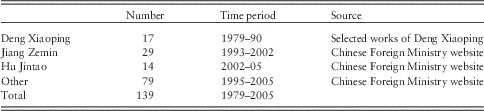
Deng Xiaoping was the paramount leader after the Cultural Revolution. He came to power in 1978 and started to transfer his power to Jiang Zemin after the Tiananmen incident in 1989. We collected 17 speeches for analysis from his published selected works between the years 1979–90. Jiang Zemin was in power from 1990 to 2002. Due to international sanctions on China after the Tiananmen incident, China was isolated in international society until 1992 when western countries started to reopen their doors to China. We collected 29 speeches between 1993 and 2002 by Jiang for analysis, and which were provided by the official website of the Chinese Foreign Ministry.Footnote 10 We also collected 14 speeches of Hu Jintao, the successor of Jiang, between 2002 and 2005 from the same webpage. In addition, we collected 79 speeches of other major decision makers from the rank of the vice foreign minister of foreign affairs to the premier. These decision makers can be treated as followers of Jiang and Hu, and their speeches are from 1995 to 2005. Table 1 is a description of our speech data collection for this project. It should be noted that these speeches are all foreign policy-related speeches delivered on an international occasion or in a domestic setting.
Description of Chinese leader’s speeches

There are three reasons for collecting all the speeches and public statements from the official website of the Chinese Foreign Ministry. First, we use targeted sampling instead of random sampling in this research, because we intend to measure the operational code beliefs of top Chinese leaders whose speeches and statements are limited in nature. Second, the operational code beliefs mainly measure the leader’s beliefs in foreign policy. Therefore, the official translations by the Chinese Foreign Ministry are the most authoritative versions of these speeches. China’s foreign ministry may select certain speeches, but not others. However, as some scholars point out, China’s hierarchical power system constrains the bureaucratic power of the Chinese Foreign Ministry (Lu, Reference Lu1997; Jakobson and Knox, Reference Jakobson and Knox2010). Therefore, we suggest that the Ministry has little room to select speeches since it is obligated to post the most relevant foreign policy speeches by Chinese top leaders, especially the Politburo members, on their website. Last but not least, the VICS content analysis software has its own dictionary to automatically code verbs, nouns, and adjectives and to analyze both instrumental and philosophical beliefs.Footnote 11
Our first test is to compare the operational code beliefs of these three top leaders to see whether operational code analysis can identify any significant belief changes among Deng, Jiang, and Hu. We expect to see belief changes between Deng and the other two leaders, because Deng transferred his power to Jiang after the end of the Cold War. Normally, a major event such as the end of the Cold War will cause individuals such as Deng’s successors to change their belief systems, that is, people will see the world differently (philosophical beliefs) and choose different strategies according to different philosophical or instrumental beliefs.Footnote 12
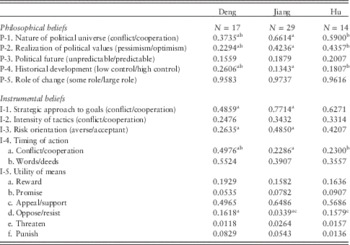
Our one-way analysis of variance (ANOVA) test on the operational codes of the three leaders supports our expectation. Table 2 shows the mean differences in operational code beliefs between Deng and Jiang/Hu. We can see that there are significant differences in the master philosophical beliefs (P1 and P4) between Deng on the one hand, and Jiang and Hu on the other. Jiang and Hu view the political universe in a more cooperative way than Deng (P1) and they attribute less control over historical development (P4) to the self than to others. They are more optimistic than Deng about the realization of political values (P2). It is also interesting to notice that Jiang and Hu do not have any significant differences in philosophical beliefs.
Operational codes comparison among three Chinese top leaders

Significant difference among three leaders at the P<0.05 level (Tukey HSD test).
Significant signs:
a Deng vs. Jiang.
b Deng vs. Hu.
c Jiang vs. Hu.
Regarding instrumental beliefs, Deng has significant differences with Jiang concerning the master belief about strategies (I1), and they also differ with regard to risk orientation (I3), timing (I4a), and the use of opposition statements as means (I5d). This suggests that compared to Jiang, Deng had a more conflictual strategic approach to goals (I1), was more risk-averse (I3), had a significantly higher propensity to shift between cooperative and conflictual tactics (I4a), and ascribed significantly more utility to oppose/resist tactics (I5d) as a means for goal attainment. Deng and Hu differ only with regard to one instrumental belief (I4a). Since the I4a belief investigates the diversity of the leader’s choices in terms of cooperation and conflict action (Schafer and Walker, Reference Schafer and Walker2006c: 36–37), Deng’s higher I4a score indicates that Deng is perhaps a more skillful leader than Hu in seizing the timing for shifting between cooperation and conflict actions. Jiang and Hu are also different in I5d, indicating that Hu utilizes the oppose/resist tactic more frequently than Jiang. The comparison of instrumental beliefs between the three leaders indicates that Deng has more differences with Jiang than with Hu in terms of how to achieve political goals.
The operational code comparisons among Deng, Jiang, and Hu show that the end of the Cold War indeed transformed the belief systems of Chinese leaders. Jiang and Hu have a more cooperative and optimistic worldview than Deng, although Deng is stronger in his belief in the ability to control historical development. This result shows that China is more socialized into the international society under Jiang and Hu’s leadership than under Deng’s era, and echoes research that suggests the end of the Cold War is the starting point for ‘China goes global’ (Shambaugh, Reference Shambaugh2013). In terms of strategies, the instrumental belief differences between Deng and Jiang are more apparent than those between Deng and Hu. Hu and Jiang do not have many significant differences in their strategies to achieve political goals. The results of these tests over time show that operational analysis can identify changes in Chinese leader’s belief systems following the end of the Cold War.
This research does not examine Mao Zedong’s belief systems because our research focus is on Chinese leadership after the Cold War. By comparing Deng’s belief systems with Jiang’s and Hu’s, we have shown that there is a generational gap in belief systems across different leadership generations in China. Other analyses of comparisons between Mao and Deng regarding their operational code beliefs endorse our finding here, that operational code analysis is a reliable analytical tool to measure the belief changes of Chinese leaders (Feng, Reference Feng2005).
One possible criticism of our operational code analysis is that the belief changes between Deng and Jiang/Hu are not driven by outside factors, that is, the end of the Cold War. Rather, they reflect individual differences in beliefs. We do not deny that it is possible that different leaders have different belief systems. However, our analysis shows that Jiang and Hu, the two top Chinese leaders after the Cold War, do not have significant differences in both philosophical and instrumental beliefs. If the assumption is that different individuals should have different belief systems, it cannot explain the similar belief systems between Jiang and Hu. Therefore, we suggest that the outside environment is the major source for these variations in the Chinese leadership’s belief systems across time.
Test two: leaders and their followers
Our next task is to see whether the belief systems of China’s top leaders have any significant differences from their followers. Since this research focuses on China’s foreign policy after the Cold War, we exclude Deng and his followers from this test and focus on their successors. As mentioned above, we have collected 79 speeches and statements of Jiang’s and Hu’s key followers from 1995 to 2005. The lowest rank of these followers is Vice Foreign Minister, which indicates that this sample of Jiang’s and Hu’s followers is also within the circle of Chinese decision making. We ran two separate ANOVA tests to see whether the operational code beliefs of Jiang and Hu have significant differences from their followers. Both tests show that the belief systems of the followers are similar to that of their leaders. In other words, we do not find any significant differences in the operational codes between Jiang/Hu and their followers. This result actually supports the long-time perception regarding the nature of the one-party political system in China. Although some research suggests that intra-party democracy has started to emerge in the domestic politics of China, China’s foreign policy elites still rigidly follow the same party line for both leaders and followers (Lin, Reference Lin2004).
Since both Jiang and Hu have similar belief systems as their followers, we decided to merge the speeches of the leaders with the speeches of their followers and test the operational code beliefs of the Chinese foreign policy elites as a group. It should be noted that although most current applications of operational code analysis focus on individuals, the first operational code study focused on a group – the Soviet politburo case by Leites (Reference Leites1951). A practical reason for us to go back to this tradition is to expand the sample size of our test.Footnote 13 This step - to retrieve the belief systems of foreign policy elites as a group - is also consistent with China’s decision-making culture of collective leadership after the Cold War.
Test three: beliefs on different occasions
Based on the occasions of the speeches and statements, we divide the foreign policy speeches by Jiang (29), Hu (14), and their key followers (79) into two groups: speeches delivered in international institutions and speeches delivered in non-international-institution settings. International institutions include both regional organizations, such as ARF and APEC and global institutions, such as the United Nations. The non-international-institution setting includes bilateral meetings, public statements about foreign policy on domestic occasions, and interviews by foreign media. We intend to test whether the Chinese foreign policy elites have different operational code beliefs in international-institution vs. non-international-institution settings. It is worth noting that we use ‘occasion’ instead of ‘audience’ to distinguish the leader’s speeches. The rationale is to see whether international institutions change Chinese foreign policy elite beliefs.Footnote 14 In addition, it is sometimes difficult to make a clear cut distinction about the audience if the meeting or conference is held in China. As we suggest before, if Chinese foreign policy elites are gradually socialized by the cooperative norms in the social environment of multilateral institutions, we should expect to see some belief system changes, in both philosophical and instrumental beliefs, in multilateral institutions compared with the non-institutional setting.
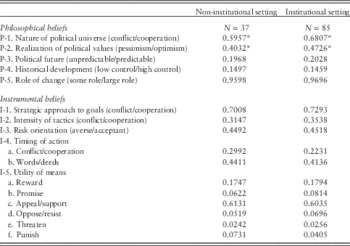
Table 3 shows the one-way ANOVA results in which we set ‘occasion of the speech’ as the factor (independent variable) and VICS operational code indices as dependent variables. We see that there are significant changes in both P1 and P2 values. While the P1 value of Chinese foreign policy elites in international institutions is 0.68, it drops to 0.59 in non-international-institution settings. The difference is also statistically significant (P<0.05). This suggests that Chinese foreign policy elites have a more cooperative worldview of the political universe in multilateral institutions than in non-institutional settings. The P2 value of Chinese foreign policy elites in international institutions is 0.47 and it drops to 0.40 in the non-institutional setting. The difference is also statistically significant (P<0.05). It suggests that Chinese foreign policy elites are more optimistic about the realization of political values in multilateral institutions than in non-institutional settings. For instrumental beliefs, there is no significant difference between these two settings.
Chinese foreign policy elite operational codes: comparisons between multilateral institutions and non-institutional settings

*Significant difference between settings at the P<0.05 level (two-tailed test).
This test suggests that the Chinese foreign policy elites have different beliefs in their operational codes regarding the political universe (P1) and their attitudes about the realization of political values (P2), depending on the setting of the speech. It may be due to the relatively friendly or cooperative environments of multilateral institutions after the Cold War. It is also understandable that the dramatic increase in both China’s economic and military capabilities after the Cold War makes China an important political actor in world politics. Any multilateral institution, which intends to have a global influence, cannot ignore China after the Cold War. Chinese foreign policy elites, therefore, have apparently changed their previously hostile attitudes toward multilateral institutions and have started to view the world differently in multilateral institutions.
Another possible explanation is that Chinese leaders just pretend to be more cooperative toward the outside world, especially in front of an international audience. However, if this audience-based, ‘impression management’ indeed is at work, then Chinese leaders should also change both their philosophical and instrumental beliefs across different audiences. However, our test suggests that Chinese foreign policy elites have not changed their beliefs in strategies (instrumental beliefs) in multilateral institutions. In other words, multilateral institutions have not transformed Chinese foreign policy elite beliefs regarding what means they should adopt to realize their political goals. This result indicates that the operational code analysis can filter the ‘impression management’ out of the measurement of leader beliefs.Footnote 15 There are two possible explanations for Chinese policy elites to hold different beliefs in strategies across different settings. First, as the previous three-leader test has shown, both Jiang and Hu have a more cooperative world view and strategies than Deng after the Cold War. It may suggest that Chinese policy elites have adopted a more cooperative strategy because of the transformation of the international system, and they do not need to change any more through multilateral institutions.
Second, the Chinese leaders are still living in the high church of realpolitik as Christensen suggested more than 10 years ago (1996). Although Chinese policy elites have perceived a changing and more cooperative outside world and have become more optimistic about China’s future, they still insist on a realist approach - though not necessarily a conflictual one as in the Cold War - to deal with pressures and threats from the outside world. In other words, multilateral institutions have changed what Chinese policy elites think about the world, but have not changed how they behave toward the world, even in multilateral institutions.
In order to test the consistency of Chinese elite philosophical belief differences between institutional settings and non-institutional settings, we also conducted a multivariate analysis of variance (MANOVA) test to see whether Chinese foreign policy elite beliefs change over time as well as in different settings. We used the year 2002 as a dividing line to separate the speeches into two time periods. There are two reasons for using 2002 as the dividing line. First, Jiang and Hu transferred power in 2002. Second, from 1990 to 2001, China experienced three major foreign policy crises, the 1995/96 Taiwan crisis, the 1999 Embassy Bombing incident, and the 2001 EP3 aircraft collision with the United States. Therefore, the time of 1990–2002 can be seen as a crisis period for China’s foreign policy. In comparison, the 2003–05 period is a relatively peaceful time in China’s foreign policy, especially due to the US global anti-terrorism campaign after the September 11 tragedies.
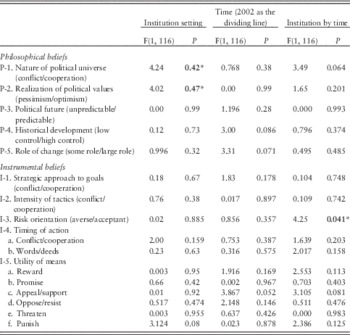
Through comparing operational codes of Chinese elites in these two periods, we can see whether Chinese foreign policy elites change their beliefs over time. In the MANOVA test showed in Table 4, we used ‘speech setting’ and ‘speech time’ as two factors (independent variables) and operational code indices, for both philosophical and instrumental beliefs as dependent variables. The results show that speech setting is still significant for P1 belief, F(1, 116)=4.235, P<0.05 and P2 belief, F(1, 116), P<0.05, when controlling for time. It means that Chinese elites, in both crisis and peaceful periods, have different P1 and P2 beliefs across different settings. Neither time, nor most interactions between time and setting, are significant in these tests.Footnote 16 It suggests, as well, that Chinese elites have not changed either instrumental or philosophical beliefs over time (the crisis period vs. non-crisis period in Sino-American relations) when controlling for the speech setting. These results support our previous conclusion that Chinese elites have consistently different philosophical beliefs regarding P1 and P2 in different settings (institutional vs. non-institutional).Footnote 17
MANOVA results for Chinese foreign policy elite operational codes across institution settings and times

*Significance at the P<0.05 level (two-tailed test).
Recalling the three hypotheses based on the socialization-operational code framework, we can conclude that China’s multilateral diplomacy is a result of ‘superficial socialization’. It is not merely adaptation, because Chinese foreign policy elites indeed have changed some of their beliefs regarding the political universe and the chances of realizing their political values. Although they do perceive a relatively cooperative and optimistic political universe within a multilateral institutional setting, Chinese foreign policy elites have neither changed their beliefs regarding strategies nor redefined their interests and preferences.
Conclusion
Borrowing insights from socialization theory and operational code analysis, we have introduced a ‘superficial socialization’ argument to provide an alternative explanation of China’s multilateral diplomacy after the Cold War. We argue that China’s pro-multilateralist foreign policy is a product of superficial socialization, in which Chinese foreign policy elites have changed some of their beliefs about the outside world in a cooperative and optimistic direction within the context of multilateral institutions, but their strategies for realizing political goals have not changed.
There are two theoretical and policy implications. First, this research bridges the theoretical gap between rationalism and constructivism by employing operational code analysis in studies of China’s foreign policy. We suggest that it will be promising and fruitful to encourage a marriage between grand international relations theory and middle-range theorizations in foreign policy analysis.Footnote 18 Second, the ‘superficial socialization’ argument suggested by this study calls for ‘realistic expectations’ in studies of China’s foreign policy. There are two extreme views of China’s behavior after the Cold War. While pessimists believe that China never changes, and even its cooperative behavior in multilateral institutions is either a disguise or a new strategy, optimists think that multilateral institutions have fundamentally changed China’s definitions of interests and preferences through a process of socialization.
These two extreme views are theoretically flawed and politically dangerous. As our operational code analysis shows, there is a realistic but ignored middle ground – the process of superficial socialization – inbetween the pessimistic adaptation and the optimistic fundamental socialization arguments. China has indeed changed in multilateral institutions but has not been socialized to the extent that some constructivist theorists have suggested. Both pessimistic and optimistic views on China’s behavior may cause misleading policies. Under the pessimistic view, policy makers are more likely to contain and pressure China in a preemptive way. This may push Chinese leaders to return to the hostile, conflictual world view that they exhibited during the Cold War and perhaps alter their risk orientation toward the escalation and de-escalation of conflicts. Under the optimistic view, policy makers may prefer engagement to containment in coping with China’s rise. However, an over-optimistic view of the effects of socialization through multilateralism on China’s behavior may result in an expectation gap, between what is expected about China’s behavior and how China actually behaves.
For example, China has been widely criticized for its ‘offensive or assertive turn’ in foreign policy since the late 2000s (Green, Reference Green2010; Nye, Reference Nye2010; Swaine, Reference Swaine2010, Reference Swaine2011; Christensen, Reference Christensen2011). The reasoning for calling it an ‘offensive turn’ is because China had behaved cooperatively for more than 10 years after the Cold War, but in the late 2000s, its foreign policy seemingly turned assertive. It is truly puzzling to understand China’s behavioral change in the late 2000s if we hold an optimistic socialization argument, which suggests that Chinese decision makers have been successfully socialized by the cooperative norms in the international system since the 1990s.
Our ‘superficial socialization’ argument suggests that we should have a realistic – not simply a high – expectation about China’s cooperative behavior. Our research shows that Chinese policy makers have not changed their basic strategies to achieve their political goals through multilateral institutions. China’s cooperative behavior in the 1990s may only reflect its simple adaptation to a relatively friendly and cooperative external environment after the Cold War. Chinese leaders’ beliefs in strategy, however, have not been changed through participation in multilateral institutions. When the external environment changes in an unfriendly and non-cooperative direction, therefore, it should be no surprise that China adopts a non-cooperative and even conflictual strategy. In addition, at this superficial socialization stage, China still faces two options in international institutions. On the one hand, China can further integrate into the existing international institutions by accepting or internalizing universal norms. On the other hand, China can say ‘no’ to universal norms and move in the ‘norm transformation’ direction. Therefore, China’s behavioral changes in the mid-2000s are not surprising in the context of the ‘realistic expectations’ suggested by the results of our study.
However, our research also shows that Chinese leaders have indeed changed their worldview in the context of multilateral institutions. It indicates a positive sign of the potential effects of multilateral institutions on China’s behavior in the future. China is not a monolith that cannot be penetrated. Chinese leaders have been socialized through historical experiences and social interactions. It may just take a long time for them to change their interests, preferences, and even identity at a ‘fundamental socialization’ level. Socialization theory is right that an engagement policy can transform China’s interests, reset its preferences, and change its behavior. However, we need to keep a realistic view of China’s foreign policy behavior while insisting on engaging China through multilateral institutions to effect this transformation. Finally, this research suggests that the continuous engagement of international institutions is the right way for China to be accepted and socialized by international society. Even if China intends to change the norms and rules during its ascent, it will be better and easier to make the challenge and resistance inside multilateral institutions (Schweller and Pu, Reference Schweller and Pu2011). In a word, China will change the world as much as the world will change China. The socialization of China’s rise may lead to a more peaceful outcome than widely predicted.
Acknowledgments
The authors would like to thank Stephen Walker, anonymous reviewers, and editors of EPSR, for comments and suggestions. All errors and omissions are the authors’ own.