





1. Introduction
The Milky Way (MW) Nuclear Stellar Cluster (NSC) is home to many special objects; a supermassive black hole (SMBH, see Neumayer et al. Reference Neumayer, Seth and Böker2020, and references therein), the S-stars (Schödel et al. Reference Schödel, Nogueras-Lara and Gallego-Cano2020, and references therein), G-objects (Ghez et al. Reference Ghez, Salim and Hornstein2005; Ciurlo et al. Reference Ciurlo, Campbell and Morris2020), Blue Straggler stars (BSSs, Thorsbro et al. Reference Thorsbro, Forsberg and Kordopatis2023) and more. The origin of these objects remains somewhat debatable, but they are typically believed to originate from binaries (see also e.g. Trani et al. Reference Trani, Fujii and Spera2019). Binaries make up most of the systems in the Galactic field (Raghavan et al. Reference Raghavan, McAlister and Henry2010; Moe and Di Stefano Reference Moe and Di Stefano2017), yet in the NSC, only a handful of stellar binaries have been observed (Martins et al. Reference Martins, Trippe and Paumard2006; Pfuhl et al. Reference Pfuhl, Alexander and Gillessen2014; Peiß ker et al. Reference Peißker, Zajaček and Labadie2024). This lack of binaries can be partially explained by the extreme dynamical environment of the NSC. High number densities lead to frequent encounters that can destroy binaries (see e.g. Marklund et al. Reference Marklund, Church and Trani2025), and other secular processes such as von Zeipel-Lidov-Kozai (ZLK, von Zeipel Reference von Zeipel1910; Lidov Reference Lidov1962; Kozai Reference Kozai1962) oscillations can drive binaries to near-parabolic orbits where they merge (e.g. Prodan et al. Reference Prodan, Antonini and Perets2015; Stephan et al. Reference Stephan, Naoz and Ghez2019). The outcome and evolution of these binaries depend on many different initial parameters, such as, for example, the initial distribution of the binaries’ orbital elements and the region in which they originate in the NSC. It therefore becomes useful to define the hard/soft boundary (H/SB); where the ratio between a binary’s binding energy and the average kinetic energy of the surrounding stars is unity (
 $h\sim 1$
). Very soft binaries (
 $h\ll1$
) inevitably evaporate, and very hard binaries (
 $h\gg1$
) eventually merge (Rose et al. Reference Rose, Naoz and Gautam2020), while for binaries
 $h\sim1$
, binary evolution is not reliably predictable and requires numerical simulations (Marklund et al. Reference Marklund, Church and Trani2025).
2. Numerical set-up
We perform numerical simulations of three-body encounters using tsunami (Trani and Spera Reference Trani and Spera2023), where in addition we also incorporate the quadrupole approximation for ZLK following the implementation described in Naoz et al. (Reference Naoz, Farr and Lithwick2013) and tidal dissipation as implemented in Mardling and Aarseth (Reference Mardling and Aarseth2001). In total, we evolve 5736 binaries originating at a distance of either
 $0.1$
or
 $0.3~\mathrm{pc}$
from the SMBH, for 10 Gyr or until they are either destroyed (merge or evaporate), unbound from the SMBH (ejected) or the primary evolves due to stellar evolution (this process can dominate the binary’s evolution, and therefore diminishing the role the dynamical processes). The initial population is chosen to be low-mass (
 $\le 1\,\mathrm{M}_\odot$
stars) short-period binaries (
 $\lesssim 1000$
days) that are found in the Galactic field (Moe and Di Stefano Reference Moe and Di Stefano2017), and are sampled with COSMIC (Breivik et al. Reference Breivik, Coughlin and Zevin2020). A significant fraction of the binaries (
 $\gtrsim1/3$
) lie very near the H/SB.
3. Results
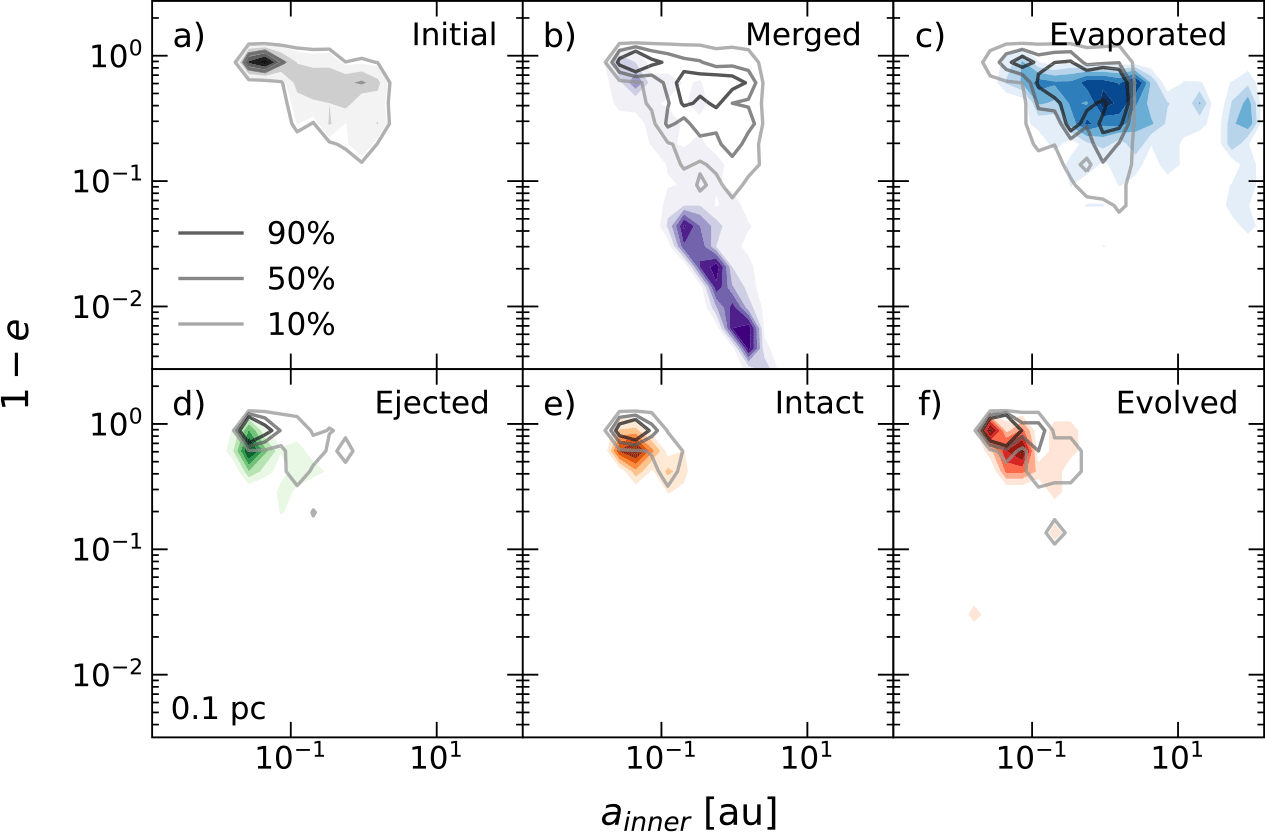
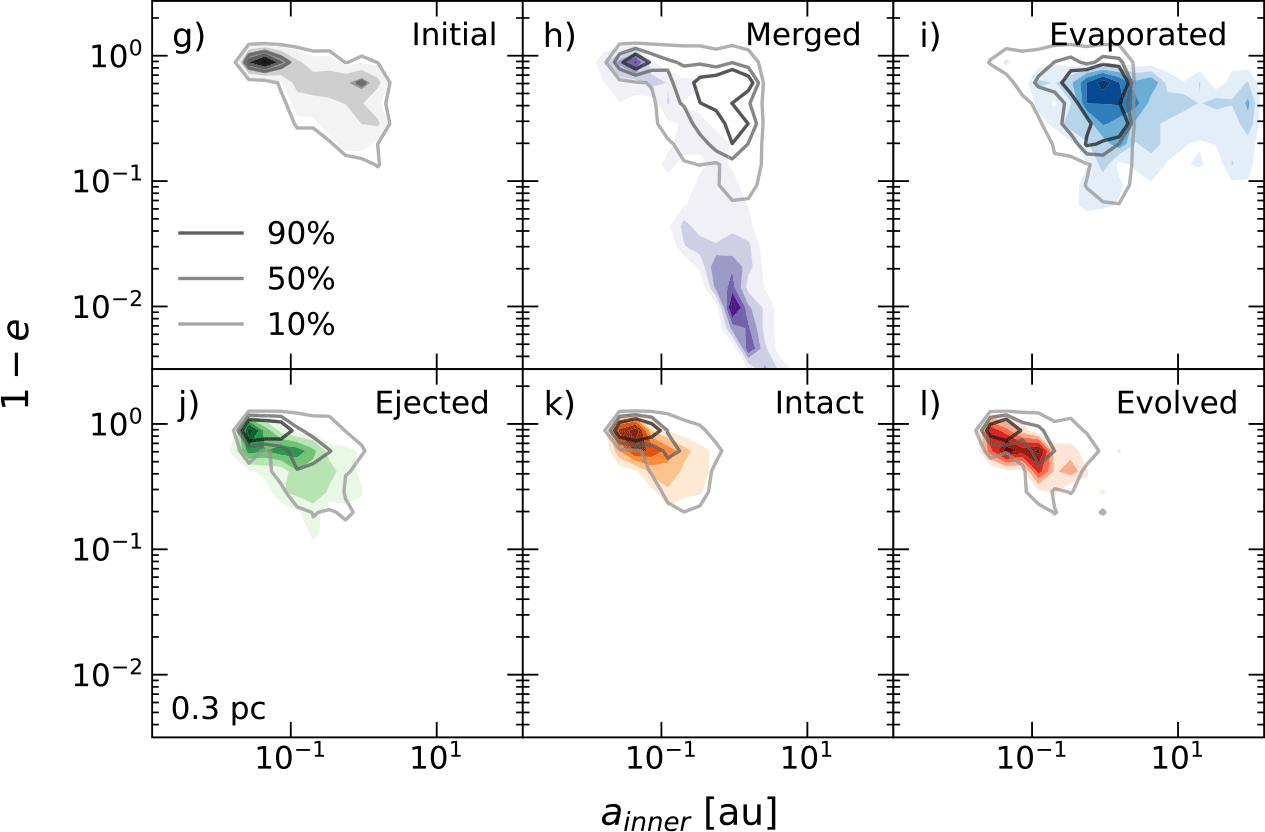
Figures 1 & 2 show the distributions of binaries in the (inner) separation-eccentricity plane at
 $0.1$
and
 $0.3~\mathrm{pc}$
, respectively. The line contours show the initial distribution, while the coloured contours show the final distribution for each respective panel: a) Initial total sample, b) Merged binaries, c) Evaporated binaries, d) Ejected binaries, e) Intact binaries (10 Gyr), and finally f) Evolved binaries. There are two distinct groups; initially softer binaries are exclusively destroyed via mergers and evaporation, while the initially harder binaries are subject to all different outcomes. We find that the kick received in three-body encounters is the deciding factor; an inward migration typically leads to the binaries being destroyed whereas outward migration does the opposite – binaries typically remain intact, with a few unbinding from the SMBH and a few evolving before 10 Gyr. The binaries that evolve either have a primary with an initial mass
 $M_* \geq 0.97~\mathrm{M}_\odot$
, or due to stellar collisions with surrounding stars, gain mass and acquire an accelerated stellar evolution.
Initial (solid line contours) and final distributions (coloured contours) of binaries in the semi-major axis and
 $1 \,-$
eccentricity originating at
 $0.1\,\mathrm{pc}$
from the SMBH: a) initial distribution, b) merged binaries c) evaporated binaries, d) ejected binaries, e.g. unbound to the SMBH, e) intact binaries and f) binaries where primary has evolved owing to stellar evolution. Figure adapted from Marklund et al. (Reference Marklund, Church and Trani2025).

Same as figure 1 but for binaries originating at
 $0.3\,\mathrm{pc}$
from the SMBH. Figure adapted from Marklund et al. (Reference Marklund, Church and Trani2025).

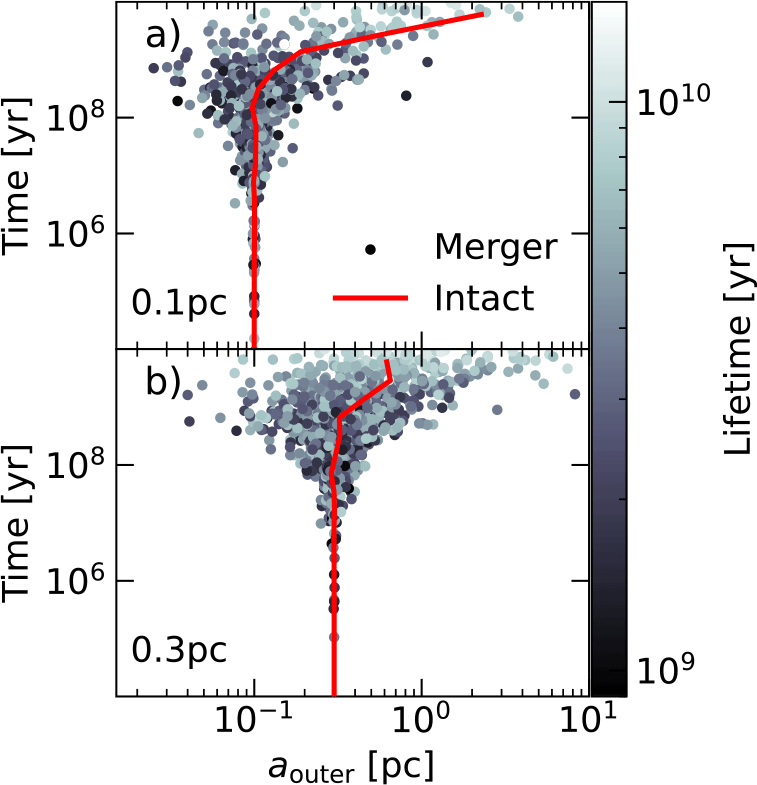
Figure 3 shows the average distance of intact binaries as a function of time (red solid lines) for binaries originating at
 $0.1$
and
 $0.3~\mathrm{pc}$
in panels a) and b), respectively. Each panel also show the corresponding position and time of all mergers, and are colour-coded by their total expected lifetime (both pre-merger and post-merger). Notably, a group of binaries originating at
 $0.1~\mathrm{pc}$
have migrated to the inner arcsec (
 $\sim 0.04~\mathrm{pc}$
) where they then merge, within a few
 $ 10^8$
years. Furthermore, and interestingly enough, there are a lot of binaries that migrate outwards where the timescales for most dynamical processes are longer, allowing them to remain intact for
 $\gtrsim 10~\mathrm{Gyr}$
. A significant fraction of these binaries merge close to present day, and would therefore be observable as either main-sequence or recently evolved BSSs (see also for example Thorsbro et al. Reference Thorsbro, Forsberg and Kordopatis2023).
Time (y-axis) and outer semi-major axis (x-axis) of mergers colour-coded by total expected lifetime (pre-merger and post-merger). The red solid line(s) show the mean outer semi-major axis of all intact binaries as a function of time; a) binaries originating at
 $0.1\,\mathrm{pc}$
from the SMBH and b) binaries originating
 $0.3\,\mathrm{pc}$
from the SMBH.

4. Conclusions
The main conclusion from this study is that binaries may migrate both inward and outward as a consequence of strong kicks from binary-single encounters. This in turn leads to (i) mergers in the inner arcsec of the NSC that occur after
 $\gtrsim 10^8$
years, which is too slow to explain the S-stars and G-objects that have estimated ages of
 $\lesssim10^7$
years (e.g. Schödel et al. Reference Schödel, Nogueras-Lara and Gallego-Cano2020; Peiß ker et al. Reference Peißker, Zajaček and Labadie2024) and (ii) both intact and recently merged binaries (which should appear as BSSs) throughout the NSC. A more detailed discussion of the consequences for these points is included in Marklund et al. (Reference Marklund, Church and Trani2025).
Acknowledgements
The computations and data handling were enabled by resources provided by LUNARC, The Centre for Scientific and Technical Computing at Lund University. AAT acknowledges support from the Horizon Europe research and innovation programs under the Marie Skłodowska-Curie grant agreement no. 101103134.
 1−
 0.1pc
 0.3pc
 0.1pc
 0.3pc

 Open access

